
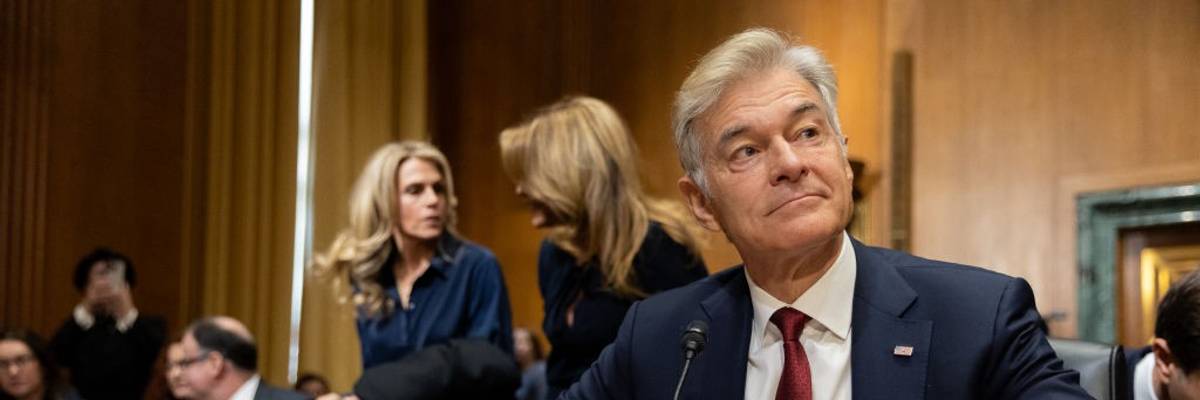
Mehmet Oz, head of the Centers for Medicare and Medicaid Services, testified to the Senate on March 14, 2025.
Over a Million Seniors Sent Scrambling as Medicare Advantage Giants Slash Plans Under Trump
Medicare Advantage giants are seeking to boost their profits by cutting benefits and exiting counties across the US—despite receiving a big payment boost from the Trump administration.
Seniors across the United States are scrambling to find alternative health coverage as Humana, UnitedHealthcare, and other private insurance giants slash Medicare Advantage benefits and cancel some plans entirely—despite receiving a major payment increase from the Trump administration for the coming fiscal year.
Humana and UnitedHealthcare's plan cancellations are expected to impact more than 1 million seniors nationwide, forcing people to find new plans in the current open enrollment period that runs until December 7. Both companies have signaled that they are trying to boost their bottom lines by exiting unprofitable Medicare Advantage markets and cutting benefits such as routine dental coverage, which is not offered by traditional Medicare.
"My biggest challenge for picking a plan next year is the cost of dental plans and vision are going up," one Medicare Advantage enrollee told PBS last week.
The health policy nonprofit KFF noted in an analysis earlier this month Humana and UnitedHealthcare are withdrawing their Medicare Advantage prescription drug plans from more US counties than they are entering in 2027. UnitedHealthcare is exiting 228 counties and entering nine new ones, while Humana is leaving 62 counties and entering four new ones, KFF found.
Blue Cross Blue Shield is also eliminating some of its Medicare Advantage plans, which are funded by the federal government—at a massive cost to US taxpayers—and run by private companies. The Boston Globe reported on Monday that "about 20,000 seniors in Massachusetts will be forced to find new health insurance plans" due to the Blue Cross Blue Shield cuts.
In Minnesota, an analysis by the Star Tribune found that around two-thirds of state residents enrolled in Medicare Advantage—around 340,000 people—will have to find new coverage for the coming year due to private insurers' cuts.
"Fifteen counties are losing their remaining Medicare Advantage options next year. In 12 of those counties, though, insurers will sell a different kind of privatized Medicare coverage called a Cost plan," the Star Tribune reported last week. "Cost plans sell at typically higher monthly premiums than Medicare Advantage plans."
Nationwide, more than half of the Medicare-eligible population is enrolled in Medicare Advantage plans, which are notorious for overbilling the federal government and denying coverage for necessary care—increasingly using artificial intelligence technology.
Medicare Payment Advisory Commission estimated in a report published earlier this year that the federal government will pay roughly $76 billion more to cover seniors on Medicare Advantage plans than it would have if those same people were on traditional Medicare. Over the next decade, according to the nonpartisan Congressional Budget Office, Medicare Advantage overpayments could cost the federal government around $1 trillion.
Earlier this year, the Trump administration gave the Medicare Advantage industry a significant boost by hiking federal payments to private insurers by roughly 2.5%—a sizeable increase compared to the 0.9% raise that the administration previously floated. Reuters reported in April that the industry will also receive a "2.5% benefit from a change to risk assessment payments related to health status, for a total increase of about 5%."
The Centers for Medicare & Medicaid Services, which announced the payment boost, is currently headed by Mehmet Oz, who once proposed a healthcare plan dubbed "Medicare Advantage for All."
The advocacy group Families USA called the 2027 payment increase for Medicare Advantage insurers "a big giveaway" that could have gone toward "bolstering benefits in Medicare for all seniors and people with disabilities."
We are at a crossroads
This country and this world are at a monumental crossroads. In a few short weeks, US voters will have an opportunity to beat back the forces of fascism and confront the billionaires who are rigging the economy, our media system, and our democracy, making it increasingly impossible for ordinary people to get by. We’re not just talking about the election. We’re talking about what must be done once these fascist elements are vanquished from power. We need a bolder set of solutions than what either major party has so far been willing to offer and a working-class movement ready to fight like hell for it. Trump didn't emerge from nowhere. The conditions that fueled MAGA authoritarianism were created by decades of radical neoliberal economic policies and a corrupt political system dominated by corporate interests. They slashed taxes on the super-rich, promising that the benefits would trickle down. They said giveaways to the corporate titans would make life more affordable for the rest of us. It was all bullshit. And when a bitter, betrayed populace searches for someone to blame, right-wing demagogues have little trouble finding scapegoats. People know when they're being lied to, but you won't hear any of this from the corporate media. Only independent journalism—powered and funded by people who believe in building a better world—can deliver truly trustworthy daily news. Our Fall Campaign is underway, and we need your help. To power our newsroom through the rest of the year, we need to raise $125,000 by midnight on October 31. So if you share our vision, please contribute whatever you can to sustain our work. |
Seniors across the United States are scrambling to find alternative health coverage as Humana, UnitedHealthcare, and other private insurance giants slash Medicare Advantage benefits and cancel some plans entirely—despite receiving a major payment increase from the Trump administration for the coming fiscal year.
Humana and UnitedHealthcare's plan cancellations are expected to impact more than 1 million seniors nationwide, forcing people to find new plans in the current open enrollment period that runs until December 7. Both companies have signaled that they are trying to boost their bottom lines by exiting unprofitable Medicare Advantage markets and cutting benefits such as routine dental coverage, which is not offered by traditional Medicare.
"My biggest challenge for picking a plan next year is the cost of dental plans and vision are going up," one Medicare Advantage enrollee told PBS last week.
The health policy nonprofit KFF noted in an analysis earlier this month Humana and UnitedHealthcare are withdrawing their Medicare Advantage prescription drug plans from more US counties than they are entering in 2027. UnitedHealthcare is exiting 228 counties and entering nine new ones, while Humana is leaving 62 counties and entering four new ones, KFF found.
Blue Cross Blue Shield is also eliminating some of its Medicare Advantage plans, which are funded by the federal government—at a massive cost to US taxpayers—and run by private companies. The Boston Globe reported on Monday that "about 20,000 seniors in Massachusetts will be forced to find new health insurance plans" due to the Blue Cross Blue Shield cuts.
In Minnesota, an analysis by the Star Tribune found that around two-thirds of state residents enrolled in Medicare Advantage—around 340,000 people—will have to find new coverage for the coming year due to private insurers' cuts.
"Fifteen counties are losing their remaining Medicare Advantage options next year. In 12 of those counties, though, insurers will sell a different kind of privatized Medicare coverage called a Cost plan," the Star Tribune reported last week. "Cost plans sell at typically higher monthly premiums than Medicare Advantage plans."
Nationwide, more than half of the Medicare-eligible population is enrolled in Medicare Advantage plans, which are notorious for overbilling the federal government and denying coverage for necessary care—increasingly using artificial intelligence technology.
Medicare Payment Advisory Commission estimated in a report published earlier this year that the federal government will pay roughly $76 billion more to cover seniors on Medicare Advantage plans than it would have if those same people were on traditional Medicare. Over the next decade, according to the nonpartisan Congressional Budget Office, Medicare Advantage overpayments could cost the federal government around $1 trillion.
Earlier this year, the Trump administration gave the Medicare Advantage industry a significant boost by hiking federal payments to private insurers by roughly 2.5%—a sizeable increase compared to the 0.9% raise that the administration previously floated. Reuters reported in April that the industry will also receive a "2.5% benefit from a change to risk assessment payments related to health status, for a total increase of about 5%."
The Centers for Medicare & Medicaid Services, which announced the payment boost, is currently headed by Mehmet Oz, who once proposed a healthcare plan dubbed "Medicare Advantage for All."
The advocacy group Families USA called the 2027 payment increase for Medicare Advantage insurers "a big giveaway" that could have gone toward "bolstering benefits in Medicare for all seniors and people with disabilities."