SUBSCRIBE TO OUR FREE NEWSLETTER
Daily news & progressive opinion—funded by the people, not the corporations—delivered straight to your inbox.
5
#000000
#FFFFFF
To donate by check, phone, or other method, see our More Ways to Give page.
Daily news & progressive opinion—funded by the people, not the corporations—delivered straight to your inbox.
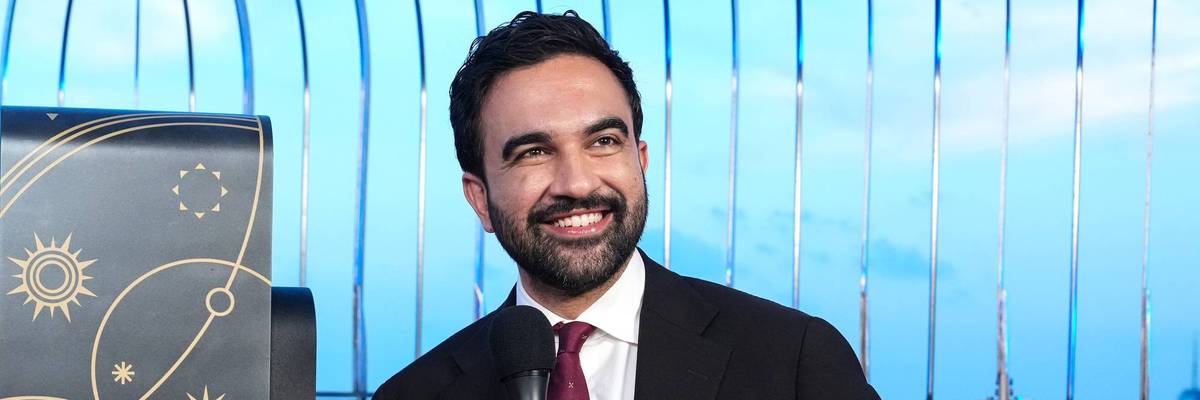
New York City Mayor Zohran Mamdani lights the Empire State Building in celebration of America 250 at The Empire State Building on July 4, 2026 in New York City.
"After years of corporate greed and impunity, we are holding DoorDash to account."
New York City Mayor Zohran Mamdani on Tuesday touted a settlement with food delivery app DoorDash as a "landmark win" for workers.
During a press event, Mamdani announced DoorDash had agreed to pay $131 million—of which $115 million will go directly to short-changed workers—in what he described as "the largest settlement for food delivery workers ever secured in American municipal history."
The mayor said that DoorDash's systematic exploitation and underpayment of its workers showed it profited by using "greed as a business model."
"Two months ago, Tony Xu, the CEO of DoorDash, gave business owners a piece of advice," Mamdani said. "A CEO, he said, has to take the greedy algorithm and keep going all the way to see if there is more. In computer science, a greedy algorithm is one that makes the most optimized, best short-term outcome at every step, and never weighs the consequences."
Mamdani: Today, after years of corporate greed and impunity, we are holding DoorDash to account. I am proud to announce that DoorDash will pay more than $131 million, the largest settlement for food delivery workers ever secured in American municipal history, and a landmark win… pic.twitter.com/XuCMMSyBMR
— Acyn (@Acyn) September 22, 2026
Mamdani explained that DoorDash for years "failed to count every hour worked by deliver workers," emphasizing that this was "not an accidental rounding error or a mistake."
The mayor touted the work done by the New York City Department of Consumer and Worker Protection (DCWP), which analyzed more than 150 million DoorDash payments and determined that the company had "underpaid more than 260,000 delivery workers across New York City" over a four-year period.
"After years of corporate greed and impunity, we are holding DoorDash to account," Mamdani said. "City Hall will not sit idly by while a megacorporation that made nearly a billion dollars in profits last year rips off the working people who keep our city moving."
A Tuesday report in The New York Times noted that, in addition to making a $131 million payout, DoorDash has also agreed to allow closer monitoring of its payment methods to ensure that its workers get what they are owed.
While the company defended its payment calculation model as "fair, practical, and legal," it also acknowledged it made mistakes that led to some workers not getting everything they had earned.
"We screwed up,” DoorDash said, “and our mistakes meant some NYC Dashers were underpaid or paid late."
DCWP Commissioner Samuel Levine told the Times that the city's settlement with the delivery app "sends a strong message that we are in a new era of enforcement in New York," adding that "we will not tolerate nickeling and diming New York City workers."
Melanie D'Arrigo, executive director of Campaign for New York Healthcare, said in a Tuesday social media post that the DoorDash settlement showed the importance of electing leaders willing to take on corporate power.
"Just in case you were wondering why DoorDash was spending so much money to elect Andrew Cuomo and oppose Zohran Mamdani," D'Arrigo observed, "DoorDash now has to pay $115 million to the workers it stole wages from."
Dear Common Dreams reader, It’s been nearly 30 years since I co-founded Common Dreams with my late wife, Lina Newhouser. We had the radical notion that journalism should serve the public good, not corporate profits. It was clear to us from the outset what it would take to build such a project. No paid advertisements. No corporate sponsors. No millionaire publisher telling us what to think or do. Many people said we wouldn't last a year, but we proved those doubters wrong. Together with a tremendous team of journalists and dedicated staff, we built an independent media outlet free from the constraints of profits and corporate control. Our mission has always been simple: To inform. To inspire. To ignite change for the common good. Building Common Dreams was not easy. Our survival was never guaranteed. When you take on the most powerful forces—Wall Street greed, fossil fuel industry destruction, Big Tech lobbyists, and uber-rich oligarchs who have spent billions upon billions rigging the economy and democracy in their favor—the only bulwark you have is supporters who believe in your work. But here’s the urgent message from me today. It's never been this bad out there. And it's never been this hard to keep us going. At the very moment Common Dreams is most needed, the threats we face are intensifying. We need your support now more than ever. We don't accept corporate advertising and never will. We don't have a paywall because we don't think people should be blocked from critical news based on their ability to pay. Everything we do is funded by the donations of readers like you. When everyone does the little they can afford, we are strong. But if that support retreats or dries up, so do we. Will you donate now to make sure Common Dreams not only survives but thrives? —Craig Brown, Co-founder |
New York City Mayor Zohran Mamdani on Tuesday touted a settlement with food delivery app DoorDash as a "landmark win" for workers.
During a press event, Mamdani announced DoorDash had agreed to pay $131 million—of which $115 million will go directly to short-changed workers—in what he described as "the largest settlement for food delivery workers ever secured in American municipal history."
The mayor said that DoorDash's systematic exploitation and underpayment of its workers showed it profited by using "greed as a business model."
"Two months ago, Tony Xu, the CEO of DoorDash, gave business owners a piece of advice," Mamdani said. "A CEO, he said, has to take the greedy algorithm and keep going all the way to see if there is more. In computer science, a greedy algorithm is one that makes the most optimized, best short-term outcome at every step, and never weighs the consequences."
Mamdani: Today, after years of corporate greed and impunity, we are holding DoorDash to account. I am proud to announce that DoorDash will pay more than $131 million, the largest settlement for food delivery workers ever secured in American municipal history, and a landmark win… pic.twitter.com/XuCMMSyBMR
— Acyn (@Acyn) September 22, 2026
Mamdani explained that DoorDash for years "failed to count every hour worked by deliver workers," emphasizing that this was "not an accidental rounding error or a mistake."
The mayor touted the work done by the New York City Department of Consumer and Worker Protection (DCWP), which analyzed more than 150 million DoorDash payments and determined that the company had "underpaid more than 260,000 delivery workers across New York City" over a four-year period.
"After years of corporate greed and impunity, we are holding DoorDash to account," Mamdani said. "City Hall will not sit idly by while a megacorporation that made nearly a billion dollars in profits last year rips off the working people who keep our city moving."
A Tuesday report in The New York Times noted that, in addition to making a $131 million payout, DoorDash has also agreed to allow closer monitoring of its payment methods to ensure that its workers get what they are owed.
While the company defended its payment calculation model as "fair, practical, and legal," it also acknowledged it made mistakes that led to some workers not getting everything they had earned.
"We screwed up,” DoorDash said, “and our mistakes meant some NYC Dashers were underpaid or paid late."
DCWP Commissioner Samuel Levine told the Times that the city's settlement with the delivery app "sends a strong message that we are in a new era of enforcement in New York," adding that "we will not tolerate nickeling and diming New York City workers."
Melanie D'Arrigo, executive director of Campaign for New York Healthcare, said in a Tuesday social media post that the DoorDash settlement showed the importance of electing leaders willing to take on corporate power.
"Just in case you were wondering why DoorDash was spending so much money to elect Andrew Cuomo and oppose Zohran Mamdani," D'Arrigo observed, "DoorDash now has to pay $115 million to the workers it stole wages from."
New York City Mayor Zohran Mamdani on Tuesday touted a settlement with food delivery app DoorDash as a "landmark win" for workers.
During a press event, Mamdani announced DoorDash had agreed to pay $131 million—of which $115 million will go directly to short-changed workers—in what he described as "the largest settlement for food delivery workers ever secured in American municipal history."
The mayor said that DoorDash's systematic exploitation and underpayment of its workers showed it profited by using "greed as a business model."
"Two months ago, Tony Xu, the CEO of DoorDash, gave business owners a piece of advice," Mamdani said. "A CEO, he said, has to take the greedy algorithm and keep going all the way to see if there is more. In computer science, a greedy algorithm is one that makes the most optimized, best short-term outcome at every step, and never weighs the consequences."
Mamdani: Today, after years of corporate greed and impunity, we are holding DoorDash to account. I am proud to announce that DoorDash will pay more than $131 million, the largest settlement for food delivery workers ever secured in American municipal history, and a landmark win… pic.twitter.com/XuCMMSyBMR
— Acyn (@Acyn) September 22, 2026
Mamdani explained that DoorDash for years "failed to count every hour worked by deliver workers," emphasizing that this was "not an accidental rounding error or a mistake."
The mayor touted the work done by the New York City Department of Consumer and Worker Protection (DCWP), which analyzed more than 150 million DoorDash payments and determined that the company had "underpaid more than 260,000 delivery workers across New York City" over a four-year period.
"After years of corporate greed and impunity, we are holding DoorDash to account," Mamdani said. "City Hall will not sit idly by while a megacorporation that made nearly a billion dollars in profits last year rips off the working people who keep our city moving."
A Tuesday report in The New York Times noted that, in addition to making a $131 million payout, DoorDash has also agreed to allow closer monitoring of its payment methods to ensure that its workers get what they are owed.
While the company defended its payment calculation model as "fair, practical, and legal," it also acknowledged it made mistakes that led to some workers not getting everything they had earned.
"We screwed up,” DoorDash said, “and our mistakes meant some NYC Dashers were underpaid or paid late."
DCWP Commissioner Samuel Levine told the Times that the city's settlement with the delivery app "sends a strong message that we are in a new era of enforcement in New York," adding that "we will not tolerate nickeling and diming New York City workers."
Melanie D'Arrigo, executive director of Campaign for New York Healthcare, said in a Tuesday social media post that the DoorDash settlement showed the importance of electing leaders willing to take on corporate power.
"Just in case you were wondering why DoorDash was spending so much money to elect Andrew Cuomo and oppose Zohran Mamdani," D'Arrigo observed, "DoorDash now has to pay $115 million to the workers it stole wages from."