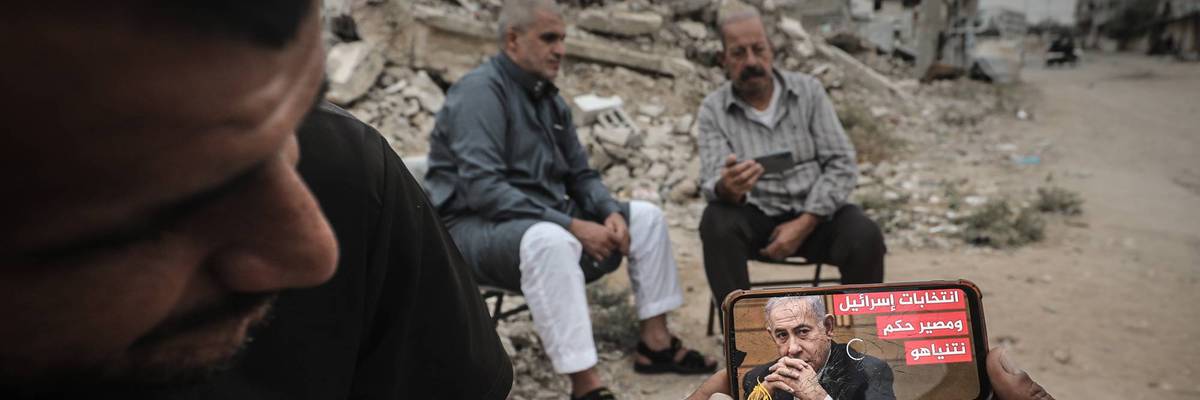
Palestinians follow coverage of the Israeli general elections on their mobile phones in the bombed-out ruins of the Gaza Strip on October 27, 2026.
'Who Will Bomb Me Next?': As Israel Awaits Election Results, Palestinians Brace for the Worst—No Matter Who Wins
"Israeli policy will stay the same," said one woman in a Gaza refugee camp. "It's the policy that the Israeli state was founded on."
As Israelis await the results of this week's elections with a sense of uncertainty, Palestinians are certain of one thing—that their suffering will continue regardless of who emerges victorious.
"We don't care about their elections in any way. Gaza is in the same state. Their elections change nothing here," one elderly Palestinian woman told The Specter on Wednesday from a refugee camp in the obliterated strip, where three years of US-backed Israeli genocide have left 250,000 people dead or wounded, nearly 2 million inhabitants displaced, and the territory in ruins.
A younger woman in the camp told the outlet that "things in Gaza won't change, and they will get worse" if Prime Minister Benjamin Netanyahu is reelected.
"The first thing he'll do is pick up where he left off, displacing Palestinians from the occupied West Bank... and from the Gaza Strip," she continued.
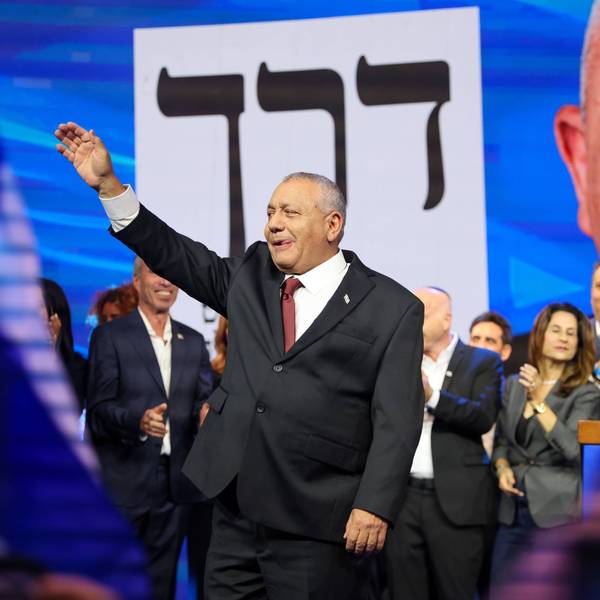
If former lawmaker and ex-Israel Defense Forces Chief of Staff Gadi Eisenkot wins, "things may unfold a little differently," she predicted, but Israeli policy will stay the same. It's the policy the Israeli state was founded on."
Like Netanyahu, Eisenkot emphatically rejects Palestinian statehood, calling the two-state solution “a mistake" and "delusional," given the October 2023 attack led by the militant resistance group Hamas—whose animus was fueled by over a century of Zionist usurpation.
With around 90% of ballots counted as of Thursday, Israeli media projected that Netanyahu’s right-wing and ultra-Orthodox allies would capture 53 seats in the 120-member Knesset, compared with 48 for the opposition led by Eisenkot.
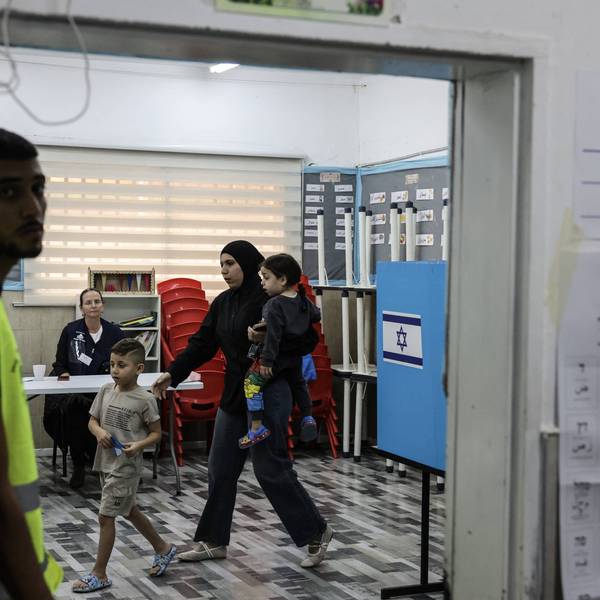
The Knesset has 120 seats, so 61 are needed for a parliamentary majority. The candidates' shortfall means either side would likely need support from Arab parties to emerge victorious—a prospect rejected by many Jewish political leaders.
Netanyahu would remain caretaker prime minister throughout any negotiations to form a new coalition.
Palestinian American fashion designer Alana Hadid—the half-sister of models Gigi and Bella Hadid—said in a video posted to social media that "it's important for people to understand that the intention of an election in Israel to make you think that there will be change. And of course, there will be some change in that there will be a different brand of Zionism."
"Zionism is universal across Israelis," she added, "so whoever wins this election, the change will be in name only."
Haaretz, Israel's oldest daily newspaper, on Thursday published an article in which Gazans mostly shrugged off the Israeli elections.
"Honestly, I don't feel anything about the results. As someone from Gaza, I'm just waiting to see who will bomb me next—the right or the left," a young man named Mahmoud said. "In the end, the bad will go, and the worse will come. They're two sides of the same coin, and both support your killing as a Gazan."
"I think people in Gaza will be happy to see Netanyahu fall, not because of Eisenkot, of course, but because they experienced Netanyahu and saw what he did," he added. "They hope Eisenkot will deal with Gaza differently, or that there will be some relief. But, as I said, even though the two are against each other, both want you killed."
We are at a crossroads
This country and this world are at a monumental crossroads. US voters have an opportunity to beat back the forces of fascism and confront the billionaires who are rigging the economy, our media system, and our democracy, making it increasingly impossible for ordinary people to get by. We’re not just talking about the election. We’re talking about what must be done once these fascist elements are vanquished from power. We need a bolder set of solutions than what either major party has so far been willing to offer and a working-class movement ready to fight like hell for it. Trump didn't emerge from nowhere. The conditions that fueled MAGA authoritarianism were created by decades of radical neoliberal economic policies and a corrupt political system dominated by corporate interests. They slashed taxes on the super-rich, promising that the benefits would trickle down. They said giveaways to the corporate titans would make life more affordable for the rest of us. It was all bullshit. And when a bitter, betrayed populace searches for someone to blame, right-wing demagogues have little trouble finding scapegoats. People know when they're being lied to, but you won't hear any of this from the corporate media. Only independent journalism—powered and funded by people who believe in building a better world—can deliver truly trustworthy daily news. Our Fall Campaign is underway, and we need your help. To power our newsroom through the rest of the year, we need to raise $125,000 by midnight on October 31. So if you share our vision, please contribute whatever you can to sustain our work. |
As Israelis await the results of this week's elections with a sense of uncertainty, Palestinians are certain of one thing—that their suffering will continue regardless of who emerges victorious.
"We don't care about their elections in any way. Gaza is in the same state. Their elections change nothing here," one elderly Palestinian woman told The Specter on Wednesday from a refugee camp in the obliterated strip, where three years of US-backed Israeli genocide have left 250,000 people dead or wounded, nearly 2 million inhabitants displaced, and the territory in ruins.
A younger woman in the camp told the outlet that "things in Gaza won't change, and they will get worse" if Prime Minister Benjamin Netanyahu is reelected.
"The first thing he'll do is pick up where he left off, displacing Palestinians from the occupied West Bank... and from the Gaza Strip," she continued.
If former lawmaker and ex-Israel Defense Forces Chief of Staff Gadi Eisenkot wins, "things may unfold a little differently," she predicted, but Israeli policy will stay the same. It's the policy the Israeli state was founded on."
Like Netanyahu, Eisenkot emphatically rejects Palestinian statehood, calling the two-state solution “a mistake" and "delusional," given the October 2023 attack led by the militant resistance group Hamas—whose animus was fueled by over a century of Zionist usurpation.
With around 90% of ballots counted as of Thursday, Israeli media projected that Netanyahu’s right-wing and ultra-Orthodox allies would capture 53 seats in the 120-member Knesset, compared with 48 for the opposition led by Eisenkot.
The Knesset has 120 seats, so 61 are needed for a parliamentary majority. The candidates' shortfall means either side would likely need support from Arab parties to emerge victorious—a prospect rejected by many Jewish political leaders.
Netanyahu would remain caretaker prime minister throughout any negotiations to form a new coalition.
Palestinian American fashion designer Alana Hadid—the half-sister of models Gigi and Bella Hadid—said in a video posted to social media that "it's important for people to understand that the intention of an election in Israel to make you think that there will be change. And of course, there will be some change in that there will be a different brand of Zionism."
"Zionism is universal across Israelis," she added, "so whoever wins this election, the change will be in name only."
Haaretz, Israel's oldest daily newspaper, on Thursday published an article in which Gazans mostly shrugged off the Israeli elections.
"Honestly, I don't feel anything about the results. As someone from Gaza, I'm just waiting to see who will bomb me next—the right or the left," a young man named Mahmoud said. "In the end, the bad will go, and the worse will come. They're two sides of the same coin, and both support your killing as a Gazan."
"I think people in Gaza will be happy to see Netanyahu fall, not because of Eisenkot, of course, but because they experienced Netanyahu and saw what he did," he added. "They hope Eisenkot will deal with Gaza differently, or that there will be some relief. But, as I said, even though the two are against each other, both want you killed."
- UN Report Details Israeli Crimes Against Humanity in Palestine, Including Extermination, Rape, and Torture ›
- Israeli Election Panel OKs Ben-Gvir and Smotrich's Far-Right Parties After Voting to Ban Arab Ones ›
- Are Israeli Opposition Parties 'Brave Enough' to Join Forces and End 'Blood-Soaked' Netanyahu Government? ›
- Netanyahu Accused of 'Incitement' as Arab Israelis Face Intimidation and Surveillance at Polls ›