SUBSCRIBE TO OUR FREE NEWSLETTER
Daily news & progressive opinion—funded by the people, not the corporations—delivered straight to your inbox.
5
#000000
#FFFFFF
To donate by check, phone, or other method, see our More Ways to Give page.
Daily news & progressive opinion—funded by the people, not the corporations—delivered straight to your inbox.
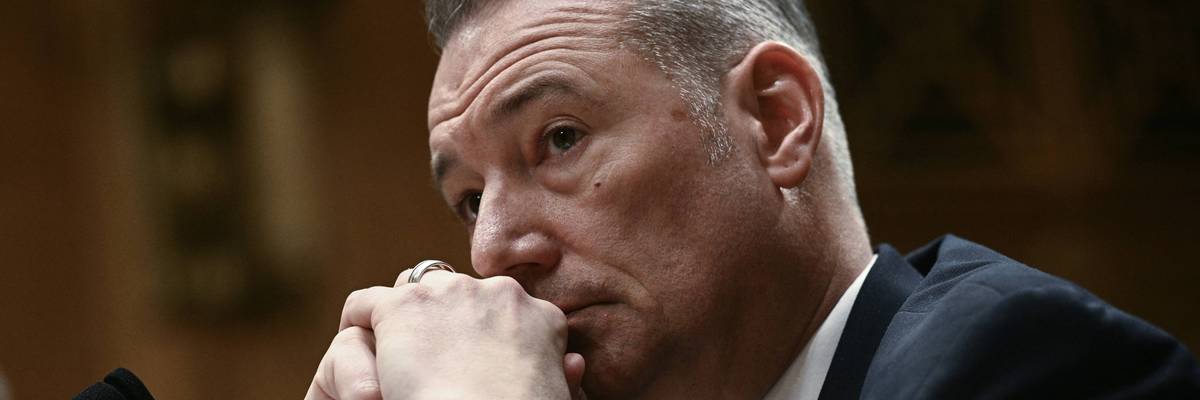
Acting Director of US Immigration and Customs Enforcement (ICE) Todd Lyons testifies before a Senate Homeland Security and Governmental Affairs Committee in an oversight hearing amid scrutiny over immigration enforcement and recent developments in Minnesota at the Dirksen Senate Office Building in Washington, DC, on February 12, 2026.
Their boss, Homeland Security Secretary Kristi Noem, has said that videotaping officers on the job is a form of "doxing" and "violence."
The US Department of Homeland Security has claimed for months that filming immigration agents on the job constitutes a criminal offense. But under oath during a Senate Homeland Security Committee oversight hearing on Thursday, the leaders of immigration agencies under the department’s umbrella admitted this is not true.
Sen. Rand Paul (R-Ky.), the chair of the committee, interrogated Todd Lyons, the acting head of Immigration and Customs Enforcement (ICE); Rodney Scott, the commissioner of Customs and Border Protection (CBP); and Joseph Edlow, the director of US Citizenship and Immigration Services (USCIS) about the recent surge of agents in Minnesota, which has resulted in the killing of two US citizens since January.
He zeroed in on the case of Alex Pretti, the 37-year-old intensive care unit nurse who was shot by a pair of immigration agents on January 24, showing footage of the incident leading up to Pretti's killing, which DHS claimed was justified prior to any investigation taking place.
"So what we see is the beginning of the encounter with Alexander Pretti. He's filming in the middle of the street," Paul explained after rolling the tape.
The senator then asked Scott and Lyons, "Is filming of ICE or Border Patrol either an assault or a crime in any way?"
They both responded flatly, "No."
Courts have generally affirmed that filming law enforcement agents is protected by the First Amendment. But this admission by Lyons and Scott is a major deviation from what their parent agency has claimed.
Their boss, Homeland Security Secretary Kristi Noem, stated during a July press briefing that “violence” against DHS agents includes “doxing them” and “videotaping them where they’re at when they’re out on operations.”
Even in the wake of last month's shootings, DHS has held to this line, with spokesperson Tricia McLaughlin claiming that “videoing our officers in an effort to dox them and reveal their identities is a federal crime and a felony.”
Agents have been directed to treat those who film ICE as criminals—a DHS bulletin from June described filming at protests as "unlawful civil unrest" tactics and "threats."
Several videos out of Minnesota, Maine, and other places flooded by ICE have documented federal agents telling bystanders to stop recording and issuing threats against them or detaining them.
In one case, a bystander was told that because she was filming, she was going to be put in a "nice little database" and was now "considered a domestic terrorist."
Last month, a federal judge sided with a group of journalists in California who cited the June bulletin to argue that Noem had "established, sanctioned, and ratified an agency policy of treating video recording of DHS agents in public as a threat that may be responded to with force and addressed as a crime," in violation of the First Amendment.
Dear Common Dreams reader, It’s been nearly 30 years since I co-founded Common Dreams with my late wife, Lina Newhouser. We had the radical notion that journalism should serve the public good, not corporate profits. It was clear to us from the outset what it would take to build such a project. No paid advertisements. No corporate sponsors. No millionaire publisher telling us what to think or do. Many people said we wouldn't last a year, but we proved those doubters wrong. Together with a tremendous team of journalists and dedicated staff, we built an independent media outlet free from the constraints of profits and corporate control. Our mission has always been simple: To inform. To inspire. To ignite change for the common good. Building Common Dreams was not easy. Our survival was never guaranteed. When you take on the most powerful forces—Wall Street greed, fossil fuel industry destruction, Big Tech lobbyists, and uber-rich oligarchs who have spent billions upon billions rigging the economy and democracy in their favor—the only bulwark you have is supporters who believe in your work. But here’s the urgent message from me today. It's never been this bad out there. And it's never been this hard to keep us going. At the very moment Common Dreams is most needed, the threats we face are intensifying. We need your support now more than ever. We don't accept corporate advertising and never will. We don't have a paywall because we don't think people should be blocked from critical news based on their ability to pay. Everything we do is funded by the donations of readers like you. When everyone does the little they can afford, we are strong. But if that support retreats or dries up, so do we. Will you donate now to make sure Common Dreams not only survives but thrives? —Craig Brown, Co-founder |
The US Department of Homeland Security has claimed for months that filming immigration agents on the job constitutes a criminal offense. But under oath during a Senate Homeland Security Committee oversight hearing on Thursday, the leaders of immigration agencies under the department’s umbrella admitted this is not true.
Sen. Rand Paul (R-Ky.), the chair of the committee, interrogated Todd Lyons, the acting head of Immigration and Customs Enforcement (ICE); Rodney Scott, the commissioner of Customs and Border Protection (CBP); and Joseph Edlow, the director of US Citizenship and Immigration Services (USCIS) about the recent surge of agents in Minnesota, which has resulted in the killing of two US citizens since January.
He zeroed in on the case of Alex Pretti, the 37-year-old intensive care unit nurse who was shot by a pair of immigration agents on January 24, showing footage of the incident leading up to Pretti's killing, which DHS claimed was justified prior to any investigation taking place.
"So what we see is the beginning of the encounter with Alexander Pretti. He's filming in the middle of the street," Paul explained after rolling the tape.
The senator then asked Scott and Lyons, "Is filming of ICE or Border Patrol either an assault or a crime in any way?"
They both responded flatly, "No."
Courts have generally affirmed that filming law enforcement agents is protected by the First Amendment. But this admission by Lyons and Scott is a major deviation from what their parent agency has claimed.
Their boss, Homeland Security Secretary Kristi Noem, stated during a July press briefing that “violence” against DHS agents includes “doxing them” and “videotaping them where they’re at when they’re out on operations.”
Even in the wake of last month's shootings, DHS has held to this line, with spokesperson Tricia McLaughlin claiming that “videoing our officers in an effort to dox them and reveal their identities is a federal crime and a felony.”
Agents have been directed to treat those who film ICE as criminals—a DHS bulletin from June described filming at protests as "unlawful civil unrest" tactics and "threats."
Several videos out of Minnesota, Maine, and other places flooded by ICE have documented federal agents telling bystanders to stop recording and issuing threats against them or detaining them.
In one case, a bystander was told that because she was filming, she was going to be put in a "nice little database" and was now "considered a domestic terrorist."
Last month, a federal judge sided with a group of journalists in California who cited the June bulletin to argue that Noem had "established, sanctioned, and ratified an agency policy of treating video recording of DHS agents in public as a threat that may be responded to with force and addressed as a crime," in violation of the First Amendment.
The US Department of Homeland Security has claimed for months that filming immigration agents on the job constitutes a criminal offense. But under oath during a Senate Homeland Security Committee oversight hearing on Thursday, the leaders of immigration agencies under the department’s umbrella admitted this is not true.
Sen. Rand Paul (R-Ky.), the chair of the committee, interrogated Todd Lyons, the acting head of Immigration and Customs Enforcement (ICE); Rodney Scott, the commissioner of Customs and Border Protection (CBP); and Joseph Edlow, the director of US Citizenship and Immigration Services (USCIS) about the recent surge of agents in Minnesota, which has resulted in the killing of two US citizens since January.
He zeroed in on the case of Alex Pretti, the 37-year-old intensive care unit nurse who was shot by a pair of immigration agents on January 24, showing footage of the incident leading up to Pretti's killing, which DHS claimed was justified prior to any investigation taking place.
"So what we see is the beginning of the encounter with Alexander Pretti. He's filming in the middle of the street," Paul explained after rolling the tape.
The senator then asked Scott and Lyons, "Is filming of ICE or Border Patrol either an assault or a crime in any way?"
They both responded flatly, "No."
Courts have generally affirmed that filming law enforcement agents is protected by the First Amendment. But this admission by Lyons and Scott is a major deviation from what their parent agency has claimed.
Their boss, Homeland Security Secretary Kristi Noem, stated during a July press briefing that “violence” against DHS agents includes “doxing them” and “videotaping them where they’re at when they’re out on operations.”
Even in the wake of last month's shootings, DHS has held to this line, with spokesperson Tricia McLaughlin claiming that “videoing our officers in an effort to dox them and reveal their identities is a federal crime and a felony.”
Agents have been directed to treat those who film ICE as criminals—a DHS bulletin from June described filming at protests as "unlawful civil unrest" tactics and "threats."
Several videos out of Minnesota, Maine, and other places flooded by ICE have documented federal agents telling bystanders to stop recording and issuing threats against them or detaining them.
In one case, a bystander was told that because she was filming, she was going to be put in a "nice little database" and was now "considered a domestic terrorist."
Last month, a federal judge sided with a group of journalists in California who cited the June bulletin to argue that Noem had "established, sanctioned, and ratified an agency policy of treating video recording of DHS agents in public as a threat that may be responded to with force and addressed as a crime," in violation of the First Amendment.