SUBSCRIBE TO OUR FREE NEWSLETTER
Daily news & progressive opinion—funded by the people, not the corporations—delivered straight to your inbox.
5
#000000
#FFFFFF
To donate by check, phone, or other method, see our More Ways to Give page.
Daily news & progressive opinion—funded by the people, not the corporations—delivered straight to your inbox.
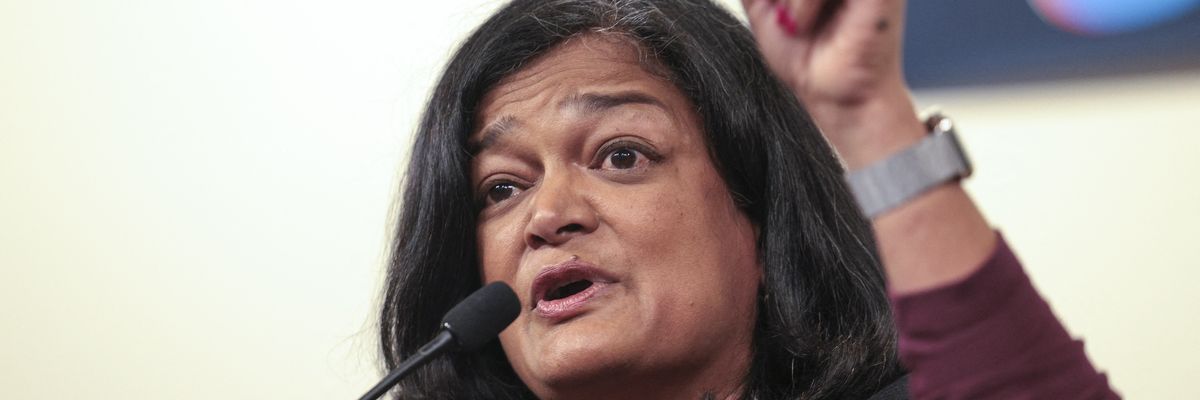
U.S. Rep. Pramila Jayapal (D-Wash.) speaks at the Seattle Union Hall in Seattle, Washington on October 15, 2024.
"In every election cycle since the disastrous Citizens United decision, we have seen more and more special interest dark money poured into campaigns across the country," said Rep. Pramila Jayapal.
With the impact of the 2010 U.S. Supreme Court decision in the Citizens United case becoming clearer by the day as billionaire megadonor Elon Musk spearheads the reshaping of the federal government, Congresswoman Pramila Jayapal on Thursday led more than two dozen Democratic lawmakers in introducing a constitutional amendment that would reverse the pivotal ruling.
The Washington Democrat has introduced the We the People Amendment in previous years, but she noted that this year she is proposing the measure after "a billionaire [paid] millions to buy a seat as Shadow President," referring to the more than $270 million Musk spent on President Donald Trump's campaign last year—an effort that promptly made him $170 billion richer and has resulted in new government contracts for his companies and his leadership of the so-called Department of Government Efficiency (DOGE).
"Corporations are not people and money is not speech," said Jayapal. "In every election cycle since the disastrous Citizens United decision, we have seen more and more special interest dark money poured into campaigns across the country... My We the People Amendment hands power back to the people by finally ending corporate constitutional rights, reversing Citizens United, and ensuring that our democracy is truly of the people, by the people, and for the people—not corporations."
The ruling in Citizens United v. Federal Election Commission struck down long-held rules on corporate "independent" spending that doesn't go directly to a candidate or political party, eliminating restrictions for money that flows to campaigns through super political action committees (PACs) which purport to be separate from candidates.
The We the People Amendment—which is not supported by any Republican lawmakers—would specify that constitutional rights apply to people, not corporations, "and that artificial entities have no constitutional rights," said Jayapal's office.
It would also mandate that federal, state, and local governments require public disclosure of all political contributions and expenditures.
As Brendan Fischer wrote at Rolling Stone last month, Musk's "astonishing influence over Trump and the Republican Party is not merely a function of his wealth, his celebrity, or his ownership of the social media platform X (formerly Twitter). It is attributable to his pouring of at least $277 million into super PACs last year, which purchased enormous influence."
Cole Bennett, legislative co-director of the advocacy group Move to Amend, applauded Jayapal's understanding "that the changes she and many of her colleagues support to advance healthcare, expand economic justice, ensure a livable world, and promote real democracy are incredibly difficult but necessary."
"This is especially true given the unjustifiable Supreme Court decisions declaring corporations as entities with many of the same constitutional rights as human persons and that money spent in elections is equivalent to First Amendment-protected free speech," said Bennett. "The exponential growth of corporate power and corrupting political influence from huge sums of money flooding elections can only be solved with a systemic solution that is equivalent in scale to these systemic problems—the We the People Amendment, which will end all corporate constitutional rights and money as free speech."
Dear Common Dreams reader, It’s been nearly 30 years since I co-founded Common Dreams with my late wife, Lina Newhouser. We had the radical notion that journalism should serve the public good, not corporate profits. It was clear to us from the outset what it would take to build such a project. No paid advertisements. No corporate sponsors. No millionaire publisher telling us what to think or do. Many people said we wouldn't last a year, but we proved those doubters wrong. Together with a tremendous team of journalists and dedicated staff, we built an independent media outlet free from the constraints of profits and corporate control. Our mission has always been simple: To inform. To inspire. To ignite change for the common good. Building Common Dreams was not easy. Our survival was never guaranteed. When you take on the most powerful forces—Wall Street greed, fossil fuel industry destruction, Big Tech lobbyists, and uber-rich oligarchs who have spent billions upon billions rigging the economy and democracy in their favor—the only bulwark you have is supporters who believe in your work. But here’s the urgent message from me today. It's never been this bad out there. And it's never been this hard to keep us going. At the very moment Common Dreams is most needed, the threats we face are intensifying. We need your support now more than ever. We don't accept corporate advertising and never will. We don't have a paywall because we don't think people should be blocked from critical news based on their ability to pay. Everything we do is funded by the donations of readers like you. When everyone does the little they can afford, we are strong. But if that support retreats or dries up, so do we. Will you donate now to make sure Common Dreams not only survives but thrives? —Craig Brown, Co-founder |
With the impact of the 2010 U.S. Supreme Court decision in the Citizens United case becoming clearer by the day as billionaire megadonor Elon Musk spearheads the reshaping of the federal government, Congresswoman Pramila Jayapal on Thursday led more than two dozen Democratic lawmakers in introducing a constitutional amendment that would reverse the pivotal ruling.
The Washington Democrat has introduced the We the People Amendment in previous years, but she noted that this year she is proposing the measure after "a billionaire [paid] millions to buy a seat as Shadow President," referring to the more than $270 million Musk spent on President Donald Trump's campaign last year—an effort that promptly made him $170 billion richer and has resulted in new government contracts for his companies and his leadership of the so-called Department of Government Efficiency (DOGE).
"Corporations are not people and money is not speech," said Jayapal. "In every election cycle since the disastrous Citizens United decision, we have seen more and more special interest dark money poured into campaigns across the country... My We the People Amendment hands power back to the people by finally ending corporate constitutional rights, reversing Citizens United, and ensuring that our democracy is truly of the people, by the people, and for the people—not corporations."
The ruling in Citizens United v. Federal Election Commission struck down long-held rules on corporate "independent" spending that doesn't go directly to a candidate or political party, eliminating restrictions for money that flows to campaigns through super political action committees (PACs) which purport to be separate from candidates.
The We the People Amendment—which is not supported by any Republican lawmakers—would specify that constitutional rights apply to people, not corporations, "and that artificial entities have no constitutional rights," said Jayapal's office.
It would also mandate that federal, state, and local governments require public disclosure of all political contributions and expenditures.
As Brendan Fischer wrote at Rolling Stone last month, Musk's "astonishing influence over Trump and the Republican Party is not merely a function of his wealth, his celebrity, or his ownership of the social media platform X (formerly Twitter). It is attributable to his pouring of at least $277 million into super PACs last year, which purchased enormous influence."
Cole Bennett, legislative co-director of the advocacy group Move to Amend, applauded Jayapal's understanding "that the changes she and many of her colleagues support to advance healthcare, expand economic justice, ensure a livable world, and promote real democracy are incredibly difficult but necessary."
"This is especially true given the unjustifiable Supreme Court decisions declaring corporations as entities with many of the same constitutional rights as human persons and that money spent in elections is equivalent to First Amendment-protected free speech," said Bennett. "The exponential growth of corporate power and corrupting political influence from huge sums of money flooding elections can only be solved with a systemic solution that is equivalent in scale to these systemic problems—the We the People Amendment, which will end all corporate constitutional rights and money as free speech."
With the impact of the 2010 U.S. Supreme Court decision in the Citizens United case becoming clearer by the day as billionaire megadonor Elon Musk spearheads the reshaping of the federal government, Congresswoman Pramila Jayapal on Thursday led more than two dozen Democratic lawmakers in introducing a constitutional amendment that would reverse the pivotal ruling.
The Washington Democrat has introduced the We the People Amendment in previous years, but she noted that this year she is proposing the measure after "a billionaire [paid] millions to buy a seat as Shadow President," referring to the more than $270 million Musk spent on President Donald Trump's campaign last year—an effort that promptly made him $170 billion richer and has resulted in new government contracts for his companies and his leadership of the so-called Department of Government Efficiency (DOGE).
"Corporations are not people and money is not speech," said Jayapal. "In every election cycle since the disastrous Citizens United decision, we have seen more and more special interest dark money poured into campaigns across the country... My We the People Amendment hands power back to the people by finally ending corporate constitutional rights, reversing Citizens United, and ensuring that our democracy is truly of the people, by the people, and for the people—not corporations."
The ruling in Citizens United v. Federal Election Commission struck down long-held rules on corporate "independent" spending that doesn't go directly to a candidate or political party, eliminating restrictions for money that flows to campaigns through super political action committees (PACs) which purport to be separate from candidates.
The We the People Amendment—which is not supported by any Republican lawmakers—would specify that constitutional rights apply to people, not corporations, "and that artificial entities have no constitutional rights," said Jayapal's office.
It would also mandate that federal, state, and local governments require public disclosure of all political contributions and expenditures.
As Brendan Fischer wrote at Rolling Stone last month, Musk's "astonishing influence over Trump and the Republican Party is not merely a function of his wealth, his celebrity, or his ownership of the social media platform X (formerly Twitter). It is attributable to his pouring of at least $277 million into super PACs last year, which purchased enormous influence."
Cole Bennett, legislative co-director of the advocacy group Move to Amend, applauded Jayapal's understanding "that the changes she and many of her colleagues support to advance healthcare, expand economic justice, ensure a livable world, and promote real democracy are incredibly difficult but necessary."
"This is especially true given the unjustifiable Supreme Court decisions declaring corporations as entities with many of the same constitutional rights as human persons and that money spent in elections is equivalent to First Amendment-protected free speech," said Bennett. "The exponential growth of corporate power and corrupting political influence from huge sums of money flooding elections can only be solved with a systemic solution that is equivalent in scale to these systemic problems—the We the People Amendment, which will end all corporate constitutional rights and money as free speech."