
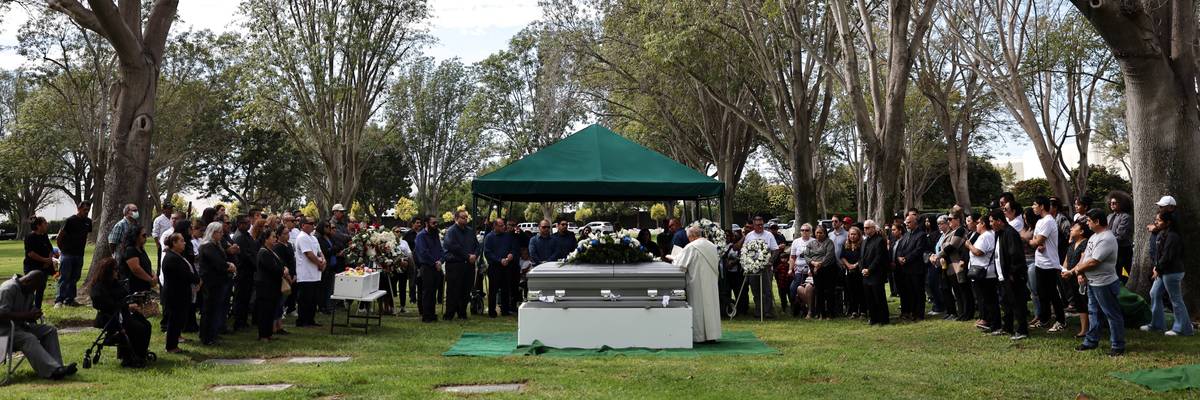
People gather around Ismael Ayala-Uribe's casket during his burial service at Westminster Memorial Park and Mortuary on October 9, 2025 in Westminster, California. The 39-year-old, who was originally from Mexico, died the previous month while in US Immigration and Customs Enforcement custody.
Debt After Death: How Unchecked Corporate Power Even Makes Dying More Expensive
"No one should be forced into debt just to bury a loved one, but as corporations exploit families," said Groundwork Collaborative's leader, "loved ones are being driven to the brink to pay for a dignified death."
Americans are struggling with the soaring cost of living—and dying, according to a Groundwork Collaborative report released Thursday.
The think tank's associate director of policy and advocacy, Zoe Butler, analyzed data on related topics, from life insurance to funeral expenses, and explained how deaths—especially unexpected ones—can affect US households.
As "Death, Debt, and Paperwork: How the Business of Dying Is Burying American Families" details, "the average funeral now costs $7,726, before cemetery plots, headstones, and other add-ons that can push the total above $10,000."
Data from 2023 shows that "funeral homes charge a nondeclinable basic services fee of $2,495 for both cremation and burial, along with $395 to transfer the body to the funeral home," plus additional charges for using facilities for services. The report notes that "even lower-cost options still carry added fees, including about $400 for cremation and $295 for an urn."
"For burial, costs increase further with additional required services," the publication continues. "These include over $1,000 for embalming and other preparation of the body, as well as $2,500 for a casket. Burial also introduces a separate set of expenses outside the funeral home, including $1,000 to $3,000 for a headstone, around $1,000 for a burial vault, and $1,000 to $2,500 to open and close the grave."
"Prices have surged 310% since 1986, far outpacing overall inflation of 193%," Butler highlighted. "As prices increase, more families are going into debt to cover funerals, with the share rising from 14% in 2024 to 37% in 2025."
Deaths can also mean navigating probate, "the often costly legal process of settling a loved one's estate," she wrote. Probate fees can take 3-8%, so "even modest estates in probate can lead to thousands of dollars in legal and administrative expenses."
"For example, a family inheriting a $250,000 home may have to pay $7,500 to $20,000 in probate-related expenses," the document says. "Fewer than 1 in 4 Americans have a will, and just 13% have a living trust, one of the few tools that lets assets pass to heirs without going through probate."
Some families dealing with a relative's death are assisted by life insurance, but "coverage is uneven and increasingly inadequate," the report stresses. "Nearly half of Americans do not have life insurance, meaning many families cannot cover funeral expenses or manage immediate costs after a loss."
"Access to employer-sponsored coverage is also highly unequal," according to the analysis. "While 77% of full-time workers have access to employer-provided life insurance, only 14% of part-time workers do. Just 20% of workers in the bottom tenth of wages have access to coverage, compared to 91% of top earners."
Additionally, 40% of new policies "are term-limited rather than permanent, meaning coverage can expire before a person dies," the report explains—so some "families may spend years paying into life insurance policies that ultimately provide no support for funeral expenses or other end-of-life costs."
It not only catalogs the costs of death in the US, it also points out that "median household savings are roughly $8,200, meaning many households have little cushion to absorb these costs."
The publication also offers "a path forward," urging Congress to cut prices and boost transparency with legislation that would "require funeral homes to provide standardized and itemized pricing online, including all fees and third-party costs," as well as "prohibit hidden fees and forced bundling of services."
Other actions Congress could take include expanding the Social Security Death benefit and creating a basic life insurance program administered through the Social Security Administration. There are also several probate-related proposals for states and localities.
"No one should be forced into debt just to bury a loved one, but as corporations exploit families at their most vulnerable moments, more and more grieving loved ones are being driven to the brink to pay for a dignified death," said Groundwork president and CEO, Lindsay Owens in a statement.
"Funeral companies are raising prices, hiding costs, and taking advantage of a system that gives grieving families no time and no transparency," she added. "Policymakers must act to bring down prices, increase accountability, and ensure families can access what is already theirs without delay."
We are at a crossroads
This country and this world are at a monumental crossroads. US voters have an opportunity to beat back the forces of fascism and confront the billionaires who are rigging the economy, our media system, and our democracy, making it increasingly impossible for ordinary people to get by. We’re not just talking about the election. We’re talking about what must be done once these fascist elements are vanquished from power. We need a bolder set of solutions than what either major party has so far been willing to offer and a working-class movement ready to fight like hell for it. Trump didn't emerge from nowhere. The conditions that fueled MAGA authoritarianism were created by decades of radical neoliberal economic policies and a corrupt political system dominated by corporate interests. They slashed taxes on the super-rich, promising that the benefits would trickle down. They said giveaways to the corporate titans would make life more affordable for the rest of us. It was all bullshit. And when a bitter, betrayed populace searches for someone to blame, right-wing demagogues have little trouble finding scapegoats. People know when they're being lied to, but you won't hear any of this from the corporate media. Only independent journalism—powered and funded by people who believe in building a better world—can deliver truly trustworthy daily news. Our Fall Campaign is underway, and we need your help. To power our newsroom through the rest of the year, we need to raise $125,000 by midnight on October 31. So if you share our vision, please contribute whatever you can to sustain our work. |
Americans are struggling with the soaring cost of living—and dying, according to a Groundwork Collaborative report released Thursday.
The think tank's associate director of policy and advocacy, Zoe Butler, analyzed data on related topics, from life insurance to funeral expenses, and explained how deaths—especially unexpected ones—can affect US households.
As "Death, Debt, and Paperwork: How the Business of Dying Is Burying American Families" details, "the average funeral now costs $7,726, before cemetery plots, headstones, and other add-ons that can push the total above $10,000."
Data from 2023 shows that "funeral homes charge a nondeclinable basic services fee of $2,495 for both cremation and burial, along with $395 to transfer the body to the funeral home," plus additional charges for using facilities for services. The report notes that "even lower-cost options still carry added fees, including about $400 for cremation and $295 for an urn."
"For burial, costs increase further with additional required services," the publication continues. "These include over $1,000 for embalming and other preparation of the body, as well as $2,500 for a casket. Burial also introduces a separate set of expenses outside the funeral home, including $1,000 to $3,000 for a headstone, around $1,000 for a burial vault, and $1,000 to $2,500 to open and close the grave."
"Prices have surged 310% since 1986, far outpacing overall inflation of 193%," Butler highlighted. "As prices increase, more families are going into debt to cover funerals, with the share rising from 14% in 2024 to 37% in 2025."
Deaths can also mean navigating probate, "the often costly legal process of settling a loved one's estate," she wrote. Probate fees can take 3-8%, so "even modest estates in probate can lead to thousands of dollars in legal and administrative expenses."
"For example, a family inheriting a $250,000 home may have to pay $7,500 to $20,000 in probate-related expenses," the document says. "Fewer than 1 in 4 Americans have a will, and just 13% have a living trust, one of the few tools that lets assets pass to heirs without going through probate."
Some families dealing with a relative's death are assisted by life insurance, but "coverage is uneven and increasingly inadequate," the report stresses. "Nearly half of Americans do not have life insurance, meaning many families cannot cover funeral expenses or manage immediate costs after a loss."
"Access to employer-sponsored coverage is also highly unequal," according to the analysis. "While 77% of full-time workers have access to employer-provided life insurance, only 14% of part-time workers do. Just 20% of workers in the bottom tenth of wages have access to coverage, compared to 91% of top earners."
Additionally, 40% of new policies "are term-limited rather than permanent, meaning coverage can expire before a person dies," the report explains—so some "families may spend years paying into life insurance policies that ultimately provide no support for funeral expenses or other end-of-life costs."
It not only catalogs the costs of death in the US, it also points out that "median household savings are roughly $8,200, meaning many households have little cushion to absorb these costs."
The publication also offers "a path forward," urging Congress to cut prices and boost transparency with legislation that would "require funeral homes to provide standardized and itemized pricing online, including all fees and third-party costs," as well as "prohibit hidden fees and forced bundling of services."
Other actions Congress could take include expanding the Social Security Death benefit and creating a basic life insurance program administered through the Social Security Administration. There are also several probate-related proposals for states and localities.
"No one should be forced into debt just to bury a loved one, but as corporations exploit families at their most vulnerable moments, more and more grieving loved ones are being driven to the brink to pay for a dignified death," said Groundwork president and CEO, Lindsay Owens in a statement.
"Funeral companies are raising prices, hiding costs, and taking advantage of a system that gives grieving families no time and no transparency," she added. "Policymakers must act to bring down prices, increase accountability, and ensure families can access what is already theirs without delay."