I know something about solitary confinement. I also know what it feels like when a government would rather silence you than answer for its transgressions. That’s why I can’t stay quiet about Major Watson. And it’s why I think we need to talk about the kind of courage this country says it admires, right up until someone actually shows it.
What Major Watson Did
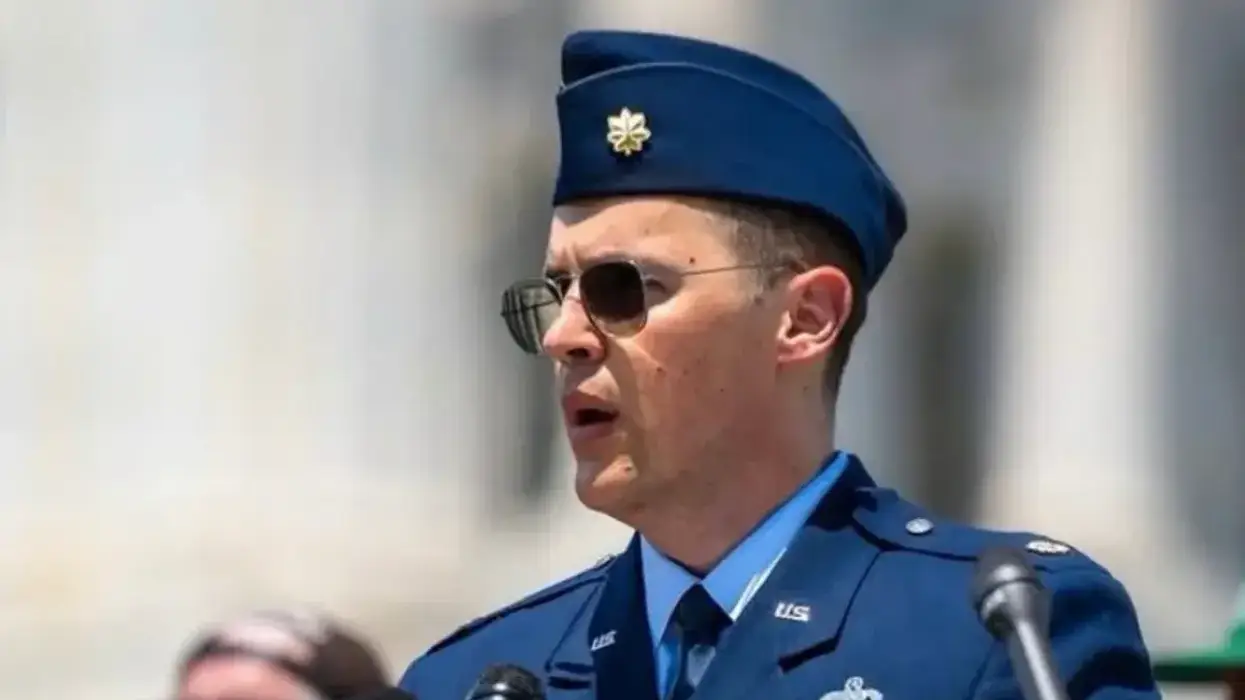
On July 1, Major Watson walked up the House steps of the US Capitol in uniform and stood there holding a sign that read “Impeach. Convict. Remove.” He was calling for the removal of President Trump and Vice President Vance. Capitol Police arrested him. The D.C. charges were dropped, but he was taken from the courthouse straight into Air Force custody and restricted to base. In August he went on CNN and said it again. The next day, the Air Force ordered him into pretrial confinement.
He now faces ten charges under three articles of the Uniform Code of Military Justice (UCMJ): three under Article 88 for allegedly using “contemptuous words” against the president, five under Article 92 for failing to obey orders or regulations, and two under Article 133 for “conduct unbecoming an officer,” as his lawyers confirmed in a public statement.
I’m not here to argue about uniform regulations. What bothers me, and what should bother anyone paying attention, is what the Article 88 charges and that solitary cell tell us about how power handles real dissent.
Major Watson has shown a steady, stubborn courage that’s rare anywhere, and rarer still when your career and freedom are on the line.
Watson didn’t hide behind a fake name. He didn’t retain or leak anything classified. He put his own name and face on what he believed, in public, knowing what it would cost.
Before he took that stand, he asked himself, “What’s the highest price that I’m willing to pay?” His answer was, more or less, whatever it takes. That’s what bravery looks like. You’re still afraid. You go anyway, knowing hell is coming.
Punished Before He Is Tried
Here is what troubles me most. The military is punishing Major Watson while claiming to follow the very rules that forbid it. Article 13 of the UCMJ says no one being held for trial may be punished, and that pretrial confinement may be no “more rigorous than the circumstances require to insure his presence.” The idea is straight-forward. Someone waiting for a court-martial is presumed innocent, and the military isn’t allowed to treat him as guilty.
Locking a person alone in a cell for months is punishment by any ordinary meaning of the word. Watson’s attorney has said solitary is usually reserved for people who are violent or disobedient, and even then only for a few days or a week. At Watson’s Article 32 hearing, the hearing officer said the isolation was required because he can’t be housed with civilian inmates.
Even if you accept that explanation, it doesn’t undo what isolation does to a person’s mind. And it doesn’t answer the bigger question: why is a peaceful man whose only “offense” was speaking locked up at all? You can’t even argue that the punishment doesn’t fit the crime, because officially it isn’t punishment. When the people offended by your words also get to decide what counts as a crime, and what counts as punishment, the law stops being fair or predictable.
I can tell you from experience that solitary is built to grind you down. I was thrown into solitary in prison because I wouldn’t let a guard on a power trip treat me as anything less than a human being. My punishment for standing up for my dignity was a cell less than half the size of my usual cage. No window. No sunlight. Nothing to remind me there was a world outside. No contact with anyone, including my family, who went days without hearing from me and had no idea what was happening.
That kind of isolation isn’t about safety or order or paperwork. It’s about breaking someone, and about sending a message to everyone else. Major Watson stood up against an administration he believes is trampling the Constitution. For that act of conscience, they’re trying to make him disappear.
Article 88 and the Espionage Act
Article 88 makes it a crime for a commissioned officer to use “contemptuous words” against the president, the vice president, Congress, and certain other officials. It is almost never used. A CNN review found only two convictions under it since the modern military code took effect in 1950.
The military’s own Manual for Courts-Martial, as one legal analysis explains, says that criticism of an official in the course of political discussion, even strongly worded criticism, shouldn’t be charged under this article unless it is personally contemptuous. Watson put it simply at his hearing: “discomfort is not contempt.”
For that act of conscience, they’re trying to make him disappear.
How the article gets used is concerning. In 2021, Marine Lt. Col. Stuart Scheller posted videos in uniform demanding accountability from senior leaders over the Afghanistan withdrawal, at one point saying he felt “contempt” for them. He was charged under Article 88 too. With prominent supporters cheering him on, his case went to a special court-martial, the lower-level forum. He spent nine days in the brig, pleaded guilty, and walked away with a letter of reprimand and a $5,000 forfeiture of pay. Watson’s lawyers summed up the problem: “The law will not make the same word a virtue in one officer’s mouth and a felony in another’s.”
I recognize this double standard because I’ve lived it. The Espionage Act of 1917 was written to catch spies. Today it’s regularly used against whistleblowers who tell the public what the government would rather keep quiet, and defendants usually aren’t allowed to argue that their disclosures served the public interest. Groups like PEN America, the ACLU, and Human Rights Watch have warned for years that laws this broad invite selective prosecution. The cases of John Kiriakou, Reality Winner, and Thomas Drake show those warnings were right.
Look at Courtney Williams, who worked in a support role for Delta Force at Fort Bragg from 2010 to 2016. She talked to an investigative reporter about sexual harassment and discrimination inside the unit. In April, the FBI arrested her, and she now faces four Espionage Act counts, each carrying up to ten years. Prosecutors say some of what she shared was classified. The reporter she spoke with calls the case retaliation against a whistleblower. Either way, plenty of former special operators talk openly about their units on popular podcasts without ending up in handcuffs.
Article 88 and the Espionage Act are different laws, but they end up doing the same job. They’re old, broad nets that can be thrown over anyone who speaks uncomfortable truths about those in power. Whether the target is a whistleblower or an outspoken officer, the result is silence. And every time we let these tools get dusted off, we make it easier to use them on the next person.
The Oath Wasn’t to a Person
Every public servant, civilian or military, swears to support and defend the Constitution. None of them swears loyalty to a president, a party, or a movement.
There’s a difference between the enlisted and officer oaths worth knowing. Enlisted members promise to “obey the orders of the President of the United States and the orders of the officers appointed over me.” Officers don’t make that promise. Under the officer’s oath, they swear to support and defend the Constitution and to “well and faithfully discharge the duties” of their office. That difference, as the Marine Corps itself explains, is deliberate. An officer’s final loyalty belongs to the Constitution and the rule of law, not to whoever is sitting in the Oval Office.
Watson has said his oath is exactly why he went to those Capitol steps, and that he acted out of duty, not partisanship. His point is that no leader is above the law. Yet “support and defend the Constitution” keeps getting bent into a demand for personal loyalty. People who stand on principle end up in solitary. People who look the other way get promoted.
Service and Speech
I have deep respect for the military and its traditions. The military can’t be anyone’s political tool, and service members have to follow lawful orders. The rules that keep uniforms out of partisan politics exist for good reason: they keep the military under civilian control and out of the hands of any one side. Those rules matter.
But this is about proportion. Joining the military doesn’t mean giving up your basic rights. Courts have long held that service members keep some free-speech protection, even if it is narrower than a civilian’s, as long as their speech doesn’t seriously threaten discipline or the mission.
So it’s fair to ask where the line really is. Does one peaceful protest justify criminal charges and months in solitary? A military confident enough to handle criticism from within its own ranks is stronger than one that keeps people in line through fear.
“I Was Only Following Orders”
We settled the question of blind obedience after World War II. At Nuremberg, the world rejected “just following orders” as an excuse. The principle that came out of those trials says acting on orders doesn’t relieve you of responsibility “provided a moral choice was in fact possible.” Our own military law requires service members to obey lawful orders, not unlawful ones.
We rightly honor people like Hugh Thompson, the Army helicopter pilot who landed his aircraft between American soldiers and fleeing Vietnamese civilians at My Lai in 1968. He was treated as an outcast for years. The Army didn’t award him the Soldier’s Medal until 1998, thirty years later. We can’t keep telling every generation of service members that they have a duty to refuse wrongdoing, then crush the ones who actually say so out loud.
Dr. Martin Luther King Jr. wrote about this from a Birmingham jail cell. We have a duty to obey just laws, he said, and an equal duty to disobey unjust ones. But “one who breaks an unjust law must do so openly, lovingly, and with a willingness to accept the penalty.”
That’s the tradition Major Watson acted in. He didn’t hide. He stood in the open, told his superiors where he stood, and accepted the consequences. If the right of conscience doesn’t belong to every citizen, it doesn’t really belong to anyone. And a country where no one can tell the powerful the truth isn’t a free country.
What We Owe Him
Major Watson has shown a steady, stubborn courage that’s rare anywhere, and rarer still when your career and freedom are on the line. He didn’t hide behind technicalities or double-talk. He put everything on the line for the principles he swore to uphold.
We owe him our voices, for his sake and for our own. When the government turns its full weight against someone who takes his oath seriously, we can’t just wait for politicians or courts to fix it. It takes ordinary people, standing together, to demand fairness, shine a light into those cells, and make sure the people who tell the truth don’t have to stand alone.
I encourage everyone to show support for Major Watson by spreading the word about his courage and how he is being persecuted for standing up for truth. You can also help by sending letters of support to Major Watson while he is being confined to the following address:
Jason P. Watson
Calvert County Detention Center
P.O. Box 9
Barstow, MD 20610