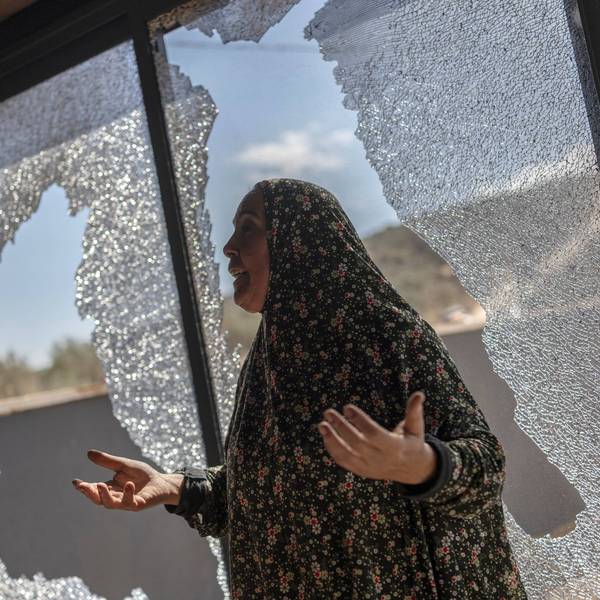
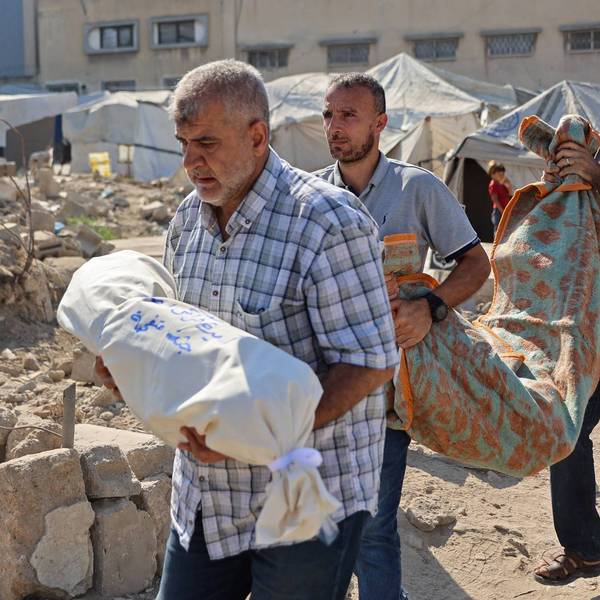
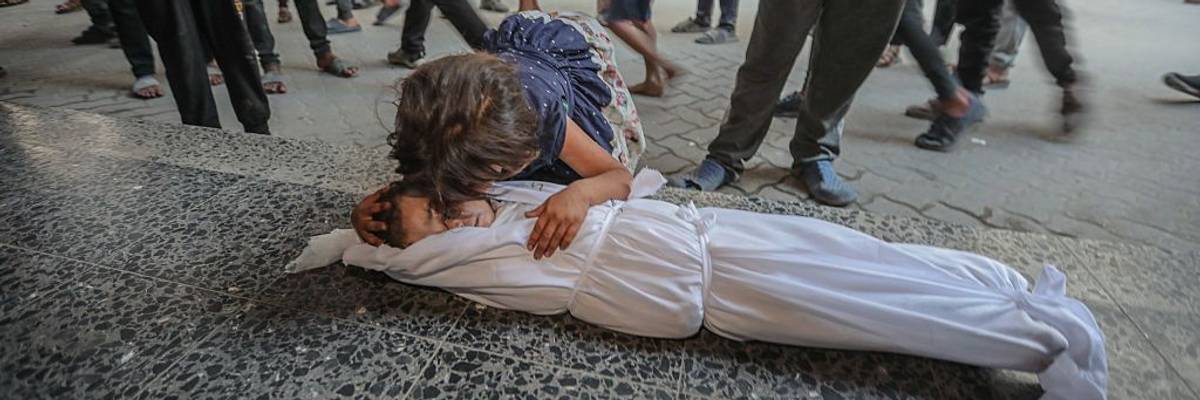
The body of a Palestinian child, who lost his life following the Israeli attack on al-Tuffah neighborhood, is brought to al-Ahli Hospital for funeral process in Gaza City, Gaza on October 4, 2025.
US Imperialism and the Language of Erasure in Palestine
The phrase “US imperialism” may sound antique, but the reality is current. It lives in supply chains, military aid, diplomatic vetoes, and the expectation that our media will avoid language that might complicate partnership.
I grew up believing that fidelity to language is fidelity to truth. Scripture taught me that truth is a form of prayer and that naming is part of justice. Then I learned how language is trained to look away. In the American conversation about the U.S.-backed genocide in Gaza and Palestine, words are rinsed until they shine with neutrality, while the bodies they describe grow dim. The result is a strange theology of news, where grief must pass an examination before it is shared, and where power writes the glossary.
In the weeks after October 7, anchors found an ease of speech they rarely grant Palestinians. Faces from southern Israel filled our screens—named and mourned. By mid-October, Israel had killed thousands in Gaza, many of them children. The camera kept its distance. The word that leapt to the teleprompter was caution. Images blurred and numbers hedged, context was treated as suspicion rather than care.
The grief of one people became a national ceremony; the grief of another, a footnote.
I want a common speech that lets readers feel that a child pulled from rubble requires no preface.
If language is a vessel for conscience, these choices matter. A hospital becomes a “compound,” bombardment becomes an “operation,” a family under rubble becomes “collateral.” Such phrasing allows atrocity to appear as policy, and policy to pass as inevitability. We are told this is balance, when in reality it scolds both the arsonist and the burning house.
As the psychiatrist Thomas Szasz once observed, “In the typical Western two men fight desperately for the possession of a gun that has been thrown to the ground: whoever reaches the weapon first shoots and lives; his adversary is shot and dies. In ordinary life, the struggle is not for guns but for words; whoever first defines the situation is the victor; his adversary, the victim.” The stakes of language decide whose grief is recognized and whose life is made expendable.
What we call balance often conceals allegiance. The United States supplies weapons, funding, diplomatic cover, and ideological shelter to Israel. Washington fast-tracks munitions while vetoing cease-fire resolutions at the United Nations, demanding the press describe the result as a “cycle.” Institutions obey through habits as much as manufactured consent because the script is already written.
Editors learn which nouns invite trouble. Reporters learn which verbs are preferred. Freelancers learn the cost of clarity.
The money is not incidental. Contracts enrich the usual firms as careers rise in their shadow. The casualties are an afterthought. The ledger sits backstage, while the performance onstage goes by the name of neutrality. The empire supplies language and weapons, while it is language that returns the favor by laundering intent.
Every culture keeps a book of sorrows. In ours, some sorrows earn public sympathy more readily than others. When a Palestinian journalist is killed, headlines bend into the passive voice, and the subject disappears. When a Palestinian American is beaten at a checkpoint or murdered, procedure replaces justice. Families who bury their children must clear a test of civility, then defend the right to weep without a preface.
To mourn openly is treated as a provocation. To ask for equal mourning is to be accused of provocation.
This is how imperial culture works. If Palestinian grief is marginalized, policy can proceed. The audience is soothed by the idea that tragedy has no author, that rubble is a natural event, and that history began yesterday. In such a world, the right dead receive sympathy, while the living must demonstrate moderation.
If the prophets have any lesson for journalism, it is this: Speak without fear where the truth is plain. Refuse to wrap cruelty in fine phrases. Follow conscience where it burns, even when it threatens comfort.
We were told that social media would democratize speech. Instead, many Palestinians and their allies discovered another border regime. Posts vanish without explanation and archives dissolve, as certain words trigger shadow bans. Meanwhile, coordinated networks flood platforms with talking points until the algorithm mistakes noise for truth.
People adapt. They speak in code. They smuggle testimony through poetry. They post with patience. The work continues because memory continues. Forgetting is the most dangerous technology.
Before my essays, I wrote sanctioned paragraphs inside large institutions. I learned how official speech is constructed, and how clarity is stripped from a sentence . . . One is encouraged to prefer symmetry over accuracy.
The effect is spiritual and does violence to one’s soul. Conscience is taught to whisper. The room obeys, when it should sound an alarm.
Our grief must first earn a hearing; our dead are assigned numbers rather than names. Empires hold territory and vocabulary alike. As such, recovering our speech is part of recovering our dignity.
The phrase “U.S. imperialism” may sound antique, but the reality is current. It lives in supply chains, military aid, diplomatic vetoes, and the expectation that our media will avoid language that might complicate partnership. It governs which deaths are described and which are rendered abstract. It shapes curriculum, philanthropy, and the scope of respectable debate. Above all, it trains the public to treat Palestinian life as a question, not a fact.
Imperial culture does not announce its arrival with banners. It moves through careful renaming. It borrows the aura of reason while pruning history. It requests deference in the name of complexity, and it rewards those who provide it with access.
Say occupation where there is an occupation. Say siege where there is a siege. If a journalist is killed, name the bullet and the chain of command. If a neighborhood is erased, name the policy that permits erasure. Then listen to survivors.
Such speech is an act of repair. It gives words back to the people who have lived under them. It restores trust between the public and the page.
There are journalists in the United States who begin from testimony rather than performance; who respect context over an alibi; who resist the symmetry that mistakes management for justice. Chris Hedges and Moustafa Bayoumi are among them. Their work does not flatter power. It honors the living by telling the truth about the dead. It remembers that language can also be occupied, and that freeing it is part of the same struggle.
To name is a civic and spiritual duty. Will you reflect? Will you testify? Will you remember the stranger? These are disciplines of attention. When we choose the word compound for a hospital, or incident for a massacre, we are answering those questions in the negative. When we choose accurate names, we widen the circle of humanity.
I do not write to police the language of others. I write to examine mine. I want a Western vocabulary that does not reduce Palestinians to a problem or political question in need of management. I want a common speech that lets readers feel that a child pulled from rubble requires no preface.
Empire teaches us to treat reality as talking points. Faith teaches the opposite. If the prophets have any lesson for journalism, it is this: Speak without fear where the truth is plain. Refuse to wrap cruelty in fine phrases. Follow conscience where it burns, even when it threatens comfort.
I offer these lines in the name of tenderness and law, memory and justice, which belong together when language is healthy. Violence is asymmetrical, just like truth. The world deserves words that admit as much.
Support journalists who center Palestinian testimony with patience and respect. Hold editors to their standards. Share stories that restore names and faces. Each act strengthens the possibility of a public language that does not betray the people who must live under it.
This is the work of citizens and of writers. It is the work of the heart.
Excerpted from If You Cannot Say GENOCIDE: Essays on Conscience and Witness by Yahia Lababidi. Copyright © 2026 by Yahia Lababidi. All Rights Reserved.
We are at a crossroads
This country and this world are at a monumental crossroads. In a few short weeks, US voters will have an opportunity to beat back the forces of fascism and confront the billionaires who are rigging the economy, our media system, and our democracy, making it increasingly impossible for ordinary people to get by. We’re not just talking about the election. We’re talking about what must be done once these fascist elements are vanquished from power. We need a bolder set of solutions than what either major party has so far been willing to offer and a working-class movement ready to fight like hell for it. Trump didn't emerge from nowhere. The conditions that fueled MAGA authoritarianism were created by decades of radical neoliberal economic policies and a corrupt political system dominated by corporate interests. They slashed taxes on the super-rich, promising that the benefits would trickle down. They said giveaways to the corporate titans would make life more affordable for the rest of us. It was all bullshit. And when a bitter, betrayed populace searches for someone to blame, right-wing demagogues have little trouble finding scapegoats. People know when they're being lied to, but you won't hear any of this from the corporate media. Only independent journalism—powered and funded by people who believe in building a better world—can deliver truly trustworthy daily news. Our Fall Campaign is underway, and we need your help. To power our newsroom through the rest of the year, we need to raise $125,000 by midnight on October 31. So if you share our vision, please contribute whatever you can to sustain our work. |
I grew up believing that fidelity to language is fidelity to truth. Scripture taught me that truth is a form of prayer and that naming is part of justice. Then I learned how language is trained to look away. In the American conversation about the U.S.-backed genocide in Gaza and Palestine, words are rinsed until they shine with neutrality, while the bodies they describe grow dim. The result is a strange theology of news, where grief must pass an examination before it is shared, and where power writes the glossary.
In the weeks after October 7, anchors found an ease of speech they rarely grant Palestinians. Faces from southern Israel filled our screens—named and mourned. By mid-October, Israel had killed thousands in Gaza, many of them children. The camera kept its distance. The word that leapt to the teleprompter was caution. Images blurred and numbers hedged, context was treated as suspicion rather than care.
The grief of one people became a national ceremony; the grief of another, a footnote.
I want a common speech that lets readers feel that a child pulled from rubble requires no preface.
If language is a vessel for conscience, these choices matter. A hospital becomes a “compound,” bombardment becomes an “operation,” a family under rubble becomes “collateral.” Such phrasing allows atrocity to appear as policy, and policy to pass as inevitability. We are told this is balance, when in reality it scolds both the arsonist and the burning house.
As the psychiatrist Thomas Szasz once observed, “In the typical Western two men fight desperately for the possession of a gun that has been thrown to the ground: whoever reaches the weapon first shoots and lives; his adversary is shot and dies. In ordinary life, the struggle is not for guns but for words; whoever first defines the situation is the victor; his adversary, the victim.” The stakes of language decide whose grief is recognized and whose life is made expendable.
What we call balance often conceals allegiance. The United States supplies weapons, funding, diplomatic cover, and ideological shelter to Israel. Washington fast-tracks munitions while vetoing cease-fire resolutions at the United Nations, demanding the press describe the result as a “cycle.” Institutions obey through habits as much as manufactured consent because the script is already written.
Editors learn which nouns invite trouble. Reporters learn which verbs are preferred. Freelancers learn the cost of clarity.
The money is not incidental. Contracts enrich the usual firms as careers rise in their shadow. The casualties are an afterthought. The ledger sits backstage, while the performance onstage goes by the name of neutrality. The empire supplies language and weapons, while it is language that returns the favor by laundering intent.
Every culture keeps a book of sorrows. In ours, some sorrows earn public sympathy more readily than others. When a Palestinian journalist is killed, headlines bend into the passive voice, and the subject disappears. When a Palestinian American is beaten at a checkpoint or murdered, procedure replaces justice. Families who bury their children must clear a test of civility, then defend the right to weep without a preface.
To mourn openly is treated as a provocation. To ask for equal mourning is to be accused of provocation.
This is how imperial culture works. If Palestinian grief is marginalized, policy can proceed. The audience is soothed by the idea that tragedy has no author, that rubble is a natural event, and that history began yesterday. In such a world, the right dead receive sympathy, while the living must demonstrate moderation.
If the prophets have any lesson for journalism, it is this: Speak without fear where the truth is plain. Refuse to wrap cruelty in fine phrases. Follow conscience where it burns, even when it threatens comfort.
We were told that social media would democratize speech. Instead, many Palestinians and their allies discovered another border regime. Posts vanish without explanation and archives dissolve, as certain words trigger shadow bans. Meanwhile, coordinated networks flood platforms with talking points until the algorithm mistakes noise for truth.
People adapt. They speak in code. They smuggle testimony through poetry. They post with patience. The work continues because memory continues. Forgetting is the most dangerous technology.
Before my essays, I wrote sanctioned paragraphs inside large institutions. I learned how official speech is constructed, and how clarity is stripped from a sentence . . . One is encouraged to prefer symmetry over accuracy.
The effect is spiritual and does violence to one’s soul. Conscience is taught to whisper. The room obeys, when it should sound an alarm.
Our grief must first earn a hearing; our dead are assigned numbers rather than names. Empires hold territory and vocabulary alike. As such, recovering our speech is part of recovering our dignity.
The phrase “U.S. imperialism” may sound antique, but the reality is current. It lives in supply chains, military aid, diplomatic vetoes, and the expectation that our media will avoid language that might complicate partnership. It governs which deaths are described and which are rendered abstract. It shapes curriculum, philanthropy, and the scope of respectable debate. Above all, it trains the public to treat Palestinian life as a question, not a fact.
Imperial culture does not announce its arrival with banners. It moves through careful renaming. It borrows the aura of reason while pruning history. It requests deference in the name of complexity, and it rewards those who provide it with access.
Say occupation where there is an occupation. Say siege where there is a siege. If a journalist is killed, name the bullet and the chain of command. If a neighborhood is erased, name the policy that permits erasure. Then listen to survivors.
Such speech is an act of repair. It gives words back to the people who have lived under them. It restores trust between the public and the page.
There are journalists in the United States who begin from testimony rather than performance; who respect context over an alibi; who resist the symmetry that mistakes management for justice. Chris Hedges and Moustafa Bayoumi are among them. Their work does not flatter power. It honors the living by telling the truth about the dead. It remembers that language can also be occupied, and that freeing it is part of the same struggle.
To name is a civic and spiritual duty. Will you reflect? Will you testify? Will you remember the stranger? These are disciplines of attention. When we choose the word compound for a hospital, or incident for a massacre, we are answering those questions in the negative. When we choose accurate names, we widen the circle of humanity.
I do not write to police the language of others. I write to examine mine. I want a Western vocabulary that does not reduce Palestinians to a problem or political question in need of management. I want a common speech that lets readers feel that a child pulled from rubble requires no preface.
Empire teaches us to treat reality as talking points. Faith teaches the opposite. If the prophets have any lesson for journalism, it is this: Speak without fear where the truth is plain. Refuse to wrap cruelty in fine phrases. Follow conscience where it burns, even when it threatens comfort.
I offer these lines in the name of tenderness and law, memory and justice, which belong together when language is healthy. Violence is asymmetrical, just like truth. The world deserves words that admit as much.
Support journalists who center Palestinian testimony with patience and respect. Hold editors to their standards. Share stories that restore names and faces. Each act strengthens the possibility of a public language that does not betray the people who must live under it.
This is the work of citizens and of writers. It is the work of the heart.
Excerpted from If You Cannot Say GENOCIDE: Essays on Conscience and Witness by Yahia Lababidi. Copyright © 2026 by Yahia Lababidi. All Rights Reserved.
- Congress’ Censure of Rep Tlaib Shows There’s a ‘Palestine Exception’ to Free Speech ›
- The Only Way to End the Inhumanity Is to Humanize Palestinians ›
- On 'Conflict', 'Peace' and 'Genocide': Time for New Language on Palestine and Israel ›
- The Erasure of Palestinians ›
- Palestine And Its Metaphors ›
- ‘Human Animals’: The Sordid Language Behind Israel’s Genocide in Gaza ›