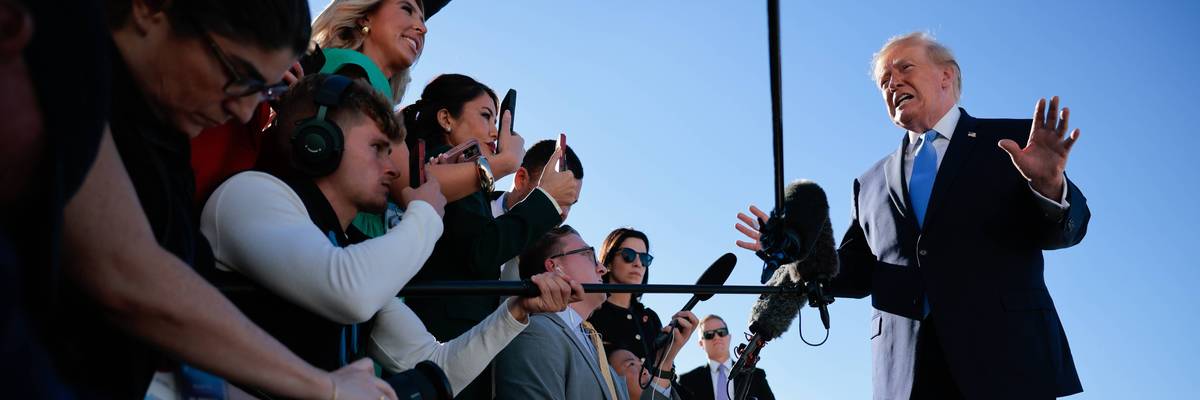
US President Donald Trump answers questions from the press before boarding Air Force One on October 26, 2026 in Joint Base Andrews, Maryland. Trump is scheduled to travel to Mississippi today to continue his campaign for Republican candidates in the midterm elections.
The Media Has a Critical Role in Safeguarding Our Democracy This Election Season
Even if Trump and his allies know they will lose in court if they try these illegal moves to subvert the election, they can still successfully control our elections if they cause enough noise to overwhelm voters and discourage turnout. The confusion is the point. Clarity is the cure.
We’re just days out from November 3, and already millions of Americans are heading to the polls or dropping off their mail-in ballots, while threats to their freedom to vote continue making front-page news.
Since returning to office, President Donald Trump and members of his administration have desperately tried to take over our elections—a move that is both unconstitutional and has, thus far, failed. But these realities haven’t stopped him from indicating a willingness to have federal officers show up at polling places, something that has been illegal since the Civil War. He has continually railed against vote-by-mail, despite the US Supreme Court blocking his most damaging plans. And where he has failed to pass federal legislation or successfully move executive orders, he has repeatedly attacked our elections. In fact, he spread false or misleading claims about our elections on 70% of the days of his second term.
And while Trump’s efforts continue to fail to pass legal muster, there are two intertwined threats built into his continued public flirtation with election interference: anti-voter actions themselves, and the confusion and chaos created by floating these plans in public.
The job of the media ecosystem—whether print journalists, TV pundits, or content creators on TikTok—is to make sure the American people know the truth.
The media ecosystem has a big role to play in mitigating that second threat.
Even if Trump and his allies know they will lose in court if they try these illegal moves to subvert the election, they can still successfully control our elections if they cause enough noise to overwhelm voters and discourage turnout.
The confusion is the point. Clarity is the cure.
Consider the rumors about the federal government deploying its agents in connection with voting.
Surely, the Trump administration knows that sending ICE to polling places is illegal and unpopular. And the administration is already backtracking on earlier statements. But as voting gets underway, the media and anyone with a platform must avoid sensationalizing, verify any reports before sharing, and make clear that the presence of ICE or other federal agents at voting sites would be straightforwardly illegal. That doesn’t mean dismissing the tangible fears Black and Brown voters may have. Instead, we can reassure voters by highlighting election workers' preparations, encouraging voters to cast their ballots with their neighbors (as millions of Americans have already done), and emphasizing the steps voting rights advocates are taking to protect access to the ballot.
While the fears of ICE feel unique to 2026, we have been down a similar road in the past. In 2022, there was extensive media coverage of a handful of armed people in tactical gear who showed up at voting drop boxes in Maricopa County, AZ. As courts later confirmed, this was undoubtedly an illegal situation that should never have happened. Although it was isolated to two drop boxes in a county larger than Connecticut, the incident received widespread coverage throughout Arizona and nationwide, and spread quickly on social media. Coverage of important incidents like this should include the key context that lets voters know they can still vote safely.
The media is powerful, and its job is so important. In 1965, the media coverage of Selma’s Bloody Sunday allowed the whole country to see the reality of voter suppression, generating outrage in communities beyond those directly affected by it. Eight days after images from Selma aired on live broadcasts and appeared on the front pages of newspapers, President Lyndon Johnson spoke to a joint session of Congress, urging them to pass the Voting Rights Act.
The job of the media ecosystem—whether print journalists, TV pundits, or content creators on TikTok—is to make sure the American people know the truth. As we approach Election Day, that includes the reality that threats of election interference are desperate moves doomed to fail.
We cannot treat threats to deploy federal officers at polling places, efforts to restrict mail-in voting, or refusals to certify lawful election results as ordinary legal debates. We must call them out as attempts to control our elections that we, the American people, will not tolerate. This is how we instill confidence in the election and in our democracy.
After all the rhetoric undermining elections from the White House, it’s understandable that voters may fear the worst-case scenarios. Those steering the public conversation should remember the power of their work to dispel those fears with the truth.
The framers of the Constitution considered the role of the press important enough to list it explicitly in the First Amendment. Two hundred and fifty years after our founding, the media is as critical as ever in safeguarding our democracy.
We are at a crossroads
This country and this world are at a monumental crossroads. In a few short weeks, US voters will have an opportunity to beat back the forces of fascism and confront the billionaires who are rigging the economy, our media system, and our democracy, making it increasingly impossible for ordinary people to get by. We’re not just talking about the election. We’re talking about what must be done once these fascist elements are vanquished from power. We need a bolder set of solutions than what either major party has so far been willing to offer and a working-class movement ready to fight like hell for it. Trump didn't emerge from nowhere. The conditions that fueled MAGA authoritarianism were created by decades of radical neoliberal economic policies and a corrupt political system dominated by corporate interests. They slashed taxes on the super-rich, promising that the benefits would trickle down. They said giveaways to the corporate titans would make life more affordable for the rest of us. It was all bullshit. And when a bitter, betrayed populace searches for someone to blame, right-wing demagogues have little trouble finding scapegoats. People know when they're being lied to, but you won't hear any of this from the corporate media. Only independent journalism—powered and funded by people who believe in building a better world—can deliver truly trustworthy daily news. Our Fall Campaign is underway, and we need your help. To power our newsroom through the rest of the year, we need to raise $125,000 by midnight on October 31. So if you share our vision, please contribute whatever you can to sustain our work. |
We’re just days out from November 3, and already millions of Americans are heading to the polls or dropping off their mail-in ballots, while threats to their freedom to vote continue making front-page news.
Since returning to office, President Donald Trump and members of his administration have desperately tried to take over our elections—a move that is both unconstitutional and has, thus far, failed. But these realities haven’t stopped him from indicating a willingness to have federal officers show up at polling places, something that has been illegal since the Civil War. He has continually railed against vote-by-mail, despite the US Supreme Court blocking his most damaging plans. And where he has failed to pass federal legislation or successfully move executive orders, he has repeatedly attacked our elections. In fact, he spread false or misleading claims about our elections on 70% of the days of his second term.
And while Trump’s efforts continue to fail to pass legal muster, there are two intertwined threats built into his continued public flirtation with election interference: anti-voter actions themselves, and the confusion and chaos created by floating these plans in public.
The job of the media ecosystem—whether print journalists, TV pundits, or content creators on TikTok—is to make sure the American people know the truth.
The media ecosystem has a big role to play in mitigating that second threat.
Even if Trump and his allies know they will lose in court if they try these illegal moves to subvert the election, they can still successfully control our elections if they cause enough noise to overwhelm voters and discourage turnout.
The confusion is the point. Clarity is the cure.
Consider the rumors about the federal government deploying its agents in connection with voting.
Surely, the Trump administration knows that sending ICE to polling places is illegal and unpopular. And the administration is already backtracking on earlier statements. But as voting gets underway, the media and anyone with a platform must avoid sensationalizing, verify any reports before sharing, and make clear that the presence of ICE or other federal agents at voting sites would be straightforwardly illegal. That doesn’t mean dismissing the tangible fears Black and Brown voters may have. Instead, we can reassure voters by highlighting election workers' preparations, encouraging voters to cast their ballots with their neighbors (as millions of Americans have already done), and emphasizing the steps voting rights advocates are taking to protect access to the ballot.
While the fears of ICE feel unique to 2026, we have been down a similar road in the past. In 2022, there was extensive media coverage of a handful of armed people in tactical gear who showed up at voting drop boxes in Maricopa County, AZ. As courts later confirmed, this was undoubtedly an illegal situation that should never have happened. Although it was isolated to two drop boxes in a county larger than Connecticut, the incident received widespread coverage throughout Arizona and nationwide, and spread quickly on social media. Coverage of important incidents like this should include the key context that lets voters know they can still vote safely.
The media is powerful, and its job is so important. In 1965, the media coverage of Selma’s Bloody Sunday allowed the whole country to see the reality of voter suppression, generating outrage in communities beyond those directly affected by it. Eight days after images from Selma aired on live broadcasts and appeared on the front pages of newspapers, President Lyndon Johnson spoke to a joint session of Congress, urging them to pass the Voting Rights Act.
The job of the media ecosystem—whether print journalists, TV pundits, or content creators on TikTok—is to make sure the American people know the truth. As we approach Election Day, that includes the reality that threats of election interference are desperate moves doomed to fail.
We cannot treat threats to deploy federal officers at polling places, efforts to restrict mail-in voting, or refusals to certify lawful election results as ordinary legal debates. We must call them out as attempts to control our elections that we, the American people, will not tolerate. This is how we instill confidence in the election and in our democracy.
After all the rhetoric undermining elections from the White House, it’s understandable that voters may fear the worst-case scenarios. Those steering the public conversation should remember the power of their work to dispel those fears with the truth.
The framers of the Constitution considered the role of the press important enough to list it explicitly in the First Amendment. Two hundred and fifty years after our founding, the media is as critical as ever in safeguarding our democracy.