

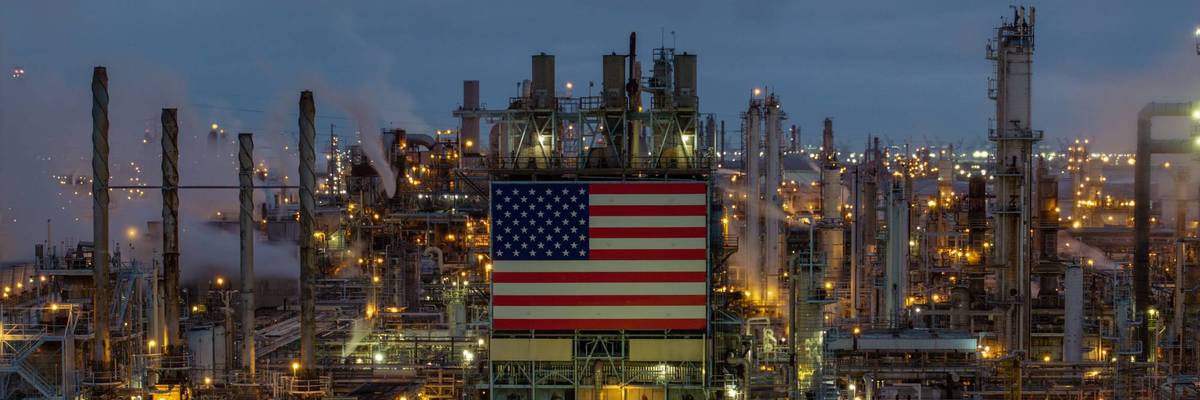
In an aerial view, Marathon Petroleum Corp's Los Angeles Refinery, one of the largest oil refineries in the North America, operates as gas prices rocket upward due to worldwide oil supply disruptions caused by the US and Israeli attack on Iran, on March 10, 2026 in Carson, California.
‘Permitting Reform’ Is a Giveaway to Data Centers and Fossil Fuels
Making it easier to build data centers and fossil fuel infrastructure benefits no one except Big Tech and Big Oil. A bipartisan group of Senators wants to do it anyway.
The US Senate is considering a bill to ease the environmental permitting of infrastructure projects. It’s a blatant giveaway to the fossil fuel and data center industries that would stifle input from the communities most impacted by their expansion.
Bill proponents claim it will ease the buildout of renewable energy. However, peer reviewed studies have shown that most renewable energy projects do not face significant permitting delays, and that permitting delays under the National Environmental Policy Act (NEPA) are mostly attributable to staff shortages and communication delays between project developers and permitting agencies—not the stringency of the permitting process itself.
If bill proponents really wanted to expand renewable energy, they would focus on reversing the disastrous repeal of wind and solar tax credits in last year’s budget bill, the so-called “Big Beautiful Bill.” Under that law, there are no remaining federal tax credits for households to put solar panels on their homes, stifling the growth of distributed solar energy. And most utility-scale solar or wind projects that commenced construction after July 4, 2026 will also be ineligible for tax credits.
This bill strips the public of their right to have a say in what gets built in their communities, in whose interest, and at what cost to human rights, air and water quality, public health, and culturally important places.
Instead, the permitting bill limits the power of communities and state, local, and tribal governments to challenge fossil fuel and data center projects, stacking the deck in favor of project developers.
For example, Section 1202 of the bill limits the authority states and tribes currently have under the Clean Water Act to certify federally permitted projects as compliant with their own water quality standards. This would prevent states and tribes from requiring stronger standards than the federal government, allowing projects that they determine will harm water quality to go forward.
Additionally, the “project certainty” provisions in Sections 1401 through 1403 of the bill grant project developers the right to sue the government for “disparate treatment” if their project is denied a permit when similar projects have been approved in the past. This would effectively bar a future administration from denying permits for polluting infrastructure if this one greenlights them.
A Dream Bill for Data Center Developers and Fossil Fuel Companies
The proliferation of data centers is leading to a boom in fracked gas power generation, driving up greenhouse gas emissions and undoing progress in making the electric grid fossil fuel free. This is a giant step backwards happening at the worst possible time, with the Antarctic ice sheet collapsing, and drought and glacier loss threatening the world’s freshwater supply.
Backup diesel and gas turbine generators at data centers also emit toxic air pollutants such as particulate matter and nitrogen oxides, which are responsible for cancer, asthma and other respiratory diseases, and cardiovascular disease.
While families struggle with the high cost of living, massive (and growing) energy consumption by data centers is driving up utility bills for regular people. The permitting bill purports to address this problem by requiring data center developers to pay for the added cost of transmission to meet their demand, but that’s only one of the ways in which data centers impact utility bills. Increased demand for fracked gas from data centers is also driving up natural gas prices, and consequently household electricity and gas bills.
Direct water consumption by data centers for cooling servers, and indirect water consumption for fracked gas power generation to supply data centers, pose an additional threat to water availability in already water-stressed communities.
In spite of these serious concerns, the bill makes it harder for communities to use federal law to challenge proposals for data centers or their ancillary fossil fuel infrastructure (such as fracked gas pipelines and power plants).
The overwhelming scientific consensus is that fossil fuel infrastructure should not be built today, period. Bill proponents’ assumption that the increased buildout of renewable energy and transmission lines from deregulating permitting would more than make up for the simultaneous increase in fossil fuels is at odds with peer-reviewed science.
Easing permitting of fossil fuel infrastructure is discriminatory and contrary to environmental justice. Our environmental permitting system already allows for rampant race and class discrimination in the siting of polluting facilities. This racist bill will lock in protections for polluting corporations while depriving historically marginalized communities of even the limited rights they have today.
Speeding up infrastructure permitting will not lower energy bills either, contrary to bill proponents’ claims. It might increase the cost of living instead. In addition to data centers driving up demand for natural gas, natural gas prices could also rise if more liquid natural gas (LNG) is exported. Under the bill, LNG exports will get a boost from easier permitting of LNG terminals.
Despite greenlighting more fossil fuel infrastructure, proponents claim that the bill will reduce overall emissions. But that claim is based on seriously flawed modeling.
For one example, the models use the EPA estimates for leakage of methane, a short-lived but potent climate pollutant from oil and gas production, when accounting for the emissions impact of more fossil fuel infrastructure. But a number of independent studies have shown that the EPA seriously underestimates methane leakage.
For another, the models conveniently ignore emissions from US fossil fuel exports, because the emissions from burning the fuels occur in a different country. Ignoring emissions from exports is a bad faith shell game.
Assault on Democracy
This bill strips the public of their right to have a say in what gets built in their communities, in whose interest, and at what cost to human rights, air and water quality, public health, and culturally important places.
This is an end-run around democracy. Yes, bad faith actors sometimes misuse procedural protections for the wrong reasons, delaying or blocking good projects based on frivolous objections. But using that as a pretext to limit communities’ ability to have any say in projects institutionalizes the subordination of community rights to corporate interests.
That’s exactly why powerful industry groups such as the American Petroleum Institute (API) have come out in support of this bill. Senators who claim to care about addressing climate change should recognize that if they’re on the same side as API, they’re on the wrong side of the climate fight.
We are at a crossroads
This country and this world are at a monumental crossroads. In a few short weeks, US voters will have an opportunity to beat back the forces of fascism and confront the billionaires who are rigging the economy, our media system, and our democracy, making it increasingly impossible for ordinary people to get by. We’re not just talking about the election. We’re talking about what must be done once these fascist elements are vanquished from power. We need a bolder set of solutions than what either major party has so far been willing to offer and a working-class movement ready to fight like hell for it. Trump didn't emerge from nowhere. The conditions that fueled MAGA authoritarianism were created by decades of radical neoliberal economic policies and a corrupt political system dominated by corporate interests. They slashed taxes on the super-rich, promising that the benefits would trickle down. They said giveaways to the corporate titans would make life more affordable for the rest of us. It was all bullshit. And when a bitter, betrayed populace searches for someone to blame, right-wing demagogues have little trouble finding scapegoats. People know when they're being lied to, but you won't hear any of this from the corporate media. Only independent journalism—powered and funded by people who believe in building a better world—can deliver truly trustworthy daily news. Our Fall Campaign is underway, and we need your help. To power our newsroom through the rest of the year, we need to raise $125,000 by midnight on October 31. So if you share our vision, please contribute whatever you can to sustain our work. |
The US Senate is considering a bill to ease the environmental permitting of infrastructure projects. It’s a blatant giveaway to the fossil fuel and data center industries that would stifle input from the communities most impacted by their expansion.
Bill proponents claim it will ease the buildout of renewable energy. However, peer reviewed studies have shown that most renewable energy projects do not face significant permitting delays, and that permitting delays under the National Environmental Policy Act (NEPA) are mostly attributable to staff shortages and communication delays between project developers and permitting agencies—not the stringency of the permitting process itself.
If bill proponents really wanted to expand renewable energy, they would focus on reversing the disastrous repeal of wind and solar tax credits in last year’s budget bill, the so-called “Big Beautiful Bill.” Under that law, there are no remaining federal tax credits for households to put solar panels on their homes, stifling the growth of distributed solar energy. And most utility-scale solar or wind projects that commenced construction after July 4, 2026 will also be ineligible for tax credits.
This bill strips the public of their right to have a say in what gets built in their communities, in whose interest, and at what cost to human rights, air and water quality, public health, and culturally important places.
Instead, the permitting bill limits the power of communities and state, local, and tribal governments to challenge fossil fuel and data center projects, stacking the deck in favor of project developers.
For example, Section 1202 of the bill limits the authority states and tribes currently have under the Clean Water Act to certify federally permitted projects as compliant with their own water quality standards. This would prevent states and tribes from requiring stronger standards than the federal government, allowing projects that they determine will harm water quality to go forward.
Additionally, the “project certainty” provisions in Sections 1401 through 1403 of the bill grant project developers the right to sue the government for “disparate treatment” if their project is denied a permit when similar projects have been approved in the past. This would effectively bar a future administration from denying permits for polluting infrastructure if this one greenlights them.
A Dream Bill for Data Center Developers and Fossil Fuel Companies
The proliferation of data centers is leading to a boom in fracked gas power generation, driving up greenhouse gas emissions and undoing progress in making the electric grid fossil fuel free. This is a giant step backwards happening at the worst possible time, with the Antarctic ice sheet collapsing, and drought and glacier loss threatening the world’s freshwater supply.
Backup diesel and gas turbine generators at data centers also emit toxic air pollutants such as particulate matter and nitrogen oxides, which are responsible for cancer, asthma and other respiratory diseases, and cardiovascular disease.
While families struggle with the high cost of living, massive (and growing) energy consumption by data centers is driving up utility bills for regular people. The permitting bill purports to address this problem by requiring data center developers to pay for the added cost of transmission to meet their demand, but that’s only one of the ways in which data centers impact utility bills. Increased demand for fracked gas from data centers is also driving up natural gas prices, and consequently household electricity and gas bills.
Direct water consumption by data centers for cooling servers, and indirect water consumption for fracked gas power generation to supply data centers, pose an additional threat to water availability in already water-stressed communities.
In spite of these serious concerns, the bill makes it harder for communities to use federal law to challenge proposals for data centers or their ancillary fossil fuel infrastructure (such as fracked gas pipelines and power plants).
The overwhelming scientific consensus is that fossil fuel infrastructure should not be built today, period. Bill proponents’ assumption that the increased buildout of renewable energy and transmission lines from deregulating permitting would more than make up for the simultaneous increase in fossil fuels is at odds with peer-reviewed science.
Easing permitting of fossil fuel infrastructure is discriminatory and contrary to environmental justice. Our environmental permitting system already allows for rampant race and class discrimination in the siting of polluting facilities. This racist bill will lock in protections for polluting corporations while depriving historically marginalized communities of even the limited rights they have today.
Speeding up infrastructure permitting will not lower energy bills either, contrary to bill proponents’ claims. It might increase the cost of living instead. In addition to data centers driving up demand for natural gas, natural gas prices could also rise if more liquid natural gas (LNG) is exported. Under the bill, LNG exports will get a boost from easier permitting of LNG terminals.
Despite greenlighting more fossil fuel infrastructure, proponents claim that the bill will reduce overall emissions. But that claim is based on seriously flawed modeling.
For one example, the models use the EPA estimates for leakage of methane, a short-lived but potent climate pollutant from oil and gas production, when accounting for the emissions impact of more fossil fuel infrastructure. But a number of independent studies have shown that the EPA seriously underestimates methane leakage.
For another, the models conveniently ignore emissions from US fossil fuel exports, because the emissions from burning the fuels occur in a different country. Ignoring emissions from exports is a bad faith shell game.
Assault on Democracy
This bill strips the public of their right to have a say in what gets built in their communities, in whose interest, and at what cost to human rights, air and water quality, public health, and culturally important places.
This is an end-run around democracy. Yes, bad faith actors sometimes misuse procedural protections for the wrong reasons, delaying or blocking good projects based on frivolous objections. But using that as a pretext to limit communities’ ability to have any say in projects institutionalizes the subordination of community rights to corporate interests.
That’s exactly why powerful industry groups such as the American Petroleum Institute (API) have come out in support of this bill. Senators who claim to care about addressing climate change should recognize that if they’re on the same side as API, they’re on the wrong side of the climate fight.