

SUBSCRIBE TO OUR FREE NEWSLETTER
Daily news & progressive opinion—funded by the people, not the corporations—delivered straight to your inbox.
5
#000000
#FFFFFF
To donate by check, phone, or other method, see our More Ways to Give page.
Daily news & progressive opinion—funded by the people, not the corporations—delivered straight to your inbox.
A few weeks back, the Guardian ran an article profiling the team that John Kerry has assembled to carry out his plan for bringing peace to Israel-Palestine. According to the story it includes some 10-12 people under the direction of the British-born and Australian-raised Martin Indyk, who for several decades has earned a living switching back and forth between in the influence-peddling sector as a major lobbyist-advocate for Israel, and in the US government, as a so-called "expert" on Middle
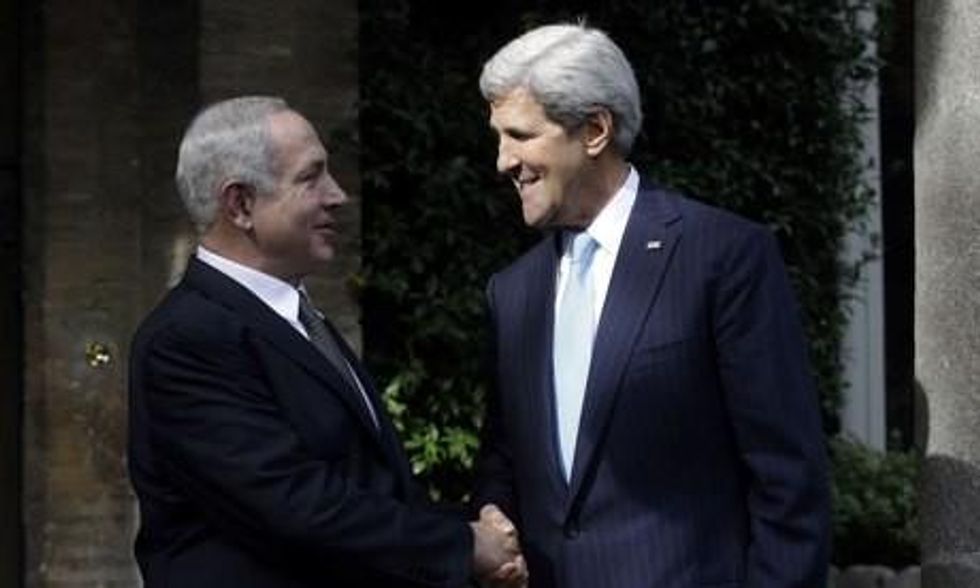
Indyk's devotion to the overall geo-strategic prerogatives of the Zionist state are so evident that he is often referred to in Washington policy circles as "Israel's lawyer."
According to the Guardian, the rest of the people on his team are: Ilan Goldenberg, Frank Lowenstein, David Makovsky, Julie Sawyer, Hady Amyr, Michael Yaffe, Laura Blumenfeld, Jonathan Schwartz, Phil Gordon, and Jon Allen.
While it is always a dicey proposition to impute the ethnic or religious background of someone from their name and/or online information, it would appear (and I am glad to proven wrong if it is not the case) that at least 7 of the 10 people on his team are Jewish. And of the people on the team whose names and/or available biographies provide somewhat less guidance in this regard, two, Hady Amr and Julie Sawyer, have held important appointments at the Saban Center at the Brookings Institution, the intellectual nerve center of so-called "liberal Zionism" in the US, which is to say, Zionism with almost all the same expansionist and ethnocratic goals as the Likudite brand, but with a less brutish and apocalyptical rhetoric.
Is it realistic to expect that a team of this particular makeup can or will serve as anything remotely resembling honest broker in the negotiations underway?
To state what I have just stated is, I know, to enter into what many consider to be scurrilous territory. I am aware--as my professor of Jewish Studies told me in no uncertain terms decades ago-- that to even raise the question of "dual-loyalty" in regard to the comportment of Jewish Americans is, for some, to engage in a contemporary form of "blood libel".
That's pretty strong stuff.
But if there is anything we have learned--or should have learned--in recent years it is that people and groups with entrenched positions of power (witness the serial and, at this point, frankly comical threats issued by James Clapper and his fellow fulminators to keep Dorothy and Toto--that's you and me--from looking at what is going on "behind the curtains" of the security state) will use any means of intimidation at their disposal to prevent public discourse from going to places where they do not want it to go.
So, the real question becomes, is it, in fact, a grave mental crime redolent of anti-Semitism to suspect that Jewish-Americans might be less than impartial when it comes matters concerning Israel?
This being the US, where there can be no differential treatment for any sub-group under our system of governance, we can resolve the question by asking, "What are the suppositions that have attended to the issue of dual-loyalty in other national and ethnic groups in the recent history of the US? "
During the last decades of the 19th century first third of the 20th century, the US was a key site of organization and financing for groups devoted to catalyzing nationalist movements in other places. The contributions of foreign-born US citizens and their offspring were absolutely essential to the consolidation of the Cuban, Czech, Slovak, Polish and Irish drives for national liberation during these times.
Did these people have dual loyalties? Of course they did! And very few people who know anything about this history would deny it.
It was against the backdrop of this then still quite recent history (obviously not without its strong xenophobic elements) that John Kennedy was forced to famously speak to the question of his Catholic identity.
Though the suspicions about his possible dual loyalty were quite vague, contrived and, had they been true, relatively trivial in terms of their possible impact on the US's geopolitical standing (Can we say the same about Indyk and company's role in Israel-Palestine?), he nonetheless felt the need to address them before the American people.
So, what has been the governmental approach to this issue in this country of immigrants?
In general, it has tacitly acknowledged the probable existence of partisan sympathies in regard to the country of origin within such activist groups, and this being the case, has--without openly condemning this very natural and generally benign phenomenon--nonetheless tended to shy away from having such people overly represented in operations or negotiations with a heavy bearing on the fate of their "other" country of spiritual allegiance.
For example, while the head of Bill Clinton's Northern Irish negotiating team, George Mitchell, was of Irish Catholic birth, he had quite little on his record--especially when compared to other Irish-American legislators--as an advocate for Ulster's Catholics before being named to his post on the President's negotiating team. If he was known for any ethnic identity, it was more for his Lebanese one.
Moreover, none of the three people running the policy shop behind him on the negotiations--Tony Lake, Nancy Soderberg and Jane Holl Lute--appear to have been Irish Catholics (as before, ready to stand corrected on this) or to have had any previous interest in the plight of Ulster's Catholics, or Unionists for that matter.
But let's imagine if Clinton had decided instead to appoint someone like NY Representative Peter King, a long-time advocate of the IRA's "right to defend itself" through violent means against the region's historically dominant Protestant Unionists, as the head of the negotiating team? And what if he then allowed him to put together a staff composed almost entirely of Irish Catholics?
Would it be a smear against the Irish Catholics in America, and throughout the world-wide Irish diaspora, to suggest that forming a team of these characteristics might not be a good idea, nor a particularly strong way of demonstrating this country's seriousness about arriving at a fair and just solution (a opposed to an unfair and imposed one) in that part of the world?
I don't think so. Rather, I think it would be seen as a fairly clear-cut case of exercising common sense.
And yet, if the US media silence on the issue is any indication, we are supposed to pretend that the make-up of the team that Kerry has put together, analogous in many ways to the King group I imagined in the case above, is of no real importance.
The case for respecting the media's injunction on this issue is further undermined by two other realities.
The first is the tendency among some of Israel's more high profile advocates in the US--Lawrence Summers comes most immediately to mind--to suggest that criticizing Israel is tantamount to engaging in anti-Semitism.
Indeed, this is one of the core assertions--in both its implied and explicit forms--of those who promote the notion that the world currently in the grip of a "New Anti-Semitism".
And this position is no longer just a matter of mere rhetoric among the televised class. In August of 2012, the California Legislature embedded this line of reasoning in law when it passed its HR 35, which holds, among other things, that suggesting that Israel is a racist or apartheid state, or that Israel has committed ethnic cleansing can and should be classified under the rubric of Anti-Semitism.
It's worth taking a moment to unpack the structure of that argument.
I may be wrong, but the belief here seems to be that criticism of Israel's acts is constitutes a slander upon the lives of the worldwide community of Jews. The underlying premise, then, would seem to be that all Jews are, in some way, morally or spiritually connected to the state of Israel, and from there, to each other.
If we accept that proposition, then doesn't it follow under the basic principles of reciprocal logic that all Jewish-Americans, including the ones on Kerry's negotiating team, are per se non-neutral and fundamentally biased parties when it comes to matters involving Israel?
I should make clear that I do not for a moment accept the premise that undergirds the school of thought I have just outlined, which to repeat, is that there is a moral umbilical cord that joins all Jews to Israel and, from there, to each other.
My sense is that Jews in America are, like everyone else under our system government, individuals first and foremost, people whose degree of devotion to particular foreign states and/ or the sub-culture they were born into is essentially unknowable.
Indeed, to embrace the underlying reasoning of HR 35 would force me, as someone who believes that any argument applied to a Jew and his ethnic milieu can be applied to me and mine, to also accept the absurd notion that a similar device of ethnic transitivity binds me morally, as a fellow Irish-American, to Peter King's boorish support of IRA violence.
The point here is that you can't have it both ways.
You can't make arguments that rest on the presumption of a seamless connectivity between Israel and the world-wide community of Jews, while simultaneously resisting the idea--and having the accusation Anti-Semitism hang like a Sword of Damocles over the heads of those who might deign to bring it up--that having a team headed by a prominent advocate for Israel, and made up largely of American Jews, might not be a really honest or effective way of "brokering" peace in the Israel-Palestine region.
The second undermining factor here is that, since September 11th, neither our government nor our media establishment has had much compunction about spreading the suspicions of "dual loyalty" in regard US-based Muslims in general, and Arabs in particular. Just ask a friend from one of these groups about what it is like to pass through airport security or to apply for a job in our government.
If it is outrageous to even think about the possible dual loyalty of Jews, isn't it also outrageous, in this country where it is patently illegal to grant or deny legal rights on the basis of ethnic identity, to contemplate, never mind institutionalize into an entire array of harassing and prosecutorial practices, the idea of Muslim and/or Arab dual loyalty?
Of course it is.
But I am not holding my breath waiting for the Pamela Gellers and David Horowitzes of the world, and important neo-cons in our government who regularly allege the same things in in somewhat subtler tones, to stop promoting this class of suspicions, suspicions that, if they were directed at Jews, would provoke loud cries about discrimination and/or Anti-Semitism.
Dual loyalties have been a ubiquitous part of the American experience.
For the most part, however, they have been harmless to the overall health of this country.
One reason for this is that public officials, aware of the potentially corrosive nature of such things, have generally been prudent about embedding people with highly-divided loyalties too deeply within policy-making structures with a direct bearing on what could be perceived as such people's secondary country of allegiance.
This prudence has long-since been abandoned in the case of US involvement in Israel-Palestine.
To suggest that it is Anti-Semitic to point this out, is rather mendacious, especially when high profile American supporters of Israel regularly advance arguments--some of which have now been written into US law--that presume the existence of a seamless moral bond between all US Jews and the geo-strategic prerogatives of the state of Israel. Or who regularly and quite zealously impute malignant "dual-loyalties" to millions of Muslim Americans and encourage our government to treat them in way that differ sharply from the ways it treats people of other national or ethnic backgrounds.
Post Script: Two days ago, Mahmoud Abbas, the man who is paid handsomely to serve a as Israel's ever-pliable Palestinian "negotiating partner" described Kerry's peace plan as "madness". Should we be surprised given the composition of Kerry's negotiating team?
Oil is the source of so much pain in the world. Around the globe, wherever oil is extracted, people suffer a constellation of injuries, from coups and dictatorship to pollution, displacement and death. Pipelines leak, refineries explode, tankers break up and deep-sea drill rigs explode. The thirst for oil disrupts democracies and the climate. Not far from the burgeoning fracking fields of Colorado, Frederic "Rick" Bourke sits in a minimum-security federal prison.
Oil is the source of so much pain in the world. Around the globe, wherever oil is extracted, people suffer a constellation of injuries, from coups and dictatorship to pollution, displacement and death. Pipelines leak, refineries explode, tankers break up and deep-sea drill rigs explode. The thirst for oil disrupts democracies and the climate. Not far from the burgeoning fracking fields of Colorado, Frederic "Rick" Bourke sits in a minimum-security federal prison. His crime: blowing the whistle on corruption and bribery in the oil-rich region of the Caspian Sea.

Rick Bourke is perhaps best known for founding the luxury handbag company Dooney and Bourke. He is a philanthropist, and has invested his wealth into ventures seeking novel cures for cancer. In the mid-1990s, he met a Czech national named Viktor Kozeny, dubbed "The Pirate of Prague," who reaped tens of millions of dollars through controversial deals during the privatization of Czech national assets. Kozeny sought greater fortunes by recruiting investors for the takeover of SOCAR, the state-owned oil company of Azerbaijan, a former Soviet republic on the western shore of the Caspian Sea.
Kozeny promised unprecedented returns on the investments. Serious investors vetted the opportunity and sank huge sums into the enterprise, including Columbia University's investment fund, the insurance giant AIG, legendary hedge-fund manager Lee Cooperman, a longtime executive at Goldman Sachs, and former Senate majority leader George Mitchell. Bourke's attorney, Michael Tigar, summed up the result on the "Democracy Now!" news hour: "Kozeny was a crook. He stole every bit of Rick Bourke's money and all of the other investors' money. He bribed Azeri officials. He lives today happily unextradited in the Bahamas."
Kozeny paid huge sums to the president of Azerbaijan, Heydar Aliyev. Like Russia's President Vladimir Putin, Aliyev was a former top-level KGB official. He gained control of the country shortly after the Soviet breakup. His son, Ilham, during the period of Kozeny's scheme, was the head of SOCAR. Kozeny employed a Swiss lawyer named Hans Bodmer to coordinate the complex scam. An American named Thomas Farrell, who runs a bar in St. Petersburg, Russia, became the bagman, ferrying duffel bags of cash to Baku, the capital of Azerbaijan.
The investment tanked, and Kozeny absconded with the remaining funds. Rick Bourke went to the Manhattan District Attorney's Office, which has a history of going after white-collar crime. He spoke with Assistant District Attorney Mariam Klipper, an expert on privatization in Eastern Europe. The DA's office indicted Kozeny, who skirted the prosecution and is enjoying relative immunity in the Bahamas.
As the lone whistle-blower, Bourke also cooperated with federal prosecutors. Nevertheless, they decided to set their sights on him. He eventually was found guilty under the Foreign Corrupt Practices Act, not for bribing anyone, but for alleged knowledge of the bribes, even though the entire case rested on testimony of the Swiss lawyer, Bodmer, and Farrell. At sentencing, former assistant district attorney Klipper wrote to federal Judge Shira Scheindlin, seeking a lenient sentence for Bourke: "He was extremely helpful," she wrote. He "came to my office voluntarily and spoke candidly and with conviction about the case. We did not offer anything in return. ... I never had reason to doubt him." While Bodmer and Farrell also were indicted, they received very favorable plea deals. They both quickly left the U.S.
Much of the court record is sealed, likely because of the involvement of intelligence agencies. In a remarkable twist in the case, the former head of Britain's intelligence service, MI6, Sir Richard Dearlove, and the former deputy director of operations at the CIA, James Pavitt, both sought to testify on Bourke's behalf. They were reportedly denied the opportunity, perhaps to protect the intelligence value of both Bodmer and Farrell. In the murky world of petroleum geopolitics, it is very difficult to know.
The son of Heydar Aliyev, Ilham Aliyev, succeeded his father as president of Azerbaijan, ruling the country with dictatorial control. He just won his third term as president last week, with the initial election results being reported the day BEFORE voting began. Human Rights Watch issued a report in September, "Tightening the Screws: Azerbaijan's Crackdown in Civil Society and Dissent."
Rick Bourke sits in the federal prison in Englewood, Colo., sentenced to a year and a day. Former Washington Post reporter Scott Armstrong, who founded the National Security Archive and chaired the Government Accountability Project, spent years investigating the case. As a senior investigator on the Senate Watergate Committee, Armstrong uncovered the existence of President Richard Nixon's secret taping system. He knows corruption when he sees it, and considers Bourke a genuine whistle-blower. He summed up the case: "This elaborate set of frauds that Kozeny was involved in were in essence covered up by the United States government, who chose instead to bring the full weight of their investigative enthusiasm against the whistle-blower. And that just shocks the conscience."
Denis Moynihan contributed research to this column.
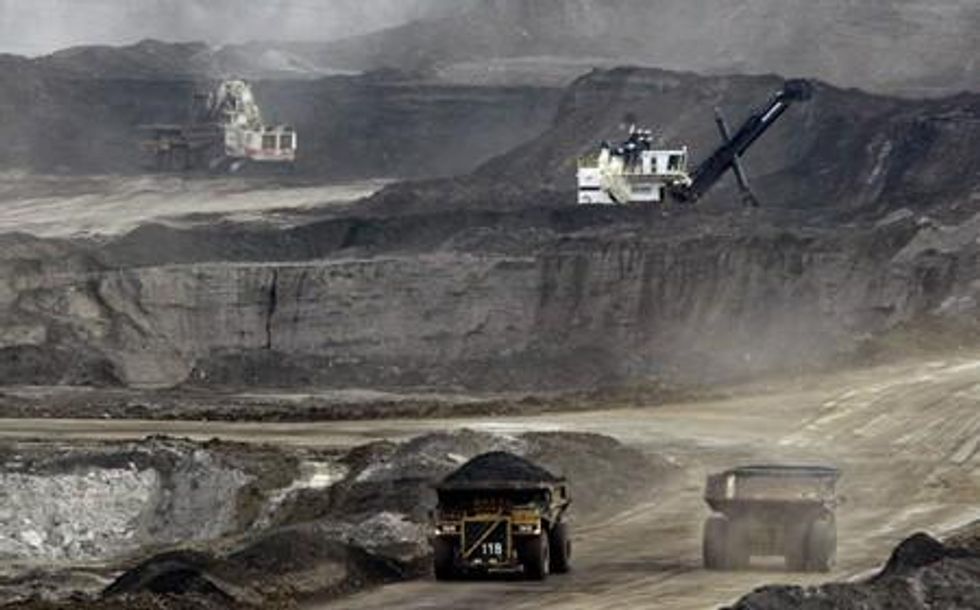
Many other experts share this view, assuring us that increased reliance on "clean" natural gas combined with expanded investments in wind and solar power will permit a smooth transition to a green energy future in which humanity will no longer be pouring carbon dioxide and other greenhouse gases into the atmosphere. All this sounds promising indeed. There is only one fly in the ointment: it is not, in fact, the path we are presently headed down. The energy industry is not investing in any significant way in renewables. Instead, it is pouring its historic profits into new fossil-fuel projects, mainly involving the exploitation of what are called "unconventional" oil and gas reserves.
"Humanity is not entering a period that will be dominated by renewables. Instead, it is pioneering the third great carbon era, the Age of Unconventional Oil and Gas."
The result is indisputable: humanity is not entering a period that will be dominated by renewables. Instead, it is pioneering the third great carbon era, the Age of Unconventional Oil and Gas.
That we are embarking on a new carbon era is increasingly evident and should unnerve us all. Hydro-fracking -- the use of high-pressure water columns to shatter underground shale formations and liberate the oil and natural gas supplies trapped within them -- is being undertaken in ever more regions of the United States and in a growing number of foreign countries. In the meantime, the exploitation of carbon-dirty heavy oil and tar sands formations is accelerating in Canada, Venezuela, and elsewhere.
It's true that ever more wind farms and solar arrays are being built, but here's the kicker: investment in unconventional fossil-fuel extraction and distribution is now expected to outpace spending on renewables by a ratio of at least three-to-one in the decades ahead.
According to the International Energy Agency (IEA), an inter-governmental research organization based in Paris, cumulative worldwide investment in new fossil-fuel extraction and processing will total an estimated $22.87 trillion between 2012 and 2035, while investment in renewables, hydropower, and nuclear energy will amount to only $7.32 trillion. In these years, investment in oil alone, at an estimated $10.32 trillion, is expected to exceed spending on wind, solar, geothermal, biofuels, hydro, nuclear, and every other form of renewable energy combined.
In addition, as the IEA explains, an ever-increasing share of that staggering investment in fossil fuels will be devoted to unconventional forms of oil and gas: Canadian tar sands, Venezuelan extra-heavy crude, shale oil and gas, Arctic and deep-offshore energy deposits, and other hydrocarbons derived from previously inaccessible reserves of energy. The explanation for this is simple enough. The world's supply of conventional oil and gas -- fuels derived from easily accessible reservoirs and requiring a minimum of processing -- is rapidly disappearing. With global demand for fossil fuels expected to rise by 26% between now and 2035, more and more of the world's energy supply will have to be provided by unconventional fuels.
In such a world, one thing is guaranteed: global carbon emissions will soar far beyond our current worst-case assumptions, meaning intense heat waves will become commonplace and our few remaining wilderness areas will be eviscerated. Planet Earth will be a far -- possibly unimaginably -- harsher and more blistering place. In that light, it's worth exploring in greater depth just how we ended up in such a predicament, one carbon age at a time.
The First Carbon Era
The first carbon era began in the late 1800s, with the introduction of coal-powered steam engines and their widespread application to all manner of industrial enterprises. Initially used to power textile mills and industrial plants, coal was also employed in transportation (steam-powered ships and railroads), mining, and the large-scale production of iron. Indeed, what we now call the Industrial Revolution was largely comprised of the widening application of coal and steam power to productive activities. Eventually, coal would also be used to generate electricity, a field in which it remains dominant today.
This was the era in which vast armies of hard-pressed workers built continent-spanning railroads and mammoth textile mills as factory towns proliferated and cities grew. It was the era, above all, of the expansion of the British Empire. For a time, Great Britain was the biggest producer and consumer of coal, the world's leading manufacturer, its top industrial innovator, and its dominant power -- and all of these attributes were inextricably connected. By mastering the technology of coal, a small island off the coast of Europe was able to accumulate vast wealth, develop the world's most advanced weaponry, and control the global sea-lanes.
The same coal technology that gave Britain such global advantages also brought great misery in its wake. As noted by energy analyst Paul Roberts in The End of Oil, the coal then being consumed in England was of the brown lignite variety, "chock full of sulfur and other impurities." When burned, "it produced an acrid, choking smoke that stung the eyes and lungs and blackened walls and clothes." By the end of the nineteenth century, the air in London and other coal-powered cities was so polluted that "trees died, marble facades dissolved, and respiratory ailments became epidemic."
For Great Britain and other early industrial powers, the substitution of oil and gas for coal was a godsend, allowing improved air quality, the restoration of cities, and a reduction in respiratory ailments. In many parts of the world, of course, the Age of Coal is not over. In China and India, among other places, coal remains the principal source of energy, condemning their cities and populations to a twenty-first-century version of nineteenth-century London and Manchester.
The Second Carbon Era
The Age of Oil got its start in 1859 when commercial production began in western Pennsylvania, but only truly took off after World War II, with the explosive growth of automobile ownership. Before 1940, oil played an important role in illumination and lubrication, among other applications, but remained subordinate to coal; after the war, oil became the world's principal source of energy. From 10 million barrels per day in 1950, global consumption soared to 77 million in 2000, a half-century bacchanalia of fossil fuel burning.
Driving the global ascendancy of petroleum was its close association with the internal combustion engine (ICE). Due to oil's superior portability and energy intensity (that is, the amount of energy it releases per unit of volume), it makes the ideal fuel for mobile, versatile ICEs. Just as coal rose to prominence by fueling steam engines, so oil came to prominence by fueling the world's growing fleets of cars, trucks, planes, trains, and ships. Today, petroleum supplies about 97% of all energy used in transportation worldwide.
Oil's prominence was also assured by its growing utilization in agriculture and warfare. In a relatively short period of time, oil-powered tractors and other agricultural machines replaced animals as the primary source of power on farms around the world. A similar transition occurred on the modern battlefield, with oil-powered tanks and planes replacing the cavalry as the main source of offensive power.
These were the years of mass automobile ownership, continent-spanning highways, endless suburbs, giant malls, cheap flights, mechanized agriculture, artificial fibers, and -- above all else -- the global expansion of American power. Because the United States possessed mammoth reserves of oil, was the first to master the technology of oil extraction and refining, and the most successful at utilizing petroleum in transportation, manufacturing, agriculture, and war, it emerged as the richest and most powerful country of the twenty-first century, a saga told with great relish by energy historian Daniel Yergin in The Prize. Thanks to the technology of oil, the U.S. was able to accumulate staggering levels of wealth, deploy armies and military bases to every continent, and control the global air and sea-lanes -- extending its power to every corner of the planet.
However, just as Britain experienced negative consequences from its excessive reliance on coal, so the United States -- and the rest of the world -- has suffered in various ways from its reliance on oil. To ensure the safety of its overseas sources of supply, Washington has established tortuous relationships with foreign oil suppliers and has fought several costly, debilitating wars in the Persian Gulf region, a sordid history I recount in Blood and Oil. Overreliance on motor vehicles for personal and commercial transportation has left the country ill-equipped to deal with periodic supply disruptions and price spikes. Most of all, the vast increase in oil consumption -- here and elsewhere -- has produced a corresponding increase in carbon dioxide emissions, accelerating planetary warming (a process begun during the first carbon era) and exposing the country to the ever more devastating effects of climate change.
The Age of Unconventional Oil and Gas
The explosive growth of automotive and aviation travel, the suburbanization of significant parts of the planet, the mechanization of agriculture and warfare, the global supremacy of the United States, and the onset of climate change: these were the hallmarks of the exploitation of conventional petroleum. At present, most of the world's oil is still obtained from a few hundred giant onshore fields in Iran, Iraq, Kuwait, Russia, Saudi Arabia, the United Arab Emirates, the United States, and Venezuela, among other countries; some additional oil is acquired from offshore fields in the North Sea, the Gulf of Guinea, and the Gulf of Mexico. This oil comes out of the ground in liquid form and requires relatively little processing before being refined into commercial fuels.
But such conventional oil is disappearing. According to the IEA, the major fields that currently provide the lion's share of global petroleum will lose two-thirds of their production over the next 25 years, with their net output plunging from 68 million barrels per day in 2009 to a mere 26 million barrels in 2035. The IEA assures us that new oil will be found to replace those lost supplies, but most of this will be of an unconventional nature. In the coming decades, unconventional oils will account for a growing share of the global petroleum inventory, eventually becoming our main source of supply.
The same is true for natural gas, the second most important source of world energy. The global supply of conventional gas, like conventional oil, is shrinking, and we are becoming increasingly dependent on unconventional sources of supply -- especially from the Arctic, the deep oceans, and shale rock via hydraulic fracturing.
In certain ways, unconventional hydrocarbons are akin to conventional fuels. Both are largely composed of hydrogen and carbon, and can be burned to produce heat and energy. But in time the differences between them will make an ever-greater difference to us. Unconventional fuels -- especially heavy oils and tar sands -- tend to possess a higher proportion of carbon to hydrogen than conventional oil, and so release more carbon dioxide when burned. Arctic and deep-offshore oil require more energy to extract, and so produce higher carbon emissions in their very production.
"Many new breeds of petroleum fuels are nothing like conventional oil," Deborah Gordon, a specialist on the topic at the Carnegie Endowment for International Peace, wrote in 2012. "Unconventional oils tend to be heavy, complex, carbon laden, and locked up deep in the earth, tightly trapped between or bound to sand, tar, and rock."
By far the most worrisome consequence of the distinctive nature of unconventional fuels is their extreme impact on the environment. Because they are often characterized by higher ratios of carbon to hydrogen, and generally require more energy to extract and be converted into usable materials, they produce more carbon dioxide emissions per unit of energy released. In addition, the process that produces shale gas, hailed as a "clean" fossil fuel, is believed by many scientists to cause widespread releases of methane, a particularly potent greenhouse gas.
All of this means that, as the consumption of fossil fuels grows, increasing, not decreasing, amounts of CO2 and methane will be released into the atmosphere and, instead of slowing, global warming will speed up.
And here's another problem associated with the third carbon age: the production of unconventional oil and gas turns out to require vast amounts of water -- for fracking operations, to extract tar sands and extra-heavy oil, and to facilitate the transport and refining of such fuels. This is producing a growing threat of water contamination, especially in areas of intense fracking and tar sands production, along with competition over access to water supplies among drillers, farmers, municipal water authorities, and others. As climate change intensifies, drought will become the norm in many areas and so this competition will only grow fiercer.
Along with these and other environmental impacts, the transition from conventional to unconventional fuels will have economic and geopolitical consequences hard to fully assess at this moment. As a start, the exploitation of unconventional oil and gas reserves from previously inaccessible regions involves the introduction of novel production technologies, including deep-sea and Arctic drilling, hydro-fracking, and tar-sands upgrading. One result has been a shakeup in the global energy industry, with the emergence of innovative companies possessing the skills and determination to exploit the new unconventional resources -- much as occurred during the early years of the petroleum era when new firms arose to exploit the world's oil reserves.
This has been especially evident in the development of shale oil and gas. In many cases, the breakthrough technologies in this field were devised and deployed by smaller, risk-taking firms like Cabot Oil and Gas, Devon Energy Corporation, Mitchell Energy and Development Corporation, and XTO Energy. These and similar companies pioneered the use of hydro-fracking to extract oil and gas from shale formations in Arkansas, North Dakota, Pennsylvania, and Texas, and later sparked a stampede by larger energy firms to obtain stakes of their own in these areas. To augment those stakes, the giant firms are gobbling up many of the smaller and mid-sized ones. Among the most conspicuous takeovers was ExxonMobil's 2009 purchase of XTO for $41 billion.
That deal highlights an especially worrisome feature of this new era: the deployment of massive funds by giant energy firms and their financial backers to acquire stakes in the production of unconventional forms of oil and gas -- in amounts far exceeding comparable investments in either conventional hydrocarbons or renewable energy. It's clear that, for these companies, unconventional energy is the next big thing and, as among the most profitable firms in history, they are prepared to spend astronomical sums to ensure that they continue to be so. If this means investment in renewable energy is shortchanged, so be it. "Without a concerted policymaking effort" to favor the development of renewables, Carnegie's Gordon warns, future investments in the energy field "will likely continue to flow disproportionately toward unconventional oil."
In other words, there will be an increasingly entrenched institutional bias among energy firms, banks, lending agencies, and governments toward next-generation fossil-fuel production, only increasing the difficulty of establishing national and international curbs on carbon emissions. This is evident, for example, in the Obama administration's undiminished support for deep-offshore drilling and shale gas development, despite its purported commitment to reduce carbon emissions. It is likewise evident in the growing international interest in the development of shale and heavy-oil reserves, even as fresh investment in green energy is being cut back.
As in the environmental and economic fields, the transition from conventional to unconventional oil and gas will have a substantial, if still largely undefined, impact on political and military affairs.
U.S. and Canadian companies are playing a decisive role in the development of many of the vital new unconventional fossil-fuel technologies; in addition, some of the world's largest unconventional oil and gas reserves are located in North America. The effect of this is to bolster U.S. global power at the expense of rival energy producers like Russia and Venezuela, which face rising competition from North American companies, and energy-importing states like China and India, which lack the resources and technology to produce unconventional fuels.
At the same time, Washington appears more inclined to counter the rise of China by seeking to dominate the global sea lanes and bolster its military ties with regional allies like Australia, India, Japan, the Philippines, and South Korea. Many factors are contributing to this strategic shift, but from their statements it is clear enough that top American officials see it as stemming in significant part from America's growing self-sufficiency in energy production and its early mastery of the latest production technologies.
"America's new energy posture allows us to engage [the world] from a position of greater strength," National Security Advisor Tom Donilon asserted in an April speech at Columbia University. "Increasing U.S. energy supplies act as a cushion that helps reduce our vulnerability to global supply disruptions [and] affords us a stronger hand in pursuing and implementing our international security goals."
For the time being, the U.S. leaders can afford to boast of their "stronger hand" in world affairs, as no other country possesses the capabilities to exploit unconventional resources on such a large scale. By seeking to extract geopolitical benefits from a growing world reliance on such fuels, however, Washington inevitably invites countermoves of various sorts. Rival powers, fearful and resentful of its geopolitical assertiveness, will bolster their capacity to resist American power -- a trend already evident in China's accelerating naval and missile buildup.
At the same time, other states will seek to develop their own capacity to exploit unconventional resources in what might be considered a fossil-fuels version of an arms race. This will require considerable effort, but such resources are widely distributed across the planet and in time other major producers of unconventional fuels are bound to emerge, challenging America's advantage in this realm (even as they increase the staying power and global destructiveness of the third age of carbon). Sooner or later, much of international relations will revolve around these issues.
Surviving the Third Carbon Era
Barring unforeseen shifts in global policies and behavior, the world will become increasingly dependent on the exploitation of unconventional energy. This, in turn, means an increase in the buildup of greenhouse gases with little possibility of averting the onset of catastrophic climate effects. Yes, we will also witness progress in the development and installation of renewable forms of energy, but these will play a subordinate role to the development of unconventional oil and gas.
Life in the third carbon era will not be without its benefits. Those who rely on fossil fuels for transportation, heating, and the like can perhaps take comfort from the fact that oil and natural gas will not run out soon, as was predicted by many energy analysts in the early years of this century. Banks, the energy corporations, and other economic interests will undoubtedly amass staggering profits from the explosive expansion of the unconventional oil business and global increases in the consumption of these fuels. But most of us won't be rewarded. Quite the opposite. Instead, we'll experience the discomfort and suffering accompanying the heating of the planet, the scarcity of contested water supplies in many regions, and the evisceration of the natural landscape.
What can be done to cut short the third carbon era and avert the worst of these outcomes? Calling for greater investment in green energy is essential but insufficient at a moment when the powers that be are emphasizing the development of unconventional fuels. Campaigning for curbs on carbon emissions is necessary, but will undoubtedly prove problematic, given an increasingly deeply embedded institutional bias toward unconventional energy.
Needed, in addition to such efforts, is a drive to expose the distinctiveness and the dangers of unconventional energy and to demonize those who choose to invest in these fuels rather than their green alternatives. Some efforts of this sort are already underway, including student-initiated campaigns to persuade or compel college and university trustees to divest from any investments in fossil-fuel companies. These, however, still fall short of a systemic drive to identify and resist those responsible for our growing reliance on unconventional fuels.
For all President Obama's talk of a green technology revolution, we remain deeply entrenched in a world dominated by fossil fuels, with the only true revolution now underway involving the shift from one class of such fuels to another. Without a doubt, this is a formula for global catastrophe. To survive this era, humanity must become much smarter about this new kind of energy and then take the steps necessary to compress the third carbon era and hasten in the Age of Renewables before we burn ourselves off this planet.

The "center" has provided a useful reminder that bipartisanship has all too often meant a coming together of Democrats and Republicans in the service of the same corporate elites.
But only three U.S.-based fashion companies and retailers--Abercrombie & Fitch, PVH (which includes the Calvin Klein, Tommy Hilfiger, and Izod labels), and Sean John (Sean Combs's company)--have become party to the compact, despite the repeated urgings of anti-sweatshop and workers' rights organizations. Wal-Mart, Gap, Target, Sears, JCPenney, and other iconic U.S retailers have resisted. Under mounting pressure, however, last Thursday those companies and others, along with the National Retail Federation, the Retail Industries Leaders Association, and the American Apparel and Footwear Council, announced that they had joined together to "develop and implement a new program to improve fire and safety regulations in the garment factories of Bangladesh." The announcement of the group's formation made no reference to any pledge by the companies to fund the factory improvements.
More curious yet was the source of Thursday's announcement. It was released by the Bipartisan Policy Center, a D.C. think tank of sorts founded by four long-retired U.S. Senate majority leaders--Democrats George Mitchell and Tom Daschle, and Republicans Howard Baker and Bob Dole. According to the announcement, the retailer organizations had asked the center to convene a series of meetings to develop a joint policy for the industry, with the meetings to be chaired by Mitchell and another former Maine senator, Republican Olympia Snowe.
Describing itself as "the only Washington, D.C.-based think tank that actively promotes bipartisanship," the center proclaims in its mission statement that it promotes "principled solutions through rigorous analysis, reasoned negotiation and respectful dialogue." Those solutions, it continues, "are the product of informed deliberations by former elected and appointed officials, business and labor leaders, and academics and advocates who represent both ends of the political spectrum."
So what on earth is the center doing convening a process that will determine the commitments, if any, that U.S. retailers and clothing lines will make with no one but U.S. retailers and clothing lines at the table? "Respectful dialogue" is all well and good, all the more among "advocates who represent both ends of the political spectrum," but in this case, that spectrum runs from Wal-Mart to Target, with a stop at JCPenney. Where are the labor leaders whom the center viewed as sufficiently important to mention in its mission statement? Where are the anti-sweatshop activists?
It's not as if labor leaders and workers' rights activists have been absent from the public debate over the Bangladeshi garment industry. They've repeatedly and publicly demanded that U.S. companies that get their goods from Bangladesh commit their resources to upgrading the factories and safety procedures there, as their European counterparts have. From AFL-CIO President Richard Trumka on down, there's no shortage of labor leaders or U.S.-based advocates for Bangladeshi workers whom the center could have invited to its meetings if it wanted a genuine dialogue.
By opting instead to hold a discussion among only like-minded companies with a common interest in quelling the controversy at the lowest possible cost to themselves, the center has provided a useful reminder that bipartisanship has all too often meant a coming together of Democrats and Republicans in the service of the same corporate elites. At a time when congressional Republicans have no mission save to be against anything and anyone that President Barack Obama and congressional Democrats are for, it's only natural to grow nostalgic for the days when Tip O'Neill and Bob Michael could cut a deal. But in today's Washington, where corporate money flows everywhere, including into think tanks, and where labor is increasingly marginalized, bipartisanship can easily become a code word for whatever presumably responsible American corporations desire--such as the free-trade agreements that both parties have ratified. If it didn't before, the process that the Bipartisan Policy Center has now convened--of the retailers, by the retailers, for the retailers--makes clear just how pro-corporate bipartisanship has become.
The new Secretary of State John Kerry taking four trips to the Israeli/Palestinian region in the past two months means yet another U.S. effort for a negotiated peace process between the Palestinians (under ruthless occupation) and the very dominant Israelis.
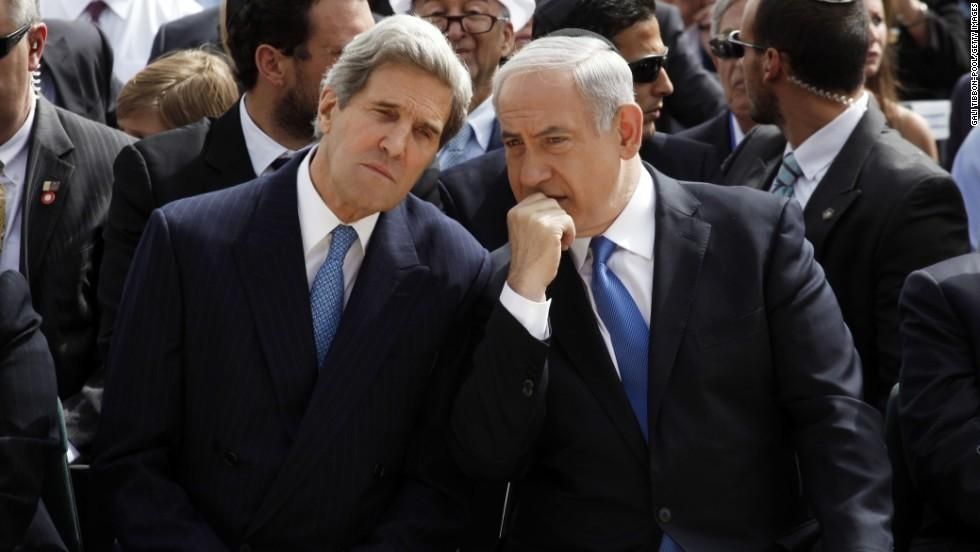
As senator with a "grade A" from the powerful pro-Israeli government lobby AIPAC, Secretary Kerry has forged a coalition of Israeli and Palestinian businessmen behind a $4 billion economic assistance plan for the West Bank and Gaza. He is also tapping into the significant Israeli public opinion behind a two-state solution.
Israeli Prime Minister Benjamin Netanyahu is outwardly going through the motions of supporting peace negotiations but demands preconditions and no cessation of expanding Israeli colonies in Palestine. Netanyahu knows how to play the U.S. government like a harp. He talks about negotiations for peace, but remains intransigent.
Back in 1996, he told an applauding joint session of Congress that Israel's mature economy would no longer need U.S. foreign aid. Today, Israel is a prosperous, bigger economy but is still receiving U.S. foreign aid.
The problem is that almost nobody in Israel - hawks, peace advocates, or those in the middle - believes anything will come out of Kerry's shuttle diplomacy.
Kerry's trump card is recognizing the long neglected specific peace offer by the 22-member Arab league in 2002. These Arab countries have renewed and updated their proposal to make it easier for Israel to accept. It includes a comprehensive peace treaty with all Arab nations and Israeli recognition of a Palestinian state within the 1967 borders, with minor land swaps. Netanyahu has given this offer the back of his hand despite its highly-publicized reiteration in the ensuing years. But this year, Israeli President (an honorific post) Shimon Peres highlighted the verbal Israeli government endorsement of a two-state solution and urged that "a broad structure of support be created for making progress."
The problem is that almost nobody in Israel - hawks, peace advocates, or those in the middle - believes anything will come out of Kerry's shuttle diplomacy.
Here are some reasons why. There is no pressure on Netanyahu's governing coalition to wage peace. As Ethan Bronner, long-time The New York Times reporter in Israel, wrote this past Sunday: "Israel has never been richer, safer, more culturally productive or dynamic." He might have added that, with huge natural gas finds offshore, Israel is about to be both self-sufficient in fossil fuels and a net exporter.
Nor is there any pressure that Netanyahu recognizes from the Palestinian/Arab side. Palestinians are continually subjugated, impoverished, divided internally and on the losing end of the casualty toll by a ratio exceeding 400 to 1. Israel can strike targets in Palestine at will.
Arab nations are internally preoccupied with civil wars, sectarian conflicts and, except for the Gulf countries, weak economies. Israel, with the most modern military, heavily furnished by the United States, and scores of ready nuclear bombs, stands astride the Middle East as a giant colossus.
The main reality in Israeli domestic politics is that, if it weren't for external threats, however exaggerated, the Israeli government and society would have to face very deep divisions inside Israel between secular and ultraorthodox populations. From expanding the colonies in Palestine to strict religious rituals and social mores, exemptions from military service, the place of women, and the treatment of the Israeli Arabs, there are two Israels that are ready to erupt were peace to break out with Palestine and Arab neighbors. (See a letter here.)
Faced with this harrowing prospect of domestic civil strife, Netanyahu's government feels no urgency for peace, according to Bronner. The regional status quo is under control of its iron fist.
Many out-of-power Israeli politicians, such as former Prime Minister Ehud Olmert, and former Deputy Prime Minister Dan Meridor, have all argued for vigorously pursuing a two-state solution to head off Israel becoming a state that, in a few decades, contains more Palestinians than Israelis. The militarists, however, are the ones running the government.
Moreover, Kerry cannot expect any pressure from Washington on the Israeli government, because Washington, especially Congress, always goes along with the Israeli government, to such a degree that it astonishes opposition parties in the Israeli Knesset.
Washington, especially Congress, always goes along with the Israeli government, to such a degree that it astonishes opposition parties in the Israeli Knesset.
Make no mistake about Netanyahu. He is and has long been a vintage extreme hardliner against any Palestinian sovereignty. In 1989, after the Tiananmen Square massacre in China, Netanyahu, then Israeli Deputy Foreign Minister, told students at Bar Ilan University that: "Israel should have exploited the repression of the demonstrations in China, when world attention focused on that country, to carry out mass expulsions among the Arabs of the territories."
Eviction and the expropriation of what is left of the original Palestine has long been the dogma of Israeli militarists and leaders of the expansionist Likud Party, including Ariel Sharon.
The award-winning Israeli documentary "The Gatekeepers" presents six retired leaders of the Shin Bit - the Israeli FBI - speaking with remarkable candor about how rational actions, including those toward peace, were continually overruled by politicians who exploited the Israeli-Arab conflict for their own domestic advantage.
So, what is our Secretary of State to do? Kerry should propose that these men and other prominent retired outspoken leaders from the military, security, and elected political leaders, together with well-known writers and scholars testify at length before the U.S. House and Senate. AIPAC cannot stop them from testifying. Congress and the American people will be given an opportunity to hear these experienced, persuasive voices for a peace settlement.
After all, peace in the Middle East is more in the U.S. national interest and security than ever before. Americans are paying too hefty a human and financial price to allow a muzzled Congress to stay on bended knee, supporting whatever the Israeli government wants.
Such a breakthrough on Capitol Hill will also enhance the Israeli peace and human rights movement which reflects the moral dimension for ending the occupation/colonization of Palestine.
In a recent pamphlet by Americans for Peace Now and its counterpart in Israel, Rabbi Michael Melchior, a former Israel deputy foreign minister and member of the Knesset, declared that "to occupy and control the lives of millions of Palestinians living in Judea and Samaria, and to negate their right to create their own state and future in peace, side by side with the State of Israel is not just, is not moral, and is not Judaism." (See info here.)
In May 2004 Senator Kerry told me "I have many friends in the Israeli peace movement." It is time for him to begin the mission for peace in his old haunt the U.S. Congress, without which he will share the decades-long failure of those who came before him in both Republican and Democratic Administrations.
The United States and the Central Intelligence Agency have never acknowledged the potential for "blowback," or negative fallout, from their military and covert actions. The Watergate burglary by the veterans of the Bay of Pigs was an obvious example of blowback. CIA's support for the anti-Soviet mujahideen in the 1980s proved particularly damaging, because the mujahideen

Former CIA director Robert Gates may believe that support to the mujahideen was the CIA's "greatest success," but don't tell that to U.S. soldiers and Marines in Afghanistan who have had to deal with former mujahideen forces, such as the Haqqani and Hekmatyar networks, for the past decade. The United States inadvertently created, trained, and sustained an infrastructure of terror that exported terror wrapped in the language of religious war.
Now we are dealing with an updated version of "blowback," a series of terrorist attacks in the United States where perpetrators claim their inspiration is the U.S. "war on Islam." They cite the use of U.S. military power and CIA operations in Muslim countries. The surviving Boston Marathon bomber, who contends that he acted to counter U.S. policies in Iraq and Afghanistan, is the latest example.
But he is one of many. Osama bin Laden claimed that he targeted the United States because of the "occupation" of Saudi Arabia and its holy places by the U.S. military. Faisal Shahzad, a Pakistani immigrant who went to college in Connecticut, said he left a S.U.V. packed with explosives in Times Square because of U.S. drone strikes in Pakistan. Major Nidal Malik Hasan killed 13 people at Fort Hood, Texas in 2009 because of U.S. military strikes in the Middle East and the Persian Gulf. Najibullah Zazi, an Afghan-American, planned a suicide attack on New York City's subway system because of the U.S. role in Afghanistan.
The attack on the Benghazi consulate last year focused on the U.S. intelligence platform in eastern Libya. The groups claiming responsibility for the Benghazi attack had been targeted by U.S. intelligence throughout Southwest Asia and North Africa. Any U.S. intelligence component is a likely target of the wrath of militant and terrorist organizations because of the CIA's key role in the war on terror and the increasingly widespread use of drone aircraft.
The United States has been single-minded and narrow-minded in dealing with terrorism, believing that a unilateral use of military power would provide the best protection for its interests. We have used unwieldy military instruments, such as armed drones, to counter the threat. There is increased evidence that the militarization of U.S. foreign policy and the increased operational tempo of the U.S. military itself is creating many more terrorists and insurgents than it is destroying. Secretary of Defense Donald Rumsfeld acknowledged this fact ten years ago, and more recently the former commander of U.S. forces in Afghanistan, General Stanley McChrystal, did the same. A Yemeni activist told a subcommittee of the Senate Judiciary Committee on April 23, 2013, that a single drone strike creates a greater hatred of the United States than the actions of Yemeni insurgents.
Just as a bipartisan panel in the 1950s, the Doolittle Committee, declared that there were "no rules" in the global competition with the Soviet Union and that "hitherto acceptable norms of human conduct do not apply," which led to the misuse of the CIA and a series of misbegotten covert actions from the 1950s to the early 1970s, the War on Terror became the justification for another surge in illegal CIA activities, including the use of torture and abuse, secret prisons, and extraordinary renditions. These tactics raise important moral and humanitarian questions and compromise the strategic quest for international stability.
The "creativity" of the United States in using the CIA as a military weapon has not been matched by the use of diplomacy in the international arena. At the outset of his first term, President Barack Obama sent strong signals regarding the need for diplomacy and conciliation as opposed to President Bush's emphasis on military force and covert action. President Obama even named three so-called tsars for diplomatic dealings with the Middle East (George Mitchell), Iran (Dennis Roth), and Afghanistan-Pakistan (Richard Holbrooke). It was soon obvious that the tsars were isolated and ignored within Hillary Clinton's Department of State and General James Jones' National Security Council. The example of Holbrook was particularly revealing because, unlike his colleagues, Holbrook had actual ideas about using a prisoner exchange to get the Taliban to talks similar to the Dayton talks for Bosnia or Rambouillet for Kosovo in the 1990s. But the Pentagon-backed by congressional conservatives-opposed any prisoner release that would possibly lead to putting Taliban fighters back on the battlefield. The Pentagon is even dragging its heels in implementing further withdrawal of forces from Afghanistan.
The end of the Cold War dramatically widened the area of diplomacy and conciliation in U.S. foreign policy, but three presidents over a twenty-year period chose to ignore the opportunity. President Bill Clinton ignored signs of conciliation from Iran, and instead of "anchoring" Russia to the Western security architecture, he enlarged the North Atlantic Treaty Organization. President George W. Bush abrogated the Anti-Ballistic Missile Treaty, the core of strategic deterrence, in order to deploy a national missile defense that does not work, and then manipulated specious intelligence to lead the country into an unnecessary and immoral war against Iraq.
President Obama ignored a credible signal from North Korea for the start of a diplomatic dialogue, and has relied on sanctions and coercion in dealing with Iran's nuclear program. His administration has ignored fundamental questions of law and morality in the war on terror. At home, the Obama administration has endorsed a National Defense Authorization Act that permits indefinite detention of U.S. citizens; prosecutes whistleblowers; refuses to close Guantanamo; and allowed solitary confinement for Bradley Manning.
After the Pentagon was attacked on 9/11, Secretary of Defense Donald Rumsfeld told his closest advisors to "go massive-sweep it all up, things related and not." Going massive has meant the use of an even blunter military instrument to stabilize a lawless tribal region in Southwest Asia that has been causing trouble for the past 150 years. Pakistan has used U.S. money and support to fund the regrouping of the Afghan Taliban, thus assuring defeat in any counter-insurgency. The U.S. policy of extraordinary renditions created a virtual global network for torture and abuse that involved dozens of countries in Europe, Asia, the Middle East, and Africa.
Military tools will not solve the myriad problems that include India vs. Pakistan; Afghanistan vs. Pakistan; Iran vs. Afghanistan; and the powder kegs that exist in Central Asia. The long-term commitment of military forces and money has further destabilized the region, and contributed to the violence aimed at U.S. forces and even the United States itself. We cannot occupy the entire world. The sooner we close certain doors and turn the keys over to key regional actors, the better off we will be.
WASHINGTON - Dennis Ross, President Barack Obama's top Middle East aide who has attracted criticism for his allegedly strong pro-Israel sympathies, will leave his post at the end of this month, the White House announced here Thursday.
He will rejoin the Washington Institute for Near East Policy (WINEP), an Israel-centered think tank that was spun off in 1985 from the powerful lobby group, the American Israel Public Affairs Committee (AIPAC). Ross served as WINEP's counselor and a fellow during the George W. Bush administration from 2001 to 2009.
"An institution that believes sound policy lies at the intersection of scholarship with statesmanship is especially proud that Dennis is returning to his intellectual home," said WINEP's executive director Dr. Robert Satloff.
Despite the generally hawkish views of WINEP's fellows and their frequent criticism of Obama's approach to the Middle East, Ross said in a statement that his departure from the White House was due to family reasons. It offered no hint of major policy differences between him and Obama or his colleagues on the National Security Council.
"Obviously, there is still work to do but I promised my wife I would return to government for only two years and we both agreed it is time to act on my promise," added Ross.
"I am grateful to President Obama for having given me the opportunity once again to work on a wide array of Middle Eastern issues and challenges and to support his efforts to promote peace in the region," he said.
But coming as it does as Republicans in the 2012 presidential primary race and in Congress have been hammering away at what they have characterized as Obama's "hostility" toward Israel and its prime minister, Binyamin Netanyahu, Ross's departure could give them more ammunition.
Because of Ross's unusually close ties to leaders in the Jewish community and the Israel lobby, his presence in the White House has acted as a shield against those attacks.
"...(W)ith the diplomacy frozen, Ross's departure is not a diplomatic problem for the White House; it is instead a problem for the Obama re-election campaign," wrote Elliott Abrams, Ross's counterpart in the George W. Bush White House, who, as a neo-conservative Republican, has been relentlessly critical of Obama's Mideast policies.
"For Ross was the only official in whom most American Jewish leaders had confidence. As most of them are Democrats who have long accepted Ross's faith in the 'peace process,' they viewed his role as the assurance that a steady, experienced, pro-Israel hand was on or near the tiller," Abrams, now with the Council on Foreign Relations, wrote on his cfr.org blog early Friday morning.
A former Soviet specialist who served in top Middle East positions under former presidents George H.W. Bush and Bill Clinton, Ross was initially brought into the Obama administration as the State Department's special advisor for the Gulf and Southwest Asia, a post he held from February to June 2009.
He then moved over to the White House where he has served as special assistant to the president and senior director for the "Central Region" at the National Security Council, making him the civilian counterpart of the chief of the Pentagon's Central Command (CentCom), covering a region stretching from Egypt to Afghanistan.
While adept at keeping a low profile, Ross has focused in particular on U.S. policy toward Iran, about which he has long-held hawkish views, and on Israel-Arab relations, especially the U.S.-led Israel- Palestinian "peace process" which appears to have reached a dead end under his supervision.
Indeed, Palestinian leaders, who have often referred to Ross as "Israel's lawyer", have refused to meet with him formally since shortly after the resignation of Obama's first special envoy for the Middle East, Sen. George Mitchell, last May.
Indeed, one senior U.S. diplomat, Amb. Daniel Kurtzer, who took part in the Clinton-era negotiations, cited a number of anonymous officials who were critical of Ross's mediation in the 1990s in his book co-authored with Scott Lasensky, entitled "Negotiating Arab- Israeli Peace".
"The perception was always that Dennis started from the Israeli bottom line, that he listened to what Israel wanted and then tried to sell it to the Arabs," one Arab negotiator told them. "...He was never looked at ...as a trusted world figure or as an honest broker."
Similarly, Abraham Foxman, the long-time head of the strongly pro- Israel Anti-Defamation League, once referred to Ross as "the closest thing you'll find to a melitz yosher, as far as Israel is concerned". Melitz yosher is the ancient Hebrew word for "advocate".
Mitchell, who was replaced by a career State Department official, David Hale, reportedly left out of frustration over Obama's failure to take a harder line toward Netanyahu's rejection of U.S. appeals to resume a partial moratorium on Israeli settlement activity and take other measures that would bolster Palestinian Authority (PA) President Mahmoud Abbas and induce him to return to direct negotiations. Mitchell considered Ross his main antagonist in internal policy debates, according to a number of sources.
Ross also strongly and successfully opposed suggestions by Mitchell and others that the U.S. put forward its own proposals on a final settlement of the conflict.
While Ross has long been critical of Israeli settlement expansion, he reportedly argued, as he did under Clinton, that exerting serious pressure on Israeli leaders would prove counterproductive.
According to various reports, he was privately critical of Obama's demand in 2009 that Israel halt all settlement activity in the Occupied Territories and East Jerusalem as a precondition for re- launching negotiations with the Palestinians.
Despite those differences, Ross's early endorsement of Obama as president - as well as his role during the 2008 campaign as a liaison to AIPAC and other Israel Lobby groups - earned him entree into the incoming administration's top foreign policy ranks.
Ross stance on Iran was also considerably more hawkish than Obama's public position of "engagement" with the Islamic Republic, at least during the campaign and at the outset of the administration.
In the run-up to the 2008 elections, Ross participated in two task forces on Iran policy, including one by the Bipartisan Policy Center, which called for military strikes against Tehran if it did not agree to abandon its uranium enrichment program. Other task force members included prominent neo-conservatives who championed the 2003 invasion of Iraq.
Ross was also a founding member in 2008 of United Against Iran (UANI), another hawkish group that has mounted an aggressive public campaign to highlight the alleged threat posed by Iran to Israel and the U.S.
And, in a book co-written by WINEP fellow David Makovsky and published just after the 2008 election, Ross called for using diplomatic engagement primarily as a means to rally international support behind "tougher policies - either militarily or meaningful containment" - an approach that has been largely adopted by the administration.
Indeed, the fact that Ross has largely prevailed in setting the basic policy parameters on both the "peace process" and on Iran, at least for through next year's election, makes it unlikely that Obama will make any major policy changes in the interim.
"The administration does not need Dennis Ross anymore," said M.J. Rosenberg, a Mideast expert at Media Matters, who used to work for AIPAC and the more dovish Israel Policy Forum. "It's on automatic pilot, enhanced by direct demands from AIPAC and Netanyahu that will invariably get a positive response. Ross was a middle man and a middle man is no longer necessary."
"Dennis Ross is returning to the outpost of the Israel Lobby whence he came, leaving a diplomatic shambles behind him," according to Amb. Chas Freeman (ret.), former head of the Middle East Policy Council here.
"None of the issues in his charge prospered during his tenure, which saw the collapse of any pretense of a peace process between Israel and the Arabs, a deepening of the Iranian conviction that a nuclear deterrent is necessary to deter Israeli or American attack, and the collapse of American prestige and influence among the Arabs and in the Islamic world more generally," he wrote in an email exchange with IPS.
It's been like dueling banjos in Washington this week. President Obama and Israeli Prime Minister Benjamin Netanyahu each got to say the same thing at length and at least twice. Last Thursday, the president gave his "Arab Spring" speech in which -- after a reportedly "furious phone call" between Netanyahu and Secr
It's been like dueling banjos in Washington this week. President Obama and Israeli Prime Minister Benjamin Netanyahu each got to say the same thing at length and at least twice. Last Thursday, the president gave his " Arab Spring" speech in which -- after a reportedly "furious phone call" between Netanyahu and Secretary of State Hillary Clinton -- he included the following line: "We believe the borders of Israel and Palestine should be based on the 1967 lines with mutually agreed swaps, so that secure and recognized borders are established for both states."
And a storm of commentary burst forth. Though this, it was said, had long been a privately agreed upon American presidential position, it had never before been stated publicly by a president (or perhaps any other top U.S. official). Netanyahu was reportedly incensed and on Friday could be found "hectoring" a polite but uncomfortable-looking Obama before the cameras in the Oval Office on the "indefensibility" of those 1967 borders. On Sunday, Obama nonetheless went before the wildly pro-Israeli lobbying group AIPAC and gave a speech restating his position on the 1967 borders, but qualifying it as well.
On Monday, to rapturous ovations, Netanyahu appeared before the same crew to restate his position on the indefensibility of those borders and on Tuesday before Congress -- in an invitation initiated by the House Republican leadership and clearly meant to embarrass the president -- he did it again to more standing ovations (29 of them).
It was a clash of titans over a difference so basic that... in November, the two governments were theoretically in accord on the very same point. Chris Nelson of the insider Washington newsletter The Nelson Report has just uncovered a "joint statement" agreed to and issued after a Netanyahu meeting with Secretary of State Clinton last November which said in part: "The Prime Minister and the Secretary agreed on the importance of continuing direct negotiations to achieve our goals. The Secretary reiterated that 'the United States believes that through good faith negotiations, the parties can mutually agree on an outcome which ends the conflict and reconciles the Palestinian goal of an independent and viable state, based on the 1967 lines, with agreed swaps, and the Israeli goal of a Jewish state with secure and recognized borders that reflect subsequent developments and meet Israeli security requirements.'"
No screaming. No complaints. No hectoring. Nothing. An old Miller Lite ad comes to mind: "Tastes Great. Less Filling." Or perhaps the immortal lyrics given to Eliza Doolittle in the musical My Fair Lady: "Words, words, words! I'm so sick of words!... Is that all you blighters can do?"
All that sound and fury signifying, well, maybe nothing at all. As TomDispatch regular Ira Chernus points out in his post "Israel and the Palestinians Through the Looking Glass," it's not just what the president says, but what he does that counts. And when it comes to doing, with George Mitchell, Obama's special Middle Eastern envoy (appointed on his second day in office) abruptly quitting -- whether in frustration, despair, or disgust we don't know -- there's no evidence that the president will do anything at all when it comes to those 1967 borders, not before the 2012 election anyway.
Let's give David Bromwich, writing on the President's Thursday speech for the New York Review of Books, the last word for now: "Obama has always preferred the symbolic authority of the grand utterance to the actual authority of a directed policy -- a policy fought for in particulars, carefully sustained, and traceable to his own intentions."
This week's hysterical, reality-deprived reaction to President Obama's pronouncements on the Israel/Palestine conflict genuinely provoked laughter on several occasions. That happened when I thought of the intense controversy triggered by publication of Stephen Walt and John Mearsheimer's The Israel Lobby, which examined the "loose coalition of individuals and organizations who actively work to steer U.S.
This week's hysterical, reality-deprived reaction to President Obama's pronouncements on the Israel/Palestine conflict genuinely provoked laughter on several occasions. That happened when I thought of the intense controversy triggered by publication of Stephen Walt and John Mearsheimer's The Israel Lobby, which examined the "loose coalition of individuals and organizations who actively work to steer U.S. foreign policy in a pro-Israel direction," a coalition driven by "a core consisting of organizations whose declared purpose is to encourage the U.S. government and the American public to provide material aid to Israel and to support its government's policies, as well as influential individuals for whom these goals are also a top priority." This week's events underscore how remarkable it is that that book's argument was demonized as some sort of radical, hateful conspiracy tract rather than treated as what it was: a statement of the bleeding obvious (albeit a brave one, given that discussions of that reality had previously been taboo).

Obama's call for a peace deal ultimately "based on the 1967 lines with mutually agreed swaps" is not even arguably a change from past American policy. Though he's the first President to publicly call for such an outcome, that's been the working premise of American policy for decades. It's controversial in one sense -- it unduly rewards Israel for its illegal seizures of land by suggesting they should be able to permanently keep West Bank settlements (the "land swap" aspect of the formula) -- but it does not remotely constitute a step in an anti-Israel direction. When even Israel-devoted stalwarts such as former IDF Corporal Jeffrey Goldberg and the ADL's Abe Foxman are dismissive of the condemnation of Obama's statements, it's crystal clear that they pose no challenge to the dominant pro-Israel orthodoxy that has shaped American policy (and political discourse) for decades.
At most, Obama's public endorsement of this position was a symbolic gesture to chide Netanyahu for his overt indifference to U.S. interests (and, more so, belligerence toward Obama), and a small rhetorical fig leaf to the populist forces driving the Arab rebellion. Yet even the most microscopic deviation from the dictates of the Israel Government produce shrill and ludicrous backlash from The inside-the-U.S. Israel Lobby.
The Right Wing Noise Machine all but accused Obama of trying to destroy Israel, with the GOP's leading presidential candidates condemning the President for the crime of "disrespecting" and "throwing Israel under the bus," Glenn Beck denouncing him for "betraying Israel," and Matt Drudge exploiting ignorance to screech in headlines that "Obama Sides With Palestinians." Meanwhile, a former AIPAC spokesman demanded that Obama take a renewed public pledge of devotion to Israel, and circulated to the media statements of condemnation from numerous "pro-Israel" Democrats in Congress. The neoconservative Israel-devotees at The Washington Post editorialized against Obama and predictably blamed him for the resulting tension with Netanyahu, siding (as usual) with this foreign government over their own. And a Reuters article this morning claims that "some prominent Jewish Americans are rethinking their support for President Barack Obama's 2012 re-election bid" due to that speech:
The backlash after Obama's keynote speech on the Middle East has Democratic Party operatives scrambling to mollify the Jewish community as the president prepares to seek a second term in the White House. . . .
"I have spoken to a lot of people in the last couple of days -- former supporters -- who are very upset and feel alienated," billionaire real estate developer and publisher Mortimer Zuckerman said.
"He'll get less political support, fewer activists for his campaign, and I am sure that will extend to financial support as well."
But remember: it's so very heinous and hateful to suggest -- as Walt and Mearsheimer shamefully did -- that some Americans are driven by devotion to Israel as their primary political preoccupation and that, banded together, they exert substantial influence. Perish the thought.
* * * * *
This is one area where I think President Obama deserves support and some modest credit. From the start of his administration -- from appointing George Mitchell as his envoy to demanding a settlement freeze in the West Bank -- the White House has appeared to recognize that tongue-wagging subservience to the Israeli Government is a counter-productive policy. Of course, the movement away from such blind support has been extremely slow and cautious -- Obama was silent in the wake of the attack on Gaza, supportive after the flotilla assault, and recently vetoed a thoroughly uncontroversial U.N. Resolution calling for a settlement freeze -- but there have been signs of a genuine desire to push the Israelis in a direction they plainly do not want to go.
I don't believe Obama is guided in these efforts by any principled concern or moral empathy for the plight of Palestinians or the injustice of the 45-year-old occupation; it seems clear that he isn't ever driven by considerations of that sort. But what he is, at least compared to the prior President, is a competent technocrat, a more calculating imperial manager, able to rationally assess costs and benefits with a ruthless analytical stoicism. And Obama has been surrounded by top advisers -- such as Gen. James Jones and David Petraeus -- who clearly recognize, and have publicly said, that the festering Israeli/Palestinian conflict, and the (obviously accurate) perception in the Muslim world that the U.S. enables Israel, is harmful in numerous ways to U.S. interests in the region. Especially with largely anti-Israel Arab public opinion starting to supplant easily manipulated, U.S.-serving Arab tyrants, it is vital -- for what the U.S. government perceives to be its interests in the region -- that Israel reach a peace agreement, and that in turn requires that the U.S. use its leverage to pressure Israel to do things it plainly does not want to do.
What made this last week significant is that it underscores how politically difficult such an undertaking is for any American President: precisely because of the obsessive, relentless Israel Lobby that Walt and Mearsheimer invented in their conspiratorial, bigoted heads. If even the tiniest step provokes the backlash that we saw this week, imagine the domestic political upheaval which a true effort would engender. The New Yorker's Hendrick Hertzberg put it this way:
The President wants to make peace and presumably knows that it won't happen without a huge and politically brutal American effort. Such an effort would probably provoke the Israel lobby (a better name for which would be the Likud lobby) into an all-out fight against his reelection.
Andrew Sullivan added: "To achieve this, he has to face down the apocalyptic Christianist right, the entire FNC-RNC media machine, a sizable chunk of his party's financial base, and the US Congress."
It's far from clear that Obama's commitment to this outcome is genuine. I've seen very little evidence that the President is willing to sacrifice his political self-interest in pursuit of a deeply held conviction, and ample evidence that he isn't. But whatever else is true, even these minimal applications of presidential pressure open up the discussion about our Israel policy wider than it's ever been, trigger very rare criticisms of the Israeli government in U.S. political discourse (from the President's loyalists, angry at Netanyahu), and shine a much-needed light on the multiple ways that U.S. policy toward Israel is so harmful to the national interest (aside from being morally unjust).
Regardless of Obama's intentions here -- and that remains unclear -- a prerequisite to any meaningful change in U.S./Israel policy is the defeat of those who want to suppress the debate entirely. Those are the people now wildly demonizing the President for his tepid Middle East speech, and it's why it is incumbent upon anyone who desires real change in this area to defend him from those attacks. At the very least, the notion that defying the Israeli Government is some sort of supreme evil -- and, conversely, that loyalty to that government is a solemn duty -- needs to be demolished.
Read more at Salon.com
As the Palestine Papers demonstrated, the major obstacle to a real, lasting and just peace in Palestine is the Israeli leadership's unwillingness to accept anything less than full domination over the Palestinians. Not only do Israeli leaders refuse to partake in any serious peace talks, they also refuse to agree on universally accepted notions, for example, the law.
On 13 November 2007, then Israeli foreign minister Tzipi Livni told chief Palestinian negotiator Saeb Ereikat that she despised the very notion of law. According to the Palestine Papers, published by Al-Jazeera and the Guardian, Livni said: "I was the Minister of Justice. I am a lawyer... But I am against law -- international law in particular. Law in general."
Livni is often contrasted with current rightwing Israeli leader Binyamin Netanyahu, and has been described as a "dove" when compared to him. This unfounded reputation caused many broken hearts when Netanyahu became prime minister of Israel in March 2009, as chances for real peace supposedly diminished.
Such Israeli obduracy was a prime reason for Palestinians to unify their ranks. The signing of the Hamas-Fatah unity agreement in Cairo on 27 April was indeed a fitting response to Israel's incessant attempts at dividing the Palestinians.
Palestinian unity must not be co-opted into the peace charade, however. It should not become a condition Palestinians are required to fulfil in order to demonstrate their worthiness for Israeli-US-styled peace. Such a rationale, now gleefully argued by many, would not explain why ordinary Palestinians celebrated throughout the occupied territories. What compelled the celebrations was a common understanding that political unity was necessary to confront that very Israeli intransigence, and that the use of democratic and truly representative political institutions could achieve such goals as liberation, sovereignty and the right of return for Palestinian refugees.
Following the official signing of the unity deal, Daniel Levy wrote in the Guardian : "It makes sense to speculate that a course correction by Israel's leaders towards greater realism, pragmatism and compromise might emerge in response to a more challenging, strategic and -- one would hope -- non- violent Palestinian adversary."
Others have made similar points, arguing that Palestinian political unity will force Israel to compromise. Hamas and Fatah could together prevent Netanyahu's government from expanding settlements, and also prevent further exploitation of disunity by challenging the idea that Israel has no peace partner with which an agreement can be reached and honoured.
This argument, as thoughtful or well-intended as it may be, actually seems to ignore recurring historical events. Israel's colonial programme underway in occupied East Jerusalem and the West Bank has never been affected by Palestinian discord or unity. The real problem lies in Israel's entrenched belief that only absolute military domination over the Palestinians could guarantee Israel's position in what Livni described as a "rough neighbourhood".
However, Palestinian leaders, especially in the two main parties, Hamas and Fatah, already know this. Fatah has been through nearly 20 years of frivolous negotiations, and Hamas has, all this time, watched Fatah concede, both politically and territorially, without gaining any significant peace dividends in return. Thus, it's a foretold conclusion that giving Israel yet another break to change its ways, as proposed by Hamas's politburo chief Khaled Meshaal, will bring nothing new to the table.
To avoid being viewed as compromising, Meshaal made his remarks in the form of a threat. During a meeting with young leaders of the Egyptian revolution on 10 May, Meshaal stated that Hamas was "willing to give Israel a one- year extension on recognising a Palestinian state within the 1967 borders with Jerusalem as its capital." If Israel failed to do this, the movement would be forced to bring additional "cards to the pack of resistance". The Hamas leader made it clear, however, that the additional cards wouldn't necessarily indicate a declaration a war on Israel.
Giving Israel another year -- enough time to confiscate more Palestinian land and to build thousands of new illegal housing units in its ever expanding settlements -- is hardly the political strategy that Palestinians expect from the Hamas-Fatah unity.
In fact, neither Hamas nor Fatah have a political mandate to make such sweeping political compromises, especially as Palestinians are very familiar with Israel's lack of tendency to reciprocate. In fact, Israel is likely to escalate, both politically and militarily, to counter whatever strategy Hamas and Fatah have in mind.
Palestinian leaders need to use caution before making such offerings, especially as the next phase in the Palestinian struggle for freedom and rights is likely to be a very challenging one. The Arab revolution is sounding the alarms in Tel Aviv that Israel's rough neighbourhood is getting even rougher. Israel's political contingency is at an all-time high, as united Palestinian parties will be pushing for international recognition of an independent state at the United Nations next September. More, the US is likely to curtail its omnipresent role as the propeller of the peace process, following the resignation of the Obama administration's special envoy for Middle East peace.
The announcement of former Senator George Mitchell's resignation after two years of fruitless talks, in conjunction with the mobilisation of the pro-Israel lobby in Washington, suggest that the coming months will see much arm-twisting, if not outright coercion, of the Palestinian leadership.
Fatah should not interpret unity as a mandate to carry on with its failed policy of the past. And Hamas should take care not to repeat the kind of text-book mistakes Palestinians have repeatedly committed, even if the reward might be greater legitimacy or inconsequential recognitions.
Palestinians didn't celebrate unity out of love for Hamas or Fatah. Rather they were eager to see a sound Palestinian strategy that could revitalise Palestinian energies everywhere towards one common goal: freedom. The freedom Palestinians want is based on Palestinian political constants, enshrined in international law. Any deviation from such understanding for limited political and factional gains will turn the prevailing sense of joy into grief, and celebrations into protests.