
SUBSCRIBE TO OUR FREE NEWSLETTER
Daily news & progressive opinion—funded by the people, not the corporations—delivered straight to your inbox.
5
#000000
#FFFFFF
To donate by check, phone, or other method, see our More Ways to Give page.


Daily news & progressive opinion—funded by the people, not the corporations—delivered straight to your inbox.
U.S. voters, said one campaigner, now have a choice "between an aspiring dictator who is running for office so that he can escape accountability and punish his political enemies, and a leader who will protect our democracy."
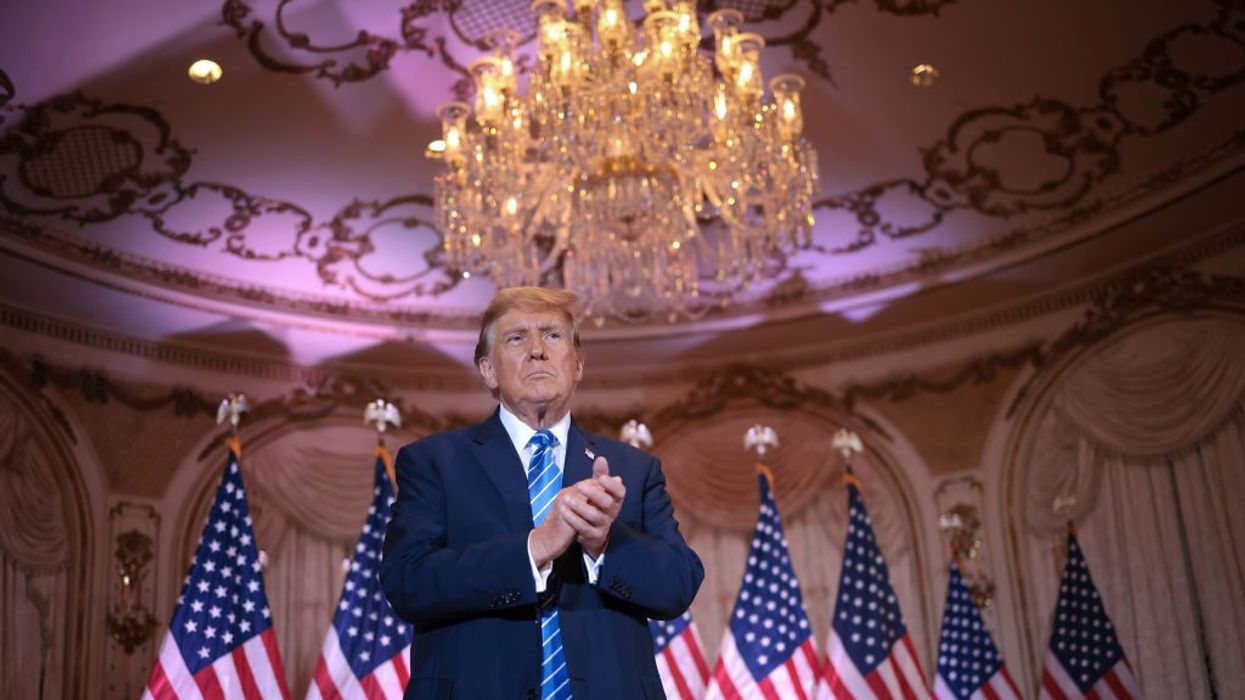
The Republican Party's lurch toward fascism appeared to accelerate Wednesday as former President Donald Trump notched two important political victories and fresh warnings emerged of the stark choice U.S. voters face with a 2020 rematch against President Joe Biden now all but certain.
Following a slew of Super Tuesday defeats and Monday's ruling by the U.S. Supreme Court—which includes three Trump appointees—to block states from barring the presumptive Republican nominee from the ballot for engaging in insurrection, Nikki Haley dropped out of the GOP presidential primary and outgoing Senate Minority Leader Mitch McConnell (R-Ky.) endorsed the 77-year-old former president.
Christina Harvey, executive director of the progressive advocacy group Stand Up America, emphasized the stakes of the upcoming election, saying that "Republicans have effectively chosen an aspiring dictator as their nominee for president."
"Trump's plans to undermine our freedoms and our democracy should be chilling to every American, including his pledges to abuse his power to seek revenge on political opponents, pardon his violent allies, and purge dissenters from the federal government," she said. "Voters will face a clear choice this fall, between an aspiring dictator who is running for office so that he can escape accountability and punish his political enemies, and a leader who will protect our democracy and fundamental freedoms."
Sen. Bernie Sanders (I-Vt.) also warned against Trump and suggested the choice could not be more clear.
"Another Trump presidency would be a disaster—not only for our country, but for the world," Sanders said. "We will lose the fight against climate change. Women will no longer have control over their own bodies. Billionaires will get richer and working people will suffer."
Sanders, who ran for president in both 2016 and 2020, also spoke about the threat Trump poses during a Tuesday night appearance with late-night host Stephen Colbert.
Another Trump presidency would be a disaster — not only for our country, but for the world.
We will lose the fight against climate change.
Women will no longer have control over their own bodies.
Billionaires will get richer and working people will suffer. pic.twitter.com/hkdUyGkwzU
— Bernie Sanders (@BernieSanders) March 6, 2024
Haley, who previously served as South Carolina's governor and Trump's ambassador to the United Nations, was the last Republican challenging him. She suspended her campaign after winning just the District of Columbia and Vermont.
"I have always been a conservative Republican and always supported the Republican nominee," she said. "It is now up to Donald Trump to earn the votes of those in our party and beyond it who did not support him and I hope he does that."
Responding to Haley's decision to exit the primary race, Biden said in a statement Wednesday that "Donald Trump made it clear he doesn't want Nikki Haley's supporters. I want to be clear: There is a place for them in my campaign."
"I know there is a lot we won't agree on," he acknowledged. "But on the fundamental issues of preserving American democracy, on standing up for the rule of law, on treating each other with decency and dignity and respect, on preserving NATO and standing up to America's adversaries, I hope and believe we can find common ground."
"We all know this is no ordinary election. And the stakes for America couldn't be higher," Biden stressed.
Democratic Legislative Campaign Committee (DLCC) president Heather Williams also warned of the threat posed by Trump and his committed far-right allies nationwide.
"As Donald Trump solidifies his control of the Republican Party, we can't lose sight of the hundreds of MAGA Trump loyalists serving in legislatures across the country who pose a direct threat to our communities and our democracy," she said. "These MAGA die-hards will stop at nothing to advance Trump's dangerous agenda, even as he careens more and more towards becoming a hardline dictator."
"From pushing for a nationwide abortion ban to destroying the foundation of our democracy, a Trump presidency would be supported and enacted by his allies in state legislatures," Williams warned. "The DLCC is sounding the alarm on the dangers of a united MAGA front at the national and state level, and we are laser-focused on defeating MAGA loyalists in state legislatures."
Although the U.S. Supreme Court last June ruled against the independent state legislature theory that Trump supporters used to justify their attempts to overturn the 2020 election results, CNN's Marshall Cohen noted at the time that "the somewhat limited ruling leaves plenty of avenues for future election-related challenges, regarding how districts are drawn, the deadlines for mail-in ballots, and other key questions."
Trump has been the GOP front-runner since formally launching his campaign in November 2022 and recent polling shows him having a slim lead over Biden in this year's anticipated rematch. This, despite the Republican being impeached twice during his first term and now facing four criminal cases—two related to his 2020 election interference.
Biden has faced criticism from many Democratic and younger voters for not being bold enough in tackling the climate emergency and for supporting Israel's ongoing assault on the Gaza Strip, which is being investigated at the International Court of Justice as genocide.
Congressman Dean Phillips (D-Minn.), a longshot Biden primary challenger, suspended his campaign on Wednesday and endorsed the president for reelection, saying that "in light of the stark reality we face, I ask you join me in mobilizing, energizing, and doing everything you can to help keep a man of decency and integrity in the White House. That's Joe Biden."
Speaking on MSNBC after McConnell's endorsement on Wednesday, Rep. Jamie Raskin (D-Md.) said that he believes American voters "know who Donald Trump is," but the real question for 2024 remains: "Who are we?"
"Are we going to stand with democracy and freedom or will we lapse into some other kind of theocratic or autocratic kind of government?" the congressman asked. "That's really the question for the American people."
Raskin—who led the historic second Trump impeachment following the January 6, 2021 insurrection—also called out the ex-president for continuing "to campaign almost exclusively on his Big Lie and the idea that he was somehow cheated out of an election."
"He wasn't. He lost the election in 2020," Raskin added of Trump. "He's going to lose the election in 2024 because the vast majority of the people reject what it is he's selling."
"Tonight's numbers showed that President Biden cannot earn back our votes with just rhetoric."
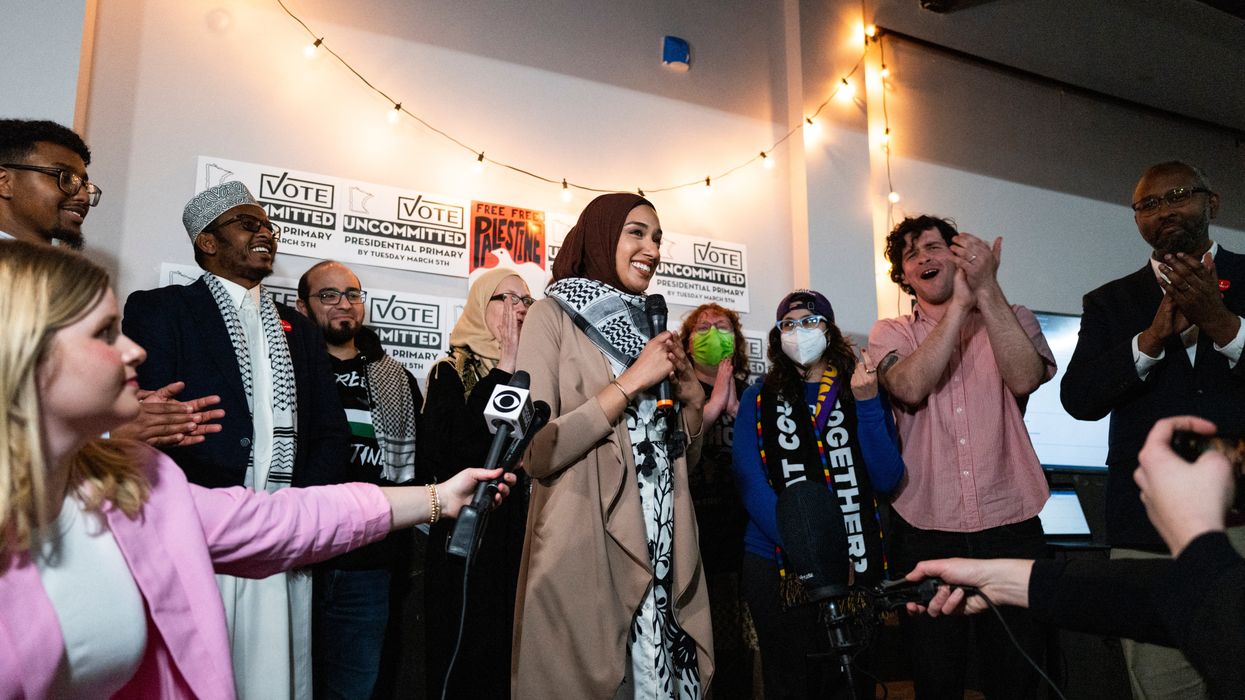
Nearly 20% of Minnesotans who took part in their state's Democratic presidential primary on Super Tuesday voted "uncommitted," the latest warning to President Joe Biden that his unwavering support for Israel's assault on Gaza risks eroding his base ahead of November's high-stakes general election.
Roughly 46,000 Democratic primary voters in Minnesota, which Biden won in 2020, marked the uncommitted option on their ballots just a week after more than 100,000 Michiganders registered their own protest votes against the incumbent president.
Leaders of the hastily organized uncommitted effort in Minnesota expect to win at least one delegate to the Democratic National Convention. Uncommitted won two delegates in Michigan.
(Update: Uncommitted won 11 delegates in Minnesota.)
"Tonight's numbers showed that President Biden cannot earn back our votes with just rhetoric," Asma Nizami, a spokesperson for Vote Uncommitted MN, said Tuesday. "It is not enough to simply use the word 'cease-fire' while Biden funds bombs that kill civilians every day."
"Democrats want Joe Biden to change his policies: stop sending weapons to Israel and use all possible leverage to end Israel's war crimes in Gaza," Nizami added.
Biden, who is likely to face former President Donald Trump in November, swept to victory in all 15 Democratic primaries held in U.S. states on Tuesday. (Businessman Jason Palmer won American Samoa's Democratic caucus.)
In total, more than 250,000 voters marked uncommitted or a similar option in Democratic primaries across the 15 states, including more than 54,000 in Massachusetts, over 43,400 in Colorado, and around 88,000 in North Carolina.
"Voters strongly rejected Biden's funding of Israel's war in Gaza at the polls," said Layla Elebad, campaign manager of Listen to Michigan. "And they will continue to do so until the Biden administration changes course and calls for a permanent cease-fire and stops their unchecked funding of Israel's genocide."
On the Republican side, Trump won every state that voted Tuesday except for Vermont. The Financial Times and other outlets reported early Wednesday that Nikki Haley, Trump's last-remaining Republican challenger, has decided to end her campaign.
"Take them seriously, their message is clear that they think this is an intolerable situation and that we can do more."
Organizers of uncommitted efforts across the U.S. have made clear that their goal is not to harm Biden's general election prospects, but rather to make clear that his support for Israel's war on Gaza is both morally odious and politically dangerous, potentially costing him key support in Michigan and other battleground states.
In a statement following Tuesday's contests, senior Biden campaign spokesperson Lauren Hitt said the president "shares the goal for an end to the violence and a just, lasting peace in the Middle East" and is "working tirelessly to that end."
But the administration's military support for Israel has continued even as Biden has called for a temporary cease-fire and criticized the Israeli government for impeding the flow of humanitarian aid into the Gaza Strip. Biden's campaign has also reportedly been avoiding college campuses and holding smaller events to dodge Gaza-related protests.
"Our goal is to get the president's attention, and we are doing that," Asma Mohammed, an organizer of the uncommitted effort in Minnesota, said Tuesday as the primary results rolled in. The uncommitted vote in Minnesota was reportedly strongest in areas with higher concentrations of young voters.
Polling data released Tuesday by the Center for Economic and Policy Research showed that 62% of voters who supported Biden in 2020 want the U.S. to "stop weapons shipments to Israel until Israel discontinues its attacks on the people of Gaza."
Tim Walz, Minnesota's Democratic governor, said during a CNN appearance late Tuesday that "the situation in Gaza is intolerable" and that uncommitted voters are "asking to be heard."
"And that's what they should be doing," said Walz. "That's a healthy thing that's happening here... Take them seriously, their message is clear that they think this is an intolerable situation and that we can do more."
Independent media outlets are partnering up to cover Super Tuesday Democratic primary results with a pair of live-streamed evening broadcasts that offer progressives an alternative to the U.S. corporate media that has been widely criticized for favoring centrist candidates and putting the interests of their advertisers over those of viewers and the common good.
"This race is not gonna just determine who takes on Donald Trump--it also has at its center the future of the Democratic Party and movements for justice."
-- Amy Goodman, Democracy Now!
Democracy Now! and The Intercept's Super Tuesday live special runs from 7:00pm to midnight Eastern Time (4:00pm to 9:00pm Pacific).
Rising Up With Sonali's live program--a production of KPFK Pacifica Radio in collaboration with the nonprofit RootsAction Education Fund--runs from 10:00pm to 1:00am Eastern Time (7:00pm to 10:00pm Pacific) and will be streamed at Truthdig.com, KPFK.org, FreeSpeech.org, TheRealNews.com, and RisingUpWithSonali.com.
Detailing its special coverage, Democracy Now! explained its chief anchors--Amy Goodman, Juan Gonzalez, and Nermeen Shaikh--would be joined by The Intercept's Jeremy Scahill to host "a rolling roundtable discussion with guests across the country, reporting real-time results and analysis as polls close in 14 states."
Registered Democrats turned out Tuesday in Alabama, Arkansas, California, Colorado, Maine, Massachusetts, Minnesota, North Carolina, Oklahoma, Tennessee, Texas, Utah, Vermont, and Virginia to cast votes for the party's primary candidates. Tuesday also featured American Samoa's caucuses and the first day for "Democrats living abroad" to vote.
In a clip that kicked off the Intercepted podcast's Tuesday episode, Goodman said that "the stakes in this Democratic primary are very high, and the corporate media's failing to bring people the crucial context necessary for voters to make informed decisions... This race is not gonna just determine who takes on Donald Trump--it also has at its center the future of the Democratic Party and movements for justice."
The Intercept's Aida Chavez, Lee Fang, Ryan Grim, Mehdi Hasan, Naomi Klein, Akela Lacy, and Robert Mackey are slated to participate in the program, according to promotional tweets by the outlet and journalists. Other guests will include Linda Sarsour, Masha Gessen, Katrina vanden Heuvel, Rashad Robinson, Briahna Joy Gray, Joe Salazar, and Raquel Willis.
On Tuesday morning, Intercepted published a special episode titled "Super Tuesday: Which Side Are You On?" The episode, hosted by Scahill, features Fang discussing the impact of dark money and super-delegates on the Democratic presidential primary as well as former Hillary Clinton adviser Peter Daou explaining why he is now supporting Sen. Bernie Sanders (I-Vt.) in 2020 contest.
Sanders and four other candidates--former Vice President Joe Biden, billionaire businessman and former New York City Mayor Mike Bloomberg, Rep. Tulsi Gabbard (D-Hawaii), and Sen. Elizabeth Warren (D-Mass.)--still remain in what was once a crowded race. In the wake of South Carolina's primary last Saturday, former South Bend, Indiana Mayor Pete Buttigieg and Sen. Amy Klobuchar (D-Minn.) both dropped out and endorsed Biden.
Biden's win in South Carolina followed weak performances in the first three contests in Iowa, New Hampshire, and Nevada, where Sanders collected the most pledged delegates and continued to build his "Not Me, Us." movement. Sanders' strong support in early states culminated in anchors and contributors at Comcast-owned MSNBC descending into what one observer called a "full-blown freakout" after the progressive senator's massive victory in Nevada last month.
"Democracy depends on a free and independent press that can hold power accountable, but sadly, the corporate media does not meet that standard," Sonali Kolhatkar of Rising Up With Sonali (RUWS) and Norman Solomon of RootsAction argued in an op-ed published last week.
Kolhatkar and Solomon made a broad case for the value of independent media:
Truly independent journalism relies on facts, just as corporate media often does, but frames issues with a clearly stated bias--a bias that lights a fire under the powerful and roots for the vulnerable, amplifies the voices of working people to topple power, and strengthen the powerless. The function of the press in a democracy is to pursue truth in the interest of progress, not in the interest of an unjust status quo. Seen through such a lens it isn't hard to judge whether the likes of The New York Times (or CNN, MSNBC, The Washington Post, etc.) truly meet the definition of independent journalism.
A crucial way to fight back is to drastically amp up support for independent progressive media. Information flow is key, whether in small communities or nationwide. That flow is essential to the health of the body politic, but blockage is routine from massive clots of concentrated wealth and corporate power. Media organizations that are fueled by people power instead of money power can disrupt the dominant media narratives--and replace them with authentic stories about people's lives and grassroots efforts to create a more humane society.
The op-ed also highlighted the RUWS Super Tuesday program featuring Solomon and other guest commentators and reporters, including Jane McAlevey, Zahra Billoo, John Nichols, Kshama Sawant, Arun Guta, Mitch Jeserich, and Julio Ricard Varela.
"This year is the first time that California--the nation's most populous and most racially diverse state--will participate in primary elections so early in the season," RUWS noted ahead of Tuesday's broadcast. "Based in the Los Angeles area, Rising Up With Sonali is poised to offer a unique perspective on the race for presidential nominations."
In the wake of Super Tuesday, you can find one of two Bernie Sanders articles on the internet. You have those writing his obituary, telling voters it's over and it is time to support Hillary Clinton, no questions asked, simply fall in line with the party and obey your marching orders. Then you have the overly optimistic that wants to explain how even after losing to Clinton, somehow Sanders still won.
These are generally well-meaning exposes that focus on the states that Sanders won, which are mainly Democratic and swing states, states needed in the general election, versus Clinton's wins in conservative states, states that the Democrats won't win in the general election, making those state victories all but meaningless.
Yet, even with history on the side of Clinton, saying that every politician who wins on Super Tuesday goes on to win the nomination, this race is far from over the nomination is not yet secure. This rings true for both parties, but it is important for Sanders supporters to tune out the media telling them the race is over and to continue to show up in the over 30 remaining states that need to cast ballots in these primaries.
However, even if the race does go the way of Clinton, Sanders supporters, democrats, socialists, and democratic socialists alike should use Sander's campaign as momentum for the future. At the point where we stand now, Sander's version of a political revolution took place. Young voters, for the first time, had a candidate they could rally behind and not look at as the lesser of two evils and instead saw a candidate they can truly believe in and were shown a vision of the country that is possible if they try. While President Obama tried to do this in both 2008 and 2012, he never laid out such a revolutionary vision as Sanders has.
Tomorrow's left will not be the establishment left that continues to pander to the center-right and feels the need to give up freedoms and rights to make the establishment right satisfied. This breed of liberals would not dream of taking single-payer off the table when discussing health care reform and would never allow insurance companies to wield the kind of power they continue to have over Americans.
Win or lose, Sanders opened the floodgates that will lead to the toppling of the establishment party that is fighting tooth and nail to crown Clinton as president. Clinton and her allies in Congress should be shaking. Their days in office are numbered. Sander's shake-up of this status quo is only the beginning. Kshama Sawant, a Seattle-based socialist who was elected to the city council, will no longer be the odd person out. She will become the norm as socialists and radical leftists take office from city councils, state senates, and even Congress.
This is a dream many of never thought possible in our lifetime, yet because Bernie Sanders decided to take on the establishment like never before, we are finally seeing voters ready to enact real change. The trick now is continuing that momentum even if it has to be done without Sanders running for office. His campaign it of itself was revolutionary when compared to the campaigns of the last 20 to 30 years, and as revolutionists, it is our duty to push that revolution forward.
Even while Sanders never stood for demolishing capitalism, he shined the brightest light on its flaws and showed that there is a better way of doing things. He took the dirtiest word in American politics, socialism, and turned it back into a word with power, with vision, and with importance.
It is now up to us to stand behind the banner of socialism that has been raised above the American people and march forward and say loudly we won't support the bigoted regimes of the Republican Party and won't line up to support a war hawk-like Hillary Clinton and instead show the world we are going to shape a new future for this country and demand change and then in no uncertain terms, make it a new reality.
Every American on the left knows that when labor leader Eugene Debs ran for President in 1920 as a socialist, he got a million votes.
I don't know if Howard Zinn would approve this message, but by this standard, Team Sanders is arguably kicking Debs' butt. Bernie Sanders has more than a million campaign contributors. A campaign contribution, for an ordinary person of modest means, is like a vote with a little bit of extra blood on it. You mean business. It costs you something. You have skin in the game.
Every member of Team Sanders knows that the average contribution to Team Sanders is twenty-seven dollars. This is a regular theme of Sanders' speeches. When Sanders says, "...and the average contribution to this campaign is ..." the crowd shouts, "Twenty-seven dollars!"
And of course, Eugene Debs did not win New Hampshire, Colorado, Oklahoma, Vermont, and Minnesota, like Sanders just did. As a Midwest nationalist, I am especially happy about the Minnesota result. Eugene Debs was from Indiana. Emma Goldman is buried in Chicago with the Haymarket martyrs who died fighting for the eight-hour workday. Mother Jones is buried in Mount Olive, Illinois alongside miners who died in the Battle of Virden. People from the Midwest know these things.
I went to a Sanders appearance at the Minneapolis Convention Center the day before the caucus. The "warm-up acts" were as impressive as the main speaker. Lisa Bender, a member of the Minneapolis City Council, talked about local issues. Winona LaDuke talked about protecting our environment from corporate greed. Keystone XL isn't the only oil pipeline we need to stop, she said; we need a government that will build infrastructure for people, not oil companies. Keith Ellison talked about the right to tuition-free public college. If the UK can do it, if Denmark can do it, we can do it too, Ellison said. More than talking about Bernie Sanders, each was giving their own version of The Speech.
Regardless of what happens at the Democratic convention, Lisa Bender, Winona LaDuke and Keith Ellison will still be with us, and this will be Sanders' lasting legacy, helping to mobilize a wave of progressive activists to engagement and challenge in the political system, and establishing a culture of primary challenges to the establishment on the left like the one that which now exists on the right. The right has more influence in the Republican Party than the left has in the Democratic Party because the right has mastered the weapon of the primary challenge. When the left masters the primary challenge weapon, the left will have more influence.
The establishment hates contested primaries because they hate competition. In the establishment's ideal election, the establishment would anoint the candidate and everyone else would accept without question the establishment's choice. But making the establishment happy by avoiding contested primaries is terrible for democracy, and terrible for people who want to talk about issues that the establishment doesn't want to talk about.
We're building an army for the long march through the institutions. With the right campaigns, voting and encouraging others to vote can be like Zuccotti Park without the tear gas: occupy Schoolhouse Rock. One, two, three, many Keith Ellisons, as the Argentine doctor might have said.
Just as every American has the right to health care, just as every high school student who applies themselves has the right to tuition-free public college, so every American has the right to participate in this movement, even if they aren't so fortunate as to live in Minnesota. Count every vote.
Now that Super Tuesday is behind us and the field of presidential candidates is narrowing with the suspension of Dr. Ben Carson's campaign, a potentially paradigm-shattering general election looms ever closer. "The stakes in this election have never been higher," Democratic candidate Hillary Clinton said in her speech after she had been declared the victor over Sen. Bernie Sanders in seven of 11 Super Tuesday states. As Donald Trump, piling victory upon victory on top of insult upon insult, edges closer to clinching the Republican nomination, the GOP is in chaos, with some predicting a historic split in the party. The presidential race to date has been well-characterized by a line of closed captioning text from a recent Republican debate: "unintelligible yelling." The circuslike atmosphere masks deeply troubling statements made by several candidates who fan the flames of racism, white supremacy, and xenophobia. It also deflects attention from a critical and worsening deficit in our democracy: the attack on the right to vote, and in particular, the wholesale disenfranchisement of close to 5 million Americans, mostly people of color.
Race has been a defining issue in the 2016 election season. On the Republican side, there are overtly racist statements by front-runner Donald Trump, railing against Mexicans as "rapists" and refusing to denounce the former Ku Klux Klan Grand Wizard David Duke after Duke endorsed him. Trump said of an African-American protester who Trump supporters attacked at one of his rallies, "Maybe he should have been roughed up." Trump is also a proud retweeter of Italian dictator Benito Mussolini. When asked by NBC's Chuck Todd if he wanted to be associated with a fascist, Trump replied, "I want to be associated with interesting quotes."
Republicans fear that a Donald Trump candidacy will cost their party not only a shot at the White House but also control of the Senate and House of Representatives. That is where the torrent of restrictive voting laws comes in. The American Civil Liberties Union has noted that 10 states will be implementing new restrictive voting laws that will impact up to 80 million voters and could decide the assignment of 129 electoral votes out of the 270 needed to win the election. Dale Ho of the ACLU writes, "These laws range from new hurdles to registration to cutbacks on early voting to strict voter identification requirements."
Denial of the right to vote for those who have been convicted of felonies is another way that voter participation is suppressed on a massive scale. With only 5 percent of the world's population, the United States holds 25 percent of the world's prisoners. Laws vary from state to state. Maine and Vermont allow prisoners to vote, but as of 2014, according to The Sentencing Project, every other state and the District of Columbia have some form of disenfranchisement as a consequence of a felony. In 12 states, the right to vote is stripped permanently. That means even when people have served their sentence and paid their debt to society, they can never vote again. These states are Alabama, Arizona, Delaware, Florida, Iowa, Kentucky, Mississippi, Nebraska, Nevada, Tennessee, Virginia, and Wyoming.
According to a 2002 study by sociologists Christopher Uggen and Jeff Manza, "If disenfranchised felons in Florida had been permitted to vote, Democrat Gore would certainly have carried the state and the election." The Sentencing Project, in a 2014 report, summarized, "Nationwide, one in every 13 black adults cannot vote as the result of a felony conviction, and in three states--Florida, Kentucky, and Virginia--more than one in five black adults is disenfranchised."
Ari Berman, author of "Give Us the Ballot: The Modern Struggle for Voting Rights in America," said on the "Democracy Now!" news hour: "More than 5 million Americans can't vote because of felon disenfranchisement laws. Voter disenfranchisement is another legacy of Jim Crow that we are still wrestling with today."
This is just one of the many devastating impacts of mass incarceration in the United States. And Republicans aren't the only ones responsible. That is why Black Lives Matter activists have been interrupting Democratic presidential campaign events. During a recent private fundraiser for Hillary Clinton in Charleston, South Carolina, Ashley Williams held up a banner reading "We have to bring them to heel," a reference to controversial statements Hillary Clinton made in 1996 about some youth whom she called "superpredators." Williams confronted Clinton, saying, "I am not a superpredator." She was quickly whisked away. On Super Tuesday, a young Somali-American woman confronted Clinton in Minneapolis about those same comments.
The struggle for racial justice and voting rights are inextricably linked. Race is indeed central to this year's race for the White House.
It's the day after the big vote, and I'm doing my best to dig Tulsi Gabbard's endorsement of Bernie Sanders out from beneath the pile of Super Tuesday numbers and media declarations of winners and losers.
As a Boston Globe headline said: "Clinton and Trump are now the presumptive nominees. Get used to it."
However, something besides winning and losing still matters more than ever in the 2016 presidential race. War, peace, and fundamental questions about who we are as a nation are on the line in this race—or could be—for the first time since 1972 when George McGovern was the Democratic presidential nominee.
Embrace what matters profoundly, and there's no such thing as losing.
Gabbard, an Iraq war vet, the congresswoman from Hawaii, and "rising star" in the Democratic establishment, stepped down as vice-chair of the Democratic National Committee to endorse Sanders -- because he's the only candidate who is not financially and psychologically tied to the military-industrial complex.
"As a veteran of two Middle East deployments, I know firsthand the cost of war," she said, cracking the mainstream silence on U.S. militarism. "As a vice chair of the DNC, I must stay neutral in democratic primaries, but I cannot remain neutral any longer. The stakes are just too high."
Because of Gabbard -- only because of Gabbard -- the multi-trillion-dollar monstrosity of U.S. militarism is getting a little mainstream media attention amid the reality TV histrionics of this year's presidential race, the Donald Trump phenomenon and the spectacle of Republican insult-flinging.
As the results of Super Tuesday started coming in on Tuesday night, Gabbard was given a few minutes to talk on MSNBC. While Rachel Maddow wanted to discuss the risk her Sanders endorsement might have on her career, Gabbard insisted on addressing the slightly larger matter of our unchecked, resource-hemorrhaging military adventurism across the globe.
"War is a very real thing," she said. "If the Syrian war continues, we won't have the resources to fund important social programs. This isn't a question of the past -- it's a question of today. Regime-change wars do nothing to strengthen our national security, but they do strengthen our enemies."
Fine. We'll return after these messages . . .
The MSNBC analysts' attention returned to the Trump phenomenon a short while later. Someone opined: "The vast majority of Trump supporters are enamored of winning" far more than they care about the goofball issues Trump is supposedly running on, like the wall across the Mexican border and the ban on Muslims entering the country.
Maybe it's true, but I sense the mainstream media is a lot more comfortable with an issue-free presidential race, which is what the powers that be want. The presidential election is supposed to be a distraction, not some public accountability process.
While the Sanders phenomenon is as shocking and unexpected as the success of the Trump campaign, it is far too substantive to garner a similar amount of media attention, let alone seriously considering the issues he raises. Yet remarkably, his call for social change—for the transformation of a "rigged economy"—has not receded to the margins, either.
So what happens next? Tulsi Gabbard's endorsement is the key. As Dave Lindorff recently wrote:
"Sanders, who has been avoiding talking about the country's military budget and its imperialist foreign policy, should use the opportunity of Gabbard's defection from the DNC to announce that if elected, he would immediately slash military spending by 25 percent, he would begin pulling U.S. forces back from most of the 800 or more bases they occupy around the world, and that he would end a decades-long foreign policy of overthrowing elected leaders around the globe."
The shock waves generated by such a stance from a candidate with 386 delegates would be enormous. Conventional wisdom cries no, no, that's too much. No matter how much harm our wars have caused in the last decade, no matter how absurd a slice that war preparation -- including nuclear weapons development -- gouges from the national budget, the U.S. military, the planet's biggest polluter and most prolific terrorist, remains untouchable. The public has no say in these matters. The president has no say in these matters.
This delusion goes back to the Vietnam War and McGovern's loss to Richard Nixon. Since then, the Democrats have attempted to purge themselves of antiwar -- or what perhaps should be called trans-military -- thinking. In doing so, they've tied themselves to their own, and the country's, inevitable collapse.
The other option is transformation. This is the year it could begin.
Having notched Super Tuesday victories in Colorado, Minnesota, Oklahoma, and Vermont, the Bernie Sanders presidential campaign says it's "going all the way to the Democratic National Convention in Philadelphia and beyond."
The results in the 11 states that voted on March 1, seven of which went to Hillary Clinton, widened the former secretary of state's delegate lead against Sanders and reinforced her support among minority voters. Some even suggested that Clinton's solid Super Tuesday performance would increase pressure on Sanders to drop out of the race.
But at a rally Tuesday night with more than 4,000 supporters in his home state of Vermont--where he won resoundingly with 86 percent of the vote--and in a statement Wednesday morning, Sanders stressed his determination to carry his message to voters in all 50 states.
"At the end of tonight, 15 states will have voted, 35 states remain," he told the crowd in Burlington, where he once served as mayor. "And let me assure you, we are going to take our fight for economic justice, social justice, environmental sanity, and a world of peace to every one of those states."
"People should not underestimate us," Sanders' campaign manager Jeff Weaver added in an email to supporters late Tuesday night.
"By winning four states last night, including the general election swing state of Colorado, and many delegates, Bernie Sanders has shown that this campaign to take on a rigged political system and economy is gaining momentum," declared Ilya Sheyman, executive director of MoveOn.org Political Action. "There are still more than forty primaries and caucuses to go and MoveOn members are excited to continue to mobilize to support Bernie and turn out the progressive vote. Your zip code should not determine if your primary vote matters or not."
Meanwhile, even Clinton's narrow victory in Massachusetts was painted as a partial win for Sanders.
Clinton "was made a better candidate thanks to Bernie Sanders engaging her in a race to the top on popular economic populism issues like debt-free college, expanding Social Security, and jailing Wall Street bankers who break the law," said Adam Green, co-founder of the Progressive Change Campaign Committee (PCCC), in a statement Wednesday.
There's no denying that Sanders faces an uphill climb. "Democrats award delegates proportionally, which means Sanders would need to win by big margins in the remaining states to catch up," Harry Enten wrote at FiveThirtyEight.
Still, John Nichols wrote at The Nation on Wednesday, "Sanders won more states from Clinton in the Democratic contests on Super Tuesday than the combined efforts of Ted Cruz and Marco Rubio won from Donald Trump in the far more intensely covered Republican contest."
"That," he continued, "to borrow a phrase from Sanders, was 'pretty good'--especially because the Super Tuesday map was always seen as favoring Clinton."
Nichols continued:
If he hopes to level things out, Sanders must broaden his appeal to African-American and Latino voters, who will be a factor in many of the states where he must win in the weeks to come. He must also recognize that Clinton's pivot to a focus on fighting Trump is an example of not just smart but necessary, politics. Democratic primary and caucus voters want to hear about issues - especially the economic-and-social justice issues that have animated the Sanders campaign -- but they also want to be reassured that their party's nominee will have a message and a strategy that is sufficient to see off Donald Trump. Right now, Clinton is doing a very good job of providing that assurance - and it is helping her to have some very super Tuesdays.
To that very end, top Sanders strategists reportedly held a press briefing Wednesday morning highlighting Sanders' electability against Trump.
"The political revolution has begun," Sanders himself said Wednesday. "I look forward to a contest this fall between democracy and demagoguery, between ordinary Americans and the oligarchs. I look forward to the chance for our people-powered campaign to show Donald Trump that the United States of America belongs to all of us and not just billionaire bullies."
The Democrats will face off in two debates over the next 10 days, including one Sunday in Flint, Michigan. Earlier this year, Sanders called on Michigan Gov. Rick Snyder to resign for his administration's failure to deal with a lead-poisoning crisis that has sickened thousands of children in that city.
Millions of Americans will cast ballots on Super Tuesday and in November, but many people will have no choice but to stay away from the polls. State felony disenfranchisement laws in 48 states prevent nearly six million citizens from exercising their voting rights, according to a 2015 Sentencing Project policy brief. More than two million, or nearly 40 percent, of these disenfranchised people are African American.
Felon voting laws vary widely, from allowing convicts to vote while in prison to permanent disenfranchisement. Several Super Tuesday states allow some ex-offenders to vote if they meet certain conditions. Although Virginia Governor Terry McAuliffe relaxed some of the rules regarding restoring voting rights to ex-felons, people who served time for violent offenses must wait three years before applying to have their rights restored. They also must not have any outstanding fines, damages owed to victims, or court costs. In the Old Dominion State, the racial disparities are particularly pronounced: 20 percent of black adults in Virginia are disenfranchised.
In Tennessee, people who have committed certain violent and sexual crimes are permanently banned from voting. Notably, the Volunteer State also bars ex-felons from voting if they are not up-to-date on child-support payments. But similar to Virginia, certain Tennessee ex-felons are eligible to vote: Those who are eligible can apply for restoration of their voting rights only after they have completed their entire sentence or fulfilled any parole or probation conditions and have paid any court-ordered restitution damages.
Wyoming, which holds its Republican caucus on Super Tuesday, passed a law in 2015 that required the state's Department of Corrections to issue a certificate of voting rights to first-time, nonviolent offenders after their release from prison. Prior to this change, first-time nonviolent offenders in Wyoming could only apply to have their voting rights restored five years after completing parole and probation. (People convicted of violent or multiple offenses are permanently disenfranchised.)
The movement to end disenfranchisement has a broad base of support from criminal justice reform advocates and voting-rights advocates alike. And getting ex-offenders registered to vote is a successful re-entry strategy. "Over the last few decades, a lot of states have been taking positive steps," says Tomas Lopez, a counsel at the Democracy Program of the Brennan Center for Justice at New York University's School of Law. "We want people civically engaged."
Elsewhere, Maryland recently changed its policies on felony disenfranchisement. Democratic state lawmakers introduced a bill that sought to restore voting rights to felons upon their release from prison rather than having people wait until they complete parole and probation.
The bills passed the legislature with overwhelming bipartisan support only to be vetoed by Republican Governor Larry Hogan. However, state lawmakers overrode the governor's veto, restoring voting rights to 40,000 Marylanders. "If you're living and working in the community, you're allowed to vote," says Lopez, describing the new law.
In an attempt to alleviate overcrowded prisons, California lawmakers passed a series of bills in 2011 that would have placed low-level felony offenders under community supervision in county jails. They allowed others to be monitored by county agencies instead of state parole boards.
But California's then-Secretary of State Debra Bowen ruled that community supervision was essentially the same as being on parole, so felons being monitored by counties were still ineligible to vote. Three years later, civil rights groups, including the American Civil Liberties Union of California, sued Bowen, asserting that she had stripped tens of thousands of citizens of their right to vote.
Alameda County Superior Court Judge Evelio Grillo sided with the civil rights groups, but the state appealed the ruling. Last year, current California Secretary of State Alex Padilla finally dropped the appeal, which effectively restored voting rights to 60,000 Golden State ex-offenders.
Kentucky made some strides and then saw a reversal. Former governor Steve Beshear, a Democrat, issued an executive order that restored voting rights to approximately 100,000 citizens with nonviolent felony convictions. However, new Republican Governor Matt Bevin reversed the order during his first days in office last December, saying that the matter must be left to the state lawmakers and the "will of the people." Even though restoring the right to vote in Kentucky had bipartisan support, the Bluegrass State now rejoins Iowa and Florida as the three states that have permanently disenfranchised felons, no matter what type of crime they have committed.
This sort of backtracking is troubling. "Denying the right to vote to an entire class of citizens is deeply problematic to a democratic society and counterproductive to effective reentry," the Sentencing Project concluded in its report.
During a campaign stop in Minneapolis, Minnesota on Monday, Bernie Sanders took decisive aim at the fossil fuel industry and his Republican colleagues who deny the science of climate change, telling the crowd: "I do not know what [they] are smoking."
Sanders launched into his speech with the declaration: "Climate change is real, climate change is caused by human activity, and climate change is already doing devastating harm in our country and all over the world."
"Now," he continued, "I don't know what my Republican colleagues are smoking, but they go around the country and they say, 'Well climate change is a hoax. It is not real.' It is a very dangerous thing for a nation when you reject science. I will not reject science. What the scientific community found is that--as serious and dangerous as the situation is today--it will only get worse in the coming years if we do not get our act together and transform our energy system away from fossil fuels to energy efficiency."
In Minnesota, which is among the states holding a presidential primary on Super Tuesday, oil giant Enbridge is currently seeking to build two new pipelines, the Sandpiper and the Alberta Clipper, which together would transport over 1.4 million barrels of oil per day.
During the rally, which was held at the Minneapolis Convention Center, Sanders declared his opposition to those projects.
"President Obama said when his administration was reviewing Keystone XL that he wouldn't grant approval if the project made climate change significantly worse," Sanders said. "A Sanders administration would direct the State Department to apply that same test to the Alberta Clipper and the Sandpiper because we need to ensure corporations don't keep wrecking our climate and environment for their own profit."
Sanders also touted his record of environmental leadership, which included being one of the first in Congress to oppose Keystone XL, which his Democratic rival Hillary Clinton only recently came out against.
Last week, his campaign also released an email criticizing Clinton for her support of fracking, as well as for attending a fundraiser hosted by a major fracking investor. "[J]ust as I believe you can't take on Wall Street while taking their money, I don't believe you can take on climate change effectively while taking money from those who would profit off the destruction of the planet," the email stated.
After Monday's rally, environmental campaigners commended Sanders for "once again" exemplifying leadership on environmental and climate issues.
"The litmus test of climate leadership in 2016 is keeping fossil fuels in the ground," said Jason Kowalski, spokesperson for 350 Action. "Once again Senator Sanders has come out against new fossil fuel infrastructure that would exacerbate the climate crisis. President Obama rejected the Keystone XL pipeline because of its devastating impacts on our climate and communities, and the Sandpiper and Clipper Pipelines are not much different."