SUBSCRIBE TO OUR FREE NEWSLETTER
Daily news & progressive opinion—funded by the people, not the corporations—delivered straight to your inbox.
5
#000000
#FFFFFF
To donate by check, phone, or other method, see our More Ways to Give page.
Daily news & progressive opinion—funded by the people, not the corporations—delivered straight to your inbox.
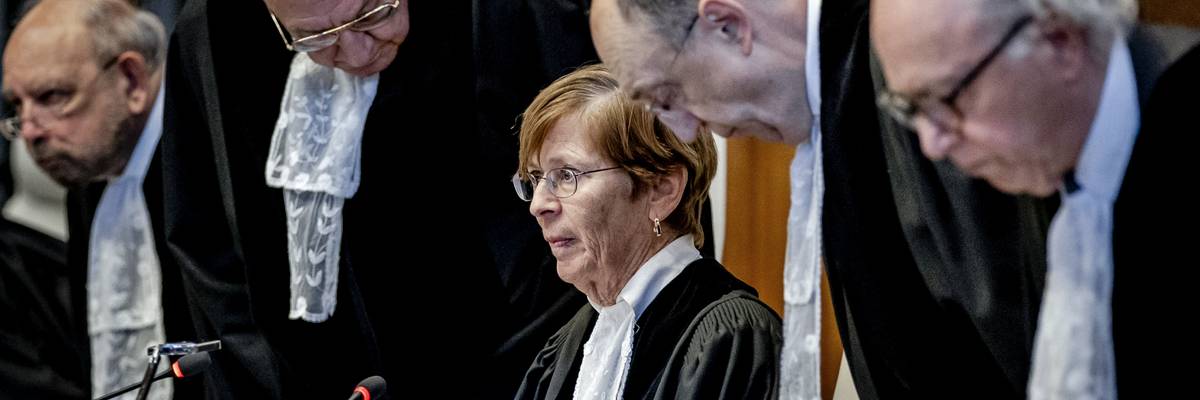
International Court of Justice President Joan Donoghue and ICJ judges arrive prior to the verdict announcement in the genocide case against Israel brought by South Africa in The Hague, Netherlands on January 26, 2024.
"One thing has been made clear on the world stage: There is vastly documented evidence that Israel is committing genocide against Palestinians," said the U.S. Campaign for Palestinian Rights.
The International Court of Justice ruled Friday that South Africa's genocide case is plausible and ordered Israel to "take all measures within its power" to uphold its obligations under Article II of the Genocide Convention.
The court also ordered the Israeli government to ensure its military does not commit violations of the convention in Gaza, punish those who incite genocide, immediately provide basic services and humanitarian assistance to Gazans, prevent the destruction of evidence that could show violations of international law, and submit a report to the ICJ on all steps it takes to implement the above measures.
The ICJ did not grant South Africa's request for a cease-fire.
While a final determination from the court on whether Israel is guilty of genocide in Gaza could be years away, Friday's ruling from the United Nations' highest court was seen as a huge blow to the Israeli government and its top arms supplier, the United States, which called South Africa's case "meritless."
"This ruling from the ICJ is a massive legal defeat for Israel and its premiere defenders, the U.S. and Germany," The Intercept's Jeremy Scahill wrote Friday. "The question now is enforceability and whether the U.S. will openly trample international law in an effort to continue aiding Israeli crimes against Palestinians."
As she read the court's interim decision, ICJ President Joan Donoghue cited testimony from United Nations officials and others on the appalling conditions on the ground in the Gaza Strip, where most of the population is displaced, starving, and struggling to survive Israel's relentless aerial and ground assault.
Donoghue said the court deemed the threat of "irreparable harm" to Gazans real and concluded that emergency measures were necessary to protect the Palestinian population from genocide.
"This is a crucial moment in history to finally holding Israel accountable," the U.S. Campaign for Palestinian Rights said in response to the decision. "One thing has been made clear on the world stage: There is vastly documented evidence that Israel is committing genocide against Palestinians."
Dear Common Dreams reader, It’s been nearly 30 years since I co-founded Common Dreams with my late wife, Lina Newhouser. We had the radical notion that journalism should serve the public good, not corporate profits. It was clear to us from the outset what it would take to build such a project. No paid advertisements. No corporate sponsors. No millionaire publisher telling us what to think or do. Many people said we wouldn't last a year, but we proved those doubters wrong. Together with a tremendous team of journalists and dedicated staff, we built an independent media outlet free from the constraints of profits and corporate control. Our mission has always been simple: To inform. To inspire. To ignite change for the common good. Building Common Dreams was not easy. Our survival was never guaranteed. When you take on the most powerful forces—Wall Street greed, fossil fuel industry destruction, Big Tech lobbyists, and uber-rich oligarchs who have spent billions upon billions rigging the economy and democracy in their favor—the only bulwark you have is supporters who believe in your work. But here’s the urgent message from me today. It's never been this bad out there. And it's never been this hard to keep us going. At the very moment Common Dreams is most needed, the threats we face are intensifying. We need your support now more than ever. We don't accept corporate advertising and never will. We don't have a paywall because we don't think people should be blocked from critical news based on their ability to pay. Everything we do is funded by the donations of readers like you. When everyone does the little they can afford, we are strong. But if that support retreats or dries up, so do we. Will you donate now to make sure Common Dreams not only survives but thrives? —Craig Brown, Co-founder |
The International Court of Justice ruled Friday that South Africa's genocide case is plausible and ordered Israel to "take all measures within its power" to uphold its obligations under Article II of the Genocide Convention.
The court also ordered the Israeli government to ensure its military does not commit violations of the convention in Gaza, punish those who incite genocide, immediately provide basic services and humanitarian assistance to Gazans, prevent the destruction of evidence that could show violations of international law, and submit a report to the ICJ on all steps it takes to implement the above measures.
The ICJ did not grant South Africa's request for a cease-fire.
While a final determination from the court on whether Israel is guilty of genocide in Gaza could be years away, Friday's ruling from the United Nations' highest court was seen as a huge blow to the Israeli government and its top arms supplier, the United States, which called South Africa's case "meritless."
"This ruling from the ICJ is a massive legal defeat for Israel and its premiere defenders, the U.S. and Germany," The Intercept's Jeremy Scahill wrote Friday. "The question now is enforceability and whether the U.S. will openly trample international law in an effort to continue aiding Israeli crimes against Palestinians."
As she read the court's interim decision, ICJ President Joan Donoghue cited testimony from United Nations officials and others on the appalling conditions on the ground in the Gaza Strip, where most of the population is displaced, starving, and struggling to survive Israel's relentless aerial and ground assault.
Donoghue said the court deemed the threat of "irreparable harm" to Gazans real and concluded that emergency measures were necessary to protect the Palestinian population from genocide.
"This is a crucial moment in history to finally holding Israel accountable," the U.S. Campaign for Palestinian Rights said in response to the decision. "One thing has been made clear on the world stage: There is vastly documented evidence that Israel is committing genocide against Palestinians."
The International Court of Justice ruled Friday that South Africa's genocide case is plausible and ordered Israel to "take all measures within its power" to uphold its obligations under Article II of the Genocide Convention.
The court also ordered the Israeli government to ensure its military does not commit violations of the convention in Gaza, punish those who incite genocide, immediately provide basic services and humanitarian assistance to Gazans, prevent the destruction of evidence that could show violations of international law, and submit a report to the ICJ on all steps it takes to implement the above measures.
The ICJ did not grant South Africa's request for a cease-fire.
While a final determination from the court on whether Israel is guilty of genocide in Gaza could be years away, Friday's ruling from the United Nations' highest court was seen as a huge blow to the Israeli government and its top arms supplier, the United States, which called South Africa's case "meritless."
"This ruling from the ICJ is a massive legal defeat for Israel and its premiere defenders, the U.S. and Germany," The Intercept's Jeremy Scahill wrote Friday. "The question now is enforceability and whether the U.S. will openly trample international law in an effort to continue aiding Israeli crimes against Palestinians."
As she read the court's interim decision, ICJ President Joan Donoghue cited testimony from United Nations officials and others on the appalling conditions on the ground in the Gaza Strip, where most of the population is displaced, starving, and struggling to survive Israel's relentless aerial and ground assault.
Donoghue said the court deemed the threat of "irreparable harm" to Gazans real and concluded that emergency measures were necessary to protect the Palestinian population from genocide.
"This is a crucial moment in history to finally holding Israel accountable," the U.S. Campaign for Palestinian Rights said in response to the decision. "One thing has been made clear on the world stage: There is vastly documented evidence that Israel is committing genocide against Palestinians."