SUBSCRIBE TO OUR FREE NEWSLETTER
Daily news & progressive opinion—funded by the people, not the corporations—delivered straight to your inbox.
5
#000000
#FFFFFF
To donate by check, phone, or other method, see our More Ways to Give page.
Daily news & progressive opinion—funded by the people, not the corporations—delivered straight to your inbox.
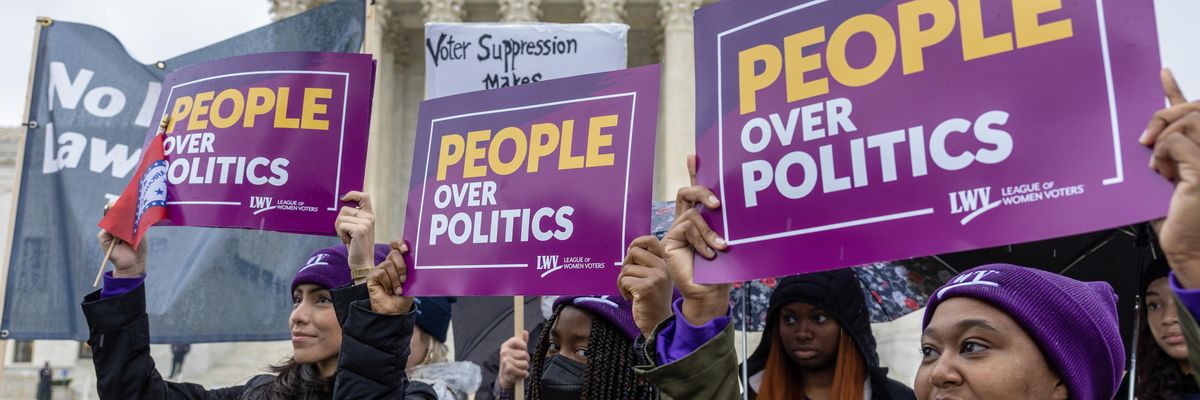
By ruling against the independent state legislature theory, said one activist, "the U.S. Supreme Court made clear that state courts and state constitutions should serve as a critical check against abuses of power by legislators."
Democracy defenders across the United States on Tuesday breathed a collective sigh of relief after half of the U.S. Supreme Court's right-wing supermajority joined with the three liberal justices to reject a "dangerous" legal theory that could dramatically impact federal elections.
"The Supreme Court took an important and crucial step today in protecting our system of checks and balances," said Hilary Harris Klein, senior counsel for voting rights at Southern Coalition for Social Justice. "Today's decision will ensure that voters will continue to have the full protection of state constitutions against harmful and anti-democratic voter suppression and election manipulation."
Oral arguments for Moore v. Harper in December had some campaigners worried that at least five justices would embrace the independent state legislature theory (ISLT), whose proponents claim the U.S. Constitution only empowers state legislatures to regulate federal elections, without checks from state constitutions, courts, or governors.
However, in the case—which stemmed from a fight over North Carolina's congressional map—Chief Justice John Roberts, fellow conservatives Amy Coney Barrett and Brett Kavanaugh, and liberals Elena Kagan, Ketanji Brown Jackson, and Sonia Sotomayor rejected the ISLT. Right-wing Justices Samuel Alito, Clarence Thomas, and Neil Gorsuch dissented.
The elections clause of the U.S. Constitution "does not vest exclusive and independent authority in state legislatures to set the rules regarding federal elections," Roberts wrote for the majority. "When state legislatures prescribe the rules concerning federal elections, they remain subject to the ordinary exercise of state judicial review."
"When a state legislature carries out its federal constitutional power to prescribe rules regulating federal elections, it acts both as a lawmaking body created and bound by its state constitution, and as the entity assigned particular authority by the federal Constitution," he continued. "Both constitutions restrain the state legislature's exercise of power."
"Although the elections clause does not exempt state legislatures from the ordinary constraints imposed by state law, federal courts must not abandon their duty to exercise judicial review," Roberts added. "This court has an obligation to ensure that state court interpretations of state law do not evade federal law."
Both the majority opinion and campaigners pointed to precedent. Fair Elections Center litigation director Jon Sherman said that "for 233 years and counting, no court has ever found that state election laws are unconstrained by state constitutional requirements, because this is a fantasy that is antithetical to our system of government."
Elias Law Group partner Abha Khanna, counsel of record for the plaintiffs, called the 6-3 decision "a resounding victory for free and fair elections in the United States."
The ISLT "is a dangerous, fringe legal theory that has no place in our democracy," Khanna said. "In its most extreme form, the independent state legislature theory could have weakened the foundation of our democracy, removing a crucial check on state legislatures and making it easier for rogue legislators to enact policies that suppress voters and subvert elections without adequate oversight from state court."
The case was argued in the wake of former President Donald Trump—who is seeking the Republican nomination for 2024—and his supporters refusing the accept the results of the 2020 election, which led to the January 6, 2021 attack on the U.S. Capitol. Notably, two of the three Trump-appointed justices, Barrett and Kavanaugh, rejected the ISLT.
While celebrating the new ruling as "a historic victory for the people of North Carolina and for American democracy," Bob Phillips, Common Cause North Carolina's executive director, also looked ahead.
"Today, the U.S. Supreme Court made clear that state courts and state constitutions should serve as a critical check against abuses of power by legislators," he said. "Now, we must ensure our state courts fulfill their duty to protect our freedoms against attacks by extremist politicians."
Campaign Legal Center senior vice president Paul Smith similarly said that "while the Supreme Court's ruling is a victory for democracy, the fight for fair maps in North Carolina and across the country is far from over," and vowed his group "will continue fighting for fair maps so voters can feel confident that they choose their representatives, not the other way around."
Common Cause vice president of programs Kathay Feng highlighted that there is also work to be done at the national level, saying that "now Congress must act and pass long overdue protections for voters, so that we can put an end once and for all to the persistent attempts to undermine and restrict our right to vote."
Since the election chaos of 2020, the U.S. Senate's filibuster rule, right-wing obstructionist Democrats, and Republicans reclaiming control of the House of Representatives have impeded the passage of national voting rights legislation, as GOP state legislators have continued voter suppression efforts across the country.
Still, Senate Majority Leader Chuck Schumer (D-N.Y.) on Tuesday pledged to keep up the fight, quoting the late civil rights icon and Democratic Congressman John Lewis, for whom a key voting rights package is named.
"Today those who support democracy, fair elections and the rule of law can stand a bit taller," Schumer said of the Moore decision. "There is still much work to do to protect American democracy. As John Lewis said, 'Democracy is not a state. It is an act,' which is why Senate Democrats will continue to fight for free and fair elections."
Campaigners in recent years have urged Congress to act on not only voting rights legislation but also Supreme Court reforms.
"Today marks a rare example of our politicized court falling on the right side of history," said Carrol Olinger, Fayetteville director at Action N.C., a Center for Popular Democracy Action affiliate. "This decision was too close of a call, and there was far too much at stake. It is essential to recognize that the need for crucial court reforms remains."
Take Back the Court Action Fund president Sarah Lipton-Lubet agreed. "The fact that this case wasn't laughed out of the court is a sign of how far we have fallen," she said. "Worse, the right-wing justices crowned themselves the ultimate arbiters of future state election disputes. Don't be surprised if we see Bush v. Gore 2.0 in 2024 or beyond."
"What rulings like this one actually highlight is just how afraid Roberts is of the momentum behind Court reform—and how far he'll go to try to quell our power," she added. "The bar for a 'victory' with this court is on the floor. We deserve better. We deserve a judiciary that puts the American people first. And we can only get it if we expand the court."
Dear Common Dreams reader, It’s been nearly 30 years since I co-founded Common Dreams with my late wife, Lina Newhouser. We had the radical notion that journalism should serve the public good, not corporate profits. It was clear to us from the outset what it would take to build such a project. No paid advertisements. No corporate sponsors. No millionaire publisher telling us what to think or do. Many people said we wouldn't last a year, but we proved those doubters wrong. Together with a tremendous team of journalists and dedicated staff, we built an independent media outlet free from the constraints of profits and corporate control. Our mission has always been simple: To inform. To inspire. To ignite change for the common good. Building Common Dreams was not easy. Our survival was never guaranteed. When you take on the most powerful forces—Wall Street greed, fossil fuel industry destruction, Big Tech lobbyists, and uber-rich oligarchs who have spent billions upon billions rigging the economy and democracy in their favor—the only bulwark you have is supporters who believe in your work. But here’s the urgent message from me today. It's never been this bad out there. And it's never been this hard to keep us going. At the very moment Common Dreams is most needed, the threats we face are intensifying. We need your support now more than ever. We don't accept corporate advertising and never will. We don't have a paywall because we don't think people should be blocked from critical news based on their ability to pay. Everything we do is funded by the donations of readers like you. When everyone does the little they can afford, we are strong. But if that support retreats or dries up, so do we. Will you donate now to make sure Common Dreams not only survives but thrives? —Craig Brown, Co-founder |
Democracy defenders across the United States on Tuesday breathed a collective sigh of relief after half of the U.S. Supreme Court's right-wing supermajority joined with the three liberal justices to reject a "dangerous" legal theory that could dramatically impact federal elections.
"The Supreme Court took an important and crucial step today in protecting our system of checks and balances," said Hilary Harris Klein, senior counsel for voting rights at Southern Coalition for Social Justice. "Today's decision will ensure that voters will continue to have the full protection of state constitutions against harmful and anti-democratic voter suppression and election manipulation."
Oral arguments for Moore v. Harper in December had some campaigners worried that at least five justices would embrace the independent state legislature theory (ISLT), whose proponents claim the U.S. Constitution only empowers state legislatures to regulate federal elections, without checks from state constitutions, courts, or governors.
However, in the case—which stemmed from a fight over North Carolina's congressional map—Chief Justice John Roberts, fellow conservatives Amy Coney Barrett and Brett Kavanaugh, and liberals Elena Kagan, Ketanji Brown Jackson, and Sonia Sotomayor rejected the ISLT. Right-wing Justices Samuel Alito, Clarence Thomas, and Neil Gorsuch dissented.
The elections clause of the U.S. Constitution "does not vest exclusive and independent authority in state legislatures to set the rules regarding federal elections," Roberts wrote for the majority. "When state legislatures prescribe the rules concerning federal elections, they remain subject to the ordinary exercise of state judicial review."
"When a state legislature carries out its federal constitutional power to prescribe rules regulating federal elections, it acts both as a lawmaking body created and bound by its state constitution, and as the entity assigned particular authority by the federal Constitution," he continued. "Both constitutions restrain the state legislature's exercise of power."
"Although the elections clause does not exempt state legislatures from the ordinary constraints imposed by state law, federal courts must not abandon their duty to exercise judicial review," Roberts added. "This court has an obligation to ensure that state court interpretations of state law do not evade federal law."
Both the majority opinion and campaigners pointed to precedent. Fair Elections Center litigation director Jon Sherman said that "for 233 years and counting, no court has ever found that state election laws are unconstrained by state constitutional requirements, because this is a fantasy that is antithetical to our system of government."
Elias Law Group partner Abha Khanna, counsel of record for the plaintiffs, called the 6-3 decision "a resounding victory for free and fair elections in the United States."
The ISLT "is a dangerous, fringe legal theory that has no place in our democracy," Khanna said. "In its most extreme form, the independent state legislature theory could have weakened the foundation of our democracy, removing a crucial check on state legislatures and making it easier for rogue legislators to enact policies that suppress voters and subvert elections without adequate oversight from state court."
The case was argued in the wake of former President Donald Trump—who is seeking the Republican nomination for 2024—and his supporters refusing the accept the results of the 2020 election, which led to the January 6, 2021 attack on the U.S. Capitol. Notably, two of the three Trump-appointed justices, Barrett and Kavanaugh, rejected the ISLT.
While celebrating the new ruling as "a historic victory for the people of North Carolina and for American democracy," Bob Phillips, Common Cause North Carolina's executive director, also looked ahead.
"Today, the U.S. Supreme Court made clear that state courts and state constitutions should serve as a critical check against abuses of power by legislators," he said. "Now, we must ensure our state courts fulfill their duty to protect our freedoms against attacks by extremist politicians."
Campaign Legal Center senior vice president Paul Smith similarly said that "while the Supreme Court's ruling is a victory for democracy, the fight for fair maps in North Carolina and across the country is far from over," and vowed his group "will continue fighting for fair maps so voters can feel confident that they choose their representatives, not the other way around."
Common Cause vice president of programs Kathay Feng highlighted that there is also work to be done at the national level, saying that "now Congress must act and pass long overdue protections for voters, so that we can put an end once and for all to the persistent attempts to undermine and restrict our right to vote."
Since the election chaos of 2020, the U.S. Senate's filibuster rule, right-wing obstructionist Democrats, and Republicans reclaiming control of the House of Representatives have impeded the passage of national voting rights legislation, as GOP state legislators have continued voter suppression efforts across the country.
Still, Senate Majority Leader Chuck Schumer (D-N.Y.) on Tuesday pledged to keep up the fight, quoting the late civil rights icon and Democratic Congressman John Lewis, for whom a key voting rights package is named.
"Today those who support democracy, fair elections and the rule of law can stand a bit taller," Schumer said of the Moore decision. "There is still much work to do to protect American democracy. As John Lewis said, 'Democracy is not a state. It is an act,' which is why Senate Democrats will continue to fight for free and fair elections."
Campaigners in recent years have urged Congress to act on not only voting rights legislation but also Supreme Court reforms.
"Today marks a rare example of our politicized court falling on the right side of history," said Carrol Olinger, Fayetteville director at Action N.C., a Center for Popular Democracy Action affiliate. "This decision was too close of a call, and there was far too much at stake. It is essential to recognize that the need for crucial court reforms remains."
Take Back the Court Action Fund president Sarah Lipton-Lubet agreed. "The fact that this case wasn't laughed out of the court is a sign of how far we have fallen," she said. "Worse, the right-wing justices crowned themselves the ultimate arbiters of future state election disputes. Don't be surprised if we see Bush v. Gore 2.0 in 2024 or beyond."
"What rulings like this one actually highlight is just how afraid Roberts is of the momentum behind Court reform—and how far he'll go to try to quell our power," she added. "The bar for a 'victory' with this court is on the floor. We deserve better. We deserve a judiciary that puts the American people first. And we can only get it if we expand the court."
Democracy defenders across the United States on Tuesday breathed a collective sigh of relief after half of the U.S. Supreme Court's right-wing supermajority joined with the three liberal justices to reject a "dangerous" legal theory that could dramatically impact federal elections.
"The Supreme Court took an important and crucial step today in protecting our system of checks and balances," said Hilary Harris Klein, senior counsel for voting rights at Southern Coalition for Social Justice. "Today's decision will ensure that voters will continue to have the full protection of state constitutions against harmful and anti-democratic voter suppression and election manipulation."
Oral arguments for Moore v. Harper in December had some campaigners worried that at least five justices would embrace the independent state legislature theory (ISLT), whose proponents claim the U.S. Constitution only empowers state legislatures to regulate federal elections, without checks from state constitutions, courts, or governors.
However, in the case—which stemmed from a fight over North Carolina's congressional map—Chief Justice John Roberts, fellow conservatives Amy Coney Barrett and Brett Kavanaugh, and liberals Elena Kagan, Ketanji Brown Jackson, and Sonia Sotomayor rejected the ISLT. Right-wing Justices Samuel Alito, Clarence Thomas, and Neil Gorsuch dissented.
The elections clause of the U.S. Constitution "does not vest exclusive and independent authority in state legislatures to set the rules regarding federal elections," Roberts wrote for the majority. "When state legislatures prescribe the rules concerning federal elections, they remain subject to the ordinary exercise of state judicial review."
"When a state legislature carries out its federal constitutional power to prescribe rules regulating federal elections, it acts both as a lawmaking body created and bound by its state constitution, and as the entity assigned particular authority by the federal Constitution," he continued. "Both constitutions restrain the state legislature's exercise of power."
"Although the elections clause does not exempt state legislatures from the ordinary constraints imposed by state law, federal courts must not abandon their duty to exercise judicial review," Roberts added. "This court has an obligation to ensure that state court interpretations of state law do not evade federal law."
Both the majority opinion and campaigners pointed to precedent. Fair Elections Center litigation director Jon Sherman said that "for 233 years and counting, no court has ever found that state election laws are unconstrained by state constitutional requirements, because this is a fantasy that is antithetical to our system of government."
Elias Law Group partner Abha Khanna, counsel of record for the plaintiffs, called the 6-3 decision "a resounding victory for free and fair elections in the United States."
The ISLT "is a dangerous, fringe legal theory that has no place in our democracy," Khanna said. "In its most extreme form, the independent state legislature theory could have weakened the foundation of our democracy, removing a crucial check on state legislatures and making it easier for rogue legislators to enact policies that suppress voters and subvert elections without adequate oversight from state court."
The case was argued in the wake of former President Donald Trump—who is seeking the Republican nomination for 2024—and his supporters refusing the accept the results of the 2020 election, which led to the January 6, 2021 attack on the U.S. Capitol. Notably, two of the three Trump-appointed justices, Barrett and Kavanaugh, rejected the ISLT.
While celebrating the new ruling as "a historic victory for the people of North Carolina and for American democracy," Bob Phillips, Common Cause North Carolina's executive director, also looked ahead.
"Today, the U.S. Supreme Court made clear that state courts and state constitutions should serve as a critical check against abuses of power by legislators," he said. "Now, we must ensure our state courts fulfill their duty to protect our freedoms against attacks by extremist politicians."
Campaign Legal Center senior vice president Paul Smith similarly said that "while the Supreme Court's ruling is a victory for democracy, the fight for fair maps in North Carolina and across the country is far from over," and vowed his group "will continue fighting for fair maps so voters can feel confident that they choose their representatives, not the other way around."
Common Cause vice president of programs Kathay Feng highlighted that there is also work to be done at the national level, saying that "now Congress must act and pass long overdue protections for voters, so that we can put an end once and for all to the persistent attempts to undermine and restrict our right to vote."
Since the election chaos of 2020, the U.S. Senate's filibuster rule, right-wing obstructionist Democrats, and Republicans reclaiming control of the House of Representatives have impeded the passage of national voting rights legislation, as GOP state legislators have continued voter suppression efforts across the country.
Still, Senate Majority Leader Chuck Schumer (D-N.Y.) on Tuesday pledged to keep up the fight, quoting the late civil rights icon and Democratic Congressman John Lewis, for whom a key voting rights package is named.
"Today those who support democracy, fair elections and the rule of law can stand a bit taller," Schumer said of the Moore decision. "There is still much work to do to protect American democracy. As John Lewis said, 'Democracy is not a state. It is an act,' which is why Senate Democrats will continue to fight for free and fair elections."
Campaigners in recent years have urged Congress to act on not only voting rights legislation but also Supreme Court reforms.
"Today marks a rare example of our politicized court falling on the right side of history," said Carrol Olinger, Fayetteville director at Action N.C., a Center for Popular Democracy Action affiliate. "This decision was too close of a call, and there was far too much at stake. It is essential to recognize that the need for crucial court reforms remains."
Take Back the Court Action Fund president Sarah Lipton-Lubet agreed. "The fact that this case wasn't laughed out of the court is a sign of how far we have fallen," she said. "Worse, the right-wing justices crowned themselves the ultimate arbiters of future state election disputes. Don't be surprised if we see Bush v. Gore 2.0 in 2024 or beyond."
"What rulings like this one actually highlight is just how afraid Roberts is of the momentum behind Court reform—and how far he'll go to try to quell our power," she added. "The bar for a 'victory' with this court is on the floor. We deserve better. We deserve a judiciary that puts the American people first. And we can only get it if we expand the court."