
SUBSCRIBE TO OUR FREE NEWSLETTER
Daily news & progressive opinion—funded by the people, not the corporations—delivered straight to your inbox.
5
#000000
#FFFFFF
To donate by check, phone, or other method, see our More Ways to Give page.


Daily news & progressive opinion—funded by the people, not the corporations—delivered straight to your inbox.
Britain’s role in US wars during the Trump administration has been much more significant than many people realize.
Britain’s role in the recent machinations of the US empire has been central, despite going underreported and little criticized. Britain has a significant hand in the ongoing US war of aggression against Iran and its recent invasion of Venezuela. Britain’s empire and overseas bases, and associated intelligence and surveillance capabilities, are cornerstones of its contribution to these ongoing wars.
Just as Britain’s colonial bases in occupied Cyprus served an intelligence and surveillance role in the Gaza genocide, so to did they help surveil Iran and prepare intelligence in preparation for US attacks, and are now being used as a staging post for those attacks. The ongoing United Kingdom-Mauritius Chagos Islands deal and subsequent US-UK rift over Diego Garcia’s use in the attack on Iran show the potential for decolonial practice in international law and is a case that the US-UK Bases off Cyprus campaign can learn from.
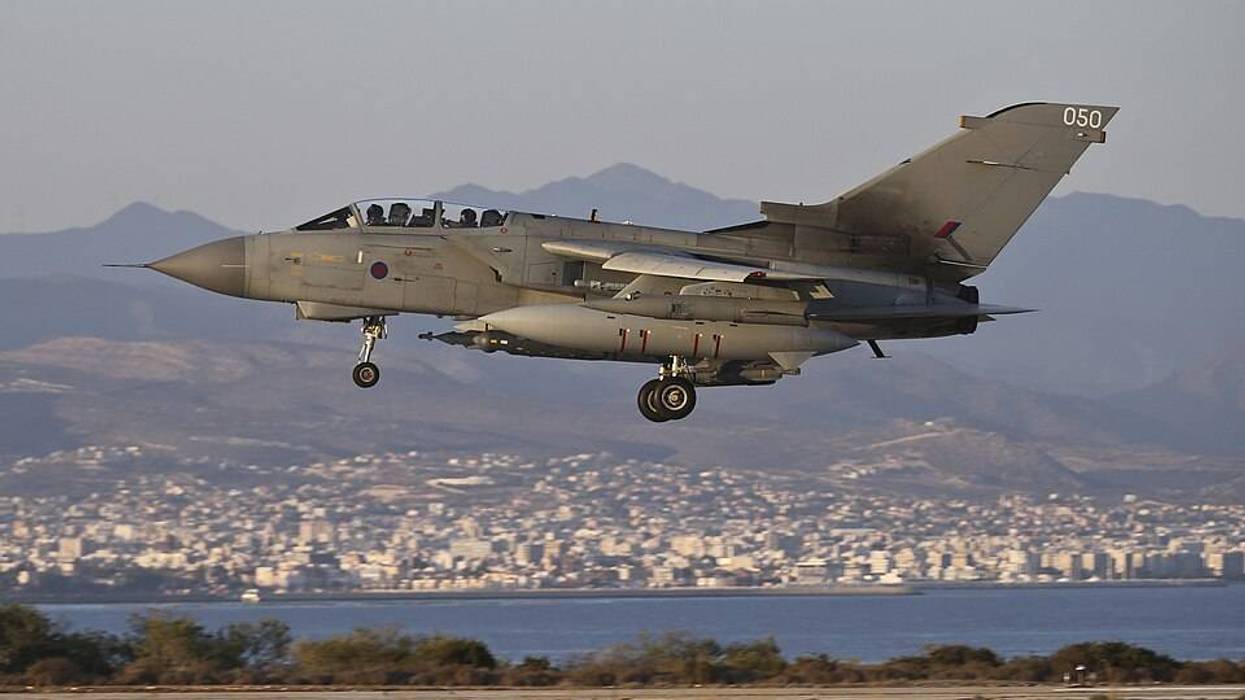
Royal Air Force (RAF) Akrotiri has been very important in the US attacks on Iran to date. For example, it provided a base for air refueling planes that refueled the bombers that struck Iran’s nuclear sites in June last year, and the bases likely provided intelligence and surveillance support for this operation too. Between March and May last year, the base also refueled US bombers, which attacked Yemen, an attack in which the RAF also directly participated. The base is used for all UK bombing of Iraq and Syria, which still happens sometimes, and it was almost certainly an intelligence hub for the American support for the successful counterrevolution in Syria. British F-35s are currently stationed in Akrotiri, reportedly to conduct ELINT (electronic intelligence) against Iran, essentially to use their advanced sensors to gather intelligence on Iranian air defenses as part of the current war. Any strike on Iran would commence with SEAD (suppression of enemy air defense) operations, necessitating mapping those air defenses out beforehand, which is what the F-35s are doing.
Now the British government has allowed the use of the bases on Cyprus for attacks on Iran, despite earlier denying this. Government Communications Headquarters (GCHQ) and the National Security Agency’s (NSA) main Middle Eastern intelligence base is in the British base area, which is extremely important to any military operations in the region. The NSA controls part of these bases more than GCHQ, meaning that there would be no oversight of US intelligence operations by the UK, let alone democratic accountability for the people of Britain or Cyprus to decide if they want this kind of thing happening on their land and in their political jurisdictions.
In the UK, we are facing the trumping of our own government and legal system by US imperial diktats, and our military and certainly this government, are choosing to actively promote it.
Britain’s role in US wars during the Trump administration has been much more significant than many people realize. Britain actually suspended Caribbean and Eastern Pacific-related intelligence sharing with the US in November 2025 because of the US strikes on fishing boats, which killed innocent people. The British state was briefing, ie, telling journalists anonymously, that this was because the strikes were illegal murders that Britain didn’t want to be implicated in legally, which was, of course, a self-interested position, not a moral one.
Yet by the start of this year, Britain had started to contribute to the Southern Spear mission directly, this time in relation to the oil blockade of Venezuela. Essentially, the UK drew a line between these different parts of US actions in the area, even though the tanker seizures are clearly illegal too. There were at least four examples where this is evidence of a direct British role in the seizure of tankers. Britain helped the US seize three tankers in the Caribbean with a total of 2.5 million barrels of oil—the M Sophia, the Olina, and the Sagitta—between January 7 and January 20. Britain contributed to this with surveillance flights, probably operating from British colonies in the Caribbean, from Florida, and from the Azores.
So once again, we see the intelligence and surveillance role that Britain plays in the imperial alliance; in lieu of a powerful navy, Britain seems to have specialized to an extent in its role. This type of activity is by its nature quite secretive—it would be politically difficult to have sent navy ships to interdict ships off Venezuela. But the surveillance contribution, enabled by the remaining empire’s geographical footprint, has not been picked up by the media here at all, and is also pretty unaccountable to parliament, and not subject to much democratic oversight. This, of course, mirrors Britain’s role in the Gaza genocide, where its surveillance contributions have been shrouded in secrecy and the details hidden even from members of Parliament who are supposed to have some oversight of the military or at least its participation in foreign wars.
The other case is that of the ship, the Bella 1, renamed the Marinera, which the US seized in the North Atlantic, between Iceland and Scotland, on January 7. This was a Russian-flagged tanker sailing from Venezuela to Russia. What happened here was more direct—US special forces flew to Britain, which was tracked by flight trackers following known special ops planes. Then, they undertook the seizure operation after flying from Britain in helicopters, and meeting US Navy ships. Britain provided more intense logistical and surveillance help in this instance, as it happened so close to Britain. The ship was stolen and brought to Scotland, and the 26 crew were kidnapped and falsely imprisoned in Scotland, with most being able to leave after the US had determined they were allowed to.
The captain and first mate of this ship, the captain being a Georgian citizen, were not allowed to go home by the US once detained in Scotland. The wife of the captain made an appeal to the Scottish courts, arguing that her husband was being illegally detained without the right to the proper extradition procedures. A Scottish court granted an interim interdict, an emergency injunction, prohibiting the removal of the captain from Scotland, while the case was heard and the courts made their decisions. However, immediately after that court decision, the very same night, the two men were taken from Scotland to a US Navy ship, which set sail for the US. A couple of days ago, the captain had his first court hearing in Puerto Rico, where he will be transferred to DC and put on trial for "preventing a lawful seizure" and failure to stop the vessel during the Coast Guard chase. The Scottish government condemned the US actions, but the Green Party of Scotland led a more serious analysis of the situation in the Scottish parliament, arguing that the US had basically illegally kidnapped people from Scotland, ignoring the courts.
There are a few things to pick up on here. Firstly, like all the US actions around Venezuela and the tankers, there was no legal basis for them to do any of this. A ship isn’t "illegal" or part of a "dark fleet" just because it’s "sanctioned" by one country. Venezuela and Russia are, in theory, sovereign nations that can conduct trade and sail ships between them; no one gets to randomly call any of that illegal. There is this pretense that somehow these sanctions represent international law, but they are just edicts by one country, with no relation to international law, treaties, the United Nations, or any multilateral decision-making body. In fact, Bella 1 was not even sanctioned by the UK, so what was the possible legal justification for the UK’s involvement in this?
The second part is the US flouting of Scottish and British law. Scotland has its own judicial system that is separate from the rest of the UK. It is under the UK Supreme Court and the British Parliament, but it can exercise judicial authority otherwise. Likewise, the Scottish government has a high level of autonomy within the UK, with its own elected parliament and government. The US violating the law of places where its troops are based is pretty normal—take all the murders and rapes that go along with US bases abroad, cases that have come to prominence in Japan and Korea, especially. A US diplomat’s wife killed a young man in a car crash near a US base a few years ago in England, and flew back to the US, never to face any consequences.
So, regardless of UK law and international law, the US is allowed, and even invited, to do whatever it wants in Britain, and can commission the British military to help. The British military is helping the US commit crimes in Britain, crimes under British law, in the case of the kidnapping of the sailors from Scotland. The British military is literally helping a foreign power defy civilian courts here. In the UK, we are facing the trumping of our own government and legal system by US imperial diktats, and our military and certainly this government, are choosing to actively promote it.
It is a serious crisis of sovereignty for the UK. It is more important to think of the imperial violence that we are dishing out to others rather than ruminating too much on the implications of that violence in the metropole, but there are the seeds of a domestic political and legal crisis here, which could one day help to undermine Britain’s role in all of this.
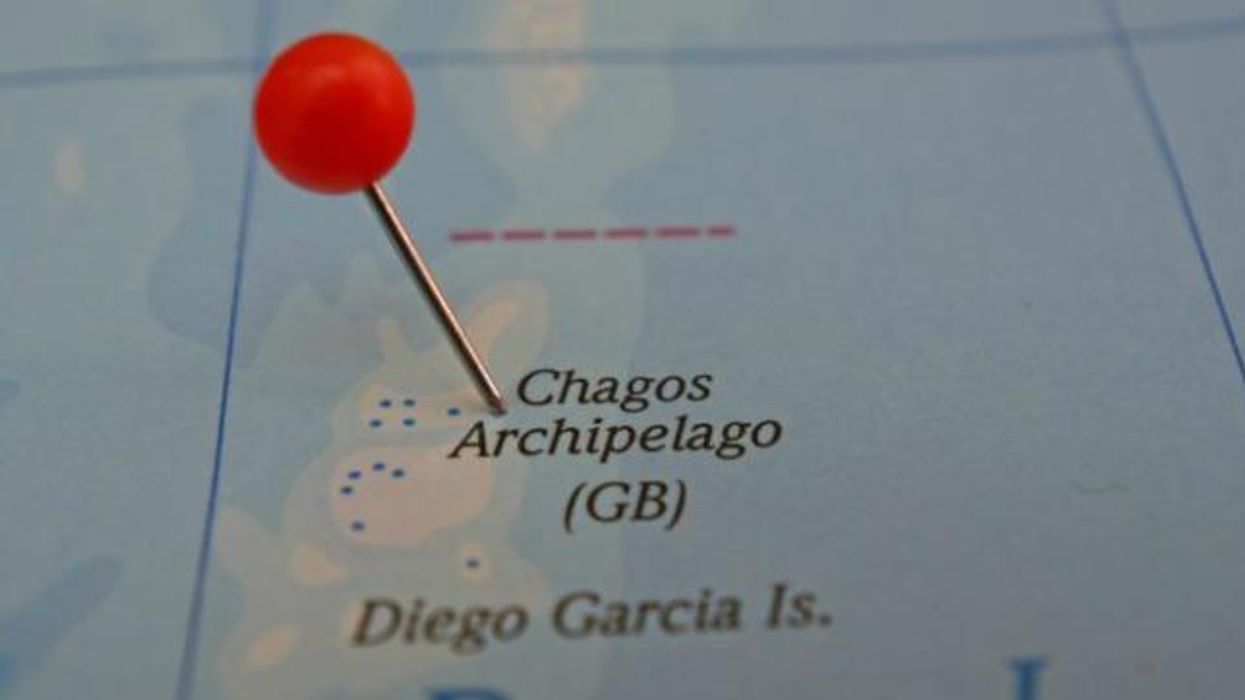
There was relatively big news in mid-February about the UK denying the US the use of its bases for their coming renewed war on Iran. Namely, bases in England and Diego Garcia, in the Indian Ocean. President Donald Trump posted angrily about this and again withdrew his support for the Chagos Islands deal. To summarize the current situation regarding the Chagos Islands, there’s a UK colony in the middle of the Indian Ocean called the British Indian Ocean Territory. After World War II, the US leased the main island, Diego Garcia, as an airbase, and it's now one of the most important US bases in the world due to its location. It was one of the CIA's black sites and has supported attacks on the region before, including on Iran. Mauritius went through international courts to force the UK to give it back to them and won, so, in 2025, the UK government made an agreement to hand over the territory but lease the base back from Mauritius for 99 years, guaranteeing the base’s status is basically unchanged.
The fact that the bases are a colonial relic is important because it gives our campaign the leverage to say that this is obviously wrong and obviously contradicts the international law that you, the imperial powers, set up, and this gives us the opportunity to build alliances based on that.
This is good news that there is some kind of rift between Britain and the US on this, but it does raise some interesting questions, and these denials have been rescinded anyway. Namely, can the UK always exercise this right of denial, because then it would proactively have had to have proactively approved US use of bases for attacking Iran last year, or did they approve the torture black site on Diego Garcia, do they approve the use of UK bases as transit for all this equipment to the Middle East which will be used to attack Iran anyway? Secondly, Trump posting that he "may have to use" the Fairford and Diego Garcia bases to attack Iran, despite apparently being told he can’t, should be a big deal! Again, the question of UK sovereignty over its own land and military resources comes up—can we even say no to the US, is it possible at all? And will this government do anything about it if their request is ignored? Highly unlikely.
However, it turns out that this whole issue may have originated in an order to the civil service in the foreign office, telling them to act as if the Chagos Islands deal had already gone through. In this case, it seems that the UK government asked the Mauritian government about the US request, and they must have said no, and so Britain said no. Alternatively, the foreign office may have said no based on the specific wording of the deal, where Britain must consult Mauritius on an attack on a third state from Diego Garcia, and have judged Trump’s intended actions to be an attack on the Iranian state, rather than self-defense, which would not require consultation.
This then makes it seem all the less benevolent. This government and the previous government, which started negotiations with Mauritius over this deal, have faced attacks from the right in the UK for giving away British land and throwing away an important base. The government has justified the deal not because it is the right thing to do, or by accepting any of the principles of the arguments around it, but instead, they justify it because they say it is the only way to keep the base operating. They claim that because of the International Court of Justice ruling, they would be forced to cede the territory very soon, and so it was best to make a deal first.
We don’t typically have much faith in these organs of international law, as they were set up to enforce the imperial order. However, it is possible for the subjects of that order to assert some agency and attempt to use that system in an insurgent manner. In this case, it is Mauritius and much of the world supporting it, which has forced this to happen, and indirectly has caused this rift and may prevent the base from being used for these attacks.
I don’t think this will ultimately work, and the US would probably just use them anyway, but these are all interesting things to consider in relation to the base question. It seems that the UK is now allowing the use of Diego Garcia for attacks on Iran, which it deems "defensive" even though that definition includes strikes on ground targets. The potential utility of this model of handover deal, despite keeping the base open, does then seem to restrict the uses of the base in line with aspects of Mauritian sovereignty, disrupting the bases in some way or another, which is a big decolonial win the left has not yet fully grasped.
We could then conclude that a big concerted international campaign against blatant colonial practices may actually work in damaging the effectiveness of these colonial overseas bases to some extent. Mauritius exploited the inherent contradictions between international law on the one hand and the bases’ colonial nature on the other, to build a campaign, get almost everyone onside, and force a reckoning in the international courts, which is binding. So for Cyprus, although it is a different situation in many ways, we can see similarities, and we can learn from what’s happened around Diego Garcia.
The fact that the bases are a colonial relic is important because it gives our campaign the leverage to say that this is obviously wrong and obviously contradicts the international law that you, the imperial powers, set up, and this gives us the opportunity to build alliances based on that. That is actually much easier and much less radical than talking about the bases’ role in genocide, which seems wholly exempt from the international law system, which shows how dehumanized Palestinians and Gaza are.
The US-UK Bases Off Cyprus Campaign that CODEPINK is running has those two integral parts to it, working on the bases in Cyprus’ contribution to genocide and imperial wars, and their inherent status as a colony on occupied land. Linking those two parts of the base question is the central point of what we’re trying to do and trying to expose, as a step toward practical change to the bases’ status.
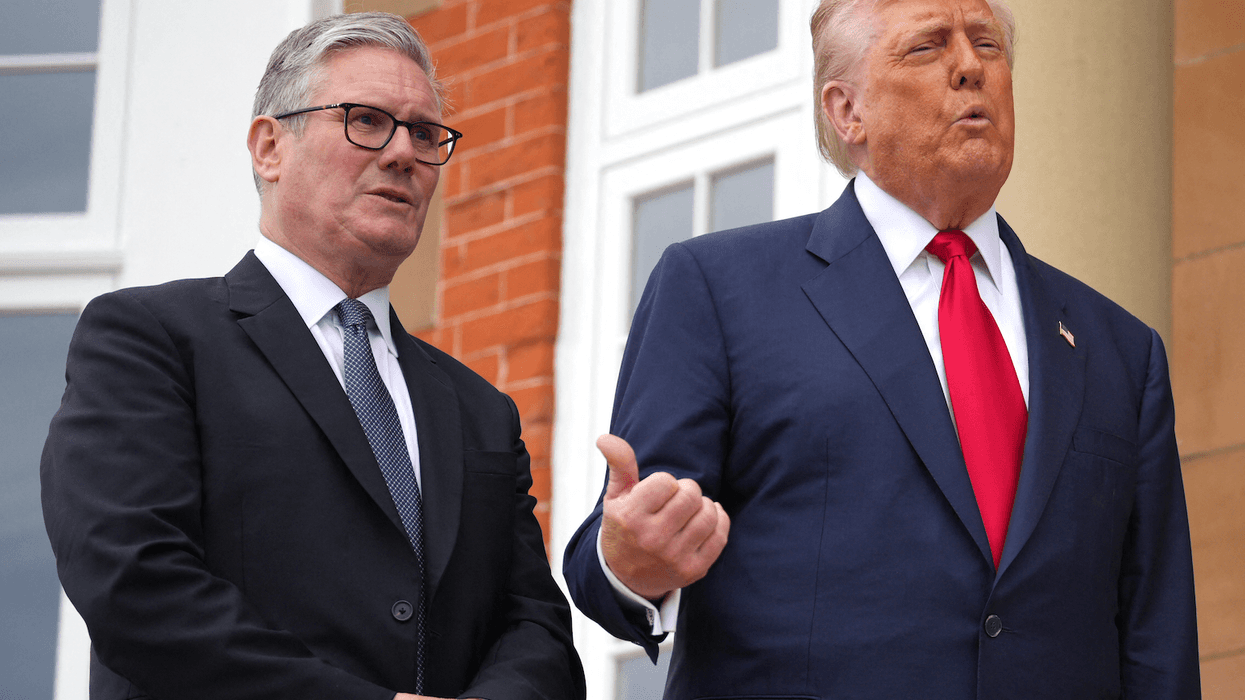
Trump lambasted Britain for an agreement transferring sovereignty of the Chagos archipelago—which includes Diego Garcia, site of a major US-UK military base—to Mauritius.
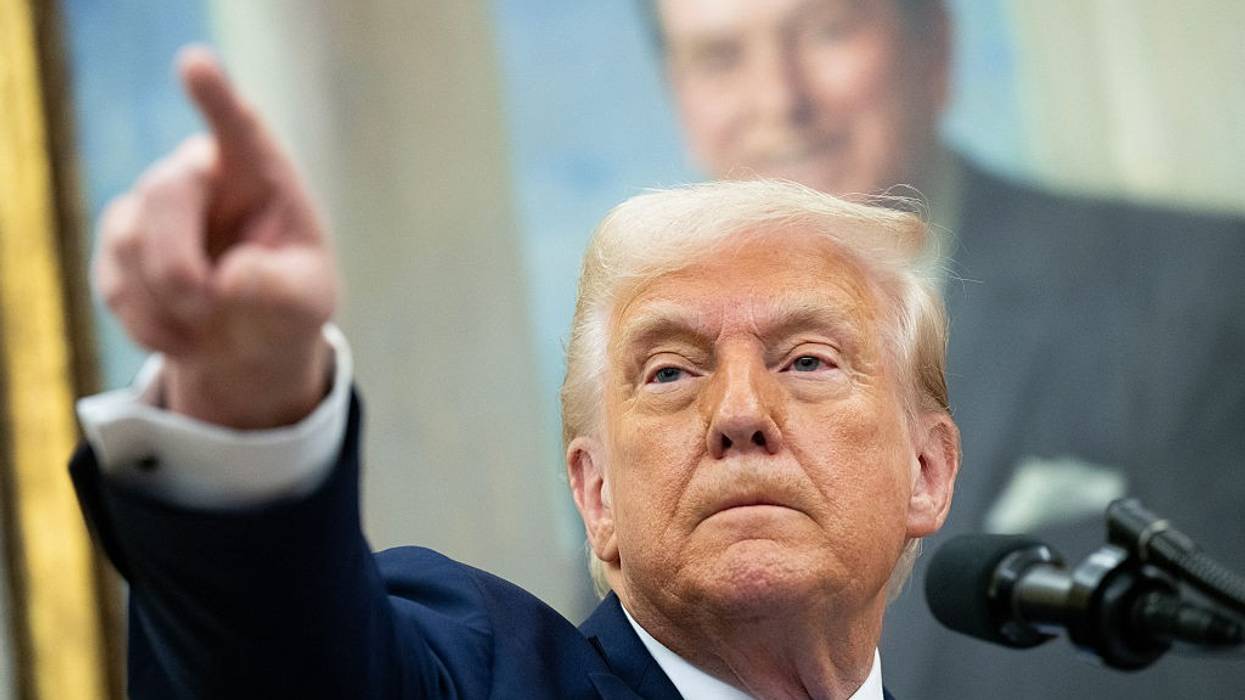
President Donald Trump on Wednesday suggested that the United States could launch attacks on Iran from British territory with or without the permission of the UK government.
Trump opened a characteristically rambling post on his Truth Social network by disparaging last year's deal under which the UK is ceding sovereignty of the Chagos archipelago to Mauritius, with the exception of Diego Garcia, an island from which the Indigenous Chagossian people were forcibly expelled over half a century ago to make way for one of the world’s largest and most important US military bases, which is jointly operated by Britain.
"I have been telling [UK] Prime Minister Keir Starmer, of the United Kingdom, that Leases are no good when it comes to Countries, and that he is making a big mistake by entering a 100 Year Lease with whoever it is that is 'claiming' Right, Title, and Interest to Diego Garcia, strategically located in the Indian Ocean," Trump wrote.
"Our relationship with the United Kingdom is a strong and powerful one, and it has been for many years, but Prime Minister Starmer is losing control of this important Island by claims of entities never known of before," the president continued. "In our opinion, they are fictitious in nature."
"Should Iran decide not to make a Deal, it may be necessary for the United States to use Diego Garcia, and the Airfield located in Fairford, in order to eradicate a potential attack by a highly unstable and dangerous Regime—An attack that would potentially be made on the United Kingdom, as well as other friendly Countries," Trump added, referring to the critical US Air Force forward operating base at RAF Fairford in Gloucestershire.
Trump's post came as an advisor to the president said there is "a 90% chance" of a US attack on Iran in the coming weeks after nuclear talks end in Switzerland. Administration rhetoric and US movements suggest that Trump may soon resume bombing of Iran following last summer's bombing and assassination campaign targeting the country's nuclear scientists and infrastructure.
The president's Truth Social post concluded: "Prime Minister Starmer should not lose control, for any reason, of Diego Garcia, by entering a tenuous, at best, 100 Year Lease. This land should not be taken away from the UK and, if it is allowed to be, it will be a blight on our Great Ally. We will always be ready, willing, and able to fight for the UK, but they have to remain strong in the face of Wokeism, and other problems put before them. DO NOT GIVE AWAY DIEGO GARCIA!"
Trump's post stood in stark contrast the State Department, which said Tuesday that the US "supports the decision of the United Kingdom to proceed with its agreement with Mauritius concerning the Chagos archipelago".
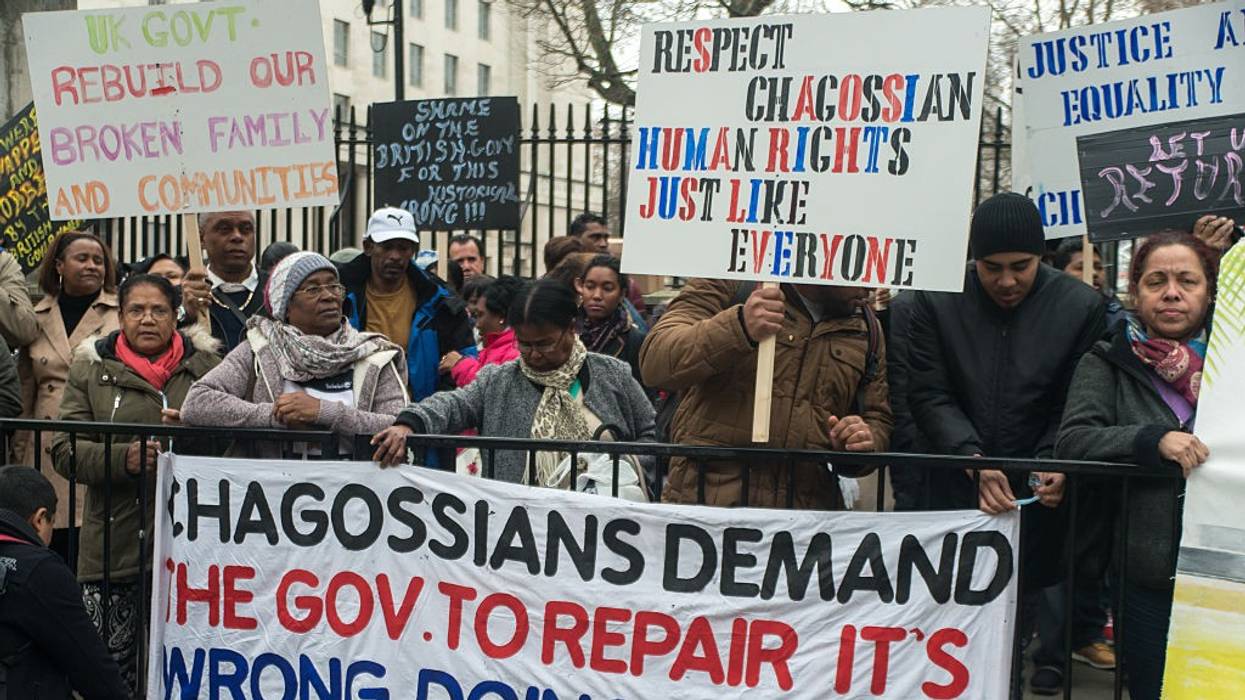
Under the UK-Mauritius deal, Mauritius authorities will facilitate Chagossians’ eventual resettlement of their archipelago, with the apparent glaring exception of Diego Garcia. While some Chagossians welcomed the agreement, others denounced it, largely due to the exclusion of the Chagossian community from the negotiations.
Diego Garcia was once home to around 1,500 Creole-speaking Chagossians and their beloved dogs. However, in the 1960s the US convinced Britain to grant it full control there and subsequently began to “sweep” and “sanitize” the atoll of its Indigenous population, in the words of one American official.
“We must surely be very tough about this,” a British official privately wrote, adding that “there will be no Indigenous population except seagulls.”
Many Chagossians were tricked or terrorized into leaving. US Marines told them they’d be bombed if they didn’t evacuate, and Chagossians’ dogs were gassed to death with fumes from military vehicles. The islanders were permitted to take just one suitcase with them. Most were shipped to Mauritius, where they were treated as second-class citizens and where many ended up living in poverty and heartbreak in the slums of the capital, Port Louis.
Meanwhile, the US and Britain used Diego Garcia as a base for attacks on countries including Afghanistan, Pakistan, and Iraq during the so-called War on Terror, while despoiling the atoll's water with human sewage.
Britain’s High Court of Justice twice ruled that the Chagossians' removal was illegal. In 2019, the International Court of Justice in The Hague issued an advisory opinion that the UK was exercising “illegal” sovereignty over Diego Garcia and urged the British government to “decolonize” the atoll by handing sovereignty to Mauritius, whose government long contended it was forced to cede control in order to secure its own independence.
The Chagossians’ return to most of their homeland is a victory for resolving conflicts through diplomacy rather than force, as well as for decolonization and international law.
At a time when many may feel that good news has gone the way of the dodo, look no further than the homeland of that long-extinct bird—Mauritius—for a dose of encouragement. There, among the islands of the Indian Ocean, news can be found about the power of resistance and the ability of small groups of people to band together to overcome the powerful.
Amid ongoing slaughter from Gaza and Ukraine to Sudan and the Congo, the news also offers a victory for resolving conflicts through diplomacy rather than force. It’s a victory for decolonization and international law. And it’s a victory for Africa, the African diaspora, and Indigenous and other displaced peoples who simply want to go home. To the shock of many, President Donald Trump actually played a role in making such good news possible by bucking far-right allies in the United States and Britain.
While the victories the Chagossians, a group numbering less than 8,000, finally achieved last month are anything but perfect, they wouldn’t have happened without a more than half-century-long struggle for justice.
The news came in late May when the British government signed a historic treaty with Mauritius giving up Britain’s last African colony, the Chagos Islands, and allow the exiled Chagossian people to return home to all but one of them. The British also promised to pay an estimated £3.4 billion over 99 years in exchange for continuing control over one island, the largest, Diego Garcia. Though few in the U.S. even know that it exists, the Chagos Archipelago, located in the center of the Indian Ocean, is also home to a major U.S. military base on Diego Garcia that has played a key role in virtually every U.S. war and military operation in the Middle East since the 1970s.
Diego Garcia is one of the most powerful installations in a network of more than 750 U.S. military bases around the world that have helped control foreign lands in a largely unnoticed fashion since World War II. Far more secretive than the Guantánamo Bay naval base, Diego Garcia has been, with rare exceptions, off limits to anyone but U.S. and British military personnel since that base was created in 1971. Until recently, that ban also applied to the other Chagos Islands from which the Indigenous Chagossian people were exiled during the base’s creation in what Human Rights Watch has called a “crime against humanity.”
While the victories the Chagossians, a group numbering less than 8,000, finally achieved last month are anything but perfect, they wouldn’t have happened without a more than half-century-long struggle for justice. A real-life David and Goliath story, it demonstrates the ability of small but dedicated groups to overcome the most powerful governments on Earth.
The story begins around the time of the American Revolution when the ancestors of today’s Chagossians first began settling on Diego Garcia and the other uninhabited Chagos islands. Enslaved at the time, they were brought from Africa, along with indentured laborers from India, by French businessmen from Mauritius who used the workers to build coconut plantations there.
Over time, the population grew, gaining its emancipation, while a new society emerged. First known as the Ilois (the Islanders), they developed their own traditions, history, and Chagossian Kreol language. Although their islands were dominated by plantations, the Chagossians enjoyed a generally secure life, thanks in part to their often militant demands for better working conditions. Over time, they came to enjoy universal employment, free basichealthcare and education, regular vacations, housing, burial benefits, and a workday they could control, while living on gorgeous tropical islands.
“Life there paid little money, a very little,” one of the longtime leaders of the Chagossian struggle, Rita Bancoult, told me before her death in 2016, “but it was the sweet life.”
Chagos remained a little-known part of the British Empire from the early 19th century when Great Britain seized the archipelago from France until the 1950s when Washington grew interested in the islands as possible military bases.
Amidst Cold War competition with the Soviet Union and accelerating decolonization globally, U.S. officials worried about being evicted from bases in former European colonies then gaining their independence. Securing rights to build new military installations on strategically located islands became one solution to that perceived problem. Which is what led Stuart Barber, a U.S. Navy planner, to find what he called “that beautiful atoll of Diego Garcia, right in the middle of the ocean.” He and other officials loved Diego Garcia because it was within striking distance of a vast region, from southern Africa and the Middle East to South and Southeast Asia, while also possessing a protected lagoon capable of handling the largest naval vessels and a major air base.
In 1960, U.S. officials began secret negotiations with their British counterparts. By 1965, they had convinced the British to violate international law by separating the Chagos Islands from the rest of its colony of Mauritius to create the “British Indian Ocean Territory.” No matter that United Nations decolonization rules then prohibited colonial powers from chopping up colonies when, like Mauritius, they were gaining their independence. Britain’s last--created colony would have one purpose: hosting military bases. U.S. negotiators insisted Chagos come under their “exclusive control (without local inhabitants)”—an expulsion order embedded in a parenthetical phrase.
British officials and American sailors rounded up people’s pet dogs, lured them into sealed sheds, and gassed them with the exhaust from Navy vehicles before burning their carcasses.
U.S. and British officials sealed their deal with a 1966 agreement in which Washington would secretly transfer $14 million to the British government in exchange for basing rights on Diego Garcia. The British agreed to do the dirty work of getting rid of the Chagossians.
First, they prevented any Chagossians who had left on vacation or for medical treatment from returning home. Next, they cut off food and medical supplies to the islands. Finally, they deported the remaining Chagossians 1,200 miles to Mauritius and the Seychelles in the western Indian Ocean.
Both governments acknowledged that the expulsions were illegal. Both agreed to “maintain the fiction” that the Chagossians were “migrant laborers,” not a people whose ancestors had lived and died there for generations. In a secret cable, a British official called them “Tarzans” and, in a no less racist reference to Robinson Crusoe, “Man Fridays.”
In 1971, as the U.S. Navy started base construction on Diego Garcia, British officials and American sailors rounded up people’s pet dogs, lured them into sealed sheds, and gassed them with the exhaust from Navy vehicles before burning their carcasses. Chagossians watched in horror. Most were then deported in the holds of overcrowded cargo ships carrying dried coconut, horses, and guano (bird shit). Chagossians have compared the conditions to those found on slave ships.
In exile, they effectively received no resettlement assistance. When The Washington Post finally broke the story in 1975, a journalist found Chagossians living in “abject poverty” in the slums of Mauritius. By the 1980s, the base on Diego Garcia would be a multibillion-dollar installation. The U.S. military dubbed it the “Footprint of Freedom.”
The Chagossians have long demanded both the right to go home and compensation for the theft of their homeland. Led mostly by a group of fiercely committed women, they protested, petitioned, held hunger strikes, resisted riot police, went to jail, approached the U.N., filed lawsuits, and pursued nearly every strategy imaginable to convince the U.S. and British governments to let them return.
In the late 1970s and early 1980s, Chagossian protests in Mauritius won them small amounts of compensation from the British government (valued at around $6,000 per adult). Many used the money to pay off significant debts incurred since their arrival. Chagossians in the Seychelles, however, received nothing.
Still, their desire to return to the land of their ancestors remained, and hope was rekindled when the Chagos Refugees Group sued the British government in 1997, led by Rita Bancoult’s son, Olivier. To the surprise of many, they won. Over several tumultuous years, British judges ruled their expulsion illegal three times—only to have Britain’s highest court repeatedly rule in favor of the government by a single vote. Judges in the U.S. similarly rejected a suit, deferring to the president’s power to make foreign policy. The European Court of Human Rights also ruled against them.
Despite the painful defeats, Chagossian prospects brightened when the Chagos Refugees Group allied with the Mauritian government to take Britain to the International Court of Justice. Aided by Chagossian testimony about their expulsion, which an African Union representative called “the voice of Africa,” Mauritius won. In 2019, that court overwhelmingly ruled that Mauritius was the rightful sovereign in Chagos. It directed the U.K. to end its colonial rule “as rapidly as possible.” A subsequent U.N. General Assembly resolution ordered the British “to cooperate with Mauritius in facilitating the resettlement” of Chagossians.
Backed by the U.S., the British initially ignored the international consensus—until, in 2022, Prime Minister Liz Truss’ government suddenly began negotiations with the Mauritians. Two years later, a deal was reached with the support of the Biden administration. The deal recognized Mauritian sovereignty over Chagos but allowed Britain to retain control of Diego Garcia for at least 99 years, including the continued operation of the U.S. base. The Chagossians would be allowed to return to all their islands except, painfully, Diego Garcia and receive compensation.
The Chagos Refugees Group and other Chagossian organizations generally supported the deal, while continuing to demand the right to live on Diego Garcia. Some smaller Chagossian groups, especially in Britain (where many Chagossians have lived since winning full U.K. citizenship in 2002), opposed the agreement. Some still support British rule. Others seek Chagossian sovereignty.
Right-wing forces in Britain and the United States quickly tried to kill the deal. Former Prime Minister Boris Johnson, Brexit protagonist Nigel Farage, and then-Senator Marco Rubio campaigned for continued British colonial rule, often spouting bogus theories suggesting the agreement would benefit China.
Donald Trump’s election and the appointment of Rubio as secretary of state left many fearing they would kill the treaty. Instead, when Prime Minister Keir Starmer visited Washington, Trump indicated his support. A finalized treaty was in sight.
In the last hours, the deal was briefly blocked by a lawsuit that a judge later dismissed. “I’ve been betrayed by the British government,” Bernadette Dugasse, one of two Chagossians who brought the suit, said of the treaty. “I will have to keep on fighting the British government till they accept for me to settle” on Diego Garcia (where she was born).
Dugasse’s suit and plans for additional legal action are being funded by a shadowy “Great British PAC” that won’t disclose its donors. The group is led by right-wing political figures still trying, in their words, to “Save Chagos.” However, “saving Chagos” doesn’t mean saving Chagos for the Chagossians, but “saving” it from the end of British colonial control. In other words, right-wing figures are cynically using Chagossians to try to uphold the colonial status quo. (Even Dugasse fears she’s being used.)
On the other hand, the Chagos Refugees Group and many other Chagossians are celebrating, at least partially. For the first time in more than half a century of struggle they can go home to most of their islands, even if they, too, criticize the ban on returning to Diego Garcia and the shamefully small amount of compensation being offered: just £40 million earmarked for a Chagossian “trust fund” operated by the Mauritian government (with British consultation). Divided among the entire population, this could be as little as £5,000 per person for the theft of their homeland and more than half a century in exile. (People in car accidents get far more.)
Chagossians, backed by allies in Mauritius and beyond, are continuing their struggle for the right to return to Diego Garcia, for the reconstruction of Chagossian society in Chagos, and for full, proper compensation.
“I’m very happy after such a long fight,” Sabrina Jean, leader of the Chagos Refugees Group U.K. Branch, told me. “But I’m also upset about how the U.K. government continues to treat us for all the suffering it gave Chagossians,” she added. “£40 million is not enough.”
The Mauritian government should benefit more unambiguously than the Chagossians: The treaty formally ends decolonization from Britain, reuniting Mauritius and the Chagos Islands. Mauritius will receive an average of £101 million in rent per year for 99 years for Diego Garcia plus £1.125 billion in “development” funds paid over 25 years.
“The development fund will be used to resettle” Chagossians on the islands outside Diego Garcia, said Olivier Bancoult, now the president of the Chagos Refugees Group, about a commitment he’s received from the Mauritian government. “They have promised to rebuild Chagos.”
Bancoult and other Chagossians insist they also should receive some of the annual rent for Diego Garcia. “Parts of it needs to be used for Chagossians,” he told me by phone from Mauritius.
The continuing ban on Chagossians living on Diego Garcia clearly violates Chagossians’ human rights as well as the International Court’s ruling and that U.N. resolution of 2019. Human Rights Watch criticized the treaty for appearing to “entrench the policy that prevents Chagossians from returning to Diego Garcia” and failing to acknowledge U.S. and British responsibility for compensating the Chagossians and reconstructing infrastructure to enable their return.
“We will not give up concerning Diego,” Olivier Bancoult told me. For those born on Diego Garcia and those with ancestors buried there, it’s not enough to return to the other Chagos islands, at least 150 miles away. “We will continue to argue for our right to return to Diego Garcia,” he added.
While U.S. and British officials have long used “security” as an excuse to keep Chagossians off the island, they could, in truth, still live on the other half of Diego Garcia, miles from the base, just as civilians live near U.S. bases worldwide. Civilian laborers who are neither U.S. nor British citizens have lived and worked there for decades. (Chagossians will be eligible for such jobs, although historically they’ve faced discrimination getting hired.)
That the U.S. military has ended up a winner in the treaty could explain Donald Trump’s surprising support. The treaty secures base access for at least 99 years and possibly 40 more.
Which means the treaty is a setback for those Mauritians, Americans, and others who have campaigned to close a base that has cost U.S. taxpayers billions of dollars and has been a launchpad for catastrophic wars in the Middle East, which a certain president claimed to oppose.
While many Chagossians are privately critical of the base that caused their expulsion and occupies their land, most have prioritized going home over demanding its closure. The campaign to return has been hard enough.
Ultimately, I’m in no position to decide if the Chagos treaty is a victory or not. That’s for Chagossians and Mauritians to decide, not a citizen of the country that, along with Great Britain, is the primary author of that ongoing, shameful crime.
Let me note that victories are rarely, if ever, complete, especially when the power imbalance between parties is so vast. Chagossians, backed by allies in Mauritius and beyond, are continuing their struggle for the right to return to Diego Garcia, for the reconstruction of Chagossian society in Chagos, and for full, proper compensation. The Mauritian and British governments can correct the treaty’s flaws through a diplomatic “exchange of letters.”
“We are closer to the goal” of full victory, Olivier assured me. “We are very near.”
Having won the right to return to most of their islands after 50 years of struggle, Olivier has been thinking a lot about his mother, longtime leader Rita Bancoult. “I would like that my mom would be here, but I know if she would be here, she would be crying,” he said, “because she always believed in what I do, and she always encouraged me to go until the destination, the goal.”
For now, inspired by the memory of his mother and too many Chagossians who will never see a return to their homeland, Olivier told me, “lalit kontin.” The struggle continues.
Despite U.S. intelligence once again finding Iran is not currently developing nukes, the president is trying to force Tehran into a nuclear deal after unilaterally abrogating an existing one in 2018.
Iran's military has reportedly readied ballistic missiles for possible launch against U.S. bases in the Middle East after President Donald Trump renewed his threat to wage war on the country if it does not reach an agreement with his administration regarding nuclear weapons—which American intelligence agencies have repeatedly found Tehran is not building.
Trump discussed Iran during a Sunday phone call with NBC News' Kristen Welker, telling her that "if they don't make a deal, there will be bombing, and it will be bombing the likes of which they have never seen before," adding that there is also "a chance that if they don't make a deal, that I will do secondary tariffs on them like I did four years ago."
Ayatollah Seyyed Ali Khamenei, the supreme leader of Iran's theocratic government, warned Monday that "if any hostile act is committed from outside, though the likelihood is not high, it will undoubtedly be met with a strong counterstrike."
Esmaeil Baghaei, a spokesperson for Iran's Foreign Ministry, said on social media Monday that "an open threat of bombing by a head of state against Iran is a shocking affront to the very essence of international peace and security."
"It violates the United Nations Charter and betrays the safeguards under the [International Atomic Energy Agency]," Baghaei added. "Violence breeds violence, peace begets peace. The U.S. can choose the course."
Iranian Gen. Amir Ali Hajizadeh, commander of the Islamic Revolutionary Guard Corps' (IRGC) Aerospace Division, noted Monday that "the Americans have 10 bases in the region, particularly around Iran, and 50,000 troops based in there."
"This means they are sitting in a glass house; and when one sits in a glass house, one does not throw stones at others," he added.
The Tehran Times reported Monday that Iran's military has "readied missiles with the capability to strike U.S.-related positions" and that "a significant number of these launch-ready missiles are located in underground facilities scattered across the country, designed to withstand airstrikes."
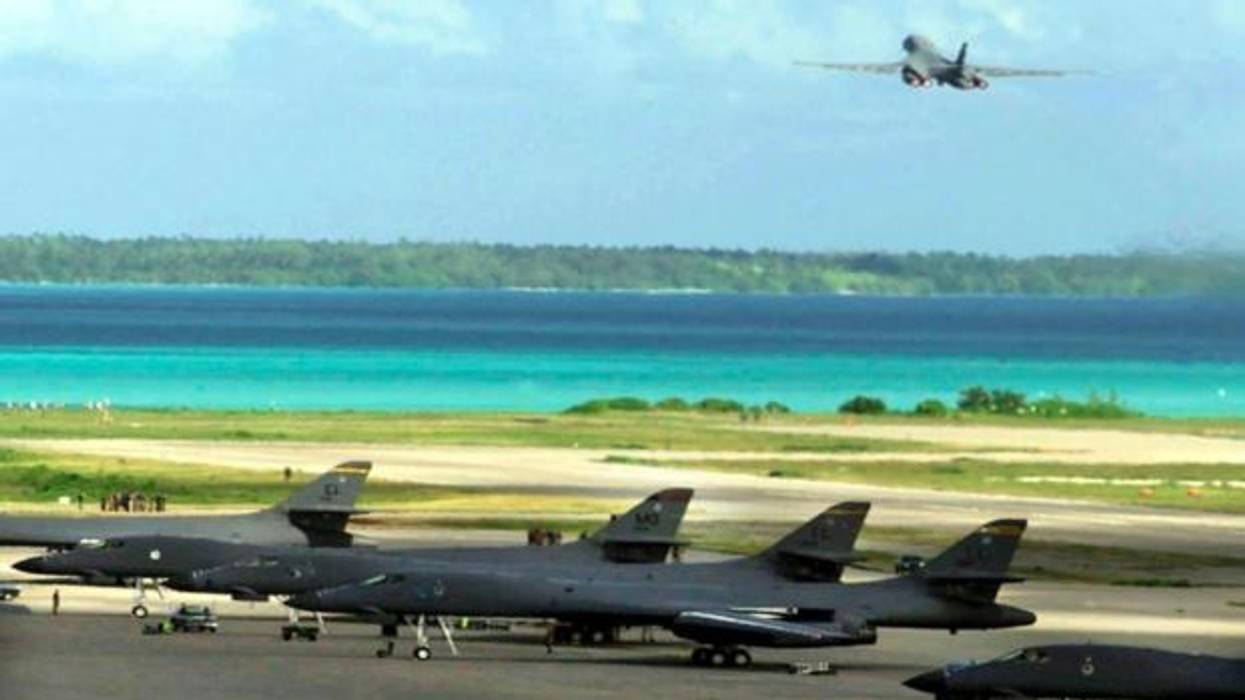
The U.S., meanwhile, is amassing firepower including B-2 Stealth Bombers at its base on the forcibly depopulated island of Diego Garcia in the Indian Ocean for possible use in strikes against Iran.
Trump today: If Iran does not agree to a deal “There will be bombing and it will be bombing the likes of which they have never seen before” Can he go 1 day without threatening a new war? How many would he like? - Greenland - Panama - Gaza - Mexico - Yemen - Somalia - Gaza - Venezuela Is 8 enough?
— Secular Talk (@kylekulinskishow.bsky.social) March 30, 2025 at 8:36 PM
Trump's threat to attack Iran—which hasn't started a war since the mid-19th century—comes despite U.S. Director of National Intelligence Tulsi Gabbardtestifying before the Senate Select Committee on Intelligence last week that "Iran is not building a nuclear weapon and Supreme Leader Khamanei has not authorized the nuclear weapons program he suspended in 2003."
U.S. intelligence agencies have repeatedly come to the same conclusion since the George W. Bush administration.
However, Gabbard added that "Iran's enriched uranium stockpile is at its highest levels and is unprecedented for a state without nuclear weapons."
That's at least partly due to the unilateral U.S. withdrawal from the landmark Joint Comprehensive Plan of Action (JCPOA)—also known as the Iran nuclear deal—in 2018 during Trump's first administration.
Since Trump abandoned the JCPOA—which was signed in 2015 during the Obama administration by China, France, Germany, Iran, Russia, the United Kingdom, and the United States—Tehran has been operating advanced centrifuges and rapidly stockpiling enriched uranium.
While there were hopes of a renewed deal during the tenure of former U.S. President Joe Biden, no agreement was reached, and Iranians continue to suffer under economic sanctions that critics have said are killing people and crippling the country's economy.
Earlier this month, Trump sent a letter to Khamenei in which he claims to have said, "I hope you're going to negotiate because if we have to go in militarily, it's going to be a terrible thing."
On Sunday, Iranian President Masoud Pezeshkian left open the possibility of indirect talks but said that the U.S. could not be trusted to keep its word.
"We don't avoid talks; it's the breach of promises that has caused issues for us so far," Pezeshkian said during a televised Cabinet meeting. "They must prove that they can build trust."
This isn't the first time that Trump has threatened Iran. In 2020, during his first term, the president vowed to strike 52 sites across Iran "very fast and very hard" if it retaliated for the U.S. assassination of IRGC commander Gen. Qasem Soleimani in Iraq. Later that year, Trump had another message for Iran: "If you fuck around with us, if you do something bad to us, we are going to do things to you that have never been done before."
On the campaign trail last September, Trump told Iranians he would "blow your largest cities and the country itself to smithereens" if he was reelected and Iran didn't cease what he perceives as threats against the United States.
While the U.S. has never directly attacked Iran, it did help overthrow the country's reformist government in 1953 and supported a repressive monarchy for decades leading up to the Islamic Revolution of 1979. The U.S. backed Iraq during that country's eight-year war against Iran, during which then-Iraqi President Saddam Hussein's forces used chemical weapons against Iranian troops and his own restive Kurdish population. In 1988, a U.S. warship in Iranian waters accidentally shot down Iran Air Flight 655, killing all 290 passengers and crew aboard. Then-President Ronald Reagan blamed the incident on the "barbaric Iranians."
The U.S. has also
supported the People's Mujahedin of Iran (MEK), a State Department-designated terrorist group that had previously assassinated six American officials, and successive U.S. administrations have used international financial institutions to punish Iran, like in 2007 when Bush pressured the World Bank into suspending emergency relief aid after the 2003 Bam earthquake, which killed more than 26,000 Iranians.
"We remain powerless and voiceless in determining our own future and the future of our homeland," one diaspora Chagossian said in response to the agreement.
Activists on Thursday decried a deal under which the United Kingdom will cede sovereignty of the Chagos Archipelago to Mauritius with the exception of Diego Garcia, an island from which the Indigenous Chagossian people were forcibly expelled over half a century ago to make way for one of the world's largest and most important U.S. military bases.
The agreement—which was announced Thursday by the U.K. and Mauritius governments—grants the latter full sovereignty over the remote Indian Ocean archipelago, while allowing the United States and Britain to keep the joint base on Diego Garcia for the next 99 years. Under the deal, Mauritius authorities will facilitate Chagossians' eventual resettlement of the archipelago, with the apparent glaring exception of Diego Garcia.
"Following two years of negotiation, this is a seminal moment in our relationship and a demonstration of our enduring commitment to the peaceful resolution of disputes and the rule of law," a joint statement published by the U.K. and Mauritius governments states. "Negotiations have been conducted in a constructive and respectful manner, as equal sovereign states, on the basis of international law, and with the intention of resolving all outstanding issues between the United Kingdom and Mauritius concerning the Chagos Archipelago, including those relating to its former inhabitants."
"The treaty will address wrongs of the past and demonstrate the commitment of both parties to support the welfare of Chagossians," the statement adds. "Mauritius will now be free to implement a program of resettlement on the islands of the Chagos Archipelago, other than Diego Garcia, and the U.K. will capitalize a new trust fund, as well as separately provide other support, for the benefit of Chagossians."
U.S. President Joe Biden welcomed what he called the "historic agreement," which he said represents a "clear demonstration that through diplomacy and partnership, countries can overcome long-standing historical challenges to reach peaceful and mutually beneficial outcomes."
Some Chagossians also welcomed the deal. Isabelle Charlot, chair of the Chagos Islanders Movement, told BBC Radio 4 that the agreement gave her hope that her family could return to "a place that we can call home, where we will be free."
Other Chagossians decried the deal. The advocacy group Chagossian Voices—which is based in Crawley in West Sussex, England—said in a statement:
Chagossian Voices deplore the exclusion of the Chagossian community from the negotiations which have produced this statement of intent concerning the sovereignty of our homeland. Chagossians have learned this outcome from the media and remain powerless and voiceless in determining our own future and the future of our homeland. The views of Chagossians, the Indigenous inhabitants of the islands, have been consistently and deliberately ignored and we demand full inclusion in the drafting of the treaty.
"We remain powerless and voiceless in determining our own future and the future of our homeland," Chagossian Voices founding member Frankie Bontemps told the BBC.
Diego Garcia was once home to around 1,500 Creole-speaking Chagossians and their beloved dogs. However, in the 1960s the U.S. convinced Britain to grant it full control there and subsequently began to "sweep" and "sanitize" the atoll of its Indigenous population, in the words of one American official.
"We must surely be very tough about this," one British official privately wrote, adding that "there will be no Indigenous population except seagulls."
Many Chagossians were tricked or terrorized into leaving. U.S. Marines told them they'd be bombed if they didn't evacuate, and Chagossians' dogs were gassed to death with fumes from military vehicles. The islanders were permitted to take just one suitcase with them. Most were shipped to Mauritius, where they were treated as second-class citizens and where many ended up living in poverty and heartbreak in the slums of the capital, Port Louis.
Meanwhile—and without any apparent sense of irony—the U.S. military dubbed the new Halliburton-built base on Diego Garcia Camp Justice. In addition to launching an unknown number of attacks on countries including Afghanistan, Pakistan, and Iraq from Diego Garcia during the ongoing so-called War on Terror, the U.S. military also dumped large amounts of human sewage into a protected coral lagoon on the atoll, belying British claims of commitment to ecological stewardship.
The forced displacement of the Chagossians was largely hidden from the U.S. and British public. However, the Chagossians never stopped fighting for justice. Britain's High Court of Justice twice ruled that their removal was illegal. In 2010, WikiLeaks published a secret U.S. diplomatic cable exposing nefarious intentions—denying Chagossians their right of return—behind the establishment of a marine reserve around the atoll.
In 2019, the International Court of Justice in The Hague issued an advisory opinion that the U.K. was exercising "illegal" sovereignty over Diego Garcia and urged the British government to "decolonize" the atoll by handing sovereignty to Mauritius, whose government long contended it was forced to cede control in order to secure its own independence from Britain.
Responding to the new agreement, Human Rights Watch (HRW) said Thursday that while the deal will "address the wrongs against the Chagossians of the past," it "looks like it will continue the crimes long into the future."
"It does not guarantee that the Chagossians will return to their homeland, appears to explicitly ban them from the largest island, Diego Garcia, for another century, and does not mention the reparations they are allowed to rebuild their future," HRW senior legal adviser Clive Baldwin said in a statement.
This month I got two of the most distressing pieces of news I could imagine. The first was a headline: US to use Galapagos island as a military airfield. The second came from my grandmother: two of our family friends are in the end stages of Agent Orange poisoning.
I'm from Guam; one of the countless islands of the Pacific used by the United States military as a base. At just 8 miles wide and 30 miles long, about a third of our island is covered by military installations with more build-up expected. My family and my community know all too well what being used as an airfield means. 52,000 veterans have organized into the group Agent Orange Survivors of Guam to lobby for benefits related to their exposure to the infamous herbicide while serving in the Pacific.
While we are home to a vibrant indigenous community, beautiful and sadly rare flora and fauna, and a rich history, we are also home to stockpiled chemical weapons, countless ammunitions, regular bombings and live-fire trainings, and more consequences of a military positioned for a world of constant danger.
Former Ecuadorian president, Rafael Correa, took to Twitter after the announcement of the airfield saying, "Galapagos NO es un 'portaaviones' para uso gringo." Galapagos is "not an aircraft carrier" for the Americans. The sentiment is a familiar one. Many know my island as the United States' "unsinkable aircraft carrier." While we are home to a vibrant indigenous community, beautiful and sadly rare flora and fauna, and a rich history, we are also home to stockpiled chemical weapons, countless ammunitions, regular bombings and live-fire trainings, and more consequences of a military positioned for a world of constant danger.
Along with the physical consequences of being used as a military base, CHamorus (the indigenous people of Guam) and others around the US's more than 600 bases globally know the threats to sovereignty these installations bring with them. For CHamorus this has meant 500 years without self-determination as well as a system of rights that is left to the discretion of a Congress 8,000 miles away from Guam. The inhabitants of the island Diego Garcia experienced forcible removal from their homes as build up began. Panama created a constitution that would specifically allow United States military intervention resulting in 24 invasions between 1856 and 1989.
Ecuador's constitution explicitly states, "establishment of foreign military bases or foreign facilities for military purposes shall not be allowed," as the nation is "a territory of peace." Defense Minister Oswaldo Jarrin insists that no installation will have "permanence".
This reasoning has been seen in justification of United States presence at the Soto Canal Air Base in Honduras. While officials insist that the U.S. forces are simply "guests" on the site of the Honduran Air Force Academy, the installation is now more than 30 years old. As reported by the Associated Press in the late 80's, some U.S. officials describe the build-up as "temporary but indefinite."
Many of these bases are within indigenous communities, particularly communities whose natural environment is deeply integrated to a nation or a people's culture.
My family's home has been forced to leave our ecological future in the hands of the United States military, one of the largest polluters globally. In the Department of Defense's latest plans, about 1,000 acres (about 8%) of Guam's remaining native limestone forest will be razed. The sites of planned build-up are culturally significant to CHamoru people and artifacts continue to be unearthed as construction continues.
CHamoru activists and members of the State Historic Preservation Office have expressed needs to halt construction. Linda Aguon, the office's divisional supervisor, said, "We keep discovering things, we keep discovering things. Can't we just stop?" She was joined in questioning the planned build up by Senators Therese Terlaje and Kelly Marsh.
An environmental director with Marine Corps Activity Guam, Al Borja, responded insisting, "Will we preserve in place for latte shards from a pot that was dropped? That's not going to happen because I know the ranges have to be where they are, and that's not going to force us to reconsider this." Sentiments like this from representatives of the United States military, for me, are a reminder of the massive land seizures by the Department of Defense following the liberation of my grandmother and about 13,000 other CHamorus from a World War II era concentration camp.
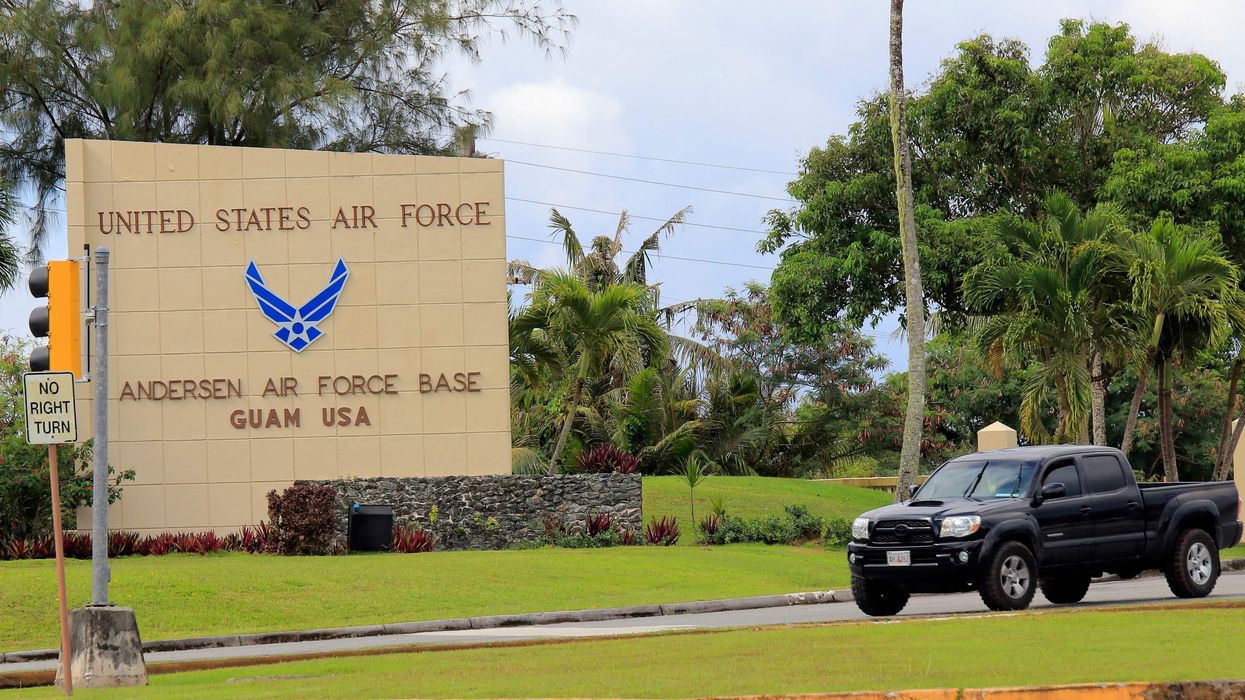
In August of 1944, Guam was to become the forward base for United States attacks targeting Japan and to accomplish this goal the military seized 82% of the land of the island for military purposes (this is the high water mark of American land holdings on the island). Anyone without explicit authorization to access American military bases would be shot on sight if they were found on what had been taken as military land. Eighteen construction and engineering battalions immediately began construction of military outfits including what is now known as Anderson Airforce Base and began using it as the flight strip from which daily bombings of Japanese territory would occur by way of B-29's.
Since then just a few families have received little, in any, compensation for their lost land or severe health problems consistent with exposure to continuous simulated war.
This is a problem that has global importance. A report by Brown's Watson Institute published last week found that the average annual carbon footprint of the United States' military-industrial complex is about on par with that of the Netherlands: 153 million metric tons per year. And this is a conservative number given the secrecy of the Pentagon and the reporting loopholes for military organizations written into the Kyoto Protocol.
The Pentagon has significantly acknowledged the threats that continued carbon consumption poses. One of the report's authors, Neta Crawford, explains "We have defense forces so they protect us. If in the long run, these defense forces make us less secure then we need to rethink what we're doing." Still, build-up continues in Guam and, apparently, on Galapagos.
For the communities affected by these military installations, the continued political, cultural, and medical issues represent a far greater threat than that which the bases supposedly protect us from. They are an affront to self-determination and spell the end for a place's environment.
The recent decision by the Hague-based International Court of Justice that the Chagos Islands -- with its huge U.S. military base at Diego Garcia -- are being illegally occupied by the United Kingdom (UK) has the potential to upend the strategic plans of a dozen regional capitals, ranging from Beijing to Riyadh.
For a tiny speck of land measuring only 38 miles in length, Diego Garcia casts a long shadow. Sometimes called Washington's "unsinkable aircraft carrier," planes and warships based on the island played an essential role in the first and second Gulf wars, the invasion of Afghanistan, and the war in Libya. Its strategic location between Africa and Indonesia and 1,000 miles south of India gives the U.S. access to the Middle East, Central and South Asia, and the vast Indian Ocean. No oil tanker, no warship, no aircraft can move without its knowledge.
Most Americans have never heard of Diego Garcia for a good reason: No journalist has been allowed there for more than 30 years, and the Pentagon keeps the base wrapped in a cocoon of national security. Indeed, the UK leased the base to the Americans in 1966 without informing either the British Parliament or the U.S. Congress.
The February 25 Court decision has put a dent in all that by deciding that Great Britain violated United Nations Resolution 1514 prohibiting the division of colonies before independence. The UK broke the Chagos Islands off from Mauritius, a former colony on the southeast coast of Africa that Britain decolonized in 1968. At the time, Mauritius objected, reluctantly agreeing only after Britain threatened to withdraw its offer of independence.
The Court ruled 13-1 that the UK had engaged in a "wrongful act" and must decolonize the Chagos "as rapidly as possible."
"The Great Game" in the Indian Ocean
While the ruling is only "advisory," it comes at a time when the U.S. and its allies are confronting or sanctioning countries for supposedly illegal occupations -- Russia in the Crimea and China in the South China Sea.
The suit was brought by Mauritius and some of the 1,500 Chagos islanders who were forcibly removed from the archipelago in 1973. The Americans, calling it "sanitizing" the islands, moved the Chagossians more than 1,000 miles to Mauritius and the Seychelles, where they've languished in poverty ever since.
Diego Garcia is the lynchpin for U.S. strategy in the region. With its enormous runways, it can handle B-52, B-1 and B-2 bombers, and huge C-5M, C-17, and C-130 military cargo planes. The lagoon has been transformed into a naval harbor that can handle an aircraft carrier. The U.S. has built a city -- replete with fast food outlets, bars, golf courses and bowling alleys -- that hosts some 3,000 to 5,000 military personnel and civilian contractors.
What you can't find are any native Chagossians.
The Indian Ocean has become a major theater of competition between India, the U.S., and Japan on one side, and the growing presence of China on the other. Tensions have flared between India and China over the Maldives and Sri Lanka, specifically China's efforts to use ports on those island nations. India recently joined with Japan and the U.S. in a war game -- Malabar 18 -- that modeled shutting down the strategic Malacca Straits between Sumatra and Malaysia, through which some 80 percent of China's energy supplies pass each year.
A portion of the exercise involved anti-submarine warfare aimed at detecting Chinese submarines moving from the South China Sea into the Indian Ocean. To Beijing, those submarines are essential for protecting the ring of Chinese-friendly ports that run from southern China to Port Sudan on the east coast of Africa. Much of China's oil and gas supplies are vulnerable, because they transit the narrow Mandeb Strait that guards the entrance to the Red Sea and the Strait of Hormuz that oversees access to the oil-rich Persian Gulf. The U.S. 5th Fleet controls both straits.
Tensions in the region have increased since the Trump administration shifted the focus of U.S. national security from terrorism to "major power competition" -- that is, China and Russia. The U.S. accuses China of muscling its way into the Indian Ocean by taking over ports, like Hambantota in Sri Lanka and Gwadar in Pakistan that are capable of hosting Chinese warships.
India, which has its own issues with China dating back to their 1962 border war, is ramping up its anti-submarine forces and building up its deep-water navy. New Delhi also recently added a long-range Agni-V missile that's designed to strike deep into China, and the right-wing government of Narendra Modi is increasingly chummy with the American military. The Americans even changed their regional military organization from "Pacific Command" to "Indo-Pacific Command" in deference to New Delhi.
The term for these Chinese friendly ports --"string of pearls" -- was coined by Pentagon contractor Booz Allen Hamilton and, as such, should be taken with a grain of salt. China is indeed trying to secure its energy supplies and also sees the ports as part of its worldwide Road and Belt Initiative trade strategy. But assuming the "pearls" have a military role, akin to 19th century colonial coaling stations, is a stretch. Most the ports would be indefensible if a war broke out.
An "Historic" Decision
Diego Garcia is central to the U.S. war in Somalia, its air attacks in Iraq and Syria, and its control of the Persian Gulf, and would be essential in any conflict with Iran. If the current hostility by Saudi Arabia, Israel, and the U.S. toward Iran actually translates into war, the island will quite literally be an unsinkable aircraft carrier.
Given the strategic centrality of Diego Garcia, it's hard to imagine the US giving it up -- or rather, the British withdrawing their agreement with Washington and de-colonizing the Chagos Islands. In 2016, London extended the Americans' lease for 20 years.
Mauritius wants the Chagos back, but at this point doesn't object to the base. It certainly wants a bigger rent check and the right eventually to take the island group back.
It also wants more control over what goes on at Diego Garcia. For instance, the British government admitted that the Americans were using the island to transit "extraordinary renditions," people seized during the Afghan and Iraq wars between 2002 and 2003, many of whom were tortured. Torture is a violation of international law.
As for the Chagossians, they want to go back.
Diego Garcia is immensely important for U.S. military and intelligence operations in the region, but it's just one of some 800 American military bases on every continent except Antarctica. Those bases form a worldwide network that allows the U.S. military to deploy advisors and Special Forces in some 177 countries across the globe. Those forces create tensions that can turn dangerous at a moment's notice.
For instance, there are currently U.S. military personal in virtually every country surrounding Russia: Norway, Poland, Hungary, Kosovo, Romania, Turkey, Latvia, Lithuania, Estonia, Georgia, Ukraine, and Bulgaria. Added to that is the Mediterranean's 6th Fleet, which regularly sends warships into the Black Sea.
Much the same can be said for China. U.S. military forces are deployed in South Korea, Japan, and Australia, plus numerous islands in the Pacific. The American 7th fleet, based in Hawaii and Yokohama, is the Navy's largest.
In late March, U.S. Navy and Coast Guard ships transited the Taiwan Straits, which, while international waters, the Chinese consider an unnecessary provocation. British ships have also sailed close to Chinese-occupied reefs and islands in the South China Sea.
The fight to de-colonize the Chagos Islands will now move to the UN General Assembly. In the end, Britain may ignore the General Assembly and the Court, but it will be hard pressed to make a credible case for doing so. How Great Britain can argue for international law in the Crimea and South China Sea, while ignoring the International Court of Justice on the Chagos, will require some fancy footwork.
In the meantime, Mauritius Prime Minister Pravind Jugnauth calls the Court decision "historic," and one that will eventually allow the 6,000 native Chagossians and their descendants "to return home."
Give Chagos back to the Chagossians! That's a slogan I first heard in 2000. It was a demonstration in London, outside a courthouse, a small group of people with handmade signs appealing to the British legal system to return their islands to them. Few people paid them any attention. The courts sided with the islanders (whose case is unimpeachable) and then did nothing to enforce their verdict.
The Chagos Archipelago is a group of 60 islands in the Indian Ocean. These islands are claimed by Mauritius, a country that won its independence from the United Kingdom in 1968. Three years before the independence of Mauritius, the British separated the Chagos Archipelago and converted it into the British Indian Ocean Territory. To cement its control over the islands, the British expelled over 2,000 Chagossians. Some of these Chagossians stood in London, fighting for their lost islands.
At the end of February, the UN's International Court of Justice (ICJ) ruled that the UK must give the islands back to Mauritius. In 2017, the UN General Assembly had heard the case of the islanders and referred it to the ICJ. Now, the ICJ--with a 13 to 1 ruling (the U.S. voting against)--has sided with the Chagossians. But this is not a binding ruling, and the British government has said it would ignore the International Court of Justice.
Diego Garcia
Why would the United Kingdom need these islands? By the 1960s, the United States had begun to take over many of the British imperial bases for its own massive military base system. There are now over 800 U.S. military bases in more than 70 countries (for comparison, the Russians have about eight overseas military bases, most of them in the territory of the former USSR--such as in Moldova and in Belarus--with only the bases in Syria and Vietnam outside that zone). No country can match the U.S. military footprint.
The biggest island on the Chagos Archipelago is Diego Garcia. The United States leases this island from the United Kingdom. The UK gave the United States the lease in exchange for a discount on the sale of the Polaris nuclear submarine system. That lease ends in 2036. Diego Garcia has been one of the most important U.S. overseas bases--used in the U.S. war on Vietnam, the U.S. war on Afghanistan and the U.S. war on Iraq. It was used by the CIA as a black site in the War on Terror (150 Sri Lankan fishermen were held there in its prisons).
Zone of Peace
The United States has faced legal threats to its base for the past five decades. The bereft Chagossians have taken their case to British courts, hoping to exert pressure to return the islands to them. When the British broke off the islands from Mauritius in 1965, the UK violated UN Resolution 1514 (XV) on Decolonization that argued against the breakup of colonies. Britain strong-armed the Mauritius independence movement, telling them that they could have their freedom without Chagos or have no freedom at all.
More difficult for the U.S. military operations was the attempt by the Non-Aligned Movement (NAM) and the United Nations to constitute the Indian Ocean as a "zone of peace." As early as 1964, at the Cairo, Egypt, Non-Aligned summit, the member states recommended that the oceans of the world be "denuclearized zones" (the NAM was inspired by the 1959 Antarctic Treaty and the 1963 Treaty of Tlatelolco--to keep Latin America free of nuclear weapons). In 1970, the Non-Aligned summit in Lusaka, Zambia, declared that the Indian Ocean must be a "zone of peace from which Great Power rivalries and competition, as well as bases," must be excluded.
The United States attacked this idea. Admiral Elmo Zumwalt told the U.S. Congress in 1974 that the USSR stood atop the "central part of the West's energy jugular down to the Persian Gulf." For that reason, the Indian Ocean--and Diego Garcia--has "become a focal point of U.S. foreign and economic policies and has a growing impact on our security."
Marine Reserve
Every attempt was made to deny the people of Chagos their homeland. In April 2010, the British Foreign Office said that 640,000 square kilometers of the archipelago would now be a "marine reserve," which should remain uninhabited. The British government told the U.S. government--in a secret cable--that the "former inhabitants would find it difficult, if not impossible, to pursue their claim for resettlement on the islands if the entire Chagos were a marine reserve." This was environmental conservation for military purposes. No statement was made to remove the U.S. base from Diego Garcia, which would be at the heart of the marine reserve.
In 2015, Mauritius went to the court of arbitration at the Hague, where they won a ruling that the British declaration of the marine reserve was illegal. The UK had not consulted either Mauritius or the Chagossians. Britain eventually said that the Chagossians would not be able to exercise their right to return because of the objections of the U.S. military. So be it.
After this ruling, a spokeswoman for the British foreign office said that the ICJ's ruling "was an advisory opinion, not a judgment." It is unlikely that the UK--or the United States--will honor the opinion. The United States voted against it. The UK now says that the military base "helps to protect people here in Britain and around the world from terrorist threats, organized crime and piracy." The door closes once more on the hopes of the Chagossians.
Those hopes, eternal and persistent, are captured in the poet Saradha Soobrayen's prize-winning work:
"On the main island of Diego Garcia, the U.S. base, Camp Justice squats.
The Chagossians are still chanting, 'Rann nu Diego'
thirty, forty years later, fighting for the right to return.
Their loss is unimaginable, these guardians of the Chagos archipelago
Their homecoming is not yet out of reach, not yet out of sight."
First, they tried to shoot the dogs. Next, they tried to poison them with strychnine. When both failed as efficient killing methods, British government agents and U.S. Navy personnel used raw meat to lure the pets into a sealed shed. Locking them inside, they gassed the howling animals with exhaust piped in from U.S. military vehicles. Then, setting coconut husks ablaze, they burned the dogs' carcasses as their owners were left to watch and ponder their own fate.
The truth about the U.S. military base on the British-controlled Indian Ocean island of Diego Garcia is often hard to believe. It would be easy enough to confuse the real story with fictional accounts of the island found in the Transformersmovies, on the television series 24, and in Internet conspiracy theories about the disappearance of Malaysia Airlines flight MH370.
While the grim saga of Diego Garcia frequently reads like fiction, it has proven all too real for the people involved. It's the story of a U.S. military base built on a series of real-life fictions told by U.S. and British officials over more than half a century. The central fiction is that the U.S. built its base on an "uninhabited" island. That was "true" only because the indigenous people were secretly exiled from the Chagos Archipelago when the base was built. Although their ancestors had lived there since the time of the American Revolution, Anglo-American officials decided, as one wrote, to "maintain the fiction that the inhabitants of Chagos [were] not a permanent or semi-permanent population," but just "transient contract workers." The same official summed up the situation bluntly: "We are able to make up the rules as we go along."
And so they did: between 1968 and 1973, American officials conspired with their British colleagues to remove the Chagossians, carefully hiding their expulsion from Congress, Parliament, the U.N., and the media. During the deportations, British agents and members of a U.S. Navy construction battalion rounded up and killed all those pet dogs. Their owners were then deported to the western Indian Ocean islands of Mauritius and the Seychelles, 1,200 miles from their homeland, where they received no resettlement assistance. More than 40 years after their expulsion, Chagossians generally remain the poorest of the poor in their adopted lands, struggling to survive in places that outsiders know as exotic tourist destinations.
During the same period, Diego Garcia became a multi-billion-dollar Navy and Air Force base and a central node in U.S. military efforts to control the Greater Middle East and its oil and natural gas supplies. The base, which few Americans are aware of, is more important strategically and more secretive than the U.S. naval base-cum-prison at Guantanamo Bay, Cuba. Unlike Guantanamo, no journalist has gotten more than a glimpse of Diego Garcia in more than 30 years. And yet, it has played a key role in waging the Gulf War, the 2003 invasion of Iraq, the U.S.-led war in Afghanistan, and the current bombing campaign against the Islamic State in Syria and Iraq.
Following years of reports that the base was a secret CIA "black site" for holding terrorist suspects and years of denials by U.S. and British officials, leaders on both sides of the Atlantic finally fessed up in 2008. "Contrary to earlier explicit assurances," said Secretary of State for Foreign and Commonwealth Affairs David Miliband, Diego Garcia had indeed played at least some role in the CIA's secret "rendition" program.
Last year, British officials claimed that flight log records, which might have shed light on those rendition operations, were "incomplete due to water damage" thanks to "extremely heavy weather in June 2014." A week later, they suddenly reversed themselves, saying that the "previously wet paper records have been dried out." Two months later, they insisted the logs had not dried out at all and were "damaged to the point of no longer being useful." Except that the British government's own weather data indicates that June 2014 was an unusually dry month on Diego Garcia. A legal rights advocate said British officials "could hardly be less credible if they simply said 'the dog ate my homework.'"
And these are just a few of the fictions underlying the base that occupies the Chagossians' former home and that the U.S. military has nicknamed the "Footprint of Freedom." After more than four decades of exile, however, with a Chagossian movement to return to their homeland growing, the fictions of Diego Garcia may finally be crumbling.
No "Tarzans"
The story of Diego Garcia begins in the late eighteenth century. At that time, enslaved peoples from Africa, brought to work on Franco-Mauritian coconut plantations, became the first settlers in the Chagos Archipelago. Following emancipation and the arrival of indentured laborers from India, a diverse mixture of peoples created a new society with its own language, Chagos Kreol. They called themselves the Ilois -- the Islanders.
While still a plantation society, the archipelago, by then under British colonial control, provided a secure life featuring universal employment and numerous social benefits on islands described by many as idyllic. "That beautiful atoll of Diego Garcia, right in the middle of the ocean," is how Stuart Barber described it in the late 1950s. A civilian working for the U.S. Navy, Barber would become the architect of one of the most powerful U.S. military bases overseas.
Amid Cold War competition with the Soviet Union, Barber and other officials were concerned that there was almost no U.S. military presence in and around the Indian Ocean. Barber noted that Diego Garcia's isolation -- halfway between Africa and Indonesia and 1,000 miles south of India -- ensured that it would be safe from attack, yet was still within striking distance of territory from southern Africa and the Middle East to South and Southeast Asia.
Guided by Barber's idea, the administrations of John F. Kennedy and Lyndon Johnson convinced the British government to detach the Chagos Archipelago from colonial Mauritius and create a new colony, which they called the British Indian Ocean Territory. Its sole purpose would be to house U.S. military facilities.
During secret negotiations with their British counterparts, Pentagon and State Department officials insisted that Chagos come under their "exclusive control (without local inhabitants)," embedding an expulsion order in a polite-looking parenthetical phrase. U.S. officials wanted the islands "swept" and "sanitized." British officials appeared happy to oblige, removing a people one official called "Tarzans" and, in a racist reference to Robinson Crusoe, "Man Fridays."
"Absolutely Must Go"
This plan was confirmed with an "exchange of notes" signed on December 30, 1966, by U.S. and British officials, as one of the State Department negotiators told me, "under the cover of darkness." The notes effectively constituted a treaty but required no Congressional or Parliamentary approval, meaning that both governments could keep their plans hidden.
According to the agreement, the United States would gain use of the new colony "without charge." This was another fiction. In confidential minutes, the United States agreed to secretly wipe out a $14 million British military debt, circumventing the need to ask Congress for funding. In exchange, the British agreed to take the "administrative measures" necessary for "resettling the inhabitants."
Those measures meant that, after 1967, any Chagossians who left home for medical treatment or a routine vacation in Mauritius were barred from returning. Soon, British officials began restricting the flow of food and medical supplies to Chagos. As conditions deteriorated, more islanders began leaving. By 1970, the U.S. Navy had secured funding for what officials told Congress would be an "austere communications station." They were, however, already planning to ask for additional funds to expand the facility into a much larger base. As the Navy's Office of Communications and Cryptology explained, "The communications requirements cited as justification are fiction." By the 1980s, Diego Garcia would become a billion-dollar garrison.
In briefing papers delivered to Congress, the Navy described Chagos's population as "negligible," with the islands "for all practical purposes... uninhabited." In fact, there were around 1,000 people on Diego Garcia in the 1960s and 500 to 1,000 more on other islands in the archipelago. With Congressional funds secured, the Navy's highest-ranking admiral, Elmo Zumwalt, summed up the Chagossians' fate in a 1971 memo of exactly three words: "Absolutely must go."
The authorities soon ordered the remaining Chagossians -- generally allowed no more than a single box of belongings and a sleeping mat -- onto overcrowded cargo ships destined for Mauritius and the Seychelles. By 1973, the last Chagossians were gone.
"Abject Poverty"
At their destinations, most of the Chagossians were literally left on the docks, homeless, jobless, and with little money. In 1975, two years after the last removals, a Washington Post reporter found them living in "abject poverty."
Aurelie Lisette Talate was one of the last to go. "I came to Mauritius with six children and my mother," she told me. "We got our house... but the house didn't have a door, didn't have running water, didn't have electricity. And then my children and I began to suffer. All my children started getting sick."
Within two months, two of her children were dead. The second was buried in an unmarked grave because she lacked money for a proper burial. Aurelie experienced fainting spells herself and couldn't eat. "We were living like animals. Land? We had none... Work? We had none. Our children weren't going to school."
Today, most Chagossians, who now number more than 5,000, remain impoverished. In their language, their lives are ones of lamizer(impoverished misery) and sagren (profound sorrow and heartbreak over being exiled from their native lands). Many of the islanders attribute sickness and even death to sagren. "I had something that had been affecting me for a long time, since we were uprooted," was the way Aurelie explained it to me. "This sagren, this shock, it was this same problem that killed my child. We weren't living free like we did in our natal land."
Struggling for Justice
From the moment they were deported, the Chagossians demanded to be returned or at least properly resettled. After years of protest, including five hunger strikes led by women like Aurelie Talate, some in Mauritius received the most modest of compensation from the British government: small concrete houses, tiny plots of land, and about $6,000 per adult. Many used the money to pay off large debts they had accrued. For most, conditions improved only marginally. Those living in the Seychelles received nothing.
The Chagossian struggle was reinvigorated in 1997 with the launching of a lawsuit against the British government. In November 2000, the British High Court ruled the removal illegal. In 2001 and 2002, most Chagossians joined new lawsuits in both American and British courts demanding the right to return and proper compensation for their removal and for resettling their islands. The U.S. suit was ultimately dismissed on the grounds that the judiciary can't, in most circumstances, overrule the executive branch on matters of military and foreign policy. In Britain, the Chagossians were more successful. In 2002, they secured the right to full U.K. citizenship. Over 1,000 Chagossians have since moved to Britain in search of better lives. Twice more, British courts ruled in the people's favor, with judges calling the government's behavior "repugnant" and an "abuse of power."
On the government's final appeal, however, Britain's then highest court, the Law Lords in the House of Lords, upheld the exile in a 3-2 decision. The Chagossians appealed to the European Court of Human Rights to overturn the ruling.
A Green Fiction
Before the European Court could rule, the British government announced the creation of the world's largest Marine Protected Area (MPA) in the Chagos Archipelago. The date of the announcement, April Fool's Day 2010, should have been a clue that there was more than environmentalism behind the move. The MPA banned commercial fishing and limited other human activity in the archipelago, endangering the viability of any resettlement efforts.
And then came WikiLeaks. In December 2010, it released a State Department cable from the U.S. Embassy in London quoting a senior Foreign and Commonwealth Office official saying that the "former inhabitants would find it difficult, if not impossible, to pursue their claim for resettlement on the islands if the entire Chagos Archipelago were a marine reserve." U.S. officials agreed. According to the Embassy, Political Counselor Richard Mills wrote, "Establishing a marine reserve might, indeed... be the most effective long-term way to prevent any of the Chagos Islands' former inhabitants or their descendants from resettling."
Not surprisingly, the main State Department concern was whether the MPA would affect base operations. "We are concerned," the London Embassy noted, that some "would come to see the existence of a marine reserve as inherently inconsistent with the military use of Diego Garcia." British officials assured the Americans there would be "no constraints on military operations."
Although the European Court of Human Rights ultimately ruled against the Chagossians in 2013, this March, a U.N. tribunal found that the British government had violated international law in creating the Marine Protected Area. Next week, Chagossians will challenge the MPA and their expulsion before the British Supreme Court (now Britain's highest) armed with the U.N. ruling and revelations that the government won its House of Lords decision with the help of a fiction-filled resettlement study.
Meanwhile, the European Parliament has passed a resolution calling for the Chagossians' return, the African Union has condemned their deportation as unlawful, three Nobel laureates have spoken out on their behalf, and dozens of members of the British Parliament have joined a group supporting their struggle. In January, a British government "feasibility study" found no significant legal barriers to resettling the islands and outlined several possible resettlement plans, beginning with Diego Garcia. (Notably, Chagossians are not calling for the removal of the U.S. military base. Their opinions about it are diverse and complicated. At least some would prefer jobs on the base to lives of poverty and unemployment in exile.)
Of course, no study was needed to know that resettlement on Diego Garcia and in the rest of the archipelago is feasible. The base, which has hosted thousands of military and civilian personnel for more than 40 years, has demonstrated that well enough. In fact, Stuart Barber, its architect, came to the same conclusion in the years before his death. After he learned of the Chagossians' fate, he wrote a series of impassioned letters to Human Rights Watch and the British Embassy in Washington, among others, imploring them to help the Chagossians return home. In a letter to Alaska Senator Ted Stevens, he said bluntly that the expulsion "wasn't necessary militarily."
In a 1991 letter to the Washington Post, Barber suggested that it was time "to redress the inexcusably inhuman wrongs inflicted by the British at our insistence." He added, "Substantial additional compensation for 18-25 past years of misery for all evictees is certainly in order. Even if that were to cost $100,000 per family, we would be talking of a maximum of $40-50 million, modest compared with our base investment there."
Almost a quarter-century later, nothing has yet been done. In 2016, the initial 50-year agreement for Diego Garcia will expire. While it is subject to an automatic 20-year renewal, it provides for a two-year renegotiation period, which commenced in late 2014. With momentum building in support of the Chagossians, they are optimistic that the two governments will finally correct this historic injustice. That U.S. officials allowed the British feasibility study to consider resettlement plans for Diego Garcia is a hopeful sign that Anglo-American policy may finally be shifting to right a great wrong in the Indian Ocean.
Unfortunately, Aurelie Talate will never see the day when her people go home. Like others among the rapidly dwindling number of Chagossians born in the archipelago, Aurelie died in 2012 at age 70, succumbing to the heartbreak that is sagren.