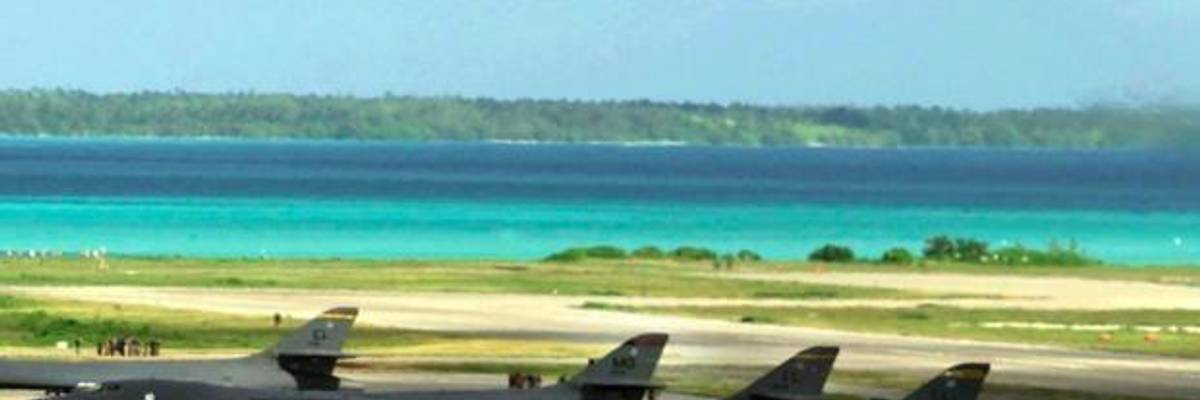
A U.S. Air Force B-1B bomber takes off from the Indian Ocean island of Diego Garcia, on a strike mission over Afghanistan in 2001. (Photo: DoD photo via AFP)
The Rightful Owners of a Key Island Military Base for the U.S. Would Like It Back, and the UN Agrees
The Chagos Archipelago belongs to the country of Mauritius; it’s not a bargaining chip for the American empire
Give Chagos back to the Chagossians! That's a slogan I first heard in 2000. It was a demonstration in London, outside a courthouse, a small group of people with handmade signs appealing to the British legal system to return their islands to them. Few people paid them any attention. The courts sided with the islanders (whose case is unimpeachable) and then did nothing to enforce their verdict.
The Chagos Archipelago is a group of 60 islands in the Indian Ocean. These islands are claimed by Mauritius, a country that won its independence from the United Kingdom in 1968. Three years before the independence of Mauritius, the British separated the Chagos Archipelago and converted it into the British Indian Ocean Territory. To cement its control over the islands, the British expelled over 2,000 Chagossians. Some of these Chagossians stood in London, fighting for their lost islands.
At the end of February, the UN's International Court of Justice (ICJ) ruled that the UK must give the islands back to Mauritius. In 2017, the UN General Assembly had heard the case of the islanders and referred it to the ICJ. Now, the ICJ--with a 13 to 1 ruling (the U.S. voting against)--has sided with the Chagossians. But this is not a binding ruling, and the British government has said it would ignore the International Court of Justice.
Diego Garcia
Why would the United Kingdom need these islands? By the 1960s, the United States had begun to take over many of the British imperial bases for its own massive military base system. There are now over 800 U.S. military bases in more than 70 countries (for comparison, the Russians have about eight overseas military bases, most of them in the territory of the former USSR--such as in Moldova and in Belarus--with only the bases in Syria and Vietnam outside that zone). No country can match the U.S. military footprint.
The biggest island on the Chagos Archipelago is Diego Garcia. The United States leases this island from the United Kingdom. The UK gave the United States the lease in exchange for a discount on the sale of the Polaris nuclear submarine system. That lease ends in 2036. Diego Garcia has been one of the most important U.S. overseas bases--used in the U.S. war on Vietnam, the U.S. war on Afghanistan and the U.S. war on Iraq. It was used by the CIA as a black site in the War on Terror (150 Sri Lankan fishermen were held there in its prisons).
Zone of Peace
The United States has faced legal threats to its base for the past five decades. The bereft Chagossians have taken their case to British courts, hoping to exert pressure to return the islands to them. When the British broke off the islands from Mauritius in 1965, the UK violated UN Resolution 1514 (XV) on Decolonization that argued against the breakup of colonies. Britain strong-armed the Mauritius independence movement, telling them that they could have their freedom without Chagos or have no freedom at all.
More difficult for the U.S. military operations was the attempt by the Non-Aligned Movement (NAM) and the United Nations to constitute the Indian Ocean as a "zone of peace." As early as 1964, at the Cairo, Egypt, Non-Aligned summit, the member states recommended that the oceans of the world be "denuclearized zones" (the NAM was inspired by the 1959 Antarctic Treaty and the 1963 Treaty of Tlatelolco--to keep Latin America free of nuclear weapons). In 1970, the Non-Aligned summit in Lusaka, Zambia, declared that the Indian Ocean must be a "zone of peace from which Great Power rivalries and competition, as well as bases," must be excluded.
The United States attacked this idea. Admiral Elmo Zumwalt told the U.S. Congress in 1974 that the USSR stood atop the "central part of the West's energy jugular down to the Persian Gulf." For that reason, the Indian Ocean--and Diego Garcia--has "become a focal point of U.S. foreign and economic policies and has a growing impact on our security."
Marine Reserve
Every attempt was made to deny the people of Chagos their homeland. In April 2010, the British Foreign Office said that 640,000 square kilometers of the archipelago would now be a "marine reserve," which should remain uninhabited. The British government told the U.S. government--in a secret cable--that the "former inhabitants would find it difficult, if not impossible, to pursue their claim for resettlement on the islands if the entire Chagos were a marine reserve." This was environmental conservation for military purposes. No statement was made to remove the U.S. base from Diego Garcia, which would be at the heart of the marine reserve.
In 2015, Mauritius went to the court of arbitration at the Hague, where they won a ruling that the British declaration of the marine reserve was illegal. The UK had not consulted either Mauritius or the Chagossians. Britain eventually said that the Chagossians would not be able to exercise their right to return because of the objections of the U.S. military. So be it.
After this ruling, a spokeswoman for the British foreign office said that the ICJ's ruling "was an advisory opinion, not a judgment." It is unlikely that the UK--or the United States--will honor the opinion. The United States voted against it. The UK now says that the military base "helps to protect people here in Britain and around the world from terrorist threats, organized crime and piracy." The door closes once more on the hopes of the Chagossians.
Those hopes, eternal and persistent, are captured in the poet Saradha Soobrayen's prize-winning work:
"On the main island of Diego Garcia, the U.S. base, Camp Justice squats.
The Chagossians are still chanting, 'Rann nu Diego'
thirty, forty years later, fighting for the right to return.
Their loss is unimaginable, these guardians of the Chagos archipelago
Their homecoming is not yet out of reach, not yet out of sight."
We are at a crossroads
This country and this world are at a monumental crossroads. In a few short weeks, US voters will have an opportunity to beat back the forces of fascism and confront the billionaires who are rigging the economy, our media system, and our democracy, making it increasingly impossible for ordinary people to get by. We’re not just talking about the election. We’re talking about what must be done once these fascist elements are vanquished from power. We need a bolder set of solutions than what either major party has so far been willing to offer and a working-class movement ready to fight like hell for it. Trump didn't emerge from nowhere. The conditions that fueled MAGA authoritarianism were created by decades of radical neoliberal economic policies and a corrupt political system dominated by corporate interests. They slashed taxes on the super-rich, promising that the benefits would trickle down. They said giveaways to the corporate titans would make life more affordable for the rest of us. It was all bullshit. And when a bitter, betrayed populace searches for someone to blame, right-wing demagogues have little trouble finding scapegoats. People know when they're being lied to, but you won't hear any of this from the corporate media. Only independent journalism—powered and funded by people who believe in building a better world—can deliver truly trustworthy daily news. Our Fall Campaign is underway, and we need your help. To power our newsroom through the rest of the year, we need to raise $125,000 by midnight on October 31. So if you share our vision, please contribute whatever you can to sustain our work. |
Give Chagos back to the Chagossians! That's a slogan I first heard in 2000. It was a demonstration in London, outside a courthouse, a small group of people with handmade signs appealing to the British legal system to return their islands to them. Few people paid them any attention. The courts sided with the islanders (whose case is unimpeachable) and then did nothing to enforce their verdict.
The Chagos Archipelago is a group of 60 islands in the Indian Ocean. These islands are claimed by Mauritius, a country that won its independence from the United Kingdom in 1968. Three years before the independence of Mauritius, the British separated the Chagos Archipelago and converted it into the British Indian Ocean Territory. To cement its control over the islands, the British expelled over 2,000 Chagossians. Some of these Chagossians stood in London, fighting for their lost islands.
At the end of February, the UN's International Court of Justice (ICJ) ruled that the UK must give the islands back to Mauritius. In 2017, the UN General Assembly had heard the case of the islanders and referred it to the ICJ. Now, the ICJ--with a 13 to 1 ruling (the U.S. voting against)--has sided with the Chagossians. But this is not a binding ruling, and the British government has said it would ignore the International Court of Justice.
Diego Garcia
Why would the United Kingdom need these islands? By the 1960s, the United States had begun to take over many of the British imperial bases for its own massive military base system. There are now over 800 U.S. military bases in more than 70 countries (for comparison, the Russians have about eight overseas military bases, most of them in the territory of the former USSR--such as in Moldova and in Belarus--with only the bases in Syria and Vietnam outside that zone). No country can match the U.S. military footprint.
The biggest island on the Chagos Archipelago is Diego Garcia. The United States leases this island from the United Kingdom. The UK gave the United States the lease in exchange for a discount on the sale of the Polaris nuclear submarine system. That lease ends in 2036. Diego Garcia has been one of the most important U.S. overseas bases--used in the U.S. war on Vietnam, the U.S. war on Afghanistan and the U.S. war on Iraq. It was used by the CIA as a black site in the War on Terror (150 Sri Lankan fishermen were held there in its prisons).
Zone of Peace
The United States has faced legal threats to its base for the past five decades. The bereft Chagossians have taken their case to British courts, hoping to exert pressure to return the islands to them. When the British broke off the islands from Mauritius in 1965, the UK violated UN Resolution 1514 (XV) on Decolonization that argued against the breakup of colonies. Britain strong-armed the Mauritius independence movement, telling them that they could have their freedom without Chagos or have no freedom at all.
More difficult for the U.S. military operations was the attempt by the Non-Aligned Movement (NAM) and the United Nations to constitute the Indian Ocean as a "zone of peace." As early as 1964, at the Cairo, Egypt, Non-Aligned summit, the member states recommended that the oceans of the world be "denuclearized zones" (the NAM was inspired by the 1959 Antarctic Treaty and the 1963 Treaty of Tlatelolco--to keep Latin America free of nuclear weapons). In 1970, the Non-Aligned summit in Lusaka, Zambia, declared that the Indian Ocean must be a "zone of peace from which Great Power rivalries and competition, as well as bases," must be excluded.
The United States attacked this idea. Admiral Elmo Zumwalt told the U.S. Congress in 1974 that the USSR stood atop the "central part of the West's energy jugular down to the Persian Gulf." For that reason, the Indian Ocean--and Diego Garcia--has "become a focal point of U.S. foreign and economic policies and has a growing impact on our security."
Marine Reserve
Every attempt was made to deny the people of Chagos their homeland. In April 2010, the British Foreign Office said that 640,000 square kilometers of the archipelago would now be a "marine reserve," which should remain uninhabited. The British government told the U.S. government--in a secret cable--that the "former inhabitants would find it difficult, if not impossible, to pursue their claim for resettlement on the islands if the entire Chagos were a marine reserve." This was environmental conservation for military purposes. No statement was made to remove the U.S. base from Diego Garcia, which would be at the heart of the marine reserve.
In 2015, Mauritius went to the court of arbitration at the Hague, where they won a ruling that the British declaration of the marine reserve was illegal. The UK had not consulted either Mauritius or the Chagossians. Britain eventually said that the Chagossians would not be able to exercise their right to return because of the objections of the U.S. military. So be it.
After this ruling, a spokeswoman for the British foreign office said that the ICJ's ruling "was an advisory opinion, not a judgment." It is unlikely that the UK--or the United States--will honor the opinion. The United States voted against it. The UK now says that the military base "helps to protect people here in Britain and around the world from terrorist threats, organized crime and piracy." The door closes once more on the hopes of the Chagossians.
Those hopes, eternal and persistent, are captured in the poet Saradha Soobrayen's prize-winning work:
"On the main island of Diego Garcia, the U.S. base, Camp Justice squats.
The Chagossians are still chanting, 'Rann nu Diego'
thirty, forty years later, fighting for the right to return.
Their loss is unimaginable, these guardians of the Chagos archipelago
Their homecoming is not yet out of reach, not yet out of sight."
Give Chagos back to the Chagossians! That's a slogan I first heard in 2000. It was a demonstration in London, outside a courthouse, a small group of people with handmade signs appealing to the British legal system to return their islands to them. Few people paid them any attention. The courts sided with the islanders (whose case is unimpeachable) and then did nothing to enforce their verdict.
The Chagos Archipelago is a group of 60 islands in the Indian Ocean. These islands are claimed by Mauritius, a country that won its independence from the United Kingdom in 1968. Three years before the independence of Mauritius, the British separated the Chagos Archipelago and converted it into the British Indian Ocean Territory. To cement its control over the islands, the British expelled over 2,000 Chagossians. Some of these Chagossians stood in London, fighting for their lost islands.
At the end of February, the UN's International Court of Justice (ICJ) ruled that the UK must give the islands back to Mauritius. In 2017, the UN General Assembly had heard the case of the islanders and referred it to the ICJ. Now, the ICJ--with a 13 to 1 ruling (the U.S. voting against)--has sided with the Chagossians. But this is not a binding ruling, and the British government has said it would ignore the International Court of Justice.
Diego Garcia
Why would the United Kingdom need these islands? By the 1960s, the United States had begun to take over many of the British imperial bases for its own massive military base system. There are now over 800 U.S. military bases in more than 70 countries (for comparison, the Russians have about eight overseas military bases, most of them in the territory of the former USSR--such as in Moldova and in Belarus--with only the bases in Syria and Vietnam outside that zone). No country can match the U.S. military footprint.
The biggest island on the Chagos Archipelago is Diego Garcia. The United States leases this island from the United Kingdom. The UK gave the United States the lease in exchange for a discount on the sale of the Polaris nuclear submarine system. That lease ends in 2036. Diego Garcia has been one of the most important U.S. overseas bases--used in the U.S. war on Vietnam, the U.S. war on Afghanistan and the U.S. war on Iraq. It was used by the CIA as a black site in the War on Terror (150 Sri Lankan fishermen were held there in its prisons).
Zone of Peace
The United States has faced legal threats to its base for the past five decades. The bereft Chagossians have taken their case to British courts, hoping to exert pressure to return the islands to them. When the British broke off the islands from Mauritius in 1965, the UK violated UN Resolution 1514 (XV) on Decolonization that argued against the breakup of colonies. Britain strong-armed the Mauritius independence movement, telling them that they could have their freedom without Chagos or have no freedom at all.
More difficult for the U.S. military operations was the attempt by the Non-Aligned Movement (NAM) and the United Nations to constitute the Indian Ocean as a "zone of peace." As early as 1964, at the Cairo, Egypt, Non-Aligned summit, the member states recommended that the oceans of the world be "denuclearized zones" (the NAM was inspired by the 1959 Antarctic Treaty and the 1963 Treaty of Tlatelolco--to keep Latin America free of nuclear weapons). In 1970, the Non-Aligned summit in Lusaka, Zambia, declared that the Indian Ocean must be a "zone of peace from which Great Power rivalries and competition, as well as bases," must be excluded.
The United States attacked this idea. Admiral Elmo Zumwalt told the U.S. Congress in 1974 that the USSR stood atop the "central part of the West's energy jugular down to the Persian Gulf." For that reason, the Indian Ocean--and Diego Garcia--has "become a focal point of U.S. foreign and economic policies and has a growing impact on our security."
Marine Reserve
Every attempt was made to deny the people of Chagos their homeland. In April 2010, the British Foreign Office said that 640,000 square kilometers of the archipelago would now be a "marine reserve," which should remain uninhabited. The British government told the U.S. government--in a secret cable--that the "former inhabitants would find it difficult, if not impossible, to pursue their claim for resettlement on the islands if the entire Chagos were a marine reserve." This was environmental conservation for military purposes. No statement was made to remove the U.S. base from Diego Garcia, which would be at the heart of the marine reserve.
In 2015, Mauritius went to the court of arbitration at the Hague, where they won a ruling that the British declaration of the marine reserve was illegal. The UK had not consulted either Mauritius or the Chagossians. Britain eventually said that the Chagossians would not be able to exercise their right to return because of the objections of the U.S. military. So be it.
After this ruling, a spokeswoman for the British foreign office said that the ICJ's ruling "was an advisory opinion, not a judgment." It is unlikely that the UK--or the United States--will honor the opinion. The United States voted against it. The UK now says that the military base "helps to protect people here in Britain and around the world from terrorist threats, organized crime and piracy." The door closes once more on the hopes of the Chagossians.
Those hopes, eternal and persistent, are captured in the poet Saradha Soobrayen's prize-winning work:
"On the main island of Diego Garcia, the U.S. base, Camp Justice squats.
The Chagossians are still chanting, 'Rann nu Diego'
thirty, forty years later, fighting for the right to return.
Their loss is unimaginable, these guardians of the Chagos archipelago
Their homecoming is not yet out of reach, not yet out of sight."