SUBSCRIBE TO OUR FREE NEWSLETTER
Daily news & progressive opinion—funded by the people, not the corporations—delivered straight to your inbox.
5
#000000
#FFFFFF
To donate by check, phone, or other method, see our More Ways to Give page.


Daily news & progressive opinion—funded by the people, not the corporations—delivered straight to your inbox.

press@groundworkcollaborative.org
Slowing wage growth, ever-increasing prices put the squeeze on Americans’ budgets ahead of midterm elections
Today’s Consumer Price Index (CPI) report shows prices rose 0.6% in September and are up 3.7% over the past year, the fastest pace since May. Gasoline prices jumped 9.1% in September alone, accounting for over half of the monthly increase in overall prices, and are up 34% from a year ago. Core CPI, excluding food and energy, rose 0.33% in September, the largest monthly increase since April.
Americans are increasingly frustrated with Trump's failure to bring down high prices. Consumers' views of current economic conditions are at an all-time low, and 82% of Americans disapprove of Trump's handling of the cost of living. Instead of working to rein in inflation, Trump is trying to pull a fast one on voters, spewing empty promises to bring prices down and send Americans a $5,000 “Trump dividend” if Republicans hold Congress, despite having never delivered on the DOGE and tariff checks he promised last year.
Today's inflation report is the last before the Federal Reserve's October 28 interest rate decision. The Fed raised interest rates last month for the first time in three years because of inflation concerns, and most officials anticipate another increase by the end of the year. In its latest meeting minutes, the Fed pointed to Trump's tariffs and higher energy costs, as well as the president’s never-ending war with Iran, as drivers of persistent inflation. Trump’s war and tariffs are raising the prices of nearly everything families buy, and now his actions are raising borrowing costs for families, too.
Groundwork’s Senior Vice President of Policy, Advocacy, and Research Alex Jacquez, released the following statement:
“It’s no wonder Americans have lost faith in Trump’s economy. The president has repeatedly made promises he can’t keep, and despite the band-aid attempts from the White House, there is a gaping hole in our economy just weeks from the midterms. Between the president’s war in Iran and reckless tariffs, his economy is on life support.”
The Groundwork Collaborative is dedicated to advancing a coherent and persuasive progressive economic worldview and narrative capable of delivering meaningful opportunity and prosperity for everyone. Our work is driven by a core guiding principle: We are the economy. Groundwork Collaborative envisions an economic system that produces strong, broadly shared prosperity and power for all people, not just a wealthy few.

Rogers' Democratic opponent for US Senate, Abdul El-Sayed, has accused the former House intel chair of trying to “monetize his time in public office.”
Former US Rep. Mike Rogers, the Republican Senate candidate in Michigan, saw his personal wealth soar after he was named chair of the House Intelligence Committee in 2011, thanks in large part to his marriage to the CEO of a powerful military contracting firm.
Financial disclosures reviewed by Drop Site News as part of an investigation published Tuesday show that Rogers had just $4,000-$60,000 worth of investment holdings in fiscal year 2008 after he divorced his first wife of 17 years.
But that all began to change in 2010, when he married Kristi Clemens, a senior executive for the British-founded private security contractor Aegis, which has a major US subsidiary that she helped to establish.
During the 2000s, the company won multiple Pentagon contracts worth hundreds of millions of dollars to support US military operations in Iraq, where it was put in charge of coordinating other private contractors.
Less than a year after his marriage, Rogers was named chair of the House Intelligence Committee—one of the nation's most powerful oversight posts, which gave him access to highly classified intelligence.
Within seven months—despite concerns about conflicts of interest—Aegis was awarded a contract worth more than $1 billion to protect the US embassy in Kabul, Afghanistan. In a since-deleted online biography for a law firm she joined after leaving Aegis, Kristi took credit for leading a "two-year pursuit and capture strategy" to secure the contract.
In the meantime, Rogers' financial assets—now merged with Kristi's—grew substantially. Up from between $136,000 and $391,000 during the first year of their marriage, the pair now held anywhere from $230,000 to $925,000 three years later.
Rogers' potential conflicts of interest became a subject of scrutiny even among fellow Republicans, who accused him of slow-walking an investigation into the killing of four Americans at a US compound in Benghazi, Libya.
Aegis had been heavily active in Libya since 2011, when NATO launched its operation to overthrow President Muammar Gaddafi, which plunged the country into civil war in the following years.
Rogers' handling of the Benghazi investigation would later draw a scathing rebuke from longtime right-wing operative Dick Morris, who accused him of "obstructing and delaying the Benghazi investigation in order to shield his wife, Kristi, from scrutiny.”
Amid this controversy, Rogers announced that he would not run for reelection. In 2015, after serving 14 years in Congress, he returned to the private sector.
Rogers went on to profit from the national security and surveillance industries he'd helped to oversee—taking board positions with military contractors and cybersecurity firms.
According to Business Insider, financial disclosures showed he received nearly $2 million in payments from technology and cybersecurity companies between January 2022 and late 2023.
When he left Congress in 2015, Mike and Kristi Rogers' combined net worth was about $1.7 million. As of 2026, it is estimated to have climbed to between $7 million and $14 million.
Rogers is currently in the midst of a battle to reenter Congress as Michigan's US senator, in a close race that could decide whether Democrats retake the chamber next month.
His Democratic opponent, Abdul El-Sayed—a former Detroit public health official—has run as a staunch opponent of President Donald Trump's aggressive wars abroad, including in Iran, and his support for Israel's assaults on Gaza and Lebanon, which Rogers has backed.
With less than a month before polls close on November 3, El-Sayed has hammered on Rogers' support for legislation that expanded government spying powers in the wake of the 9/11 attacks. He's also zeroed in on the Republican's lucrative personal ties to the military-industrial complex.
"[Rogers] hasn't been serious about providing healthcare his entire career," El-Sayed said during last week's contentious Senate debate. “What he has been serious about is making sure that he can monetize his time in public office—$14 million, two yachts, a McMansion in Florida."
El-Sayed highlighted Drop Site's findings in a social media post Tuesday: "STUNNING, [Mike Rogers'] deep state grift includes massive contracts for his wife’s firm," he said.
A spokesperson for Rogers said on Wednesday that "the accusation that Mike used his position in Congress to protect his family in any way, shape, or form is patently false."
"If Musk is going to... assist Putin's invasion of Ukraine, Ukraine's allies should sanction Starlink, X, and Tesla," said one expert.
The Ukrainian government on Tuesday night said that its access to the SpaceX-owned Starlink satellite internet service was throttled, prompting critics to question the wisdom of depending on any company owned by far-right billionaire Elon Musk.
According to a Wednesday report in The New York Times, Ukrainian officials suspect that orders to restrict their access to Starlink "had come from Washington," as President Donald Trump has been pressuring the country to stop attacking Russian energy infrastructure ahead of the 2026 midterm elections.
Musk, who was Trump's single biggest donor in the 2024 presidential campaign, has spent at least $276 million since July to help Republicans maintain their congressional majorities.
In a Wednesday social media post, Ukrainian military expert Serhiy Beskrestnov revealed that Ukrainian military forces "have not received any warnings about this restriction" to Starlink, which he said "has led to the failure of several missions."
"Obviously, this action cannot be a coincidence," Beskrestnov added, "and is related to the current political situation."
As noted by the Kyiv Independent on Wednesday, Ukraine depends on Starlink for "several military applications including operating its mid-strike campaign in Russian-occupied Ukraine, as well as interceptor drones that defend against Russia's new jet-powered attack drones."
The sudden restrictions on Starlink drew the ire of Polish Foreign Affairs Minister Radosław Sikorski, who directly called out Musk in a social media post.
"Hey, Elon Musk, big man, are you playing politics with your products again?" Sikorski asked. "As your European customers, we are watching you."
Ian Bond, deputy director of the Center for European Reform think tank, wrote that the sudden Starlink restrictions "should set off a siren in every defense ministry in Europe."
"There needs to be much more urgency about developing autonomous capabilities," Bond added, "not subject to US caprices, for early warning of attacks, countering ballistic missiles, communicating with forces or controlling offensive weapons."
Gideon Rachman, chief foreign affairs commentator for the Financial Times, expressed a similar view, arguing that "the Starlink restriction over Ukraine is a perfect illustration of the danger of relying on US technology."
Steve Peers, professor of EU law and human rights law at Royal Holloway, University of London, argued that democratic nations must start viewing Musk and his companies as geopolitical adversaries.
"If Musk is going to (in effect) assist Putin's invasion of Ukraine," wrote Peers, "Ukraine's allies should sanction Starlink, X, and Tesla."
Nicholas Grossman, professor of international relations at the University of Illinois, pointed out that he has been calling for governments to end their dependence on Musk and his companies for the last three years.
"The problem is too much power, especially for an enemy of democracy," Grossman wrote.
Grossman also took a shot at former President Joe Biden's administration for not taking Musk's threat to democracy seriously, as it continued to award SpaceX lucrative contracts even as its owner used his vast fortune to power Trump's 2024 comeback.
"Big mistake," he wrote.
"He’s so completely full of shit, and voters across the country know it," said one patient advocate.
US President Donald Trump, who signed into law the largest Medicaid cuts in history last year and allowed private insurance premiums to skyrocket, assured supporters gathered at a rally in Wasilla, Alaska on Tuesday that he intends to enact "a truly great healthcare plan" if Republicans retain control of Congress in next month's midterm elections.
As with his earlier empty promises of a forthcoming overhaul of the US healthcare system, Trump offered virtually no detail on what his proposal would entail, saying vaguely that he wants to "stop all payments to big insurance companies" and "give the money directly to you, the people," to "go out and buy better healthcare."
While Trump's supporters in Wasilla applauded his promise—"clapping like seals," as one critic put it—patient advocates noted that Republicans have done nothing but make the country's healthcare system even more brutal and expensive over the past two years.
"All they did was cut Medicaid by $1 trillion to give tax cuts to billionaires and kick 3 million off of [Affordable Care Act] insurance," Dr. Rob Davidson, executive director of the Committee to Protect Healthcare, wrote in a social media post late Tuesday.
"He’s so completely full of shit," said Davidson, "and voters across the country know it."
Watch Trump's comments:
The advocacy group Protect Our Care noted ahead of Tuesday's rally that more than 34,000 Alaskans have health insurance coverage during Trump's second White House term. Brad Woodhouse, the group's president, said in a statement that “Trump has miserably failed Alaskans on healthcare, and now, with Election Day closing in, he has the audacity to waltz back into the state and act like none of it ever happened?"
"Make no mistake, this is a healthcare election, and Republicans have a whole lot to answer for," said Woodhouse. "With just weeks left until voters head to the polls, Trump is pulling out all the stops, from flashy rallies to desperate bribes. But the fallout from his healthcare cuts isn’t going anywhere. Families across Alaska are stretching their medications, skipping checkups, and crossing their fingers that nobody in the family gets sick enough to send them spiraling into debt."
"So Trump can put on his little show all he wants," Woodhouse added, "but eventually the stage lights will go out, the cameras will leave, and Alaskans will still be stuck paying the price."
Trump's rally came a week after the health policy organization KFF released a survey showing that 66% of Americans strongly or somewhat favor Medicare for All—the highest rate of approval since the group began asking about Medicare for All in 2017.
Separate Axios polling published Tuesday showed that a plurality of Americans support Medicare for All—and that Medicare for All's supporters outnumber its opponents nearly two to one.
Despite widespread and growing support for the proposal—which would guarantee comprehensive health coverage to everyone in the US at a lower overall cost than the status quo—Trump has openly attacked Medicare for All, falsely claiming it would cost "the entire budget of the whole country."
A federal court in California on Tuesday order the US Department of Agriculture to halt any further enactment of a plan by President Donald Trump to dramatically restructure the agency, which public workers unions and pro-democracy advocates argued in court was unlawful.
The order from the US District Court of the Northern District of California came in response to a lawsuit brought by four unions representing various USDA workers within the agency as well as a broader group of advocacy organizations and conservationists who warned the reorganization would hurt not only USDA workers but farmers, consumers, and the nation's agricultural system as a whole.
The temporary injunction issued by the court forbids agency officials from using congressionally appropriated money to fund the restructuring plan, stating that “on the facts of this case, the most appropriate remedy is indeed to stay USDA’s reorganization expenditures, full stop.”
In a statement, the coalition behind the lawsuit, called the ruling “a welcome reprieve to the Trump-Vance administration’s reckless, unlawful, and disruptive reorganization of USDA."
The agency, the statement continues, "provides vital services across America, supporting rural communities, protecting our food supply, feeding families, advancing agricultural research, guarding our forests and public lands, and so much more. We look forward to achieving more permanent relief and continuing to fight for American families, farmers, and workers.”
The plaintiffs explained that the worker relocations and shuttering of key facilities at the USDA would have "made the food on American tables less safe, wildfires harder to fight, and rural communities wait longer for help, all while leaving farmers with less support." The coalition alleges that Trump's USDA leadership "knew forced relocation would drive out its experienced people and never once studied what losing that expertise would do to the department’s ability" to fulfill its duties mandated by federal law.
“Congress told USDA in plain language that it could not close offices and uproot its workforce without permission. USDA did it anyway, so AFGE and our partners took them to court. These forced moves were never about efficiency. They were about pushing experienced people out the door.” said Everett Kelley, president of the American Federation of Government Employees (AFGE), one of the four unions behind the suit. “Today’s ruling keeps those workers on the job serving the American people, and AFGE and our allies will keep fighting for as long as it takes to make sure this administration follows the law.”
AFSCME President Patrick Moran said the Trump administration's effort "to gut this essential agency is blatantly illegal, and we’re thankful the court has stopped it, for now, from proceeding with a reckless plan that would threaten public benefits like SNAP, endanger public safety by hindering wildfire response, and hurt American farmers at a time working families can least afford it."
As Politico notes, the order could be "short-lived," due to possible appeal and the fact that the current appropriations cycle for the USDA funds in question runs out in approximately two months. After that, if Congress approves money for future restructuring, the Trump administration could ultimately gets its way, though the opposition coalition has vowed to continue their resistance.
“Congress, not the President, still determines the mission and functions of federal agencies created by statute, and Congress has drawn the line to say no to this reorganization," said Corinne Johnson, a partner with Altshuler Berzon, the lead legal counsel for the coalition. "On behalf of our clients, we will continue to ask the courts to hold that line.”
"I'm not going to stand up for ICE, and I don't think Senator Collins should either," said Democratic US Senate candidate Troy Jackson.
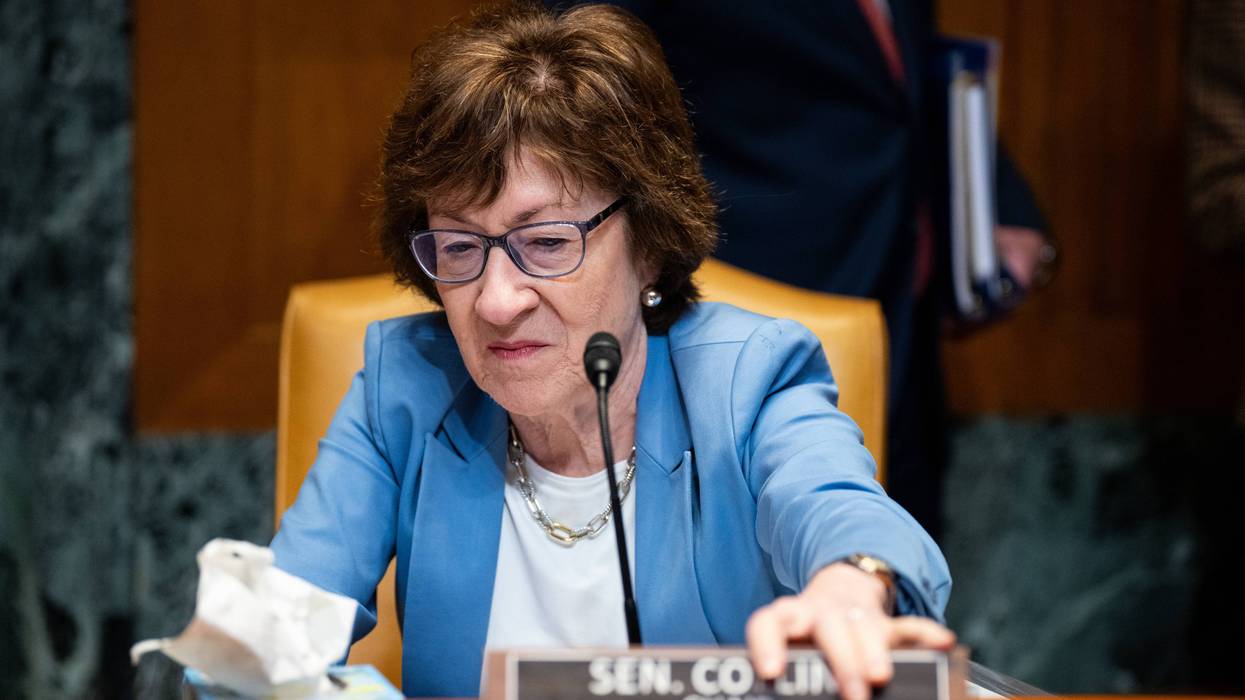
Democratic US Senate candidate Troy Jackson on Tuesday castigated his Republican opponent, incumbent Sen. Susan Collins, for voting to funnel tens of millions of dollars to Immigration and Customs Enforcement just over a month before one of the agency's officers killed 25-year-old Johan Sebastián Durán Guerrero in Biddeford, Maine.
"Senator Collins paid for the bullets at [President] Donald Trump's command. Now she wants credit for not pulling the trigger," Jackson said in his closing remarks at the third debate of the critical US Senate contest. The debate was held three months to the day after ICE agent David Brouillette shot and killed Durán Guerrero—a father and Colombian national who had been authorized to work in the US—during a traffic stop.
Jackson pointed to Collins' June vote in favor of a $70 billion funding package that included nearly $40 billion for ICE, whose agents Trump has unleashed on American cities with deadly consequences. According to a CBS News review, federal immigration agents have killed at least nine people and injured over a dozen more in roughly 30 shootings so far during Trump's second White House term.
Days after the shooting in Biddeford, Collins—who chairs the powerful Senate Appropriations Committee—declined to say she regretted supporting the additional ICE funding, which had few meaningful guardrails.
During Tuesday's debate, Collins admitted that "far too many ICE officers were hired and deployed without adequate vetting and training" and touted funding she secured for body cameras and "deescalation training" for immigration agents. (Collins voted against a Democratic amendment to the $70 billion funding package that would have required federal immigration agents to wear body cameras and make footage "accessible to Congress.")
Jackson said marginal reforms aren't enough to rein in "a rogue agency that's doing Trump's bidding."
"I do believe it's important to get rid of it and take that money and prioritize it into existing law enforcement," said Jackson. "So, no, I'm not going to stand up for ICE, and I don't think Senator Collins should either."
"No Mr. Musk, we should be worried about the pain that AI could cause humanity, not the other way around."
US Sen. Bernie Sanders responded Tuesday to Elon Musk's apparent concern for artificial intelligence's potential feelings by arguing for a human-centered approach to the rapidly advancing technology.
Musk, the CEO of Tesla and SpaceX who also runs the AI company xAI, recently endorsed rival Anthropic's recent decision to ban employees from "sustained and needless abusive or cruel behavior" toward the company's Claude chatbot models.
Last week, Musk responded to a discussion on X about Anthropic's updated usage policy, calling the company's decision “the right move.”
“Cruelty to something that believes it is experiencing pain is not OK," he added.
Sanders (I-Vt.), meanwhile, has repeatedly warned that AI's effects on workers, families, and society deserve far more attention than the priorities of the billionaires developing it.
" Elon Musk, who wants to build millions of robots per year to replace workers, is now worried about the 'pain' humans may cause AI," Sanders wrote on X. "No, Mr. Musk, we should be worried about the pain that AI could cause humanity, not the other way around. HUMANS FIRST."
Anthropic's policy, which is scheduled to take effect November 12, does not prohibit ordinary expressions of frustration, disagreement with a chatbot, or dark creative writing.
There is no established evidence that today's chatbots experience pain or possess feelings in the human sense.
Critics of Anthropic's policy have warned that treating AI systems like they possess human emotions could mislead users or make them more susceptible to manipulation. Scott Stevenson, CEO of legal AI company Spellbook, called the policy “a dangerous precedent,” while journalist Michael Shellenberger accused the company of “anthropomorphizing machines,” Cybernews reported Sunday.
Sanders has cited Musk's own prediction that AI and robots could “replace all jobs,” questioning how ordinary people would earn a living if machines displaced workers on a massive scale. The senator has also raised concerns about the social consequences of AI companions, especially for children and teenagers.
Last week, Sanders renewed his call for a congressional ban on the development of advanced artificial intelligence, citing Big Tech oligarchs' secret preparations for a "catastrophic AI event."
Sanders and Congressman Greg Casar (D-Texas) last month introduced legislation to pause advanced AI development and ban the creation or deployment of artificial superintelligence, which experts believe poses a grave threat to humanity.
"They’re racing to build a technology they can’t control and that threatens humanity," the senator wrote last week.
"After years of using socialism to frighten voters away from Democrats, political interests with apparent Republican connections are trying a remarkable reversal: selling voters on a socialist," said one news site.
A mysterious right-wing political action committee has spent nearly $400,000 promoting a socialist running for the US Senate in Ohio, raising questions about an apparent effort to siphon progressive votes from Democratic candidate Sherrod Brown in a key midterm contest, according to reports published Monday.
The Columbus Dispatch and Cleveland.com are among the media outlets reporting that the newly formed Enough Promises Ohio PAC has financed mailers urging voters to support Greg Levy, an independent candidate affiliated with the Party for Socialism and Liberation (PSL), whose working-class platform includes implementing a $30 hourly minimum wage, ending the "US war machine" and "war on Black America," and working to "save the planet from capitalism."
The mailers were not produced by Levy's campaign. Federal campaign finance filings trace the spending to a printing vendor with connections to President Donald Trump's political network. Seven Farms shares a business address with Whistlestop Strategies, a direct mail operation associated with Big Dog Strategies, a Republican consulting firm that has worked with Republican candidates and has ties to MAGA Inc., Trump's principal super political action committee (PAC).
"After years of using socialism to frighten voters away from Democrats, political interests with apparent Republican connections are trying a remarkable reversal: selling voters on a socialist," Cleveland.com reported, noting what some are calling a "cynical attempt to turn growing interest in socialism into a weapon against Sherrod Brown."
The connections raise questions about whether the spending is part of a Republican strategy to divide Democratic-leaning voters. Enough Promises Ohio has not disclosed its contributors, leaving the source of the money unclear. The PAC and the involved companies have yet to explain the spending.
"The Greg Levy for Senate campaign team has recently discovered, through messages circulating on social media, that mailers falsely impersonating our campaign are being sent out to voters across Ohio," Levy said on X. "The Greg Levy for Senate campaign has no ties to the entities circulating the mailer, and we condemn this attempted deception of voters."
"There is a well-established record of both Republican and Democratic Party operatives using their financial resources to try and trick voters," he continued. "This is a highly undemocratic practice and does a disservice to voters in Ohio and throughout the country."
"Our campaign is historically rooted in Black and working-class communities throughout our state, and our message of fighting for working people against the biggest banks and corporations is resonating with voters all over Ohio," Levy said. "We reject and condemn the dirty tricks and racist impersonation of our campaign by entities working on behalf of those same capitalist institutions."
"This racist caricaturing of our candidate, a form of digital blackface, is a cheap, cowardly attack that is meant to demean the communities we represent and scare voters away from policies that put the needs of working families ahead of corporate profits," he added. "The Greg Levy for Senate campaign is considering taking legal action against the operatives behind this crude impersonation."
The murky mailers come as Brown, a former US senator seeking to reclaim his seat, faces Republican Sen. Jon Husted in a closely watched race that could help determine control of the Senate. Numerous recent polls indicate a low- to mid-single-digit lead for Brown.
Progressives who eschew Brown in favor of Levy cite the latter's pro-working-class economic agenda, Brown's support for Israel's genocidal assault on Gaza, and general frustration with the two major parties.
In an opinion piece published Tuesday by Common Dreams, Ohio Peace Council Chair Werner Lange argued that Levy's candidacy risks being a "spoiler," particularly among younger and pro-Palestinian voters dissatisfied with Brown's record and his acceptance of campaign contributions from pro-Israel interests—including the American Israel Public Affairs Committee—which have given more than $1.2 million to the former senator since 1990, according to the campaign finance tracker OpenSecrets.
"The danger is that Levy may do to the 2026 Senate race in Ohio what Ralph Nader did to the 2000 Presidential race in Florida—snatch defeat out of the jaws of victory for progressive forces," Lange wrote, repeating the controversial, and, according to some experts, false claim that the consumer advocate's Green Party run tipped the highly contentious contest in favor of Republican nominee George W. Bush.
That does not mean that Levy can't divert enough votes from Brown to deliver a win for Husted and, possibly, control of the narrowly divided Senate to Republicans.
The right-wing funding in support of Levy underscores how outside groups can spend enormous sums to influence voters while keeping their own donors hidden, at least until disclosure deadlines require them to reveal more, largely as a result of US Supreme Court rulings, chiefly 2010's Citizens United v. Federal Election Commission.
Recently, Democrats including former US Transportation Secretary Pete Buttigieg, Michigan US Senate candidate Abdul El-Sayed, and comedian/commentator Jon Stewart have called for a constitutional amendment to overturn Citizens United and get big money out of politics.
Last year, Congresswoman Pramila Jayapal (D-Wash.) led the introduction of the We the People Amendment, which rejects corporate personhood and would enshrine that "the rights protected and extended by the Constitution are the rights of natural persons only."
"Instead of helping countries withstand another major shock," Oxfam's executive director said, the IMF "is forcing them to cut back on the very spending that can help protect people and recover."
The US-Israeli war with Iran has exacerbated economic hardship across the world. It's especially bad for the developing nations currently being forced to implement austerity programs by the International Monetary Fund.
Under IMF loan programs, countries struggling with debt are required to reduce government budget deficits by introducing spending cuts and tax increases that tend to hurt their poorest citizens. They often include cuts to public services and welfare programs, caps on government workers' salaries, and the elimination of subsidies that keep basic needs affordable.
According to a report out Monday from Oxfam—amid the IMF's annual meeting in Bangkok this week—24 of the 28 nations currently receiving IMF loans have been forced to implement austerity measures. Some of them, like Sierra Leone and Guinea-Bissau, are among the poorest nations in the world.
Even before the war—which has caused oil prices to soar and driven inflation worldwide—people in many of these countries were struggling to meet their basic needs and facing severe economic pressure: 51% were food insecure, and 57% lacked access to clean cooking fuel.
Emergency government programs have been able to backstop the worst effects for up to 130 million of the world's poorest people, according to a report published before the meeting by the United Nations Development Program.
But as those countries run out of resources, many are being forced to pivot, and the stiff requirements imposed by the IMF may exacerbate the hardship.
In Ecuador and Guinea-Bissau, the IMF is requiring governments to cut spending, raise taxes, or both to the equivalent of roughly 4% of the nations' annual gross domestic product (GDP).
The terms are even harsher for Sierra Leone, where the government is required to cut spending or raise costs equivalent to more than five times its annual healthcare budget.
A loan approved last week for Bolivia requires the government to slash as much as 8.5% of its GDP from the deficit—about twice its annual healthcare spending. The country has already been forced to eliminate a diesel subsidy that drove high prices down for consumers and businesses.
The IMF has acknowledged that these cuts are likely to make the strain worse for many low-income countries already suffering from the war, but said they had "no choice" but to cut spending or restructure their debts.
Oxfam International executive director Amitabh Behar noted that during previous crises like the Covid-19 pandemic and the war in Ukraine, the IMF has enacted tools to ease the burden on nations in debt by providing emergency loans and access to foreign currency without requiring additional borrowing.
"But this time, the fund is taking a very different path," he said. "Instead of helping countries withstand another major shock, it is doubling down on austerity—forcing them to cut back on the very spending that can help protect people and recover—and leaving them even more vulnerable to the next crisis."
"If the administration wants to investigate anyone, maybe they should look at themselves first."
Progressive US Rep. Pramila Jayapal this week not only joined a growing chorus outraged by President Donald Trump's "rogue" Department of Homeland Security agents raiding Congresswoman Ilhan Omar's home, the Washington Democrat took it a step further.
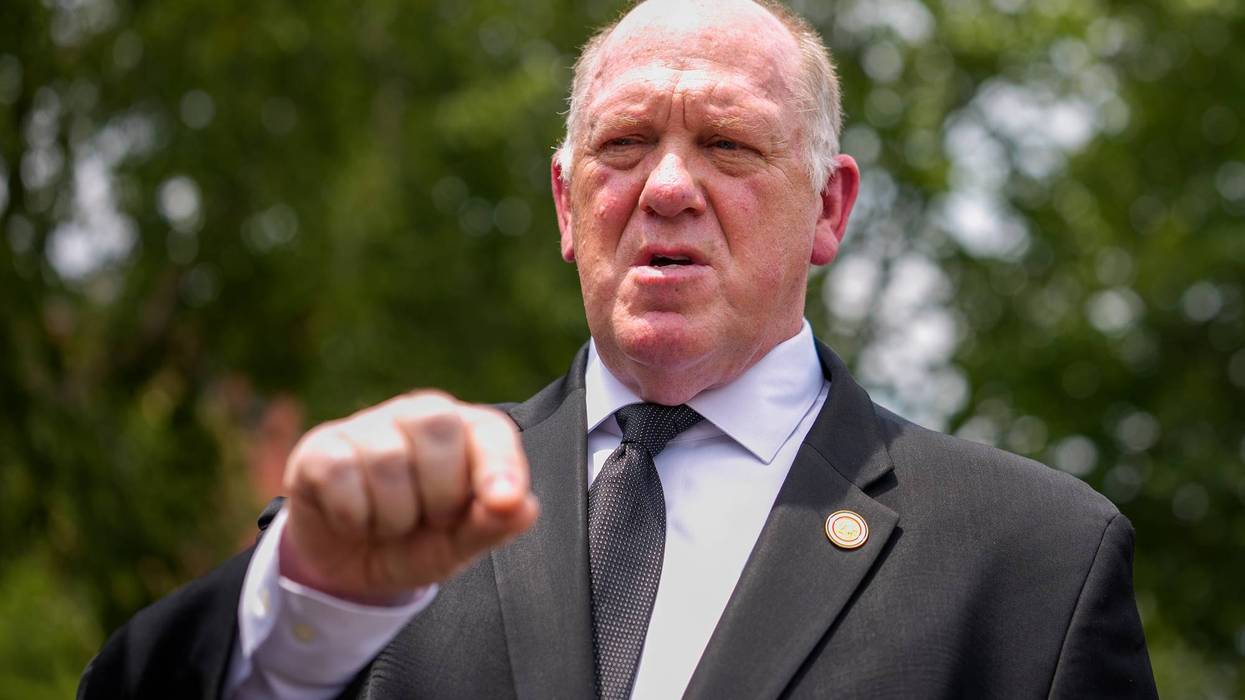
After putting out a nearly three-minute video decrying Trump's repeated attacks on her Democratic colleague from Minnesota, Jayapal reminded social media users of the president's "border czar," Tom Homan, allegedly accepting a bribe in the form of a paper bag stuffed with $50,000 in cash.
As part of a probe launched under the Biden administration, Homan was the target of a Federal Bureau of Investigation sting operation. In September 2024, he was recorded taking the bag of cash from undercover FBI agents posing as businessmen interested in securing government contracts if Trump returned to the White House.
"If the administration wants to investigate anyone, maybe they should look at themselves first. Anyone remember this?" Jayapal wrote alongside a photo of media coverage that notes Trump's Department of Justice (DOJ) closed the probe into Homan last year.
Before former US Attorney General Pam Bondi was fired by Trump this past April, she insisted last year that "the investigation into Mr. Homan was subjected to a full review by the FBI, agents, and DOJ prosecutors," who "found no credible evidence of any wrongdoing."
However, congressional Democrats as well as the groups Democracy Defenders Fund and Democracy Forward have fought for access to records, including the recording of Homan and the undercover agents.
Homan is far from the only member of Trump's second administration to face credible allegations of corruption. In fact, according to polling results released Tuesday, 59% of Americans believe the president himself has done illegal or unethical things to cash in on his return to power.
Jayapal also isn't the only critic of the Omar raid to point a finger at Trump's border czar this week. Rep. Don Beyer (D-Va.) similarly wrote on social media that "Tom Homan, the man leading Trump’s authoritarian 'investigation' of Rep. Ilhan Omar right before the midterm, was caught by the FBI accepting a bribe of $50,000 in cash in a paper bag."
"But Trump's Justice Department simply dropped the case and covered it up," Beyer stressed. "The most corrupt presidential administration in history."
"For 23 years, since its inception, DHS has been utilized by the government to target and persecute those they consider the public enemy," Ramirez said.
In response to the agency's rampant abuses during President Donald Trump's second term, many elected Democrats have warmed to the idea of abolishing US Immigration and Customs Enforcement. But one progressive lawmaker is pushing to go a step further: abolishing the entire Department of Homeland Security.
Rep. Delia Ramirez (D-Ill.) introduced legislation on Tuesday that would repeal all “duplicative and overreaching terrorism laws,” including getting rid of DHS, which was created in 2003 following the September 11 terrorist attacks.
The bill, titled the Reimagining Safety Act, would not only eliminate ICE and Customs and Border Protection (CBP). It seeks to eliminate immigration detention altogether and begin the process of replacing it with a civil court-based immigration system run through the US Department of Justice (DOJ).
In a dramatic departure from current immigration procedures, all deportations would need to be approved by Congress before they could proceed.
The bill comes just one day after agents with the DHS Investigations unit raided the home of Ramirez's colleague, Rep. Ilhan Omar (D-Minn.), as part of a federal criminal investigation related to her citizenship documents.
The investigation---which follows years of attacks by President Donald Trump and other Republicans against Omar's Somali background and Muslim faith, and comes just weeks before an election---has been described by critics as intimidation against a political opponent.
"For almost a decade, Trump and Republicans have lied about Congresswoman Omar to silence her dissent," Ramirez said on Monday. "My sister [Ilhan] has not backed down, so now they are using DHS and the federal government to target and persecute her."
"We must strip them of their weapons," she said. "We must dismantle DHS."
Under Ramirez's legislation, a new agency called the Department of Community Safety would assume DHS's duties. This would include running the Federal Emergency Management Agency (FEMA), which handles the federal response to natural disasters and other emergencies.
The new agency would use DHS's massive pot of federal funding for programs that aim to stop gun violence and other crime; provide support to asylum seekers at the border; redirect federal resources toward community needs like healthcare, housing, education, and emergency preparedness; and support community-based safety programs that do not adopt the militarized law enforcement of DHS.
Other functions of DHS would be scattered across different agencies: Immigration enforcement would belong to the DOJ, the Department of Transportation would take over the Transportation Security Administration and Coast Guard, and the Treasury Department would conduct customs enforcement.
Some of the expansive powers introduced during the War on Terror would also be rolled back: Those without criminal convictions or warrants would no longer be able to be put on "no-fly" lists, which civil liberties advocates have long criticized for stripping people of their right to travel on arbitrary, often racist, grounds.
The legislation would also eliminate the authority of the secretary of state to declare "foreign terrorist" organizations, a power that has been wielded to criminalize protest.
Ramirez told The Intercept that the need to abolish the agency was also underscored by an ICE agent's shooting of 28-year-old Oscar Belgal in the neck last week in New York. Belgal was shot through the window of his car while his 5-year-old child was in the back seat. In the past year, ICE agents have shot at least 25 people, and six of those shootings have been fatal.
Since Trump's return to office in January 2025, at least 58 people have died in immigration custody, according to the ACLU—a dramatic spike from previous administrations.
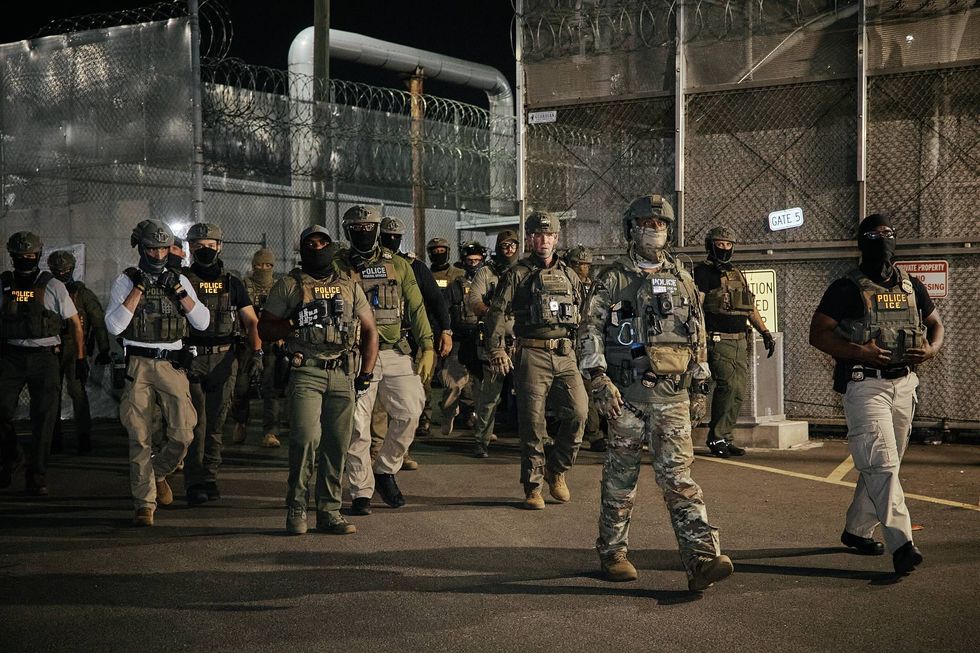
The rising death toll comes as the Trump administration and Republican Congress have dramatically expanded DHS and its budget to create a massive network of new detention camps, where immigrants (and some US citizens)—most of whom have not been convicted of crimes—have been disappeared, often arbitrarily, denied access to legal representation, and subjected to severe physical mistreatment.
Some noncitizens have been targeted explicitly over their political speech, including the hundreds of students who suddenly found their legal status stripped over their participation in pro-Palestine protests, many of whom were summarily arrested and faced with the threat of deportation.
Ramirez told The Intercept all of these were examples of how DHS is "not rogue," but working as designed.
"For 23 years, since its inception, DHS has been utilized by the government to target and persecute those they consider the public enemy," she said, "whether it is Muslim Americans, Haitians escaping violence, Latinos yearning for a better life, or dissenting voices demanding an end to the genocide in Palestine and the kidnapping of our neighbors.”

During the second Trump administration, public opinion has dramatically shifted against ICE, to the point where a plurality of voters, 48%, said they wanted the agency abolished in a July YouGov poll. In a February poll by the Public Religion Institute, 60% said they opposed increasing ICE's budget, compared with just 36% who favored it.
“In the past, the type of policy we are fighting for would have been written off as outlandish, too ‘extreme,’ or simply put, impossible," said Viviana Baraja, a Chicago-based immigrants' rights advocate who has helped to launch Ramirez's proposal.
"I have seen this administration make the most impossible nightmares possible," Baraja said. "And in the most distorted way, it has strengthened my resolve that if the worst can be possible, we can also dare to dream and to believe that the best can be possible too."