SUBSCRIBE TO OUR FREE NEWSLETTER
Daily news & progressive opinion—funded by the people, not the corporations—delivered straight to your inbox.
5
#000000
#FFFFFF
To donate by check, phone, or other method, see our More Ways to Give page.
Daily news & progressive opinion—funded by the people, not the corporations—delivered straight to your inbox.
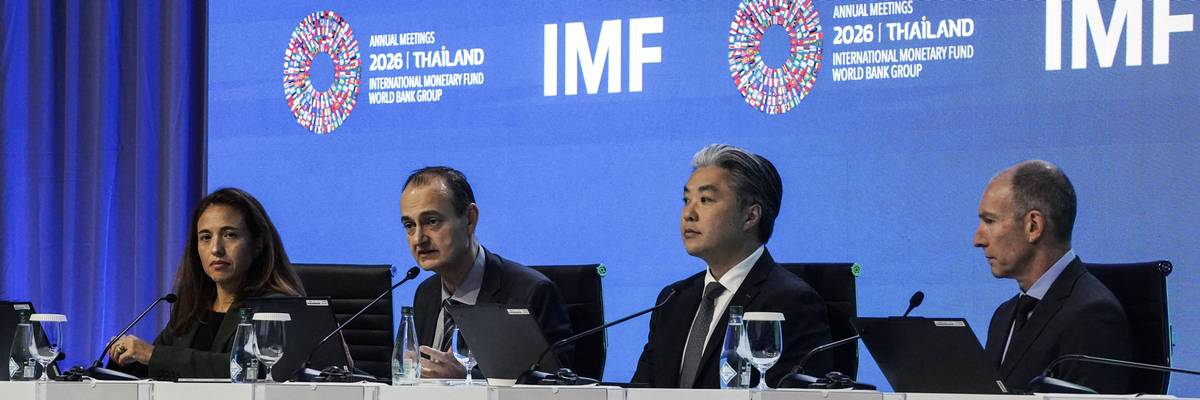
International Monetary Fund (IMF) officials speak at a press conference during the IMF and World Bank's annual meetings in Bangkok, Thailand, on October 13, 2026.
"Instead of helping countries withstand another major shock," Oxfam's executive director said, the IMF "is forcing them to cut back on the very spending that can help protect people and recover."
The US-Israeli war with Iran has exacerbated economic hardship across the world. It's especially bad for the developing nations currently being forced to implement austerity programs by the International Monetary Fund.
Under IMF loan programs, countries struggling with debt are required to reduce government budget deficits by introducing spending cuts and tax increases that tend to hurt their poorest citizens. They often include cuts to public services and welfare programs, caps on government workers' salaries, and the elimination of subsidies that keep basic needs affordable.
According to a report out Monday from Oxfam—amid the IMF's annual meeting in Bangkok this week—24 of the 28 nations currently receiving IMF loans have been forced to implement austerity measures. Some of them, like Sierra Leone and Guinea-Bissau, are among the poorest nations in the world.
Even before the war—which has caused oil prices to soar and driven inflation worldwide—people in many of these countries were struggling to meet their basic needs and facing severe economic pressure: 51% were food insecure, and 57% lacked access to clean cooking fuel.
Emergency government programs have been able to backstop the worst effects for up to 130 million of the world's poorest people, according to a report published before the meeting by the United Nations Development Program.
But as those countries run out of resources, many are being forced to pivot, and the stiff requirements imposed by the IMF may exacerbate the hardship.
In Ecuador and Guinea-Bissau, the IMF is requiring governments to cut spending, raise taxes, or both to the equivalent of roughly 4% of the nations' annual gross domestic product (GDP).
The terms are even harsher for Sierra Leone, where the government is required to cut spending or raise costs equivalent to more than five times its annual healthcare budget.
A loan approved last week for Bolivia requires the government to slash as much as 8.5% of its GDP from the deficit—about twice its annual healthcare spending. The country has already been forced to eliminate a diesel subsidy that drove high prices down for consumers and businesses.
The IMF has acknowledged that these cuts are likely to make the strain worse for many low-income countries already suffering from the war, but said they had "no choice" but to cut spending or restructure their debts.
Oxfam International executive director Amitabh Behar noted that during previous crises like the Covid-19 pandemic and the war in Ukraine, the IMF has enacted tools to ease the burden on nations in debt by providing emergency loans and access to foreign currency without requiring additional borrowing.
"But this time, the fund is taking a very different path," he said. "Instead of helping countries withstand another major shock, it is doubling down on austerity—forcing them to cut back on the very spending that can help protect people and recover—and leaving them even more vulnerable to the next crisis."
Dear Common Dreams reader, It’s been nearly 30 years since I co-founded Common Dreams with my late wife, Lina Newhouser. We had the radical notion that journalism should serve the public good, not corporate profits. It was clear to us from the outset what it would take to build such a project. No paid advertisements. No corporate sponsors. No millionaire publisher telling us what to think or do. Many people said we wouldn't last a year, but we proved those doubters wrong. Together with a tremendous team of journalists and dedicated staff, we built an independent media outlet free from the constraints of profits and corporate control. Our mission has always been simple: To inform. To inspire. To ignite change for the common good. Building Common Dreams was not easy. Our survival was never guaranteed. When you take on the most powerful forces—Wall Street greed, fossil fuel industry destruction, Big Tech lobbyists, and uber-rich oligarchs who have spent billions upon billions rigging the economy and democracy in their favor—the only bulwark you have is supporters who believe in your work. But here’s the urgent message from me today. It's never been this bad out there. And it's never been this hard to keep us going. At the very moment Common Dreams is most needed, the threats we face are intensifying. We need your support now more than ever. We don't accept corporate advertising and never will. We don't have a paywall because we don't think people should be blocked from critical news based on their ability to pay. Everything we do is funded by the donations of readers like you. When everyone does the little they can afford, we are strong. But if that support retreats or dries up, so do we. Will you donate now to make sure Common Dreams not only survives but thrives? —Craig Brown, Co-founder |
The US-Israeli war with Iran has exacerbated economic hardship across the world. It's especially bad for the developing nations currently being forced to implement austerity programs by the International Monetary Fund.
Under IMF loan programs, countries struggling with debt are required to reduce government budget deficits by introducing spending cuts and tax increases that tend to hurt their poorest citizens. They often include cuts to public services and welfare programs, caps on government workers' salaries, and the elimination of subsidies that keep basic needs affordable.
According to a report out Monday from Oxfam—amid the IMF's annual meeting in Bangkok this week—24 of the 28 nations currently receiving IMF loans have been forced to implement austerity measures. Some of them, like Sierra Leone and Guinea-Bissau, are among the poorest nations in the world.
Even before the war—which has caused oil prices to soar and driven inflation worldwide—people in many of these countries were struggling to meet their basic needs and facing severe economic pressure: 51% were food insecure, and 57% lacked access to clean cooking fuel.
Emergency government programs have been able to backstop the worst effects for up to 130 million of the world's poorest people, according to a report published before the meeting by the United Nations Development Program.
But as those countries run out of resources, many are being forced to pivot, and the stiff requirements imposed by the IMF may exacerbate the hardship.
In Ecuador and Guinea-Bissau, the IMF is requiring governments to cut spending, raise taxes, or both to the equivalent of roughly 4% of the nations' annual gross domestic product (GDP).
The terms are even harsher for Sierra Leone, where the government is required to cut spending or raise costs equivalent to more than five times its annual healthcare budget.
A loan approved last week for Bolivia requires the government to slash as much as 8.5% of its GDP from the deficit—about twice its annual healthcare spending. The country has already been forced to eliminate a diesel subsidy that drove high prices down for consumers and businesses.
The IMF has acknowledged that these cuts are likely to make the strain worse for many low-income countries already suffering from the war, but said they had "no choice" but to cut spending or restructure their debts.
Oxfam International executive director Amitabh Behar noted that during previous crises like the Covid-19 pandemic and the war in Ukraine, the IMF has enacted tools to ease the burden on nations in debt by providing emergency loans and access to foreign currency without requiring additional borrowing.
"But this time, the fund is taking a very different path," he said. "Instead of helping countries withstand another major shock, it is doubling down on austerity—forcing them to cut back on the very spending that can help protect people and recover—and leaving them even more vulnerable to the next crisis."
The US-Israeli war with Iran has exacerbated economic hardship across the world. It's especially bad for the developing nations currently being forced to implement austerity programs by the International Monetary Fund.
Under IMF loan programs, countries struggling with debt are required to reduce government budget deficits by introducing spending cuts and tax increases that tend to hurt their poorest citizens. They often include cuts to public services and welfare programs, caps on government workers' salaries, and the elimination of subsidies that keep basic needs affordable.
According to a report out Monday from Oxfam—amid the IMF's annual meeting in Bangkok this week—24 of the 28 nations currently receiving IMF loans have been forced to implement austerity measures. Some of them, like Sierra Leone and Guinea-Bissau, are among the poorest nations in the world.
Even before the war—which has caused oil prices to soar and driven inflation worldwide—people in many of these countries were struggling to meet their basic needs and facing severe economic pressure: 51% were food insecure, and 57% lacked access to clean cooking fuel.
Emergency government programs have been able to backstop the worst effects for up to 130 million of the world's poorest people, according to a report published before the meeting by the United Nations Development Program.
But as those countries run out of resources, many are being forced to pivot, and the stiff requirements imposed by the IMF may exacerbate the hardship.
In Ecuador and Guinea-Bissau, the IMF is requiring governments to cut spending, raise taxes, or both to the equivalent of roughly 4% of the nations' annual gross domestic product (GDP).
The terms are even harsher for Sierra Leone, where the government is required to cut spending or raise costs equivalent to more than five times its annual healthcare budget.
A loan approved last week for Bolivia requires the government to slash as much as 8.5% of its GDP from the deficit—about twice its annual healthcare spending. The country has already been forced to eliminate a diesel subsidy that drove high prices down for consumers and businesses.
The IMF has acknowledged that these cuts are likely to make the strain worse for many low-income countries already suffering from the war, but said they had "no choice" but to cut spending or restructure their debts.
Oxfam International executive director Amitabh Behar noted that during previous crises like the Covid-19 pandemic and the war in Ukraine, the IMF has enacted tools to ease the burden on nations in debt by providing emergency loans and access to foreign currency without requiring additional borrowing.
"But this time, the fund is taking a very different path," he said. "Instead of helping countries withstand another major shock, it is doubling down on austerity—forcing them to cut back on the very spending that can help protect people and recover—and leaving them even more vulnerable to the next crisis."