5
#000000
#FFFFFF
To donate by check, phone, or other method, see our More Ways to Give page.
Daily news & progressive opinion—funded by the people, not the corporations—delivered straight to your inbox.
"If Musk is going to... assist Putin's invasion of Ukraine, Ukraine's allies should sanction Starlink, X, and Tesla," said one expert.
The Ukrainian government on Tuesday night said that its access to the SpaceX-owned Starlink satellite internet service was throttled, prompting critics to question the wisdom of depending on any company owned by far-right billionaire Elon Musk.
According to a Wednesday report in The New York Times, Ukrainian officials suspect that orders to restrict their access to Starlink "had come from Washington," as President Donald Trump has been pressuring the country to stop attacking Russian energy infrastructure ahead of the 2026 midterm elections.
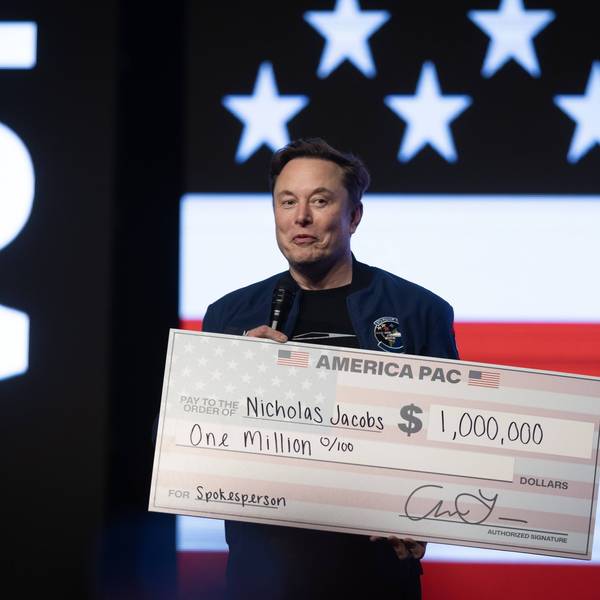
Musk, who was Trump's single biggest donor in the 2024 presidential campaign, has spent at least $276 million since July to help Republicans maintain their congressional majorities.
In a Wednesday social media post, Ukrainian military expert Serhiy Beskrestnov revealed that Ukrainian military forces "have not received any warnings about this restriction" to Starlink, which he said "has led to the failure of several missions."
"Obviously, this action cannot be a coincidence," Beskrestnov added, "and is related to the current political situation."
As noted by the Kyiv Independent on Wednesday, Ukraine depends on Starlink for "several military applications including operating its mid-strike campaign in Russian-occupied Ukraine, as well as interceptor drones that defend against Russia's new jet-powered attack drones."
The sudden restrictions on Starlink drew the ire of Polish Foreign Affairs Minister Radosław Sikorski, who directly called out Musk in a social media post.
"Hey, Elon Musk, big man, are you playing politics with your products again?" Sikorski asked. "As your European customers, we are watching you."
Ian Bond, deputy director of the Center for European Reform think tank, wrote that the sudden Starlink restrictions "should set off a siren in every defense ministry in Europe."
"There needs to be much more urgency about developing autonomous capabilities," Bond added, "not subject to US caprices, for early warning of attacks, countering ballistic missiles, communicating with forces or controlling offensive weapons."
Gideon Rachman, chief foreign affairs commentator for the Financial Times, expressed a similar view, arguing that "the Starlink restriction over Ukraine is a perfect illustration of the danger of relying on US technology."
Steve Peers, professor of EU law and human rights law at Royal Holloway, University of London, argued that democratic nations must start viewing Musk and his companies as geopolitical adversaries.
"If Musk is going to (in effect) assist Putin's invasion of Ukraine," wrote Peers, "Ukraine's allies should sanction Starlink, X, and Tesla."
Nicholas Grossman, professor of international relations at the University of Illinois, pointed out that he has been calling for governments to end their dependence on Musk and his companies for the last three years.
"The problem is too much power, especially for an enemy of democracy," Grossman wrote.
Grossman also took a shot at former President Joe Biden's administration for not taking Musk's threat to democracy seriously, as it continued to award SpaceX lucrative contracts even as its owner used his vast fortune to power Trump's 2024 comeback.
"Big mistake," he wrote.
Dear Common Dreams reader, It’s been nearly 30 years since I co-founded Common Dreams with my late wife, Lina Newhouser. We had the radical notion that journalism should serve the public good, not corporate profits. It was clear to us from the outset what it would take to build such a project. No paid advertisements. No corporate sponsors. No millionaire publisher telling us what to think or do. Many people said we wouldn't last a year, but we proved those doubters wrong. Together with a tremendous team of journalists and dedicated staff, we built an independent media outlet free from the constraints of profits and corporate control. Our mission has always been simple: To inform. To inspire. To ignite change for the common good. Building Common Dreams was not easy. Our survival was never guaranteed. When you take on the most powerful forces—Wall Street greed, fossil fuel industry destruction, Big Tech lobbyists, and uber-rich oligarchs who have spent billions upon billions rigging the economy and democracy in their favor—the only bulwark you have is supporters who believe in your work. But here’s the urgent message from me today. It's never been this bad out there. And it's never been this hard to keep us going. At the very moment Common Dreams is most needed, the threats we face are intensifying. We need your support now more than ever. We don't accept corporate advertising and never will. We don't have a paywall because we don't think people should be blocked from critical news based on their ability to pay. Everything we do is funded by the donations of readers like you. When everyone does the little they can afford, we are strong. But if that support retreats or dries up, so do we. Will you donate now to make sure Common Dreams not only survives but thrives? —Craig Brown, Co-founder |
The Ukrainian government on Tuesday night said that its access to the SpaceX-owned Starlink satellite internet service was throttled, prompting critics to question the wisdom of depending on any company owned by far-right billionaire Elon Musk.
According to a Wednesday report in The New York Times, Ukrainian officials suspect that orders to restrict their access to Starlink "had come from Washington," as President Donald Trump has been pressuring the country to stop attacking Russian energy infrastructure ahead of the 2026 midterm elections.
Musk, who was Trump's single biggest donor in the 2024 presidential campaign, has spent at least $276 million since July to help Republicans maintain their congressional majorities.
In a Wednesday social media post, Ukrainian military expert Serhiy Beskrestnov revealed that Ukrainian military forces "have not received any warnings about this restriction" to Starlink, which he said "has led to the failure of several missions."
"Obviously, this action cannot be a coincidence," Beskrestnov added, "and is related to the current political situation."
As noted by the Kyiv Independent on Wednesday, Ukraine depends on Starlink for "several military applications including operating its mid-strike campaign in Russian-occupied Ukraine, as well as interceptor drones that defend against Russia's new jet-powered attack drones."
The sudden restrictions on Starlink drew the ire of Polish Foreign Affairs Minister Radosław Sikorski, who directly called out Musk in a social media post.
"Hey, Elon Musk, big man, are you playing politics with your products again?" Sikorski asked. "As your European customers, we are watching you."
Ian Bond, deputy director of the Center for European Reform think tank, wrote that the sudden Starlink restrictions "should set off a siren in every defense ministry in Europe."
"There needs to be much more urgency about developing autonomous capabilities," Bond added, "not subject to US caprices, for early warning of attacks, countering ballistic missiles, communicating with forces or controlling offensive weapons."
Gideon Rachman, chief foreign affairs commentator for the Financial Times, expressed a similar view, arguing that "the Starlink restriction over Ukraine is a perfect illustration of the danger of relying on US technology."
Steve Peers, professor of EU law and human rights law at Royal Holloway, University of London, argued that democratic nations must start viewing Musk and his companies as geopolitical adversaries.
"If Musk is going to (in effect) assist Putin's invasion of Ukraine," wrote Peers, "Ukraine's allies should sanction Starlink, X, and Tesla."
Nicholas Grossman, professor of international relations at the University of Illinois, pointed out that he has been calling for governments to end their dependence on Musk and his companies for the last three years.
"The problem is too much power, especially for an enemy of democracy," Grossman wrote.
Grossman also took a shot at former President Joe Biden's administration for not taking Musk's threat to democracy seriously, as it continued to award SpaceX lucrative contracts even as its owner used his vast fortune to power Trump's 2024 comeback.
"Big mistake," he wrote.
The Ukrainian government on Tuesday night said that its access to the SpaceX-owned Starlink satellite internet service was throttled, prompting critics to question the wisdom of depending on any company owned by far-right billionaire Elon Musk.
According to a Wednesday report in The New York Times, Ukrainian officials suspect that orders to restrict their access to Starlink "had come from Washington," as President Donald Trump has been pressuring the country to stop attacking Russian energy infrastructure ahead of the 2026 midterm elections.
Musk, who was Trump's single biggest donor in the 2024 presidential campaign, has spent at least $276 million since July to help Republicans maintain their congressional majorities.
In a Wednesday social media post, Ukrainian military expert Serhiy Beskrestnov revealed that Ukrainian military forces "have not received any warnings about this restriction" to Starlink, which he said "has led to the failure of several missions."
"Obviously, this action cannot be a coincidence," Beskrestnov added, "and is related to the current political situation."
As noted by the Kyiv Independent on Wednesday, Ukraine depends on Starlink for "several military applications including operating its mid-strike campaign in Russian-occupied Ukraine, as well as interceptor drones that defend against Russia's new jet-powered attack drones."
The sudden restrictions on Starlink drew the ire of Polish Foreign Affairs Minister Radosław Sikorski, who directly called out Musk in a social media post.
"Hey, Elon Musk, big man, are you playing politics with your products again?" Sikorski asked. "As your European customers, we are watching you."
Ian Bond, deputy director of the Center for European Reform think tank, wrote that the sudden Starlink restrictions "should set off a siren in every defense ministry in Europe."
"There needs to be much more urgency about developing autonomous capabilities," Bond added, "not subject to US caprices, for early warning of attacks, countering ballistic missiles, communicating with forces or controlling offensive weapons."
Gideon Rachman, chief foreign affairs commentator for the Financial Times, expressed a similar view, arguing that "the Starlink restriction over Ukraine is a perfect illustration of the danger of relying on US technology."
Steve Peers, professor of EU law and human rights law at Royal Holloway, University of London, argued that democratic nations must start viewing Musk and his companies as geopolitical adversaries.
"If Musk is going to (in effect) assist Putin's invasion of Ukraine," wrote Peers, "Ukraine's allies should sanction Starlink, X, and Tesla."
Nicholas Grossman, professor of international relations at the University of Illinois, pointed out that he has been calling for governments to end their dependence on Musk and his companies for the last three years.
"The problem is too much power, especially for an enemy of democracy," Grossman wrote.
Grossman also took a shot at former President Joe Biden's administration for not taking Musk's threat to democracy seriously, as it continued to award SpaceX lucrative contracts even as its owner used his vast fortune to power Trump's 2024 comeback.
"Big mistake," he wrote.