

SUBSCRIBE TO OUR FREE NEWSLETTER
Daily news & progressive opinion—funded by the people, not the corporations—delivered straight to your inbox.
5
#000000
#FFFFFF
To donate by check, phone, or other method, see our More Ways to Give page.
Daily news & progressive opinion—funded by the people, not the corporations—delivered straight to your inbox.
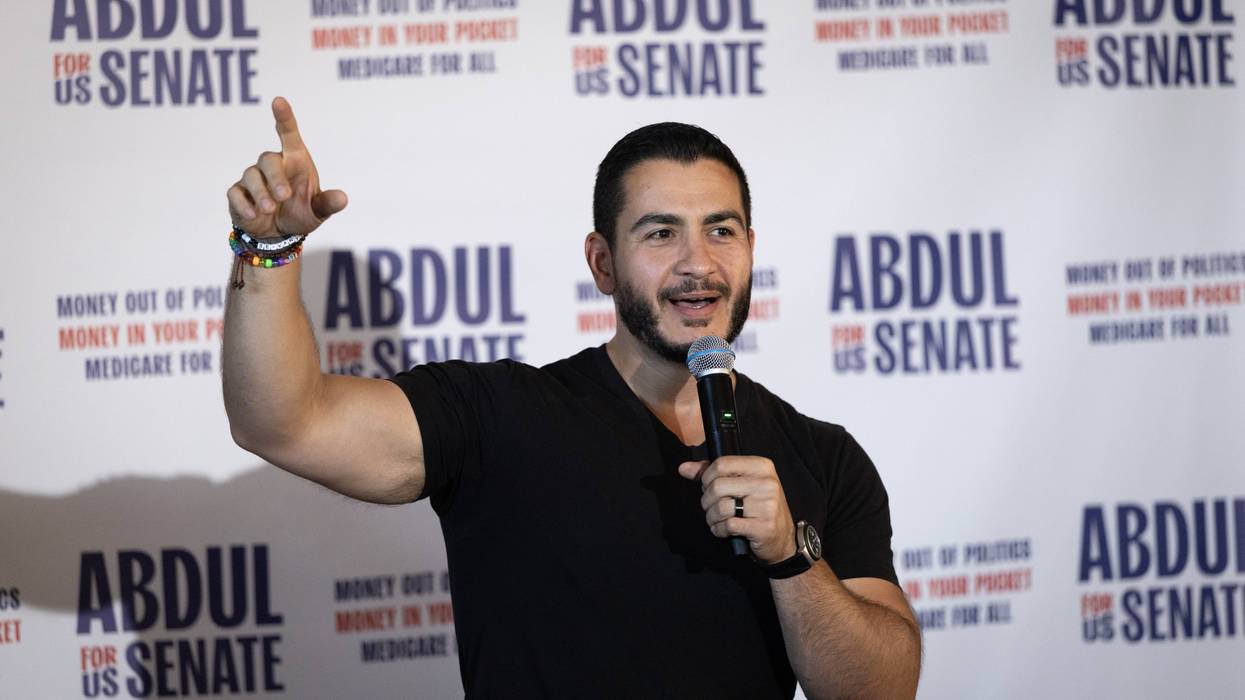
"Honestly, this goes further than a lot of poll data to show you that GOPs are cooked," one journalist said of the Republican candidates claiming to oppose the president's unpopular conflict before the midterms.
With US President Donald Trump's approval rating tanking—largely due to his illegal war on Iran and the resulting economic fallout—Michigan's Republican US Senate candidate, Mike Rogers, on Monday afternoon called for an end to the conflict, and his Democratic opponent, Abdul El-Sayed, wasted no time turning to the receipts.
Rogers posted a 75-second video on social media: He's in a grocery store, noting the need to bring down food prices. He also says that "the war with Iran needs to end," and in the meantime, the United States should impose a temporary embargo on exports of diesel—which has hit a record high of $6.51 per gallon.
El-Sayed responded with a pair of clips from the Republican's previous interviews and wrote: "You've spent your entire campaign supporting the war in Iran. Liar, coward, fraud."
The Democratic super political action committee Senate Majority PAC also called out Rogers, writing in response to his ad: "No one’s buying this. You supported the war in Iran every step of the way. Rogers six months ago: 'How anyone says [the war] is a bad idea, I don't know what is.'"
Michigan Democratic Party spokesperson Joey Hannum similarly stressed that "Mike Rogers has been all-in on Trump's Iran War from day one, repeatedly dismissed Michiganders' pain as gas prices skyrocketed, and has vowed to hand Trump a blank check to keep this war going indefinitely."
"Every time a Michigander fills up their gas tank, they're paying the price for the Rogers-Trump war in Iran," Hannum continued, as the average cost of gasoline stood at $4.48 a gallon. "Price Hike Mike promised he would give Trump the authority to keep his cost-raising war going, and Michiganders won't forget it."
Track AIPAC, which documents political spending by the American Israel Public Affairs Committee and related groups, responded to Rogers' post with another clip of his previous comments on the war, which has dragged on for nearly seven months—with no end in sight—and killed thousands of people.
Mike Rogers pledges to support unconditional military aid to the country that dragged us into this war: pic.twitter.com/GluXUGKk3X
— AIPAC Tracker (@TrackAIPAC) September 21, 2026
Journalists and pollsters highlighted that Rogers isn't the only Republican running in the November midterms who is now calling for an end to the war, which polling has shown is deeply unpopular with the US public.
Republican Iowa Congresswoman Ashley Hinson—who has repeatedly voted against war powers resolutions intended to end the conflict in Iran—wrote on social media Monday morning that "Iowans are being squeezed and shouldn't have to foot the bill at the pump or the checkout line for the war in Iran. We need to use every option at our disposal to provide some relief from high prices."
"That includes suspending the gas tax, pausing diesel exports, unleashing E-15 everywhere we can, reinstating the $1/gallon biodiesel tax credit, and creating a diesel relief program to help our farmers and truckers being crushed by the high costs," Hinson continued, adding that "the war needs to be brought to a successful and immediate end."
In response, her Democratic opponent, Josh Turek, said that "it's easy to send a tweet, but when you had the chance to vote to end this war, you chose not to. You voted seven times to continue it, including just last week. It's time to actually end the forever wars and put Iowa and Iowans first. Glad you're finally following my lead after waffling on the proposals I put forward last week to address the rising costs of the war in Iran."
Ryan Costello, policy director at the National Iranian American Council, wrote to Hinson: "It's good you're calling for the Iran War to end, though you've also voted against six war powers resolutions directing an end to the war, including just six days ago. Will you vote for the next one, and commit to cut off funding for the backfiring war?"
Sen. Chris Murphy (D-Conn.) asked: "How dumb does she think voters are? If Hinson wins, then Republicans control the Senate. And they've pledged to Trump to kill any legislative effort to end the war as long as they keep power."
Noting that "first Hinson, now Rogers" is claiming to want an end to the war, Punchbowl News senior congressional reporter Andrew Desiderio said that it "will be fascinating to see which way vulnerable R incumbents," such as Sens. Jon Husted (Ohio) and Dan Sullivan (Alaska), "vote on the Iran war powers resolution expected to come up this week."
Following Rogers' post, longtime Capitol Hill journalist Jamie Dupree wrote: "Wow. The war in Iran + high gas/diesel costs must be killing Republicans in their internal polling."
Zenith Research founding partner Adam Carlson posited: "The Republican strategy memo must have gone out this weekend. And the numbers must have been dire, particularly in the already tariff-battered Midwest."
Talking Points Memo founder Josh Marshal suggested, "Honestly, this goes further than a lot of poll data to show you that GOPs are cooked."
Republicans are trying to hang on to their slim majorities in both chambers of Congress for the latter half of Trump's second term, and with the midterms less than two months away, The Cook Political Report currently ranks seven Senate seats as a "toss-up." In addition to the contests in Iowa and Michigan, there is Sullivan's race against former Democratic Congresswoman Mary Peltola in Alaska and Husted versus former Democratic Sen. Sherrod Brown in Ohio.
There's also former Democratic Maine Senate President Troy Jackson's challenge to Republican Sen. Susan Collins, the race between Democratic New Hampshire Congressman Chris Pappas and former Republican Sen. John Sununu, and Texas' contest between Democratic state Rep. James Talarico and Trump-backed state Attorney General Ken Paxton.
"If I were him, I wouldn't debate me either," said Democratic US Senate nominee Abdul El-Sayed.
Democratic US Senate candidate Abdul El-Sayed on Tuesday ridiculed Republican rival Mike Rogers after he skipped out on a town hall event hosted by FOX 2 Detroit.
Shortly after the event, a reporter asked El-Sayed what he thought of "the elephant in the room, or lack thereof," in reference to Rogers' absence.
"The elephant was not in the room," the Michigan Democrat replied. "The elephant decided that they did not want to be in the room. The elephant cowarded out."
Reporter: The elephant in the room tonight, or lack thereof—
El-Sayed: No, the elephant was not in the room. The elephant decided that they did not want to be in the room. The elephant cowarded out. Although the elephants were all in the room in Dallas.
It’s wild to me that… pic.twitter.com/cd9OYD5smM
— Acyn (@Acyn) September 16, 2026
El-Sayed noted that Rogers was able to attend President Donald Trump's midterm convention in Dallas last week, even as he skipped out on a chance to talk directly with Michigan voters.
"It’s wild to me that this guy is more interested in going to speak for, what, six minutes and 48 seconds in Dallas," he said, "than he is to have 60 minutes with Michiganders here in Detroit. But it tells you who he is. He’s a coward."
El-Sayed then expressed mock empathy for his Republican opponent.
"[Rogers] knows that the minute he and I have to actually share the same stage and share podiums, he's not going to have much to say," he said. "Because at the end of the day, I'm going to hold him accountable to his record, which is awful on all the things... If I were him, I wouldn't debate me either."
A reported then asked El-Sayed if he bought Rogers' excuse for not being at the event.
"He's probably at a corporate fundraiser," he replied. "What was his excuse? He's in Florida? He got stuck in Dallas? He's in all the places that are not Michigan? What's his excuse, I don't even know what it is."
In an interview with CBS News Detroit published Wednesday, Rogers defended his decision to skip the event, and pointed out that his campaign had never agreed to attend.
The Michigan Republican also reiterated his concerns about Fox 2 Detroit Roop Raj, whom he alleged is biased against his campaign.
"When you have someone who's already picked their candidate," said Rogers, "you can't have a two-on-one event in a TV studio."
El-Sayed and Rogers are both scheduled to take part in two debates in October.
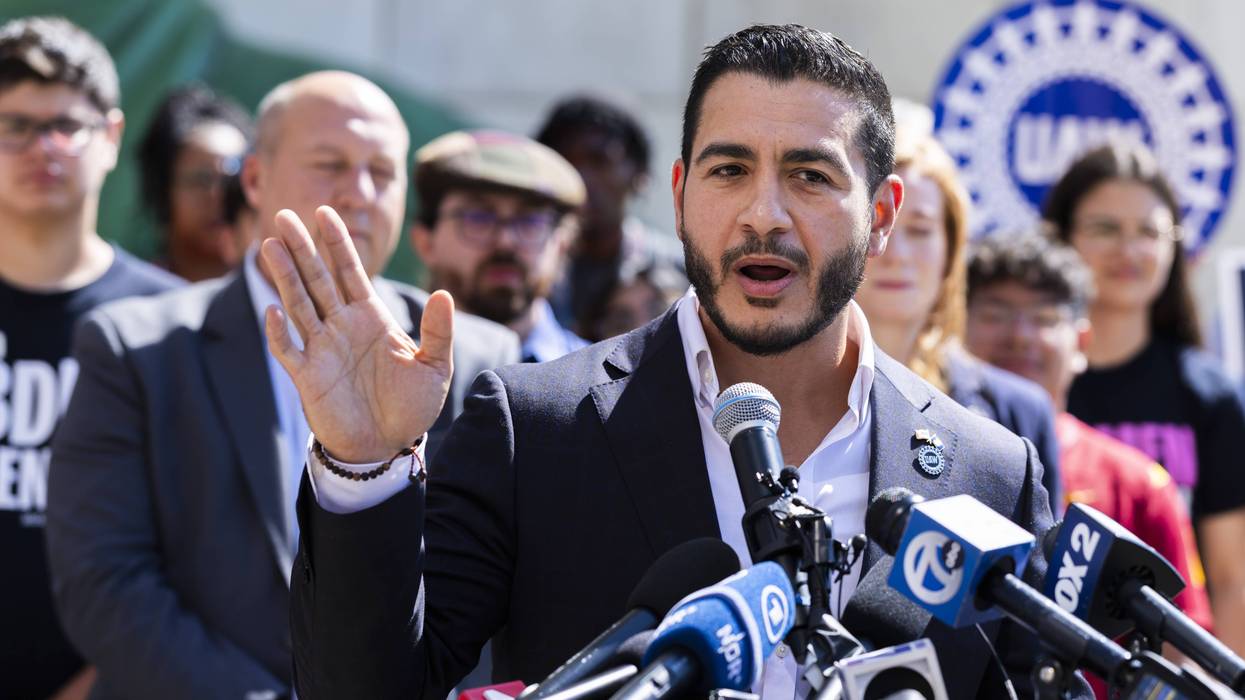
And why Mike Rogers would be a disaster for the country.
The Democratic establishment, along with AIPAC, the American Israel Public Affairs Committee, spent between $60 million and $70 million trying to prevent Dr. Abdul El-Sayed from winning Michigan’s Democratic primary—roughly 11 times the money backing El-Sayed.
He won nonetheless and now faces the Republican nominee, Mike Rogers, in a race that will help determine control of the Senate after the midterms in November.
I hope Michiganders elect El-Sayed, who will be a great US senator.
After receiving an advanced degree in public health, El-Sayed worked as an epidemiologist. Informed by this experience and expertise, he advocates access to healthcare as a right and not a privilege.
He also advocates economic security for all, financed by a tax system that asks more from the wealthy. He’s a champion of civil rights. He’s a fighter for affordability against predatory landlords, monopolistic corporations, and billionaires who turn their wealth into political power.
Most Jewish Americans have values that align with Dr. El-Sayed’s. He believes in social justice—that government can be a force for good as it helps expand opportunities, protect rights, and advance the common good.
Yet AIPAC is continuing its battle against El-Sayed. It is expected to put tens of millions of dollars behind Rogers, some of it disguised behind other PACs. “Our members remain determined to ensure that voters reject Dr. El-Sayed and his radical anti-Israel agenda in November,” said Deryn Sousa, a spokeswoman for AIPAC.
El-Sayed is no more anti-Israel than I am.
Being opposed to Benjamin Netanyahu’s extreme right-wing Israeli government is not the same as being anti-Israel. Nor should it be equated with being antisemitic. Nor, for that matter, should opposition to Netanyahu and his government be seen as condoning the brutal Hamas attack on Israel on October 7, 2023, in which 1,200 were murdered and 251 taken hostage. It was an atrocity and a crime against humanity.
I believe Netanyahu is a war criminal and that his government has committed genocide in Gaza. I’m appalled that he and it continue to allow and excuse horrific violence on the West Bank against Palestinians. For this reason, I don’t believe the United States should arm Netanyahu’s government with destructive military equipment.
This doesn’t make me anti-Israel. For decades I’ve advocated a two-state solution for Israel and Palestine, and I continue to believe it’s the only sane and reasonable way for these two peoples to peacefully coexist.
This certainly doesn’t make me antisemitic, either. I’m Jewish. Some of my relatives died in Hitler’s gas chambers. My mother and father were told they were unwelcome in the small town they moved to when I was a toddler because, according to the group of old men who met them at the doorstep of our new home, it was a “Christian community.”
Like me, Dr. El-Sayed opposes what the government of Netanyahu has done and continues to do. El-Sayed has affirmed that “Jewish Israelis and Palestinians alike have the right to peace, dignity, and self-determination.” He has acknowledged the horror of October 7, condemned all forms of antisemitism, and been highly critical of Israel’s war in Gaza and abuses in the West Bank.
Ten days ago El-Sayed publicly apologized for any misinterpretation people might have placed on remarks he made after a man attacked a synagogue in a Detroit suburb in March. The man, Ayman Mohammad Ghazali, had lost four relatives in an Israeli airstrike on Lebanon the week before.
In a video response at the time, El-Sayed condemned the attack. He added that “hurt people hurt people,” a reference to what happened to Ghazali’s family. Critics accused El-Sayed of justifying Ghazali’s actions.
If you read the transcript of what El-Sayed actually said, it’s clear he was merely trying to explain and give context for the violence. “What I was trying to do was offer context for why it happened, but it wasn’t the time for context,” El-Sayed said in apology. “And you don’t ever want to trample somebody’s pain.”
There is enough pain on all sides—pain for Israelis and Palestinians, for Muslims and Jews. Which is why it’s so important that all of us think clearly and carefully. Being anti-Netanyahu isn’t being anti-Israel, nor is it being antisemitic.
It’s also critically important that the good people of Michigan oppose Mike Rogers, who endorsed and voted for legislation last year that cut Affordable Care Act insurance for millions of Americans, weakened Medicaid and food assistance to less affluent citizens, and provided tax breaks to the very rich.
Rogers has warmly and enthusiastically praised Trump. He’s failed to publicly condemn or even criticize Trump’s bigoted statements about ethnic communities in the United States. He hasn’t said a word against Trump’s unconscionable pardon of the more than 1000 insurrectionists who rioted at the Capitol on January 6, 2021. This includes those found guilty of the most heinous acts, causing grievous bodily harm to law enforcement officers.
My view is we need smart, committed progressives such as Abdul El-Sayed in the Senate. And we need right-wing Trump suckups such as Mike Rogers out of the Senate.

"You can't have your privacy violated if you don't know your privacy is violated," Rogers said in an infamous clip from 2013 as he defended the NSA's mass spying programs.
Amid an expanding assault on privacy by the federal government, Democratic nominee Dr. Abdul El-Sayed has brought the issue of mass surveillance to the forefront of Michigan's Senate race, attacking his Republican opponent, former Rep. Mike Rogers, for his longtime defense of the PATRIOT Act.
"Mike Rogers out here fighting for the Peeping Tom vote," wrote El-Sayed, a former public health official, in a social media post on Monday. "Creepy stuff, Mike."
El-Sayed was responding to an unearthed comment from Rogers, then the chair of the House Intelligence Committee, made during a 2013 committee hearing in Congress just months after whistleblower Edward Snowden's explosive revelations about the extent of the National Security Agency's (NSA) warrantless surveillance of Americans.
At the time, Congress was debating whether to enact legislation reining in a provision in the PATRIOT Act, Section 215, which the government had used to secretly collect phone records and other information in bulk from Americans not accused of wrongdoing.
Rogers was pushing American University law professor Stephen Vladeck to agree that the government should be allowed to examine Americans' business records to determine if they were connected to a foreign terrorist organization. Vladeck said he believed it should, but that protecting Americans' privacy needed to be taken into account. "The way we do it matters," he said.
The chair responded that in the decade since the policy had been enacted, nobody had ever complained about it. Vladeck, noting that the program was a secret, responded: "But who would be complaining?”
"Somebody whose privacy was violated," Rogers retorted. "You can't have your privacy violated if you don't know your privacy is violated."
The quote is highly representative of Rogers' record of support for extensive government surveillance over his decade-and-a-half in Congress. He was one of the PATRIOT Act's leading champions since its introduction in 2001 and led the charge to stop mass collection powers from being curtailed after the Snowden revelations.
“The charge that the program tramples on the privacy of citizens is simply wrong,” he said in a statement with Rep. Dutch Ruppersberger (D-Md.), then the ranking member of the Intelligence Committee.
Rogers and Ruppersberger also coauthored the Cyber Intelligence Sharing and Protection Act (CISPA) in 2012, which would have allowed companies to share cybersecurity-related information with the government, including the NSA, with protections from existing privacy restrictions. The American Civil Liberties Union argued that the bill, which failed in the Senate, would have allowed the government to obtain large amounts of sensitive personal data with few restrictions.
"You can't have your privacy violated if you don't know your privacy is violated."
In 2026, as artificial intelligence becomes a new tool for even more powerful and pervasive spying, El-Sayed has said the government must be banned from using it to "conduct warrantless surveillance."
As part of an AI policy platform rolled out in June, he said rules should be put in place to prevent its use for "domestic authoritarianism," including "mass political surveillance, protected-characteristic predictive policing, or AI targeting of dissent."
During President Donald Trump's second term, as he's used anti-"terrorism" rhetoric to justify a legal crackdown on domestic opposition, the government's expanding spy powers have become an increasing concern.
With the aid of private surveillance companies like Palantir, the administration has created an unprecedented surveillance dragnet that connects AI-powered facial recognition technology, license plate readers, and phone location tools to piles of data on Americans that have been used to supercharge its mass deportation campaign and aggressively monitor protesters and dissenters.
It has been met with some pushback in the Senate, where Republicans earlier this year narrowly failed to extend Trump's powers to surveil noncitizens under Section 702 of the Foreign Intelligence Surveillance Act (FISA) without warrants. Though US citizens are not supposed to be targeted, civil liberties advocates argue that their information is often collected easily and the government has used it to prosecute them.
Rogers has attempted to back off some of his earlier defense of mass surveillance, though he has not meaningfully pushed to reduce the government's spying powers. During a losing Senate bid against Sen. Elissa Slotkin (D-Mich.) in 2024, he said that it's "wrong" for the FBI to conduct warrantless searches against US citizens, but did not call for actually repealing or blocking Section 702.
Since serving in Congress, Rogers parlayed his time overseeing the intelligence community into a lucrative career advising and governing cybersecurity, intelligence, and government-contracting firms.
He served as a senior security adviser to AT&T while the company operated a little-known program that gave law enforcement access to searches of trillions of domestic phone records, though there is no record that he personally worked on the program.
Michigan Advance reported earlier this year that he also made almost $100,000 advising a company that helped the government of former Venezuelan President Nicolás Maduro spy on dissidents.
Noting the Republican nominee's recent pivot to Trumpian election denialism, journalist Spencer Ackerman—who has extensively covered the expansion of government surveillance during the War on Terror—suggested in a post on social media that there is little reason to believe Rogers has changed much after over a decade out of Congress.
"I saw up close his efforts, post-Snowden, to protect the NSA and ensure it continues to nullify your constitutionally-protected privacy," Ackerman said. "He was for impunity then and wants the same thing for himself."