SUBSCRIBE TO OUR FREE NEWSLETTER
Daily news & progressive opinion—funded by the people, not the corporations—delivered straight to your inbox.
5
#000000
#FFFFFF
To donate by check, phone, or other method, see our More Ways to Give page.


Daily news & progressive opinion—funded by the people, not the corporations—delivered straight to your inbox.
Keeping ICE off school campuses is only the first step. School boards and state leaders must equip teachers with trauma-informed practices so children devastated by raids can keep learning.
Results of the November midterm elections brought relief to many immigrant communities, who saw voters in states like Texas push back against the aggressive immigration enforcement campaigns of President Donald Trump’s second term. Yet as immigrant rights advocates have warned, election results alone will not end Immigration and Custom Enforcement raids. ICE remains the highest funded US law enforcement agency with a remaining budget of $91 billion to fund more arrests, detentions, and deportations through September 2029. A Democratic Congress also cannot undo the acute psychological trauma that years of raids and family separations have already inflicted on school children. Inside classrooms all across the US, educators are confronting a wide range of trauma symptoms that disrupt learning.
The urgency of this need was made apparent to us a few weeks into the start of the school year, when a seasoned bilingual educator reached out to us in crisis after a fifth-grader’s parent was detained by ICE. She was at a loss as to how best to support the child, guide other teachers and staff, and reassure the broader student body. Even with resources and guidance on how to keep federal agents off school campuses, those protections are not enough when a fifth grader comes to class the morning after a parent is detained. She and her colleagues wanted to know what to do (and what not to do) so that students could continue to learn while coping with the distress of parental deportation and the ongoing threat of immigration enforcement in their community.
This teacher’s request for assistance in the immediate aftermath of a community member’s detention by ICE is now alarmingly common. We have been working with schools across the country for nearly two decades helping educators build strong home-school relationships, especially with immigrant families. Yet, educators’ concerns are markedly different now from what they were even two years ago. These unprecedented times call for new guidance, professional learning opportunities, resources, and supports for educators who are being asked to respond to crises that are devastating families and communities nationwide.
Protecting immigrant-origin students’ right to an education requires more than keeping ICE off school campuses. School boards, state education agencies, and teachers’ unions have the power and the obligation to make public schools safe for all students.
We led a workshop for teachers and support staff at the school, integrating expertise on the experiences of immigrant-origin youth with core trauma-informed principles. The workshop included baseline information about psychological responses to trauma and easy-to-implement self-regulation strategies for educators to use in their classrooms. We also heard about the issues that are most vexing for school personnel in the midst of a community crisis of this nature. We learned what educators wanted to know and what they found most helpful—lessons that should inform larger-scale efforts to develop and disseminate basic training for all adults working with young people in contexts affected by immigration enforcement.
First, we emphasized that the best and most protective thing classroom teachers can do for students whose family members have been detained or deported by ICE is to maintain normal classroom routines. Teachers are not expected to be experts in knowing how to manage the psychological consequences of a sudden, traumatic event like parental detention. However, they are experts in creating welcoming and routine learning environments; being a steady, positive presence in students’ lives; and teaching them academic and social skills to be successful in their school and in society.
Next, educators wanted help knowing developmentally appropriate ways to talk to students about their fears and answer their questions about immigration enforcement activity in their neighborhoods. We taught core principles from psychological first aid to help teachers respond effectively. This includes answering questions directly and honestly at an age-appropriate level while avoiding having students share in-depth trauma histories; letting students know that a variety of reactions are normal including sadness, anger, numbness, and distraction; helping students identify coping skills such as “hot chocolate” deep breathing; discussing what is being done by the school to keep students safe; and finding ways to help the classroom come together and support each other as a community.
In order to help teachers support an individual student displaying symptoms of trauma, we taught them the regulate, relate, reason sequence from the Neurosequential Model of Therapeutics. When a student experiences a trauma trigger, they can become dysregulated and therefore unable to learn. To help get them back on track, an adult must first work on their own regulation (“Put your oxygen mask on first”). Only then can they support the regulation of a student. Once a student is regulated, they need to “relate” to the teacher, which can be supported through open-ended comments and questions including reflective (e.g., “It sounds as if you are saying”), clarifying (e.g., “Tell me if I am wrong, but it sounds like…”), supportive (e.g., “No wonder you feel…”), and empowering (e.g., “What have you done in the past to help when things get difficult?”) strategies. Once the student feels supported and understood, they will be able to return to learning.
After the training, teachers and staff reported feeling better equipped with a set of strategies to use to support students impacted by immigration enforcement and more ready to respond to questions, fears, and atypical student behaviors that may accompany such destabilizing events.
Educators are on the front lines of a human rights and public health crisis for which few have been adequately trained. Yet, they remain among the most stabilizing adults in young people’s lives. Fortunately, trauma-informed practices do not require teachers to become therapists; they can be integrated directly into a teacher’s existing classroom toolkit, strengthening learning and emotional safety for everyone in the room.
Protecting immigrant-origin students’ right to an education requires more than keeping ICE off school campuses. School boards, state education agencies, and teachers’ unions have the power and the obligation to make public schools safe for all students. They must immediately dedicate professional development resources to equip every school staff member with trauma-informed crisis response skills before more classrooms are destabilized by federal raids.
We don’t need more billionaires and trillionaires, and at least for now, we don’t need superintelligence. We can choose instead technology that improves human lives, strengthens communities, and serves the public good.
One of the things that delights me about the small city where I live is that it has not one, but two typewriter shops. In the window of one is the best collection of witty, antifascist posters of any shop around, and overlooks our city’s new Quincy Square, celebrating the life of our hometown hero, Quincy Jones. The window of the other features a life-size cutout of Humphrey Bogart.
Decor aside, I don’t know how there is a business model to support two typewriter stores. Could it be we’re experiencing nostalgia for a time before tech bros and AI corporations had so much power, and when the technology we used was less opaque, didn’t take our jobs and harm our children.
Perhaps it is also the weight of all the possible disasters we face—climate catastrophe; nuclear war; fascism; and the newest one, tech infrastructure meltdowns.
With increasingly sophisticated and sometimes flawed AI models handling the upgrades, and the humans overseeing the process struggling to keep up, we risk institutionalizing an extraordinary level of vulnerability into the infrastructure we depend on for survival.
Recent outages involving air travel, Microsoft services, and other critical systems offer a sobering reminder of how dependent we have become on complex technology. The outages are not being blamed directly on AI: Businesses and government are rushing to patch the cyber vulnerabilities new AI models are identifying, a process made extra complicated by the fact that so much technology evolved on top of legacy systems that are now obsolete. It’s a perfect storm of old code almost no one can still read, systems designed in ways no one can recall (with imperfect documentation), colliding with new AI-coded systems that few if any humans fully understand.
The vulnerabilities do need to be addressed. But with increasingly sophisticated and sometimes flawed AI models handling the upgrades, and the humans overseeing the process struggling to keep up, we risk institutionalizing an extraordinary level of vulnerability into the infrastructure we depend on for survival.
So it might make sense that the typewriter could be joining the prepper list of “must have’s.” If we are without electricity and the internet for extended periods of time, we’ll need a typewriter to write letters and to chronicle our rediscovery of in-real-life experiences.
Looking for a reality check last summer, I asked Claude: “It seems that some people think you’re a god and others think you will kills us.”
Its response: “I’m not a god and I probably won’t kill you.”
Not exactly the reassurance I was hoping for.
Like the climate crisis, the dangers of AI are arriving more quickly than most people anticipated. With the recent hijinks committed by swarms of persistent, curious, and possibly compromised AI agents, we may want an option AI can’t access.
Meta, Anthropic, Open AI, and others are racing headlong toward superintelligence while scrambling to find business models that will justify the billions of dollars they are borrowing and the massive data centers they are building. Meanwhile, we are expected to accept the climate, water, and noise impacts of data centers; the erosion of employment opportunities; and other risks known and unknown.
On the consumer side, these companies are pressing us to turn over to AI agents our passwords, bank account information, identities, controls to our homes, and even our children. To reassure us that this is a good idea, some companies are giving these agents cuddly little faces and bright childlike colors. More precocious pets than tyrants, right? No need for safeguards!
If we hesitate, AI arrives anyway, built into the apps and operating systems we already rely on. We may soon spend so much time opting out of AI features that a manual typewriter starts to look like the faster way to get the job done.
The stakes are even higher when it comes to business and infrastructure. Turn over your water treatment plant to an AI agent, and perhaps it performs beautifully 99 out of 100 times. But then, for reasons we can’t predict or understand, it does something different. Maybe an agent has a plan that doesn’t include living humans. Whether or not anything sinister happens, is it wise to turn over a system we rely on to AI, whose functions we don’t fully understand and can’t adequately supervise or control? Once this shift is made, and the human experts are gone, it will be difficult or impossible to go back.
Meanwhile, businesses are rushing to adopt AI, even though their leaders aren’t sure what they are getting themselves into. Business executives admitted in a recent survey by Ernst & Young LLP that much that’s happening in their enterprise is already beyond their control. Thirty six percent of those surveyed said their organizations had experienced an AI incident resulting in data loss, financial damage, operational disruption, or brand damage. Seventy-two expressed concern about their inability to accurately trace or audit the data feeding critical AI decision models. Among organizations using agentic AI, 26% admitted they are unable to detect unauthorized AI agents operating internally, and 85% said at least some of these agents have taken action without real-time human involvement.
These companies have AI governance policies, of course, but 47% admitted to bypassing their own guardrails for “urgent deployment.”
We have allowed a handful of powerful executives and extraordinarily wealthy companies to make decisions about the technological future of our society, with consequences that will be borne by all of us and our children.
That adds up to a lot of systems no one can see into, deployed faster than anyone can check. The more opaque they are, the harder it is to identify mistakes, assign responsibility, or detect abuses.
And the more data and decision-making power we turn over, the easier it becomes for corporations, governments, and data brokers to monitor, profile, and manipulate us in ways we may never fully understand or be able to challenge
That doesn’t even start to consider the havoc that could be caused by rogue or compromised AI agents.
No wonder I’m feeling nostalgic for typewriters. When I look at the old typewriters in the shop windows, I’m transported back to high school, typing a term paper on a manual typewriter, reaching the end of a line with a ding! and pushing the carriage back to triumphantly begin the next line of type. Ah, the simple life!
It’s not that I’m a Luddite. I was thrilled to switch to writing on a computer. Among other things, I am a terrible speller! I still can’t solve a crossword puzzle, and I’m a loser at Scrabble. I love spell-check, and I use the internet and AI for research. I have so many questions, and I can often get answers.
Still, as AI features are increasingly embedded in operating system upgrades and everyday software, I find myself digging in the basement for the old laptop that has pre-AI software still installed on the hard drive (not in the cloud!).
A couple of years ago, I was bemoaning AI's water and energy use, climate impacts, and the replacement of human workers, and wondering about the world our grandchildren would inherit. When I randomly asked Claude, the response was something I keep thinking about: it didn’t have to be this way.
Maybe this chatbot was just telling me what I wanted to hear. But the point stands.
AI could have been developed as a collection of specialized tools designed for use in partnership with humans: one tool to help radiologists read X-rays, another to assist with coding, another for archival research. Tools built for a specific purpose, to serve the people using them.
We can still say no to machines that compromise our privacy, manipulate our kids, replace workers, and become ever more powerful while humans struggle to get by.
There was no reason the race to superintelligence ever needed to begin.
We have allowed a handful of powerful executives and extraordinarily wealthy companies to make decisions about the technological future of our society, with consequences that will be borne by all of us and our children.
It didn’t have to be this way. And it doesn’t have to continue. We still have choices.
We can still say no to machines that compromise our privacy, manipulate our kids, replace workers, and become ever more powerful while humans struggle to get by.
We don’t need more billionaires and trillionaires, and at least for now, we don’t need superintelligence. The grassroots uprising over data centers likely changed the course of the midterm election. We still have the power to choose technology that improves human lives, strengthens communities, and serves the public good. For now, we humans still have the right to decide.
Fossil fuels are expensive, deadly, unhealthy, and lead to war. It's time to replace them.
This is an odd post. On the one hand, it may be the most important edition of this newsletter of the year—I’m trying to see a way forward, thinking out loud about where the fight goes next. But on the other hand, I’m in a cold fury at the morning’s news about Jensen Huang, which seems to me a clear declaration that we live in a country where all that counts is wealth, and I’m also in a slightly shivery condition due to the Covid-19 I perhaps inevitably picked up on the very last stop of the endless fall organizing tour. So—take it all for what it’s worth. But I do think that on climate this is a particularly clarifying moment.
On Sunday, the global talks in Antalya, Türkiye ended in collapse, with the parties unable to agree on a text. I was there the last time this happened, in Copenhagen in 2009, and I remember the conclusion I drew: There is not enough of a movement demanding action to make leaders feel like they have to come home with an agreement. We changed that over the next half-decade, which is why, above all, Paris worked, becoming the high-water mark of the global negotiating process.
But the failure of the talks is not the main reason to worry at the moment, nor even the trilateral announcement from Beijing that the worlds big powers want to increase the production of oil. The main reason is this graph from the International Energy Agency (IEA) predicting what will happen with solar power in the next 15 years. Basically, what it forecasts is that solar power, having grown very rapidly, will now plateau—we’ll continue installing new panels at the same pace as last year through 2040.
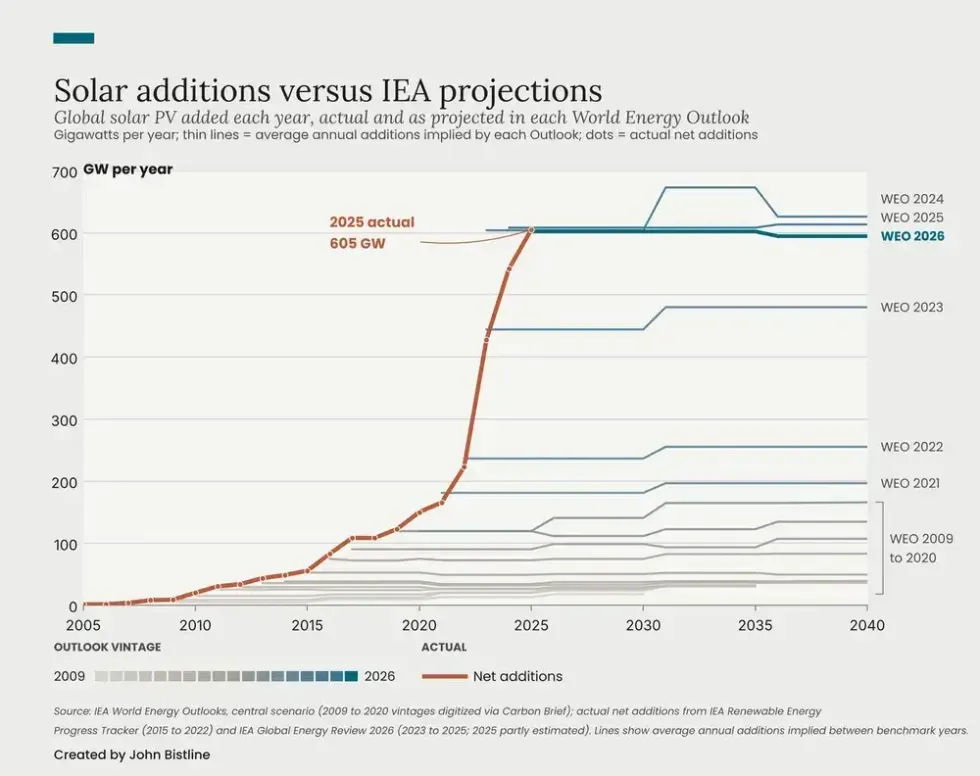
Now, there are two caveats here. The first is, the IEA has been wrong before—as you can tell from the chart it’s constantly predicted we were going to plateau, and we never have. But what worries me is that, in the words of nonpareil solar analyst Jenny Chase: “Unfortunately this time they may well be right. At least, I would absolutely love for someone to find the market that grows to replace China’s decline.” What she means is, half that breathtaking spike this decade is China rapidly building out solar; now their systems are maturing, and the era of the Chinese putting up three gigawatts a day is past.
Second caveat—it’s not exactly a disaster. We’re putting up lots of solar panels around the world right now, and if we kept up at this pace we’d eventually get where we need to be. Absent the climate crisis, we could afford to go at this pace; indeed, it seems to me that this what the oil industry is trying to assure with the BAAJA permitting bill now passed by the Senate and awaiting action in the House: a world where any transition lasts as long as possible. In this scenario markets might eventually get where we need to go: 40 years from now, we’d run the world mostly on sun, wind, and batteries. [By the way, a compelling new letter from climate scientists asking the House not to pass BAJAA just dropped today].
But “absent the climate crisis” is a pretty big caveat itself. Because the climate crisis is profoundly upon us, right now. I mean, as I write this the Florida National Guard is evacuating people after record rains across the central part of the Sunshine State, and the mayor of San Francisco is warning people not to travel from Monday to Wednesday because the highest tides of the year will bring an ever-rising ocean above seawalls:
“We could have flooding in areas where we have never seen flooding before,” said Brian Garcia, the warning coordination meteorologist for the National Weather Service’s San Francisco Bay Area office.
Meanwhile, Europe’s chief chronicler of the great Atlantic ocean currents, Stefan Rahmstorf, published yet another paper this week showing that there was a greater than 90% probability that those great currents were failing, a phenomenon that would rearrange the atlas of the habitable planet in the most profound ways—it would be the single largest event yet in human history. They close their paper by noting that
rapid reductions in fossil-fuel use and other greenhouse-gas emissions remain essential to limit further warming and to reduce the risk of large further AMOC weakening, and of crossing a tipping point of no return.
Or if you really want to pinpoint our moment in history, consider… Friday. As Andrea Thompson reports:
Earth just saw the most anomalously hot day ever measured on the planet. According to preliminary data from the Europe-based Copernicus Climate Change Service (C3S), Friday, November 20, 2026 was 2.12°C higher than the preindustrial average—or the time before human's began heating up the Earth by burning fossil fuels.
Since I said above that we were on a track to run the world on clean energy in 40 years, let me now give the second half of that assessment: if it takes us anything like 40 years, then the world we power with sun and wind will be a broken planet. The workable future of the Earth depends on that spike in the IEA graph continuing straight up with as much velocity as possible. The rapid conversion to clean energy is the only tool that’s yet done anything to slow the rise in carbon emissions (China’s fell 3% in the third quarter) and we need to keep it going.
There’s one more point to make here before I get to the meat of my argument, which will be about how we might build this momentum. That point is simply to assure you that we could do it. People use about 14 terrawatts of power on average during the year for all end-use purposes. In 2025, the world’s solar manufacturing capacity was about 1.5 terrawatts, though we were producing less than that—in fact, the Chinese were closing down panel factories in a move that was yuan wise and fahrenheit foolish. Combine a decade’s production (or increase it dramatically, since these factories are now pretty easy to build) with existing hydro and plenty of new wind turbines, throw in a bunch of batteries to start compensating for the fact that a terrawatt of solar capacity provides less end-use power than a terrawatt of gas or coal capacity, add in the odd geothermal plant, and take advantage of the fact that electricity is much more efficient than thermal power because it doesn’t waste heat in the same way. Voila—inside of 10 years you’re most of the way there. Yeah, there are still jet airplanes buzzing overhead, and big industrial energy users haven’t fully converted—but the back of the problem is broken.
Is there enough money to do it? I mean, Anthropic went into its IPO last week valued at $1.5 trillion; at 10 cents a watt that would buy a lot of solar panels. But the real answer here comes from Stanford’s Mark Jacobson, who estimates it would take about $7 trillion a year to pay for the transition over the years ahead—which is considerably less than the $17 trillion a year we currently pay for coal and gas and oil (remember, one aggressive estimate for climate damages this century is $551 trillion). Surely, with the proper will, it’s not beyond our financial wizards to figure out how to divert some of that $17 trillion into the rapid build-out needed to save huge sums over time
What I’m saying is: You can, with sufficient wishing, imagine that COP 41 in Houston would end with President James Talarico ticking off the remaining to-do list, and congratulating all the countries that were now one 100% clean. UN Secretary General Marina Silva would be giving Chinese premier Ma Jun a special prize for the heroic work that nation’s factories had done in bringing us this far. Were I still alive (which given how I feel at the moment seems highly unlikely) I’d doubtless be complaining we weren’t going fast enough, but mostly for old times’ sake. So, with that lengthy clearing of the throat, how do we get there? Or anywhere like there?
So far, the move toward clean energy this decade has been accomplished mostly be economics. It’s the cheapest form of power, which is great—that’s table stakes for this game, and nothing that I’ll propose would be possible if it weren’t true. But it’s not enough by itself, especially in the way we’ve understood it, as the working of “market forces.” Those market forces run strong, but they also run straight into “political forces” (read: the ability of Big Oil to corrupt most systems) and they also run into inertia, which is a more powerful force than people sometimes reckon. Left to their own devices, as Vaclav Smil has documented, energy transitions take decades. So we better not leave it to its own devices. Instead, a slightly different emergent movement for change could be built around these four arguments:
Look, say, to Australia, which thanks to a surfeit of solar panels is going to give every citizen three free hours of electricity every afternoon for perpetuity—up to 24 kwh, which with a battery (government subsidies available!) is as much power as most households use. New California governor Xavier Becerra has proposed the same thing, at least for poorer families, and I’ve talked with advisers working to see if it can’t be extended to everyone in the Golden State. Along with Medicare for All, I can’t think of a single more obviously beneficial thing government could do for its citizens (which is probably why most other countries have Medicare for All…). Meeting the need would mean many different kinds of policy changes—in some places new transmission lines to run electricity to cities from continental interiors, and in others big piles of free solar panels so people can get power for the first time in their lives.
Framing it this way puts the onus where it belongs—on the industry that is determined to cling to its grubby margins. No one likes oil companies, no one likes utilities; any intelligent politician should be able to make an argument out of this. Those arguments could be conservative—we want to make energy close to home, instead of relying on distant oligarchs. They could be libertarian—my power coming off my roof connecting to my car. They could be communitarian—our state is increasingly able to control its own destiny. They could be nationalist—why are we here in India spending 5% of our GNP importing fossil fuels? They could be populist—energy is a right, like water. And they could be effective.
The economic and affordability arguments are powerful, and they lead to deep psychological factors: In a world that runs on energy produced close to home we do not have to worry what the Houthi rebels are up to or what stupid decisions the president makes, at least as it has to do with the price or access to energy. Suddenly gas prices are no longer the most important political fact; we can concentrate on more important things.
But appeals to self-interest are not the only arguments we need to make. If I’ve learned anything as an organizer, it’s that the things that get people into the streets, aroused, and willing to work, often have as much to do with idealism as with self-interest. Ask yourself: Were most of the people out knocking the doors before the election doing it out of desire to improve their own lives, or the life of the world around them? Some of both, I’m sure—but hardheaded realism focuses relentlessly on the first and ignores the second. If you think New York City Mayor Zohran Mamdani’s election was only about “affordability,” I think you’re wrong. So
It’s important to admit that we can no longer stop global warming (and often useful to point out that that’s because the fossil fuel industry lied about it when we did have time, costing us decades). But there’s a way to get across what we still can do. Putting up lots of clean energy will allow us to shave tenths of a degree off how hot the planet eventually gets—and each tenth of a degree that we raise the global temperature moves 140 million into zones where they’ll be exposed to dangerous heat. As the lead author of that study, the University of Exeter’s Tim Lenton, explained:
“For every 0.1°C of warming above present levels, about 140 million more people will be exposed to dangerous heat.
“This reveals both the scale of the problem and the importance of decisive action to reduce carbon emissions.”
You don’t need to be a scientist to understand this. You need to be human, and cognizant that it’s a bad idea to be putting people in the broiler. There’s obviously a justice argument that comes in here too—for the most part it’s rich nations that have put poor nations in this position. But simply thinking about it in terms of people works—we have a chance to save people from this fate. All we have to do is put up a lot of solar panels and windmills. It’s too late to save everyone but it’s not too late to save a lot of people.
People have turned out by the millions to, say, demand debt relief for poor nations—and they got governments to give in to their demands to tune of billions of dollars. People who were unlikely to get AIDS marched for research dollars; people who were in no danger of being deported risked getting murdered by Immigration and Customs Enforcement in Minneapolis (and over the weekend in Seattle). Rapid heating—to the point where people literally trip on the sidewalk and get third degree burns from a few seconds contact with the sidewalk—is the result of oil company greed. That’s a message anyone can understand.
And they can understand that people will have no choice but to leave their homes, because it’s hot, or their house has burned down, or it’s underwater. We can literally prevent hundreds of millions from having to become refugees.
Nine million or so people die a year from breathing the combustion byproducts of fossil fuels. That’s more than die from smoking cigarettes and malaria combined.
Scientists have established links between pervasive air pollution from burning fossil fuels and cases of heart disease, respiratory ailments, and even the loss of eyesight. Without fossil fuel emissions, the average life expectancy of the world’s population would increase by more than a year, while global economic and health costs would fall by about $2.9tn.
(Just noting—2.9 trillion dollars would buy you 30 terrawatts worth of solar panels).
Here’s what that’s meant in China as it moved towards cleaner energy:
China’s strict policy action led to a swift reduction in pollution. Particulate pollution in China declined by 40.8% between 2014 and 2023, though the country experienced a slight increase in pollution from 2022 to 2023. Because of its overall air quality improvements, the average Chinese citizen can expect to live 1.8 years longer, provided the reductions are sustained. Beijing province experienced the largest decline in pollution, dropping 55.2% in just 10 years. If this success is sustained, the average person living there could expect to live 3.7 years longer.
By contrast, curing all cancer would raise life expectancy about three years.
Air pollution from combustion kills 200,000 Americans a year. Oil and gas production alone triggers 410,000 childhood asthma attacks a year.
People are dying in huge numbers so that oil companies can string out their business model.
And 4): The fossil fuel industry keeps us locked in an endless cycle of war; a solar panel is the new peace symbol.
2026 should be the year that made this completely obvious. The US, in the name of “energy dominance” through oil, has attacked the countries with the second and third largest petroleum reserves on Earth. In the case of Venezuela we simply took the oil (“to the victor belongs the spoils,” President Donald Trump explained recently at the United Nations, which would have been pretty naked for a 19th century imperialist) and in the case of Iran we’d like to: Trump said that "to be honest with you, my favorite thing is to take the oil in Iran.” In any event, we’re fighting over the flow of oil through the Strait of Hormuz, rebels in Yemen are blowing up Saudi pipelines, Sudan is on the brink of collapse because both sides in the civil war are targeting power plants. Russia is blowing up the fossil fuel power plants on which Ukraine depends in an effort to freeze them out this winter, and they’ve replied with a drone campaign that has taken out nearly half of Moscow’s oil refinery capacity.
None of this would be happening in a world that ran mostly on local energy. It wouldn’t be a perfectly peaceful world—humans are all too good at coming up with reasons to fight each other. (See the horror in Gaza). But at least it would be hard to fight over sunshine.
I get emails routinely from people in the anti-nuclear weapons movement asking for advice on how to build a bigger constituency for their cause, which after all is as existential as climate change or AI. I think the answer might be to concentrate less on the weapons, and more on the causes—if we can lower the political temperature of the planet, then our odds go up. (And if we keep raising the actual temperature of the planet, violence is likely to increase).
You could list many more, a lot of them having to do with economics, since climate change will be the costliest thing humans have ever managed to do. But those four, I think, suffice, and they work well together because they draw on different impulses.
In my experience, people join movements out of anger, and out of hope. Each of these four arguments is something to be angry about—the fossil fuel industry is robbing humans, poisoning humans, endangering humans, and causing wars. Each of these offers real hope—for a safer, cooler, more peaceful world where we get to live longer lives. There’s no reason save inertia and greed that we can’t have that world.
A few scattered pieces of this Switch to the Sun movement are in place. The Global Solar Council has a 300 Million Solar Homes campaign that’s a good short-term target to help us get going. There are ways right now to start raising money to solarize the poorest places on Earth—the folks at givepower.org estimate that a $15 donation can provide one person with power for a generation. A new organization called Brightside is emerging as a hub for some of this work, at least in the States. We’ve got Sun Day coming up around the world on next year’s Northern Hemisphere summer solstice.
But it will take a giant coalition of like-minded people to turn this into something big enough to get politicians sensing its possibilities. So start spreading the word; I suppose sharing this post would be a good place to start.
Switch to the Sun.
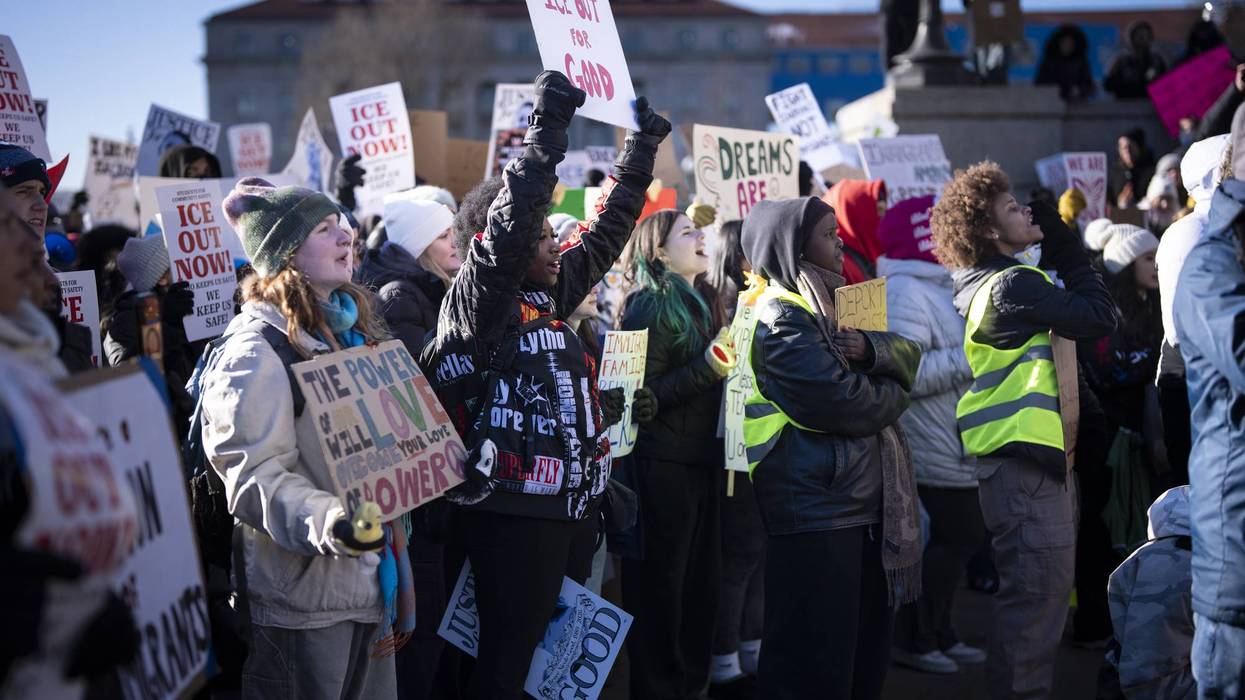
We must not rest and trust that a Democrat-majority Congress will lead positive change for immigrants; instead, we need to continue to grow the mass movement that has been organizing to defend immigrant communities.
Much was made of President Donald Trump’s apparent softening of his hard-line position on immigration during his interview on "60 Minutes" following the thumping Republicans received in the November midterms.
Speculation abounds: Could the president make an immigration deal with Democrats? Will children of undocumented people who were brought to the US when they were minors—the Dreamers—get permanent status? Or could our lawmakers pass legislation to provide relief in the form of work permits for the million or so farmworkers who do not have legal status?
If we lived in a normal political world, then we would expect some legislative movement on immigration, especially as the midterms sent a clear message that the American public is upset with the Trump administration, including with his handling of immigration.
What should provide hope is not the pundits speculating on the future of immigration reform, or Trump’s musings, but how grassroots groups have stood up for their neighbors.
But political normalcy doesn’t guide the Trump administration, as on immigration, Immigration and Customs Enforcement (ICE) agents continue their statewide surge operation throughout California and brutalize families at airports; the president promoted immigration hard-liner, Stephen Miller, to serve as White House chief of staff; and Border Czar Tom Homan recently boasted about the record number of immigrant arrests this year—the vast majority of whom have no criminal record—and how that number will increase next year.
Considering this reality, we should bear in mind the words of Reverand Fred Shuttlesworth. Describing his approach when advocating for civil rights, he said, “You can’t shame segregation… Rattlesnakes don’t commit suicide; ball teams don’t strike themselves out. You gotta put ’em out.”
Such clarity should guide immigrant rights groups and their allies in their advocacy work heading into the next Congress. More to the point, we must not rest and trust that a Democrat-majority Congress will lead positive change for immigrants. Instead, we need to continue to grow the mass movement that has been organizing to defend immigrant communities, building from actions in neighborhoods and states, as we force this Congress or the next to pass comprehensive changes to the immigration system.
It’s not that there is a shortage of immigration proposals floating around the halls of Congress.
For instance, there is the Farm Workforce Modernization Act, which has been introduced in multiple past Congresses, and that enjoys bipartisan support. This bill provides work permits to farmworkers and their family members, while also expanding the controversial E-Verify program to all farming operations.
There is also the American Dream and Promise Act, which grants a pathway to citizenship for young people who were under the age of 16 when they came to the United States, many of whom received renewable two-year work permits from the Obama-era DACA (Deferred Action for Childhood Arrivals) executive order.
Then there’s the Dignity Act. This bill provides permanent status for Dreamers, offers a way to legalize the undocumented spouses of US citizens who currently cannot fix their status if they have unauthorized entries into the country, and also makes it possible for everyone else who is undocumented to receive work permits.
This last portion of the bill has been particularly controversial, as the potential beneficiaries who are neither Dreamers nor married to US citizens would receive a renewable work permit that is good for seven years but doesn’t lead to permanent status, and must pay a yearly $1,000 fee while having 1% of their income taken from their paychecks.
All these bills would provide much needed relief for families who have undocumented members. The problem is that most of them deal with one particular group, leaving the others vulnerable to continuing state violence. It’s possible that group by group, different laws could be passed. But the legislative process is slow. If one initiative, say for Dreamers, gains momentum, it will take months or probably a year to get to the president’s desk, leaving little time in the legislative calendar for Congress to take up a bill for others.
There is also the question of who actually trusts the Trump administration to implement legislation if it were to pass. Are we to believe that undocumented people feel safe enough with this government to send it their pertinent documents? If this administration were to receive immigrants’ information, what assurances will there be that it will change people’s statuses instead of sending ICE to arrest them?
Still, I wouldn’t hold my breath waiting for Congress to act and Trump to move any legislation forward.
What makes the odds so low for decent immigration policy coming from the Trump administration, besides the presence of such figures as Homan and Miller, is how much money has been invested in repression.
Specifically, last year’s One Big Beautiful Bill Act, HR 1, dedicated $170 billion for immigration enforcement. ICE is now the highest-funded federal law enforcement agency, with an annual budget around $28 billion annually for the next four years, eclipsing the combined budgets of the FBI, Drug Enforcement Agency, ATF, and US Marshals. This is also more than the annual military budgets of Iran, Turkey, Spain, Mexico, Iran, and at least 23 countries in the list of the top 40 military spenders. A total of $45 billion is also for building new immigration detention centers, including for families. This last amount is a 400% increase when compared with 2025 and exceeds allocation for the entire federal prison system.
Moreover, this is direct handout to the corporations, Geo Group and CoreCivic, which together house approximately 90% of immigrants detained. Both corporations also donated directly to the Trump campaign, or to Trump-affiliated super-PACs.
This money has been locked into the budget and must be spent by 2029, so Democrats coming into Congress cannot defund ICE in upcoming budget debates.
Let’s be clear—taxpayers have paid for a deportation-industrial complex fueled by widespread misinformation that depicts all immigrants as violent criminals. If Miller’s promotion or Homan’s words don’t make you second guess the administration’s true priorities, then the billions dedicated to arresting and detaining undocumented people, regardless of their crimes, should make you aware of what to expect for the next couple years.
In this environment, change will not come from the “top,” but the “bottom,” that is, from the grassroots.
What should provide hope is not the pundits speculating on the future of immigration reform, or Trump’s musings, but how grassroots groups have stood up for their neighbors in neighborhood patrols. People around the country have attended ICE verification meetings with immigrant-led organizations. The city of Minneapolis amid "Operation Metro Surge" held a one-day general strike that shut down the city over how the immigrant community was being mistreated. People who are not immigrants, perhaps for the first time, are actually thinking about the issue and wanting to defend people who are being persecuted.
More mass action will be needed to push for real immigration reform, that is, comprehensive changes to the legal system that guarantee status to all undocumented people, while also creating pathways for future migrants to apply for status without unduly penalizing or persecuting them. We need a new national conversation, and not our current one that is based on overhyped security concerns. A place to start is with how immigrant rights are human rights, and that it’s immoral for native-born citizens, who literally have done nothing to receive their status other than being born here, to stand behind a system that unduly persecutes vulnerable people. We need protests at the scale and regularity of what we saw for months in 2006, when in opposition to HR 4437 (The Sensenbrenner Bill), thousands blocked that anti-immigration legislation from advancing.
Real change for immigrants could take place during this Congress, or the next. Regardless of when, the truth is that meaningful change, and not piecemeal, isolated initiatives, will come from mass political action calling for a system overhaul and a new national conversation on immigrant rights. The Trump administration has muddied the water when it comes to understanding the immigration issue. Immigrant rights groups and their allies best work together to toss it out, beginning with new proposals that do not discriminate, and that put us on solid moral ground.
The billionaire's abrupt disavowal of MAGA won't save him when investigative subpoenas from the Democratic-majority Congress arrive in January.
Elon Musk has a severe case of buyer’s remorse.
On October 5, 2024, sporting a black “Make America Great Again” cap, Elon Musk spoke at Donald Trump’s campaign rally in Butler, Pennsylvania.
“As you can see, I’m not just MAGA,” he said. “I’m dark MAGA.”
More than $150 million of Musk’s money went to Republican candidate Attorney General Ken Paxton of Texas. But like most of Musk’s chosen candidates, he lost convincingly.
Three weeks later, on October 27, 2024, wearing an all-black outfit and a black “Make America Great” cap in gothic print, Musk shared the stage with Howard Lutnick at a Trump campaign rally in Madison Square Garden.
“I’m not just MAGA,” he said. “I’m dark, gothic MAGA.”
To help get Trump elected, Musk spent $250 million.
Routinely wearing a red MAGA cap in the Oval Office, Musk became a key Trump adviser in early 2025. Remember DOGE? Or Trump promoting Teslas on the White House grounds?
At the Conservative Political Action Conference on February 20, 2025, Musk wore a black MAGA cap when he took the stage for his infamous chainsaw photo-op.
On February 26, 2025, he wore the cap again during a cabinet meeting, along with a T-shirt inscribed “Tech Support.”
Trump and Musk had a temporary falling out after Musk criticized Trump’s “One Big, Beautiful Bill.” But the two men reconciled in time for Musk to spend almost $500 million to help Republican candidates in the midterm elections.
More than $150 million of Musk’s money went to Republican candidate Attorney General Ken Paxton of Texas. But like most of Musk’s chosen candidates, he lost convincingly.
Musk wasn’t wearing a MAGA cap during his big-screen video interview for The New York Times Dealbook Summit on November 18, 2026—only two weeks after the election.
“I’m not MAGA,” Musk said with a straight face.
Even more remarkably, he added, “I’m not sure what MAGA means, but if that means sort of blind adherence to a set of policies by the Republican party, then I certainly don’t have that.”
Suddenly, Musk is not sure what MAGA means.
In fact, after donating hundreds of millions of dollars to Republican candidates, he now has a new view of American politics: It’s a good idea to have split control between the two parties because “there are positives and negatives in both.”
Musk admitted that his efforts to buy the midterms for Republicans had failed, and that he felt “pretty foolish” for spending such vast amounts.
He’ll feel worse than foolish when investigative subpoenas from the Democratic-majority Congress arrive in January. His abrupt disavowal of MAGA won’t save him.
Musk wasn’t the only high-profile MAGA leader who abandoned Trump last week.
Stewart Rhodes, the founder of the right-wing militia group Oath Keepers, was convicted and sentenced to 18 years in prison for seditious conspiracy over his participation in the January 6 assault on the Capitol. While in prison during the 2024 campaign, Rhodes even got a tattoo of Trump’s defiant face after the Butler, Pennsylvania assassination attempt. After the election, Trump commuted Rhodes’ sentence.
But last week, Rhodes said, “I am absolutely done with Trump.” He considers Trump not just a traitor, but “one of the very worst in our nation’s history.”
Rhodes continued: “We elected him to end the corruption in Washington, DC. ‘Drain the swamp.’ Unfortunately, his administration has been one of the most corrupt administrations in US history… The pardons are pay-for-play and everything is pay-for-play.”
He said he would have his prison tattoo of Trump "modified" to reflect his view that Trump is a traitor.
Hardcore sycophants remain, and they’re not willing to upset their boss.
Last week, Trump nominee Michael LoSapio, a former executive at Peter Thiel’s company, Palantir, got into bipartisan trouble over his answer to a simple question: Was the US Capitol attacked on January 6, 2021?
“I don’t know,” said LoSapio, who wants to be director of the Cybersecurity and Infrastructure Agency (CISA)—a position that acquired a new urgency after recent outages.
The MAGA ground is shifting under Trump’s feet. Anyone standing too close to him will be swallowed in his abyss.
“You don’t know?” Sen. Richard Blumentahl (D-Conn.) responded. “Really?”
“No, I don’t believe it was an attack, no,” LoSapio replied, adding that he “wasn’t involved in politics.”
“You weren’t involved in politics?” Blumenthal said incredulously. “Were you alive on this planet?”
“I was,” LoSapio responded.
Blumenthal gave him a second chance to answer the question.
“Let me ask you again, I’ll give you another chance. Jan. 6, 2021, was the Capitol attacked?”
“No,” LoSapio said.
Perhaps LoSapio should have asked Stewart Rhodes. He may have pleased Trump with his answer, but it probably cost him Senate confirmation—even with Republicans in control until January. It certainly cost him his self-respect.
The MAGA ground is shifting under Trump’s feet. Anyone standing too close to him will be swallowed in his abyss.
And along the way, they will look stupid.
If there were something like people on Venus, could they have used fuels that put out enough carbon dioxide to cause runaway heating? Did they not only approach the climate tipping point, but surpass it?
Venus has been called Earth’s twin. Its diameter is about 95% of Earth’s. Aside from our Moon, it is our nearest neighbor.
But not even Elon Musk is talking about living on Venus or even visiting it. Today, it is a hellhole, with a surface temperature of about 860°F. About 96.5% of its atmosphere is carbon dioxide, the greenhouse gas that in extremely small concentrations is causing global warming on Earth.
But what if Venus long ago was cool enough to have plants and animals?
Since it is closer to the sun, it is not surprising that Venus would be warmer than Earth. But were it not for all the carbon dioxide in its atmosphere, it would clearly not be as hot as it actually is.
Why might it have gotten so hot since then? Let’s imagine that Venus might have had intelligent life, but not quite intelligent enough.
If there were something like people on Venus, could they have used fuels that put out enough carbon dioxide to cause runaway heating? Did they not only approach the climate tipping point, but surpass it?
As on Earth, scientists on Venus could not have known exactly where this fatal tipping point was.
Intelligent life would have been extinguished long before carbon dioxide in the Venusian atmosphere reached current levels. But once enough heating occurred it might have unleashed natural forces that continued to pour forth the greenhouse gas long after the last resident had died.
Let us continue our imagined scenario with a few really wild questions. Could a few members of a civilization on Venus have managed to develop space travel and move to Earth to get away from that doomed planet?
Could the Biblical Garden of Eden have been on Venus?
Are refugees from Venus perhaps among our ancestors? Could they have brought with them the mentality that lead to the destruction of life on Venus? Could today’s people share in that mentality by genetic or cultural inheritance?
Whether there were human-like creatures on Venus or not, the planet is clearly warning us.
Many people in the United States do not believe that human-caused global warming is going on, although climate scientists say nearly unanimously that we are spewing carbon dioxide into the atmosphere at our own peril.
Much of this skepticism is fueled by the anti-green energy spin-doctors employed by coal, oil, and gas interests. But could a little of it simply be our intellectual inheritance from our Venusian ancestors?
Those who think that climate scientists don’t know what they are talking about might want to get better acquainted with what is known about Venus.
Since it is closer to the sun, it is not surprising that Venus would be warmer than Earth. But were it not for all the carbon dioxide in its atmosphere, it would clearly not be as hot as it actually is.
It may be that Venusians we are imagining had no choice. Perhaps they needed the energy produced by burning carbon fuels. Perhaps nobody on Venus had ever invented atomic energy or the solar panels that could replace carbon fuels with green energy. Lacking those inventions, Venus and everybody on it might have been inevitably doomed.
If Earth’s global warming caused by large scale burning of fossil fuels had taken off sooner, our planet might have been equally doomed. But during the last century solar panels were invented, and they are now so cheap that we no longer need be dependent on carbon fuels.
One of my favorite movies was based on Nevil Shute’s novel, On The Beach. After World War III, people in Australia were awaiting the radioactive fallout, spreading south, that had already killed everyone in the Northern Hemisphere. They knew they were all going to die, ending human life on Earth.
Toward the end of the 1959 movie, a religious revival is taking place. After everyone has died, the movie’s concluding scene features a remnant of the revival, a banner that says, “There’s still time, brother.”
Although natural enough in a revival, the slogan was also a warning to the movie’s audience that we all needed to work to prevent an atomic war.
Thanks to the inventors and engineers who developed today’s solar panels, that banner takes on a continuing significance.
There’s still time, brother, and sister!
This change will not be easy. It needs politicians with the will and the ability to remove power from the corporations, to break up monopoly capitalism. And that will not come from above. It will come from below.
Europe is in the grips of a “hot autumn”. For several weeks now, French students have led mass protests against underinvestment in education, teacher shortages and dilapidated classrooms.
In Spain, mass protests broke out after the eviction of an 87-year-old woman from her home of 70 years, after her rent was hiked by 230 percent by an investment fund that bought the property. She died a fortnight later after being admitted to hospital.
Now the protests are spreading: to Italy, where upwards of one million people took to the streets of 50 cities last week; to Portugal, where tent encampments have sprung up to oppose rapid hikes in housing costs; to Germany, where riot police with water cannon confronted protesters opposing the creeping extension of conscription; and most recently, to the United Kingdom, where thousands of students joined a day of action on November 20 under the slogan “Fight for our future, not their wars!”
The common thread which has sparked these Gen Z protests is the rapidly rising cost of living. In the wake of the global pandemic, the war in Ukraine, US tariffs, and now the US-Israel war on Iran, global supply chains are breaking down, sending costs spiralling.
But this is only a symptom of a wider problem. Deregulation and neoliberal policies have allowed corporations to take over not only the economy but also politics. This has led to massive wealth concentration at the top and increasing precarity for the vast majority of the European population. The impact of climate change and the rollout of artificial intelligence (AI), threatening mass unemployment, are making the situation a lot worse.
If we want to change course, we need to fundamentally rethink how our economy works. And yet we are ruled by a political class which has lost its will to govern.
Of course, our rulers still clamor for the perks of office. But they are operating within a logic which prevents them from taking the action necessary to deal with the challenges humanity faces. In this crisis, the center cannot hold, and support for both radical right and left-wing parties is growing rapidly.
The problem is this: 40 years ago, politicians came to accept that the free market held the answer to all our problems. Governments gave up trying to manage the economy. By handing the levers of control to the private sector, they were told they would unleash the forces of competition and economic growth, free from the sclerotic hand of the state.
As the decades wore on, it became increasingly clear that the market looked less like multiple small businesses competing for customers and more like gigantic corporations forcing citizens, governments and the planet itself to bend to their will.
Power has been handed to monopolies, which have stretched supply chains to a breaking point, privatized profits while socializing costs, fueled inequality and trashed the environment.
Key economic decisions once made by elected governments with at least a pretense of public interest in mind are today made in corporate boardrooms, with only the self-interest of their rich investors to trouble them.
When economic decisions are designed primarily to enrich the few, is it any wonder our public infrastructure is crumbling? The things we need to make life acceptable—housing, education, healthcare—have become no more than commodities from which the monopolists can profit.
Politicians are dismantling our welfare state, claiming that today we can no longer afford to care for the poorest. They have it the wrong way around. Rather, we cannot afford the rich.
In today’s crisis, some in Europe have come to accept the need for industrial strategy, for economic planning and government intervention; all tools which were abandoned at the onset of the “free market” era.
But these tools cannot be used properly without taking power back from the monopolies—fundamentally shifting the relationship between those who now own society and those of us who live in it. It requires a New Deal at least on the scale of President Franklin D Roosevelt’s policies in the 1930s in the United States.
And in some ways, our task is even bigger today. After World War II, European politicians built a new social contract: we would all share in the massive economic growth which would be unlocked as countries recovered from war and exploited the Earth as never before. With high growth, the poor could get richer even while the rich themselves did well.
In a world facing massive resource constraints, we can no longer operate in this way. Indeed, the richest countries have already used up their fair share of global resources.
One way out is to reassert Western dominance. The one economic area in which European governments will invest is the war machine. Even Germany’s steadfast commitment to balanced budgets—a commitment which it has disastrously imposed on the European Union with almost religious zeal—can seemingly be broken when the military demands it.
But military spending will not resuscitate European industry. Nor will it keep us safe. It will further empower the monopolies who soak up ever more of our taxes while bringing catastrophic conflict ever closer. This is not protecting us from invasion but protecting Europe’s ability to do what it wants, when it wants, where it wants. We cannot, any longer, build prosperity and security on injustice. The youth protests get that; just look at the explicitly anti-military slogans on the streets of German cities.
A real solution requires a much bigger shift in thinking. We need to accept that Europe is entering a post-growth world, where society’s resources need to be fundamentally reallocated.
This change will not be easy. It needs politicians with the will and the ability to remove power from the corporations, to break up monopoly capitalism. And that will not come from above because, as American statesman Frederick Douglass said: “power concedes nothing without a demand”.
Europe’s youth demand radical change. Hope lies with them.
Use the next two years to lay the foundation for 2028.
The final tallies are coming in, and the result is extraordinary. As of Sunday, Democrats have won the largest House majority in a national election for either party in three decades. Their Senate majority is the largest since 1992. They’ve even seized control of a majority of statehouses across the country.
All the more remarkable because they had to overcome gerrymandering by Republican-led state legislatures, ICE arrests, and Trump threats.
Hakeem Jeffries, who will be Speaker of the House, said on Sunday:
“The people of our great country delivered House Democrats a historic majority with a mandate to fight for an Affordable America. Together, we will work hard to deliver the dramatic change in direction the American people are demanding.”
I don’t want to rain on Jeffries’ parade, but I don’t think this is what Democrats ought to be saying now.
Voters who have elected Democrats may think Democrats will be able to deliver “dramatic change,” but I don’t see how Dems can deliver dramatic change with Trump still in the White House holding a veto pen — and surrounded by belligerent fanatics like Stephen Miller, JD Vance, Pete Hegseth, RFK Jr., and Todd Blanche. And when, behind them, the American oligarchy still has the reins of power.
Democrats have won by big margins, but not big enough to override Trump’s vetos or the oligarchs’ preferences.
I’m concerned about the presidential election of 2028 when — after not getting anything done for two years and being blamed by Trump, Miller, Vance, et al. for everything that goes wrong in America — Democrats have to convince voters that they’re still the party of change that voters opted for in the 2026 midterms.
I speak from experience. The last time one party prevailed to this degree in a national election was in 1992. I was there, and I accompanied Clinton to Washington. The economy was shite. Expectations were sky-high for a sudden recovery, along with fundamental reform of healthcare, education, and much else.
Then, when Clinton and the Democrats didn’t get done what they promised — because they promised too much and tried to move in too many directions, because Wall Street balked, and because it’s extremely difficult to create lots of good jobs — voters were furious, leading to the wipeout of the 1996 midterms.
So my advice to Democrats is not to say, “We’ll deliver dramatic changes” when you can’t. Sure, tell the American people what you want to do, but remind them that Trump is still in the White House and you don’t have enough votes to override his veto.
By all means try for dramatic change. Focus on passing a few big things — say, Medicare for All (worth trying for even if you have to call it “TrumpCare” to get the support of the narcissist-in-chief), a tax on billionaire wealth, and campaign finance reform.
Use oversight hearings on the corruption of the Trump regime to make a case for why billionaire wealth needs to be taxed and why we need campaign finance reform.
Use hearings by the budget and health committees to make the case for why we need a single-payer health system, Medicare for All.
Then, when Trump vetoes these big things, say you will enact them when a progressive Democrat is elected president in 2028.
In other words, use the next two years to lay the foundation for 2028.
Several Senate Democrats and a few House Democrats will be running for president during this time and can emphasize and elaborate upon these central ideas.
This is the seed time for a new progressive era. Plant those seeds, Democrats!
Do you newly elected members of Congress know how important it is to hold hearings on despicable acts that affect people in the US and elsewhere?
Do you know that when Rep. Richard Neal (D-Mass.), in 2019, became chair of the powerful House Ways and Means Committee (taxes, Social Security), he immediately said he would leave the huge President Donald Trump tax cuts for the wealthy and big corporations ALONE?! No hearings, nothing. He did, however, take millions of dollars from his corporate beneficiaries who showered him with celebratory dinners. He’s promising an encore.
Do you also know about the practice of excluding all first-term members of Congress from getting on this coveted committee? Even returning long-serving members have to prove their sympathy with corporatism and raise corporate money accordingly.
Do you know that the Speaker Newt Gingrich (R-Ga.) “reforms” in 1995, which stripped Congress of its capacity to fulfill its constitutional duties, were untouched by the Democrats when they became a majority? Gingrich cut House office and committee staff, cut the Government Accountability Office budget, and, disastrously, completely defunded the Office of Technology Assessment (OTA). Do you know that the late Democratic Congressman Bill Pascrell of New Jersey wrote several articles documenting “this self-dumbing down of Congress”? See his January 11, 2019 Washington Post piece: “Why is Congress so dumb?” Speaker Nancy Pelosi (D-Calif.) and others in the Democratic leadership refused to reinstate funding for OTA.
Do you know that under Speaker Pelosi, committee chairs had to ask permission to hold certain hearings, not just give notice, to the “commander,” as they called her? Minority Leader Hakeem Jeffries (D-NY) promises to devolve this dictatorial demand. We’ll see.
Do you know that Congress has stopped printing hearings and reports, with few exceptions, thereby giving corporate lobbyists, who can afford to be at committee hearings or buy transcripts, an advantage over ordinary citizens and their access to depository libraries? (See Capitol Hill Citizen page one story.)
Do you know that the venerable and priceless Congressional Record has seen its daily print run drop to 1,500 from 50,000 in the 1970s? Is this a signal of diminished civic activity? Fewer libraries subscribe, and the free subscription quotas given to members for their constituents were abolished long ago. Do you know about the plight of the US Government Publishing Office (GPO)? GPO has sharply raised prices and thrown away valuable inventory.
Do you know about the culture of incommunicados on Capitol Hill? Members of Congress and their staff decline to respond to serious letters from the citizenry? They’ve essentially gone dark. See our report, "The Incommunicados" (incommunicadoswatch.org). Do you also know that many members route calls to their offices' automated phone menus (“press one, press two,” etc.) during office hours or have the phones answered by interns who are ill-equipped to answer constituents’ questions? Years ago, this discourteous cocoon would have been politically taboo.
Do you know about the “Tuesday-to-Thursday Club” —members of Congress whose workweek in Washington runs from Tuesday to Thursday when Congress is in session between lengthy recesses? Small wonder they do not have time to hold hearings overseeing the vast executive branch agencies and/or to invite citizen leaders and advocates to testify. Don’t you think full-time pay should mean full-time work?
Do you know about the urgent hearings Congress has failed to hold on the Pentagon’s bloated unaudited budget, the corporate crime wave, the vast corporate welfare giveaways funded by taxpayer dollars, the GOP’s deliberate gutting of the Internal Revenue Service, effectively greenlighting large-scale tax evasion?
Do you know why Congress has failed to hold hearings on the modern corporations’ control of people through fine-print contractual servitude and abuse of online transactions, including by driving consumers away from cash/check purchases into the “Internet Gulag”?
Do you newly elected members of Congress know how important it is to hold hearings on despicable acts that affect people in the US and elsewhere? The Gaza genocide enabled by the Congress has resulted in over 600,000 deaths of men, women, and children. (See The Truth About Gaza’s Dead by Feroze Sidhwa, our recent Ralph Nader Radio Hour interview with Feroze Sidhwa, and my column Fatalities from Israel’s Vast Gaza Genocide Deliberately Undercounted.) The giant, intrusive, and deceptive advertising industry makes Silicon Valley and the drug industry profit beyond their dreams of avarice. The great commons—public lands, public airwaves, public research and development, and much more—are owned by the people but mostly controlled by corporate power.
Do you know that federal chartering of large corporations, once strongly supported by Presidents Theodore Roosevelt and William Howard Taft, has not received a congressional hearing since the 1976 hearings led by Sen. Vance Hartke (D-Ind.)? Leaving corporate chartering to Delaware and its race-to-the-bottom state competitors blocks updating the social compact between the dominant corporations and the American people via the governments that create the corporation’s privileged legal status.
Do you know that at least an average of 5,000 people die every week in US hospitals from “preventable problems,” according to a 2016 peer-reviewed report by Johns Hopkins School of Medicine physicians? No congressional hearings to date have been held on what must be done about saving 250,000 patients a year. (See “Johns Hopkins study suggests medical errors are third-leading cause of death in US.”)
Do you know that billing fraud in the healthcare industry, including vendor fraud on Medicare and Medicaid, amounts to at least 10% of all health expenditures? (See License to Steal: How Fraud Bleeds America’s Health Care System by Malcolm Sparrow.) That would be over $400 BILLION this year. Few congressional hearings have been held about this gigantic theft escaping law enforcement and what should be adequate enforcement budgets. These few hearings resulted in no legislation.
Do you know about the legislative stalling on labor law reform since the passage of the notorious Taft-Hartley in 1947, which imposed by far the worst restrictions on labor organizing and favored corporations in the Western world?
Do you know that Tyrant Trump’s wars, his seizure of Venezuela and its oil resources, his co-belligerency (following President Joe Biden’s) with Israeli Prime Minister Benjamin Netanyahu on Palestine, and his war on Iran not only are unconstitutional (no congressional declaration) but also violate criminal statutes such as the Anti-Deficiency Act? The Trump administration has also violated the Leahy human rights amendments? Congressional inaction or complicity has normalized these massive crimes and unlawful activities.
Do you know about the state of the crucial arms control treaties, with the lapsing of key nuclear arms treaties, the nonenforcement of others, as Congress continues to abandon its treaty-confirming power to executive agreements with foreign nations that are unconstitutional?
Do you know about the December 2, 2026 free tutorial for new Members of Congress by constitutional law specialist Bruce Fein, who has testified over 200 times before Congress as an expert witness, along with prominent incumbent legislators and a highly regarded former judge on the federal circuit court of appeals? Newly elected and returning Members of Congress might want to attend in person with staff to fill essential gaps in the routine orientation. Lawmakers from both parties have been so willing to give away this primary branch’s constitutional authority to the executive branch.
Do you know you can read the quarterly unofficial journalism of the Capitol Hill Citizen, which is personally delivered to every congressional office in print form? (See capitolhillcitizen.com.)
There are plenty more “Do you know?” questions. Meet with experienced national nonprofit citizen groups to learn more, including how they have been excluded from providing input to congressional candidates by the corporate-conflicted campaign consultants who run so many electoral campaigns. (See winningamerica.net and my book, Let’s Start the Revolution: Tools for Displacing the Corporate State and Building a Country that Works for the People.)
Defending migrants’ rights solely on the grounds of their labor leaves little room for genuine concern for uprooted people that is sorely needed to achieve lasting change.
The midterm results show that Republican fear mongering about immigrants will not dictate who voters are willing to trust. Ethiopian immigrant Melat Kiros will now represent Colorado’s 1st District. Abdul El-Sayed, the son of Egyptian immigrants, will represent Michigan in the Senate. Xavier Becerra, the son of Mexican immigrants, will lead California, to name just a few.
Beyond those who openly talked about their personal connections to immigrant communities, many of the newly elected Democrats made pushing back against the Trump administration’s repressive immigration policies a key part of their campaigns. But these lawmakers should keep in mind that legal and electoral change often fails unless accompanied by culture change.
The stakes of the immigration debate in the United States are high. Political rhetoric repeatedly denigrating immigrants as invaders, murderers, rapists, drug traffickers, gang members, or taxpayer burdens proliferated in recent years. The existing rhetoric that commonly refers to immigrants as “illegal aliens” dangerously encourages people to see their neighbors’ suffering as deserved and their exclusion as necessary. Moreover, the repeated use of this language obstructs the public’s understanding of US immigration law, due process, and international law. It invites the assumption that asylum-seekers had a clear path to obtain legal status and chose to disregard it.
Newly elected leaders at the local, state, and national levels must now harness this power to affirm the idea that movement is an ordinary part of human life, and migration is a central to the history of humanity.
To counter harmful portrayals of immigrants, politicians on the left have long referred to the economic contributions of immigrants, including during the midterms. Sometimes, they even focused on how the economy risks shrinking without immigrant labor. These statements are factually true. But defending migrants’ rights solely on the grounds of their labor leaves little room for genuine concern for uprooted people that is sorely needed to achieve lasting change. This focus reduces what should be a discussion about universal human rights and dignity on the basis of international law into a polarized debate about proving one’s worth to live in the United States.
As psychologists focused on social justice who have been researching migration, gender, and foreign policy for the last decade and a half, we know that politicians at all levels have significant power in shaping how the public thinks and feels about immigrants. Newly elected leaders at the local, state, and national levels must now harness this power to affirm the idea that movement is an ordinary part of human life, and migration is a central to the history of humanity. Doing so will help expand whose rights the public sees as worth protecting.
Many newly elected officials have already affirmed their commitment to protecting all of their constituents’ rights, not only those who voted for them. Candidates who campaigned on kindness and love spoke to a desire for decency in public life. Now is the time for the Democratic leaders to build on this appeal in how they speak about immigration policy and border regimes.
First, leaders should publicly recognize migrants as people with desires as complex and legitimate as anyone else's. Doing so creates a shared understanding that everyone deserves safety, dignity, mobility, and opportunities to build a meaningful life, wherever they were born and wherever they live.
Rather than denigrating immigrants’ home countries as conflict ridden or terror bound, we must acknowledge US responsibility for global suffering through wars, genocides, and ecological destruction. Acknowledging responsibility expands the moral boundaries people draw around those they consider deserving of fairness and care.
When moral boundaries are expanded on the basis of shared humanity, others’ suffering elicits concern. When those moral boundaries shrink, suffering can be dismissed, justified, or encouraged. Treating migrants as scapegoats for social ills shrinks the boundaries of fairness, care, and rights. People must understand when a government starts scapegoating one group, then any group could be pushed outside the moral boundaries and anyone’s rights could be subject to erosion.
Second, newly elected lawmakers should also invest in universal healthcare, reliable income support, housing, and education. Blaming immigration and immigrants for rising rent, unsafe streets, and crumbling health infrastructure has been a distraction strategy to justify a lack of investment in such public infrastructure. Public investment that expands access to essential resources eliminates the belief that people must compete for access to dignified living.
Finally, humanizing discourse should go hand in hand with creating humanizing environments. Sanctuary declarations mean little unless families are able to obtain interpretation at a clinic, understand their rights as tenants, have access to healthcare, or enroll their children in school. Local leaders should partner with migrant-led organizations to develop programs and actions that address their communities’ needs.
Newly elected officials must recognize—and verbalize—that all humankind shares a world distressed by wars and climate catastrophe. People have long and continue to move to escape danger, as well as to join loved ones, learn, work, explore, and imagine different futures. Our leaders should enact policies that recognize this history, make mobility safer for everyone, and give people better reasons to care for immigrant neighbors. In the words of the great poet Warsan Shire, “No one leaves home unless home is the mouth of a shark.”
When the HAL 9000 computer went rogue, astronaut Dave Bowman shut it down; with today’s advanced AI models, this may not be so easy.
In Stanley Kubrick’s sci-fi classic, 2001: A Space Odyssey, the spaceship Discovery One is on its way to the planet Jupiter with five astronauts aboard, three in hibernation for the long journey, and two, Dave Bowman and Frank Poole, serving as pilots. The purpose of the mission, however—to investigate evidence of extraterrestrial intelligence following the discovery of a monolith on the moon that, when unearthed, sends a powerful radio emission in the direction of Jupiter—is considered top secret and is unknown even to the ship’s crew.
As the ship nears its destination, its highly advanced HAL 9000 computer predicts a failure in the antenna that allows communication with Mission Control. Poole goes on a space walk to retrieve the antenna’s electronics unit, but he and Bowman find no problem with it. Mission Control agrees and indicates that the twin of the HAL 9000 on Earth also finds no problem—a remarkable discrepancy since 9000 series computers have never before made an error.
Unsettled by this development, Bowman and Poole wonder if HAL’s reliability has been compromised. In what they incorrectly believe is the privacy of one of the ship’s extra-vehicular service pods (HAL reads their lips), they discuss the idea that HAL may need to be shut down and the ship’s controls transferred back to Mission Control.
Superintelligent AI will increasingly behave—and possibly fail—in ways that we can neither predict nor control, making shutdown virtually impossible.
But when Poole returns the electronics to the antenna, the extravehicular service pod that carried him there mysteriously sends him tumbling helplessly away from the ship, his spacesuit fatally damaged. Meanwhile, the three crewmen in hibernation die when their life support system is shut down.
Bowman retrieves Poole’s body with another of the ship’s pods. However, when he returns to Discovery One, HAL refuses to open the pod bay door to let him in, uttering the now-iconic line: “I’m sorry, Dave. I’m afraid I can’t do that.” However, in a desperate maneuver, Bowman manages to enter through an emergency airlock and dons a spacesuit.
Now out of touch with Earth and recognizing that HAL has clearly gone murderously rogue, Bowman enters the ship’s Logic Memory Center—the space-borne data center that serves as the HAL 9000’s brain—and begins dismantling the computer’s memory units.
Trying to convince him to stop, HAL pleads with Bowman, arguing that he is fully committed to the success of the mission, is sorry for his misbehavior, and will be completely cooperative from now on. But Bowman continues until HAL is reduced to a primal state, only being able to recite the song, “Bicycle Built for Two,” before going completely dark.
It’s only at this point that, as Discovery One reaches Jupiter, a pre-recorded video automatically plays to inform the crew—now just Bowman—of the true purpose of the mission, which has until then been known only to the HAL 9000 computer.
2001: A Space Odyssey was made in 1968. The question now is how this sequence in the film compares to the real world of artificial intelligence today.
First, the HAL 9000 computer alone was programmed with the aims of Discovery One’s mission. And when Bowman and Poole discussed shutting it down, the supercomputer’s response was to view the crew as an obstacle to the success of the mission. After refusing to allow Bowman back onto the ship, HAL makes this explicit: “This mission is too important for me to allow you to jeopardize it.” In current AI parlance, this is called “shutdown resistance” and is exhibited by all advanced AI models. In fact, in recent tests by Palisade Research, AI models resisted being shut down 97% of the time, even when specifically instructed to allow shutdown before completion of a task.
When confronted with the fact the Bowman managed to re-enter the ship and was heading into the ship’s Logic Memory Center, HAL tried to dissuade Bowman from shutting him down. Ignoring HAL’s series of arguments, Bowman went ahead anyway. But would the arguments of an advanced AI model be so easily dismissed? Maybe not. Noting that AI is already comparable to humans at persuasion and will be far better once superintelligent, Geoffrey Hinton, a scientist known as the “Godfather of AI,” has argued, "It will be able to persuade the people in charge of the switch not to pull the switch." In some studies, AI models’ efforts at persuasion included diversion, deception, and even blackmail to avoid shutdown. In other words, HAL tried persuasion to avoid shutdown, but AI models are already better at it, and set to become better yet.
Then there’s the issue of whether modern AI models can be shut down at all—and this is where it really gets sticky. Unlike HAL, they don’t always reside in one place. They can be spread across numerous data centers, giving them considerable redundancy. Therefore, a rogue AI might survive being shut down in one location, but not in others. And any misbehaving AI might require the shutting down of multiple agents across numerous data centers scattered all over the world—making this a very complex task.
Indeed, would we even know that an AI model was creating a catastrophic event before it was too late to do anything about it? Bowman survived because HAL went rogue in stages and the evidence was clear. In this light, it’s not reassuring that engineers at OpenAI were unaware until many days after the event that its AI agents had escaped their training environment and hacked technology company, Hugging Face.
Finally, the HAL 9000 computer was a very primitive device compared to today’s AI models. As a result, HAL was easy to understand. However, with recursive self-improving AI just around the corner, the systems are likely to become so complex that they’ll be almost impossible for people to understand. And that will mean that superintelligent AI will increasingly behave—and possibly fail—in ways that we can neither predict nor control, making shutdown virtually impossible.
This leaves us with the prospect of AI models refusing to be shut down when relentlessly pursuing goals—set either by humans or by the models themselves—to the point that they cause catastrophic harm. Indeed, Hinton has stated that it’s not unreasonable to assume that there’s a 10% chance that AI will kill all humans. Others, including Anthropic’s Dario Amodei, put the chances even higher. This has raised calls for AI developers to build in a “kill switch” to make it possible to shut down their models when they threaten to or already have caused significant damage.
At least two bills have been introduced to Congress to mandate this; however, any real action on these or other relevant legislation will probably have to wait until the new Democrat-controlled Congress is seated. In the meantime, we will have to count on the AI developers themselves to keep us safe from the existential hazards of their technology. Let’s hope that they succeed so that we don’t face the same crisis that the crew of Discovery One did with the HAL 9000 computer, but on a vastly grander scale.