5
#000000
#FFFFFF
To donate by check, phone, or other method, see our More Ways to Give page.
Daily news & progressive opinion—funded by the people, not the corporations—delivered straight to your inbox.
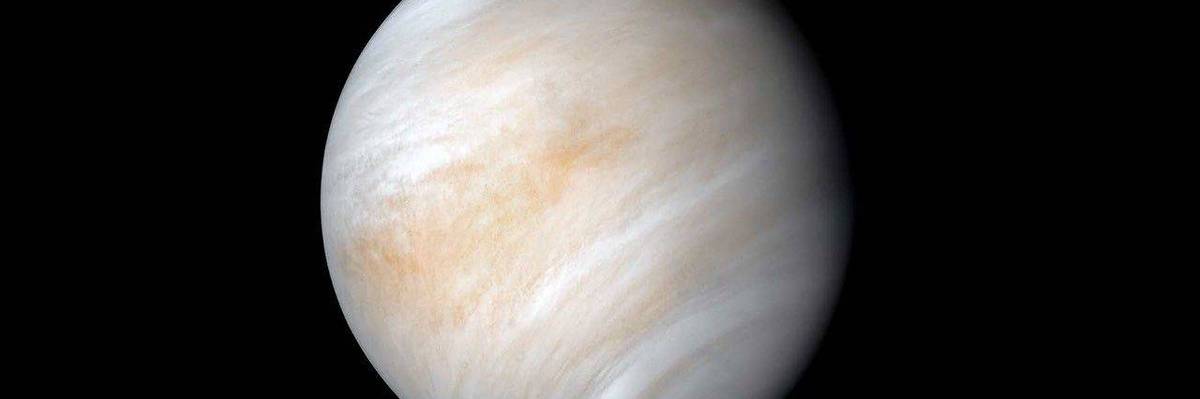
An image taken by NASA's Mariner 10 spacecraft shows Venus covered in a cloud layer.
If there were something like people on Venus, could they have used fuels that put out enough carbon dioxide to cause runaway heating? Did they not only approach the climate tipping point, but surpass it?
Venus has been called Earth’s twin. Its diameter is about 95% of Earth’s. Aside from our Moon, it is our nearest neighbor.
But not even Elon Musk is talking about living on Venus or even visiting it. Today, it is a hellhole, with a surface temperature of about 860°F. About 96.5% of its atmosphere is carbon dioxide, the greenhouse gas that in extremely small concentrations is causing global warming on Earth.
But what if Venus long ago was cool enough to have plants and animals?
Since it is closer to the sun, it is not surprising that Venus would be warmer than Earth. But were it not for all the carbon dioxide in its atmosphere, it would clearly not be as hot as it actually is.
Why might it have gotten so hot since then? Let’s imagine that Venus might have had intelligent life, but not quite intelligent enough.
If there were something like people on Venus, could they have used fuels that put out enough carbon dioxide to cause runaway heating? Did they not only approach the climate tipping point, but surpass it?
As on Earth, scientists on Venus could not have known exactly where this fatal tipping point was.
Intelligent life would have been extinguished long before carbon dioxide in the Venusian atmosphere reached current levels. But once enough heating occurred it might have unleashed natural forces that continued to pour forth the greenhouse gas long after the last resident had died.
Let us continue our imagined scenario with a few really wild questions. Could a few members of a civilization on Venus have managed to develop space travel and move to Earth to get away from that doomed planet?
Could the Biblical Garden of Eden have been on Venus?
Are refugees from Venus perhaps among our ancestors? Could they have brought with them the mentality that lead to the destruction of life on Venus? Could today’s people share in that mentality by genetic or cultural inheritance?
Whether there were human-like creatures on Venus or not, the planet is clearly warning us.
Many people in the United States do not believe that human-caused global warming is going on, although climate scientists say nearly unanimously that we are spewing carbon dioxide into the atmosphere at our own peril.
Much of this skepticism is fueled by the anti-green energy spin-doctors employed by coal, oil, and gas interests. But could a little of it simply be our intellectual inheritance from our Venusian ancestors?
Those who think that climate scientists don’t know what they are talking about might want to get better acquainted with what is known about Venus.
Since it is closer to the sun, it is not surprising that Venus would be warmer than Earth. But were it not for all the carbon dioxide in its atmosphere, it would clearly not be as hot as it actually is.
It may be that Venusians we are imagining had no choice. Perhaps they needed the energy produced by burning carbon fuels. Perhaps nobody on Venus had ever invented atomic energy or the solar panels that could replace carbon fuels with green energy. Lacking those inventions, Venus and everybody on it might have been inevitably doomed.
If Earth’s global warming caused by large scale burning of fossil fuels had taken off sooner, our planet might have been equally doomed. But during the last century solar panels were invented, and they are now so cheap that we no longer need be dependent on carbon fuels.
One of my favorite movies was based on Nevil Shute’s novel, On The Beach. After World War III, people in Australia were awaiting the radioactive fallout, spreading south, that had already killed everyone in the Northern Hemisphere. They knew they were all going to die, ending human life on Earth.
Toward the end of the 1959 movie, a religious revival is taking place. After everyone has died, the movie’s concluding scene features a remnant of the revival, a banner that says, “There’s still time, brother.”
Although natural enough in a revival, the slogan was also a warning to the movie’s audience that we all needed to work to prevent an atomic war.
Thanks to the inventors and engineers who developed today’s solar panels, that banner takes on a continuing significance.
There’s still time, brother, and sister!
This country and this world are at a monumental crossroads. US voters have an opportunity to beat back the forces of fascism and confront the billionaires who are rigging the economy, our media system, and our democracy, making it increasingly impossible for ordinary people to get by. We’re not just talking about the election. We’re talking about what must be done once these fascist elements are vanquished from power. We need a bolder set of solutions than what either major party has so far been willing to offer and a working-class movement ready to fight like hell for it. Trump didn't emerge from nowhere. The conditions that fueled MAGA authoritarianism were created by decades of radical neoliberal economic policies and a corrupt political system dominated by corporate interests. They slashed taxes on the super-rich, promising that the benefits would trickle down. They said giveaways to the corporate titans would make life more affordable for the rest of us. It was all bullshit. And when a bitter, betrayed populace searches for someone to blame, right-wing demagogues have little trouble finding scapegoats. People know when they're being lied to, but you won't hear any of this from the corporate media. Only independent journalism—powered and funded by people who believe in building a better world—can deliver truly trustworthy daily news. If you share our vision, please contribute whatever you can to sustain our work. |
Venus has been called Earth’s twin. Its diameter is about 95% of Earth’s. Aside from our Moon, it is our nearest neighbor.
But not even Elon Musk is talking about living on Venus or even visiting it. Today, it is a hellhole, with a surface temperature of about 860°F. About 96.5% of its atmosphere is carbon dioxide, the greenhouse gas that in extremely small concentrations is causing global warming on Earth.
But what if Venus long ago was cool enough to have plants and animals?
Since it is closer to the sun, it is not surprising that Venus would be warmer than Earth. But were it not for all the carbon dioxide in its atmosphere, it would clearly not be as hot as it actually is.
Why might it have gotten so hot since then? Let’s imagine that Venus might have had intelligent life, but not quite intelligent enough.
If there were something like people on Venus, could they have used fuels that put out enough carbon dioxide to cause runaway heating? Did they not only approach the climate tipping point, but surpass it?
As on Earth, scientists on Venus could not have known exactly where this fatal tipping point was.
Intelligent life would have been extinguished long before carbon dioxide in the Venusian atmosphere reached current levels. But once enough heating occurred it might have unleashed natural forces that continued to pour forth the greenhouse gas long after the last resident had died.
Let us continue our imagined scenario with a few really wild questions. Could a few members of a civilization on Venus have managed to develop space travel and move to Earth to get away from that doomed planet?
Could the Biblical Garden of Eden have been on Venus?
Are refugees from Venus perhaps among our ancestors? Could they have brought with them the mentality that lead to the destruction of life on Venus? Could today’s people share in that mentality by genetic or cultural inheritance?
Whether there were human-like creatures on Venus or not, the planet is clearly warning us.
Many people in the United States do not believe that human-caused global warming is going on, although climate scientists say nearly unanimously that we are spewing carbon dioxide into the atmosphere at our own peril.
Much of this skepticism is fueled by the anti-green energy spin-doctors employed by coal, oil, and gas interests. But could a little of it simply be our intellectual inheritance from our Venusian ancestors?
Those who think that climate scientists don’t know what they are talking about might want to get better acquainted with what is known about Venus.
Since it is closer to the sun, it is not surprising that Venus would be warmer than Earth. But were it not for all the carbon dioxide in its atmosphere, it would clearly not be as hot as it actually is.
It may be that Venusians we are imagining had no choice. Perhaps they needed the energy produced by burning carbon fuels. Perhaps nobody on Venus had ever invented atomic energy or the solar panels that could replace carbon fuels with green energy. Lacking those inventions, Venus and everybody on it might have been inevitably doomed.
If Earth’s global warming caused by large scale burning of fossil fuels had taken off sooner, our planet might have been equally doomed. But during the last century solar panels were invented, and they are now so cheap that we no longer need be dependent on carbon fuels.
One of my favorite movies was based on Nevil Shute’s novel, On The Beach. After World War III, people in Australia were awaiting the radioactive fallout, spreading south, that had already killed everyone in the Northern Hemisphere. They knew they were all going to die, ending human life on Earth.
Toward the end of the 1959 movie, a religious revival is taking place. After everyone has died, the movie’s concluding scene features a remnant of the revival, a banner that says, “There’s still time, brother.”
Although natural enough in a revival, the slogan was also a warning to the movie’s audience that we all needed to work to prevent an atomic war.
Thanks to the inventors and engineers who developed today’s solar panels, that banner takes on a continuing significance.
There’s still time, brother, and sister!