

SUBSCRIBE TO OUR FREE NEWSLETTER
Daily news & progressive opinion—funded by the people, not the corporations—delivered straight to your inbox.
5
#000000
#FFFFFF
To donate by check, phone, or other method, see our More Ways to Give page.
Daily news & progressive opinion—funded by the people, not the corporations—delivered straight to your inbox.

Josh Bell, (212) 549-2666; media@aclu.org
The Washington Post reported today that the government is putting into place a "codified" targeted killing program that is designed to last decades, if not indefinitely.
The Washington Post reported today that the government is putting into place a "codified" targeted killing program that is designed to last decades, if not indefinitely.
"Anyone who thought U.S. targeted killing outside of armed conflict was a narrow, emergency-based exception to the requirement of due process before a death sentence is being proven conclusively wrong," said Hina Shamsi, director of the American Civil Liberties Union's National Security Project. "The danger of dispensing with due process is obvious because without it, we cannot be assured that the people in the government's death database truly present a concrete, imminent threat to the country. What we do know is that tragic mistakes have been made, hundreds of civilian bystanders have died, and our government has even killed a 16-year-old U.S. citizen without acknowledging let alone explaining his death. A bureaucratized paramilitary killing program that targets people far from any battlefield is not just unlawful, it will create more enemies than it kills."
The ACLU has filed two lawsuits to enforce Freedom of Information Act requests about the program and another lawsuit, with the Center for Constitutional Rights, to challenge its constitutionality.
"It has become the norm for government officials to disclose cherry-picked information about ostensibly classified programs while insisting to the courts that the programs are too secret to be discussed or defended in court," said Jameel Jaffer, ACLU deputy legal director. "This practice deprives the public of complete and accurate information about important government policies, compromises the integrity of the classification system and suggests a disturbing contempt for the judicial process. The courts should reject the government's effort to transform FOIA into a dead letter."
More information on the ACLU's targeted killing lawsuits is at:
www.aclu.org/national-security/targeted-killings
The American Civil Liberties Union was founded in 1920 and is our nation's guardian of liberty. The ACLU works in the courts, legislatures and communities to defend and preserve the individual rights and liberties guaranteed to all people in this country by the Constitution and laws of the United States.
(212) 549-2666
Sen. Elizabeth Warren, the CFPB's architect, promised a reckoning when Democrats retake Congress: "If you've been making your profits by cheating American families... you better get ready for some investigations."
The Trump administration has almost entirely abandoned consumer protection lawsuits even as complaints about corporate abuses surge, according to a Guardian analysis published Thursday.
From mid-2012 to the start of 2025, the US Consumer Financial Protection Bureau (CFPB)—created to fight predatory actions by financial institutions in the wake of the 2008 financial crisis—averaged about 30 enforcement actions a year, helping to recoup over $21 billion for consumers illegally ripped off by banks, mortgage lenders, credit card companies, and other entities.
But since January 2025, when President Donald Trump returned to office, it has launched just two enforcement actions. Meanwhile, it has dropped pending cases against at least 23 defendants—including credit card companies like Capital One, banks like JPMorgan Chase and Bank of America, and Warren Buffett’s business empire Berkshire Hathaway.
Those cases were not abandoned because consumers no longer have complaints about these companies. On the contrary, complaints have increased against 17 of the 23 companies the bureau stopped pursuing. Overall, the number of complaints filed by consumers with the bureau has shot up from nearly 2.7 million in 2024 to 6.3 million this year.
“Consumers are telling the bureau that there is an emergency, and the bureau is not listening or acting on that information,” Erie Meyer, a former chief technologist at the CFPB who helped oversee the creation of its complaint database, told The Guardian. “People are getting screwed twice: first by the company, second by the agency that’s supposed to stick up for them.”
Austin Hinkle, a former senior counsel and section chief at the CFPB, described Trump’s new regime at the bureau as essentially issuing “corporate pardons” to firms that were being investigated under the Biden administration for alleged flagrant abuses.
“People are getting screwed twice: first by the company, second by the agency that’s supposed to stick up for them.”
In February 2025, just a month after his second term began, Trump’s CFPB dismissed a lawsuit filed under the Biden administration accusing Capital One of cheating millions of customers out of more than $2 billion in interest by deliberately concealing higher-interest savings accounts from them, going as far as directing employees not to inform customers about the accounts unless asked. The company agreed to a $425 million class-action settlement in April, considerably less than the $2 billion in lost interest alleged by the CFPB.
Also in February 2025, the bureau dismissed a lawsuit against the mortgage company Vanderbilt, a subsidiary of Berkshire Hathaway. Regulators accused the company of knowingly saddling low-income families with mortgages they could not afford in an echo of the lending behavior that spawned the 2008 housing crisis, which in turn led to the CFPB’s creation. In one case, Vanderbilt granted a mortgage to a family that, by the company’s calculations, would have had just over $57 left in income after monthly expenses. In another, it approved a mortgage for two adults who already had 33 debts in collection.
In March 2025, the bureau also dropped a case accusing three of the nation’s largest banks—JPMorgan Chase, Bank of America, and Wells Fargo—of failing to prevent widespread fraud using their money transfer system, Zelle. Consumers allegedly lost a combined $870 million after the banks failed to stop repeat scammers from using the app. Regulators also alleged that the banks refused to compensate victims even after they provided evidence that criminals had taken over their accounts.
All of these cases were dismissed with prejudice, meaning that a future CFPB cannot reopen any of them.
The administration also dropped other cases involving payday lenders accused of trapping borrowers in cycles of debt, companies allegedly charging delivery drivers fees to access their own earnings, student loan servicers accused of collecting discharged debts, and banks accused of mistreating elderly and disabled veterans receiving federal benefits. It also canceled a settlement with Navy Federal Credit Union over illegal overdraft fees charged to military service members, veterans, and their families.
In addition, the administration has terminated or weakened another 23 existing enforcement orders, often involving companies that had already agreed to compensate victims for misconduct, according to a report by Democrats on the US Senate Banking Committee. That report estimated that reduced enforcement at the CFPB had cost consumers $19 billion during Trump’s first year in office.
The money transfer company Wise, for instance, had a $2 million fine reduced to just $45,000. Other companies like Apple and US Bank were freed from enhanced oversight years ahead of schedule.
Many consumer protection cases and settlements were dismissed while the bureau was run by Russell Vought, an architect of the Heritage Foundation’s far-right Project 2025, which has functioned as a policy playbook for Trump’s second term. He also leads the White House Office of Management and Budget.
Vought has referred to the CFPB as “a woke and weaponized agency against disfavored industries and individuals” and said his goal was to “close down the agency.”
In April 2025, he attempted to fire about 90% of the CFPB’s workforce—an effort blocked by federal courts. Vought stopped serving as acting director in August. The agency is now led by Mark Paoletta, a former chief legal officer for Vought.
Democrats, who retook both the US House of Representatives and Senate earlier this month in a midterm landslide fueled by grievances about high prices and a lack of accountability for powerful corporations, have vowed to investigate the Trump administration's efforts to "dismantle" the CFPB.
Rep. Bill Foster (D-Ill.), who is in line to become the chair of the House Financial Services Subcommittee on Financial Institutions beginning in 2027, told The Guardian that he and his colleagues plan to pursue “subpoenas, investigations, hearings, and, ultimately, legislative action to restore consumer protections in this country and hold accountable those who seek to profit off the most vulnerable Americans.”
Sen. Elizabeth Warren (D-Mass.), who led the charge to create the CFPB in 2010, is expected to take over as chair of the Senate Banking Committee, where she has promised a reckoning for corporate abuses.
As ranking member, she has already confronted Vought directly about his actions while in charge of the CFPB—including during a hearing in July when she questioned him about the bureau’s decision to terminate a settlement with Toyota Motor Credit after the company donated $1 million to Trump’s inaugural fund. The company had been accused of trapping consumers into paying thousands of dollars in some cases for unwanted insurance and warranties, while making the products extremely difficult to cancel and withholding refunds.
Warren has promised that she will prioritize accountability for the financial institutions that have been allowed to run roughshod under Trump.
“Big Tech CEOs, administration officials, Trump family crypto businesses, Wall Street executives, and giant corporations should preserve their documents and prepare to answer tough questions,” an aide to Warren told Politico Monday.
On CBS’ “Face the Nation” Sunday, Warren said, “If you’ve been making your profits by cheating American families and scamming your investors, you better get ready for some investigations, serious ones.”

"The imminence of breaching 1.5°C cannot be an excuse to open the door to defeatism—the focus has to be on accelerating action to limit the magnitude and duration of overshoot."
With world leaders, climate campaigners, scientists, and more gathered in Türkiye for the United Nations Climate Change Conference, an independent project that tracks government action warned Thursday that global warming is headed toward "an irrecoverable overshoot of 1.5°C" unless countries "rapidly reduce emissions to limit both the magnitude and duration of this overshoot."
A series of analyses released in the lead-up to the summit—including the United Nations Environment Program's "Limiting Overshoot" publication from September, the UNEP's "The Emissions Gap Report 2026: The Point of Return" from October, and the World Meteorological Organization's "State of the Climate: Update for COP31" from last week—have all sounded the alarm about at least temporarily surpassing 1.5°C, the Paris Agreement's global temperature rise limit for this century.
The new Climate Action Tracker (CAT) report, "Without Rapid Action, The World Is Heading to Irrecoverable Overshoot," lays out real-world action based on current policies; pledges and targets from the nationally determined contributions (NDCs) of countries that have signed on to the Paris Agreement; and the "optimistic scenario" based on all announced ambitions.
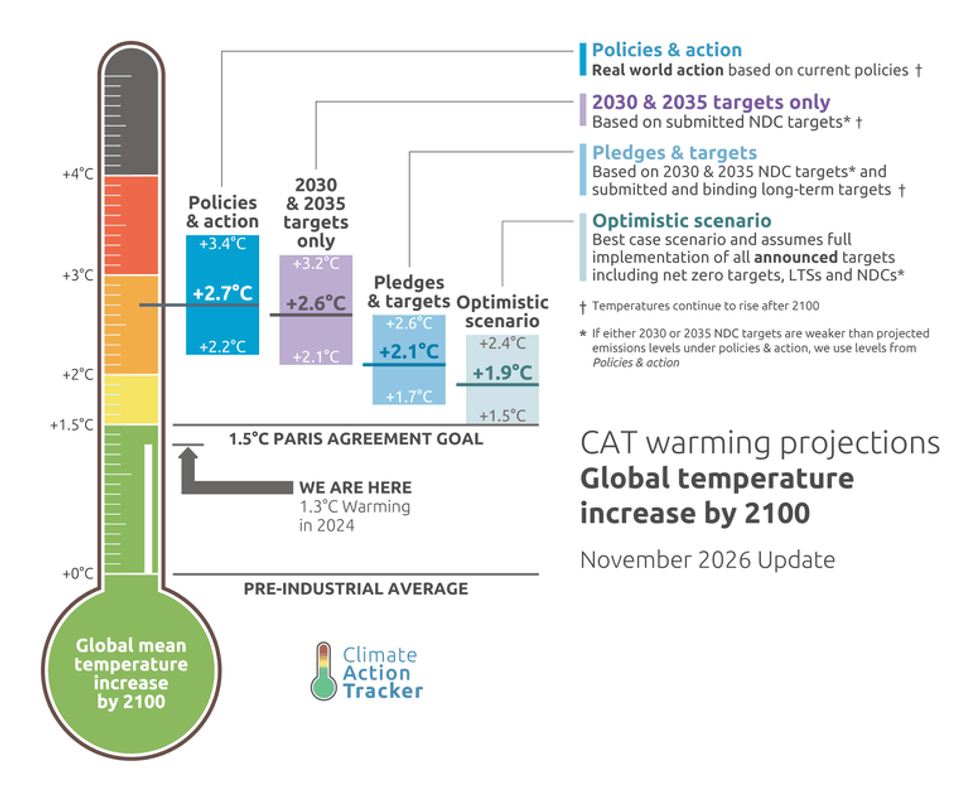
"Aggregated climate action has now essentially stalled for five consecutive years, with positive and negative actions canceling each other out," says the CAT briefing. "The warming outlook from current policies is leading to 2.7°C in 2100 (slightly up from 2.6°C) as it stood from 2021-2024."
"Our 2030 and 2035 targets scenario that assumes governments meet all their targets remains unchanged at 2.6°C in 2100," the report details. "The round of 2035 NDCs has closed: And it's clear governments have failed to meaningfully improve the outlook for end-of-century warming."
CAT's scenario that includes 2030 and 2035 NDCs as well as long-term targets projects "warming of 2.1°C in 2100, down from 2.2°C last year," the report continues. "Ambitious near- and long-term targets matter, but without credible policies and immediate implementation, they risk becoming empty promises rather than drivers of real-world emission reductions."
"Our optimistic scenario, assuming full implementation of all announced and net-zero targets, remains at 1.9°C in 2100," it stresses. "Even under our most optimistic assessment, if governments were to implement every single national pledge they have made—including the net-zero targets—we will still permanently overshoot the 1.5°C limit and get close to 2°C."
As both greenhouse gas concentrations and the profits of fossil fuel giants have soared while communities around the world face deadly heatwaves, rapidly intensifying hurricanes, rising sea levels, and destructive wildfires—like those that ravaged COP31 host Türkiye in September—scientists have reiterated warnings about the need for sweeping action to cut emissions.
"Continued warming from greenhouse gases emitted from human activities threatens to feed further warming as permafrost, wetlands, and wildfires destabilize and respond by releasing carbon dioxide, methane, and nitrous oxide," Ben Poulter, warming-induced emissions program director at Spark Climate Solutions, said in September, when a study he co-authored was published.
"This study provides a critical look at the magnitude of the temperature response," Poulter added, "and a call to action to accelerate the accounting and monitoring of warming-induced emissions to support pathways that phase out fossil emissions to stabilize the planet’s climate."
But the brutal truth is that the positive developments do not yet add up to bending the curve of emissions fast enough. Increasing energy demand and build-out of new fossil fuel infrastructure have led to still rising emissions.
[image or embed]
— Climate Action Tracker (@climateactiontracker.org) November 12, 2026 at 1:04 AM
Bill Hare, CEO of CAT partner organization Climate Analytics, emphasized Thursday that "the stark choice for governments is to either continue to support the fossil fuel industry, which would consign humanity to insurmountable economic damages, rising mortality from heat, and climate-driven diseases and disasters that they are unable to adapt to—or pivot to the solutions which are available and cheaper than ever."
"The imminence of breaching 1.5°C cannot be an excuse to open the door to defeatism—the focus has to be on accelerating action to limit the magnitude and duration of overshoot," he argued. "Every increment of warming above 1.5°C means even more significant consequences across climate, nature and human systems."
The report outlines "five key levers that could cut emissions at the speed and urgency needed to follow a Paris-aligned pathway, limiting the magnitude and duration of overshoot," which are:
"Governments collectively are simply not moving fast enough to adopt the policies that would enable us to escape from the emerging overshoot trap," said the lead author of CAT's report, Climate Analytics policy analyst Sarah Heck. "Worse, several are taking their foot off the accelerator and slowing their climate action—or in cases such as the USA, Canada, and New Zealand—rolling it back at a staggering level."
So far this week, Climate Action Network International has given its satirical "Fossil of the Day" award—long used to call out bad actors during climate summits—to New Zealand, for "dismantling its own climate commitments" under Prime Minister Christopher Luxon, as well as "absent leaders of wealthy countries," including Canada, Denmark, France, Germany, Ireland, Italy, Japan, the Netherlands, and Sweden.
The stark choice for governments is to either continue to support the fossil fuel industry – or pivot to the solutions which are available and cheaper than ever. The lack of decisive action means that long-term warming is expected to cross the 1.5°C limit around 2030.
[image or embed]
— Climate Action Tracker (@climateactiontracker.org) November 12, 2026 at 1:04 AM
While a key Democratic US senator is attending COP31, President Donald Trump is skipping the summit and has not sent a delegation, even though his country is the world's worst historical climate polluter. UNEP's report from last month highlights the dangers of the pro-fossil fuel agenda that the Republican leader has pursued since returning to power last year, including ditching the Paris Agreement, again.
Trump's ongoing illegal war on Iran has not only led to the deaths of thousands of people but also padded the pockets of those invested in the fossil fuel industry—including himself—while people around the world pay the price at the pump, due to Iran's restrictions on ship traffic through the Strait of Hormuz.
"With the closure of the Strait of Hormuz exposing our vulnerability to geopolitical shocks," said Niklas Höhne of CAT partner organization NewClimate Institute, "the case for renewables and electrification has never been stronger—and it does appear that global emissions could be on the verge of a peak and a much faster decline than we had previously thought."

“The patients in the department were all surgical patients waiting to undergo operations. The bombing happened at a time when they should have been asleep," said one doctor.
American-made bombs appeared to have been used in an Israeli strike on Nasser Hospital in Khan Younis, Gaza on Thursday, in which at least six people, including a surgeon and at least one child, were killed and at least 28 more were injured.
Trevor Ball, an analyst with Armament Research Services, told The New York Times that Associated Press footage of the aftermath of the bombing showed two 250-pound precision-guided aerial bombs that were manufactured in the US.
"Arms embargo now," said Dylan Williams, vice president of government affairs for the Center for International Policy, in response to the latest attack on the hospital, which has been struck numerous times since Israel began attacking Gaza more than three years ago in retaliation for a Hamas-led attack.
The US has passed legislation providing Israel with at least $16.3 billion in direct military aid since October 2023, on top of the $3.8 billion the Israel Defense Forces (IDF) receive from the US annually, according to the Council on Foreign Relations.
Both the Trump and the Biden administrations have also vehemently defended Israel's attacks on Gaza even as they have targeted hospitals, journalists, aid workers, and children—repeating Israel's claims that medical facilities are used as military outposts by Hamas and are therefore legitimate targets, and that Israel is targeting the Palestinian group it labels a terrorist organization and is taking steps to protect civilians.
In the case of Nasser Hospital this week, Dr. Ayman Abu Ubaid, a surgical specialist who was wounded in the attack that occurred around midnight, told The Guardian that the IDF provided no warning that could have allowed staff to remove patients and medical providers from harm's way.
“The patients in the department were all surgical patients waiting to undergo operations. The bombing happened at a time when they should have been asleep," Abu Ubaid told The Guardian.
The doctor added that "the bombing caused thick smoke to fill the rooms and fires to break out, amid the groans of [the] wounded and people’s screams. There were many casualties and blood everywhere... Most of us sustained injuries to our limbs, as well as shrapnel wounds in different parts of our bodies.”
Hadja Lahbib, the European commissioner for equality, preparedness, and crisis management, emphasized that "hospitals are protected under international humanitarian law and must never be targets.
"Civilians must be protected," said Lahbib. "I urge a prompt, independent, and impartial investigation to ensure accountability."
Israel said it had targeted and struck Hamas commanders and fighters who were operating out of the hospital, but did not provide evidence.
One confirmed death was that of Dr. Rizk Abu Shaaira, 52, who was featured in the documentary film "American Doctor," working alongside physicians from the US who traveled to Gaza to provide medical aid.
"My colleague and friend Dr. Rizk Abu Shaaira was killed yesterday at work when Israel, backed by the US as always, bombed the surgical recovery room at Nasser Medical Complex," said Dr. Feroze Sidhwa, a trauma surgeon from California who was also featured in the film.
"Dr. Rizk's shocking murder is yet another reminder of why we must get control of our country," said Sidhwa. "Our government has no right to force us to subsidize the mass murder of doctors and children, not in Palestine and not anywhere."
Dr. Thaer Ahmad, a Palestinian-American emergency doctor, also paid tribute to the surgeon, saying he had been seen in the documentary "operating and serving his people."
"He lost his life doing that, he lost his life because he was doing that," said Ahmad.
Abu Shaaira died alongside a patient he had operated on, The Guardian reported.
A 13-year-old boy named Jihad Naeem Muhammad Abu Tilikh was also among those killed, according to the hospital.
Several floors of the hospital were heavily damaged, and part of the surgery department was destroyed. The radiology, laboratory, surgical operations, and inpatient surgical departments were forced to suspend operations.
Nasser Hospital was also struck in August 2025 in a double-tap strike that killed at least 20 people, including journalists and healthcare workers.
United Nations experts have accused Israel of "medicide" due to its destruction of about 90% of Gaza's health infrastructure, which has left just two hospitals operational. More than 1,700 healthcare workers in Gaza have been killed since October 2023.
More than 74,000 Palestinians have been killed in Israeli attacks, including about 1,600 who have been killed since a ceasefire was reached in October 2025.
"How can this still be called a ceasefire?" said Philippe Lazzarini, former commissioner-general of the UN Relief and Works Agency for Palestine Refugees in the Near East. "A real one is needed and overdue."

"If all we do is kind of go back to what we've been doing in a moment where we've been given a mandate, I worry that we may not earn our mandate."
Sen.-elect Abdul El-Sayed said an interview published by NPR on Thursday that now is the time for Democrats in the US Senate to take bold action and deliver progressive change.
During the interview, the Michigan Democrat explained why he would like to see Sen. Chris Van Hollen (D-Md.) replace current Senate Minority Leader Chuck Schumer (D-NY) as head of the caucus when the party takes the majority in the upper congressional chamber next year.
"I deeply appreciate Senator Schumer," El-Sayed said. "But this is about leadership from the American public, and if all we do is kind of go back to what we've been doing in a moment where we've been given a mandate, I worry that we may not earn our mandate."
El-Sayed said he was particularly impressed by Van Hollen in 2025 when he took up the cause of Kilmar Abrego Garcia, a Maryland resident who was unlawfully deported to El Salvador by the Trump administration.
"He's willing to take risks when it matters—flying down to see Kilmar Abrego Garcia was a real risk," El-Sayed explained. "I want folks to sort of think about what it means to earn that mandate that we just got. To me, it means taking righteous risks and righteous fights."
Van Hollen has not formally stated that he will run against Schumer to be Senate Democrats' leader, but he said earlier this week that he has not ruled it out.
Two polls of progressive activists released in the last week show an overwhelming demand to find an alternative to Schumer as Senate Democratic leader.
Elswhere in the interview, El-Sayed outlined an agenda he'd like to see Senate Democrats pursue, including ending President Donald Trump's illegal war with Iran, passing Medicare for All, and abolishing US Immigration and Customs Enforcement (ICE).
El-Sayed said he'd even be willing to name the Medicare for All program after Trump if the president agreed to sign off on its passage.
"Put his name on it," El-Sayed said. "He'll probably pass it. I'm not above doing that. I don't care what it's called."
While it's unlikely that Trump would sign Medicare for All into law should it pass, El-Sayed said it would still be worth passing just to get the president on the record vetoing it.
"I dare Donald Trump to veto," he said. "I dare him, because if you want to make the argument that Democrats want to deliver for you, do that. Make him veto it."

"If every Democrat was talking like Chris Van Hollen," said one peace advocate, "we'd be just weeks away from ending this war."
As leading Democrats express hesitation about using an upcoming fight over government funding to cut off money for President Donald Trump's illegal Iran war, Sen. Chris Van Hollen and Rep. Ro Khanna are pushing their party to act boldly against a conflict that spurred massive backlash against the GOP at the ballot box last week.
The Washington Sun reported Wednesday that Van Hollen (D-Md.) and Khanna's (D-Calif.) call for Democrats to withhold their support for any government funding package unless it excludes money for the Iran war is "hitting resistance from senior members of the party." The outlet cited several top Democrats, including Rep. Adam Smith of Washington, Sen. Chris Coons of Delaware, Sen. Mark Warner of Virginia, and other lawmakers who have voiced skepticism about potentially sparking a government shutdown over war funding just weeks after the midterms.
But Van Hollen, who is considering a run for Senate majority leader in the upcoming Congress, has countered that any blame for a shutdown would fall on Trump and his Republican Party.
"If the president wants to tell the country that he’s prepared to shut down the United States government in order to conduct an illegal and senseless war in Iran, that will be his choice," said Van Hollen.
Matt Duss, executive vice president of the Center for International Policy and a former adviser to Sen. Bernie Sanders (I-Vt.), echoed Van Hollen, writing to Democrats: "You wouldn’t be shutting down the government. You’d be offering a bill that funds the government but prohibits any funds for the war."
"If Republicans oppose that," Duss added, "they would be choosing to continue the war and shut down the government."
Trump launched the war on Iran without congressional authorization in late February and has funded the conflict with existing Pentagon appropriations. The Pentagon has put the Iran war's price tag at $47 billion—an estimate that outside experts say is a dramatic undercount.
The White House has called on Congress to approve a supplemental funding package that includes tens of billions of dollars for the war, which Trump administration officials previously said would be over in a matter of weeks.
Van Hollen told The Washington Sun last week that he is "not planning to vote for anything that provides any funding to fuel the war in Iran."
“I think this is a really important moment for Democratic leadership,” said Van Hollen. “Are the Democrats, including the Democratic leadership, going to listen to the verdict of the American people and vote to end this war?”
Erik Sperling, executive director of the advocacy group Just Foreign Policy, said Wednesday that "if every Democrat was talking like Chris Van Hollen, we'd be just weeks away from ending this war."
"Instead, too many AIPAC-backed Dems are acting powerless to stop one of the most unpopular wars and lame-duck presidents in history," Sperling added.
Current government funding is set to expire on December 11.
Rep. Hakeem Jeffries (D-NY), who is vying to become House speaker in the upcoming Congress, would not commit to supporting efforts to cut off Iran war money in the upcoming government funding package and said the details are in the hands of Sen. Patty Murray (D-Wash.) and Rep. Rosa DeLauro (D-Conn.), the top Democratic appropriators.
DeLauro said in a statement to Politico last week that "Democrats will absolutely not fund Trump’s war of choice with Iran that has increased costs on American families and made us less safe." But The Washington Sun reported on Wednesday that neither DeLauro nor Murray "would commit to demanding Iran war restrictions as a condition of supporting a December funding extension, with Murray saying Democrats are examining their options."
Sen. Patty Murray, ranking member on the Senate Appropriations Committee, tells me Democrats will “explore every option” to end the Iran war, but wouldn’t commit to opposing Schumer should he refuse to block any government funding bill with dollars for it. Murray has the power to stop war funding in the CR.
— Julian Andreone (@JulianAndreone) November 10, 2026
In a social media post earlier this week, Khanna—a possible 2028 presidential candidate—argued that the midterm results were "a cry for help by Americans who are in pain." A tracker maintained by Brown University's Watson School of International and Public Affairs estimates that the Iran war has cost US consumers over $157 billion in extra gasoline and diesel costs.
"Democrats must stop the war in Iran to bring down the cost of gas, food, and diesel," Khanna wrote. "We can do this by insisting on no funding for Iran combat activities in the continuing resolution."
This election was a cry for help by Americans who are in pain.This November, Democrats must stop the war in Iran to bring down the cost of gas, food, and diesel. We can do this by insisting on no funding for Iran combat activities in the continuing resolution. https://t.co/o7IrzGJlcY
— Ro Khanna (@RoKhanna) November 9, 2026
Sen. Tim Kaine (D-Va.) has joined Van Hollen and Khanna in demanding specific provisions in any government funding bill to ensure that no more money goes toward continuing the Iran war.
“I think we should come up with a funding bill that does things like replenishes munitions... all the stuff that we need to do as a nation, but say, ‘The war is illegal, until you get [congressional] authorization,'" Kaine told Jewish Insider earlier this week. "I think we should put in a provision that says, ‘No funding for a war in Iran unless you get an authorization from Congress.'"

"It’s obscene that the very corporations which have created the climate crisis are demanding eye-watering payouts when governments take much needed climate action."
Ahead of an official side event at the United Nations Climate Change Conference in Antalya, Türkiye, campaigners on Thursday released an analysis of UN data regarding secretive deals within trade agreements aimed at protecting the profits of corporations, including fossil fuel giants, which have now claimed at least $443 billion from the legal provisions.
Investor-state dispute settlements (ISDS), which allow corporations to sue governments over their investments and profit losses as the result of laws and regulations, have increasingly been used by the fossil fuel industry as countries have started taking action to regulate planet-heating oil and gas emissions, according to data from the UN Conference on Trade and Development (UNCTAD).
The data was analyzed by the British campaign group Global Justice Now and the German research organization PowerShift, which found that based on 987 publicly disclosed ISDS cases, corporate investors have demanded a total of $1.177 trillion up to 2025.
That represents a 37.5% increase, or $321 billion more, from the amount investors were attempting to claim at the end of 2023.
$1.177 trillion is nearly equivalent to the total global climate finance needs, including mitigation costs, for 2021-22, said the campaigners.
The total compensation demanded by fossil fuel investors, $443.8 billion, "is equivalent to the estimated minimum amount of economic losses developing countries will face due to climate change in 2030," said Global Justice Now and PowerShift.
In fossil fuel cases, the amount demanded rose by $80 billion, or 22%, compared to 2023.
Fabian Flues, investment policy lead at PowerShift, pointed out that by "weaponizing" ISDS, fossil fuel giants are siphoning "money from public budgets that are already stretched," and Nick Dearden, director of Global Justice Now, compared the ISDS payouts to "the owners of enslaved people being compensated for their grotesque harms following abolition in the early 19th century.”
“We know fossil fuel corporations are making a fortune out of global crises, hitting ordinary people hard," said Dearden. "But they are also using obscure international agreements to bully governments out of responding and drain money from the public sector. It’s obscene that the very corporations which have created the climate crisis are demanding eye-watering payouts when governments take much needed climate action."
This week, US company ExxonMobil launched a legal challenge to the European Union's Net Zero Industry Act, under which the company is required to pay for carbon storage.
“We know fossil fuel corporations are making a fortune out of global crises, hitting ordinary people hard. But they are also using obscure international agreements to bully governments out of responding and drain money from the public sector."
The law would saddle Exxon with "unrealistic timelines," the company said in a statement.
A UK-based mining company and its Singapore-based majority shareholder also sued the UK government last year for £300 million ($398 million) after officials blocked their "unviable" coal mine planned for Cumbria.
“This legal challenge is a last, desperate attempt by investors to make some money out of a project which belonged in the last century," Niall Toru, a senior lawyer at Friends of the Earth, told Land and Climate Review in May.
According to Global Justice Now and PowerShift, the total amount of compensation awarded to corporate investors through ISDS cases reached $123 billion last year, with fossil fuel investors receiving "the lion’s share of $85.9 billion, representing almost 70% of all payouts to investors."
$123 billion is "equivalent to the entire bilateral development aid given by [Organization for Economic Cooperation and Development] countries in 2025," said the campaigners.
The groups are among those calling on leaders at the UN Climate Change Conference (COP31) to agree to a coordinated phase-out of ISDS.
Next Monday, Global Justice Now and the Netherlands-based group Both ENDS are organizing an official side event in Antalya featuring Vanuatu Climate Minister Ralph Regenvanu, representatives from communities at the center of ISDS disputes, and a senior government official from Australia, which announced a new policy in 2022 of excluding ISDS mechanisms from future trade deals.
"Governments need to stop this heist and cancel the international agreements that enable fossil fuel investors to sue over climate policies," said Flues. "Countries like Australia, South Africa, and Indonesia have taken significant steps to free themselves from ISDS, and others should follow suit.”

"If this is what Southern organizers and candidates can accomplish with limited investment, imagine what is possible when we meet their leadership and labor with the resources they deserve."
Local district attorney Scott Colom was declared the winner of a closely contested US Senate race in deep-red Mississippi on Wednesday after more than a week of ballot counting, a historic upset victory for grassroots organizing in a state that Republicans have dominated for decades.
"I had the courage to believe in Mississippi," said Colom, who will become the first Black senator from Mississippi since Reconstruction. Colom is also the first Democrat to win a US Senate election in Mississippi since 1982, succeeding despite ongoing attacks on voting rights across the state.
Incumbent Sen. Cindy Hyde-Smith (R-Miss.), who in 2023 blocked Colom's nomination to serve as a federal district judge, conceded the race on Wednesday and congratulated the Democratic senator-elect.
Colom said in his victory speech at Tougaloo College, a historically Black college in Jackson, that he sometimes "couldn't get donors to answer the phone" when fundraising for his campaign, a jab at Democratic higher-ups' lack of investment in Mississippi and the South more broadly.
Senate Democrats' campaign arm, the Democratic Senatorial Campaign Committee (DSCC), excluded Mississippi from a $40 million investment in battleground states across the country in July. The DSCC ultimately intervened in the final days of the race with a $500,000 ad buy for Colom, who campaigned on fighting the affordability crisis, raising wages and tying them to living costs, and reversing GOP cuts to federal healthcare programs.
Colom drew widespread attention with viral ad campaigns spotlighting Hyde-Smith's comments downplaying the rising cost of beef.
"You know, you have so many proteins to choose from," the Republican senator said in February.
"Pick another protein?" a Mississippi resident responds in one Colom campaign ad. "I'd rather pick another senator instead."
Britney Whaley, Southeast regional director of the Working Families Party, celebrated Colom's win as a challenge to "everything conventional wisdom tells us about Southern politics."
"This historic win in Mississippi should serve as a clarion call for the political establishment: It’s time to redraw the entire political map, reevaluate polling methods, and conduct a serious audit of investment portfolios. The South is in play, and it’s time to start acting like it," said Whaley. "This win belongs to the countless Black leaders and grassroots organizers who envisioned a future for Mississippi that much of the country could not imagine and spent years organizing, building, and fighting to bring that vision to life. And it belongs to the Mississippi voters who refused to have their voices silenced, showing up in the face of archaic and suppressive voting laws to make their voices heard."
"If this is what Southern organizers and candidates can accomplish with limited investment," Whaley added, "imagine what is possible when we meet their leadership and labor with the resources they deserve."
Derrick Johnson, president and CEO of the NAACP, said in a statement that "Mississippi voters made history because they refused to be intimidated, discouraged, or counted out."
"Even in the face of efforts to remove voters from the rolls, attempts to intimidate voters and election officials, and bids to create fear around the electoral process, Mississippi voters showed up," said Johnson. "They showed up for their communities, for their families, and for the future of their state. They reminded the nation that we the people have the power."
With Colom's victory, Democrats are set to hold at least 55 seats in the US Senate come January. Alaska's Senate race, where Democratic candidate Mary Peltola is narrowly leading Republican Dan Sullivan, has yet to be called.

The targeting of Abdullahi Mohamed amounts to the "blatant weaponization of the full federal government to intimidate political opponents,” said a spokesperson for Omar.
"The country is run by a criminal syndicate," one progressive organizer said Wednesday in response to the news that the Trump administration, as part of its effort to build a criminal case against US Rep. Ilhan Omar, had tried to obtain incriminating information from her former bodyguard—even offering to protect him from deportation in exchange for the information.
As The New York Times reported, Abdullahi Mohamed briefly worked as a bodyguard for Omar (D-Minn.) during an overseas trip, and drew an unusual amount of attention of federal prosecutors when he interviewed with an immigration official for a green card application in October 2025.
Mohamed, who has Somali and British citizenship, was seeking to become a permanent resident after marrying an American citizen in Minnesota.
But his interview included questions that were not routine, including whether he had "any interactions with any government officials or politicians in the United States.”
Mohamed, did not understand the question due to his lack of fluency in English, his lawyer, Bruce Rivers, told the Times, and he answered no despite having worked for Omar.
His green card application was denied—a frequent occurrence if officials believe an applicant has lied or misrepresented themselves. But in a development that one immigration judge told the Times was "deeply unusual," Mohamed received a letter from the US Department of Justice several months later, in February, saying he was under criminal investigation for lying to a government official under oath—a crime punishable by up to five years in prison.
At a meeting with prosecutors the following month, the Times reported, it became clear why Mohamed had been targeted and why his case had been assigned to top officials in the US attorney's office in Minnesota who oversaw the criminal division and fraud and public corruption cases.
"The main focus of the meeting was Ms. Omar," according to the Times.
Around the same time, President Donald Trump and Vice President JD Vance were heavily focused on an anti-fraud task force led by Vance, and a social services fraud scandal in Minnesota. The administration pointed fingers at Somali American communities across Minnesota and the country, and Trump claimed Omar was “one of the ringleaders" of fraudulent activity in the US.
Vance also told a conservative podcaster that he hoped to hold the congresswoman accountable for immigration fraud.
“They asked him if he knew who she was married to and that kind of stuff. He didn’t know any information about that stuff.”
In October, agents with the Department of Homeland Security raided Omar's Washington, DC home as part of its investigation into her immigration history. Officials have said the White House aims to deport the progressive congresswoman.
At the meeting with Mohamed in March, the prosecutors asked him about Omar's immigration from Somalia to the US when she was a child and her 2009 marriage, which some right-wing politicians and commentators have claimed was a ploy to help a man suspected of being her brother to obtain a green card.
Rivers told the Times that several times during the meeting, prosecutors told him and Mohamed that the investigation into Omar was "100% being run by 1600 Pennsylvania Avenue"—the White House.
In an indication that the administration was also investigating Omar's financial records, the prosecutors also asked Mohamed if he knew anything about a $10,000 payment involving Omar and Mohamed's brother. The prosecutors called the payment a potential bribe; his brother later told Mohamed that the payment had settled a loan.
“They asked him if he knew who she was married to and that kind of stuff,” Rivers told the Times. “He didn’t know any information about that stuff.”
The prosecutors also offered to intervene in potential deportation proceedings against Mohamed if they provided the information they were looking for.
Jackie Rogers, a spokesperson for Omar, told the Times that the prosecutors' offer to Mohamed after his green card application had been denied was "outrageous."
“This is a staggering abuse of presidential power and a blatant weaponization of the full federal government to intimidate political opponents,” Rogers said.
The prosecutors then secured a grand jury indictment against Mohamed after their gambit to use him as a witness against Omar failed.
But in September, after Mohamed once again said he had no information about Omar's immigration history as part of testimony before a grand jury, prosecutors filed a motion to dismiss the indictment against the former bodyguard, because he had been placed in deportation proceedings.
“There is no longer a federal interest in continuing prosecution in light of his anticipated removal from the United States,” said the prosecutors.
Mohamed is now in Nairobi, Kenya, while his wife remains in the US.
Despite the administration's attacks on Omar, the congresswoman easily won her reelection campaign last week, with more than 76% of the vote.
"A couple of weeks ago when they decided that they were going to come for me, they thought that they were going to find someone who was going to cower," said Omar on election night. "They thought that if you attacked me and you silenced me, that my community wouldn't show up and vote."

"In this moment in American history, Chuck's views are way out of touch with where the American people are at."
US Sen. Bernie Sanders on Wednesday offered a blistering assessment of Senate Minority Leader Chuck Schumer's leadership, saying his approach to everything from Israel and artificial intelligence to economic inequality demonstrates why Democrats need new leadership.
"I think, in this moment in American history, Chuck's views are way out of touch with where the American people are at—and especially with where [the base of] the Democratic Party is," Sanders (I-Vt.) told John Nichols, executive director of The Nation.
"On issue after issue, I think he is just not in tune with where his constituents are at," he said of the New York Democrat.
Sanders—who acknowledges that Israel is committing genocide in Gaza as determined by a UN commission of inquiry and many other experts—took particular aim at Schumer's continued support for US military aid to the country. Sanders argued that the United States should not provide "another nickel" in weapons assistance to an ally that the International Court of Justice and others say is an apartheid state, and whose prime minister is a fugitive from the International Criminal Court, wanted for alleged crimes against humanity and war crimes.
The two-time social democratic presidential candidate also questioned whether Schumer would fight for a billionaire wealth tax to fund universal childcare, tuition-free public colleges, and affordable housing.
"And I think that basically on other issues Chuck is a guy who wants to tinker around the edges," Sanders said.
Schumer's decision last year to help advance a Republican government funding bill sparked intense backlash from progressives, who accused him of surrendering Democrats' leverage and called on him to resign.
Sanders also criticized Schumer for failing to meaningfully address the power of the technology industry's billionaire executives and the rapid proliferation of artificial intelligence and data centers.
The criticism comes amid mounting progressive dissatisfaction with the party's congressional leadership following Democrats' sweeping midterm victories. As Common Dreams has reported, progressive organizers have argued that the electoral results represent a mandate for transformative change, not simply a return to business as usual under establishment Democrats.
Sen. Chris Van Hollen (D-Md.) has emerged as a potential alternative to Schumer—and one who Sanders said he would support.
"It's not a time for incrementalism," Van Hollen recently said. "It's a time to move forward a very bold kitchen table agenda."
Van Hollen has urged colleagues not to give Schumer a "blank check" without commitments to an ambitious economic program.
Schumer has sounded confident that he will be elected majority leader after Democrats retake control of Congress in January.
"I am going to be elected leader, OK, and we're united on the issues," Schumer told The Washington Sun on Wednesday. "We're united. We're united on costs and chaos."

Israel is blocking around 150,000 tents and other recovery supplies from entering flood-ravaged Gaza.
A leading United Nations human rights expert said nations must prepare to send ships to break Israel’s “siege” of Gaza as it continues to block humanitarian aid—including tents, shelter materials, and repair supplies—from entering the territory as its population is inundated by deadly floods.
"Israel must immediately open all Gaza crossings and let humanitarian aid in, starting with new tents and modular housing, clean water, nutrient-rich food, medicines," Francesca Albanese, the UN Special Rapporteur on the Occupied Palestinian Territories, wrote on social media Tuesday. "If... Israel still refuses, any principled leader would send humanitarian vessels to break the siege."
Most buildings in Gaza have been damaged or destroyed by Israel's genocidal three-year military assault. About 1.4 million people now live in makeshift shelters, including flimsy tents.
According to Gaza's Government Media Office, about 70,000 tents were flooded when heavy rains struck the territory over the weekend, leaving tens of thousands of displaced people without shelter, defenseless against the elements. At least four children and two women have died as a result of the flooding.
As The Guardian reported Wednesday, the storms have also damaged sanitation infrastructure, causing sewage to flow into families' tents. About 940,000 people in Gaza live in makeshift tent areas at risk of flooding.
“All our clothes were soaked. My kids are all sick, and I can’t afford to buy them more clothes,” said Raed Jamal, a displaced Palestinian. “Watching them suffering in the cold is heartbreaking.”
According to the UN Office for the Coordination of Humanitarian Affairs (OCHA), more than 150,000 tents are awaiting Israeli authorization to enter Gaza, even as humanitarian organizations warn that Israel's restrictions on shelter supplies are exacerbating the deadly flooding emergency.
On Monday, the International Rescue Committee said aid groups had only about 2,800 tents available, compared with roughly 121,000 that are needed. Meanwhile, no emergency shelter kits were available.
"People are exhausted and have spent days trying to secure tarpaulins and scoop water from the floor of tents," said Beckie Ryan, the humanitarian group CARE Palestine's interim country director. "For these families, most of whom have been displaced repeatedly, a flooded tent means losing their last protection against the elements as winter approaches. It also means the loss of essential belongings, including clothing, bedding, medication, documentation, and personal items."
"Israeli authorities must facilitate full, rapid, safe, and unhindered humanitarian access," she said. "This includes opening all crossings for humanitarian aid and facilitating the entry of shelter and construction materials and machinery."
Israel's restrictions on shelter materials are part of broader limits on humanitarian aid entering Gaza, with only one crossing for humanitarian cargo currently operational. Relief organizations say the closures have created bottlenecks that have delayed deliveries of food, medicine, and desperately needed shelter materials.
Israeli Prime Minister Benjamin Netanyahu has denied responsibility for the conditions, blaming the militant group Hamas for allegedly diverting humanitarian aid for military use, a claim for which he provided no supporting evidence, according to The Associated Press.
His response came after some unusually pointed criticism from the US-led Gaza Board of Peace, which said Israel's restrictions had “exacerbated the consequences of a foreseeable humanitarian challenge.”
The crisis has also drawn pledges of action from foreign officials. Ed Miliband, the UK foreign secretary, said on Monday that the "humanitarian situation in Gaza is getting worse," adding that the British government would "not stand by" and "not rest until we bring an end to the intolerable suffering."
Albanese made her call for humanitarian vessels in direct response to Miliband's remarks, challenging world leaders to do more than condemn the worsening crisis.
Several governments have previously supported civilian efforts to break Israel's blockade—including Spain and Italy, which sent naval vessels to assist the activist-led Global Sumud Flotilla, which was intercepted by Israel last year. But no government has publicly committed to sending its own ships to force humanitarian aid through Israel's blockade.
Albanese and five other UN human rights experts made a similar appeal in May, saying that “states should take necessary action to prevent genocide and to support all efforts to deliver aid to the Palestinian population.”
Richard Burgon, a Labour member of the British Parliament, introduced a motion on Tuesday calling for his government to take more concrete action to compel Israel to allow in aid, which he said has received over 50 signatures.
He said, “Governments around the world should respond to the horrific scenes from flood-hit Gaza with a clear and coordinated message to Israel: We will impose sanctions on everyone responsible for blocking humanitarian aid from getting in.”