SUBSCRIBE TO OUR FREE NEWSLETTER
Daily news & progressive opinion—funded by the people, not the corporations—delivered straight to your inbox.
5
#000000
#FFFFFF
To donate by check, phone, or other method, see our More Ways to Give page.
Daily news & progressive opinion—funded by the people, not the corporations—delivered straight to your inbox.
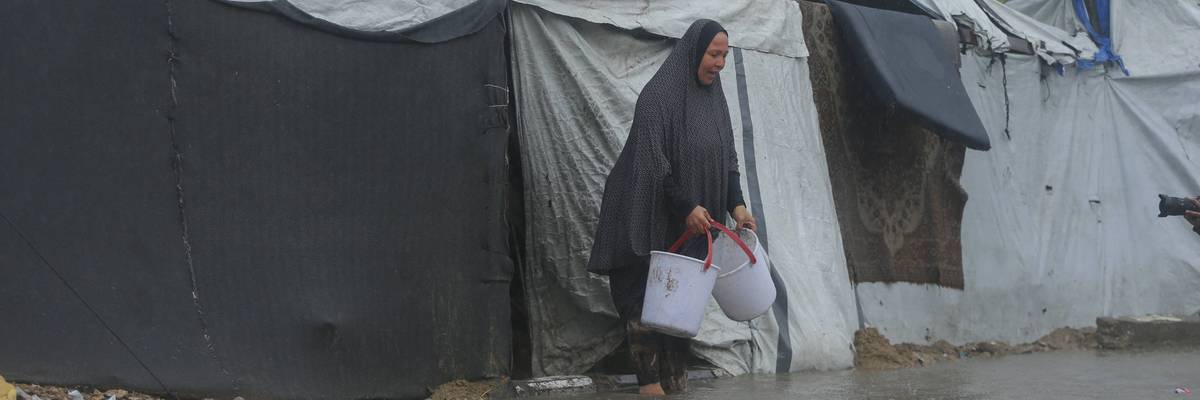
A woman carries buckets through floodwater at a camp near Gaza City’s seaport in Gaza, Palestine on November 7, 2026.
Israel is blocking around 150,000 tents and other recovery supplies from entering flood-ravaged Gaza.
A leading United Nations human rights expert said nations must prepare to send ships to break Israel’s “siege” of Gaza as it continues to block humanitarian aid—including tents, shelter materials, and repair supplies—from entering the territory as its population is inundated by deadly floods.
"Israel must immediately open all Gaza crossings and let humanitarian aid in, starting with new tents and modular housing, clean water, nutrient-rich food, medicines," Francesca Albanese, the UN Special Rapporteur on the Occupied Palestinian Territories, wrote on social media Tuesday. "If... Israel still refuses, any principled leader would send humanitarian vessels to break the siege."
Most buildings in Gaza have been damaged or destroyed by Israel's genocidal three-year military assault. About 1.4 million people now live in makeshift shelters, including flimsy tents.
According to Gaza's Government Media Office, about 70,000 tents were flooded when heavy rains struck the territory over the weekend, leaving tens of thousands of displaced people without shelter, defenseless against the elements. At least four children and two women have died as a result of the flooding.
As The Guardian reported Wednesday, the storms have also damaged sanitation infrastructure, causing sewage to flow into families' tents. About 940,000 people in Gaza live in makeshift tent areas at risk of flooding.
“All our clothes were soaked. My kids are all sick, and I can’t afford to buy them more clothes,” said Raed Jamal, a displaced Palestinian. “Watching them suffering in the cold is heartbreaking.”
According to the UN Office for the Coordination of Humanitarian Affairs (OCHA), more than 150,000 tents are awaiting Israeli authorization to enter Gaza, even as humanitarian organizations warn that Israel's restrictions on shelter supplies are exacerbating the deadly flooding emergency.
On Monday, the International Rescue Committee said aid groups had only about 2,800 tents available, compared with roughly 121,000 that are needed. Meanwhile, no emergency shelter kits were available.
"People are exhausted and have spent days trying to secure tarpaulins and scoop water from the floor of tents," said Beckie Ryan, the humanitarian group CARE Palestine's interim country director. "For these families, most of whom have been displaced repeatedly, a flooded tent means losing their last protection against the elements as winter approaches. It also means the loss of essential belongings, including clothing, bedding, medication, documentation, and personal items."
"Israeli authorities must facilitate full, rapid, safe, and unhindered humanitarian access," she said. "This includes opening all crossings for humanitarian aid and facilitating the entry of shelter and construction materials and machinery."
Israel's restrictions on shelter materials are part of broader limits on humanitarian aid entering Gaza, with only one crossing for humanitarian cargo currently operational. Relief organizations say the closures have created bottlenecks that have delayed deliveries of food, medicine, and desperately needed shelter materials.
Israeli Prime Minister Benjamin Netanyahu has denied responsibility for the conditions, blaming the militant group Hamas for allegedly diverting humanitarian aid for military use, a claim for which he provided no supporting evidence, according to The Associated Press.
His response came after some unusually pointed criticism from the US-led Gaza Board of Peace, which said Israel's restrictions had “exacerbated the consequences of a foreseeable humanitarian challenge.”
The crisis has also drawn pledges of action from foreign officials. Ed Miliband, the UK foreign secretary, said on Monday that the "humanitarian situation in Gaza is getting worse," adding that the British government would "not stand by" and "not rest until we bring an end to the intolerable suffering."
Albanese made her call for humanitarian vessels in direct response to Miliband's remarks, challenging world leaders to do more than condemn the worsening crisis.
Several governments have previously supported civilian efforts to break Israel's blockade—including Spain and Italy, which sent naval vessels to assist the activist-led Global Sumud Flotilla, which was intercepted by Israel last year. But no government has publicly committed to sending its own ships to force humanitarian aid through Israel's blockade.
Albanese and five other UN human rights experts made a similar appeal in May, saying that “states should take necessary action to prevent genocide and to support all efforts to deliver aid to the Palestinian population.”
Richard Burgon, a Labour member of the British Parliament, introduced a motion on Tuesday calling for his government to take more concrete action to compel Israel to allow in aid, which he said has received over 50 signatures.
He said, “Governments around the world should respond to the horrific scenes from flood-hit Gaza with a clear and coordinated message to Israel: We will impose sanctions on everyone responsible for blocking humanitarian aid from getting in.”
This country and this world are at a monumental crossroads. US voters have an opportunity to beat back the forces of fascism and confront the billionaires who are rigging the economy, our media system, and our democracy, making it increasingly impossible for ordinary people to get by. We’re not just talking about the election. We’re talking about what must be done once these fascist elements are vanquished from power. We need a bolder set of solutions than what either major party has so far been willing to offer and a working-class movement ready to fight like hell for it. Trump didn't emerge from nowhere. The conditions that fueled MAGA authoritarianism were created by decades of radical neoliberal economic policies and a corrupt political system dominated by corporate interests. They slashed taxes on the super-rich, promising that the benefits would trickle down. They said giveaways to the corporate titans would make life more affordable for the rest of us. It was all bullshit. And when a bitter, betrayed populace searches for someone to blame, right-wing demagogues have little trouble finding scapegoats. People know when they're being lied to, but you won't hear any of this from the corporate media. Only independent journalism—powered and funded by people who believe in building a better world—can deliver truly trustworthy daily news. If you share our vision, please contribute whatever you can to sustain our work. |
A leading United Nations human rights expert said nations must prepare to send ships to break Israel’s “siege” of Gaza as it continues to block humanitarian aid—including tents, shelter materials, and repair supplies—from entering the territory as its population is inundated by deadly floods.
"Israel must immediately open all Gaza crossings and let humanitarian aid in, starting with new tents and modular housing, clean water, nutrient-rich food, medicines," Francesca Albanese, the UN Special Rapporteur on the Occupied Palestinian Territories, wrote on social media Tuesday. "If... Israel still refuses, any principled leader would send humanitarian vessels to break the siege."
Most buildings in Gaza have been damaged or destroyed by Israel's genocidal three-year military assault. About 1.4 million people now live in makeshift shelters, including flimsy tents.
According to Gaza's Government Media Office, about 70,000 tents were flooded when heavy rains struck the territory over the weekend, leaving tens of thousands of displaced people without shelter, defenseless against the elements. At least four children and two women have died as a result of the flooding.
As The Guardian reported Wednesday, the storms have also damaged sanitation infrastructure, causing sewage to flow into families' tents. About 940,000 people in Gaza live in makeshift tent areas at risk of flooding.
“All our clothes were soaked. My kids are all sick, and I can’t afford to buy them more clothes,” said Raed Jamal, a displaced Palestinian. “Watching them suffering in the cold is heartbreaking.”
According to the UN Office for the Coordination of Humanitarian Affairs (OCHA), more than 150,000 tents are awaiting Israeli authorization to enter Gaza, even as humanitarian organizations warn that Israel's restrictions on shelter supplies are exacerbating the deadly flooding emergency.
On Monday, the International Rescue Committee said aid groups had only about 2,800 tents available, compared with roughly 121,000 that are needed. Meanwhile, no emergency shelter kits were available.
"People are exhausted and have spent days trying to secure tarpaulins and scoop water from the floor of tents," said Beckie Ryan, the humanitarian group CARE Palestine's interim country director. "For these families, most of whom have been displaced repeatedly, a flooded tent means losing their last protection against the elements as winter approaches. It also means the loss of essential belongings, including clothing, bedding, medication, documentation, and personal items."
"Israeli authorities must facilitate full, rapid, safe, and unhindered humanitarian access," she said. "This includes opening all crossings for humanitarian aid and facilitating the entry of shelter and construction materials and machinery."
Israel's restrictions on shelter materials are part of broader limits on humanitarian aid entering Gaza, with only one crossing for humanitarian cargo currently operational. Relief organizations say the closures have created bottlenecks that have delayed deliveries of food, medicine, and desperately needed shelter materials.
Israeli Prime Minister Benjamin Netanyahu has denied responsibility for the conditions, blaming the militant group Hamas for allegedly diverting humanitarian aid for military use, a claim for which he provided no supporting evidence, according to The Associated Press.
His response came after some unusually pointed criticism from the US-led Gaza Board of Peace, which said Israel's restrictions had “exacerbated the consequences of a foreseeable humanitarian challenge.”
The crisis has also drawn pledges of action from foreign officials. Ed Miliband, the UK foreign secretary, said on Monday that the "humanitarian situation in Gaza is getting worse," adding that the British government would "not stand by" and "not rest until we bring an end to the intolerable suffering."
Albanese made her call for humanitarian vessels in direct response to Miliband's remarks, challenging world leaders to do more than condemn the worsening crisis.
Several governments have previously supported civilian efforts to break Israel's blockade—including Spain and Italy, which sent naval vessels to assist the activist-led Global Sumud Flotilla, which was intercepted by Israel last year. But no government has publicly committed to sending its own ships to force humanitarian aid through Israel's blockade.
Albanese and five other UN human rights experts made a similar appeal in May, saying that “states should take necessary action to prevent genocide and to support all efforts to deliver aid to the Palestinian population.”
Richard Burgon, a Labour member of the British Parliament, introduced a motion on Tuesday calling for his government to take more concrete action to compel Israel to allow in aid, which he said has received over 50 signatures.
He said, “Governments around the world should respond to the horrific scenes from flood-hit Gaza with a clear and coordinated message to Israel: We will impose sanctions on everyone responsible for blocking humanitarian aid from getting in.”