August, 11 2011, 01:22pm EDT
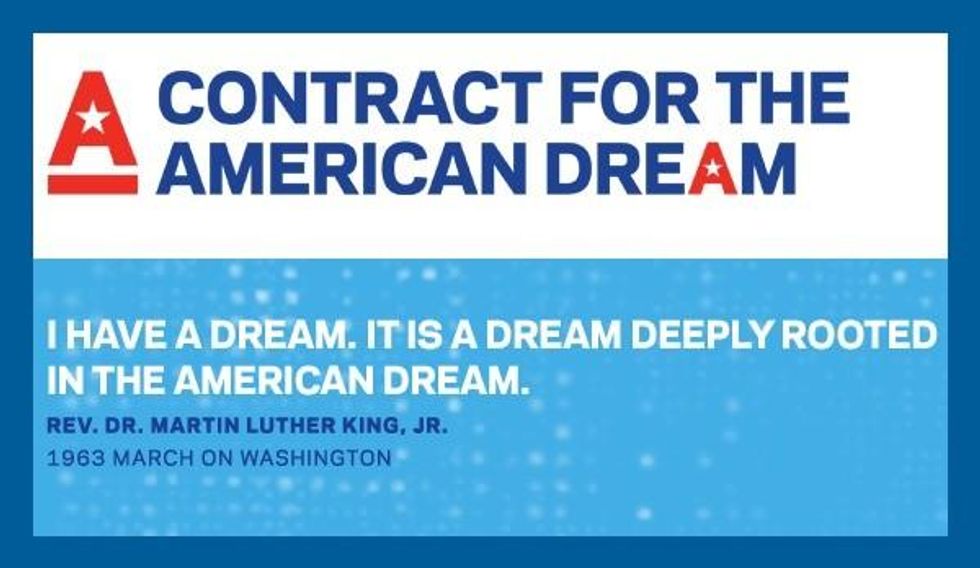
Post Debt Deal: United for a Fair Economy Partners with Rebuild the Drean for Launch of New "Contract for the American Dream"
Crowd-sourced Ten Point Plan Is Progressive Vision to Grow and Strengthen the Future Middle Class, Rebut Destructive Conservative Agenda
BOSTON
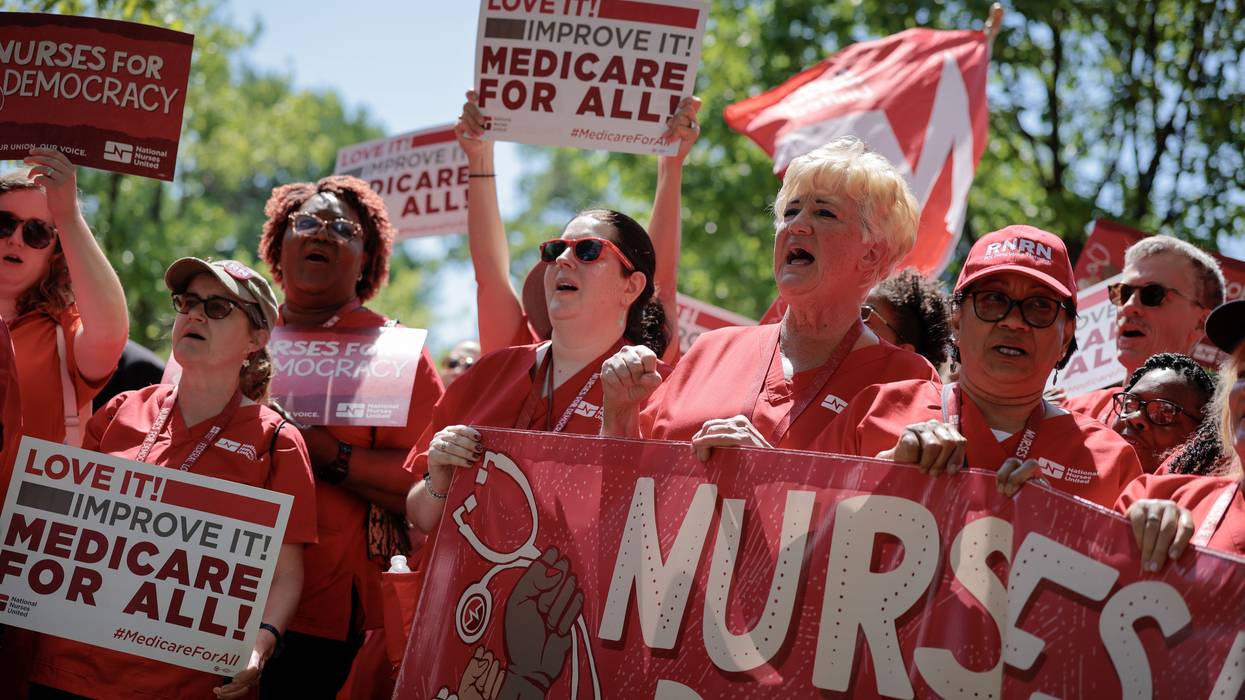
In the wake of a destructive debt ceiling deal that will cost 1.8 million jobs in 2012 and will worsen economic inequality and the decline of the American middle class, the Rebuild the Dream organization and MoveOn.org - with the support of partner United for a Fair Economy (UFE) - announced a new Contract for the American Dream. The Contract is the progressive economic vision for the American Dream Movement. Members of the American Dream Movement are taking the Contract directly to Congress during the August recess to demand "Jobs Not Cuts," beginning with hundreds of actions around the country on August 10th.

"United for a Fair Economy is proud to join the American Dream Movement as a partner to fight for the ideas and public systems that build a diverse and broad middle class, and decrease economic inequality," said Lee Farris, Federal Tax Coordinator for UFE. "The Contract for the American Dream's 10 ideas form a platform that, when enacted, will ensure that all Americans have the opportunity to thrive. One key principle is that our tax system should ensure that people who do well in America do well by America."
The Contract is a crowd-sourced document, created by people from all walks of life who submitted over 25,000 policy ideas online in July. Over 130,000 Americans participated online and in person at 1,600 house meetings in July, casting 6 million votes on the ideas. The 10 leading ideas form the Contract for the American Dream. A policy fact sheet further explains each of the 10 ideas in the Contract.
Farris is the lead author of the tax policy fact sheet that supports the tax plank of the Contract. United for a Fair Economy has educated and organized for fair and responsible tax policies since its founding in 1995.
- View the full Contract for the American Dream. <https://bit.ly/q04o19>
- Watch a video about the Contract for the American Dream. <https://bit.ly/oJVWYR>
- Read the tax fact sheet. <https://faireconomy.org/enews/rebuilding_the_dream_with_fair_taxes>
The Contract represents a sharp contrast with the destructive anti-government, anti-tax vision represented in the debt debates of recent weeks. The Contract for the American Dream will be used as a guide in influencing the upcoming budget debates in Congress.
Two weeks ago, over 25,000 people allied with the American Dream Movement held 800 rallies across the country to protest the final debt ceiling deal. "The debt ceiling deal sacrificed America's future middle class to protect tax breaks for today's millionaires, billionaires and large businesses," stated Farris. "Tax rates on the rich and corporations are at historic lows, while economic inequality and corporate profits are at historic highs. Millionaires and billion-dollar corporations need to pay their fair share so that we all can prosper."
The American Dream Movement began earlier this year to fight conservative attacks on the middle class and the poor. United for a Fair Economy, Rebuild the Dream, MoveOn.org and more than 100 organizations have joined the American Dream Movement to ensure that all Americans have the opportunity to find a decent job, afford to go to college, and provide a secure future for our children and communities.
United for a Fair Economy challenges the concentration of wealth and power that corrupts democracy, deepens the racial divide and tears communities apart. We use popular economics education, trainings, and creative communications to support social movements working for a resilient, sustainable and equitable economy. United for a Fair Economy believes another world is possible. We envision a global society which respects the humanity, rights, and creativity of all people.
LATEST NEWS
Israeli Raid on UNRWA Compound Slammed as 'Dangerous Precedent'
"This latest action represents a blatant disregard of Israel’s obligation as a United Nations member state to protect and respect the inviolability of UN premises," said UNRWA chief Philippe Lazzarini.
Dec 08, 2025
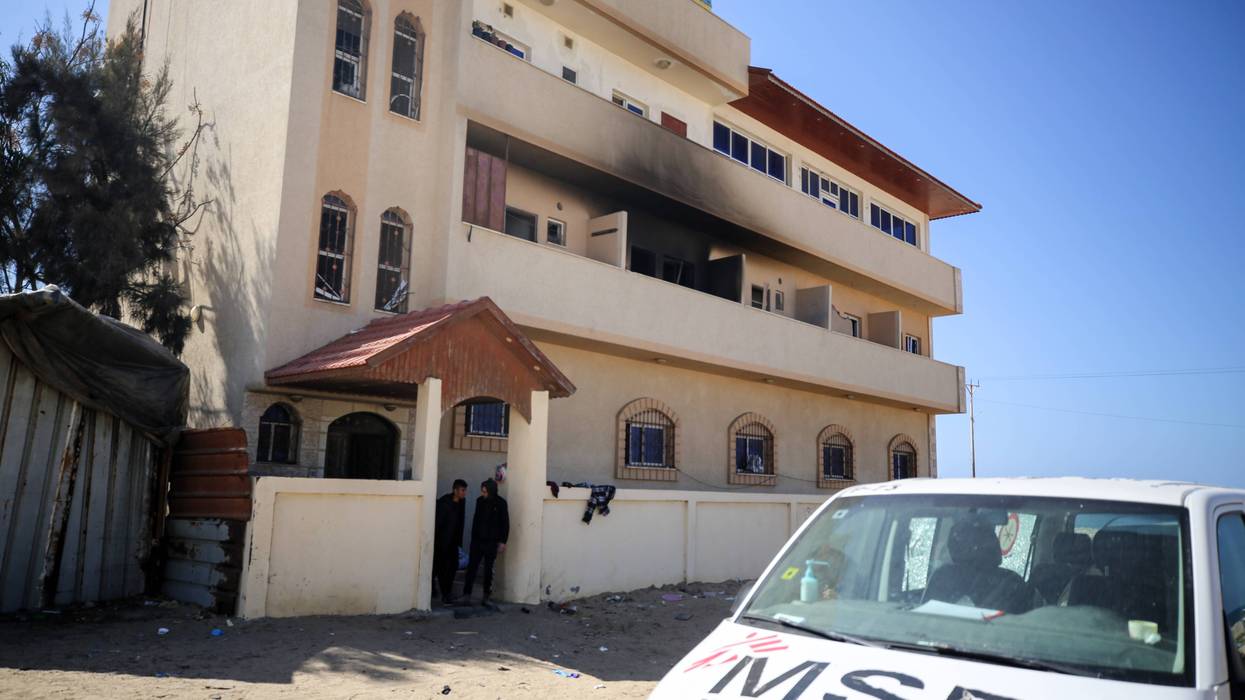
United Nations officials and others strongly condemned Monday's raid by Israeli authorities on a facility run by the UN's office for Palestinian refugees in occupied East Jerusalem—an act one rights group decried as part of an ongoing effort "to undermine and ultimately eliminate" the lifesaving agency.
Israeli police and other officials forcibly entered the UN Relief and Works Agency for Palestine Refugees in the Near East (UNRWA) compound early Monday, pulling down a UN flag on the facility's roof and replacing it with an Israeli one. Israeli officials said the raid was ordered over unpaid taxes.
"They call it 'debt collection'—we call it erasure," Claudia Webbe, a socialist former member of British Parliament, said on social media. "Over 70,000 dead in Gaza, they now seek to kill the memory of the living. The occupation must end."
Police vehicles including motorcycles, trucks, and forklifts entered the compound, while communications were cut and furniture, computer equipment, and other property were seized from the facility, according to UNRWA Commissioner-General Philippe Lazzarini.
"This latest action represents a blatant disregard of Israel’s obligation as a United Nations member state to protect and respect the inviolability of UN premises," Lazzarini said in a statement.
"To allow this represents a new challenge to international law, one that creates a dangerous precedent anywhere else the UN is present across the world," he added.
Secretary-General António Guterres was among the other senior UN officials who condemned Monday's raid.
“This compound remains United Nations premises and is inviolable and immune from any other form of interference,” he said.
“I urge Israel to immediately take all necessary steps to restore, preserve, and uphold the inviolability of UNRWA premises and to refrain from taking any further action with regard to UNRWA premises, in line with its obligations under the charter of the United Nations and its other obligations under international law," Guterres added.
In late 2024, Israeli lawmakers approved a ban on UNRWA in Israel over disproven allegations that some of its staffers were Hamas members who took part in the October 7, 2023 attack. Those accusations led to numerous nations suspending financial support for UNRWA, although most of the countries have since restored funding. Israel has also sought to ban UNRWA from Gaza since early 2024.
Israeli forces have killed more than 370 UNRWA staff members since October 2023 and destroyed or damaged over 300 of the agency's facilities in Gaza. Lazzarini and others have also accused Israeli forces of torturing UNRWA staffers in a bid to force false confessions of Hamas involvement.
In October, the International Court of Justice—which is currently weighing a genocide case against Israel—found that UNRWA has not been infiltrated by Hamas as claimed by Israeli leaders.
Others also condemned Monday's raid, including Human Rights Watch (HRW), which called the action part of an effort "to undermine and ultimately eliminate a United Nations agency providing vital services to millions of Palestinian refugees."
"Governments should condemn Israel's unlawful moves against UNRWA and urgently act to stop further abuses," HRW added.
Keep ReadingShow Less
Report Tracks Trump 'War on Free Speech' and Urges Systemic Resistance
“Trump’s censorship playbook," said the report's author, "is to lie, distort reality for the public, and deploy a cadre of henchmen to carry out Trump’s threats of reprisal.”
Dec 08, 2025
The US advocacy group Free Press on Monday released a report examining how President Donald Trump and "his political enablers have worked to undermine and chill the most basic freedoms protected under the First Amendment" since the Republican returned to the Oval Office in January, and called on all Americans to fight back.
For Chokehold: Donald Trump's War on Free Speech & the Need for Systemic Resistance, Free Press analysed "more than 500 reports of verbal threats, executive orders, presidential memoranda, statements from the White House, actions by regulators and agencies, military and law enforcement deployment and activities, litigation, removal of website language on .gov websites, removal of official history and information at national parks and museums, and discontinued data collection by the federal government."
"While the US government has made efforts throughout this nation's history to censor people's expression and association—be it the exercise of freedom of speech, religion, press, assembly, or the right to petition the government for redress—the Trump administration's incessant attacks on even the most tentatively oppositional speech are uniquely aggressive, pervasive, and escalating," the report states.
The five recurring attack methods that Free Press identified are: making threats of retribution against would-be opponents; emboldening regulators to exact penalties; supercharging the militarized police state; leveraging heavyweight corporate capitulation; and ignoring facts, removing information, rewriting history, and lying on the record.
"Trump's censorship playbook is responsible for the administration's central retaliatory ethos and inspires a set of strategies that loyal actors in government use to silence dissent and chill free expression," said the report's author, Free Press senior counsel Nora Benavidez, in a statement. "This playbook is to lie, distort reality for the public, and deploy a cadre of henchmen to carry out Trump’s threats of reprisal."
Big new report out today @freepress.bsky.social chronicling the Trump regime's war on free speech and free expression. Heroic and harrowing work by @attorneynora.bsky.social and the team. Seeing all of the attacks together is astounding.
[image or embed]
— Craig Aaron (@notaaroncraig.bsky.social) December 8, 2025 at 11:12 AM
Free Press compiled a timeline of "nearly 200 of the most potent examples," including Trump's blanket pardon for the January 6, 2021, insurrectionists shortly after beginning his second term, the White House taking control of the presidential press pool in February, the president's alarming speech to the US Department of Justice in March, and the administration blocking the Associated Press from the Oval Office in April over its refusal to refer to the Gulf of Mexico as the Gulf of America.
In May, Trump, among other things, signed an executive order to defund National Public Radio and Public Broadcasting Service. In June, he deployed the National Guard in Los Angeles. In July, he sued Rupert Murdoch and the Wall Street Journal for $10 billion over reporting on the president's ties to deceased sex offender Jeffrey Epstein. In August, he deployed the National Guard in Washington, DC.
In September, under pressure from Brendan Carr, Trump's Federal Communications Commission chair, ABC temporarily suspended late-night host Jimmy Kimmel. In October, the Pentagon's new press policy—which journalists across the political spectrum refused to sign—took effect (the New York Times, which faces a defamation lawsuit from Trump, sued over it last week). In November, Trump threatened to sue to BBC over its documentary about January 6, 2021.
The administration has also targeted foreign scholars and journalists for criticizing US policy, from federal support for Israel's genocidal assault on Palestinians in the Gaza Strip to the president's pursuit of mass deportations. The report stresses that "no one is safe from attack in Trump’s quest to control the message, though the administration targets the press most of all."
Today Free Press released a report examining the Trump's efforts to weaken the First Amendment.Analyzing nearly 200 attacks on free speech, it's sobering. But the report also charts a path to resist the censorship campaign w/ collective action. Our statement: www.freepress.net/news/report-...
[image or embed]
— Free Press (@freepress.bsky.social) December 8, 2025 at 2:45 PM
The publication also pushes back against "Trump's claims that he's protecting people and defending free speech," and acknowledges that "the administration's censorial tactics are amassing tremendous resistance across political and geographic lines, with a majority of people worried about the government's attacks on free speech."
Benavidez emphasized that "if only one person speaks out against injustice, their speech is notable, but it is also more vulnerable to attack and subversion under this administration."
"If more people speak out against injustice, the collective drumbeat can more easily withstand government reprisals," she continued. "Democracies erode little by little; would-be dictators need to scare only some of us, and the rest will follow. The very reason we must speak out together is so we can leverage our collective power."
Keep ReadingShow Less
Trump Envoy Ripped for Claim That 'Benevolent Monarchy' Is Best for Middle East
"The US labels dictators and monarchies benevolent when their behavior is aligned with US interest and when their behavior isn’t aligned with US interest they are despots," said one critic.
Dec 08, 2025
Tom Barrack, President Donald Trump's ambassador to Turkey and special envoy for Syria, faced backlash Monday after arguing that US-backed Middle Eastern monarchies—most of which are ruled by prolific human rights violators—offer the best model for governing nations in the tumultuous region.
Speaking at the Doha Forum in Qatar on Sunday, Barrack, who is also a billionaire real estate investor, cautioned against trying to impose democratic governance on the Middle East, noting that efforts to do so—sometimes by war or other military action—have failed.
“Every time we intervene, whether it's in Libya, Iraq, or any of the other places where we've tried to create a colonized mandate, it has not been successful," he said. "We end up with paralysis."
"I don’t see a democracy," Barrack said of the Middle East. "Israel can claim to be a democracy, but in this region, whether you like it or not, what has worked best is, in fact, a benevolent monarchy."
Addressing Syria's yearlong transition from longtime authoritarian rule under the Assad dynasty, Barrack added that the Syrian people must determine their political path "without going in with Western expectations of, 'We want a democracy in 12 months.'"
While Barrack's rejection of efforts to force democracy upon Middle Eastern countries drew praise, some Israelis bristled at what they claimed is the suggestion that their country is not a democracy, while other observers pushed back on the envoy's assertion regarding regional monarchies and use of what one Palestinian digital media platform called "classic colonial rhetoric."
"The reality on the ground is the opposite of his claim: It is the absence of democratic rights, accountable governance, and inclusive federal structures that has fueled Syria’s fragmentation, empowered militias, and pushed communities toward separatism," Syrian Kurdish journalist Ronahi Hasan said on social media.
Ronahi continued:
When an American official undermines the universal principles the US itself claims to defend, it sends a dangerous message: that Syrians do not deserve the same political rights as others and that minority communities should simply accept centralized authoritarianism as their fate.
Syria doesn’t need another foreign lecture romanticizing monarchy. It needs a political system that protects all its people—Druze, Alawite, Kurdish, Sunni, Christian—through genuine power-sharing, decentralization, and guarantees of equality.
"Federalism is not the problem," Ronahi added. "The problem is denying Syrians the right to shape their own future."
Abdirizak Mohamed, a lawmaker and former foreign minister in Somalia, said on social media: "Tom Barrack made public what is already known. The US labels dictators and monarchies benevolent when their behavior is aligned with US interest, and when their behavior isn’t aligned with US interest they are despots. Labeling dictators benevolent is [an] oxymoron that shows US hypocrisy."
For nearly a century, the US has supported Middle Eastern monarchies as successive administrations sought to gain and maintain control over the region's vast oil resources. This has often meant propping up monarchs in countries such as Saudi Arabia, Iran (before 1979), the United Arab Emirates, Bahrain, and Qatar—regardless of their often horrific human rights records.
While nothing new in terms of US policy and practice in the region, the Trump administration's recently published National Security Strategy prioritizes "flexible realism" over human rights and democracy and uses more candid language than past presidents have in explaining Washington's support for repressive monarchs.
"The [US] State Department will likely need to clarify whether Barrack’s comments represent official policy or personal opinion," argued an editorial in Middle East 24. "Regardless, his words have exposed an uncomfortable truth about US foreign policy in the Middle East: the persistent gap between democratic ideals and strategic realities."
"Perhaps the most troubling aspect of this episode is what it reveals about American confidence in its own values," the editorial added. "If US diplomats no longer believe democracy can work in challenging environments, what does this say about America’s faith in the universal appeal of its founding principles?"
Keep ReadingShow Less
Most Popular