

SUBSCRIBE TO OUR FREE NEWSLETTER
Daily news & progressive opinion—funded by the people, not the corporations—delivered straight to your inbox.
5
#000000
#FFFFFF
To donate by check, phone, or other method, see our More Ways to Give page.




Last Monday, you criticized me, arguing that McDonald’s problems are instead due to competition from rivals like Burger King.
(By the way, Scott,Bill Clinton didn’t fire me and Berkeley won’t, either. But your boss has a well-recorded tendency to fire his Cabinet secretaries, so I’d be careful if I were you.)
In a recent interview on CNBC’s “Squawk Box,” you even declared that the U.S. economy is no longer in a K shape: “I got sick of hearing about this K-shaped economy. I can say here definitively, the K-shaped economy is over.”
As a former Cabinet secretary, I hope you won’t mind if I’m candid with a current one. Scott, your analysis is full of shite. It’s still a K-shaped economy.
Lower-income workers continue to struggle with stagnant wages and inflation, while high-income workers are riding high on the wealth effects of the stock market. Real wages may be growing slightly more for low income than high income, but the booming stock market is mostly benefiting the high income.
Widening inequalities are partly due to policies you and your boss in the Oval Office have been pursuing — especially your tariffs and war in Iran, both of which have been pushing prices upward and imposing a far greater burden on lower-income than high-income Americans.
July’s jobs report showed wage growth falling sharply, with average hourly earnings increasing at the slowest pace in five years — 3.2% year-over-year. Inflation, meanwhile, is not slowing. As a result, consumers’ purchasing power is falling. Prices are now rising 3.5% year-over-year, as wage growth has slowed to just 3.2% — meaning that the real earnings of Americans have been dropping since April.
And I’m not just talking about McDonald’s, Scott. When major retailers reported quarterly results in May, many noted the growing divide between high- and low-income consumers. Wealthier households continue to drive spending, while lower- and middle-income households struggle to keep up. “We certainly see with our higher-income consumers, they’re benefiting probably from the wealth effect of a buoyant stock market,” said Walmart’s CFO John David Rainey. “But with low-income consumers, they don’t necessarily get that benefit, and then it’s a little bit more of paycheck to paycheck.”
Grocery chains like Kroger are considering rolling back prices to gain market share in this K-shaped consumer environment. Target is also trying to adjust to it. We’re “expanding both low, low price points, starting at $1, all the way up to some of the new premium brands,” says Cara Sylvester, who became Target’s chief merchandising officer in mid-February.
On recent quarterly earnings calls, CEOs in grocery, outdoor apparel, and kids’ apparel noted the same K-shape pattern. Kevin Depew, deputy chief economist and industry eminence program leader at RSM, attributes what’s happening to an economy in which lower- and middle-income households face real spending pressure while upper-income consumers remain cushioned by equity gains. Home improvement retailer Home Depot notes the impact of higher fuel costs in particular. “There’s no question that the average consumer is feeling pressure from rising fuel costs,” Home Depot CFO Richard McPhail said.
Other major firms report that premium travel and high-end goods (luxury airline seats and high-tier tech products) have seen double-digit growth, while discount retailers and dollar stores report high demand for basic necessities from budget-constrained consumers.
Researchers at the Federal Reserve Bank of Kansas City confirm the same trend. After analyzing changes in consumer spending between 2021 and 2025, they found that households with high incomes (fourth and fifth quintiles) increased their spending substantially faster than did consumers with low incomes (first to third quintiles). Because inflation-adjusted wage growth for the bottom quartiles has lagged behind top earners, everyday expenses like groceries, rent, and insurance are consuming larger shares of lower-income budgets.
The Federal Reserve’s May Beige Book also reflects this K-shaped divide, noting that higher-income households have remained relatively resilient, while lower-income consumers are showing greater financial strain and increased reliance on credit.
According to Moody’s Analytics, the richest 10% of American earners — composed of households making about $250,000 a year or more — are driving a record 49.7% of total U.S. consumer spending, significantly boosting the economy through the wealth effect of higher stock and home prices. They own over 90% of the value of all shares of stock, so big gains in the stock market have encouraged them to splurge on everything from vacations to designer handbags. “The finances of the well-to-do have never been better, their spending never stronger and the economy never more dependent on that group,” says Mark Zandi, who oversaw the analysis, based on data from the Federal Reserve. Zandi says the K-shaped economy remains “firmly intact.”
All told, rich Americans have increased their spending far beyond inflation, but nobody else has. The bottom 80% of earners spent 25% more than they did four years earlier, barely outpacing price increases of 21% over that period. And they’re going into debt to do so (researchers find auto repossessions and credit card delinquencies rising among lower-to-middle-income borrowers). But the top 10% spent 58% more.
Research by U.S.Bank also shows the K-shaped economy’s divide across household balance sheets, labor market access, generational wealth-building, and sector performance. “Higher-income households are more likely to own homes, equities, and retirement assets,” says Matt Schoeppner, senior economist for U.S. Bank, “allowing them to participate more directly when financial markets and home values rise.”
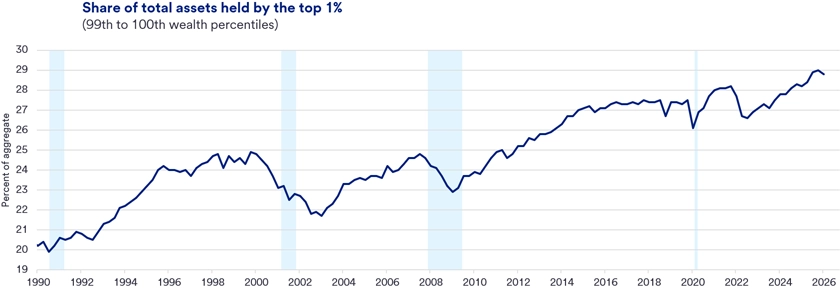
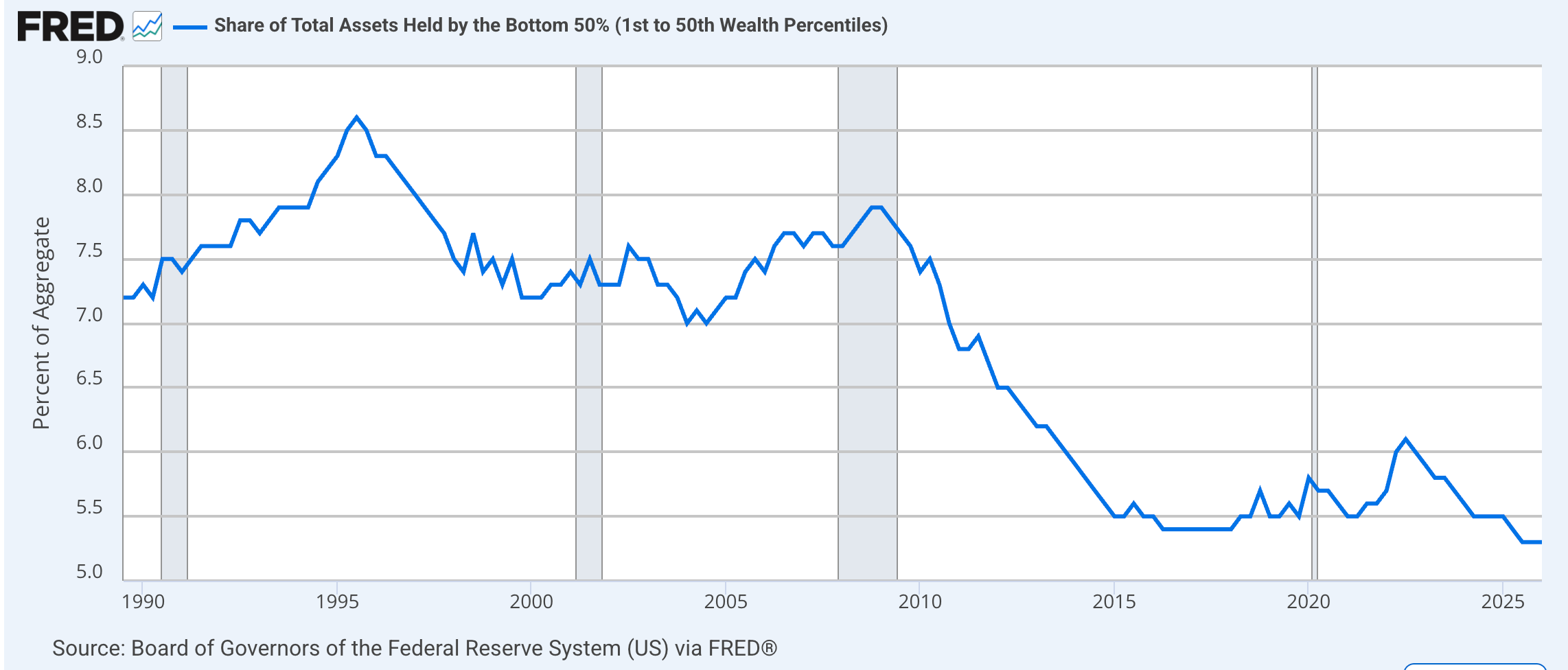
Federal Reserve distributional data reveal that wealth is increasingly concentrated. As of the fourth quarter of 2025, the richest 1% of Americans held 29.2% of the nation’s aggregate wealth (up from around 20% in the early 1990s), compared with just 5.3% for the bottom half.
Meanwhile, lower- and middle-income households are struggling. “Wage gains for most have been moderating, while essential costs for rent, groceries and gasoline remain elevated,” notes Schoeppner. “At the same time, savings buffers have continued to narrow while reliance on credit — particularly credit cards — has increased.”
Scott, what more evidence do you need? If this isn’t a K-shaped economy, what is it?
The labor market further reveals the K-shape. Hiring rates have fallen to 15-year lows of around 3.2% while layoff rates remain near historically low levels of 1.1%. In this “low-hire, low-fire” environment, workers who are already employed have some stability, but job seekers and those looking to advance are in trouble.
This is significant because mobility is the major way for workers to improve earnings, move into higher-productivity roles, and build financial buffers. “When hiring slows and job-switching premiums narrow,” says Beth Ann Bovino, U.S. Bank’s chief economist, “pathways to higher pay and better job matches become more limited.”
As a result, the labor market can appear stable at the aggregate level while becoming less dynamic beneath the surface — particularly for workers in lower-wage or more cyclical industries.
I’ve got to emphasize how badly the war in Iran is aggravating this K-shaped divide. U.S. Bank’s Schoeppner notes that “the resulting higher gasoline prices … may be more of an inconvenience for higher-income households, but for those with thinner buffers, they can quickly crowd out discretionary spending.” The San Francisco Fed has similarly noted that elevated gasoline and grocery costs are consuming a larger share of household budgets among the bottom 80%.
Credit conditions reveal the same widening divide. Bovino notes that lower-income households “tend to rely more heavily on higher-cost borrowing and devote a larger share of income to debt service, leaving them more sensitive to higher rates and reduced credit availability.” Recent Beige Book commentary also points to increased reliance on credit among lower-income households. The April 2026 Senior Loan Officer Opinion Survey shows tighter lending standards across key segments, suggesting that access to financing is becoming more constrained.
Scott, it’s important that you and your colleagues at the treasury and elsewhere in the Trump administration know what’s going on. The K-shaped economy can make the macro environment appear more stable than it is actually experienced by average working Americans. The fact is, the overall health of the economy increasingly depends on a narrowing base of consumption coming from the wealthy — who are spending because their stock market assets have risen so high but will stop spending if and when the stock market comes back to earth.
Meanwhile, inflation and credit pressures continue to land especially hard on lower-income Americans. In that sense, the K-shaped economy is not just a feature of recent cycles. It’s become the defining characteristic of how today’s economy absorbs shocks and generates growth.
Go ahead, Scott — attack me with all the ad hominem arguments you want. But you need to know the reality I’m talking about. You’re the one with the power. I’m just a retired professor. Your failure to comprehend the struggles facing average working Americans makes me worry that you and your boss will continue to pursue policies that worsen them.
Best wishes, Scott.