
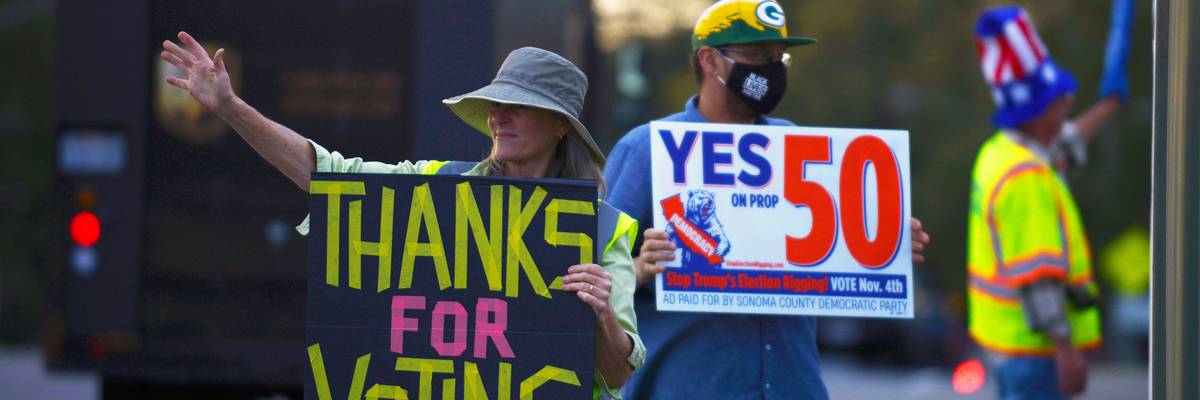
From left: Jennifer York, Zac Britton, and George Reed encourage passing motorists to vote Yes on Prop 50 along Bicentennial Way in Santa Rosa, California, on November 3, 2025.
California Voters Pass Prop 50, Punching Back at Trump in Gerrymandering Fight
"The blowout showed how showing up to fight is the most important thing in Democratic politics right now," wrote David Dayen at The American Prospect.
The people of California dealt a huge counterpunch to Republican efforts to gerrymander their way to a 2026 midterm victory, voting overwhelmingly on Tuesday for new congressional maps that are expected to net Democrats an additional five seats in the next US House elections.
Republicans have appeared on track to cling to power after President Donald Trump pushed red states to carry out largely unprecedented mid-decade redistricting efforts. New maps enacted or approved in Texas, Ohio, Missouri, and North Carolina were expected to net the GOP an extra nine seats that may have proven decisive in holding off a blue wave next November.
But on Tuesday, as Democrats romped up and down the ballot nationwide, more than 5.1 million California voters almost singlehandedly stymied the Republican advance in its tracks, passing Proposition 50 with nearly 64% of the vote, and approving new maps drawn up by Gov. Gavin Newsom and state Democrats with a more aggressive partisan gerrymander.
David Dayen, the executive editor of The American Prospect, wrote on social media that in one fell swoop, the Democrats "have largely neutralized Trump's gerrymandering push."
However, he noted that the GOP could grab a possibly insurmountable advantage if the US Supreme Court votes to gut Section 2 of the Voting Rights Act, effectively legalizing racial gerrymandering and, in the process, potentially netting Republicans at least 19 more seats.
Notably, California's maps only needed to be approved by voters in the first place to override those drawn up by the state's independent redistricting commission, which was also created by a ballot measure in 2008. Meanwhile, the new maps drawn in red states have been enacted by state legislatures without voter approval.
As the champion of Prop 50, Newsom argued that desperate times called for desperate measures, saying it was a necessary counter to Trump's "attempt to rig the 2026 election and redistrict his way out of accountability in states like Texas.”
On Tuesday night, after Prop 50's resounding passage, Newsom told a gathering of California Democrats in Sacramento that the party was "on its toes, no longer on its heels."
The passage of Prop 50 may give other blue states a shot in the arm to pursue their own mid-decade gerrymanders and further chip away at the GOP advantage.
New York Gov. Kathy Hochul has signaled her support for the state pursuing its own redistricting, and a constitutional amendment has been proposed to override the state's independent, bipartisan redistricting commission.
In Virginia, Democratic leaders have passed the first round of a constitutional amendment to give the legislature emergency powers to redraw maps, an effort that remained viable after Democrats held onto the state’s House of Delegates in Tuesday’s elections.
Earlier this week, Maryland Gov. Wes Moore also announced the creation of a new bipartisan commission to target the state's one remaining GOP district, though some Democrats have criticized the effort as a risky gambit that could backfire and benefit Republicans.
Regardless, Dayen believes that the result in California is a decisive indication of the more confrontational approach Democratic voters are looking for in the second Trump era.
"Prop 50 was called the moment polls closed in California," he wrote. "The blowout showed how showing up to fight is the most important thing in Democratic politics right now."
We are at a crossroads
This country and this world are at a monumental crossroads. In a few short weeks, US voters will have an opportunity to beat back the forces of fascism and confront the billionaires who are rigging the economy, our media system, and our democracy, making it increasingly impossible for ordinary people to get by. We’re not just talking about the election. We’re talking about what must be done once these fascist elements are vanquished from power. We need a bolder set of solutions than what either major party has so far been willing to offer and a working-class movement ready to fight like hell for it. Trump didn't emerge from nowhere. The conditions that fueled MAGA authoritarianism were created by decades of radical neoliberal economic policies and a corrupt political system dominated by corporate interests. They slashed taxes on the super-rich, promising that the benefits would trickle down. They said giveaways to the corporate titans would make life more affordable for the rest of us. It was all bullshit. And when a bitter, betrayed populace searches for someone to blame, right-wing demagogues have little trouble finding scapegoats. People know when they're being lied to, but you won't hear any of this from the corporate media. Only independent journalism—powered and funded by people who believe in building a better world—can deliver truly trustworthy daily news. Our Fall Campaign is underway, and we need your help. To power our newsroom through the rest of the year, we need to raise $125,000 by midnight on October 31. So if you share our vision, please contribute whatever you can to sustain our work. |
The people of California dealt a huge counterpunch to Republican efforts to gerrymander their way to a 2026 midterm victory, voting overwhelmingly on Tuesday for new congressional maps that are expected to net Democrats an additional five seats in the next US House elections.
Republicans have appeared on track to cling to power after President Donald Trump pushed red states to carry out largely unprecedented mid-decade redistricting efforts. New maps enacted or approved in Texas, Ohio, Missouri, and North Carolina were expected to net the GOP an extra nine seats that may have proven decisive in holding off a blue wave next November.
But on Tuesday, as Democrats romped up and down the ballot nationwide, more than 5.1 million California voters almost singlehandedly stymied the Republican advance in its tracks, passing Proposition 50 with nearly 64% of the vote, and approving new maps drawn up by Gov. Gavin Newsom and state Democrats with a more aggressive partisan gerrymander.
David Dayen, the executive editor of The American Prospect, wrote on social media that in one fell swoop, the Democrats "have largely neutralized Trump's gerrymandering push."
However, he noted that the GOP could grab a possibly insurmountable advantage if the US Supreme Court votes to gut Section 2 of the Voting Rights Act, effectively legalizing racial gerrymandering and, in the process, potentially netting Republicans at least 19 more seats.
Notably, California's maps only needed to be approved by voters in the first place to override those drawn up by the state's independent redistricting commission, which was also created by a ballot measure in 2008. Meanwhile, the new maps drawn in red states have been enacted by state legislatures without voter approval.
As the champion of Prop 50, Newsom argued that desperate times called for desperate measures, saying it was a necessary counter to Trump's "attempt to rig the 2026 election and redistrict his way out of accountability in states like Texas.”
On Tuesday night, after Prop 50's resounding passage, Newsom told a gathering of California Democrats in Sacramento that the party was "on its toes, no longer on its heels."
The passage of Prop 50 may give other blue states a shot in the arm to pursue their own mid-decade gerrymanders and further chip away at the GOP advantage.
New York Gov. Kathy Hochul has signaled her support for the state pursuing its own redistricting, and a constitutional amendment has been proposed to override the state's independent, bipartisan redistricting commission.
In Virginia, Democratic leaders have passed the first round of a constitutional amendment to give the legislature emergency powers to redraw maps, an effort that remained viable after Democrats held onto the state’s House of Delegates in Tuesday’s elections.
Earlier this week, Maryland Gov. Wes Moore also announced the creation of a new bipartisan commission to target the state's one remaining GOP district, though some Democrats have criticized the effort as a risky gambit that could backfire and benefit Republicans.
Regardless, Dayen believes that the result in California is a decisive indication of the more confrontational approach Democratic voters are looking for in the second Trump era.
"Prop 50 was called the moment polls closed in California," he wrote. "The blowout showed how showing up to fight is the most important thing in Democratic politics right now."
- California, Virginia Democrats Notch Wins in Fight Against Trump GOP's Map Rigging | Common Dreams ›
- Virginia Democrats Pass New Political Map to Combat Trump—But Court Battles Continue | Common Dreams ›
- No Kings Movement and 'All Roads Lead to the South' to Protest GOP Voting Rights Attacks | Common Dreams ›
The people of California dealt a huge counterpunch to Republican efforts to gerrymander their way to a 2026 midterm victory, voting overwhelmingly on Tuesday for new congressional maps that are expected to net Democrats an additional five seats in the next US House elections.
Republicans have appeared on track to cling to power after President Donald Trump pushed red states to carry out largely unprecedented mid-decade redistricting efforts. New maps enacted or approved in Texas, Ohio, Missouri, and North Carolina were expected to net the GOP an extra nine seats that may have proven decisive in holding off a blue wave next November.
But on Tuesday, as Democrats romped up and down the ballot nationwide, more than 5.1 million California voters almost singlehandedly stymied the Republican advance in its tracks, passing Proposition 50 with nearly 64% of the vote, and approving new maps drawn up by Gov. Gavin Newsom and state Democrats with a more aggressive partisan gerrymander.
David Dayen, the executive editor of The American Prospect, wrote on social media that in one fell swoop, the Democrats "have largely neutralized Trump's gerrymandering push."
However, he noted that the GOP could grab a possibly insurmountable advantage if the US Supreme Court votes to gut Section 2 of the Voting Rights Act, effectively legalizing racial gerrymandering and, in the process, potentially netting Republicans at least 19 more seats.
Notably, California's maps only needed to be approved by voters in the first place to override those drawn up by the state's independent redistricting commission, which was also created by a ballot measure in 2008. Meanwhile, the new maps drawn in red states have been enacted by state legislatures without voter approval.
As the champion of Prop 50, Newsom argued that desperate times called for desperate measures, saying it was a necessary counter to Trump's "attempt to rig the 2026 election and redistrict his way out of accountability in states like Texas.”
On Tuesday night, after Prop 50's resounding passage, Newsom told a gathering of California Democrats in Sacramento that the party was "on its toes, no longer on its heels."
The passage of Prop 50 may give other blue states a shot in the arm to pursue their own mid-decade gerrymanders and further chip away at the GOP advantage.
New York Gov. Kathy Hochul has signaled her support for the state pursuing its own redistricting, and a constitutional amendment has been proposed to override the state's independent, bipartisan redistricting commission.
In Virginia, Democratic leaders have passed the first round of a constitutional amendment to give the legislature emergency powers to redraw maps, an effort that remained viable after Democrats held onto the state’s House of Delegates in Tuesday’s elections.
Earlier this week, Maryland Gov. Wes Moore also announced the creation of a new bipartisan commission to target the state's one remaining GOP district, though some Democrats have criticized the effort as a risky gambit that could backfire and benefit Republicans.
Regardless, Dayen believes that the result in California is a decisive indication of the more confrontational approach Democratic voters are looking for in the second Trump era.
"Prop 50 was called the moment polls closed in California," he wrote. "The blowout showed how showing up to fight is the most important thing in Democratic politics right now."
- California, Virginia Democrats Notch Wins in Fight Against Trump GOP's Map Rigging | Common Dreams ›
- Virginia Democrats Pass New Political Map to Combat Trump—But Court Battles Continue | Common Dreams ›
- No Kings Movement and 'All Roads Lead to the South' to Protest GOP Voting Rights Attacks | Common Dreams ›