

SUBSCRIBE TO OUR FREE NEWSLETTER
Daily news & progressive opinion—funded by the people, not the corporations—delivered straight to your inbox.
5
#000000
#FFFFFF
To donate by check, phone, or other method, see our More Ways to Give page.
Daily news & progressive opinion—funded by the people, not the corporations—delivered straight to your inbox.
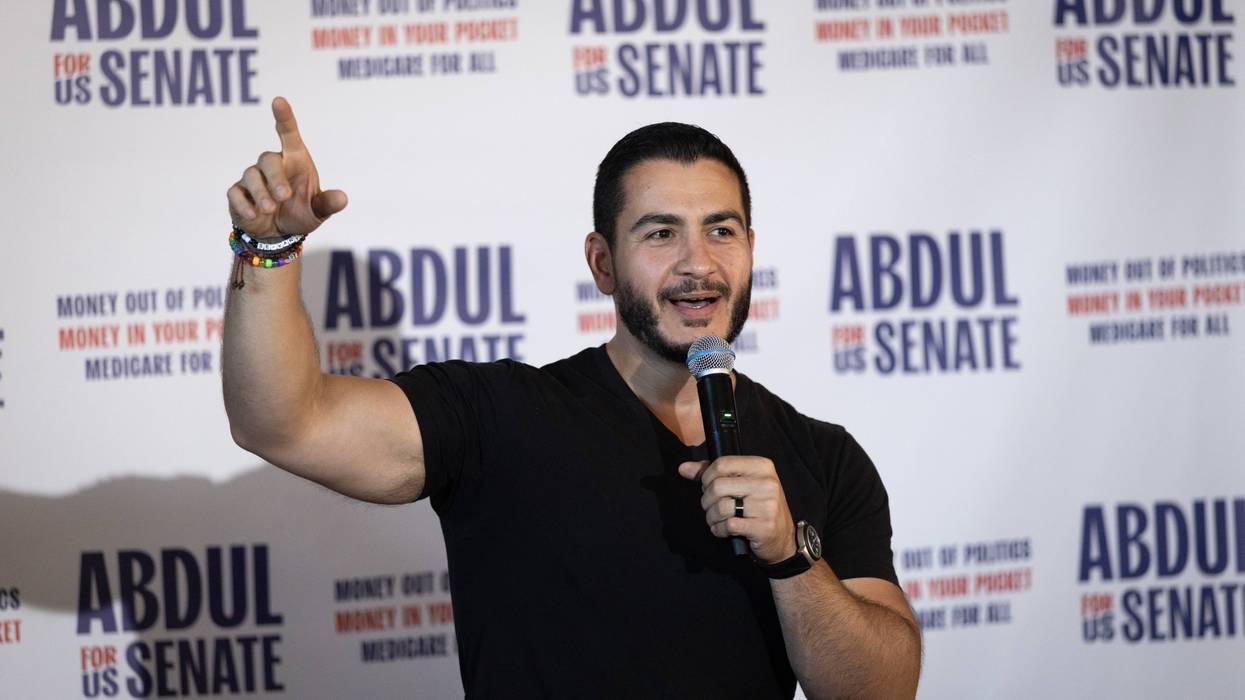
If Democrats want to deliver on their promise to make life more affordable, then they must use their new congressional majorities to finally pass universal single-payer healthcare.
America’s affordability crisis played a major role in this year’s midterm elections—and few things in American life have become more unaffordable than healthcare.
It’s about to get worse as premiums rise and Medicaid cuts from the GOP’s so-called “Big Beautiful Bill” take effect. So if Democrats want to deliver on their promise to make life more affordable, then they must use their new congressional majorities to pass Medicare for All.
The United States spends more on healthcare yet has worse health outcomes than comparable high-income countries.
We need a healthcare system that guarantees this human right for all, not one that guarantees more profits for Big Insurance and Wall Street investors.
In surveys, healthcare costs remain the top financial burden for adults and families, even when they’re insured. Around 85 million people in the US are either uninsured or underinsured, according to Rep. Pramila Jayapal’s (D-Wash.) office. Six in 10 uninsured adults polled said they’ve recently skipped or postponed care because of the staggering costs.
It’s no wonder that a record two-thirds of all US adults now support a national health plan like Medicare for All.
According to a recent Yale study, single-payer universal health coverage would save more than 100,000 lives a year and cost $1 trillion less than our current profit-driven system. The study’s authors reached these findings by modeling what would happen if the US adopted a single-payer system like the one proposed in the “Medicare for All Act.”
Introduced in 2025 by Jayapal, Rep. Debbie Dingell (D-Mich.), and Sen. Bernie Sanders (I-Vt.), the Medicare for All Act would expand Medicare to provide comprehensive health benefits to every US resident. It would include primary care, mental health, dental, vision, hearing, reproductive care, prescription drugs, and more.
Patients would choose their doctors without crushing co-pays, deductibles, and other coverage restrictions. Physicians would be able to focus more on healing their patients instead of “battling insurers over denials and delays,” as Dr. Diljeet K. Singh, president of Physicians for a National Health Program, summed it up in her endorsement of the legislation.
Much of the spending in our current health system is “consumed by administrative middlemen, soaring drug prices, and emergency care for conditions that should have been treated earlier and for less,” said Dr. Alison Galvani, the Yale study’s senior author.
Galvani and her co-authors found that the Medicare for All Act would reduce health spending by lowering pharmaceutical prices, cutting administrative overhead, cracking down on fraudulent billing, preventing avoidable emergency care, and applying savings from Medicare payment rates to all providers. “Our results indicate that the existing [federal] budget is more than sufficient to cover everyone at lower total cost,” they conclude.
Most importantly, a universal healthcare system would save lives. The Yale researchers calculate that it would prevent around 114,000 people from dying each year due to lack of healthcare. Their findings are no outlier—other studies have also found that a single-payer system would improve existing coverage while saving money.
Elected Democrats remain divided on Medicare for All, but universal healthcare is wildly popular among their voters. Several incoming lawmakers campaigned on this issue and won, like Senator-elect Dr. Abdul El-Sayed (D-Mich.).
Although the Affordable Care Act expanded access to care, it has done so by benefiting the very for-profit insurance companies that contribute to the affordability problem. Far too many people still end up drowning in medical debt.
Universal healthcare is both sound public policy and a human right. The “right to the enjoyment of the highest attainable standard of physical and mental health” has long been recognized as a fundamental human right under international law that all governments are obligated to respect, protect, and fulfill. Nevertheless, the US remains the only high-income nation in the world without universal health coverage.
We need a healthcare system that guarantees this human right for all, not one that guarantees more profits for Big Insurance and Wall Street investors. The next Congress must meet the moment by making Medicare for All a reality instead of an empty campaign slogan.

Corruption and incompetence can leave Americans wondering who is in charge. Someone is, though, and they've been draining the Middle Class dry for 50 years. It's time we took our power back.
America is experiencing a convergence of crises that are destroying public confidence in our government’s ability to function, protect its citizens, and preserve democracy.
It’s been fewer than three weeks since Democrats won the biggest election sweep since Richard Nixon’s Watergate crimes were exposed, but the feeling of dread that hangs over America doesn’t show any sign of lifting.
After all, Trump—who now calls himself “Mr. Veto”—will still be president for two more years, and Democrats are still well short of the two-thirds it’ll take to override him.
His masked secret police are still terrorizing and murdering American citizens and immigrants on our streets with absolutely no accountability, and Immigration and Customs Enforcement (ICE) continues to build and buy concentration camps where people are being tortured, dying, and being killed on an almost weekly basis.
Democrats are giddy about demanding Trump and his cronies and family “preserve their papers,” but Republicans destroyed things last time around with no consequence whatsoever.
They’re looking forward to subpoenas to drag Republicans and corrupt businesspeople before Congress, but conventional wisdom says that enforcing those subpoenas will depend on Todd Blanche’s Department of Justice, and last time around the DOJ also refused to hold Attorney General Bill Barr and Commerce Secretary Wilbur Ross in criminal contempt for refusing to show up and testify at all.
This month White House counsel William Scharf, asked whether the administration will comply with subpoenas from the incoming Congress, answered, “It depends.” Trump’s now ordered every federal agency to get his personal permission before anybody testifies, and the Justice Department reportedly told the nation’s US attorneys to take a “wartime” stance against Democrats asking questions or wanting to see files (including the Epstein files).
Much of the doomsday feeling people are expressing when they call into my show or discuss this in the media is the result of our living through a convergence of crises instead of simply any single one.
If we wimp out again, if Congress flinches, if we wait years to prosecute Republican criminals like Merrick Garland did, that the the doomsday feeling will come back stronger.
From grounded planes to Microsoft’s email to Workday’s payroll and Chase’s payments, even Trump’s incompetent Cabinet officials refuse to explain what’s happening with anything other than “trust us,” pablum-like assurances while Trump goes off to kiss Russian President Vladimir Putin’s ass and suck up to Xi Jinping in China as both continue to help Russia murder Ukrainians and American troops in the Gulf.
The federal government that’s protected us at home and defended democracy around the world for our lifetimes was gutted by the world’s richest man—more than 256,000 federal workers are now out of a job—and only 49% of Americans can reliably afford healthcare we need.
Roughly 80% of Americans are worried AI will cost them their or their children’s jobs; 33 countries are advising their citizens to stockpile food and water; at the same time Trump, his boys, and his son-in-law have screwed MAGA followers out of over $2.3 billion in crypto.
This has left Americans wondering who’s in charge of this country, and to whose benefit it’s now being run. Pew found 69% of us don’t think our democracy works anymore, and Gallup says only 28% of us believe corrupt American politicians or judges will ever be held accountable to the law.
Somebody is in charge, though, and they been at it for almost 50 years, draining dry the middle class while producing a bumper crop of right-wing oligarchs; the morbidly rich have never had it so good. As Jimmy Carter told me on my program over a decade ago, America is now more an oligarchy than a democratic republic.
And that’s both the danger and the opportunity.
As I lay out in The Hidden History of American Oligarchy, oligarchy is always a transitional form of government, rarely lasting more than two generations, because sooner or later the people get tired of being robbed and rise up, demanding their democracy back.
At that point the oligarchs face a binary choice: Back down, as they did when Franklin Roosevelt faced them down in the 1930s, or they bring down the iron fist the way Putin and Turkish President Recip Tayyip Erdoğan did.
With his National Security Presidential Memorandum-7 and ICE, Trump is clearly trying for the Iron Fist; as Stephen Miller recently said, eerily echoing Stalin and Goebbels:
We live in a world in which you can talk all you want about international niceties and everything else. But we live in a world, in the real world... that is governed by strength, that is governed by force, that is governed by power. These are the iron laws of the world.
Back in 1967, psychologist Martin Seligman found that if you gave dogs a painful electric shock and simultaneously prevented them from moving to escape it, they eventually stopped trying to get away but simply laid down and whimpered. He called it “learned helplessness.”
I’d argue that’s where the elected Republicans have been for at least the past decade, and perhaps longer.
On the other hand, almost 50 years later he argued that passivity in the face of pain is a “default” of the brain—the way a possum will play dead—but that a more important thing for humans is learned optimism and learned self-empowerment, the result of taking positive actions. They’re far more powerful, he argues in his latest book Agency, than learned helplessness.
We’ve been violently “shocked” for the better part of the last two years, and more mildly but consistently hit with corruption, theft, lies that got us into wars, and the GOP gutting the middle class for at least 45 years.
But there was also a time, between 1933 and 1981, when we picked ourselves up, dusted ourselves off from the Republican Great Depression, and learned agency, took power, and did great things.
We did it in union halls, by breaking up monopolies, by taxing the morbidly rich, and holding corporate and political criminals alike to account. And it appears, with this last election, that we’re on the road—perhaps a 2-year-long road—to doing that again.
Starting January 3, Trump can’t veto a hearing, can’t get a single judge confirmed without the consent of a Senate where Democrats will hold 56 seats, and can’t lawfully spend a dollar that Congress doesn’t appropriate.
It’s even possible—if Rep. Hakeem Jeffries (D-NY) and either Sen. Chuck Schumer (D-NY) or Sen. Chris Van Hollen (D-Md.) find the backbone—for Congress to rediscover its own inherent contempt power to send its sergeant-at-arms to arrest a witness who defies it, a power that’s sat unused for 90 years.
Seligman’s research offers us both hope and a warning.
Hope that if we push our leaders hard enough, if they stand up strong enough, we can defeat the oligarchy the ways FDR, Abraham Lincoln, and George Washington and Thomas Jefferson did in each of the previous 80-year cycles of American history.
And a warning that if we wimp out again, if Congress flinches, if we wait years to prosecute Republican criminals like Merrick Garland did, that the the doomsday feeling will come back stronger: This is obviously something the would-be Republican strongmen like Trump, Vice President JD Vance, Rep. Jim Jordan (R-Ohio), et al. are counting on it.
So reach out to your state attorneys general—who, as Christopher Armitage points out, have considerable power that’s to this day been largely unused—and your elected officials in DC and demand that they stand up to the bullies and fascists and thieves.
Assert your power as a citizen!
And find things close to home—a school board, a union drive, a food bank, where you can watch your own effort change an outcome—because that’s where our own personal power gets, as Seligman noted, learned again.
If this helped you make sense of what you’ve been feeling, please share it with somebody who’s been feeling it too. And if you aren’t yet a subscriber to The Hartmann Report I hope you’ll become one, because this work only happens with the support of readers like you.

We have spent sufficient time studying the problem of caregiving in America and praising the heroic work of family caregivers. The current moment demands strong action not words or gestures.
The odds are good that if you have an older adult in your family, you have seen the recent Saturday Night Live skit on caregiving. For those who have not seen the SNL segment, The New York Times provides an apt summary:
The “S.N.L." sketch was basically the funny version of a study published in the American Sociological Review by Angelina Grigoryeva of the University of Toronto. She showed that daughters spend 14 hours a month, on average, caring for parents, compared with six hours for sons. Sons provide less care if they have sisters, and daughters provide more if they have brothers rather than sisters. And daughters are more likely than sons to provide care even if it conflicts with their work or childcare demands.
The SNL sketch hit a nerve among so many Americans because it highlighted gender inequities that we certainly need to address. It also focuses a spotlight on a glaring inadequacy in our healthcare system. Medicare does not cover long-term care. It covers only short-term care such as that needed when recovering from a stroke. Far too many Americans are unaware of what Medicare will cover. In 2022 research by the Kaiser Family Foundation found that “...23% of adults—rising to 45% of those ages 65 and older—assume that Medicare would pay the bill for their own or a loved one’s time in a nursing home if they had a long-term illness or disability.”
Medicaid, the state and local program for low-income people, does cover long-term care including nursing homes. However, to qualify for Medicaid there are often long waiting lists and you must spend down your assets.
How many people provide unpaid care to family and friends? Research from the Kaiser Family Foundation on November 19 shows that:
The bottom line here is that we have a caregiving crisis that needs to be addressed. Just as we had a retirement income crisis in the 1930s that lead to Social Security and a healthcare crisis that resulted in the enactment of Medicare, we need bold action at the federal level to address the caregiving crisis.
During her 2024 presidential campaign, Vice President Kamala Harris proposed a new home health benefit for Medicare called “Medicare at Home.” Under her plan “Medicare will cover home care for the first time ever for all of our nation’s seniors and those with disabilities on Medicare who need it, in addition to vision and hearing benefits to help seniors live independently for longer.” For his part, then former President Trump supported protecting seniors by "'shifting resources back to at-home Senior Care,' addressing disincentives that contribute to workforce shortages, and supporting unpaid family caregivers through tax credits.”
In the current Congress, Sen. Andy Kim (D-NJ) and Congresswoman Debbie Dingell (D-MIich. have introduced the Medicare At Home Act, which would:
...establish long-term care services benefits as part of the Medicare program. The Medicare At Home Act would help older adults and people with disabilities remain safely in their homes and communities by expanding home care coverage under Medicare Part B. Medicare Part B usually covers doctor visits and everyday medical care; this bill would also cover in-home support so people don’t have to leave their homes.
Now, the question that comes up at this point is: How are we going to pay for this new Medicare benefit? Before considering this question, it is important to note that the United States supports its caregivers far less than other countries. The United States falls behind most other wealthy countries in its support for caregivers. According to the Organization for Economic Development and Cooperation (OECD), the United States spends 1.3% of its gross domestic product on caregiving, which compares poorly with countries like the Netherlands (4.1%), Belgium (3.1%), and the United Kingdom (2.6%).
The Commonwealth Foundation points out that there are several potential ways of funding a new Medicare benefit: general revenues, payroll taxes, premiums, or co-payments. This will no doubt be an intense discussion, and there are hard choices to be made. Part of this debate should include why there is always enough money for wars but not enough to take care of those most precious to us.
We have spent sufficient time studying the problem of caregiving in America and praising the heroic work of family caregivers. The current moment demands strong action not words or gestures. Sen. Kim and Rep. Dingle have boldly moved the debate forward. Hopefully, when the new Congress convenes in January of 2027, caregiving will be a top issue.

It's not too late, but we must act. We owe this fight to the people already living through the crisis, to the young people whose futures are being decided in these rooms, and to those who will inherit the consequences of what we do here.
I’m struggling to find the words for the sadness, heartbreak and disbelief I feel watching what is unfolding at COP31.
How is this possible?
Only recently, in Santa Marta, Colombia, governments, social movements, scientists, Indigenous peoples and frontline communities came together to confront the main driver of the climate emergency and ask how we move beyond fossil fuels.
For a moment, it felt as though the political courage might finally match the urgency of the science. And now, here we are. Panama is right to draw a line. If the final text contains no commitment to phase out fossil fuel production, no meaningful climate finance and no guarantee that electrification will be powered by renewables, Panama should formally object. I stand with Panama in taking that position, and I urge other governments to stand with them.
Nepal is being pushed to the point of walking out as powerful countries ignore the devastation its people have recently experienced. Fossil fuels have disappeared from the latest draft. Imagine Alcoholics Anonymous spending 30 years negotiating and producing a statement that never mentions alcohol. Now imagine the alcohol industry turning up as the largest delegation and helping shape the outcome.
We still have time to change the outcome. I’m asking the governments that came to Santa Marta, and every government that has promised to stand with frontline communities, to speak up now and insist that the COP31 outcome commits to a fast, fair and funded phase-out of fossil fuels.
Every year we delay phasing out coal, oil and gas locks in more harm for people already living through this crisis and leaves future generations with a more dangerous world. We are on course to exceed 1.5°C of long-term warming. Every fraction of a degree matters. How can governments claim to defend that goal while refusing to confront the continued production of the fuels pushing us beyond it?
The proposed commitment on adaptation finance has also disappeared. And we are still expected to call this progress. What are we to call a system in which those who have contributed least to the crisis suffer its worst consequences, while those with the greatest responsibility protect fossil fuel profits? Is this climate apartheid? What breaks my heart is that we know what is at stake. People are losing their homes, their livelihoods and their lives. Communities are struggling to hold on to places that have sustained their cultures for generations. Entire countries are fighting for their survival. And after Santa Marta, we are still negotiating away the very words we need to name the problem.
What does electrification achieve if we leave open the question of how it will be powered? How are countries supposed to deliver on their climate commitments without the finance to do so? How can we call it a just transition if we refuse to confront the continued production of the fuels driving the injustice? History will judge these talks by whose lives were protected, whose interests were defended and whose future was sacrificed.
We still have time to change the outcome. I’m asking the governments that came to Santa Marta, and every government that has promised to stand with frontline communities, to speak up now and insist that the COP31 outcome commits to a fast, fair and funded phase-out of fossil fuels.
And to our allies here at COP31, come in early, raise your voices and stand with the countries holding the line. We owe this fight to the people already living through the crisis, to the young people whose futures are being decided in these rooms, and to those who will inherit the consequences of what we do here.
There is still time to choose courage. Let’s use every hour we have.

Losing Florida’s Senate race is one of the biggest strategic fumbles this cycle, and we need to talk about it.
Three points. That is what stood between Angie Nixon and the United States Senate.
Florida has become a political blind spot for the Democratic Party. Losing Florida’s Senate race is one of the biggest strategic fumbles this cycle, and we need to talk about it.
The Senate Democrats’ lack of investment should be seen as an epic failure for a state that has one of the most diverse populations of working-class people who voted for real change in the state. This race is another reminder that we need new leadership. It reminds me so much of New York City's mayoral primary, where our now-mayor, a socialist, was written off by the Democratic establishment and ignored until voters sent a message that this was exactly what New Yorkers wanted: authentic change.
Angie Nixon and the organizers who powered her campaign demonstrated what was possible with limited resources. The national party should examine what more sustained investment might accomplish.
So how did we get here? Democrats have spent the better part of a decade writing Florida’s political obituary, with no vision for what Florida could be. After Hillary Clinton lost the state in 2016, national Democratic institutions began pulling back; donors looked elsewhere; and Florida became the state everyone talked about winning, but few were willing to invest in. Labor and community organizations had few resources but kept fighting.
Then came Angie Nixon, a generational candidate, a Black woman, a socialist with an affordability agenda. Her anti-corruption message resonated, and Floridians started to feel excited. Her campaign turned Florida upside down. The excitement her message generated made it a campaign to remember. With Sen. Bernie Sanders (I-Vt.) fully invested, he provided resources and called other elected officials across the country, while Congresswoman AOC (D-NY) visited the state twice and sent money. And the numbers were striking. But Senate Democrats dropped the ball. It’s time they pick it back up and take some accountability for the fumble.
The contrast is staggering: Sen. Jon Ossoff (D-Ga.) had $135 million invested in his campaign, compared with just $16 million in Florida. That disparity is a travesty and says a lot about the national party’s priorities.
Angie Nixon came within three percentage points of defeating Republican Sen. Ashley Moody. She did it in a state Donald Trump carried by 13 points just two years ago, where Republicans enjoy a 1.5 million-voter registration advantage and where national Democrats largely refused to make the investments necessary to compete. The numbers are historic. She ran up the score in Miami-Dade County, where left-wing candidates are not wanted and moderate Democrats run the table.
November 3’s election should end the thinking that we should place safe bets on who we know will win. In fact, the left and others have been saying again and again that we need to play everywhere because, if you are not on offense, you are on defense. The American people want brawlers, and Angie delivered. We missed a once-in-a-decade opportunity to take Florida back, leaving Democratic voters looking out the window at what could have been. Imagine what could have happened if Democrats had treated Florida like a state worth fighting for. The Democratic establishment did not just leave the state to Republicans. They let their Democratic voters down. Working-class voters are looking for relief from Immigration and Customs Enforcement, skyrocketing gas prices, lack of reproductive access, and absolute corruption in their government.
I have spent years working on campaigns across the country, in particular organizing Latino voters. I’ve seen what happens when Democrats invest early, build relationships, and take communities seriously. We won in states like Nevada, Colorado, and New Mexico because we understood that voters cannot be cultivated in the final weeks of an election. And this time, Texas, where the state was considered a lost cause, was brought back by a coalition of Latino, Black, and rural voters. And that was because of a decade of investment.
The blind spot is also pronounced when looking at what Angie has done for the Democratic down-ballot races. Even in races such as Democratic Rep. Darren Soto’s, where he won by slim margins, Angie played a role. What was it that the Senate Dems were so darn scared of? The simple truth is that Democrats ignored the will of voters.
After 2016, the retreat became institutional. Instead of rebuilding the infrastructure needed to compete, Democratic committees and major donors increasingly treated Florida as a bad investment. That neglect compounded with every election cycle, leaving local organizers to do the work that national institutions should have been supporting.
And now, after the midterms, we have the results to show what that neglect has cost us.
Look at Miami-Dade County, which swung back toward Democrats after years of Republican gains. Nixon and Democratic gubernatorial nominee David Jolly both carried the county. In Black-majority precincts, Nixon won by more than 70 percentage points. She also carried white-majority neighborhoods, while Republicans' advantages in Hispanic-majority areas vanished.
In Miami-Dade’s Hispanic-majority precincts, Ron DeSantis won about 65% of the vote in 2022. On Tuesday, Byron Donalds won a little under 52%. That same kind of shift powered Democratic wins in Texas, North Carolina, and beyond. In Texas, Latino voters who swung toward Donald Trump two years ago helped James Talarico win a US Senate seat, ending Republicans’ 32-year run of statewide victories there. Nationally, NBC News exit polls showed Latino voters backing Democratic House candidates by 27 points.
Florida’s Puerto Rican community may be the clearest opportunity of all. Puerto Ricans voted for Nixon, David Jolly, and Democratic House candidates all by over 30 points, the largest margin among any Hispanic community in Florida based on preliminary precinct analysis. Democrats who were targeted by Republican redistricting all held on thanks to the votes of Florida’s Puerto Rican voters. And yet a pre-election N+ Univision/YouGov poll found that only 30% of Puerto Rican voters said anyone had asked them to register or vote, compared with roughly 4 in 10 other Latino voters. These voters want the types of change we saw last night in other states, but they need to be asked.
These results should force Democrats to reconsider some of their assumptions about Florida’s electorate.
Nixon wasn’t the candidate national Democrats expected. Her opponents insisted her positions would make her unelectable in Florida. But she proved that an unapologetic progressive, a democratic socialist, and a working-class mother could speak directly about housing, healthcare, childcare, and the cost of living and come so close to winning in Florida.
Instead, she received nearly 4 million votes and finished within three points of Moody. Her margin was also remarkably close to Jolly's, a former Republican who ran a more moderate campaign for governor.
The results do not prove that ideology alone determines electoral success. But they certainly challenge the assumption that Democrats must abandon progressive economic policies to compete in Florida.
The down-ballot results tell another important story.
Democrats broke the Republican supermajority in the Florida House. They made gains in local government, including winning control of the Hillsborough County Commission. Tiffany Moore Russell became Orange County’s first Black woman mayor.
These are not insignificant victories. They show organizing infrastructure that can be strengthened, expanded, and sustained.
And the lesson extends beyond Black voters.
For years, I’ve argued that Democrats cannot treat Latino voters as a monolith or expect a last-minute Spanish-language advertisement to substitute for meaningful engagement.
Housing costs, insurance premiums, healthcare expenses, and wages are not abstract political talking points. They determine whether working families can afford to remain in Florida.
The Democratic Senatorial Campaign Committee, the Democratic Governors Association, and the national donor class need to answer a basic question: What would Florida look like today if they had invested consistently in these communities since 2016?
To be clear, Florida remains a difficult state for Democrats. Republicans control its major statewide offices, enjoy a substantial registration advantage, and have built a formidable political operation. No serious strategist should pretend otherwise. But difficulty is not impossibility.
Barack Obama won Florida twice. Democrats once enjoyed a substantial voter registration advantage. Those gains were built through investment and organizing, not wishful thinking. And now, with Moody facing voters again in 2028, Democrats have another opportunity to rebuild.
Every presidential candidate considering a 2028 run should study these results. Florida cannot remain an afterthought, visited for fundraising while its organizers struggle for resources. Are Democrats finally willing to make the long-term investments necessary to compete?
Angie Nixon and the organizers who powered her campaign demonstrated what was possible with limited resources. The national party should examine what more sustained investment might accomplish. The saddest part is that millions of Florida Democrats have been let down by the wave that could have been.
Florida didn’t become Republican overnight. And rebuilding Democratic strength won’t happen overnight either.
But if Democrats spend the next two years repeating the mistakes of the last decade, they shouldn’t be surprised by the results. It was a blue wave, but Democrats need to make amends and take accountability for all Floridians. Democrats must no longer view Florida as a political blind spot, but as a key strategy to win in 2028 and beyond.

Let’s not miss the significance of this moment. And now there's a chance for Democrats to reclaim the appealing tradition of Populism that inspired FDR’s New Deal “for the forgotten man”—an agenda which for decades championed working people and clipped the wings of oligarchs.
“Never before in all our history have these forces (of business and financial monopoly) been so united against one candidate as they stand today. They are unanimous in their hate for me—and I welcome their hatred.”
Hard to believe those are the words of a US president.
But they were spoken by Democrat Franklin D. Roosevelt at the final rally of his 1936 presidential campaign, sending the massive crowd at Madison Square Gardens into prolonged cheers of delirious joy.
With little opposition, Republicans have brandished their phoney populism, claiming to defend the working class. In fact, their mean-spirited policies do nothing to help working people but instead boost the fortunes of the superrich...
That capped a fiery campaign in which FDR repeatedly called for reining in big-monied interests and enacting policies favouring ordinary people—themes that thrilled Depression-weary Americans, who gave FDR one of the biggest landslides in American history, with an astounding 60.8 per cent of the popular vote.
We haven’t seen that kind of anti-oligarchy fervour sweeping the US in 90 years … until now.
Indeed, there are striking similarities between the midterm Democratic tsunami last week and FDR’s 1936 tidal wave: both are connected to the battle against oligarchy—a battle that was first waged with great passion by the Populist (or People’s) Party, which became a powerful force in US politics in the late 19th century.
Those sweeping Democratic victories of 1936 and last week remind us just how powerfully the anti-oligarchy message resonates with ordinary people—something worth remembering as commentators suggest the midterm victory was simply about high gas prices, not the appeal of left wing policies.
It’s true Americans were angry about gas prices, but that anger became fused with resentment about billionaire wealth and power, enabling Democrats to rally broad support for higher taxes on the superrich, Medicare for All and higher minimum wages.
Let’s not miss the significance of this moment. It’s a chance for Democrats to reclaim the appealing tradition of Populism that inspired FDR’s New Deal “for the forgotten man”—an agenda which for decades championed working people and clipped the wings of oligarchs.
Starting in the 1980s, however, Republicans managed to steal the mantle of populism, distorting it so that the enemy was no longer business titans but rather teachers, activists and public health officials who (tyrannically) urged people to get vaccinated.
The Republicans pushed an agenda of cutting taxes (on the rich) and smaller government, presenting this as “populism” benefitting the people.
This completely distorts the meaning of Populism. The original Populists not only fervently endorsed high taxes on the rich, they also advocated—and this isn’t widely appreciated—strong government with sufficient power to constrain eastern business monopolies, as political scientist Vanessa Williamson explains in ”The Price of Democracy.”
Sadly, the Democrats have largely let the Republicans set the agenda in recent years, abandoning the anti-oligarchy policies that made Populism and the New Deal so popular.
With little opposition, Republicans have brandished their phoney populism, claiming to defend the working class. In fact, their mean-spirited policies do nothing to help working people but instead boost the fortunes of the superrich, leaving America today resembling the Gilded Age of the 1890s, when the rapacious behaviour of “robber barons” provoked the Populist revolt.
The stunning Democratic victory in last week’s midterms represents a precious opportunity for the left in the US—(and in Canada, although that’s another column)—to reclaim the profoundly appealing Populist message about taking on billionaires and business moguls in the interests of the common person.
Trapped in an affordability crisis that leaves them struggling to pay for groceries, ordinary people are angry as their horizons shrink ever smaller. They’re ready to start demanding the fantastic things that could be attained with today’s vast wealth—if it wasn’t all simply sucked up by those at the very top.

When an industry already places disproportionate burdens on economically disadvantaged communities, should Congress make environmental oversight less effective?
Congress has a legitimate problem to solve. America’s aging electricity grid needs modernization, and the lengthy process for approving new energy infrastructure can delay investments that are essential to economic growth and decarbonization. But the Bipartisan American Affordability and Jobs Act of 2026, or BAAJA, risks addressing those challenges by weakening the very environmental safeguards designed to protect communities from industrial harm. Industrial wood biomass illustrates what is at stake.
Across the southeastern United States and beyond, industrial facilities process harvested timber into wood pellets, much of it destined for overseas power plants. Marketed as a renewable alternative to coal, the industry has expanded alongside persistent concerns about air pollution, forest degradation, and environmental justice. Now, Congress is considering legislation that could further diminish communities’ ability to challenge environmentally damaging development.
The industry’s local impacts are neither hypothetical nor insignificant. A peer-reviewed study examining wood pellet facilities across nine southeastern states found that pellet mills were approximately 50% more likely to be located in communities designated by the researchers as environmental justice communities. In North and South Carolina, every pellet facility examined was located in such a community.
Congress should preserve the bill’s valuable transmission reforms, but those benefits cannot come at the expense of meaningful judicial oversight, thorough environmental review, and public participation.
When an industry already places disproportionate burdens on economically disadvantaged communities, should Congress make environmental oversight less effective?
The Environmental Protection Agency has recognized the need for greater scrutiny. Its Wood Pellet Research Project examines potential air and water pollution, community health impacts, and the effects of forest loss on water quality. Researchers have also documented elevated community noise levels associated with wood pellet production in Gloster, Mississippi.
These are precisely the kinds of concerns that make meaningful environmental review and public participation indispensable.
Consider the experience of Ahoskie, North Carolina. In 2023, the state’s Department of Environmental Quality approved modifications to an Enviva wood pellet facility’s air permit, requiring additional pollution controls and a revised plan to prevent dust from drifting beyond the property boundary. The changes followed an extensive public engagement process. Residents raised concerns about dust, noise, and truck traffic, and state regulators incorporated additional requirements into the final permit.
This example demonstrates something frequently overlooked in permitting debates. Public participation is not necessarily an obstacle to development. Far from it. Public participation improves projects by identifying problems and producing enforceable safeguards.
To be clear, Ahoskie’s permit was issued through a state-administered program, not a National Environmental Policy Act review. BAAJA would not automatically eliminate such permits. But the case illustrates why communities need meaningful opportunities to challenge industrial activities, particularly when federal approvals bring a project within the scope of federal environmental law.
BAAJA would make it harder for communities to challenge projects that threaten their environment. The bill would give residents less time to bring legal challenges and limit who can file them. More concerning, even when a court finds that federal officials failed to properly assess a project’s environmental impacts, the law could prevent judges from stopping construction while those problems are addressed. The practical consequences could be profound. A community might successfully demonstrate that federal officials overlooked significant environmental impacts yet still be unable to stop construction while deficiencies are corrected. For developments affecting forests, wetlands, or nearby neighborhoods, that distinction is important to understand.
Environmental damage cannot always be reversed after the bulldozers have left. Supporters of permitting reform correctly argue that unnecessary delays impose costs. But speed and accountability are not mutually exclusive. Indeed, a Columbia University Center on Global Energy Policy analysis identifies both the efficiencies the legislation could produce and the significant restrictions it would place on environmental litigation. Congress should preserve the bill’s valuable transmission reforms, but those benefits cannot come at the expense of meaningful judicial oversight, thorough environmental review, and public participation. Until protections are adequately addressed, lawmakers risk advancing legislation whose environmental consequences extend far beyond the clean energy projects it was intended to support.
The wood pellet industry offers a cautionary lesson. Environmental promises should invite scrutiny. Communities asked to live alongside industrial operations deserve enforceable protections, regardless of whether those operations are labeled renewable. America needs to build its energy future faster, but the ability to build quickly should never come at the expense of the public’s ability to demand that we build responsibly.

Between the political reckoning unfolding in the West and the reality in Gaza, and throughout Palestine, stands a seemingly immovable wall: the persistent failure to translate words into meaningful action.
Every day, new footage emerges from Gaza: more explosions, flashes of light illuminating every corner of the strip, on both sides of the so-called Yellow Line.
And every day brings a seemingly endless stream of devastating images, now coupled with scenes of epic proportions: massive floods sweeping away thousands of tents, drowning entire families and destroying what little remains standing in the strip.
The storm, which began battering Gaza on November 6, devastated displacement camps already ravaged by Israel's genocide. According to Gaza's Government Media Office, at least 70,000 tents were flooded within just 12 hours of the storm, affecting approximately 350,000 displaced Palestinians.
Accountability cannot be achieved through tweets or press releases, but only through the decisive use of political, diplomatic, and economic leverage against those who refuse to respect international law.
And when these dramatic scenes subside, however briefly, Gaza returns to its grim everyday reality: millions of people waiting for salvation, languishing under fragile tents and flimsy plastic tarps that have served as their homes for nearly three years.
We watch them. We report on their suffering, particularly when the news cycle slows down. We call for action, but little action follows. We demand pressure and accountability to force Israel to honor its obligations under the so-called ceasefire agreement by allowing more aid, medicine, construction materials, and other essential supplies into Gaza. Yet these demands are met with little meaningful pressure and virtually no accountability.
Ultimately, many of us look the other way. But herein lies the danger.
This is the very pattern that has preceded every major upheaval, not only in Gaza but throughout occupied Palestine: immense suffering left unaddressed, compounded by widespread discontent and a profound sense of betrayal among Palestinians. Then comes the storm, as collective Palestinian resistance ruptures the cycle of suffering and imposed silence.
An almost scripted scenario follows. Mainstream media rush to blame Palestinians, portraying their response to Israeli violence as the cause of the conflict, rather than a consequence of decades of occupation, dispossession, and oppression.
Indeed, blaming the victim has been a textbook feature of mainstream media coverage of Palestine for nearly a century. That pattern of media coverage has remained largely unchanged.
What has changed, however, is how the world responds, and on a historic scale.
Even in the United States, the historic champion of Israel, Zionism, and their crimes against the Palestinian people, a political revolt has taken shape, reflected in one of the Republican Party's most devastating electoral defeats in decades.
The outcome of the elections must not be misinterpreted as renewed faith in the Democrats, either. Only time will tell whether they will capitalize on this historic opportunity to build genuine political legitimacy.
But the message is clear: The Biden administration paid a political price for its unconditional support of Israel and its warmongering in the Middle East. Now President Donald Trump's party is receiving the same punishment.
No one is spared, as political and moral accountability is increasingly proving to be nonpartisan.
While US opinion polls reveal an unprecedented shift in public attitudes toward Israel, Britain is also awakening to the growing danger Israel poses. A November 5 survey by the National Centre for Social Research found that 78% of Britons regard Israel as a “serious threat” to world peace.
And yet, herein lies the dilemma: Between the political reckoning unfolding in the West and the reality in Gaza, and throughout Palestine, stands a seemingly immovable wall: the persistent failure to translate words into meaningful action.
One might argue that we are entering an unprecedented historical phase, and that the inability to transform growing support for Palestine into meaningful political action reflects the challenges of navigating unfamiliar political territory.
That explanation is not entirely inaccurate. But it can no longer suffice when Israel is actively destroying the very foundations of Palestinian existence.
The circumstances simply do not allow for prolonged historical reflection while Palestinians continue to perish. Much more must be done.
Strong condemnations by United Nations officials are appreciated, but they have proved of little value.
References to international and humanitarian law make a powerful case for why Israel must end its genocide, lift the siege, and spare Palestinian children. Yet these appeals have had virtually no impact on the reality on the ground.
Even the feeble sanctions imposed by some European countries against a handful of violent Israeli settlers in the occupied West Bank, though welcomed by some Palestinians, have failed to slow down, even slightly, the relentless attacks on Palestinian farmers and communities.
There is little mystery about why words and reluctant action are yielding no dividends.
Israel has never cared about international law when it stood in the way of its political and military objectives. Why should it care now?
Weak measures merely reassure Israel that Western governments have no serious intention of escalating pressure, and that it can continue doing as it pleases.
Countries across the world, beginning with those in the Middle East, must coordinate their efforts through a unified political framework, not merely demanding accountability from Israel and its supporters but exacting it.
Collectively, these countries possess immense political, diplomatic, and economic leverage that remains largely unexplored.
What is needed now is a concrete plan of action. And there may be no more opportune moment than the present, when both the Israeli and US administrations are politically weakened, beleaguered by electoral setbacks, and increasingly unable to dictate political outcomes as they once did.
However, accountability cannot be achieved through tweets or press releases, but only through the decisive use of political, diplomatic, and economic leverage against those who refuse to respect international law.
That leverage already exists. It is time to use it, before it is too late.

Normally, when you’re not being hit by the latest heatwave, tornado, or weather disaster of whatever sort, you simply wouldn’t know from most of the media that we’re in a potentially world-destroying situation.
In some sense, all of us on this planet of... well, I was going to say ours, but I’m not so sure anymore... are living through a slow-motion cataclysm, a first-class global apocalypse in the making. As a headline on the World Meteorological Organization’s website put it recently, “State of the climate in 2026 gives new meaning to phrase ‘off the charts.’”
Here in the United States in the age of Donald Trump, though, you’d hardly know it. You might even say that, in some sense, the subject is MIA or missing in action. Count on this: If even one atomic bomb were ever to be used in a war in this world of ours, it would be the headline story across this country and planet. And yet, though seldom thought of that way, climate change is essentially the equivalent of a slow-motion atomic attack on this very planet of ours. However, in the age of Donald Trump, who grabs the headlines day after endless day, it goes remarkably unnoticed.
It seems to matter little that the weather is already setting new heat records regularly or, as United Nations Secretary-General António Guterres said all too vividly recently: “We have entered a new age of climate extremes. A supersized El Niño is colliding with a planet already superheated by manmade climate change. Climate records keep falling. The human costs keep rising. And those least responsible are suffering first and worst.”
Ah, it’s all clear now, right? Our Scamster-in-Chief, a modern Abraham Lincoln, is intent on wiping the Green New Scam from our very attention span.
Whether you think about it or not, believe me, it’s happening and, barring surprising action, it’s going to be a first-class nightmare for our children and grandchildren. Imagine this: The other day, November 7 to be exact, for the first time this fall I added a sweater to my very light jacket and shirt on my morning walk here in New York City and also switched from khakis to blue jeans. (The very next day, however, that sweater was gone and I was back in those khakis.) As it happens, I have yet to put on my fall leather jacket, which, once upon a time, I would normally have started wearing daily by at least mid-October (if not before).
Not in 2026, though, not on this already distinctly overheating planet of ours. Or as the World Meteorological Society reminds us: “The past 12 years have individually been the warmest on record, with the past four years being the top four. The global average surface temperature for January-September 2026 was about 1.4°C above the pre-industrial average. This figure is likely to rise through the end of the year because of the warming effect of El Niño, which has been intensifying since August and is expected to be the strongest on record by December.”
Whew! I’m already sweating!
In fact, while I was writing this piece, the United Nations Climate Change Conference’s annual summit, known as COP31, was underway in Turkey with 197 countries attending. However, my country and “my” president—shock! shock!—didn’t send a delegation. (Some congressional Democrats did attend, but without the usual State Department assistance!). And if you didn’t even notice, I’m not faintly surprised. After all, it was covered in the media here in an exceedingly modest fashion.
This old guy, for instance, still subscribes to and reads (on paper, believe it or not!) The New York Times and it did cover the start of that conference. Its article on the subject, however, was relegated to page 10 of the paper on a day when (of course!) the major front-page headline article was about YKEW (You Know Exactly Whom): “Clear Message to Trump, But Hazy Future for US, Parties Face a Gap Until His Term Ends.” And the theme of that article was all too apt after the Republican midterm election losses: “Mr. Trump may be wounded, but a wounded animal can thrash around powerfully.”
After a fashion, the climate did manage to sneak onto that paper’s front page in an area at the bottom right headlined, “War Both Slows and Advances Quest for an Energy Transition.” (Note, by the way, that both headlines were different in the online version of the paper.)
Unfortunately, one way “our” president does indeed continue to thrash around is exactly in terms of the climate, and that story, as I mentioned, was relegated to page 10. Think, in fact, of climate change as essentially missing in action in our all-American news world. And yet, although seldom thought of that way, it should essentially be considered the slow-motion equivalent of an atomic attack on this planet. Unfortunately, in the age of Donald Trump, who all too literally grabs the headlines, day after endless day, who among us would be interested in anything happening in such relatively slow motion?
Certainly not our president who, only recently in a typical ramble, began on the subject of transgender athletes, then wandered to George Washington’s possible thoughts on the subject. (”George Washington lived in sanity. He didn’t have men playing in women’s sports. I promise you this. I didn’t know George Washington personally, but they did not have the mutilization of your children for transgender purposes.”) Next, he moved on to how a young man from Israel had asked him who his favorite president was, leading him to Abraham Lincoln and only then concluding—if that’s faintly the word for it with him!—this way: “‘Oh.’ I said, ‘That’s nice.’ We love Abraham Lincoln. But you’re going to see something later, because they have a poll—they took a poll recently. You’re going to see it. But I also declared a national emergency on energy and terminated the Green New Scam, one of the greatest hoaxes in the history of our country.”
Ah, it’s all clear now, right? Our Scamster-in-Chief, a modern Abraham Lincoln, is intent on wiping the Green New Scam from our very attention span. And why not when, having just gotten clobbered in the midterm elections, he promptly appointed Stephen Miller to be his new White House chief of staff? We’re talking, of course, about the major architect of the president’s mass deportation policy, not to speak of his “hardline crackdown on immigration”—you know, the very policy that Trump himself recently admitted “might have been too tough” in election season.
And as passingly strange as all of that might be, it’s my personal reminder that this 82-year-old is, day by day, on a distinctly different planet from anything he once knew or imagined. Generally, if you were paying attention to the mainstream news, though, you would hardly know it. For instance, every night I watch the NBC evening news and then the PBS News, and NBC absolutely loves reporting on climate disasters—floods, tornadoes, raging wildfires, you name it, almost any night of the week. But when it comes to truly naming things, endless weeks can pass without anyone on that news crew even mentioning climate change in passing.
Now, as I said, I also watch the PBS evening news and when they report on the growing climate disasters in this country and world of ours, they do tend to mention climate change. But it’s seldom the equivalent of headline material. Nor is it, of course, in the paper New York Times, which I still read daily, and which certainly reports on the subject, but not faintly the way it reports, of course(!), on that Washington climate disaster, Donald J. Trump.
The more we wait to face our present reality, while allowing figures like Trump and Putin to control major countries on this planet, the less likely it is that we’ll be able to deal with that onrushing global future.
The one mainstream publication I read that, on a daily basis, deals with climate change in a fashion that seems genuinely appropriate is the British paper, The Guardian, which, believe it or not, actually has an online “climate crisis” section featuring new articles just about every day on the subject. As I was writing this very paragraph, in fact, it typically had these three headlines: “Slight fall in carbon emissions from fossil fuels as Iran war drives renewables push“; “Tuesday briefing: The world is falling short on climate action. Can Cop31 change that?“; “High fossil fuel prices spread inflation ‘like a cancer,’ UN climate chief tells Cop31.”
And it even writes up its reports on the climate in a striking fashion. Here’s just a typical sentence from a piece I also read as I was writing this: “The world is heading for an ‘irrecoverable overshoot’ of global temperature thresholds that will plunge billions of people into disastrous climate impacts because governments have stalled for so long to cut planet-heating emissions, analysis has found.”
And yes, we’re in a world where such coverage should make all too much sense to all of us. But normally, when you’re not being hit by the latest heatwave, tornado, or weather disaster of whatever sort, you simply wouldn’t know from most of the media that we’re in a potentially world-destroying situation (at least as we’ve known it all these centuries), just in (relatively) slow motion. Nor, if you live in the United States, would you normally have the faintest idea that, as The Guardian reported recently, “while all the other 20 major economies reduced or slowed their carbon pollution last year, the US was a ‘major exception’ by emitting an extra 133m tons of planet-heating gases from the burning of coal, oil, and gas.”
Nor, for that matter, would you be likely to know that “heat is accumulating in Earth’s systems at an accelerating rate, the UN’s weather agency has reported as the Cop31 climate change summit begins in Turkey, with 2026 on track to be one of the four warmest years on record.”
Phew! I’m already sweating!
So here we are, distinctly in a new age of ever-increasing climate extremes, with a climate-crazed president in the White House and other climate ignorers like Russia’s Vladimir Putin right before our global eyes. Yet, if you’re not listening to someone like UN Secretary-General António Guterres, you essentially might never truly know it (or at least take it in).
And the more we wait to face our present reality, while allowing figures like Trump and Putin to control major countries on this planet, the less likely it is that we’ll be able to deal with that onrushing global future and save ourselves from—all too literally—a hell on Earth.

Does Johnson speak for his fellow Republicans? If he doesn’t, they need to make that clear—and not just by saying they don’t want to shut down Social Security.
Republicans tend to be quiet about their plans for Social Security’s future. But Senator Ron Johnson (R-Wis.) just said the quiet part out loud. In a FOX Business interview this week, Johnson called Social Security “grotesque” and a “Ponzi scheme.” He claimed “you can't fix it, you just shut it down and hope that you can recover some of your money."
Johnson isn’t just any Republican Senator. He is the chair of the Senate Budget Committee, a member of the Senate Committee on Finance, which has jurisdiction over Social Security, and a member of the Senate Select Committee on Aging.
Just hours after the FOX interview, Johnson chaired a hearing on Social Security’s future—where he doubled down on slandering the nation’s most popular and effective program as a “Ponzi scheme.”
Ron Johnson has very little company: Only two percent of Americans support any benefit cuts, let alone shutting down Social Security.
Republican President Dwight Eisenhower would not recognize his party. A true supporter of Social Security, he would have been horrified at Johnson’s rhetoric. Indeed, in 1954, Eisenhower wrote to his brother:
“There is a tiny splinter group… that believes you can [abolish Social Security]. Among them are H. L. Hunt (you possibly know his background), a few other Texas oil millionaires, and an occasional politician or business man from other areas. Their number is negligible and they are stupid.”
Unfortunately, that “tiny splinter group” whose “number is negligible” and who are “stupid” now control the Republican Party. They generally are too smart to show their disdain for a program that is so essential to the economic security of their constituents. But Johnson can’t keep his hostility from showing.
Does Johnson speak for his fellow Republicans? If he doesn’t, they need to make that clear—and not just by saying they don’t want to shut down Social Security. Republicans need to explain what their plan is to prevent an automatic cut of over 20 percent when Social Security faces a shortfall around 2032.
Democrats have a solution, which is overwhelmingly supported by voters of all political views and all demographics: Make the wealthiest Americans, who currently stop paying into Social Security after their first $184,500 in income, pay in on all their income—including unearned investment income.
This would allow us to not just avert Social Security cuts, but expand its modest benefits for everyone. The Social Security Expansion Act, sponsored by Senators Bernie Sanders (I-Vt.) and Elizabeth Warren (D-Mass.), would increase benefits across the board by $200 a month, with additional targeted increases for vulnerable groups. So far, it does not have a single Republican co-sponsor.
In recent months, a few Republicans like Senator Bernie Moreno (R-Ohio) have started expressing openness to modifying the cap on contributions. That is a first step. But to truly show they are on the side of the American people, and not Eisenhower’s “tiny splinter group,” they need to go further and make a promise: Not one penny of cuts for current or future Social Security beneficiaries.
That is the will of the American people. Regardless of age, race, political affiliation, gender, or education level, Americans want to expand benefits—not cut them. Ron Johnson has very little company: Only two percent of Americans support any benefit cuts, let alone shutting down Social Security.
It is no surprise that Johnson faced a day of massive backlash, both online and from Democrats at the Budget Committee hearing. My colleague at Social Security Works, Alex Lawson, confronted Johnson outside the hearing. Johnson doubled down, again calling Social Security’s earned benefits a "Ponzi scheme.”
By the end of the day, Johnson changed tactics. He told Americans not to believe their lying ears, insisting he had never said he wanted to shut down Social Security. And he introduced the so-called “Stop Scaring Seniors Act,” which would authorize the government to use general government revenue to fund Social Security.
Johnson is the one scaring seniors. His bill is a gimmick designed to distract from what Johnson told us all he really believes: That Social Security shouldn't exist.
One of Social Security's greatest political protections is that it doesn't add even a penny to the deficit. Johnson's bill would undercut that protection and make Social Security easier to cut in the future. Given Johnson's longstanding hostility to Social Security, it is likely that paving the ground for future cuts is half the point.
Now that Democrats are in control, they should bring the Social Security Expansion Act to a vote next year.
Tellingly, back in 2022, Johnson proclaimed that Social Security spending should be moved to the discretionary budget—meaning it would be subjected to annual government funding fights. This bill serves the same purpose.
The other half of the story is that Johnson, who is worth a reported $40 million, is desperate for a solution that protects himself and his ultra-wealthy friends from paying their fair share.
Here’s the bottom line: In no more than six years, Congress must bring more money into Social Security, in order to avoid benefit cuts. The Democrats have proposed that the wealthiest should contribute their fair share into Social Security.
Now that Democrats are in control, they should bring the Social Security Expansion Act to a vote next year. Republicans can vote for it or offer an alternative.
If they instead kill it with the filibuster, that will make Social Security a front-and-center issue for the 2028 election. Because even MAGA Republicans oppose cutting Social Security, the election will likely be another Blue Tsunami. It will show that Eisenhower was right: those who hate Social Security are stupid and their number is indeed negligible.

This November, voters delivered an electoral earthquake.
A Blue Tsunami of Democratic victories in states the party scarcely dreamed of taking—from Kansas and Alaska to Texas and Mississippi.
But the more seismic political earthquake was not the size of the Democratic wave, but the new breed of Democrats riding it.
Across battleground districts and deep-red states alike, a defiant new mode of Democratic populism performed shockingly well—one with the potential to shatter old factional divisions and forge a new organizing principle for the center of the party.
To understand just how dramatically the center has shifted, look to how Democrats won Texas.
Self-declared populist Gina Hinojosa named economic power as the defining struggle of our era. James Talarico railed against billionaires buying elections, lobbyists rigging the rules, and Big Tech destroying American society. And rancher Clayton Tucker attacked agricultural consolidation and sold “Bust Monopolies” stickers.
Nationwide, the party’s election machinery trained its fire not only on Republicans, but on Big Tech data centers, price gouging monopolies, Wall Street home takeovers, AI surveillance pricing, and corporate consolidation in medicine, agriculture, groceries and beyond.
The victors—hardly all disciples of the progressive left—were united by a willingness to wage class war against concentrated economic power, echoing Texas progressive populist Jim Hightower: “Politics isn’t about left versus right, it’s about top versus bottom.”
Seemingly overnight, this has become the party’s new center of gravity.
That’s welcome news for the party’s left flank: For a generation of progressives for whom ‘Centrist Democrat’ and ‘Moderate Democrat’ have been shorthand for ‘Corporate Democrat,’ suddenly the midpoint of the party is looking very different.
But for the leaders of the party’s corporate-funded think tanks and diminishing neoliberal wing, this has presented an altogether more awkward problem: How to grapple with a party unifying against the very corporate interests they’ve spent years urging Democrats to accommodate?
Their answer has been simple enough: Declare the winners to be moderates, claim the victory as their own, and post, post, post their way through it.
Since the election, Matt Yglesias, Jonathan Chait and Third Way’s Jonathan Cowan have been trying to squeeze the populist surge into their well-worn “moderates win” narrative—claiming victory and vindication via a brand of politics that bears little resemblance to their own.
Jonathan Cowan, founder of the corporate-funded group Third Way, took a victory lap in The Wall Street Journal. It was inarguable, he said, that “moderates made both the Senate and House majority.” In The Atlantic, Chait recast the sweeping populist victory as a crushing defeat for the progressive left, framing their exuberance at the results as “election denial.” And through it all, Matt Yglesias has been relentlessly arguing that progressives Abdul El-Sayed and Troy Jackson statistically underperformed in victory.
The gall is considerable. Not just because this trio spent the whole cycle warning that economic populism was a road to ruin, but because this new crop of populists is clearly a world away from Third Way stalwarts like Joe Manchin, Kyrsten Sinema, Josh Gottheimer and Jared Moskowitz.
If it were merely a fight over folks taking a victory lap, it would be graceful to stay out of it. But the stakes run a little higher.
The fight to define the Democratic victory is ultimately a fight over what to do with it. To shape the party’s legislative, investigative, and political agenda in the years ahead—and how the media and punditocracy should cover it.
It also risks pulling both progressives and moderates back into old factional trenches just as this thumping victory opens the door to something far bigger: a more electable and durable governing coalition, a mandate for sweeping changes that both wings have long yearned for, and a unifying vision for a party that has been ideologically splintered and adrift for far too long.
As we watch this battle unfold, there are four points worth keeping in mind.
1) These Midterms Were Unifying, Actually
For veterans of factional battles past, now might seem like a good time to pause and welcome the arrival of a mode of politics that’s proven capable of unifying the progressive left and red-state Dems.
A number of centrist and progressive commentators have done just that—as have an even greater number of elected officials.
Senator Elizabeth Warren jumped in early to define the midterm results, writing in Time that the debate over whether moderates or progressives won is “the wrong question” entirely.
“Democrats won by recognizing Americans’ economic pain, denouncing Washington corruption that has made a rigged economy worse by favoring giant corporations over working people, and by pledging to upend this system,” Warren wrote.
In Denver last weekend, at a gathering hosted by the centrist Majority Democrats group, ‘moderate’ elected officials were falling over themselves to declare the party rifts over. “If you have elected officials who are spending all their time fighting progressive versus moderate, then they have missed the plot of the election,” Senator Elissa Slotkin told the crowd.
And similarly—while a battle rages between Chuck Schumer and Chris Van Hollen for Senate Majority Leader—Van Hollen has been keen to downplay the factional element.
It’s not about “progressives or moderates,” he told Fox News Sunday: “Those are old Washington labels. It’s much more about taking on a rigged economy, rigged in favor of the very wealthy and fueled by political corruption.”
Almost everyone in the party now has a reason to embrace this new mode of politics.
For progressives, it offers an alternate axis of regional, cultural and issue moderation that is less likely to gut ambitious economic legislation, frustrate major progressive reforms, or kill measures like the public option (cf. Lieberman, Manchin, and Sinema).
For moderates, it offers an election-winning bridge across the party—a way around culture-war minefields, unpopular slogans, and DSA skirmishes. And the rise of the “populist moderate” may finally allow centrists to distinguish “moderation” from deference to the wealthy and powerful.
Populism offers both wings an opening to unite around something more consequential than merely opposing a lame-duck Trump: Challenging the corporate interests and lobbyists that have spent years narrowing the limits of Democratic (and ‘democratic’) ambition.
And as we enter a post-Trump political era, it offers a clear path to redefine a Democratic Party that too many voters have come to see as elitist, out of touch, unable to deliver change, and just as beholden to wealthy donors and corporate interests as their Republican opponents.
2) These Are Not Your Grandmother’s Moderates
Branding populist midterm winners “moderates” obscures more than it illuminates.
These are candidates who railed against billionaire influence and Wall Street lobbyists, proudly refused corporate PAC money, championed ambitious new spending programs, pledged to get Big Money out of politics, publicly criticized AIPAC, savaged Big Tech oligarchs, ran against data centers, and strongly opposed US engagement in Middle East wars.
As many progressives responded: If anti-billionaire, anti-war, anti-AIPAC, big-spending Democrats are the new “moderates,” then defeat smells suspiciously like victory.
The far more accurate term would seem to be “populist”—a term which Texas governor-elect Gina Hinojosa told the New York Times “meets the moment” of our era: “The one fight in this country is about economic power, and populism is about economic power.”
New York Times opinion contributor Rotimi Adeoye described this form of populism as “a new liberal fusionism.” Candidates bundling leftist economic populism with centrist electoral pragmatism.
I might take that further: While President Barack Obama fused calls for post-partisan unity with progressive ambitions—hope and change—these new populists are fusing pragmatic coalition-building with explicit class confrontation—stop punching left and right, punch up.
It’s a distinction that runs beyond policy preferences and to a different mode of politics altogether.
Traditional moderates might promise competent management, incremental reform and political compromise. Populists are campaigning on the premise that the entire economic and political system is rigged and are demanding fundamental change.
They took public anger and channeled it toward billionaires, powerful corporations and the politicians who protect them, rather than simply railing against DC gridlock and government dysfunction.
And rather than seeking legitimacy through elite approval, reverence for institutions or bipartisan conventional wisdom, they’re earning credibility by breaking norms, confronting powerful interests and pledging to deliver results by any means necessary.
That doesn’t mean rejecting compromise or bipartisanship, it means treating them as a means to an end, not virtues in themselves.
What won this year was a mode of politics drawn from Warren’s critique of corporate power, Obama’s post-partisan optimism, Mamdani’s politics of joyful defiance and delivery, and Bernie’s anti-billionaire fury. In some cases it’s tempered by cultural moderation and left/party distancing, but it’s united, above all, by the class politics of populism: The battle isn’t left versus right, but the top versus the rest of us.
To give moderates their flowers, there is a version of moderation that may have won out earlier this month.
As Ezra Klein argued this cycle, Democrats need space to ‘moderate’ on cultural and regional issues—from religion to choice to immigration to guns—especially when running in red districts. Sure enough, we saw the election of ostensibly pro-life or pro-Second Amendment or culturally conservative Democrats in states like Mississippi, Iowa and Alaska.
The degree to which that moderation mattered is still hotly debated.
Others used different means to differentiate themselves from a Democratic brand tarred variously as elitist, culture-war obsessed, or too meek to take up big fights.
Jamie Ager embraced the brand “Mountain Democrat.” Paige Cognetti ran as a “democrat with a backbone” “like they used to make ‘em.” Marie Gluesenkamp Perez picked fights with the party repeatedly. Many worked hard to develop independent campaign branding.
Will the party’s sweep of populists come to occupy the “moderate” or “centrist” lanes? Probably. Neither label is going anywhere soon. But both terms imply midpoint posturing, whereas these candidates are trying to redraw the battle lines entirely.
This new “political center” is not seeking to carve a middle ground between the demands of the left and the concessions corporate interests are willing to tolerate. Whatever you choose to call them, these are not your grandmother’s moderates.
3) The Absolute Chutzpah
Perhaps another reason why the debate online has been particularly fiery is that folks like Cowan, Yglesias, and Chait really have no business taking a victory lap right now. They spent much of this cycle arguing explicitly against the politics of economic populism.
If anyone outside the campaigns themselves deserves a day in the sun, it’s the people who actually built the winning playbook.
More ‘progressive’ groups like Groundwork Collaborative, More Perfect Union, Data for Progress, Working Class Narrative, Working Families Party (and my own Open Markets Institute) did the hard work of figuring out how Democrats could reclaim the economy as a winning issue.
“Our democracy cannot survive an economy of powerlessness,” Senator Chris Murphy told an Open Markets conference in DC this June.
These groups were speaking with swing voters, investigating corporate corruption, identifying sleeper issues like data centers, lifting up corporate exploitation and rigorously testing economic messages and lines of attack with battleground voters.
They refined tweaks to Sanders-style populism to work better for independent-coded candidates in red states and battleground districts and supplied reams of data, polling, and message testing to campaigns. Even the DCCC and House Majority PAC ended the cycle by embracing their populist attacks in the toughest races.
What were the others busy doing?
Cowan kicked off the cycle with a Bulwark piece titled Democrats, Don’t Fall for the Allure of Left-Wing Populism, warning against precisely the kind of class-centered politics that won out.
“As a political matter, you have to squint pretty hard to see 2024 as a mandate to bring low the titans of industry,” he wrote, before reiterating Senator John Fetterman’s comparison of Elon Musk to Tony Stark. Third Way has been urging the party to focus on an “opportunity economy” of “growth and prosperity” rather than a confrontation with corporate power.
“The theory that populist economic policies can win back the working class for Democrats has been tried, and it has failed,” wrote Jonathan Chait last year, part of a series of articles urging a return to neoliberalism, championing ‘Abundance’ and warning against economic populism.
For his part, Matt Yglesias was writing pieces titled Let’s all practice billionaire positivity, describing economic populism as a “fad,” while also pressing for a deregulatory abundance agenda to dethrone it.
But on election night, victorious Democrats were bashing billionaires and corporate influence at a rate that would make Elizabeth Warren’s comms team blush.
Now, having lost the debate over how Democrats should campaign, these folks are trying to claim the mantle for how Democrats should govern—and taking their advice would be a dangerous mistake…
4) The Democratic Agenda Matters
This isn’t just an online debate, it’s one with real-world consequences.
Advocacy from corporate-funded centrist groups aims to shape party incentives, inform media coverage and, ultimately, blunt the shift toward populism.
Chamber of Progress—a self-described tech industry coalition—is already urging the party to lay off Big Tech: “Let’s not confuse an anti-Trump wave with an anti-tech mandate,” said CEO Adam Kovacevich.
It’s a bold claim after dozens of candidates explicitly campaigned on regulating AI, restricting data centers, banning surveillance pricing, and getting tech billionaires and corporate lobbyists out of politics. Axios reported that ballot measures to restrict data centers won 43–1 across 10 states, with an average margin of 75%.
“Data centers became—naturally and by design—a proxy for concerns about affordability, corporate power, and communities losing control to special interests,” admitted none other than OpenAI’s Chief Global Affairs Officer Chris Lehane in his post-election analysis.
It’s no surprise that advocacy groups and lobbyists are going in to bat for their stakeholders—just as it’s no surprise that industry groups are rebranding deregulatory agendas as affordability agendas. That’s politics.
It’s also no surprise that Third Way and the misleadingly named Progressive Policy Institute—a group whose funders have included Big Pharma and Big Tech—have both urged Democrats to train investigations on Trump rather than going hard on corporate power (this is the same PPI that advised Dems to retire “rigged system populism” mind you).
Unsurprisingly, their advice cuts against what voters have been telling pollsters.
“Perhaps the most important oversight to be done is to go after companies that are engaging in corrupt practices or practices that are unfairly raising people’s prices,” Melissa Toufanian, Managing Director at Navigator Research, told me just before the election.
In a memo shared on Capitol Hill by Groundwork Action—a top proponent of economic populism—the group shares polling which “indicates that an oversight agenda should prioritize investigating examples of corporate abuse and corruption that directly raise costs on Americans as opposed to other scandals or rule-of-law violations involving the Trump administration.”
In other words: Put corporate abuses and pay-for-play scandals under the spotlight, rather than programming a partisan defenestration for audiences on MS NOW.
“Two in three voters (66%) think that investigations of corporate greed should be a high priority for Congress—more than any other area of potential oversight we tested,” the memo says.
Extending investigations into corporate greed would show swing voters that Democratic investigations are responsive to voter concerns, serious about confronting corporate power, not consumed by partisan retribution, and capable of delivering real outcomes: Like criminal referrals and new legislation.
That broader focus should be carried through in legislation too.
“The problem is not just high prices but also the structure of the economy,” former Biden Antitrust official Tim Wu wrote recently in the New York Times. “Credibility has to come from a platform of policies that shift economic power away from the big guys in ways that voters can readily understand.”
That might be bills that raise the minimum wage or ban price gouging, congressional stock trading, Wall Street home ownership, and AI surveillance. Wedge the Republican Party with big, simple, populist economic policies. Dare Trump to use his veto pen and raise its salience.
If this new crop of populists follows the ‘Mamdani Model’ of governing pragmatism, they’ll borrow ideas from business, progressives, Republicans and centrists alike—whatever helps deliver their agenda—without pandering to those interests or pursuing deregulation for its own sake.
The danger: If Democrats let lobbyists, elites or ideological purists dilute the focus on economic populism—or swing back to milquetoast moderation—they will turn a sweeping mandate into another reason for disillusioned voters not to trust them.
Closing Thoughts
As the noise of this brawl shows, there is real anxiety on the left as well as the center.
Semafor’s Dave Weigel summed it up well: “The left’s take here is that the winning messages came from them. Economic populism with no hemming and hawing a-la 2024. Its worry is that Schumer/Jeffries could run things like Keir Starmer, taking the mandate and futzing around, giving the populist right another opening.”
Having lived through those years in Britain, I suspect the Democrats are less likely to repeat Labour’s mistakes.
For one thing, there’s no American Prime Minister with the power to impose a retreat from above—and the Democrats did not gut their own economic agenda prior to the election. Winning candidates know what they ran on. Most of those jockeying for attention in the presidential primaries will not do so by running to the right.
For another thing, key committee assignments are likely to be held by some of the party’s best anti-corruption attack dogs—from Sen. Elizabeth Warren to Reps. Jamie Raskin to Ro Khanna.
None of this guarantees that Democrats will govern as boldly as they campaigned. Their roaring return to Congress has been accompanied by a boom for Democratic lobbyists on K Street, Politico reports. But it has also prompted a flurry of legal notes to corporations, urging them to brace for a wave of Democratic subpoenas.
Ultimately, the fight raging online risks crowding out a happier story: This populist shift might do more to unite the party’s ideological factions than divide them.
(To pause for a victory lap of my own, this is something I foreshadowed last year, with victories from Mikie Sherrill and Zohran Mamdani, united by fierce anti-monopoly platforms).
The intra-party fight is not specifically what Senator-elect James Talarico was referring to in his victory speech, but his words seem apt for it: “They want us focused on how we’re different instead of on how we’re the same [...] They want us looking left and right at each other instead of looking up at them.”
The old left-versus-center argument will likely rage on for another two years. Pundits will continue tallying wins-above-replacement as though that’s the most important metric.
The more consequential question is whether Democrats can turn this populist breakthrough into the generational and geographic realignment that these midterms have put within reach—or squander the opportunity by falling back along traditional factional lines.
“That old politics is dying and a new politics is being born,” Talarico said in his victory speech. “Now, the real work begins.”
This essay was first published in Liberty & Power on Substack and appears at Common Dreams with permission.