SUBSCRIBE TO OUR FREE NEWSLETTER
Daily news & progressive opinion—funded by the people, not the corporations—delivered straight to your inbox.
5
#000000
#FFFFFF
To donate by check, phone, or other method, see our More Ways to Give page.
Daily news & progressive opinion—funded by the people, not the corporations—delivered straight to your inbox.
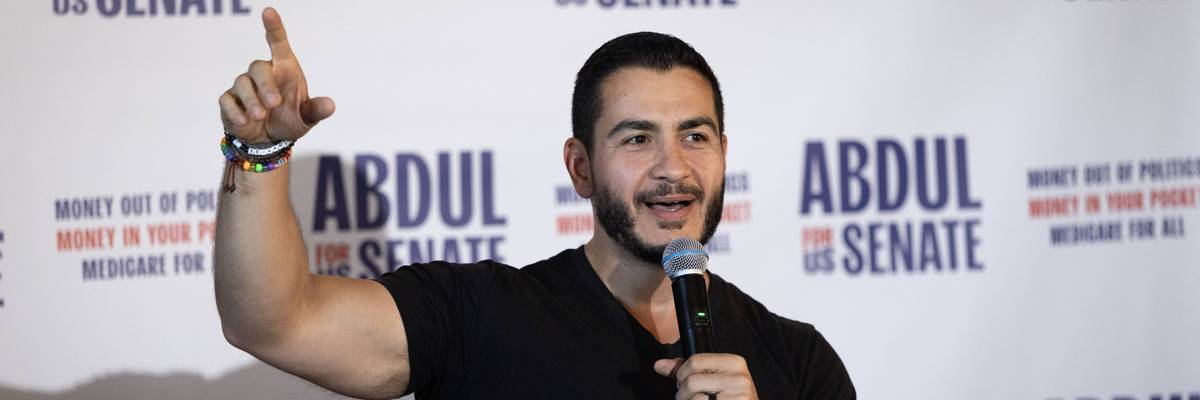
Democratic candidate for US Senate in Michigan Abdul El-Sayed speaks during a rally at The Congregation on August 3, 2026 in Detroit, Michigan.
If Democrats want to deliver on their promise to make life more affordable, then they must use their new congressional majorities to finally pass universal single-payer healthcare.
America’s affordability crisis played a major role in this year’s midterm elections—and few things in American life have become more unaffordable than healthcare.
It’s about to get worse as premiums rise and Medicaid cuts from the GOP’s so-called “Big Beautiful Bill” take effect. So if Democrats want to deliver on their promise to make life more affordable, then they must use their new congressional majorities to pass Medicare for All.
The United States spends more on healthcare yet has worse health outcomes than comparable high-income countries.
We need a healthcare system that guarantees this human right for all, not one that guarantees more profits for Big Insurance and Wall Street investors.
In surveys, healthcare costs remain the top financial burden for adults and families, even when they’re insured. Around 85 million people in the US are either uninsured or underinsured, according to Rep. Pramila Jayapal’s (D-Wash.) office. Six in 10 uninsured adults polled said they’ve recently skipped or postponed care because of the staggering costs.
It’s no wonder that a record two-thirds of all US adults now support a national health plan like Medicare for All.
According to a recent Yale study, single-payer universal health coverage would save more than 100,000 lives a year and cost $1 trillion less than our current profit-driven system. The study’s authors reached these findings by modeling what would happen if the US adopted a single-payer system like the one proposed in the “Medicare for All Act.”
Introduced in 2025 by Jayapal, Rep. Debbie Dingell (D-Mich.), and Sen. Bernie Sanders (I-Vt.), the Medicare for All Act would expand Medicare to provide comprehensive health benefits to every US resident. It would include primary care, mental health, dental, vision, hearing, reproductive care, prescription drugs, and more.
Patients would choose their doctors without crushing co-pays, deductibles, and other coverage restrictions. Physicians would be able to focus more on healing their patients instead of “battling insurers over denials and delays,” as Dr. Diljeet K. Singh, president of Physicians for a National Health Program, summed it up in her endorsement of the legislation.
Much of the spending in our current health system is “consumed by administrative middlemen, soaring drug prices, and emergency care for conditions that should have been treated earlier and for less,” said Dr. Alison Galvani, the Yale study’s senior author.
Galvani and her co-authors found that the Medicare for All Act would reduce health spending by lowering pharmaceutical prices, cutting administrative overhead, cracking down on fraudulent billing, preventing avoidable emergency care, and applying savings from Medicare payment rates to all providers. “Our results indicate that the existing [federal] budget is more than sufficient to cover everyone at lower total cost,” they conclude.
Most importantly, a universal healthcare system would save lives. The Yale researchers calculate that it would prevent around 114,000 people from dying each year due to lack of healthcare. Their findings are no outlier—other studies have also found that a single-payer system would improve existing coverage while saving money.
Elected Democrats remain divided on Medicare for All, but universal healthcare is wildly popular among their voters. Several incoming lawmakers campaigned on this issue and won, like Senator-elect Dr. Abdul El-Sayed (D-Mich.).
Although the Affordable Care Act expanded access to care, it has done so by benefiting the very for-profit insurance companies that contribute to the affordability problem. Far too many people still end up drowning in medical debt.
Universal healthcare is both sound public policy and a human right. The “right to the enjoyment of the highest attainable standard of physical and mental health” has long been recognized as a fundamental human right under international law that all governments are obligated to respect, protect, and fulfill. Nevertheless, the US remains the only high-income nation in the world without universal health coverage.
We need a healthcare system that guarantees this human right for all, not one that guarantees more profits for Big Insurance and Wall Street investors. The next Congress must meet the moment by making Medicare for All a reality instead of an empty campaign slogan.
This country and this world are at a monumental crossroads. US voters have an opportunity to beat back the forces of fascism and confront the billionaires who are rigging the economy, our media system, and our democracy, making it increasingly impossible for ordinary people to get by. We’re not just talking about the election. We’re talking about what must be done once these fascist elements are vanquished from power. We need a bolder set of solutions than what either major party has so far been willing to offer and a working-class movement ready to fight like hell for it. Trump didn't emerge from nowhere. The conditions that fueled MAGA authoritarianism were created by decades of radical neoliberal economic policies and a corrupt political system dominated by corporate interests. They slashed taxes on the super-rich, promising that the benefits would trickle down. They said giveaways to the corporate titans would make life more affordable for the rest of us. It was all bullshit. And when a bitter, betrayed populace searches for someone to blame, right-wing demagogues have little trouble finding scapegoats. People know when they're being lied to, but you won't hear any of this from the corporate media. Only independent journalism—powered and funded by people who believe in building a better world—can deliver truly trustworthy daily news. If you share our vision, please contribute whatever you can to sustain our work. |
America’s affordability crisis played a major role in this year’s midterm elections—and few things in American life have become more unaffordable than healthcare.
It’s about to get worse as premiums rise and Medicaid cuts from the GOP’s so-called “Big Beautiful Bill” take effect. So if Democrats want to deliver on their promise to make life more affordable, then they must use their new congressional majorities to pass Medicare for All.
The United States spends more on healthcare yet has worse health outcomes than comparable high-income countries.
We need a healthcare system that guarantees this human right for all, not one that guarantees more profits for Big Insurance and Wall Street investors.
In surveys, healthcare costs remain the top financial burden for adults and families, even when they’re insured. Around 85 million people in the US are either uninsured or underinsured, according to Rep. Pramila Jayapal’s (D-Wash.) office. Six in 10 uninsured adults polled said they’ve recently skipped or postponed care because of the staggering costs.
It’s no wonder that a record two-thirds of all US adults now support a national health plan like Medicare for All.
According to a recent Yale study, single-payer universal health coverage would save more than 100,000 lives a year and cost $1 trillion less than our current profit-driven system. The study’s authors reached these findings by modeling what would happen if the US adopted a single-payer system like the one proposed in the “Medicare for All Act.”
Introduced in 2025 by Jayapal, Rep. Debbie Dingell (D-Mich.), and Sen. Bernie Sanders (I-Vt.), the Medicare for All Act would expand Medicare to provide comprehensive health benefits to every US resident. It would include primary care, mental health, dental, vision, hearing, reproductive care, prescription drugs, and more.
Patients would choose their doctors without crushing co-pays, deductibles, and other coverage restrictions. Physicians would be able to focus more on healing their patients instead of “battling insurers over denials and delays,” as Dr. Diljeet K. Singh, president of Physicians for a National Health Program, summed it up in her endorsement of the legislation.
Much of the spending in our current health system is “consumed by administrative middlemen, soaring drug prices, and emergency care for conditions that should have been treated earlier and for less,” said Dr. Alison Galvani, the Yale study’s senior author.
Galvani and her co-authors found that the Medicare for All Act would reduce health spending by lowering pharmaceutical prices, cutting administrative overhead, cracking down on fraudulent billing, preventing avoidable emergency care, and applying savings from Medicare payment rates to all providers. “Our results indicate that the existing [federal] budget is more than sufficient to cover everyone at lower total cost,” they conclude.
Most importantly, a universal healthcare system would save lives. The Yale researchers calculate that it would prevent around 114,000 people from dying each year due to lack of healthcare. Their findings are no outlier—other studies have also found that a single-payer system would improve existing coverage while saving money.
Elected Democrats remain divided on Medicare for All, but universal healthcare is wildly popular among their voters. Several incoming lawmakers campaigned on this issue and won, like Senator-elect Dr. Abdul El-Sayed (D-Mich.).
Although the Affordable Care Act expanded access to care, it has done so by benefiting the very for-profit insurance companies that contribute to the affordability problem. Far too many people still end up drowning in medical debt.
Universal healthcare is both sound public policy and a human right. The “right to the enjoyment of the highest attainable standard of physical and mental health” has long been recognized as a fundamental human right under international law that all governments are obligated to respect, protect, and fulfill. Nevertheless, the US remains the only high-income nation in the world without universal health coverage.
We need a healthcare system that guarantees this human right for all, not one that guarantees more profits for Big Insurance and Wall Street investors. The next Congress must meet the moment by making Medicare for All a reality instead of an empty campaign slogan.