SUBSCRIBE TO OUR FREE NEWSLETTER
Daily news & progressive opinion—funded by the people, not the corporations—delivered straight to your inbox.
5
#000000
#FFFFFF
To donate by check, phone, or other method, see our More Ways to Give page.
Daily news & progressive opinion—funded by the people, not the corporations—delivered straight to your inbox.
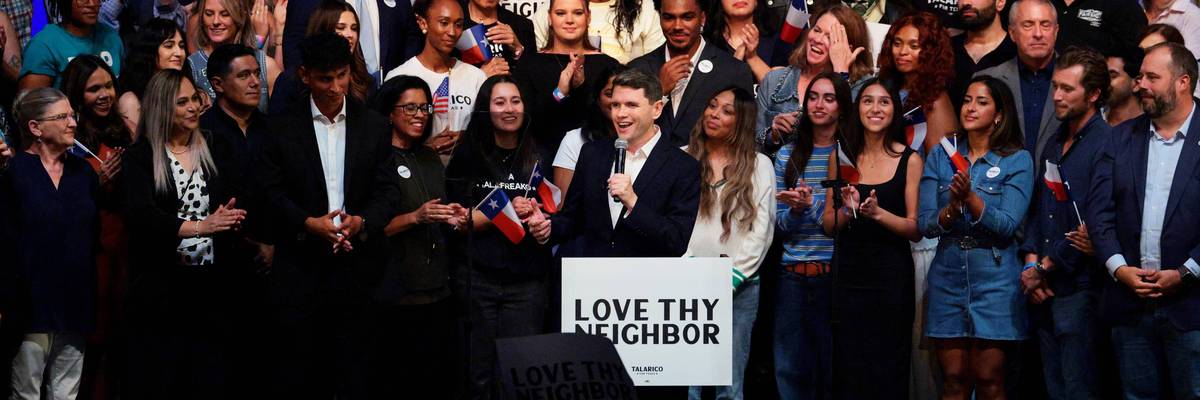
US Sen.-elect James Talarico (D-Texas) speaks during a midterm election night event on November 3, 2026 in Austin, Texas.
This November, voters delivered an electoral earthquake.
A Blue Tsunami of Democratic victories in states the party scarcely dreamed of taking—from Kansas and Alaska to Texas and Mississippi.
But the more seismic political earthquake was not the size of the Democratic wave, but the new breed of Democrats riding it.
Across battleground districts and deep-red states alike, a defiant new mode of Democratic populism performed shockingly well—one with the potential to shatter old factional divisions and forge a new organizing principle for the center of the party.
To understand just how dramatically the center has shifted, look to how Democrats won Texas.
Self-declared populist Gina Hinojosa named economic power as the defining struggle of our era. James Talarico railed against billionaires buying elections, lobbyists rigging the rules, and Big Tech destroying American society. And rancher Clayton Tucker attacked agricultural consolidation and sold “Bust Monopolies” stickers.
Nationwide, the party’s election machinery trained its fire not only on Republicans, but on Big Tech data centers, price gouging monopolies, Wall Street home takeovers, AI surveillance pricing, and corporate consolidation in medicine, agriculture, groceries and beyond.
The victors—hardly all disciples of the progressive left—were united by a willingness to wage class war against concentrated economic power, echoing Texas progressive populist Jim Hightower: “Politics isn’t about left versus right, it’s about top versus bottom.”
Seemingly overnight, this has become the party’s new center of gravity.
That’s welcome news for the party’s left flank: For a generation of progressives for whom ‘Centrist Democrat’ and ‘Moderate Democrat’ have been shorthand for ‘Corporate Democrat,’ suddenly the midpoint of the party is looking very different.
But for the leaders of the party’s corporate-funded think tanks and diminishing neoliberal wing, this has presented an altogether more awkward problem: How to grapple with a party unifying against the very corporate interests they’ve spent years urging Democrats to accommodate?
Their answer has been simple enough: Declare the winners to be moderates, claim the victory as their own, and post, post, post their way through it.
Since the election, Matt Yglesias, Jonathan Chait and Third Way’s Jonathan Cowan have been trying to squeeze the populist surge into their well-worn “moderates win” narrative—claiming victory and vindication via a brand of politics that bears little resemblance to their own.
Jonathan Cowan, founder of the corporate-funded group Third Way, took a victory lap in The Wall Street Journal. It was inarguable, he said, that “moderates made both the Senate and House majority.” In The Atlantic, Chait recast the sweeping populist victory as a crushing defeat for the progressive left, framing their exuberance at the results as “election denial.” And through it all, Matt Yglesias has been relentlessly arguing that progressives Abdul El-Sayed and Troy Jackson statistically underperformed in victory.
The gall is considerable. Not just because this trio spent the whole cycle warning that economic populism was a road to ruin, but because this new crop of populists is clearly a world away from Third Way stalwarts like Joe Manchin, Kyrsten Sinema, Josh Gottheimer and Jared Moskowitz.
If it were merely a fight over folks taking a victory lap, it would be graceful to stay out of it. But the stakes run a little higher.
The fight to define the Democratic victory is ultimately a fight over what to do with it. To shape the party’s legislative, investigative, and political agenda in the years ahead—and how the media and punditocracy should cover it.
It also risks pulling both progressives and moderates back into old factional trenches just as this thumping victory opens the door to something far bigger: a more electable and durable governing coalition, a mandate for sweeping changes that both wings have long yearned for, and a unifying vision for a party that has been ideologically splintered and adrift for far too long.
As we watch this battle unfold, there are four points worth keeping in mind.
1) These Midterms Were Unifying, Actually
For veterans of factional battles past, now might seem like a good time to pause and welcome the arrival of a mode of politics that’s proven capable of unifying the progressive left and red-state Dems.
A number of centrist and progressive commentators have done just that—as have an even greater number of elected officials.
Senator Elizabeth Warren jumped in early to define the midterm results, writing in Time that the debate over whether moderates or progressives won is “the wrong question” entirely.
“Democrats won by recognizing Americans’ economic pain, denouncing Washington corruption that has made a rigged economy worse by favoring giant corporations over working people, and by pledging to upend this system,” Warren wrote.
In Denver last weekend, at a gathering hosted by the centrist Majority Democrats group, ‘moderate’ elected officials were falling over themselves to declare the party rifts over. “If you have elected officials who are spending all their time fighting progressive versus moderate, then they have missed the plot of the election,” Senator Elissa Slotkin told the crowd.
And similarly—while a battle rages between Chuck Schumer and Chris Van Hollen for Senate Majority Leader—Van Hollen has been keen to downplay the factional element.
It’s not about “progressives or moderates,” he told Fox News Sunday: “Those are old Washington labels. It’s much more about taking on a rigged economy, rigged in favor of the very wealthy and fueled by political corruption.”
Almost everyone in the party now has a reason to embrace this new mode of politics.
For progressives, it offers an alternate axis of regional, cultural and issue moderation that is less likely to gut ambitious economic legislation, frustrate major progressive reforms, or kill measures like the public option (cf. Lieberman, Manchin, and Sinema).
For moderates, it offers an election-winning bridge across the party—a way around culture-war minefields, unpopular slogans, and DSA skirmishes. And the rise of the “populist moderate” may finally allow centrists to distinguish “moderation” from deference to the wealthy and powerful.
Populism offers both wings an opening to unite around something more consequential than merely opposing a lame-duck Trump: Challenging the corporate interests and lobbyists that have spent years narrowing the limits of Democratic (and ‘democratic’) ambition.
And as we enter a post-Trump political era, it offers a clear path to redefine a Democratic Party that too many voters have come to see as elitist, out of touch, unable to deliver change, and just as beholden to wealthy donors and corporate interests as their Republican opponents.
2) These Are Not Your Grandmother’s Moderates
Branding populist midterm winners “moderates” obscures more than it illuminates.
These are candidates who railed against billionaire influence and Wall Street lobbyists, proudly refused corporate PAC money, championed ambitious new spending programs, pledged to get Big Money out of politics, publicly criticized AIPAC, savaged Big Tech oligarchs, ran against data centers, and strongly opposed US engagement in Middle East wars.
As many progressives responded: If anti-billionaire, anti-war, anti-AIPAC, big-spending Democrats are the new “moderates,” then defeat smells suspiciously like victory.
The far more accurate term would seem to be “populist”—a term which Texas governor-elect Gina Hinojosa told the New York Times “meets the moment” of our era: “The one fight in this country is about economic power, and populism is about economic power.”
New York Times opinion contributor Rotimi Adeoye described this form of populism as “a new liberal fusionism.” Candidates bundling leftist economic populism with centrist electoral pragmatism.
I might take that further: While President Barack Obama fused calls for post-partisan unity with progressive ambitions—hope and change—these new populists are fusing pragmatic coalition-building with explicit class confrontation—stop punching left and right, punch up.
It’s a distinction that runs beyond policy preferences and to a different mode of politics altogether.
Traditional moderates might promise competent management, incremental reform and political compromise. Populists are campaigning on the premise that the entire economic and political system is rigged and are demanding fundamental change.
They took public anger and channeled it toward billionaires, powerful corporations and the politicians who protect them, rather than simply railing against DC gridlock and government dysfunction.
And rather than seeking legitimacy through elite approval, reverence for institutions or bipartisan conventional wisdom, they’re earning credibility by breaking norms, confronting powerful interests and pledging to deliver results by any means necessary.
That doesn’t mean rejecting compromise or bipartisanship, it means treating them as a means to an end, not virtues in themselves.
What won this year was a mode of politics drawn from Warren’s critique of corporate power, Obama’s post-partisan optimism, Mamdani’s politics of joyful defiance and delivery, and Bernie’s anti-billionaire fury. In some cases it’s tempered by cultural moderation and left/party distancing, but it’s united, above all, by the class politics of populism: The battle isn’t left versus right, but the top versus the rest of us.
To give moderates their flowers, there is a version of moderation that may have won out earlier this month.
As Ezra Klein argued this cycle, Democrats need space to ‘moderate’ on cultural and regional issues—from religion to choice to immigration to guns—especially when running in red districts. Sure enough, we saw the election of ostensibly pro-life or pro-Second Amendment or culturally conservative Democrats in states like Mississippi, Iowa and Alaska.
The degree to which that moderation mattered is still hotly debated.
Others used different means to differentiate themselves from a Democratic brand tarred variously as elitist, culture-war obsessed, or too meek to take up big fights.
Jamie Ager embraced the brand “Mountain Democrat.” Paige Cognetti ran as a “democrat with a backbone” “like they used to make ‘em.” Marie Gluesenkamp Perez picked fights with the party repeatedly. Many worked hard to develop independent campaign branding.
Will the party’s sweep of populists come to occupy the “moderate” or “centrist” lanes? Probably. Neither label is going anywhere soon. But both terms imply midpoint posturing, whereas these candidates are trying to redraw the battle lines entirely.
This new “political center” is not seeking to carve a middle ground between the demands of the left and the concessions corporate interests are willing to tolerate. Whatever you choose to call them, these are not your grandmother’s moderates.
3) The Absolute Chutzpah
Perhaps another reason why the debate online has been particularly fiery is that folks like Cowan, Yglesias, and Chait really have no business taking a victory lap right now. They spent much of this cycle arguing explicitly against the politics of economic populism.
If anyone outside the campaigns themselves deserves a day in the sun, it’s the people who actually built the winning playbook.
More ‘progressive’ groups like Groundwork Collaborative, More Perfect Union, Data for Progress, Working Class Narrative, Working Families Party (and my own Open Markets Institute) did the hard work of figuring out how Democrats could reclaim the economy as a winning issue.
“Our democracy cannot survive an economy of powerlessness,” Senator Chris Murphy told an Open Markets conference in DC this June.
These groups were speaking with swing voters, investigating corporate corruption, identifying sleeper issues like data centers, lifting up corporate exploitation and rigorously testing economic messages and lines of attack with battleground voters.
They refined tweaks to Sanders-style populism to work better for independent-coded candidates in red states and battleground districts and supplied reams of data, polling, and message testing to campaigns. Even the DCCC and House Majority PAC ended the cycle by embracing their populist attacks in the toughest races.
What were the others busy doing?
Cowan kicked off the cycle with a Bulwark piece titled Democrats, Don’t Fall for the Allure of Left-Wing Populism, warning against precisely the kind of class-centered politics that won out.
“As a political matter, you have to squint pretty hard to see 2024 as a mandate to bring low the titans of industry,” he wrote, before reiterating Senator John Fetterman’s comparison of Elon Musk to Tony Stark. Third Way has been urging the party to focus on an “opportunity economy” of “growth and prosperity” rather than a confrontation with corporate power.
“The theory that populist economic policies can win back the working class for Democrats has been tried, and it has failed,” wrote Jonathan Chait last year, part of a series of articles urging a return to neoliberalism, championing ‘Abundance’ and warning against economic populism.
For his part, Matt Yglesias was writing pieces titled Let’s all practice billionaire positivity, describing economic populism as a “fad,” while also pressing for a deregulatory abundance agenda to dethrone it.
But on election night, victorious Democrats were bashing billionaires and corporate influence at a rate that would make Elizabeth Warren’s comms team blush.
Now, having lost the debate over how Democrats should campaign, these folks are trying to claim the mantle for how Democrats should govern—and taking their advice would be a dangerous mistake…
4) The Democratic Agenda Matters
This isn’t just an online debate, it’s one with real-world consequences.
Advocacy from corporate-funded centrist groups aims to shape party incentives, inform media coverage and, ultimately, blunt the shift toward populism.
Chamber of Progress—a self-described tech industry coalition—is already urging the party to lay off Big Tech: “Let’s not confuse an anti-Trump wave with an anti-tech mandate,” said CEO Adam Kovacevich.
It’s a bold claim after dozens of candidates explicitly campaigned on regulating AI, restricting data centers, banning surveillance pricing, and getting tech billionaires and corporate lobbyists out of politics. Axios reported that ballot measures to restrict data centers won 43–1 across 10 states, with an average margin of 75%.
“Data centers became—naturally and by design—a proxy for concerns about affordability, corporate power, and communities losing control to special interests,” admitted none other than OpenAI’s Chief Global Affairs Officer Chris Lehane in his post-election analysis.
It’s no surprise that advocacy groups and lobbyists are going in to bat for their stakeholders—just as it’s no surprise that industry groups are rebranding deregulatory agendas as affordability agendas. That’s politics.
It’s also no surprise that Third Way and the misleadingly named Progressive Policy Institute—a group whose funders have included Big Pharma and Big Tech—have both urged Democrats to train investigations on Trump rather than going hard on corporate power (this is the same PPI that advised Dems to retire “rigged system populism” mind you).
Unsurprisingly, their advice cuts against what voters have been telling pollsters.
“Perhaps the most important oversight to be done is to go after companies that are engaging in corrupt practices or practices that are unfairly raising people’s prices,” Melissa Toufanian, Managing Director at Navigator Research, told me just before the election.
In a memo shared on Capitol Hill by Groundwork Action—a top proponent of economic populism—the group shares polling which “indicates that an oversight agenda should prioritize investigating examples of corporate abuse and corruption that directly raise costs on Americans as opposed to other scandals or rule-of-law violations involving the Trump administration.”
In other words: Put corporate abuses and pay-for-play scandals under the spotlight, rather than programming a partisan defenestration for audiences on MS NOW.
“Two in three voters (66%) think that investigations of corporate greed should be a high priority for Congress—more than any other area of potential oversight we tested,” the memo says.
Extending investigations into corporate greed would show swing voters that Democratic investigations are responsive to voter concerns, serious about confronting corporate power, not consumed by partisan retribution, and capable of delivering real outcomes: Like criminal referrals and new legislation.
That broader focus should be carried through in legislation too.
“The problem is not just high prices but also the structure of the economy,” former Biden Antitrust official Tim Wu wrote recently in the New York Times. “Credibility has to come from a platform of policies that shift economic power away from the big guys in ways that voters can readily understand.”
That might be bills that raise the minimum wage or ban price gouging, congressional stock trading, Wall Street home ownership, and AI surveillance. Wedge the Republican Party with big, simple, populist economic policies. Dare Trump to use his veto pen and raise its salience.
If this new crop of populists follows the ‘Mamdani Model’ of governing pragmatism, they’ll borrow ideas from business, progressives, Republicans and centrists alike—whatever helps deliver their agenda—without pandering to those interests or pursuing deregulation for its own sake.
The danger: If Democrats let lobbyists, elites or ideological purists dilute the focus on economic populism—or swing back to milquetoast moderation—they will turn a sweeping mandate into another reason for disillusioned voters not to trust them.
Closing Thoughts
As the noise of this brawl shows, there is real anxiety on the left as well as the center.
Semafor’s Dave Weigel summed it up well: “The left’s take here is that the winning messages came from them. Economic populism with no hemming and hawing a-la 2024. Its worry is that Schumer/Jeffries could run things like Keir Starmer, taking the mandate and futzing around, giving the populist right another opening.”
Having lived through those years in Britain, I suspect the Democrats are less likely to repeat Labour’s mistakes.
For one thing, there’s no American Prime Minister with the power to impose a retreat from above—and the Democrats did not gut their own economic agenda prior to the election. Winning candidates know what they ran on. Most of those jockeying for attention in the presidential primaries will not do so by running to the right.
For another thing, key committee assignments are likely to be held by some of the party’s best anti-corruption attack dogs—from Sen. Elizabeth Warren to Reps. Jamie Raskin to Ro Khanna.
None of this guarantees that Democrats will govern as boldly as they campaigned. Their roaring return to Congress has been accompanied by a boom for Democratic lobbyists on K Street, Politico reports. But it has also prompted a flurry of legal notes to corporations, urging them to brace for a wave of Democratic subpoenas.
Ultimately, the fight raging online risks crowding out a happier story: This populist shift might do more to unite the party’s ideological factions than divide them.
(To pause for a victory lap of my own, this is something I foreshadowed last year, with victories from Mikie Sherrill and Zohran Mamdani, united by fierce anti-monopoly platforms).
The intra-party fight is not specifically what Senator-elect James Talarico was referring to in his victory speech, but his words seem apt for it: “They want us focused on how we’re different instead of on how we’re the same [...] They want us looking left and right at each other instead of looking up at them.”
The old left-versus-center argument will likely rage on for another two years. Pundits will continue tallying wins-above-replacement as though that’s the most important metric.
The more consequential question is whether Democrats can turn this populist breakthrough into the generational and geographic realignment that these midterms have put within reach—or squander the opportunity by falling back along traditional factional lines.
“That old politics is dying and a new politics is being born,” Talarico said in his victory speech. “Now, the real work begins.”
This essay was first published in Liberty & Power on Substack and appears at Common Dreams with permission.
This country and this world are at a monumental crossroads. US voters have an opportunity to beat back the forces of fascism and confront the billionaires who are rigging the economy, our media system, and our democracy, making it increasingly impossible for ordinary people to get by. We’re not just talking about the election. We’re talking about what must be done once these fascist elements are vanquished from power. We need a bolder set of solutions than what either major party has so far been willing to offer and a working-class movement ready to fight like hell for it. Trump didn't emerge from nowhere. The conditions that fueled MAGA authoritarianism were created by decades of radical neoliberal economic policies and a corrupt political system dominated by corporate interests. They slashed taxes on the super-rich, promising that the benefits would trickle down. They said giveaways to the corporate titans would make life more affordable for the rest of us. It was all bullshit. And when a bitter, betrayed populace searches for someone to blame, right-wing demagogues have little trouble finding scapegoats. People know when they're being lied to, but you won't hear any of this from the corporate media. Only independent journalism—powered and funded by people who believe in building a better world—can deliver truly trustworthy daily news. If you share our vision, please contribute whatever you can to sustain our work. |
This November, voters delivered an electoral earthquake.
A Blue Tsunami of Democratic victories in states the party scarcely dreamed of taking—from Kansas and Alaska to Texas and Mississippi.
But the more seismic political earthquake was not the size of the Democratic wave, but the new breed of Democrats riding it.
Across battleground districts and deep-red states alike, a defiant new mode of Democratic populism performed shockingly well—one with the potential to shatter old factional divisions and forge a new organizing principle for the center of the party.
To understand just how dramatically the center has shifted, look to how Democrats won Texas.
Self-declared populist Gina Hinojosa named economic power as the defining struggle of our era. James Talarico railed against billionaires buying elections, lobbyists rigging the rules, and Big Tech destroying American society. And rancher Clayton Tucker attacked agricultural consolidation and sold “Bust Monopolies” stickers.
Nationwide, the party’s election machinery trained its fire not only on Republicans, but on Big Tech data centers, price gouging monopolies, Wall Street home takeovers, AI surveillance pricing, and corporate consolidation in medicine, agriculture, groceries and beyond.
The victors—hardly all disciples of the progressive left—were united by a willingness to wage class war against concentrated economic power, echoing Texas progressive populist Jim Hightower: “Politics isn’t about left versus right, it’s about top versus bottom.”
Seemingly overnight, this has become the party’s new center of gravity.
That’s welcome news for the party’s left flank: For a generation of progressives for whom ‘Centrist Democrat’ and ‘Moderate Democrat’ have been shorthand for ‘Corporate Democrat,’ suddenly the midpoint of the party is looking very different.
But for the leaders of the party’s corporate-funded think tanks and diminishing neoliberal wing, this has presented an altogether more awkward problem: How to grapple with a party unifying against the very corporate interests they’ve spent years urging Democrats to accommodate?
Their answer has been simple enough: Declare the winners to be moderates, claim the victory as their own, and post, post, post their way through it.
Since the election, Matt Yglesias, Jonathan Chait and Third Way’s Jonathan Cowan have been trying to squeeze the populist surge into their well-worn “moderates win” narrative—claiming victory and vindication via a brand of politics that bears little resemblance to their own.
Jonathan Cowan, founder of the corporate-funded group Third Way, took a victory lap in The Wall Street Journal. It was inarguable, he said, that “moderates made both the Senate and House majority.” In The Atlantic, Chait recast the sweeping populist victory as a crushing defeat for the progressive left, framing their exuberance at the results as “election denial.” And through it all, Matt Yglesias has been relentlessly arguing that progressives Abdul El-Sayed and Troy Jackson statistically underperformed in victory.
The gall is considerable. Not just because this trio spent the whole cycle warning that economic populism was a road to ruin, but because this new crop of populists is clearly a world away from Third Way stalwarts like Joe Manchin, Kyrsten Sinema, Josh Gottheimer and Jared Moskowitz.
If it were merely a fight over folks taking a victory lap, it would be graceful to stay out of it. But the stakes run a little higher.
The fight to define the Democratic victory is ultimately a fight over what to do with it. To shape the party’s legislative, investigative, and political agenda in the years ahead—and how the media and punditocracy should cover it.
It also risks pulling both progressives and moderates back into old factional trenches just as this thumping victory opens the door to something far bigger: a more electable and durable governing coalition, a mandate for sweeping changes that both wings have long yearned for, and a unifying vision for a party that has been ideologically splintered and adrift for far too long.
As we watch this battle unfold, there are four points worth keeping in mind.
1) These Midterms Were Unifying, Actually
For veterans of factional battles past, now might seem like a good time to pause and welcome the arrival of a mode of politics that’s proven capable of unifying the progressive left and red-state Dems.
A number of centrist and progressive commentators have done just that—as have an even greater number of elected officials.
Senator Elizabeth Warren jumped in early to define the midterm results, writing in Time that the debate over whether moderates or progressives won is “the wrong question” entirely.
“Democrats won by recognizing Americans’ economic pain, denouncing Washington corruption that has made a rigged economy worse by favoring giant corporations over working people, and by pledging to upend this system,” Warren wrote.
In Denver last weekend, at a gathering hosted by the centrist Majority Democrats group, ‘moderate’ elected officials were falling over themselves to declare the party rifts over. “If you have elected officials who are spending all their time fighting progressive versus moderate, then they have missed the plot of the election,” Senator Elissa Slotkin told the crowd.
And similarly—while a battle rages between Chuck Schumer and Chris Van Hollen for Senate Majority Leader—Van Hollen has been keen to downplay the factional element.
It’s not about “progressives or moderates,” he told Fox News Sunday: “Those are old Washington labels. It’s much more about taking on a rigged economy, rigged in favor of the very wealthy and fueled by political corruption.”
Almost everyone in the party now has a reason to embrace this new mode of politics.
For progressives, it offers an alternate axis of regional, cultural and issue moderation that is less likely to gut ambitious economic legislation, frustrate major progressive reforms, or kill measures like the public option (cf. Lieberman, Manchin, and Sinema).
For moderates, it offers an election-winning bridge across the party—a way around culture-war minefields, unpopular slogans, and DSA skirmishes. And the rise of the “populist moderate” may finally allow centrists to distinguish “moderation” from deference to the wealthy and powerful.
Populism offers both wings an opening to unite around something more consequential than merely opposing a lame-duck Trump: Challenging the corporate interests and lobbyists that have spent years narrowing the limits of Democratic (and ‘democratic’) ambition.
And as we enter a post-Trump political era, it offers a clear path to redefine a Democratic Party that too many voters have come to see as elitist, out of touch, unable to deliver change, and just as beholden to wealthy donors and corporate interests as their Republican opponents.
2) These Are Not Your Grandmother’s Moderates
Branding populist midterm winners “moderates” obscures more than it illuminates.
These are candidates who railed against billionaire influence and Wall Street lobbyists, proudly refused corporate PAC money, championed ambitious new spending programs, pledged to get Big Money out of politics, publicly criticized AIPAC, savaged Big Tech oligarchs, ran against data centers, and strongly opposed US engagement in Middle East wars.
As many progressives responded: If anti-billionaire, anti-war, anti-AIPAC, big-spending Democrats are the new “moderates,” then defeat smells suspiciously like victory.
The far more accurate term would seem to be “populist”—a term which Texas governor-elect Gina Hinojosa told the New York Times “meets the moment” of our era: “The one fight in this country is about economic power, and populism is about economic power.”
New York Times opinion contributor Rotimi Adeoye described this form of populism as “a new liberal fusionism.” Candidates bundling leftist economic populism with centrist electoral pragmatism.
I might take that further: While President Barack Obama fused calls for post-partisan unity with progressive ambitions—hope and change—these new populists are fusing pragmatic coalition-building with explicit class confrontation—stop punching left and right, punch up.
It’s a distinction that runs beyond policy preferences and to a different mode of politics altogether.
Traditional moderates might promise competent management, incremental reform and political compromise. Populists are campaigning on the premise that the entire economic and political system is rigged and are demanding fundamental change.
They took public anger and channeled it toward billionaires, powerful corporations and the politicians who protect them, rather than simply railing against DC gridlock and government dysfunction.
And rather than seeking legitimacy through elite approval, reverence for institutions or bipartisan conventional wisdom, they’re earning credibility by breaking norms, confronting powerful interests and pledging to deliver results by any means necessary.
That doesn’t mean rejecting compromise or bipartisanship, it means treating them as a means to an end, not virtues in themselves.
What won this year was a mode of politics drawn from Warren’s critique of corporate power, Obama’s post-partisan optimism, Mamdani’s politics of joyful defiance and delivery, and Bernie’s anti-billionaire fury. In some cases it’s tempered by cultural moderation and left/party distancing, but it’s united, above all, by the class politics of populism: The battle isn’t left versus right, but the top versus the rest of us.
To give moderates their flowers, there is a version of moderation that may have won out earlier this month.
As Ezra Klein argued this cycle, Democrats need space to ‘moderate’ on cultural and regional issues—from religion to choice to immigration to guns—especially when running in red districts. Sure enough, we saw the election of ostensibly pro-life or pro-Second Amendment or culturally conservative Democrats in states like Mississippi, Iowa and Alaska.
The degree to which that moderation mattered is still hotly debated.
Others used different means to differentiate themselves from a Democratic brand tarred variously as elitist, culture-war obsessed, or too meek to take up big fights.
Jamie Ager embraced the brand “Mountain Democrat.” Paige Cognetti ran as a “democrat with a backbone” “like they used to make ‘em.” Marie Gluesenkamp Perez picked fights with the party repeatedly. Many worked hard to develop independent campaign branding.
Will the party’s sweep of populists come to occupy the “moderate” or “centrist” lanes? Probably. Neither label is going anywhere soon. But both terms imply midpoint posturing, whereas these candidates are trying to redraw the battle lines entirely.
This new “political center” is not seeking to carve a middle ground between the demands of the left and the concessions corporate interests are willing to tolerate. Whatever you choose to call them, these are not your grandmother’s moderates.
3) The Absolute Chutzpah
Perhaps another reason why the debate online has been particularly fiery is that folks like Cowan, Yglesias, and Chait really have no business taking a victory lap right now. They spent much of this cycle arguing explicitly against the politics of economic populism.
If anyone outside the campaigns themselves deserves a day in the sun, it’s the people who actually built the winning playbook.
More ‘progressive’ groups like Groundwork Collaborative, More Perfect Union, Data for Progress, Working Class Narrative, Working Families Party (and my own Open Markets Institute) did the hard work of figuring out how Democrats could reclaim the economy as a winning issue.
“Our democracy cannot survive an economy of powerlessness,” Senator Chris Murphy told an Open Markets conference in DC this June.
These groups were speaking with swing voters, investigating corporate corruption, identifying sleeper issues like data centers, lifting up corporate exploitation and rigorously testing economic messages and lines of attack with battleground voters.
They refined tweaks to Sanders-style populism to work better for independent-coded candidates in red states and battleground districts and supplied reams of data, polling, and message testing to campaigns. Even the DCCC and House Majority PAC ended the cycle by embracing their populist attacks in the toughest races.
What were the others busy doing?
Cowan kicked off the cycle with a Bulwark piece titled Democrats, Don’t Fall for the Allure of Left-Wing Populism, warning against precisely the kind of class-centered politics that won out.
“As a political matter, you have to squint pretty hard to see 2024 as a mandate to bring low the titans of industry,” he wrote, before reiterating Senator John Fetterman’s comparison of Elon Musk to Tony Stark. Third Way has been urging the party to focus on an “opportunity economy” of “growth and prosperity” rather than a confrontation with corporate power.
“The theory that populist economic policies can win back the working class for Democrats has been tried, and it has failed,” wrote Jonathan Chait last year, part of a series of articles urging a return to neoliberalism, championing ‘Abundance’ and warning against economic populism.
For his part, Matt Yglesias was writing pieces titled Let’s all practice billionaire positivity, describing economic populism as a “fad,” while also pressing for a deregulatory abundance agenda to dethrone it.
But on election night, victorious Democrats were bashing billionaires and corporate influence at a rate that would make Elizabeth Warren’s comms team blush.
Now, having lost the debate over how Democrats should campaign, these folks are trying to claim the mantle for how Democrats should govern—and taking their advice would be a dangerous mistake…
4) The Democratic Agenda Matters
This isn’t just an online debate, it’s one with real-world consequences.
Advocacy from corporate-funded centrist groups aims to shape party incentives, inform media coverage and, ultimately, blunt the shift toward populism.
Chamber of Progress—a self-described tech industry coalition—is already urging the party to lay off Big Tech: “Let’s not confuse an anti-Trump wave with an anti-tech mandate,” said CEO Adam Kovacevich.
It’s a bold claim after dozens of candidates explicitly campaigned on regulating AI, restricting data centers, banning surveillance pricing, and getting tech billionaires and corporate lobbyists out of politics. Axios reported that ballot measures to restrict data centers won 43–1 across 10 states, with an average margin of 75%.
“Data centers became—naturally and by design—a proxy for concerns about affordability, corporate power, and communities losing control to special interests,” admitted none other than OpenAI’s Chief Global Affairs Officer Chris Lehane in his post-election analysis.
It’s no surprise that advocacy groups and lobbyists are going in to bat for their stakeholders—just as it’s no surprise that industry groups are rebranding deregulatory agendas as affordability agendas. That’s politics.
It’s also no surprise that Third Way and the misleadingly named Progressive Policy Institute—a group whose funders have included Big Pharma and Big Tech—have both urged Democrats to train investigations on Trump rather than going hard on corporate power (this is the same PPI that advised Dems to retire “rigged system populism” mind you).
Unsurprisingly, their advice cuts against what voters have been telling pollsters.
“Perhaps the most important oversight to be done is to go after companies that are engaging in corrupt practices or practices that are unfairly raising people’s prices,” Melissa Toufanian, Managing Director at Navigator Research, told me just before the election.
In a memo shared on Capitol Hill by Groundwork Action—a top proponent of economic populism—the group shares polling which “indicates that an oversight agenda should prioritize investigating examples of corporate abuse and corruption that directly raise costs on Americans as opposed to other scandals or rule-of-law violations involving the Trump administration.”
In other words: Put corporate abuses and pay-for-play scandals under the spotlight, rather than programming a partisan defenestration for audiences on MS NOW.
“Two in three voters (66%) think that investigations of corporate greed should be a high priority for Congress—more than any other area of potential oversight we tested,” the memo says.
Extending investigations into corporate greed would show swing voters that Democratic investigations are responsive to voter concerns, serious about confronting corporate power, not consumed by partisan retribution, and capable of delivering real outcomes: Like criminal referrals and new legislation.
That broader focus should be carried through in legislation too.
“The problem is not just high prices but also the structure of the economy,” former Biden Antitrust official Tim Wu wrote recently in the New York Times. “Credibility has to come from a platform of policies that shift economic power away from the big guys in ways that voters can readily understand.”
That might be bills that raise the minimum wage or ban price gouging, congressional stock trading, Wall Street home ownership, and AI surveillance. Wedge the Republican Party with big, simple, populist economic policies. Dare Trump to use his veto pen and raise its salience.
If this new crop of populists follows the ‘Mamdani Model’ of governing pragmatism, they’ll borrow ideas from business, progressives, Republicans and centrists alike—whatever helps deliver their agenda—without pandering to those interests or pursuing deregulation for its own sake.
The danger: If Democrats let lobbyists, elites or ideological purists dilute the focus on economic populism—or swing back to milquetoast moderation—they will turn a sweeping mandate into another reason for disillusioned voters not to trust them.
Closing Thoughts
As the noise of this brawl shows, there is real anxiety on the left as well as the center.
Semafor’s Dave Weigel summed it up well: “The left’s take here is that the winning messages came from them. Economic populism with no hemming and hawing a-la 2024. Its worry is that Schumer/Jeffries could run things like Keir Starmer, taking the mandate and futzing around, giving the populist right another opening.”
Having lived through those years in Britain, I suspect the Democrats are less likely to repeat Labour’s mistakes.
For one thing, there’s no American Prime Minister with the power to impose a retreat from above—and the Democrats did not gut their own economic agenda prior to the election. Winning candidates know what they ran on. Most of those jockeying for attention in the presidential primaries will not do so by running to the right.
For another thing, key committee assignments are likely to be held by some of the party’s best anti-corruption attack dogs—from Sen. Elizabeth Warren to Reps. Jamie Raskin to Ro Khanna.
None of this guarantees that Democrats will govern as boldly as they campaigned. Their roaring return to Congress has been accompanied by a boom for Democratic lobbyists on K Street, Politico reports. But it has also prompted a flurry of legal notes to corporations, urging them to brace for a wave of Democratic subpoenas.
Ultimately, the fight raging online risks crowding out a happier story: This populist shift might do more to unite the party’s ideological factions than divide them.
(To pause for a victory lap of my own, this is something I foreshadowed last year, with victories from Mikie Sherrill and Zohran Mamdani, united by fierce anti-monopoly platforms).
The intra-party fight is not specifically what Senator-elect James Talarico was referring to in his victory speech, but his words seem apt for it: “They want us focused on how we’re different instead of on how we’re the same [...] They want us looking left and right at each other instead of looking up at them.”
The old left-versus-center argument will likely rage on for another two years. Pundits will continue tallying wins-above-replacement as though that’s the most important metric.
The more consequential question is whether Democrats can turn this populist breakthrough into the generational and geographic realignment that these midterms have put within reach—or squander the opportunity by falling back along traditional factional lines.
“That old politics is dying and a new politics is being born,” Talarico said in his victory speech. “Now, the real work begins.”
This essay was first published in Liberty & Power on Substack and appears at Common Dreams with permission.