SUBSCRIBE TO OUR FREE NEWSLETTER
Daily news & progressive opinion—funded by the people, not the corporations—delivered straight to your inbox.
5
#000000
#FFFFFF
To donate by check, phone, or other method, see our More Ways to Give page.
Daily news & progressive opinion—funded by the people, not the corporations—delivered straight to your inbox.
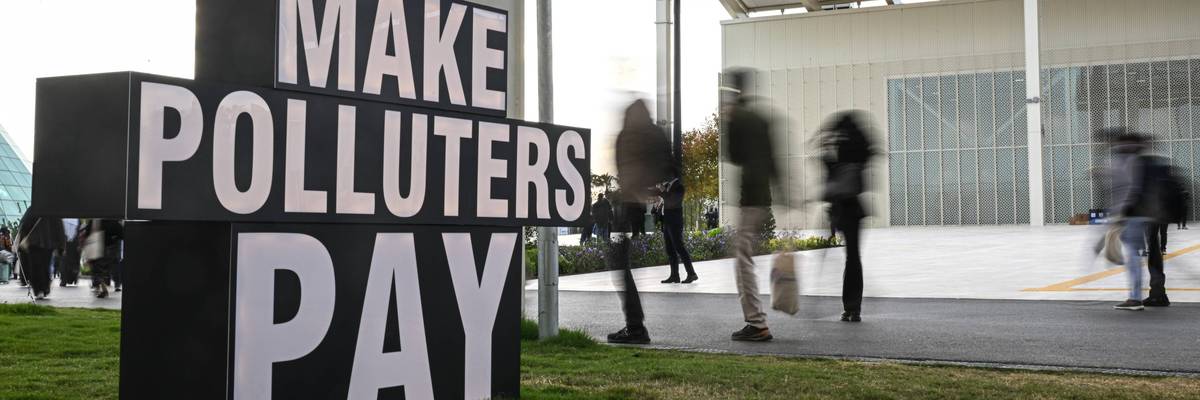
Various activities are held at the pavilions in the Blue Zone, as the 31st Conference of the Parties to the UN Framework Convention on Climate Change (COP31), hosted by Turkiye for the first time, continues at the Antalya COP31 Venue in Antalya, Turkiye, on November 19, 2026.
It's not too late, but we must act. We owe this fight to the people already living through the crisis, to the young people whose futures are being decided in these rooms, and to those who will inherit the consequences of what we do here.
I’m struggling to find the words for the sadness, heartbreak and disbelief I feel watching what is unfolding at COP31.
How is this possible?
Only recently, in Santa Marta, Colombia, governments, social movements, scientists, Indigenous peoples and frontline communities came together to confront the main driver of the climate emergency and ask how we move beyond fossil fuels.
For a moment, it felt as though the political courage might finally match the urgency of the science. And now, here we are. Panama is right to draw a line. If the final text contains no commitment to phase out fossil fuel production, no meaningful climate finance and no guarantee that electrification will be powered by renewables, Panama should formally object. I stand with Panama in taking that position, and I urge other governments to stand with them.
Nepal is being pushed to the point of walking out as powerful countries ignore the devastation its people have recently experienced. Fossil fuels have disappeared from the latest draft. Imagine Alcoholics Anonymous spending 30 years negotiating and producing a statement that never mentions alcohol. Now imagine the alcohol industry turning up as the largest delegation and helping shape the outcome.
We still have time to change the outcome. I’m asking the governments that came to Santa Marta, and every government that has promised to stand with frontline communities, to speak up now and insist that the COP31 outcome commits to a fast, fair and funded phase-out of fossil fuels.
Every year we delay phasing out coal, oil and gas locks in more harm for people already living through this crisis and leaves future generations with a more dangerous world. We are on course to exceed 1.5°C of long-term warming. Every fraction of a degree matters. How can governments claim to defend that goal while refusing to confront the continued production of the fuels pushing us beyond it?
The proposed commitment on adaptation finance has also disappeared. And we are still expected to call this progress. What are we to call a system in which those who have contributed least to the crisis suffer its worst consequences, while those with the greatest responsibility protect fossil fuel profits? Is this climate apartheid? What breaks my heart is that we know what is at stake. People are losing their homes, their livelihoods and their lives. Communities are struggling to hold on to places that have sustained their cultures for generations. Entire countries are fighting for their survival. And after Santa Marta, we are still negotiating away the very words we need to name the problem.
What does electrification achieve if we leave open the question of how it will be powered? How are countries supposed to deliver on their climate commitments without the finance to do so? How can we call it a just transition if we refuse to confront the continued production of the fuels driving the injustice? History will judge these talks by whose lives were protected, whose interests were defended and whose future was sacrificed.
We still have time to change the outcome. I’m asking the governments that came to Santa Marta, and every government that has promised to stand with frontline communities, to speak up now and insist that the COP31 outcome commits to a fast, fair and funded phase-out of fossil fuels.
And to our allies here at COP31, come in early, raise your voices and stand with the countries holding the line. We owe this fight to the people already living through the crisis, to the young people whose futures are being decided in these rooms, and to those who will inherit the consequences of what we do here.
There is still time to choose courage. Let’s use every hour we have.
This country and this world are at a monumental crossroads. US voters have an opportunity to beat back the forces of fascism and confront the billionaires who are rigging the economy, our media system, and our democracy, making it increasingly impossible for ordinary people to get by. We’re not just talking about the election. We’re talking about what must be done once these fascist elements are vanquished from power. We need a bolder set of solutions than what either major party has so far been willing to offer and a working-class movement ready to fight like hell for it. Trump didn't emerge from nowhere. The conditions that fueled MAGA authoritarianism were created by decades of radical neoliberal economic policies and a corrupt political system dominated by corporate interests. They slashed taxes on the super-rich, promising that the benefits would trickle down. They said giveaways to the corporate titans would make life more affordable for the rest of us. It was all bullshit. And when a bitter, betrayed populace searches for someone to blame, right-wing demagogues have little trouble finding scapegoats. People know when they're being lied to, but you won't hear any of this from the corporate media. Only independent journalism—powered and funded by people who believe in building a better world—can deliver truly trustworthy daily news. If you share our vision, please contribute whatever you can to sustain our work. |
I’m struggling to find the words for the sadness, heartbreak and disbelief I feel watching what is unfolding at COP31.
How is this possible?
Only recently, in Santa Marta, Colombia, governments, social movements, scientists, Indigenous peoples and frontline communities came together to confront the main driver of the climate emergency and ask how we move beyond fossil fuels.
For a moment, it felt as though the political courage might finally match the urgency of the science. And now, here we are. Panama is right to draw a line. If the final text contains no commitment to phase out fossil fuel production, no meaningful climate finance and no guarantee that electrification will be powered by renewables, Panama should formally object. I stand with Panama in taking that position, and I urge other governments to stand with them.
Nepal is being pushed to the point of walking out as powerful countries ignore the devastation its people have recently experienced. Fossil fuels have disappeared from the latest draft. Imagine Alcoholics Anonymous spending 30 years negotiating and producing a statement that never mentions alcohol. Now imagine the alcohol industry turning up as the largest delegation and helping shape the outcome.
We still have time to change the outcome. I’m asking the governments that came to Santa Marta, and every government that has promised to stand with frontline communities, to speak up now and insist that the COP31 outcome commits to a fast, fair and funded phase-out of fossil fuels.
Every year we delay phasing out coal, oil and gas locks in more harm for people already living through this crisis and leaves future generations with a more dangerous world. We are on course to exceed 1.5°C of long-term warming. Every fraction of a degree matters. How can governments claim to defend that goal while refusing to confront the continued production of the fuels pushing us beyond it?
The proposed commitment on adaptation finance has also disappeared. And we are still expected to call this progress. What are we to call a system in which those who have contributed least to the crisis suffer its worst consequences, while those with the greatest responsibility protect fossil fuel profits? Is this climate apartheid? What breaks my heart is that we know what is at stake. People are losing their homes, their livelihoods and their lives. Communities are struggling to hold on to places that have sustained their cultures for generations. Entire countries are fighting for their survival. And after Santa Marta, we are still negotiating away the very words we need to name the problem.
What does electrification achieve if we leave open the question of how it will be powered? How are countries supposed to deliver on their climate commitments without the finance to do so? How can we call it a just transition if we refuse to confront the continued production of the fuels driving the injustice? History will judge these talks by whose lives were protected, whose interests were defended and whose future was sacrificed.
We still have time to change the outcome. I’m asking the governments that came to Santa Marta, and every government that has promised to stand with frontline communities, to speak up now and insist that the COP31 outcome commits to a fast, fair and funded phase-out of fossil fuels.
And to our allies here at COP31, come in early, raise your voices and stand with the countries holding the line. We owe this fight to the people already living through the crisis, to the young people whose futures are being decided in these rooms, and to those who will inherit the consequences of what we do here.
There is still time to choose courage. Let’s use every hour we have.