SUBSCRIBE TO OUR FREE NEWSLETTER
Daily news & progressive opinion—funded by the people, not the corporations—delivered straight to your inbox.
5
#000000
#FFFFFF
To donate by check, phone, or other method, see our More Ways to Give page.
Daily news & progressive opinion—funded by the people, not the corporations—delivered straight to your inbox.
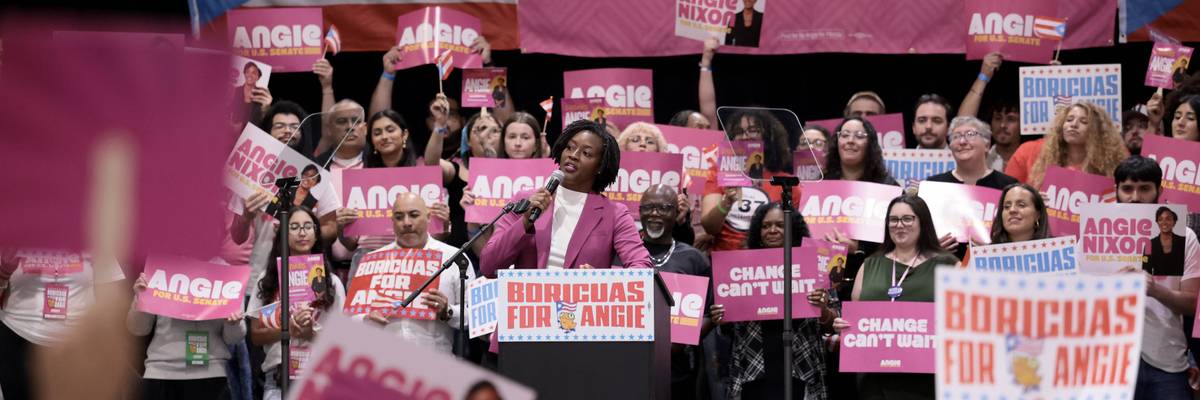
Florida Democratic Senate candidate, state Rep. Angie Nixon, speaks during a campaign event at the "Boricuas for Angie" rally in the Osceola Heritage Park Events Center on October 27, 2026 in Kissimmee, Florida.
Losing Florida’s Senate race is one of the biggest strategic fumbles this cycle, and we need to talk about it.
Three points. That is what stood between Angie Nixon and the United States Senate.
Florida has become a political blind spot for the Democratic Party. Losing Florida’s Senate race is one of the biggest strategic fumbles this cycle, and we need to talk about it.
The Senate Democrats’ lack of investment should be seen as an epic failure for a state that has one of the most diverse populations of working-class people who voted for real change in the state. This race is another reminder that we need new leadership. It reminds me so much of New York City's mayoral primary, where our now-mayor, a socialist, was written off by the Democratic establishment and ignored until voters sent a message that this was exactly what New Yorkers wanted: authentic change.
Angie Nixon and the organizers who powered her campaign demonstrated what was possible with limited resources. The national party should examine what more sustained investment might accomplish.
So how did we get here? Democrats have spent the better part of a decade writing Florida’s political obituary, with no vision for what Florida could be. After Hillary Clinton lost the state in 2016, national Democratic institutions began pulling back; donors looked elsewhere; and Florida became the state everyone talked about winning, but few were willing to invest in. Labor and community organizations had few resources but kept fighting.
Then came Angie Nixon, a generational candidate, a Black woman, a socialist with an affordability agenda. Her anti-corruption message resonated, and Floridians started to feel excited. Her campaign turned Florida upside down. The excitement her message generated made it a campaign to remember. With Sen. Bernie Sanders (I-Vt.) fully invested, he provided resources and called other elected officials across the country, while Congresswoman AOC (D-NY) visited the state twice and sent money. And the numbers were striking. But Senate Democrats dropped the ball. It’s time they pick it back up and take some accountability for the fumble.
The contrast is staggering: Sen. Jon Ossoff (D-Ga.) had $135 million invested in his campaign, compared with just $16 million in Florida. That disparity is a travesty and says a lot about the national party’s priorities.
Angie Nixon came within three percentage points of defeating Republican Sen. Ashley Moody. She did it in a state Donald Trump carried by 13 points just two years ago, where Republicans enjoy a 1.5 million-voter registration advantage and where national Democrats largely refused to make the investments necessary to compete. The numbers are historic. She ran up the score in Miami-Dade County, where left-wing candidates are not wanted and moderate Democrats run the table.
November 3’s election should end the thinking that we should place safe bets on who we know will win. In fact, the left and others have been saying again and again that we need to play everywhere because, if you are not on offense, you are on defense. The American people want brawlers, and Angie delivered. We missed a once-in-a-decade opportunity to take Florida back, leaving Democratic voters looking out the window at what could have been. Imagine what could have happened if Democrats had treated Florida like a state worth fighting for. The Democratic establishment did not just leave the state to Republicans. They let their Democratic voters down. Working-class voters are looking for relief from Immigration and Customs Enforcement, skyrocketing gas prices, lack of reproductive access, and absolute corruption in their government.
I have spent years working on campaigns across the country, in particular organizing Latino voters. I’ve seen what happens when Democrats invest early, build relationships, and take communities seriously. We won in states like Nevada, Colorado, and New Mexico because we understood that voters cannot be cultivated in the final weeks of an election. And this time, Texas, where the state was considered a lost cause, was brought back by a coalition of Latino, Black, and rural voters. And that was because of a decade of investment.
The blind spot is also pronounced when looking at what Angie has done for the Democratic down-ballot races. Even in races such as Democratic Rep. Darren Soto’s, where he won by slim margins, Angie played a role. What was it that the Senate Dems were so darn scared of? The simple truth is that Democrats ignored the will of voters.
After 2016, the retreat became institutional. Instead of rebuilding the infrastructure needed to compete, Democratic committees and major donors increasingly treated Florida as a bad investment. That neglect compounded with every election cycle, leaving local organizers to do the work that national institutions should have been supporting.
And now, after the midterms, we have the results to show what that neglect has cost us.
Look at Miami-Dade County, which swung back toward Democrats after years of Republican gains. Nixon and Democratic gubernatorial nominee David Jolly both carried the county. In Black-majority precincts, Nixon won by more than 70 percentage points. She also carried white-majority neighborhoods, while Republicans' advantages in Hispanic-majority areas vanished.
In Miami-Dade’s Hispanic-majority precincts, Ron DeSantis won about 65% of the vote in 2022. On Tuesday, Byron Donalds won a little under 52%. That same kind of shift powered Democratic wins in Texas, North Carolina, and beyond. In Texas, Latino voters who swung toward Donald Trump two years ago helped James Talarico win a US Senate seat, ending Republicans’ 32-year run of statewide victories there. Nationally, NBC News exit polls showed Latino voters backing Democratic House candidates by 27 points.
Florida’s Puerto Rican community may be the clearest opportunity of all. Puerto Ricans voted for Nixon, David Jolly, and Democratic House candidates all by over 30 points, the largest margin among any Hispanic community in Florida based on preliminary precinct analysis. Democrats who were targeted by Republican redistricting all held on thanks to the votes of Florida’s Puerto Rican voters. And yet a pre-election N+ Univision/YouGov poll found that only 30% of Puerto Rican voters said anyone had asked them to register or vote, compared with roughly 4 in 10 other Latino voters. These voters want the types of change we saw last night in other states, but they need to be asked.
These results should force Democrats to reconsider some of their assumptions about Florida’s electorate.
Nixon wasn’t the candidate national Democrats expected. Her opponents insisted her positions would make her unelectable in Florida. But she proved that an unapologetic progressive, a democratic socialist, and a working-class mother could speak directly about housing, healthcare, childcare, and the cost of living and come so close to winning in Florida.
Instead, she received nearly 4 million votes and finished within three points of Moody. Her margin was also remarkably close to Jolly's, a former Republican who ran a more moderate campaign for governor.
The results do not prove that ideology alone determines electoral success. But they certainly challenge the assumption that Democrats must abandon progressive economic policies to compete in Florida.
The down-ballot results tell another important story.
Democrats broke the Republican supermajority in the Florida House. They made gains in local government, including winning control of the Hillsborough County Commission. Tiffany Moore Russell became Orange County’s first Black woman mayor.
These are not insignificant victories. They show organizing infrastructure that can be strengthened, expanded, and sustained.
And the lesson extends beyond Black voters.
For years, I’ve argued that Democrats cannot treat Latino voters as a monolith or expect a last-minute Spanish-language advertisement to substitute for meaningful engagement.
Housing costs, insurance premiums, healthcare expenses, and wages are not abstract political talking points. They determine whether working families can afford to remain in Florida.
The Democratic Senatorial Campaign Committee, the Democratic Governors Association, and the national donor class need to answer a basic question: What would Florida look like today if they had invested consistently in these communities since 2016?
To be clear, Florida remains a difficult state for Democrats. Republicans control its major statewide offices, enjoy a substantial registration advantage, and have built a formidable political operation. No serious strategist should pretend otherwise. But difficulty is not impossibility.
Barack Obama won Florida twice. Democrats once enjoyed a substantial voter registration advantage. Those gains were built through investment and organizing, not wishful thinking. And now, with Moody facing voters again in 2028, Democrats have another opportunity to rebuild.
Every presidential candidate considering a 2028 run should study these results. Florida cannot remain an afterthought, visited for fundraising while its organizers struggle for resources. Are Democrats finally willing to make the long-term investments necessary to compete?
Angie Nixon and the organizers who powered her campaign demonstrated what was possible with limited resources. The national party should examine what more sustained investment might accomplish. The saddest part is that millions of Florida Democrats have been let down by the wave that could have been.
Florida didn’t become Republican overnight. And rebuilding Democratic strength won’t happen overnight either.
But if Democrats spend the next two years repeating the mistakes of the last decade, they shouldn’t be surprised by the results. It was a blue wave, but Democrats need to make amends and take accountability for all Floridians. Democrats must no longer view Florida as a political blind spot, but as a key strategy to win in 2028 and beyond.
This country and this world are at a monumental crossroads. US voters have an opportunity to beat back the forces of fascism and confront the billionaires who are rigging the economy, our media system, and our democracy, making it increasingly impossible for ordinary people to get by. We’re not just talking about the election. We’re talking about what must be done once these fascist elements are vanquished from power. We need a bolder set of solutions than what either major party has so far been willing to offer and a working-class movement ready to fight like hell for it. Trump didn't emerge from nowhere. The conditions that fueled MAGA authoritarianism were created by decades of radical neoliberal economic policies and a corrupt political system dominated by corporate interests. They slashed taxes on the super-rich, promising that the benefits would trickle down. They said giveaways to the corporate titans would make life more affordable for the rest of us. It was all bullshit. And when a bitter, betrayed populace searches for someone to blame, right-wing demagogues have little trouble finding scapegoats. People know when they're being lied to, but you won't hear any of this from the corporate media. Only independent journalism—powered and funded by people who believe in building a better world—can deliver truly trustworthy daily news. If you share our vision, please contribute whatever you can to sustain our work. |
Three points. That is what stood between Angie Nixon and the United States Senate.
Florida has become a political blind spot for the Democratic Party. Losing Florida’s Senate race is one of the biggest strategic fumbles this cycle, and we need to talk about it.
The Senate Democrats’ lack of investment should be seen as an epic failure for a state that has one of the most diverse populations of working-class people who voted for real change in the state. This race is another reminder that we need new leadership. It reminds me so much of New York City's mayoral primary, where our now-mayor, a socialist, was written off by the Democratic establishment and ignored until voters sent a message that this was exactly what New Yorkers wanted: authentic change.
Angie Nixon and the organizers who powered her campaign demonstrated what was possible with limited resources. The national party should examine what more sustained investment might accomplish.
So how did we get here? Democrats have spent the better part of a decade writing Florida’s political obituary, with no vision for what Florida could be. After Hillary Clinton lost the state in 2016, national Democratic institutions began pulling back; donors looked elsewhere; and Florida became the state everyone talked about winning, but few were willing to invest in. Labor and community organizations had few resources but kept fighting.
Then came Angie Nixon, a generational candidate, a Black woman, a socialist with an affordability agenda. Her anti-corruption message resonated, and Floridians started to feel excited. Her campaign turned Florida upside down. The excitement her message generated made it a campaign to remember. With Sen. Bernie Sanders (I-Vt.) fully invested, he provided resources and called other elected officials across the country, while Congresswoman AOC (D-NY) visited the state twice and sent money. And the numbers were striking. But Senate Democrats dropped the ball. It’s time they pick it back up and take some accountability for the fumble.
The contrast is staggering: Sen. Jon Ossoff (D-Ga.) had $135 million invested in his campaign, compared with just $16 million in Florida. That disparity is a travesty and says a lot about the national party’s priorities.
Angie Nixon came within three percentage points of defeating Republican Sen. Ashley Moody. She did it in a state Donald Trump carried by 13 points just two years ago, where Republicans enjoy a 1.5 million-voter registration advantage and where national Democrats largely refused to make the investments necessary to compete. The numbers are historic. She ran up the score in Miami-Dade County, where left-wing candidates are not wanted and moderate Democrats run the table.
November 3’s election should end the thinking that we should place safe bets on who we know will win. In fact, the left and others have been saying again and again that we need to play everywhere because, if you are not on offense, you are on defense. The American people want brawlers, and Angie delivered. We missed a once-in-a-decade opportunity to take Florida back, leaving Democratic voters looking out the window at what could have been. Imagine what could have happened if Democrats had treated Florida like a state worth fighting for. The Democratic establishment did not just leave the state to Republicans. They let their Democratic voters down. Working-class voters are looking for relief from Immigration and Customs Enforcement, skyrocketing gas prices, lack of reproductive access, and absolute corruption in their government.
I have spent years working on campaigns across the country, in particular organizing Latino voters. I’ve seen what happens when Democrats invest early, build relationships, and take communities seriously. We won in states like Nevada, Colorado, and New Mexico because we understood that voters cannot be cultivated in the final weeks of an election. And this time, Texas, where the state was considered a lost cause, was brought back by a coalition of Latino, Black, and rural voters. And that was because of a decade of investment.
The blind spot is also pronounced when looking at what Angie has done for the Democratic down-ballot races. Even in races such as Democratic Rep. Darren Soto’s, where he won by slim margins, Angie played a role. What was it that the Senate Dems were so darn scared of? The simple truth is that Democrats ignored the will of voters.
After 2016, the retreat became institutional. Instead of rebuilding the infrastructure needed to compete, Democratic committees and major donors increasingly treated Florida as a bad investment. That neglect compounded with every election cycle, leaving local organizers to do the work that national institutions should have been supporting.
And now, after the midterms, we have the results to show what that neglect has cost us.
Look at Miami-Dade County, which swung back toward Democrats after years of Republican gains. Nixon and Democratic gubernatorial nominee David Jolly both carried the county. In Black-majority precincts, Nixon won by more than 70 percentage points. She also carried white-majority neighborhoods, while Republicans' advantages in Hispanic-majority areas vanished.
In Miami-Dade’s Hispanic-majority precincts, Ron DeSantis won about 65% of the vote in 2022. On Tuesday, Byron Donalds won a little under 52%. That same kind of shift powered Democratic wins in Texas, North Carolina, and beyond. In Texas, Latino voters who swung toward Donald Trump two years ago helped James Talarico win a US Senate seat, ending Republicans’ 32-year run of statewide victories there. Nationally, NBC News exit polls showed Latino voters backing Democratic House candidates by 27 points.
Florida’s Puerto Rican community may be the clearest opportunity of all. Puerto Ricans voted for Nixon, David Jolly, and Democratic House candidates all by over 30 points, the largest margin among any Hispanic community in Florida based on preliminary precinct analysis. Democrats who were targeted by Republican redistricting all held on thanks to the votes of Florida’s Puerto Rican voters. And yet a pre-election N+ Univision/YouGov poll found that only 30% of Puerto Rican voters said anyone had asked them to register or vote, compared with roughly 4 in 10 other Latino voters. These voters want the types of change we saw last night in other states, but they need to be asked.
These results should force Democrats to reconsider some of their assumptions about Florida’s electorate.
Nixon wasn’t the candidate national Democrats expected. Her opponents insisted her positions would make her unelectable in Florida. But she proved that an unapologetic progressive, a democratic socialist, and a working-class mother could speak directly about housing, healthcare, childcare, and the cost of living and come so close to winning in Florida.
Instead, she received nearly 4 million votes and finished within three points of Moody. Her margin was also remarkably close to Jolly's, a former Republican who ran a more moderate campaign for governor.
The results do not prove that ideology alone determines electoral success. But they certainly challenge the assumption that Democrats must abandon progressive economic policies to compete in Florida.
The down-ballot results tell another important story.
Democrats broke the Republican supermajority in the Florida House. They made gains in local government, including winning control of the Hillsborough County Commission. Tiffany Moore Russell became Orange County’s first Black woman mayor.
These are not insignificant victories. They show organizing infrastructure that can be strengthened, expanded, and sustained.
And the lesson extends beyond Black voters.
For years, I’ve argued that Democrats cannot treat Latino voters as a monolith or expect a last-minute Spanish-language advertisement to substitute for meaningful engagement.
Housing costs, insurance premiums, healthcare expenses, and wages are not abstract political talking points. They determine whether working families can afford to remain in Florida.
The Democratic Senatorial Campaign Committee, the Democratic Governors Association, and the national donor class need to answer a basic question: What would Florida look like today if they had invested consistently in these communities since 2016?
To be clear, Florida remains a difficult state for Democrats. Republicans control its major statewide offices, enjoy a substantial registration advantage, and have built a formidable political operation. No serious strategist should pretend otherwise. But difficulty is not impossibility.
Barack Obama won Florida twice. Democrats once enjoyed a substantial voter registration advantage. Those gains were built through investment and organizing, not wishful thinking. And now, with Moody facing voters again in 2028, Democrats have another opportunity to rebuild.
Every presidential candidate considering a 2028 run should study these results. Florida cannot remain an afterthought, visited for fundraising while its organizers struggle for resources. Are Democrats finally willing to make the long-term investments necessary to compete?
Angie Nixon and the organizers who powered her campaign demonstrated what was possible with limited resources. The national party should examine what more sustained investment might accomplish. The saddest part is that millions of Florida Democrats have been let down by the wave that could have been.
Florida didn’t become Republican overnight. And rebuilding Democratic strength won’t happen overnight either.
But if Democrats spend the next two years repeating the mistakes of the last decade, they shouldn’t be surprised by the results. It was a blue wave, but Democrats need to make amends and take accountability for all Floridians. Democrats must no longer view Florida as a political blind spot, but as a key strategy to win in 2028 and beyond.