SUBSCRIBE TO OUR FREE NEWSLETTER
Daily news & progressive opinion—funded by the people, not the corporations—delivered straight to your inbox.
5
#000000
#FFFFFF
To donate by check, phone, or other method, see our More Ways to Give page.


Daily news & progressive opinion—funded by the people, not the corporations—delivered straight to your inbox.
"Without knowing their client’s detention location, attorneys cannot file time-sensitive habeas petitions... This policy change therefore raises deep concerns regarding violations of immigration, legal, and civil rights."
Following multiple recent reports of people who have been detained by federal immigration agents under the Trump administration disappearing from the government's tracking system, the progressive lawmaker who is pushing to become the leader of the Democratic Party's new majority in the US Senate was among those demanding on Monday that officials investigate how thousands of names have vanished—and warned that the administration is depriving those detainees of their constitutional rights.
Sen. Chris Van Hollen (D-Md.)—who is challenging Senate Minority Leader Chuck Schumer (D-NY) for the leadership role—joined Sens. Elizabeth Warren (D-Mass.) and Ben Ray Luján (D-NM) in leading 21 Democrats and Independents in a letter to Joseph Cuffari, the inspector general of the US Department of Homeland Security (DHS).
Their letter, dated Sunday, came two months after The Associated Press reported that US Immigration and Customs Enforcement (ICE) had abruptly stopped listing people with final deportation orders in its Online Detainee Locator System (ODLS).
The locator system, which was created by ICE, has been "critical in allowing detainees access to legal representation and their loved ones," said the senators, who also included Sens. Bernie Sanders (I-Vt.), Ed Markey (D-Mass.), and Tina Smith (D-Minn.).
But suddenly, “an official government policy of disappearing people," as one senior fellow at the Center for American Progress said, appeared to emerge in September when the names of people with final removal orders were no longer visible in the ODLS, and the locations of newly arrested people were hidden from view.
Legal experts warned that failing to make detainees' locations known to their legal representatives and families could violate their habeas corpus rights. The senators said in their letter that with the new practice, ICE is not "meeting its stated policy of updating its database “within eight hours of the release, removal, or transfer of detainees."
In a Monday statement, Warren's office noted that ICE appeared to have "deliberately changed its policy to exclude people with final removal orders from the locator system," and said the senators wanted Cuffari "to determine when the change was made and how many detainees have been affected."
Warren noted that she has led numerous investigations into the Trump administration's immigration enforcement practices, while Van Hollen was lauded last year for traveling to El Salvador to advocate for the release of his constituent, Kilmar Ábrego García, who had been wrongly deported.
The recent news reports about the absence of detainees' names and locations in the ODLS "suggest that the problem is not just one of delays or glitches but instead, DHS appears to have made an intentional policy change—without any warning to the public," wrote the senators.
"Without knowing their client’s detention location, attorneys cannot file time-sensitive habeas petitions in the proper venue and cannot intervene to challenge third-country removals," they continued. "Families and attorneys are now left scrambling to find out where the affected detainees have been taken. This policy change therefore raises deep concerns regarding violations of immigration, legal, and civil rights by the US government."
The lawmakers noted that the apparent policy change began as ICE arrests were at a "record high," with more than 50,000 people arrested in August and nearly 500,000 arrests in the 2026 fiscal year. In July, ICE was detaining more than 65,000 people in hundreds of detention centers across the country, and an estimated 30% of those people faced final removal orders.
The names also disappeared at a time when deaths in ICE detention are at a 20-year high, with at least 32 people having died while in the agency's custody this year, and the senators warned that removing people from the ODLS could put many at grave risk of physical harm.
"In one reported case, a woman with epilepsy and a history of seizures was transferred across the country without notifying her family and legal counsel," said the senators. "She became seriously ill and required oxygen during transit, but her treatment was delayed because ICE failed to inform the receiving facility about her medical conditions despite its stated transfer policy. Amid growing reports of medical neglect in detention, ICE’s failure to notify facilities and attorneys can be deadly."
"Many more lives could suffer in silence because help cannot reach them," they added.
The lawmakers demanded to know how many people's names have been removed from the ODLS, whether ICE has instructed personnel not to provide detainees' names and locations to family members and lawyers, and whether detainees have been transferred, deported, or faced medical emergencies since their records disappeared from the system.
"Your investigation," the lawmakers told Cuffari, "would help inform legislative efforts to pursue immigration reform and would
be consistent with your mission to 'provide independent oversight and promote excellence, integrity, and accountability within DHS.'"
"Workers should never have to choose between a healthy pregnancy and keeping their jobs," said one critic.
Advocates for workers' and women's rights are crying foul after a federal court last week struck down a landmark bill providing protections for pregnant employees.
In a Friday ruling, the 5th Circuit Court of Appeals declared that Congress violated the US Constitution when it passed the Pregnant Workers Fairness Act in 2022 without a majority of members physically present during the vote.
At the time, the US House of Representatives was operating under rules adopted during the Covid-19 pandemic that allowed lawmakers to vote by proxy.
The court's ruling invalidates the law in Texas, Louisiana, and Mississippi, and "could imperil" protections elsewhere, according to a Sunday report in The Associated Press.
Among other things, the Pregnant Workers Fairness Act mandates that employers "make reasonable accommodations to the known limitations related to the pregnancy, childbirth, or related medical conditions," while also making it unlawful to deny employment opportunities if "such denial is based on the need... to make reasonable accommodations" for pregnant workers.
Inimai Chettiar, president of worker advocacy group A Better Balance, said the 5th Circuit's ruling "effectively erases essential rights to pregnancy accommodations for workers," while putting "the health, livelihoods, and economic security of millions of American women and their families at risk."
"Workers should never have to choose between a healthy pregnancy and keeping their jobs," Chettiar emphasized. "This decision could force countless women out of the workforce at a moment and is made even worse by the fact that the Trump administration is already poised to gut the regulations governing the law."
The New York Times reported earlier this month that the Trump administration is planning to roll back some protections guaranteed in the law.
Although the administration is "not expected to eliminate requirements that most directly protect women during pregnancy," it could "eliminate explicit protections for conditions" related to fertility treatments, abortion, and menstruation, according to the Times.
Jessica Lee, co-director of the Center for WorkLife Law at UC Law San Francisco, spelled out the impacts that the law's invalidation will have on workers, noting that "it frees the state to deny pregnant women it employs a water bottle, a stool, or time off after a miscarriage."
"This ruling tips the first domino," Lee warned. "Some employers in Texas, Louisiana, and Mississippi, home to about 20 million women, will try to use this ruling to escape legal liability for saying no when a pregnant woman asks for a break from heavy lifting or time off for a prenatal appointment."
California Secretary of Business and Consumer Services Rohit Chopra noted that he wasn't surprised by the 5th Circuit's ruling because it "has a reputation for routinely siding with corporate lobbyists at the expense of consumers, workers, and small businesses across the country."
"As we think about ways to root out corruption in our country," Chopra added, "we need to make sure that courts at every level uphold the rule of law, rather than side with special interests."
Environmental groups have argued that the crisis was one "of the Army's own making."
Following bipartisan outcry, President Donald Trump has ordered the US Army to postpone its plans for a controlled detonation of nearly 10,000 pounds of toxic lead azide at a military facility in Iowa this week, which environmental groups have warned could create a "public health catastrophe."
The Army has already postponed the operation several times. It plans to detonate 68 barrels of lead azide at the Iowa Army Ammunition Plant near Middletown, in southeastern Iowa near the Illinois border.
The blast is expected to send a plume of toxic lead dust into the air, which could travel at least 100 miles depending on the weather.
In a post on Truth Social, Trump said he believed detonating the material was “the proper course” of action to prevent an uncontrolled explosion. He said he would order the Army to wait until the US Court of Appeals for the Eighth Circuit allows the operation to proceed. The court blocked a US Environmental Protection Agency (EPA) permit for the planned detonation last week.
Trump also said he would wait for approval from Iowa’s Democratic governor-elect, Rob Sand. Sand said the Army had known for months that its plan was a public health hazard and that its delay in dealing with the deteriorating material made the situation “more dangerous and unpredictable than it ever should have been.” He called for postponing the operation until the public better understood the risks.
Trump said that Sand, who takes office in January, would be responsible for “any and all death or destruction” resulting from the delay.
The president's order comes a day after the Army announced that it planned to detonate the chemicals on Wednesday, November 25, the day before Thanksgiving, citing what it said were optimal weather conditions to mitigate harm from the toxic cloud. The Army said it planned to carry out the detonation despite the Eighth Circuit's order from last week, citing what it claimed were emergency authorities.
While the Army has insisted the controlled detonation is the safest path to avoid an even more dangerous accidental explosion, environmental groups have argued that the crisis was one “of the Army’s own making.”
In a court filing defending the Army’s claim of emergency authority, the US Department of Justice (DOJ) revealed that the Army had removed protective blast doors, leaving the explosives more vulnerable to temperature fluctuations. The filing also revealed that the Army had failed to replenish the stabilizing solution for more than a year and had found dangerous crystallization in 58 of the 68 barrels.
Update: We filed declarations over the U.S. Army's mishandling & inadequate public notice of the lead azide detonation in Iowa.This emergency is of the Army's own making. The Army knew for years about this dangerous stockpile of munitions, and since at least March that it was becoming unstable.
— Earthjustice (@earthjustice.org) November 22, 2026 at 2:11 PM
"The new information from the DOJ indicates that the problem is significantly worse than the Army originally shared," said Michael Schmidt, general counsel for the Iowa Environmental Council—one of the groups that sued last week in an effort to halt the detonation. "It appears that detonation may be, at this point, the only feasible option due to how long this problem was allowed to persist."
The groups have criticized the Army for failing to keep residents informed as it planned the operation over several months. Outgoing Iowa Gov. Kim Reynolds’ office said the Republican governor’s staff learned of the plans only a week ago.
Earthjustice attorney Thien Chau has described the potential fallout as a “public health catastrophe for people in at least two states,” Iowa and Illinois.
The Army’s own modeling indicated that the blast could send large amounts of lead dust into the air. The particles could then settle on homes, playgrounds, and farmland or enter waterways, where contamination could persist long after the explosion.
According to the EPA, there is no safe level of lead exposure for humans. Even low levels of exposure can permanently harm children’s developing brains. Lead exposure can also cause kidney damage, cardiovascular problems, and developmental disorders.
A 2024 study published in the International Journal of Epidemiology estimated that lead exposure contributed to approximately 67,000 deaths a year in the United States from 2017-19, largely through its association with cardiovascular disease and other chronic health problems.
Wally Taylor, attorney and legal chair for the Sierra Club’s Iowa Chapter, said the Army had yet to provide documents showing it had explored safer alternatives.
“The Army has clearly mishandled this situation, and Iowans and residents in our neighboring states deserve a full review of all of the missteps that led us to this point," he said. "However, if detonation is now the only option, it is imperative that everyone impacted has access to the full range of testing, mitigation, and remediation resources."

Trump saddled Sand with responsibility for the delay even as officials in both parties called on the Army to postpone the blast.
On Thursday, Sens. Dick Durbin (D-Ill.) and Tammy Duckworth (D-Ill.), Reps. Darin LaHood (R-Ill.), Mary Miller (R-Ill.), and Eric Sorensen (D-Ill.), Democratic Illinois Gov. JB Pritzker, and Sens.-elect Juliana Stratton (D-Ill.) and Josh Turek (D-Iowa) sent a letter relaying their concerns to EPA Administrator Lee Zeldin and Acting Army Secretary Adam Telle.
“Families in the area deserve better than being left with unanswered questions about a decision that could affect their health and safety. They deserve timely information, transparent safety plans, and a meaningful opportunity to understand the risks before the Army moves forward. I’m urging them to delay this and seek out safer alternatives,” their letter reads.
Duckworth reiterated in another statement on Sunday that "the Army still has failed to explain to the public why this detonation needs to happen this way—and too many people fear for their family’s health and safety."
"This is an extreme failure of communication, planning, and leadership," she said. "And they must be held accountable for the harm done."
“How many more of the engineers and scientists at the world’s leading AI companies need to warn us about the catastrophic consequences of inaction for us to regulate this industry?!” asked one congresswoman.
Meta's chief artificial intelligence officer warned Sunday that humanity is approaching a technological point of no return beyond which people could lose control to exponentially more powerful machines, prompting fresh calls from AI experts, policymakers, and other critics for urgent government intervention in the face of the mounting—and potentially existential—threat.
"Superintelligence is arriving. How humanity acts over the next year will have great consequence on what future world we live in," Meta's Alexander Wang said in a social media post. He wasn't referring to US President Donald Trump's inane alternative word for artificial intelligence, but rather to an advanced, self-improving AI that far surpasses the cognitive abilities of the best human minds across virtually all domains.
The 29-year-old executive—who cofounded the data labeling company Scale AI before joining Meta last year—was implicitly reacting to a claim by Levent Alpöge, a mathematician at competing AI firm Anthropic, who last week said that, working with the company's Claude chatbot, he believes he has "discovered a proof of the Riemann Hypothesis," one of the most difficult unsolved math problems.
While Alpöge's claim remains unverified, Wang's larger warning was that AI could soon "become the greatest contributor of progress across nearly every field, vastly outperforming the best humans."
Forthcoming models, he said, could automate AI research, improve themselves beyond human capabilities—a process known as recursive self-improvement—and dramatically accelerate research in fields including biology, weapons, and economics.
Wang warned that humanity may lose control over unconstrained AI self-improvement or a superintelligence "1,000 times smarter and more capable than humans in every field." He urged the tech industry to prioritize safety, alignment, and security, and to rethink the assumption that superintelligence is inevitable and that the only question is how to develop it safely.
"We should not be okay with a 'handover' of society to AI," he wrote, arguing that the industry must "build a technology which delivers a positive future for humanity, where all humans have greater agency and empowerment."
"I strongly believe this is possible," Wang added, "but likely involves the whole industry taking meaningfully different actions from the 'default path' in front of us."
Wang's post sparked renewed—and urgent—demands for curbs on the breakneck development of frontier AI models, calls which followed a recent warning from Geoffrey Hinton, the Nobel Prize-winning computer scientist often called the “godfather of AI," that Congress has "maybe a year" left to act before it's too late.
Congresswoman Yassamin Ansari (D-Ariz.) argued Sunday that "it can't wait until 2027."
"How many more of the engineers and scientists at the world’s leading AI companies need to warn us about the catastrophic consequences of inaction for us to regulate this industry?!" she wrote on X. "Our top priority in Congress must be to rein in frontier AI labs, pause advanced AI development with urgency, and ban artificial superintelligence."
Citing Hinton—who has estimated that AI poses a 10-20% chance of wiping out humanity—Sen. Bernie Sanders (I-Vt.) said Sunday that "if some of the world's leading scientists are concerned about artificial intelligence becoming independent of human control with potentially catastrophic results, shouldn't we do everything in our power to prevent it?"
"This is scary stuff," Sanders added. "The new Democratic majority must stop the greed of the Big Tech oligarchs, pass a national data center moratorium, pause advanced AI development, and ban the development of superintelligence."
In September, Sanders and Rep. Greg Casar (D-Texas) introduced the Ban Artificial Superintelligence Act, which would prohibit the development and deployment of superintelligent systems, temporarily pause advanced AI development pending the establishment of federal safety regulations, and create a new Cabinet-level agency to oversee the technology.
Responding to Saturday's March Against AI Extinction in London, Leo McKee-Reid, co-founder and CEO of the San Francisco-based nonprofit AI safety startup Neolithic, said he is "in strong support of a temporary, global pause" on frontier AI research and development.
"We’re extremely unprepared for AI-enabled cyberattacks on critical infrastructure, bioterrorism, or loss of control to powerful rogue AI," he asserted. "Rushing toward a [recursive self-improvement] takeoff under these vulnerable circumstances is insane."
University of California, Berkeley statistics professor Will Fithian said on social media, "I agree with the thrust of this essay but notice what’s left unsaid: that Meta—where Wang runs Superintelligence Labs—will slow down or stop, or even that the government should intervene to stop them."
"He offers no solution except a milquetoast call to 'proceed thoughtfully' and take 'meaningfully different actions from the default path in front of us,'" he continued. "No hint of what alternative he has in mind."
"The obvious alternative: Immediately stop training new frontier models and negotiate a deal with China to make it international," Fithian said. "Let society catch its breath, adapt to the revolutionary tech we already have, and deliberate broadly about how to proceed."
"But that would mean taking power out of industry leaders’ hands," he added. "It is long past time for our discourse to stop taking its cues from the AI industry, and for democratic government, not Big Tech, to set the agenda."
AI proponents, meanwhile, envision a future in which superintelligent systems make extraordinary advances in medicine, scientific discovery, agriculture, energy production, and other fields. They argue that machines with intellectual capabilities far beyond those of humans could help cure diseases, address climate change, eliminate scarcity, and unlock discoveries that would otherwise take humanity centuries to achieve—if they are ever achieved at all.
Another frequently invoked argument against slowing the AI race is that the United States cannot afford to let China develop superintelligence first. But critics say the familiar “if we don't do it, China will” rationale risks producing dangerous competition like last century's nuclear arms race—and ignores human commonalities.
"Existential risk affects us all. China is also concerned about this," McKee Reid said. "Giving up on international policy prematurely is a loser attitude."
Still others argue that the more immediate danger isn't machine superintelligence, but rather the possibility that increasingly powerful technology becomes an instrument of authoritarian rule by the humans who control it.
"The risk isn’t the software. It’s the technofascists," University of New Hampshire theoretical cosmologist and particle physicist Chanda Prescod-Weinstein asserted on Bluesky. "There is no risk superintelligence is coming."
AI does not even have to become superintelligent to threaten democracy. Systems already capable of mass surveillance, manipulation of opinion and behavior, automated warfare, and workplace monitoring can dramatically expand the already outsized power of governments and corporations over ordinary people.
Still, the staggering potential of the superintelligence that Wang and other AI developers say is imminent has experts and laymen alike agreeing that it is beyond imprudent to rush headlong into the unknown.
As podcast host Jon Favreau said in response to Wang's post, "This is fucking insane."
"Jensen Huang’s reinstatement shows that under Trump, Vance, and Rubio, our national security is for sale," said US Sen. Ron Wyden.
Critics of President Donald Trump on Monday expressed outrage after he personally intervened to push for Jensen Huang's reinstatement as CEO of AI chip designer Nvidia just weeks after he resigned amid revelations that he'd had multiple affairs, including with a woman scrutinized by US intelligence over her ties to China’s top spy agency.
Shortly after Nvidia announced that it was bringing Huang back, Trump called into CNBC to take credit for convincing the board to give its scandal-plagued CEO a second chance.
During the interview, Trump was asked if he gave an assurance to the board that Huang would not be prosecuted for any crimes he may have committed during his tenure.
"I didn't use the word 'prosecuted,' but I said that... we believe he's fine," the president said. "He's absolutely fine. I gave them enough assurance."
CNBC: Did you give the board of Nvidia an assurance that Jensen Huang would not be prosecuted at all?TRUMP: I didn't use the word 'prosecuted,' but I said that we believe he's fine. He's absolutely fine. I gave them enough assurance. https://t.co/YOmYVD1d2t
— Aaron Rupar (@atrupar) November 23, 2026
Under Huang's leadership, Nvidia donated $25 million to Trump's luxury White House ballroom. The Nvidia CEO also pledged $1 billion to Trump's Genesis Mission AI project.
A financial disclosure report filed earlier this year revealed that Trump owned at least $12 million of Nvidia stock, meaning the president could personally profit from Huang's return if remains in possession of those shares. Nvidia share prices surged by more than 30% on Monday following news of Huang's reinstatement.
Sen. Chris Van Hollen (D-Md.), who is vying to become the next Senate Majority Leader, said Trump's moves to get Huang reinstated was just the latest example of his unprecedented corruption.
"This is what a rigged system looks like," Van Hollen wrote in a social media post. "Trump trades NVIDIA stock, they give $25 million to his ballroom, and now Trump gets Huang hired back."
Sen. Ron Wyden (D-Ore.), who is in line to become the next chair of the Senate Finance Committee, vowed the next Congress would get to the bottom of the Trump-Nvidia scandal.
"Jensen Huang’s reinstatement shows that under Trump, Vance, and Rubio, our national security is for sale," he wrote. "In January, Democrats will hold this corrupt administration accountable."
Sen. Ruben Gallego (D-Ariz.) called on Congress to "investigate what stock positions took place before the announcement" of Huang's reinstatement, while labeling the Trump White House "the most corrupt in history."
Rep. Pat Ryan (D-NY) vowed the US House of Representatives would also conduct a vigorous investigation of Trump's actions.
"Trump literally called into a Nvidia board meeting to save Jensen Huang's ass," Ryan wrote. "All it cost was a $25 million donation to the ballroom. Blatant corruption. We need an independent investigation into how Huang may have sold our national security to a Chinese spy."
Democratic lawmakers were not the only ones taking shots at Trump's corruption, as many progressive advocacy groups weighed in as well.
Nidhi Hegde, executive director of the American Economic Liberties Project, said that Trump's intervention showed that Nvidia had become "too big to fail," and accused the president of caring "more about Wall Street than American national security."
Hegde also predicted that the boost given to the stock market by Huang's return would be short lived.
"However the market reacts today, this is not a healthy economy," Hegde said. "It’s a monopoly that supports a bubble that will eventually pop, and take with it the retirement savings we’ve all allowed to get tangled up in this corrupt mess."
Jeff Hauser, executive director of the Revolving Door Project, questioned the Trump administration's loyalty to the United States.
"The entire justification for Trump’s artificial intelligence policies has been that the United States must win a purported 'race' with China," noted Hauser, "but everything about the Nvidia story suggests that Trump and [US Secretary of Commerce Howard] Lutnick are okay assisting China’s AI development."
"Given their stated policy preferences, history of corruption, and the wild disconnect with their stance on Nvidia," Hauser continued, "patriots have to take very seriously the possibility that the administration is no longer fundamentally loyal to the American people."
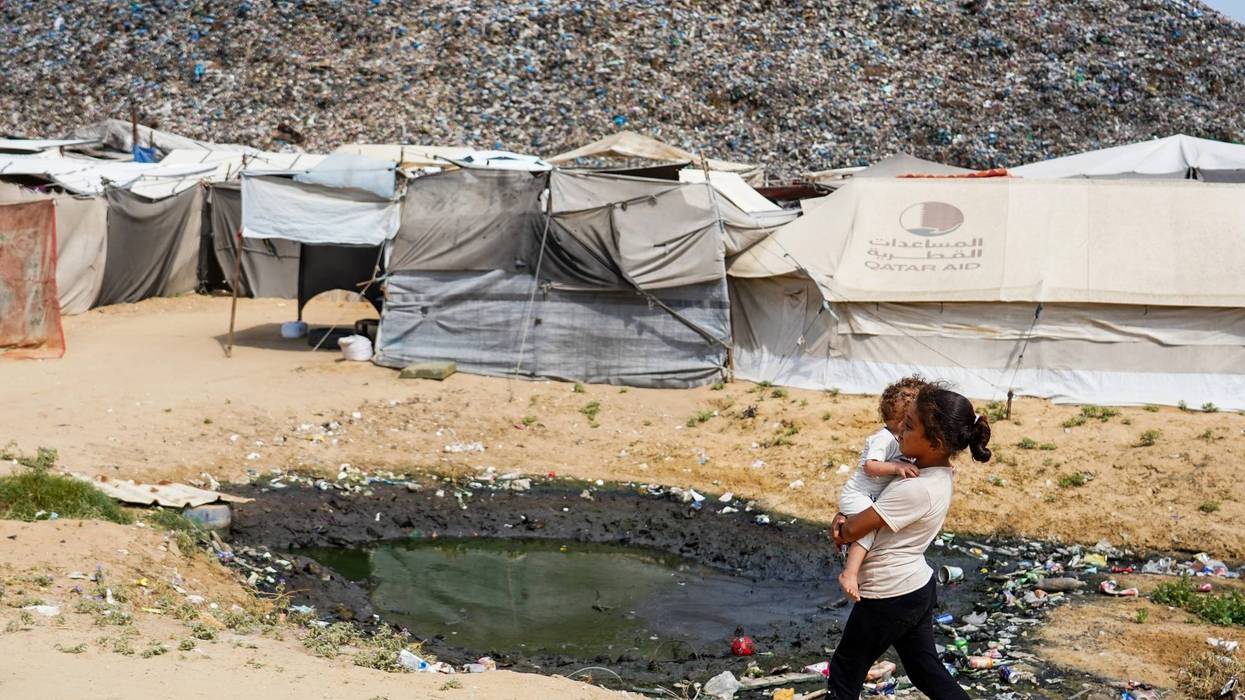
"The associated health consequences" of toxins, said one humanitarian, "will be severe, with children and pregnant women among those facing the highest risks.”
US government officials and commentators from both sides of the political aisle have insisted for years that Israel's assault on Gaza is targeted at Hamas fighters and have bristled at accusations that Israel, with US backing, is intentionally attempting to ethnically cleanse the exclave of Palestinians and make it uninhabitable for the population.
But one advocate for Palestinian rights said Monday that the "environmental war crimes" described in a new report on how Gaza's air, soil, and water have become toxic due to more than three years of relentless bombing—despite a ceasefire deal reached last year—are "also known as genocide."
The report by Oxfam International and the Conflict and Environment Observatory (CEOBS)—titled "Environmental War Crimes: How Israel’s Military Assault Has Turned Gaza Into a Toxic Wasteland, Threatening Human Survival"—finds that while Israel's military onslaught has directly impacted about 78% of Gaza's land area, a spatial analysis identified indicators of potential contamination from heavy metals, residue from explosives, asbestos from destroyed buildings, dioxins, and biological contaminants across almost the entirety of Gaza—more than 99% of the exclave.
“Israel's ongoing genocide in Gaza includes military assaults on its environment, which are environmental war crimes threatening life now and for generations to come," said Amitabh Behar, executive director of Oxfam. "The destruction and contamination of Gaza will have fundamentally degraded the environmental conditions necessary for human safety and survival. This would breach Israel’s legal obligations under international humanitarian and human rights law."
PRESS RELEASE: More than 99 per cent of #Gaza shows indicators of environmental contamination from Israel's military assault READ HERE: https://t.co/nIx81uPiPV https://t.co/1k8QkTzMzU
— Oxfam International Media Team (@newsfromoxfam) November 23, 2026
The organizations used satellite imagery, remote sensing, scientific analysis, and other open-source data—including the United Nations Environment Program's estimate that Israel's US-backed assault had generated more than 61 million tons of debris across Gaza—to build a comprehensive picture of the exclave's contamination.
The highest levels of potential contamination were identified in Gaza City, Khan Younis, Rafah, Jabalia, and the Salah al-Din Road, which correspond closely "with the areas subjected to the most sustained bombardment, ground military operations, infrastructure destruction, and debris accumulation."
The destruction of buildings, wastewater treatment facilities, industrial and energy facilities, and waste-management systems "has released a complex mixture of contaminants," reads the report, including explosive residue, perchlorates, asbestos fibers, crystalline silica, persistent organic pollutants, and pathogens—all of which can then move through the air, soil, groundwater, and surface water.

"The population is likely to have been exposed to contaminants through multiple and interconnected pathways," the report continues.
Contamination described in the report include:
The analysis of the widespread, toxic contamination "contributes to the body of evidence relevant to the prohibition of deliberately inflicting conditions of life calculated to bring about the physical destruction of a protected group under Article II(c) of the Genocide Convention," reads the report. Top human rights groups and Holocaust scholars are among those who have argued that Israel's bombardment of Gaza amounts to a genocide, and South Africa has a genocide case against Israel before the International Court of Justice.
Lama Abdul Samad, a global water and sanitation specialist at Oxfam who was the lead author of the report, said that the widespread contamination is made even more difficult to address and mitigate because "unexploded ordnance continues to restrict safe access to most areas."
"The analysis highlights the urgent need for Israel to grant access for a detailed environmental assessment on the ground to clarify the risks to public health and identify options for urgent harm reduction measures," said Samad. "Restoration is likely to require extensive clearance, monitoring, and specialized remediation of affected areas from contaminants like explosive residues, organic pollutants, and heavy metals.”
Under international law, the report states, "the natural environment is not legally neutral... It is civilian in character and therefore protected."
"International humanitarian law explicitly protects both objects indispensable to civilian survival and the natural environment," the report continues. In Israel's attacks on Gaza, "the resulting contamination of groundwater, soil, air, and coastal waters is environmental harm that is legally relevant under international humanitarian law."
Oxfam called on Israel to allow a "full, independent, field-based Post-Conflict Environmental Assessment."
"Rebuilding without addressing environmental risks could expose Palestinians to entirely preventable harm," said Saeda Shaebat, the director of the Palestinian Environmental Quality Authority in Jerusalem.
New Oxfam and CEOBS analysis finds 99% of Gaza shows indicators of environmental contamination.Toxic residues from Israel’s military assault is threatening the air, soil and water that people rely on.Israel must allow independent testing and essential aid.Read: https://t.co/KYvtJSmzpN
— Oxfam International (@Oxfam) November 23, 2026
Behar said that "Palestinians living in Gaza are being exposed to toxins in multiple ways through air, food, water, and via direct contact with contaminated soils and debris. These risks will persist for generations to come, unless clean-up, remediation, and recovery actions are prioritized.”
Joe Kasper, who served Hegseth for three months at the start of the Trump administration, said he'd "overindulged in ego, in attitude, and in entitlement."
Defense Secretary Pete Hegseth’s former chief of staff is calling for the top Pentagon official to resign over what the aide described as a “shitshow” in Iran and Hegseth’s “belligerent” leadership of the department.
Joe Kasper, who served as Hegseth’s chief of staff during the first three months of the Trump administration, told Politico in an interview published Monday that the self-styled “secretary of war” has “overindulged in ego, in attitude, and in entitlement.”
Over the course of nearly an hour, Kasper savaged Hegseth over his purges of senior military personnel, his blocking of promotions for Black and female leaders, and his obsession with “distractions” like measuring soldiers’ testosterone levels.
EXCLUSIVE: The former chief of staff to Defense Secretary Pete Hegseth, Joe Kasper, is calling on him to resign, telling me he has badly mismanaged both the Pentagon and his “shitshow” war in Iran. He said Hegseth has prioritized showmanship over his job. https://t.co/QK5YIcLIiL
— Daniel Lippman (@dlippman) November 23, 2026
“There’s quite an emphasis on the showmanship,” he said. “The virtues of humility and basically service before self and those things have disappeared. I didn’t see those at the start, and see them ever less so now.”
Kasper said he realized within his first week on the job in early 2025 that it was “all about Pete rather than the institution and the men and women who support it.”
That spring, Kasper was embroiled in a bitter power struggle with three other Pentagon officials—senior adviser Dan Caldwell, Hegseth’s deputy chief of staff Darin Selnick, and Colin Carroll, chief of staff to Deputy Defense Secretary Stephen Feinberg. All three were fired in April 2025 after they were accused of leaking sensitive information, including details of US military planning to “reclaim” the Panama Canal.
Kasper, who led the charge for their ouster, also left his full-time post that month. Hegseth has insisted that Kasper was not fired and has publicly defended him as a “great guy.”
Kasper now says there was no evidence that the men he accused had leaked information. An internal investigation also found no evidence of leaks by the three men, according to The New York Times. Caldwell later rejoined the administration in the Office of the Director of National Intelligence.
A senior Pentagon official dismissed Kasper’s criticism on Monday as “gossip” from a “disgruntled former staffer—someone who could barely survive 90 days in the building.”
“Secretary Hegseth is laser-focused on restoring lethality to the force and supporting our warfighters, while Mr. Kasper is more focused on rewriting history to cover for his own failed tenure,” the official said.
Kasper, however, suggested that Hegseth’s power is already waning. Democrats are preparing to inundate the Pentagon with subpoenas over Hegseth’s role in launching the unauthorized war on Iran, now in its ninth month despite early promises that it would last mere weeks. Other targets include his campaign of extrajudicial boat strikes, which have killed over 200 people in the Caribbean and Pacific, and the department’s award of military contracts to members of President Donald Trump’s family and to his allies.
“Pete’s ability to be effective has been constrained, and very soon he’ll have lost any ability to be effective,” Kasper said. “For that reason and others, it’s time for Pete to call it quits.”
Exclusive: Sen. Ernst rebukes lack of "transparency" from Pentagon on Iran https://t.co/g0Cn1QCyME
— Axios (@axios) November 19, 2026
Lawmakers in both parties have criticized Hegseth. Earlier this month, the House narrowly rejected a bid to advance eight articles of impeachment against him brought by Rep. Thomas Massie (R-Ky.), a leading GOP critic of Trump’s foreign policy. Massie said Hegseth would “remain a threat to the Constitution if allowed to remain in office.” He dismissed the idea that Hegseth’s problem was a lack of effectiveness.
"In fact, he was very effective at killing schoolchildren in Iran," Massie said.
Even some Republicans who support the broad outlines of the Trump administration’s aggressive foreign policy have criticized Hegseth’s extreme secrecy and hostility toward congressional oversight. Hegseth has excluded Democratic members of Congress from classified briefings, withheld information about the costs, casualties, and objectives of the war on Iran, and repeatedly denied requests for evidence in investigations into the boat strikes.
In a memoir released in October, outgoing Sen. Thom Tillis (R-NC) said his vote to confirm Hegseth was his “biggest regret.” In a separate interview, Tillis said the secretary “takes [Congress] for granted, and... treats us more like a manufacturing line in his company than his board of directors.”
Sen. Joni Ernst (R-Iowa), who is also retiring, said last week that “a lot of people would be able to guess” that she regretted voting to confirm Hegseth. She added that there is “very little transparency right now with what is being discussed between the White House and the Department of War.”
Kasper suggested Hegseth has nobody to blame but himself for the rupture with Congress.
“He’s not just burned bridges up on the Hill,” he said. “He’s napalmed them… He’s going to be suffocated, and it’s not like it’s going to be a slow suffocation. It’s going to be a quick asphyxiation.”
Should Hegseth remain in office, the incoming Democratic majority in the House could revive the impeachment effort. If the House impeaches him, it would take a two-thirds vote of senators present to remove him. With Democrats expected to hold 56 Senate seats beginning in January, potentially as few as 11 Republicans may be needed to remove Hegseth from office.
"The goal, for me, is to get Pete Hegseth removed as the head of the Department of Defense," Rep. Jason Crow (D-Colo.), who sits on the House Armed Services and Intelligence committees, told The Atlantic last week. "Every day he sits atop the DOD is a day that our service members don’t have the leadership, they don’t have the competency, they don’t have the direction and the support that they need, and they are being put at great risk."
"While everyday Americans struggle with rising gas and grocery prices, Trump hosted an exclusive dinner tonight at his own resort for top buyers of his crypto meme coin."
US President Donald Trump on Sunday hosted a third exclusive dinner for the biggest holders of his brazenly corrupt meme coin as his administration moved to strip modest nutrition assistance from over 6 million additional Americans amid high grocery prices.
Sunday's dinner took place at the president's private golf club in Sterling, Virginia, where more than 100 people who held a combined $8.6 million worth of the $TRUMP crypto coin—which is currently trading below $1, down from a high of around $75—gathered to "dine on grilled filet mignon and pan-seared halibut while hearing speeches from the likes of Kevin O'Leary of the 'Shark Tank' television show and NBA veteran Tristan Thompson," Reuters reported.
The top 120 meme coin holders who attended Sunday's gala received a gift bag that included a watch and a Trump fragrance.
Financial disclosures show that Trump pocketed around $635 million in earnings from his meme coin last year, but investors haven't fared nearly as well. According to a recent Public Citizen analysis, "Trump’s crypto schemes have left investors at least an estimated $4.7 billion underwater," with the $TRUMP coin accounting for $3.2 billion of those losses.
“As Trump tries to extract the last possible dollars from his waning $TRUMP cryptocurrency scam, it has turned into a pay-for-access deal more than ever before,” Public Citizen co-president Robert Weissman said on Sunday, pointing to his group's new finding that more than half of the crypto wallets appearing on the gala leaderboard "received their $TRUMP tokens from cryptocurrency exchanges that prohibit US customers."
“Our analysis shows that foreign interests are likely among those paying for the privilege of dining with the president," said Weissman.
Ahead of Sunday's dinner, a group of Democratic US senators argued that the scoring system used to determine who would qualify to attend the exclusive gala "appears to be a pay-to-play scheme designed to reward the president’s wealthy allies and con the president’s supporters while lining his pockets directly."
"With the president poised to grow his financial holdings as a direct result of the November 22, 2026 gala dinner—particularly as American families suffer rising costs—it is incumbent upon the administration to answer to the American people about the President’s involvement in and profits from the upcoming event," the senators wrote.
The dinner came less than two weeks after the Trump administration unveiled a proposed rule that would take Supplemental Nutrition Assistance Program (SNAP) benefits from around 6.3 million people, including many children.
The rule, if enacted, would compound the devastating impacts of the SNAP cuts that Trump and congressional Republicans enacted last year, taking food aid from more than 5 million people so far.
"Just a reminder that while everyday Americans struggle with rising gas and grocery prices, Trump hosted an exclusive dinner tonight at his own resort for top buyers of his crypto meme coin, which he claims he made $635 million off of last year," Citizens for Responsibility and Ethics in Washington, a government watchdog group, wrote on Sunday.
"Billionaires shouldn’t be able to buy our elections at any level."
Sen. Bernie Sanders is welcoming the Democratic National Committee's new restrictions on dark money in the 2028 presidential primary, but he says the party can go even further.
The DNC on Monday announced rules for the 2028 presidential primary, including one that bars Democratic candidates from appearing on a debate stage unless they denounce the involvement of super political action committees (PACs) and dark money groups in the race.
More specifically, the DNC is requiring that each presidential campaign provide "a uniform denunciation statement... upon notification of spending that violates the pledge."
The rules further state that super PAC and dark money spending that occurs "prior to a candidate’s launch must be denounced if reported to the DNC and determined to violate the terms of the pledge," a reference to the DNC’s Presidential Primary Fair Campaign Practices Pledge.
Additionally, any candidate found to have authorized super PAC spending on their behalf will need to "need to refund the spending party committee and provide proof of refund in order to be in compliance."
Sanders (I-Vt.), a longtime advocate of getting big moneyed interests out of the political process, wrote in a Monday social media post that the new DNC rules were a good start, while emphasizing more must be done.
"The DNC announced that 2028 presidential candidates must reject dark money and disavow Super PAC spending on their behalf. Excellent!" Sanders wrote. "Now let’s expand those restrictions to Democratic Senate and House primaries. Billionaires shouldn’t be able to buy our elections at ANY level."
The new DNC rules also earned kudos from Sen. Elizabeth Warren (D-Mass.).
"The DNC’s pledge is a powerfully important step in getting big money out of politics," Warren said. "Coming off an election where candidates across the country proved that the many beat the money, I hope candidates will not just take this pledge, but embrace it."
Reps. Greg Casar (D-Texas), Maxwell Frost (D-Fla.), and Pramila Jayapal (D-Wash.), co-chairs of the Congressional Progressive Caucus PAC, emphasized that "dark money should have no place in our elections, especially in Democratic primaries," noting that "Americans just rejected corruption at all levels" during the 2026 midterm elections.
"While Congress must work to ban all super PACs by law," they added, "we are glad to see the DNC taking a first step to make sure our party answers to the voters, not billionaires and special interests. We urge all 2028 candidates to take this pledge and reject dark money."
"I think the message out of this election was economic populism, and you need somebody who has a history of fighting powerful, big-money special interests in favor of the public interest. That has been my north star."
With the Senate Democratic leadership contest just over a week away, Sen. Chris Van Hollen of Maryland said Sunday that he has secured more than half of the votes he needs to lead the caucus in the new Congress, declaring that "momentum is in our direction."
Van Hollen, who decided to challenge longtime Democratic leader Sen. Chuck Schumer (D-NY) earlier this month following a surge of grassroots support, said in an appearance on NBC's "Meet the Press" that the American public wants to "see change, and you don’t get change by going back to business as usual." The Maryland Democrat needs at least 29 votes to win the Senate Democratic leadership contest, which will be held via secret ballot on December 1.
Van Hollen said Sunday that he has locked down "north of 15" supporters. According to a tracker maintained by Punchbowl News, six members of the Senate Democratic caucus have publicly endorsed Van Hollen, compared with 16 for Schumer.
Schumer, who is deeply unpopular with the Democratic base, has repeatedly insisted that he has enough votes to win reelection as caucus leader, but Van Hollen has disputed that narrative, accusing Schumer of counting some of Van Hollen's supporters as his own.
"If you look at our caucus, you can see a huge appetite for change," Van Hollen said on Sunday, pointing to support from Sen. Elissa Slotkin (D-Mich.) as evidence that "this is not about progressives versus moderates."
"This is about those who understand that the last election was an election on economic populism," said the Maryland Democrat. "People are sick and tired of an economic system rigged in favor of the very wealthy, against working people, and fueled by political corruption. That is the big tent that all of our candidates ran on, and that was the call of the American people."
Van Hollen outlined some of his top priorities if he wins the leadership election, including "completely" reforming the "very broken" US healthcare system and overhauling a tax code that "right now is rigged in favor of the very wealthy against working people." Van Hollen is a supporter of Medicare for All and a billionaire wealth tax.
"You don’t earn people’s trust by going back to business as usual," said Van Hollen. "I think the message out of this election was economic populism, and you need somebody who has a history of fighting powerful, big-money special interests in favor of the public interest. That has been my north star. That is what can bring us all together in the Senate Democratic caucus to get things done now."
Van Hollen's "Meet the Press" appearance came shortly after Sen.-elect Abdul El-Sayed (D-Mich.)—one of the newly elected senators backing the Maryland Democrat in the leadership race—said on the show that the contest is "not about rejecting Senator Schumer."
"He and I worked very well together during the general election. I like him personally. This is about embracing what Senator Van Hollen has to offer," said El-Sayed. "The people are suffering. I got elected to address the affordability crisis. I got elected to keep our money here at home. I got elected to guarantee people healthcare, and I want to make sure that we are willing to do what it takes to get that done. And that is the responsibility of the next Senate majority leader."
"I don't really care what it's called. I care that the people of this country finally have the unmet promise of guaranteed healthcare," said the Democratic senator-elect from Michigan.
US Sen.-elect Abdul El-Sayed spent the weekend reiterating his willingness to work with Republican President Donald Trump to deliver healthcare for all Americans, a key focus of the Michigan Democrat's successful midterm campaign.
After Trump said during a Friday press conference that he was "open to great healthcare," and while it couldn't be what some progressive Democrats in Congress want, "it can be a combination of what we all want," El-Sayed and Sen. Bernie Sanders (I-Vt.), the longtime leading advocate of Medicare for All on Capitol Hill, encouraged the president to work with them.
"Trumpcare for All?” El-Sayed wrote on social media with a clip of the president's remarks. Then, on Saturday, the president took to his Truth Social platform to share an earlier post from the senator-elect with images of proposed "Trumpcare" cards.
"If the president is serious about meeting the unmet promise of guaranteed healthcare in this country, I'm ready to work alongside leaders in the Senate," El-Sayed said in a Saturday statement to The Hill. He specifically pointed to Sanders and Democratic Sens. Ron Wyden (Ore.), Elizabeth Warren (Mass.), and Chris Van Hollen (Md.), who is running for Senate majority leader.
The topic also came up during El-Sayed's Sunday appearance on NBC News' "Meet the Press," during which he told Kristen Welker that "my job is to make sure that we're advancing the goal to get everybody in this country healthcare. I ran on three things: money out of politics, money in your pocket, Medicare for All. Now, I don't really care what it's called. I care that the people of this country finally have the unmet promise of guaranteed healthcare."
"If the president is serious about leaving a lasting legacy, there is nothing better than the ultimate Trump card, a card that they can have in their back pocket from the moment they are born to the moment that they pass away that guarantees them the healthcare that has been so elusive in this country without premiums, co-pays, and deductibles," El-Sayed continued. "If he's open to the conversation, I am open to it too. I know that Sen. Van Hollen, who you'll be speaking with later, is certainly open [to] it, and it’s a big reason why I support him for Senate majority leader."
Asked about getting enough votes in Congress, given that Democrats are set to take over both chambers in January but support for the policy is not universal in the party, El-Sayed said that "I think the assumption is that you can't get Republican votes. Now, the last I've seen is that Donald Trump controls a lot of that caucus. If he says that he wants Trumpcare for All and that he's open to signing it if it gets on his desk, I think you're going to find a lot of Republicans open to vote for it too. Now, it might be kind of awkward if folks in my party aren't as interested in supporting it if you have broad bipartisan support."
Welker also asked El-Sayed if he supports Sanders' Medicare for All Act—to which he responded: "I support his bill. But the version of Medicare for All I'd like to see is somewhat like thinking about health insurance like public schools. Everybody is entitled to a public school. Some people send their kids to private schools. But the next day, if they wanted to, they could send their kids to public schools. Everybody's entitled to it. That's how I'm thinking about public health insurance under Medicare for All."
"I don't think it's about what it takes away. I think it's about the guarantee and the security that it offers," El-Sayed said. "I'm broadly supportive of Sen. Sanders' extreme effort to finally force this conversation. You know, you cannot have a conversation about Medicare for All without credit to Sen. Sanders and folks like Sen. Warren, Sen. Wyden, Sen. Van Hollen, others who have been working on this for a very long time."
When Welker asked about Sanders' bill potentially eliminating private health insurance, the former public health official stressed that "the essence of Medicare for All is the guaranteed public health insurance... I understand the attempt to drive a wedge here about whether or not there is a space for private health insurance. But the goal here in an America where millions of people are struggling because they don't have health insurance is to guarantee every single person cradle-to-grave coverage."
El-Sayed also pushed back against Republicans in Congress who attacked the policy on social media, such as Sen. Rand Paul (R-Ky.), who complained about cost.
An August study by Yale University experts found that Sanders' bill would save $1 trillion and over 114,000 lives per year.
El-Sayed also called out at Sen. John Kennedy (R-La.), who discussed the policy Sunday on "Meet the Press."
El-Sayed isn't the only incoming progressive senator open to working with Trump—whose allies in Congress used their majorities last year to take away healthcare and food assistance from families in need—on expanding coverage.
As Politico pointed out, while Democratic Sen.-elect Peggy Flanagan (Minn.) said on CNN's "State of the Union" this weekend that her priority is reversing cuts to Medicaid and food aid, she also supports working with Trump on healthcare for everyone.
"Listen, call it whatever you want. I think people are ready for Medicare for All," said Flanagan, who, like El-Sayed, was backed by Sanders on the campaign trail. "If we have to call it Trumpcare in order to get it across the finish line, that's fine by me."