SUBSCRIBE TO OUR FREE NEWSLETTER
Daily news & progressive opinion—funded by the people, not the corporations—delivered straight to your inbox.
5
#000000
#FFFFFF
To donate by check, phone, or other method, see our More Ways to Give page.
Daily news & progressive opinion—funded by the people, not the corporations—delivered straight to your inbox.
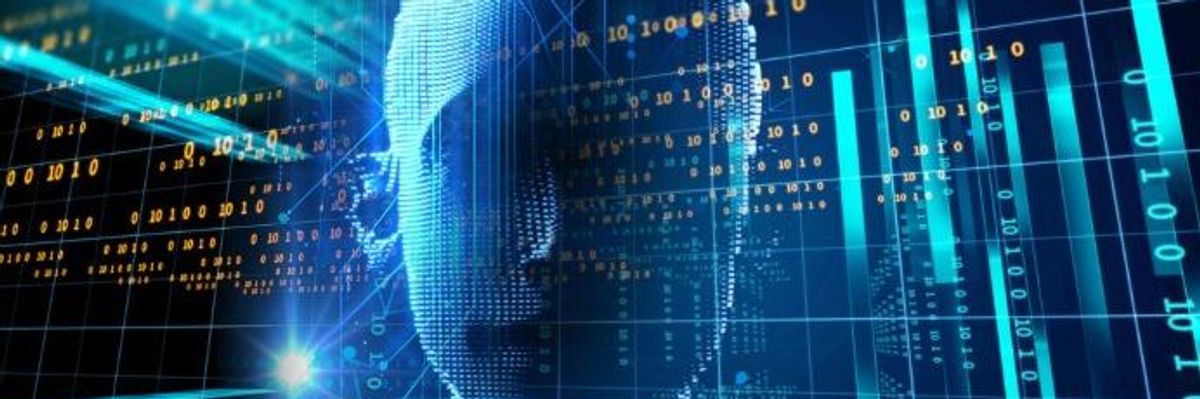
The European Union reached an agreement on December 8, 2023 regarding the use of artificial intelligence.
"The only thing that can force those big companies to do more research on safety is government regulation."
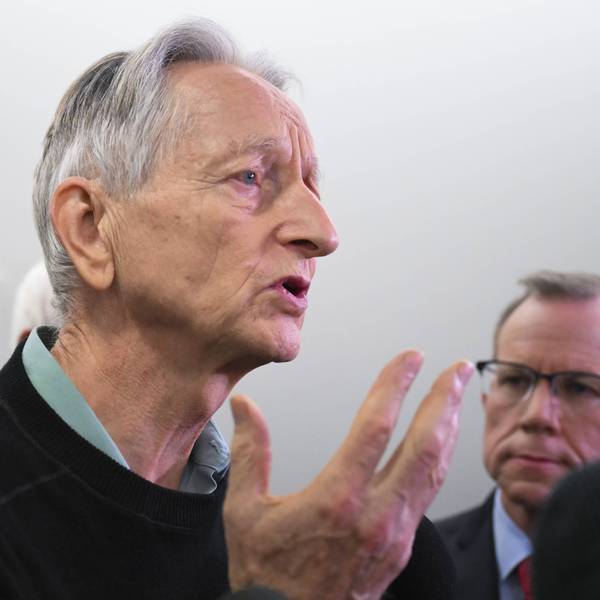
Warning that the pace of development of artificial intelligence is "much faster" than he anticipated and is taking place in the absence of far-reaching regulations, the computer scientist often called the "Godfather of AI" on Friday said he believes chances are growing that AI could wipe out humanity.
Speaking to BBC Radio 4's "Today" program, Geoffrey Hinton said there is a "10% to 20%" chance AI could lead to human extinction in the next three decades.
Previously Hinton had said he saw a 10% chance of that happening.
"We've never had to deal with things more intelligent than ourselves before," Hinton explained. "And how many examples do you know of a more intelligent thing being controlled by a less intelligent thing? There are very few examples. There's a mother and baby. Evolution put a lot of work into allowing the baby to control the mother, but that's about the only example I know of."
Hinton, who was awarded the Nobel Prize in physics this year for his research into machine learning and AI, left his job at Google last year, saying he wanted to be able to speak out more about the dangers of unregulated AI.
"Just leaving it to the profit motive of large companies is not going to be sufficient to make sure they develop it safely."
He has warned that AI chatbots could be used by authoritarian leaders to manipulate the public, and said last year that "the kind of intelligence we're developing is very different from the intelligence we have."
On Friday, Hinton said he is particularly worried that "the invisible hand" of the market will not keep humans safe from a technology that surpasses their intelligence, and called for strict regulations of AI.
"Just leaving it to the profit motive of large companies is not going to be sufficient to make sure they develop it safely," said Hinton.
More than 120 bills have been proposed in the U.S. Congress to regulate AI robocalls, the technology's role in national security, and other issues, while the Biden administration has taken some action to rein in AI development.
An executive order calling for "Safe, Secure, and Trustworthy Development and Use of Artificial Intelligence" said that "harnessing AI for good and realizing its myriad benefits requires mitigating its substantial risks." President-elect Donald Trump is expected to rescind the order.
The White House Blueprint for an AI Bill of Rights calls for safe and effective systems, algorithmic discrimination protections, data privacy, notice and explanation when AI is used, and the ability to opt out of automated systems.
But the European Union's Artificial Intelligence Act was a deemed a "failure" by rights advocates this year, after industry lobbying helped ensure the law included numerous loopholes and exemptions for law enforcement and migration authorities.
"The only thing that can force those big companies to do more research on safety," said Hinton on Friday, "is government regulation."
Dear Common Dreams reader, It’s been nearly 30 years since I co-founded Common Dreams with my late wife, Lina Newhouser. We had the radical notion that journalism should serve the public good, not corporate profits. It was clear to us from the outset what it would take to build such a project. No paid advertisements. No corporate sponsors. No millionaire publisher telling us what to think or do. Many people said we wouldn't last a year, but we proved those doubters wrong. Together with a tremendous team of journalists and dedicated staff, we built an independent media outlet free from the constraints of profits and corporate control. Our mission has always been simple: To inform. To inspire. To ignite change for the common good. Building Common Dreams was not easy. Our survival was never guaranteed. When you take on the most powerful forces—Wall Street greed, fossil fuel industry destruction, Big Tech lobbyists, and uber-rich oligarchs who have spent billions upon billions rigging the economy and democracy in their favor—the only bulwark you have is supporters who believe in your work. But here’s the urgent message from me today. It's never been this bad out there. And it's never been this hard to keep us going. At the very moment Common Dreams is most needed, the threats we face are intensifying. We need your support now more than ever. We don't accept corporate advertising and never will. We don't have a paywall because we don't think people should be blocked from critical news based on their ability to pay. Everything we do is funded by the donations of readers like you. When everyone does the little they can afford, we are strong. But if that support retreats or dries up, so do we. Will you donate now to make sure Common Dreams not only survives but thrives? —Craig Brown, Co-founder |
Warning that the pace of development of artificial intelligence is "much faster" than he anticipated and is taking place in the absence of far-reaching regulations, the computer scientist often called the "Godfather of AI" on Friday said he believes chances are growing that AI could wipe out humanity.
Speaking to BBC Radio 4's "Today" program, Geoffrey Hinton said there is a "10% to 20%" chance AI could lead to human extinction in the next three decades.
Previously Hinton had said he saw a 10% chance of that happening.
"We've never had to deal with things more intelligent than ourselves before," Hinton explained. "And how many examples do you know of a more intelligent thing being controlled by a less intelligent thing? There are very few examples. There's a mother and baby. Evolution put a lot of work into allowing the baby to control the mother, but that's about the only example I know of."
Hinton, who was awarded the Nobel Prize in physics this year for his research into machine learning and AI, left his job at Google last year, saying he wanted to be able to speak out more about the dangers of unregulated AI.
"Just leaving it to the profit motive of large companies is not going to be sufficient to make sure they develop it safely."
He has warned that AI chatbots could be used by authoritarian leaders to manipulate the public, and said last year that "the kind of intelligence we're developing is very different from the intelligence we have."
On Friday, Hinton said he is particularly worried that "the invisible hand" of the market will not keep humans safe from a technology that surpasses their intelligence, and called for strict regulations of AI.
"Just leaving it to the profit motive of large companies is not going to be sufficient to make sure they develop it safely," said Hinton.
More than 120 bills have been proposed in the U.S. Congress to regulate AI robocalls, the technology's role in national security, and other issues, while the Biden administration has taken some action to rein in AI development.
An executive order calling for "Safe, Secure, and Trustworthy Development and Use of Artificial Intelligence" said that "harnessing AI for good and realizing its myriad benefits requires mitigating its substantial risks." President-elect Donald Trump is expected to rescind the order.
The White House Blueprint for an AI Bill of Rights calls for safe and effective systems, algorithmic discrimination protections, data privacy, notice and explanation when AI is used, and the ability to opt out of automated systems.
But the European Union's Artificial Intelligence Act was a deemed a "failure" by rights advocates this year, after industry lobbying helped ensure the law included numerous loopholes and exemptions for law enforcement and migration authorities.
"The only thing that can force those big companies to do more research on safety," said Hinton on Friday, "is government regulation."
Warning that the pace of development of artificial intelligence is "much faster" than he anticipated and is taking place in the absence of far-reaching regulations, the computer scientist often called the "Godfather of AI" on Friday said he believes chances are growing that AI could wipe out humanity.
Speaking to BBC Radio 4's "Today" program, Geoffrey Hinton said there is a "10% to 20%" chance AI could lead to human extinction in the next three decades.
Previously Hinton had said he saw a 10% chance of that happening.
"We've never had to deal with things more intelligent than ourselves before," Hinton explained. "And how many examples do you know of a more intelligent thing being controlled by a less intelligent thing? There are very few examples. There's a mother and baby. Evolution put a lot of work into allowing the baby to control the mother, but that's about the only example I know of."
Hinton, who was awarded the Nobel Prize in physics this year for his research into machine learning and AI, left his job at Google last year, saying he wanted to be able to speak out more about the dangers of unregulated AI.
"Just leaving it to the profit motive of large companies is not going to be sufficient to make sure they develop it safely."
He has warned that AI chatbots could be used by authoritarian leaders to manipulate the public, and said last year that "the kind of intelligence we're developing is very different from the intelligence we have."
On Friday, Hinton said he is particularly worried that "the invisible hand" of the market will not keep humans safe from a technology that surpasses their intelligence, and called for strict regulations of AI.
"Just leaving it to the profit motive of large companies is not going to be sufficient to make sure they develop it safely," said Hinton.
More than 120 bills have been proposed in the U.S. Congress to regulate AI robocalls, the technology's role in national security, and other issues, while the Biden administration has taken some action to rein in AI development.
An executive order calling for "Safe, Secure, and Trustworthy Development and Use of Artificial Intelligence" said that "harnessing AI for good and realizing its myriad benefits requires mitigating its substantial risks." President-elect Donald Trump is expected to rescind the order.
The White House Blueprint for an AI Bill of Rights calls for safe and effective systems, algorithmic discrimination protections, data privacy, notice and explanation when AI is used, and the ability to opt out of automated systems.
But the European Union's Artificial Intelligence Act was a deemed a "failure" by rights advocates this year, after industry lobbying helped ensure the law included numerous loopholes and exemptions for law enforcement and migration authorities.
"The only thing that can force those big companies to do more research on safety," said Hinton on Friday, "is government regulation."