

SUBSCRIBE TO OUR FREE NEWSLETTER
Daily news & progressive opinion—funded by the people, not the corporations—delivered straight to your inbox.
5
#000000
#FFFFFF
To donate by check, phone, or other method, see our More Ways to Give page.
Daily news & progressive opinion—funded by the people, not the corporations—delivered straight to your inbox.
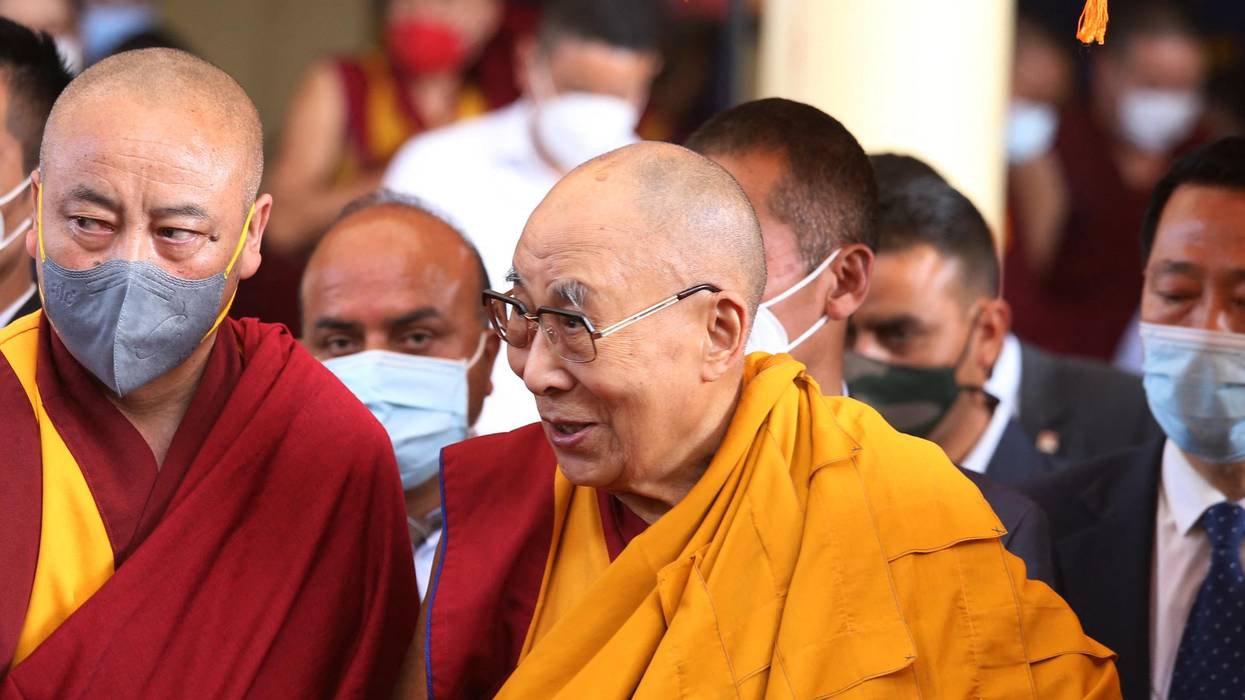
The Dalai Lama is among 16 Nobel Peace Prize laureates who jointly issued an open letter Saturday calling for the immediate end of the attack on Ukraine and an explicit vow from both Russia and NATO forces that nuclear weapons of any kind will not be used as part of this conflict or any other.
"The invasion of Ukraine has created a humanitarian disaster for its people. The entire world is facing the greatest threat in history: a large-scale nuclear war, capable of destroying our civilization and causing vast ecological damage across the Earth."
"We reject war and nuclear weapons," the letter declares. "We call on all our fellow citizens of the world to join us in protecting our planet, home for all of us, from those who threaten to destroy it."
Backed by the International Physicians for the Prevention of Nuclear War (IPPNW), which won the Nobel in 1985, and the International Campaign to Abolish Nuclear Weapons (ICAN), awarded the prize for similar advocacy in 2017, the letter was also signed by ten other individual winners--including Jody Williams, Kailash Satyarthi, and Oscar Arias Sanchez--as well as the International Peace Bureau, which won the award in 1910, the American Friends Service Committee (1947), and the Pugwash Conference on Science and World Affairs (1995).
"The invasion of Ukraine has created a humanitarian disaster for its people," the letter continues. "The entire world is facing the greatest threat in history: a large-scale nuclear war, capable of destroying our civilization and causing vast ecological damage across the Earth."
The open letter calls for an immediate ceasefire agreement and the withdrawal of all Russian troops from Ukraine. After over a month of fighting, thousands of Ukrainian civilians have been killed, according to official figures, and millions of refugees have fled across the Ukraine border to neighboring countries while millions more have been displaced internally within the country.
Concern over the possible use of nuclear weapons has been heightened throughout the conflict after Russian President Vladimir Putin on February 27 ordered his military to put its nuclear forces on "special alert"--a move that was immediately condemned as "unacceptable and reckless" by the anti-nuclear group Global Zero.
Since then there has been growing worry that Putin could resort to the use of so-called "tactical" nukes, lower-yield weapons that some have tried to justify as less dangerous or destructive than their larger counterparts. Such arguments, as Common Dreams reported earlier this week, have been roundly rejected.
Anyone suggesting use of even a "small" nuclear weapon, wrote Ploughshares Fund president Joe Circionne this week has "lost touch with the reality of nuclear war. Even the smallest conceivable nuclear blast would be many times more powerful than the largest conventional bomb."
In addition to an end of the war and a vocal promise that nuclear weapons would not be used during the conflict in Ukraine, the open letter issued Saturday by the Nobel laureates calls for all countries of the world "to support the Treaty on the Prohibition of Nuclear Weapons to ensure that we never again face a similar moment of nuclear danger."
The letter concludes, "It is either the end of nuclear weapons, or the end of us."
The full text of the letter and the list of lead signatories--which can be endorsed by anyone on the Avaaz page--follows:
We reject war and nuclear weapons. We call on all our fellow citizens of the world to join us in protecting our planet, home for all of us, from those who threaten to destroy it.
The invasion of Ukraine has created a humanitarian disaster for its people. The entire world is facing the greatest threat in history: a large-scale nuclear war, capable of destroying our civilization and causing vast ecological damage across the Earth.
We call for an immediate ceasefire and the withdrawal of all Russian military forces from Ukraine, and for all possible efforts at dialogue to prevent this ultimate disaster.
We call on Russia and NATO to explicitly renounce any use of nuclear weapons in this conflict, and we call on all countries to support the Treaty on the Prohibition of Nuclear Weapons to ensure that we never again face a similar moment of nuclear danger.
The time to ban and eliminate nuclear weapons is now. It is the only way to guarantee that the inhabitants of the planet will be safe from this existential threat.
It is either the end of nuclear weapons, or the end of us.
We reject governance through imposition and threats, and we advocate for dialogue, coexistence and justice.
A world without nuclear weapons is necessary and possible, and together we will build it. It is urgent that we give peace a chance.
----------------------------------
Signatories list of Nobel Peace Prize Laureates:
His Holiness The Dalai Lama (1989)
International Physicians for the Prevention of Nuclear War (1985)
International Campaign to Abolish Nuclear Weapons (2017)
Juan Manuel Santos (2016)
Kailash Satyarthi (2014)
Leymah Gbowee (2011)
Tawakkul Karman (2011)
Muhammad Yunus (2006)
David Trimble (1998)
Jody Williams (1997)
Jose Ramos-Horta (1996)
Pugwash Conference on Science and World Affairs (1995)
Oscar Arias Sanchez (1987)
Lech Walesa (1983)
American Friends Service Committee (1947)
International Peace Bureau (1910)
In a move they say will save $1 trillion over five years "to fight planetary emergencies" like "pandemics, climate change, and extreme poverty," a group of over 50 Nobel laureates this week published an open letter calling on countries to generate a "global peace dividend" by reducing their military spending by 2%.
"Humankind faces risks that can only be averted through cooperation. Let us cooperate, instead of fighting among ourselves."
"World military spending has doubled since 2000. It is approaching $2 trillion U.S. dollars per year, and is increasing in all regions of the world," the letter--which is being coordinated by physicists Carlo Rovelli and Matteo Smerlak--states.
"Individual governments are under pressure to increase military spending because others do so," the signers continue. "The feedback mechanism sustains a spiraling arms race--a colossal waste of resources that could be used far more wisely."
The letter's signatories include mostly Nobel science and medicine laureates, as well as a handful of winners in the peace, economics, and literature categories. The heads of several national academies also signed, and Tibetan spiritual leader and Nobel Peace Prize winner the Dalai Lama expressed his "appreciation and support" for the initiative.
"Past arms races have often had the same outcome: deadly and destructive conflicts," the signers note. "We have a simple proposal for humankind: The governments of all U.N. member-states should negotiate a joint reduction of their military expenditure by 2% every year for five years."
"We propose that half of the resources freed up by this agreement are allocated to a global fund, under U.N. supervision, to address humanity's grave common problems: pandemics, climate change, and extreme poverty."
"The other half remains at the disposal of individual governments," the signers explain. "All countries will therefore have significant new resources. Some of these can be used to redirect the strong research capacities of military industries towards urgently needed peaceful applications."
"History shows that agreements to limit the proliferation of weapons are achievable: thanks to the SALT and START [Strategic Arms Limitation Talks and Strategic Arms Reduction] treaties, the United States and the Soviet Union have reduced their nuclear arsenals by 90% since the 1980s," the letter states--its only reference to specific countries.
With a military budget of $778 billion, the United States spends more annually on its armed forces than the next 11 nations combined, according to the Stockholm International Peace Research Institute. The U.S. is followed by China ($252 billion), India ($72.9 billion), Russia ($61.7 billion), and the United Kingdom ($59.2 billion)--all of which increased their military spending in 2020.
"Such negotiations can succeed because they are rational: each actor benefits from its adversaries' armaments reduction, and so does humanity as a whole," the letter's signatories assert. "Humankind faces risks that can only be averted through cooperation. Let us cooperate, instead of fighting among ourselves."
On the eve of Earth Day and the start of U.S. President Joe Biden's Leaders Summit on Climate, a group of 101 Nobel laureates published a letter urging world leaders and governments to "keep fossil fuels in the ground" as a critical first step toward addressing the climate emergency.
"Urgent action is needed to end the expansions of fossil fuel production, phase out current production, and invest in renewable energy."
--Nobel laureates' letter
The letter--which was signed by Nobel peace, literature, medicine, physics, chemistry, and economic sciences laureates--notes that the climate emergency "is threatening hundreds of millions of lives, livelihoods across every continent, and is putting thousands of species at risk." It adds that "the burning of fossil fuels--coal, oil, and gas--is by far the major contributor" to the crisis.
Signers of the letter--who include Mairead Corrigan-Maguire, the Dalai Lama, Rigoberta Menchu Tum, Adolfo Perez Esquivel, Jody Williams, and Muhammad Yunus--said that "urgent action is needed to end the expansions of fossil fuel production, phase out current production, and invest in renewable energy."
The letter continues:
The burning of fossil fuels is responsible for almost 80% of carbon dioxide emissions since the industrial revolution. In addition to being the leading source of emissions, there are local pollution, environmental, and health costs associated with extracting, refining, transporting, and burning fossil fuels.
These costs are often paid by Indigenous peoples and marginalized communities. Egregious industry practices have led to human rights violations and a fossil fuel system that has left billions of people across the globe without sufficient energy to lead lives of dignity.
For both people and the planet, continued support must be given to tackling climate change through the United Nations Framework Convention on Climate Change and its Paris agreement. Failure to meet the Paris agreement's temperature limit of 1.5degC risks pushing the world towards catastrophic global warming. Yet, the Paris agreement has no mention of oil, gas, or coal.
Meanwhile, the fossil fuel industry continues to plan new projects. Banks continue to fund new projects. According to the most recent United Nations Environment Program report, 120% more coal, oil, and gas will be produced by 2030 than is consistent with limiting warming to 1.5degC. Efforts to meet the Paris agreement and to reduce demand for fossil fuels will be undermined if supply continues to grow.
The signatories urge world leaders to do the following "in a spirit of international cooperation":
"Fossil fuels are the greatest contributor to climate change," the letter concludes. "Allowing the continued expansion of this industry is unconscionable. The fossil fuel system is global and requires a global solution--a solution the Leaders Climate Summit must work towards. And the first step is to keep fossil fuels in the ground."
The Nobel laureates' letter comes two days after United Nations Secretary-General Antonio Guterres warned that humanity stands "on the verge of the abyss" as the climate crisis pushes the world "dangerously close" to hitting the 1.5degC target limit of warming.
Guterres said that the world is "way off track" of the goal of reducing by 2030 global greenhouse gas emissions by 45% from 2010 levels and reaching net-zero emissions by 2050, which scientists say is necessary to avert the worst impacts of the climate emergency.
At least the timing is exquisite. Former President George W. Bush and his wife, Laura, are coming to Philadelphia on Sunday night to receive the National Constitution Center's much-ballyhooed Liberty Medal, which is supposed to be earmarked for leaders "who have strived to secure the blessings of liberty to people around the globe."
This Veterans Day also marks the 100th anniversary of the end of World War I -- the massive and utterly pointless global conflagration that killed tens of millions and alienated an entire generation for reasons that historians are still struggling to explain a century later. The immoral similarities between "The War to End All Wars" and George W. Bush's 2003 lie-and-propaganda-laden push to bring the "blessings of liberty" to Iraq at the tip of a Tomahawk missile are almost beyond parody.
In announcing in July that the Bushes would be receiving the same Liberty Medal that's been draped around actual freedom fighters like Nelson Mandela, Malala Yousafzai, and Rep. John Lewis, the Constitution Center cited the couple's work with returning soldiers through George W. Bush's Military Service Initiative, which helps them cope with "the invisible wounds" of a disastrous war of choice that was launched by the 43rd president; his No. 2, Dick Cheney; and their posse.
Helping our veterans is a very good thing, and, yeah, it's a better way for the ex-president to spend his retirement years than devoting every waking moment to lucrative speeches on the hedge-fund-billionaire rubber-chicken circuit. But let's be honest: W.'s post-presidential good deeds are a kind of a mandatory community-service sentence after an administration that was essentially a criminal enterprise that caused America's standing in the world to plummet (not for the last time, unfortunately).
It's a pretty safe bet that no one on the Constitution Center's panel that selected the Bushes for the now-tarnished Liberty Medal consulted with the Iraq-born novelist Sinan Antoon, who wrote in the New York Times in March that "Fifteen Years Ago, America Destroyed My Country" and noted that estimates of as many as one million dead mean the war "is often spoken of in the United States as a 'blunder,' or even a 'colossal mistake,' " but, he writes, "It was a crime."
Nor did the panel likely investigate the "blessings" that America under Bush's leadership bestowed upon Lakhdar Boumediene, a Bosnian national scooped up in 2001 by U.S. intelligence on baseless allegations and flown to the U.S. prison camp at Guantanamo Bay, where during nine years of imprisonment he said he was kept awake for days at a time, forced into uncomfortably painful positions, and brutally force-fed during a hunger strike. "These are things I do not want to write about," he wrote. "I want only to forget."
Apparently America only wants to forget the Bush years as well. (The Iraqi Antoon complained of our "mostly amnesiac citizenry" after watching Bush do a happy dance with liberal TV host Ellen DeGeneres.) The very different kind of awfulness of Donald Trump's presidency and the arrival of a new generation of voters make it important now to do something that wouldn't have been necessary just a decade ago -- to remind everybody how the George W. Bush presidency wasn't just flawed but a moral low point in American history.
Leading a nation whose citizens felt a mix of unbridled patriotism and raw fear after 9/11, Bush, Cheney, and their crowd abused those sentiments to gin up fervor for a war against a country that had zero connection to the 2001 attacks. Not unlike World War I, Americans have never been given an understandable rationale for a war that had something to do with Machiavellian machinations in a region rich with oil -- an abstract exercise of American power that killed more than 4,000 very real Americans on top of those hundreds of thousands of Iraqis, many of them innocent women and children.
We do know this: To make their splendid little war happen, Bush and his minions lied again and again -- about "ticking time bombs" that had been unplugged years earlier, about weapons of mass destruction that did not exist, and about ties between Iraq's Saddam Hussein and Al-Qaeda that never were. The Iraq war has destabilized the Middle East to this day and paved the way for the rise of a new anti-American group called ISIS that remains a murderous scourge. And it made the world safe for oil, right at the moment when the planet's survival depends on moving away from fossil fuels.
The Iraq war alone should be disqualifying, but there's so much more to this sordid story. Team Bush also manipulated the post-9/11 mood to bring back waterboarding and other forms of torture that are clearly illegal, thanks to a 1988 treaty enacted and praised by conservative icon Ronald Reagan. Detainees who were mostly innocent -- rounded up by bounty hunters seeking easy cash -- were both abused and held for years without charges at the Guantanamo prison camp, in a stunning betrayal of American values, while others were whisked to CIA black sites around the world or tortured at notorious prisons like Afghanistan's Bagram or Iraq's Abu Ghraib.
The Bush administration also shredded the Fourth Amendment with its large-scale illegal wiretapping and surveillance of everyday Americans -- which makes Sunday's celebration of all things Bush by a center that honors the U.S. Constitution all the more bizarre. Of course, some of Bush's unpopularity when he left the White House in January 2009 was the result of things -- the inadequate response to Hurricane Katrina, the 2008 economic collapse -- that merely made W. a very bad president. But what happened in Iraq, Guantanamo, and Abu Ghraib made him a very bad person.
The sad truth is that George W., Laura, their kids, and the next 20 generations of Bushes can (and should) help veterans find jobs or cope with post-traumatic stress disorder, but it won't bring back the dead from Mosul or the hollers of West Virginia, nor can it expunge the crimes that were committed during those years. Writing Bush's name alongside the Dalai Lama, Lech Walesa, and Thurgood Marshall on the roll of Liberty Medal winners is an embarrassment to Philadelphia. And the National Constitution Center -- which told me that its head, Jeffrey Rosen, was too busy traveling for an interview and steered me to its materials touting the Bushes' award -- should be ashamed.
But the Constitution Center's action is merely the exclamation point on this much broader amnesia, a dangerous blind spot in the American soul. What are we to make at the explosion of nostalgia for the once deeply unpopular 43rd president at a time when a majority of Americans are so disgusted by the antics of the 45th president? Donald Trump's narcissistic embrace of racism, crudeness, and blatant lying is too easy to brand as un-American and "not who we are." But George W. Bush's militarism, empire-building, and hypocrisy in pursuit of those goals was maybe a little too American -- an inevitable tragedy in a country that is not very exceptional, with dark places we'd rather not confront in the mirror.
The reason you see Democrats like former vice president and 2020 White House aspirant Joe Biden -- who'll be handing the Bushes their medals on Sunday -- aiding in the restoration of W.'s reputation is because too many of us so desperately cling to notions that American Exceptionalism makes it impossible to have a criminally bad president -- and that a few acts of elite humanitarianism can bring redemption for a "colossal mistake" that was actually a war crime.
Until Donald Trump took a sledgehammer to our state of denial.
What we need to understand is that America's failure in not confronting the massive sins of the Bush years -- powerful proof that there is zero accountability for elites in this country -- is exactly what created the climate for Trump's warped presidency. A medal for George W. Bush means that nothing matters anymore -- and that's a recipe for American autocracy. That a place calling itself the National Constitution Center rewards and enables all of this is infuriating.
Driving up the two-lane mountain road along the red and orange wall of rocks on one side and the shocking sheer cliff down to the sagebrush valley far below on the other into the surreal town of Los Alamos, New Mexico, one would think--life is good, all is well, the world is beautiful, this is the true landscape of peace, the best of North America--and you would be right.
You can't get any more white, well-educated, upper-class, sophisticated, over-privileged, supposedly-"Christian" and totally normal than Los Alamos. There's the Starbucks, the Taco Bell, the pet store, the co-op, the hardware store, the fine wine store, the great high school, the beautiful churches, the day care center--and, in the center of town, like in any other town, the mammoth colonoscopy center. Life is good in Los Alamos. Everything is perfectly normal.
In Los Alamos--a town of 12,000, the second richest county in the USA, with more millionaires and PhD's per capita than practically any other city--it is perfectly normal to build weapons of mass destruction, to spend one's life in the big business of death, to prepare, like any other terrorist training camp, new sinister techniques to commit mass murder on an unprecedented global level. It's also perfectly normal to have cancer because that comes with the job--after so many decades, it's a radioactive waste dump. What job doesn't have its downside?
The normalcy of Los Alamos is so inhumanly, grotesquely, demonically abnormal as to seem perfectly reasonable.
Life is good in Los Alamos, even though the sole purpose of life there is death. One could argue that Los Alamos--where the atomic bomb that was dropped on Hiroshima, Japan, 73 years ago was first built, where tens of thousands of nuclear weapons have been built ever since--is the greatest city of death on the planet.
Los Alamos is end of the world, and it is perfectly normal. As Thomas Merton first wrote to Daniel Berrigan in 1961, when they finally succeed in blowing up the planet, it will be perfectly legal, totally reasonable, and even normal.
"Until we are willing to nonviolently break through the normalcy of death as a social methodology and wake up to the fullness of the nonviolent life, we too remain shell people who have lost our souls to despair, numbness, fear, hatred and death."
Here, all the issues of injustice coalesce into one. This is racism front and center. This is sexism. This is unadulterated greed. This is the fullness of colonialism and imperialism the likes of which the world has never seen. This is full on permanent total warfare. This is torture. This is the global death penalty. This is the murder of all creatures. This is the fullness of environmental destruction, the birthplace of the nuclear winter. All rolled into one. This is the epitome of hatred, stupidity, ignorance, arrogance, blindness, and collective insanity. This is a town for narcissistic sociopaths, modeled after our president. And it's all perfectly legal, reasonable and normal.
The politicians bet their careers on keeping it going. The generals order ever greater weaponry (the race is on behind those locked doors to find something bigger and better than a nuclear bomb!) The mad scientists stoke the fires. The priests and ministers bless the bombs. The faithful do their duty, collect their fat paychecks, and know they are doing God's will. Together, everyone pledges allegiance to their one true god, their ultimate security--the Bomb.
You don't believe me? Go see for yourself.
I think every U.S. peacemaker who cares about our predicament should visit Los Alamos once in her lifetime to witness the depths of the evil we're up against.
Los Alamos is the 1950s sci-fi movie, The Invasion of the Body Snatchers, come to life. Aliens have taken the souls out of everyone; now these shell people walk around like zombies. It's zombie town USA. Sooner or later, they'll get us all.
If this seems a little harsh, I invite you to stand outside the Labs, as we did this weekend, where the end of the world, a global nuclear holocaust, is thoughtfully, professionally, reasonably prepared. If we are willing to allow this to happen, then why not rip immigrant children from their parents, or lock millions up in our gulags, or kill the polar bears and the elephants, or destroy the coral reefs or melt the ice caps or lead drone attacks on kids in Afghanistan, Yemen, Iraq and elsewhere?
The measure of our consciousness, Gandhi once wrote, is the level of our nonviolence. Until we are willing to nonviolently break through the normalcy of death as a social methodology and wake up to the fullness of the nonviolent life, we too remain shell people who have lost our souls to despair, numbness, fear, hatred and death.
What to do? Some of us have tried to break through the cultural normalcy with nonviolent street theater. Every year, for the last fifteen years, we have gathered in Los Alamos to commemorate Hiroshima and Nagasaki in the green lawn park by Ashley Pond, where those two bombs were originally built. Over the weekend, we prayed, then marched, then put on sackcloth, then poured ashes on the ground, then sat down at the intersection of Oppenheimer Way and Trinity Drive, in thirty minutes of silent prayer, holding our signs ("Shut down Los Alamos!" "Repent of the Mortal Sin of Nuclear Weapons!" "Abolish Nuclear weapons!" and so forth).
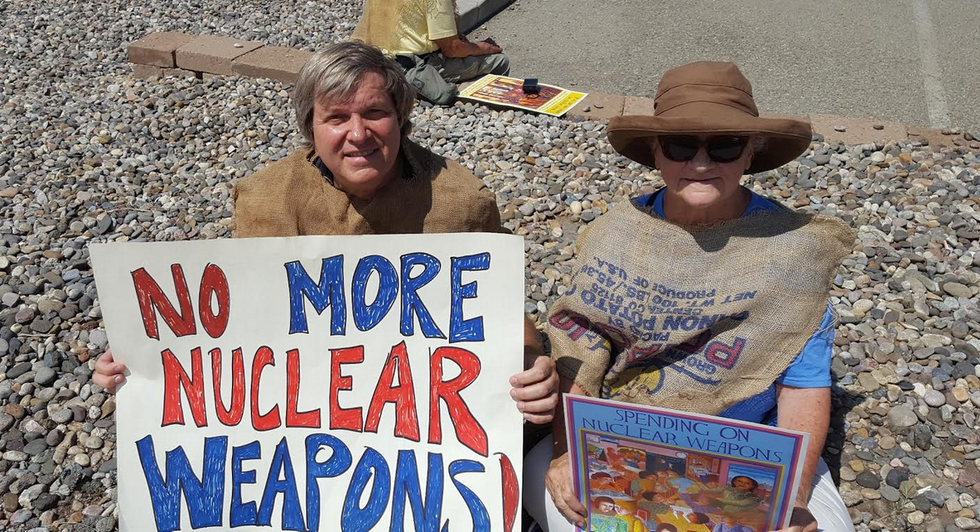
Cars and truck drive by honking, but not in support. Police officers watch from their air-conditioned trucks ("Your people are so old, Father John, we're worried that one of them is going to have a heat stroke," one says to me.) It's over 90 degrees, but we sit anyway, taking over the town, saying our NO!, accepting responsibility, and begging for the miracle of nuclear disarmament. We are, to say the least, abnormal.
Afterwards we gather back in the park to hear leading anti-nuclear activists speak about their work and our next steps. I introduce each one, heartened by their tireless dedication, the seemingly impossible task they have set before themselves, and the visionary connections they make between the Labs and racism, poverty, healthcare and environmental destruction.
Our act, I explain, is the oldest known political protest, straight from the Hebrew Bible, from the book of Jonah, where Jonah, a reluctant peace activist, walks through Ninevah, calls the people to repent of their violence, and the whole town dons sackcloth, including the cattle, sits in ashes, and pledges to be nonviolent. Everyone repents, they wake up from their madness, and learn to live in peace happily ever after. It's the only "successful," happy-ending protest in the Bible.
Of course, Nineveh today is the Iraqi town of Mosul, where the United States dropped depleted uranium and killed thousands. Now the cattle give birth to deformed, still born creatures.
As God tries to explain to poor Jonah, "These people don't know their left hand from their right hand." What must the God of peace think of us?
"The solution lies in a global, bottom up, people power, grassroots movements of nonviolence, the likes of which the world has never seen."
If we are to wake up and help one another come to our senses and begin the long haul task of nuclear disarmament, environmental cleanup and right distribution of these trillions of dollars to the world's poor, we need to publicly break through the normalcy of our collective insanity.
My friends and I will be back next year, and are already organizing for August 6 and 9, 2020, the 75th anniversary of Hiroshima and Nagaski. I've invited everyone I can think of to come join us, from Pope Francis and the Dalai Lama to Joan Baez and the Indigo Girls (Joan, Amy--will you please come?) Plan now to join us.
The solution lies in a global, bottom up, people power, grassroots movements of nonviolence, the likes of which the world has never seen, way beyond the achievements of Gandhi and Dr. King. I think that is happening across the planet; it's just not being reported by the mainstream media, even by the alternative media.
Regardless, our job is to keep on organizing, taking action and speaking out publicly for disarmament and justice, making the connections, waking one another up, and building that global grassroots movement of nonviolence.
We have to help people see that nuclear disarmament, justice, and environmental protection is what's normal, human, and Godly. Until then, we have to risk being seen as the abnormal ones, sitting at the intersection of Oppenheimer Way and Trinity Drive.
Next month, our group CampaignNonviolence.org will hold its fifth national week of action from Sept. 15-23, with over 2,000 marches and events across the nation, in every state and major city, against war, poverty, racism, nuclear weapons and environmental destruction, and for the coming of a new culture of peace and nonviolence.
On September 22, we will gather at 9 a.m. at the Dr. King statue in Washington, D.C., for reflections, then march in pairs and silence pass the Lincoln Memorial to the White House for a vigil and nonviolent direct action. (For more details see: www.campaignnonviolence.org). As far as I can tell, it's the first march ever from the Dr. King statue. We want to take a message of justice and disarmament to the White House in a spirit of Kingian nonviolence, and call for new nonviolent solutions, a new culture of nonviolence.
Perhaps some day we might learn the difference between our left hand and our right hand. On that day, we will all learn the wisdom of nonviolence and abolish nuclear weapons and war forever.
It was close to midnight, and I was sitting at a small campfire with Sybilla and Josh Medlin in back of an old warehouse in an impoverished section of the city. The Medlins paid $20,000 for the warehouse. It came with three lots. They use the lots for gardens. The produce they grow is shared with neighbors and the local homeless shelter. There are three people living in the warehouse, which the Medlins converted into living quarters. That number has been as high as 10.
"It was a house of hospitality," said Josh, 33, who like his wife came out of the Catholic Worker Movement. "We were welcoming people who needed a place to stay, to help them get back on their feet. Or perhaps longer. That kind of didn't work out as well as we had hoped. We weren't really prepared to deal with some of the needs that people had. And perhaps not the skills. We were taken advantage of. We weren't really helping them. We didn't have the resources to help them."
"For the Catholic Workers, the ratio of community members to people they're helping is a lot different than what we had here," Sybilla, 27, said. "We were in for a shock. At the time there were just three community members. Sometimes we had four or five homeless guests here. It got kind of chaotic. Mostly mental illness. A lot of addiction, of course. We don't know how to deal with hard drugs in our home. It got pretty crazy."
Two or three nights a month people gather, often around a fire, in back of the warehouse, known as Burdock House.
"The burdock is seen as a worthless, noxious weed," Josh said. "But it has a lot of edible and medicinal value. A lot of the people we come into contact with are also not valued by our society. The burdock plant colonizes places that are abandoned. We are doing the same thing with our house."
Those who come for events bring food for a potluck dinner or chip in five dollars each. Bands play, poets read and there is an open mic. Here they affirm what we all must affirm--those talents, passions, feelings, thoughts and creativity that make us complete human beings. Here people are celebrated not for their jobs or status but for their contributions to others. And in associations like this one, unseen and unheralded, lies hope.
"We are an intentional community," said Josh. "This means we are a group of people who have chosen to live together to repurpose an old building, to offer to a neighborhood and a city a place to express its creative gifts. This is an alternative model to a culture that focuses on accumulating as much money as possible and on an economic structure based on competition and taking advantage of others. We value manual labor. We value nonviolence as a tactic for resistance. We value simplicity. We believe people are not commodities. We share what we have. We are not about accumulating for ourselves. These values help us to become whole people."
The message of the consumer society, pumped out over flat screen televisions, computers and smartphones, to those trapped at the bottom of society is loud and unrelenting: You are a failure. Popular culture celebrates those who wallow in power, wealth and self-obsession and perpetuates the lie that if you work hard and are clever you too can become a "success," perhaps landing on "American Idol" or "Shark Tank." You too can invent Facebook. You too can become a sports or Hollywood icon. You too can rise to be a titan. The vast disparity between the glittering world that people watch and the bleak world they inhabit creates a collective schizophrenia that manifests itself in our diseases of despair--suicides, addictions, mass shootings, hate crimes and depression. Our oppressors have skillfully acculturated us to blame ourselves for our oppression.
Hope means walking away from the illusion that you will be the next Bill Gates, Mark Zuckerberg, Kim Kardashian. It means rejecting the lust for public adulation and popular validation. It means turning away from the maniacal creation of a persona, an activity that defines presence on social media. It means searching for something else--a life of meaning, purpose and, ultimately, dignity.
The bottomless narcissism and hunger of consumer culture cause our darkest and most depraved pathologies. It is not by building pathetic, tiny monuments to ourselves that we become autonomous and free human beings; it is through acts of self-sacrifice, by recovering a sense of humility, by affirming the sanctity of others and thereby the sanctity of ourselves. Those who fight against the sicknesses, whether squatting in old warehouses, camped out at Zuccotti Park or Standing Rock or locked in prisons, have discovered that life is measured by infinitesimal and often unseen acts of solidarity and kindness. These acts of kindness, like the nearly invisible strands of a spider's web, slowly spin outward to connect our atomized and alienated souls to the souls of others. The good, as Daniel Berrigan told me, draws to it the good. This belief--held although we may never see empirical proof--is profoundly transformative. But know this: When these acts are carried out on behalf of the oppressed and the demonized, when compassion defines the core of our lives, when we understand that justice is a manifestation of this solidarity, even love, we are marginalized and condemned by the authoritarian or totalitarian state.
Those who resist effectively will not negate the coming economic decline, the mounting political dysfunction, the collapse of empire, the ecological disasters from climate change, and the many other bitter struggles that lie ahead. Rather, they draw from their acts of kindness the strength and courage to endure. And it will be from their relationships--ones formed the way all genuine relationships form, face to face rather than electronically--that radical organizations will be created to resist.
Sybilla, whose father was an electrician and who is the oldest of six, did not go to college. Josh was temporarily suspended from Earlham College in Richmond, Ind., for throwing a pie at William Kristol as the right-wing commentator was speaking on campus in 2005. Josh never went back to college. Earlham, he said, like most colleges, is a place "where intellectualism takes precedence over truth."
"When I was in high school I was really into the punk rock community," Sybilla said. "Through that I discovered anarchism."
"Emma Goldman?" I asked.
"Yeah, mostly that brand of anarchism," she said. "Not like I'm going to break car windows for fun."
She was attracted to the communal aspect of anarchism. It fit with the values of her parents, who she said "are very anti-authoritarian" and "who always taught me to think for myself." She read a book by an anonymous author who lived outside the capitalist system for a couple of years. "That really set me on that direction even though he is a lot more extreme," she said, "only eating things from the garbage. Train hopping. As a teenager, I thought, 'Wow! The adventure. All the possible ways you could live an alternative lifestyle that's not harmful to others and isn't boring.' "
When she was 18 she left Anderson and moved to Los Angeles to join the Catholic Worker Movement.
"I [too] became pretty immersed in the anarchist scene," Josh said. "I'm also a Christian. The Catholic Worker Movement is the most well known example of how to put those ideas in practice. Also, I really didn't want anything to do with money."
"A lot of my friends in high school, despite being a part of the punk rock community, went into the military," Sybilla said. "Or they're still doing exactly what they were doing in high school."
The couple live in the most depressed neighborhood of Anderson, one where squatters inhabit abandoned buildings, drug use is common, the crime rate is high, houses are neglected and weeds choke abandoned lots and yards. The police often never appear when someone from this part of the city dials 911. When the police do appear they are usually hostile.
"If you're walking down the street and you see a cop car, it doesn't make you feel safe," Josh said.
"A lot of people view them [police] as serving the rich," Sybilla said. "They're not serving us."
"Poor people are a tool for the government to make money with small drug charges," she added. "A lot of our peers are in jail or have been in jail for drugs. People are depressed. Lack of opportunity. Frustration with a job that's boring. Also, no matter how hard you want to work, you just barely scrape by. One of our neighbors who is over here quite a bit, he had a 70-hour-a-week job. Constant overtime. And he still lives in this neighborhood in a really small one-bedroom apartment. I think Anderson has really bad self-esteem. A lot of young people, a lot of people my age I know are working for $9, $10 an hour. Moving from job to job every six months. Basically, enough money to buy alcohol, cigarettes and pay the rent."
"My mom's generation grew up thinking they were going to have a solid job," she said. "That they were just going to be able to start a job and have a good livelihood. And that's not the case. Just because you want to work really hard it doesn't necessarily mean you're going to make it."
"I work as a cashier at the local Christian college," she said. "It's a small school with 2,000 students. I work in the cafeteria. The contract changed. The school stopped doing its own food service many years ago. Has been hiring private companies. After I worked there for a year the contract was up. It was a new company and they're huge. ... I think it's the biggest food service company. They do most hospitals, schools, prisons. And the job conditions changed so dramatically. Our orientation with this new company, they had this HR guy come. He's like, 'You're going to work for the biggest company in the world. You should be so excited to be a part of our team. We're going to make you great. Anderson used to be this really powerful city full of industry. The employees demanded so much from the companies. And [the companies] all left.' "
"We're just looking at him," she said. "Why is this relevant? Basically the message was, 'You guys have no other choice. So you don't choose to work with us. You have to. And we're going to do what we want you to do.' At the time I was taking $7.50 an hour. They hired me at $7.50 from the old company. They hired the people beside me for $8, which I was not happy with. The old employees were making more money because they got consistent raises throughout the years. They would have them do jobs like carrying crates of heavy food up the stairs. Or they moved them to the dish room. Jobs that they knew they physically couldn't do, in hopes that they would quit. I think. They didn't want to pay that higher wage. And the students weren't happy either. So many employees were really upset. Everyone was talking about quitting. We lost about half the workforce. There were 100 employees when they came in. They had reduced down to 50. That makes my job twice as hard. But I still make $7.50. With no hope for a raise anytime soon."
"I went up to them," she continued. "I said, 'I need to make as much as these people at least. I've been here for a year. I'm a more valuable employee.' And they were like, 'If you don't like it, quit. Maybe you can get a job at Burger King.' I was so angry. How dare they tell me to quit. I started talking to some of my co-workers to see if they were interested in making the job better rather than quitting. And a lot of them were. Especially the people who'd been there for years and years and who were familiar with GM and UAW [the United Automobile Workers union]. And weren't scared of it. So we started having meetings. I think the campaign took two years. And we successfully organized. It's been a huge improvement. Even though it's still a low-paying job, everything is set. They can't change their mind about when we get raises. They can't change their mind about what the hiring rate is. They can't take these elderly people and make them start carrying boxes rather than run a cash register. They were also firing people for no reason. That doesn't happen anymore. ... The employees have a voice now. If we don't like something, when our contract is up for renegotiation we can change it."
"The jobs we have are boring," she said. "My job was so boring. Having this as an outlet, also with the challenge of creating the union there, I was able to not feel so useless."
Sybilla also publishes The Heartland Underground. The zine, which sells for $2 a copy and comes out every four or five months, reviews local bands like the punk group Hell's Orphans, publishes poets and writers and has articles on subjects such as dumpster diving.
In a review of Hell's Orphans, which has written songs such as "Too Drunk to Fuck" and "Underage Donk," the reviewer and the band sit in a basement drinking until one of the band members, Max, says, "Feel free to take anything we say out of context. Like, you can even just piece together individual words or phrases." (Donk, as the article explains, is "a slang term for a very round, attractive, ghetto booty and is a derivative of the term Badonkadonk.") The review reads:
Hell's Orphans has really played some unusual shows like a high school open house, a show in a garage where the audience was only four adults, four kids, a dog and a chicken, and out of the Game Exchange a buy/sell/trade video game store. They've also played under some uncomfortable circumstances like a flooded basement in which Nigel was getting shocked by the mic and guitar every few seconds and at the Hollywood Birdhouse one night when Max and Nigel were both so paranoid on some crazy pot that they were also too frozen to perform and couldn't look at the audience. For such a young band that has done zero touring they've had a lot of adventures and experiences.
A poet who went by the name Timotheous Endeavor wrote in a poem titled "The Monkey Song":
please just let me assume
that there is room for us and our lives
somewhere between your lies
and the red tape that confinesplease just let me assume
we're all monkeys
we're trained to self alienate
but it's not our fatesi was walking down the road
i wonder if there's anywhere around here
that i am truly welcome
spend my dollar move along
past all of the closed doors
In one edition of The Heartland Underground there was this untitled entry:
They pay me just to stay out of thier [sic] world. They don't want me at work I would just get in their way. They pay me just to sit at home. I feel things harder and see with such different eyes it's easier for everyone if I just stay at home, if I just stay out of their world and wait to die. I am not inept. I just don't fit into their neatly paved grids, their machines and systems.
There is no place for a schizophrenic in this world and there is no place for anything wild, crooked, or untamed anymore. When did things go so wrong? Everything is wrong!! They paved paradise and put up a parking lot. They paved the entire fucking planet. I'm on a mission to liberate myself from all the lies that poison me and rot inside my mind, holding me captive and causing me to hate myself and the world. I'm ready to stop hating! I'm ready to become fully human and join life.
The truth is: We're all drowning.
They think I'm crazy? At least I can see that I'm drowning. No one else is in a panic because they can't see or feel how wrong everything is. I don't want to drown. I want to swim and climb up to a high place. I want to rise above.
Arbitrary Aardvark wrote an article called "I was a Guinea Pig for Big Pharma," about earning money by taking part in medical experiments. He would stay in a lab for about two weeks and take "medicine, usually a pill, and they take your blood a lot. You might be pissing in a jug or getting hooked up to an EKG machine or whatever the study design calls for, and they take your blood pressure and temperature pretty often." He made between $2,000 and $5,000 depending on how long the study lasted. Most of his fellow "lab rats" were "just out of jail or rehab." In one study he had a bullet-tipped plastic tube inserted down his nose into his intestines. "It was the most painful thing I've been through in my adult life." He said he and the other subjects did not like reporting side effects because they were "worried that they'll be sent home without a full paycheck, or banned from future studies." He admitted this probably affected the viability of the studies. He became ill during one of the experiments. The pharmaceutical company refused to pay him, blaming his illness on a pre-existing condition. He wrote:
I signed up for one that was going to pay $5,000, but a week into it my liver enzymes were all wrong, and they took me out of the study but kept me at the site, because I was very sick. It turned out I'd come down with mono just before going into the study. And then I got shingles, not fun. ...
I'd spent 3 years trying to be a lawyer and failed. I'd worked in a warehouse, as the Dalai lama's nephew's headwaiter, as a courier and a temp. Lost money day trading and then in real estate. I was ready to try medical experiments again. I tried 3 times to get in at Eli Lilly but never did. Lilly no longer does its own clinical trials after a girl ... killed herself during an anti-depressant study. ...
Jared Lynch wrote an essay titled "Sometimes the Voices in Your Head are Angry Ghosts" that included these lines:
Death shrouded the whole spacetime of the latter half of high school, coating it in an extra vicious layer of depression. The first night we stayed in the house I sat in the living room, writing about ghosts in a composition book... I had a package of single edge blades in the back of my top desk drawer and sometimes I flirted too closely with that edge of darkness. I thought a lot about the blades at school. My daydreams were consumed by untold suicides, and countless times I came home to find one of my past selves in the tub with his forearm opened wide and grinning with his life essence surrounding him in the tub on the wrong side of his skin.
It was a strange, beautiful time. Melancholia wrapped around the edges with the golden glow of nostalgia for a time that felt like I had died before it existed... I fell into an expected, but incredibly deep pool of depression and I found the single edge razors that one of my future had so graciously left behind in my top drawer. I bled myself because I wanted to be with the lovely, lonely ghosts. I bled myself more than I ever had, but I didn't bleed enough to capture myself in the barbs of the whirlpool of my depression.
He ended the essay with "I still bear my scars."
Tyler Ambrose wrote a passage called "Factory Blues."
What is a factory? What is a factory? A factory is a building of varied size. Some immense tributes to humanistic insatiability, others homely, almost comfortable. Mom and Pop type places, each run-down corner lot a puzzle piece in a greater maze. Gears if you will, all part of the capitalism machine. Some so small they fall out like dandruff, plummeting into the furnaces that keep the monster thriving. Constantly shaking loose another drop of fuel from its decaying hide. For the more fuel it consumes, the drier and deader does its skin become. Until one day, when all the skin has fallen into the fires, and all that remains are rustic factory bones, the beast will fall, and all the peoples of the earth will feel its tumble. And all will fall beside it, when its decaying stench kills the sun.
The cri de coeur of this lost generation, orphans of global capitalism, rises up from deindustrialized cities across the nation. These Americans struggle, cast aside by a society that refuses to honor their intelligence, creativity and passion, that cares nothing for their hopes and dreams, that sees them as cogs, menial wage slaves who will do the drudgery that plagues the working poor in postindustrial America.
Parker Pickett, 24, who works at Lowe's, is a poet and a musician. He frequently reads his work at Burdock House. He read me a few of his poems. One was called "This is a poem with no Words." These were the concluding lines.
out of, the affection I receive from concrete whether broken or spray
painted, the old men want that money now want that control even
though they are sad and delusional, if I could I would die from the beauty
of her eyes as they shudder and gasp and relax with natural imperfections which
I hold in high regards, the glow of the city around me reaches to the night
sky, a slate of black chalkboard I wipe off the stars with my thumb one
by one, songs end stories end lives end, but the idea of some grand, silly
truth to everyone and everything with never die, we are born in love with precious life, and with that truth I will giggle and smile until I'm laid to rest in my
sweet, sweet grave.
I sat on a picnic table next to Justin Benjamin. He cradled his guitar, one of his tuning pegs held in place by locking pliers. The fire was dying down. Justin, 22, calls himself WD Benjamin, the "WD" being short for "well dressed." He wore a white shirt, a loosely knotted tie and a suit coat. He had long, frizzy hair parted in the middle that fell into his face. His father was a steelworker. His mother ran a day care center and later was an insurance agent.
"Kids would talk about wanting something better or leaving," he said. "Yet they weren't doing steps to take it. You saw they were going to spend their whole lives here begrudgingly. They would talk stuff. They would never do anything about it. It was all just talk."
He paused.
"Substance [abuse] ruined a lot of lives around here," he said.
He estimates that by age 14 most kids in Anderson realize they are trapped.
"We had seen our parents or other people or other families not go anywhere," he said. "This business went under. Pizzerias, paint stores, they all go under. About that time in my life, as much as I was enthralled with seeing cars rushing past and all these tall buildings, we all saw, well, what was the point if none of us are happy or our parents are always worrying about something. Just not seeing any kind of progression. There had to be something more."
"I've had friends die," he said. "I had a friend named Josh. We'd say, 'He Whitney Houston-ed before Whitney Houston.' He pilled out and died in a bathtub. It happened a month before Whitney Houston died. So that was a weird thing for me. Everyone is going to remember Whitney Houston but no one will remember Josh. At the time he was 16."
"I see friends who are taking very minimal jobs and never thinking anywhere beyond that," he said. "I know they're going to be there forever. I don't despise them or hold anything against them. I understand. You have to make your cut to dig out some kind of a living. ... I've done manual labor. I've done medical, partial. Food service. I've done sales. Currently I'm working on a small album. Other than that, I play for money. I sell a lot of odds and ends. I've been doing that for years. Apparently I have a knack for collecting things and they're of use for somebody. Just paying my way with food and entertainment for somebody. I live right across from the library. Eleventh Street. I can't remember the address. I'm staying with some people. I try to bring them something nice, or make dinner, or play songs. I do make enough to pay my share of utilities. I wouldn't feel right otherwise."
He is saved, he said, by the blues--Son House, Robert Johnson, all the old greats.
"My finger got caught in a Coke bottle trying to emulate his style of slide guitar," he said of House. "I asked my dad to help me please get it out. There was just something about people being downtrodden their whole lives. I used to not understand the plight of the black community. I used to think why can't they just work harder. I was raised by a father who was very adamant about capitalism. Then one day my sister-in-law told me, 'Well, Justin, you just don't understand generational poverty. Please understand.' People were told they were free yet they have all these problems, all these worries. ... It's the natural voice. You listen to Lead Belly's 'Bourgeois Blues,' it's a way of expressing their culture. And their culture is sad. 'Death Don't Have No Mercy' talks about the great equalizer of death. It didn't matter if you're black or white, death will come for you."
He bent over his guitar and played Robert Johnson's "Me and the Devil Blues."
Early this morning
When you knocked upon my door
Early this morning, oooo
When you knocked upon my door
And I said hello Satan
I believe it's time to go
"I've seen a lot of GM people, they just live in this despair," he said of the thousands of people in the city who lost their jobs when the General Motors plants closed and moved to Mexico. "They're still afraid. I don't know what they're afraid of. It's just the generation they came out of. I worked with plenty of GM people who were older and having to work for their dollars begrudgingly. They're like, 'I was made promises.' "
"I was born 3 pounds," he said. "I was not destined for this world. Somehow I came out. I did the best I could. That's all I've done. I'll never say I'm good at anything. At least I have the ability to think, speak and act. Three pounds to this now. I just can't see the use of not fighting. You always have to think about what's going to lay down in the future. What's going to happen when the factories close down? Are you going to support your fellow co-workers? Are you going to say, 'No, things will come back?' Are you going to cast everything to damnation? Cast your neighbors down, say it was their fault the jobs are gone."
"I've never seen the heights of it," he said of capitalism. "But I've seen the bottom. I've seen kids down here naked running around. I've seen parents turn on each other and kids have to suffer for that. Or neighbors. I'd just hear yelling all night. It's matters of money. It's always the kids that suffer. I always try to think from their perspective. When it comes down to kids, they feel defeated. When you grow up in a household where there's nothing but violence and squabbling and grabbing at straws, then you're going to grow up to be like that. You're going to keep doing those minimum jobs. You're fighting yourself. You're fighting a system you can't beat."
"I've seen poets, phenomenal guitarists, vocalists, percussionists, people who have tricks of the trade, jugglers, yo-yo players, jokesters," he went on. "I admire those people. They might go on to get a different job. They might find a sweetheart. They might settle down. They have that thing that got them to some point where they could feel comfortable. They didn't have to work the job that told them, 'So what if you leave? You don't matter.' I know a fellow who works at the downtown courthouse. Smart as can be. One of my favorite people. We talk about Nietzsche and Kafka in a basement for hours. The guy never really let the world get him down. Even though he's grown up in some rough situations."
And then he talked about his newborn niece.
"I wrote this in about 10 minutes," he said. "I race down the street because no one else was available. I went to a friend. I said, 'I wrote a song! I think it's neat. I don't think it's good. But I like the idea.' I'd never done that."
He hunched back over his guitar and began to play his "Newborn Ballad."
You were brushed and crafted carefully
They knew young love and now they know you
How two lives figure into one beats me
But either I'm sure they'll agree with youYour eyes will open proud I pray
May the breakneck sides around you come down
Little darling I'll be your laughing stock
So the mean old world won't get you downI ain't gonna say I ain't crazy
All are fronting and pestering your soul
When we first meet I can promise to
To listen, to play with, to talk to, to loveThere's nothing no better they'll tell you
Than your youth, no weight will end
No matter the preference child hear me
Not a moment you'll have will be absentMy pardon, my dearest apologies
For the scenes and the faces I make
For now you might find them quite funny
But they'll get old as will I, I'm afraidYour comforts they don't come easy
With an hour twenty down the road
We made lives in telling you sweetly
But you can make it, we love you, you know.
Nuclear war is coming. Our officials are currently increasing the chances of that.
I only write ominous op-ed pieces like this in the spirit of hoping I'm an inaccurate prophet. But I'm unable to avoid the difficult conclusion that nuclear war, absent an immediate, fundamental, worldwide change in attitude, is an inevitable part of our future. It could be weeks, months, or years away. But it is coming.
Nuclear war is coming. Our officials are currently increasing the chances of that.
I only write ominous op-ed pieces like this in the spirit of hoping I'm an inaccurate prophet. But I'm unable to avoid the difficult conclusion that nuclear war, absent an immediate, fundamental, worldwide change in attitude, is an inevitable part of our future. It could be weeks, months, or years away. But it is coming.
It could break out at any moment between India and Pakistan, the most likely scenario at present. Pakistan is deploying tactical nuclear weapons controlled by local commanders on the front lines in Kashmir, as if the near-miss of the Cuban crisis of 1962 had never happened. War could almost as likely start between NATO and Russia. It might begin with an accident, a misinterpretation of computer blips, a terrorist act, a careless or calculated overreach by a dictator, or a troubled officer with access to sequestered codes. There are too many weapons of too many sizes connected by too many complex but imperfect electronic systems to too many fallible human beings.
If it happens, all our incremental steps toward a semblance of world order will disappear in a few minutes of unimaginable destruction, to be replaced by a barbaric chaos where medical facilities are overwhelmed and water and food supplies are contaminated. Those still alive at the periphery of the blasts will envy those annihilated at the center.
The effects will be experienced around the world, even from a so-called "regional" war. As the ash and soot and radioactive particles from the detonations rise into the upper atmosphere and disperse upon the winds, we will learn just how small a planet we inhabit together--a lethal lesson with no do-over.
The political fallout will be equally grave and far-reaching. Those leaders who made lukewarm but ineffectual efforts to control the weapons, who paid lip service to non-proliferation treaties, who made high-minded speeches while convinced that disarmament initiatives would mean the end of their electability, will feel a remorse that screams within like the howling mobs that will surround their offices and palaces demanding to know why the leaders let disaster happen.
Not a day goes by that I do not ponder why it has not happened already. However ignored, this issue has hung over our lives like a gray pall. Working to prevent nuclear war has provided invaluable moments of shared hope, but feelings of foreboding have dominated. Morbid preoccupation seems less neurotic than total denial. Anyone who admits the urgency of this issue cringes and waits and wonders when, say, the radio goes temporarily dead--has it finally happened? There's also the magical thinking that says that since it has not yet happened, there may indeed be miraculous hidden forces at work, helping us avoid the worst until we grow mature enough to realize our folly.
History suggests to us that divine intervention will not prevent the worst. It did not stop the Nazi holocaust. Nuclear weapons were conceived and created by people. People are equally capable of realizing that such weapons have not led, and cannot lead, to the global security we seek. It is this logical conclusion, sidestepped and diluted by hundreds of thousands of "experts," but clear enough to the average 10-year-old, that can be the shared basis of universally applied, reciprocal negotiations toward absolute and total abolition. The world would rejoice in relief if it happened.
We have been gifted with the capacity to see. Instead, we are very close to doing ourselves in.Meanwhile we remain stubbornly blind. How much more deeply could we fail our 10-year-olds than by introducing them to a world where such hideous and unmerited suffering hangs over them? The bumper-sticker question persists: do we hate our enemies more than we love our children?
We have kept these weapons at the ready as our primary way to avoid looking at our own darkness. We have projected evil motives upon a series of less-than-fully-human stereotypes, from the toothy, sadistic, slant-eyed Orientals (suddenly transformed back into agonized human beings at Hiroshima and Nagasaki), to brutal, corrupt, vodka-swilling Soviets, to bearded, misogynistic Islamic thugs. And the real people behind these crude and false stereotypes have projected the same malevolence onto us. Out of this "us-and-them" animosity has arisen the systemic evil of world-destroying weapons.

Our mutual fear can only be mastered by living the golden rule common to all major religions, of doing as you would wish to be done by. Refusal to heed this practical advice has borne a perverse shadow-version of the universal rule of interdependence: if you do harm unto me, I will destroy you utterly--even if it also destroys me in the process!
We need to see, with the same visceral fright that we respond to a poisonous snake rearing up and baring its dripping fangs, the immediacy of the danger we face.
On this earth the universe has tried an experiment in consciousness, an experiment in learning to see what causal conditions lead to life and what lead to death.
We have been gifted with the capacity to see. Instead, we are very close to doing ourselves in. We ignore the life-affirming realism of Jesus, Gandhi, the Dalai Lama and Martin Luther King in favor of the illusory "realism" of Kissinger, Cheney, Trump and Cruz. Millions on the planet continue to work their hearts out to wake people up to reasonable alternatives based in common interest and common sense.
May they prove my pessimism wrong.
Modern Romance, by Aziz Ansari and Eric Klinenberg
Internet dating and social media have made the path to finding romantic love easier in some ways and more fraught in others, according to Modern Romance, written by comedian Aziz Ansari and sociologist Eric Klinenberg. The benefits of online resources are pretty obvious: Your chance of meeting someone that you click with increases with the more people you meet. But, the downside of this wealth of opportunity is that people tend to rush to judgment based on superficial information and to constantly second-guess themselves about whether, by dating someone, they may be settling too soon and missing out on Mr. or Ms. Right.
Ansari humorously recounts his angst around texting potential dates--like having to decide how soon to respond to someone's text and spending hours crafting texts that are devoid of clear intentions. Because this can lead to insecurity and confusion, though, he suggests that texting should be used minimally and only to secure face-to face-contact--still the best way to truly connect with someone and to gauge romantic interest.
The book also tackles how technology has affected ongoing relationships, via sexting, pornography, and opportunities for betrayal. Some of his observations provide important food for thought for those of us no longer in the dating scene. Ansari shows that, while the pursuit of romance may have been changed by technology, the desire for romance remains untarnished.
Unfair: The New Science of Criminal Injustice, by Adam Benforado
There is an ongoing national debate over bias in policing, which has led to some much-needed soul searching around racism and the lack of impartiality in the criminal justice system. In Unfair, law professor Adam Benforado combs through decades of social science research to demonstrate that many of the tools we use to fight crime--from interrogating the accused to solitary confinement for prisoners--are inherently flawed, too often harming the innocent rather than serving justice and keeping our communities safe.
Humans don't understand the way our minds work and the biases we carry, and therein lies the problem. We tend to see the world and make decisions about others based on gut reactions, circumstantial evidence, and preconceived notions, which leads to an unfair justice system that too often punishes the poor and disenfranchised.
Despite these limitations, there is room for hope. Benforado makes many practical suggestions of how to overcome bias--first by learning to recognize it, then changing procedures to counteract it. But, we must also open our hearts if we want change: "Our greatest opportunity for achieving true justice is learning when to override our basic instincts and when to draw on our deep well of empathy."
Rising Strong, by Brene Brown
We all do things we regret in life. But, when we fail in some way, the desire to push shame away can make us run and hide or blame others for our bad feelings--a kind of fight-or-flight response to the "danger" of difficult emotions. In Rising Strong, Brene Brown, a social work researcher at the University of Houston, provides guidance on how to process our shame and respond in a healthier, more compassionate way.
Brown explains how our brains are constantly working to put together narratives to explain our experience, and how our narratives can be sidetracked by strong emotions. The book is full of stories of people facing adultery, ineptness at work, and other shaming experiences, and how they overcame shame using Brown's model of "reckoning, rumbling, and resolution"--meaning, recognizing your emotional reactions and not being afraid to explore them, discovering the stories you tell yourself to explain your emotions and how they may be misleading you, and using this understanding to take a different approach to the situation and to responding to others. If you learn to accept your vulnerabilities and own your strengths, says Brown, you can find more connection, creativity, and safety to be your authentic self.
The Sweet Spot: How to Find Your Groove at Home and Work, by Christine Carter
Do you ever feel like your life is a long to-do list? Christine Carter's The Sweet Spot is a highly readable, diligently researched advice book that offers concrete tips on how to get off the treadmill of busyness byfocusing on what's important in life, letting go of distractions, and using the science of happiness to discover your "sweet spot"--"that place where you have both great strength and great ease."
Finding your sweet spot doesn't necessarily involve making radical changes; in fact, part of the appeal of Carter's book is that her focus is on making small changes that can be leveraged for greater relief. She suggests getting better control over your Internet use, having routines that eliminate constant decision-making, and saying "no" to whatever takes you away from your priorities, while saying "yes" to getting exercise, finding time to chill, and making time to connect with others--a surefire path to increasing personal well-being and happiness.
Triumph of the Heart: Forgiveness in an Unforgiving World, by Megan Feldman Bettencourt
Is there any reason to consider forgiveness as a better option than punishing those who've wronged us? Yes, according to journalist Megan Feldman Bettencourt's Triumph of the Heart. Research has shown that forgiveness helps victims heal from emotional pain and promotes better health and well-being. And, forgiveness can help end cycles of violence and retribution in families and communities, by increasing trust and cooperation over time.
Bettencourt dispels myths that say forgiveness means being weak or letting perpetrators off the hook. Instead, she shows how forgiveness frees the wronged victim more than the perpetrator, allowing a victim to move on with life feeling greater ease and safety, and often gaining a sense of empowerment and purpose. Though not a linear process, there are steps many victims take to forgiveness, including developing empathy for the offender, reinterpreting wrongs as less personal, understanding our common humanity, and finding a sense of purpose for moving forward.
Bettencourt recounts inspiring stories of forgiveness from around the world, highlighting individuals and programs that promote forgiveness through restorative justice and other practices. She encourages us all to do a better job of forgiving others for slights experienced in everyday life, by practicing mindfulness, empathy, and compromise in conflict situations.
The Best Place to Work: The Art and Science of Creating an Extraordinary Workplace, by Ron Friedman
In The Best Place to Work, Friedman, a psychologist and business consultant, distills decades of research on motivation, creativity, and performance to provide both business leaders and their employees with useful tips for restructuring work environments to increase innovation, efficiency, and even joy in the workplace.
Some of Friedman's suggestions to employers are counterintuitive--such as embracing failure in employees and encouraging them to pursue outside interests or take short naps on company time. These techniques, he argues, help employees broaden their thinking and make cognitive connections, which are important for innovation. For employees, he suggests seeking greater challenge and variety in job assignments and practicing gratitude to increase happiness and productivity.
Overall, Friedman recommends three ingredients for better workplace environments for employees: autonomy, competence, and relatedness. Though relatedness may be the most overlooked aspect of employee engagement, research shows that having a best friend at work increases employee focus, passion, and loyalty, and decreases sick time and workplace accidents--all good for the bottom line.
The Wisest One in the Room: How You Can Benefit from Social Psychology's Most Powerful Insights, by Thomas Gilovich and Lee Ross
To be a wise person, it's not enough to have knowledge; you also need insight and good judgment, which requires an understanding of what makes people tick. In The Wisest One in the Room, renowned psychologists Tom Gilovich and Lee Ross share some of the most salient insights gleaned from social science research to educate readers about why people behave the way they do so that they can increase their success in influencing others and creating positive change in the world.
Science has shown that many of us suffer from biases we are not aware of, such as thinking that we see the world as it truly is and that others are blind, or trusting our own instincts too much, or ignoring information that doesn't fit in with our worldview. Understanding how these biases function in our lives can increase our empathy, compassion, and insight, making us wiser and better equipped for designing effective interventions to solve problems in our familial relationships, our institutions, and our society at large.
The Gratitude Diaries: How a Year Looking on the Bright Side Can Transform Your Life, by Janice Kaplan
Sadly, we humans sometimes have trouble being happy, even when our lives seem to be on the right track. We are so wired to look for the bad in any situation that we easily gloss over the things that are going right, making ourselves--and those around us--miserable.
But, according to journalist Janice Kaplan, there's an antidote for this:gratitude.
Kaplan spent a year talking to researchers and applying lessons from the science of gratitude to her everyday life in order to be happier. Her book is full of entertaining stories of how she worked on cultivating gratitude and experienced a multitude of rewards, including improvements in her mood, relationships, and health. Also, hearing directly from the experts--people like Paul Piff, who studies the effect of wealth on giving and gratitude, and Robert Emmons, the preeminent gratitude researcher, for example--grounds Kaplan's personal experience in the science, which makes her journey seem all the more relevant and applicable to us all.
The Opposite of Spoiled: Raising Kids Who Are Grounded, Generous, and Smart About Money, by Ron Lieber
Nobody is dispassionate when it comes to talking about money, and parents are no exception. But the way parents avoid sharing information with children about their financial situation--good and bad--leaves kids woefully unprepared to manage their own financial affairs later in life.
In The Opposite of Spoiled, New York Times columnist Ron Lieber argues that parents need to directly teach kids about money--how much things cost, how to save money and spend it, and how to give it away to others in need. He makes some unintuitive suggestions for how best to help kids learn from having an allowance--for example, by not tying allowance to doing chores and by dividing allowance money into separate accounts for different spending and saving purposes.
Most importantly, Lieber recommends passing on your values of generosity and gratitude to your kids, which will go a long way toward putting money in perspective and making your kids happier and more successful to boot.
The Upside of Stress: Why Stress Is Good for You, and How to Get Good at It, by Kelly McGonigal
For years, Greater Good (among other media outlets) has warned that stress will kill you, and that we need to do everything we can to control and reduce it. With The Upside of Stress, Kelly McGonigal reports and synthesizes a huge amount of research, helping us see stress in an entirely new light. Sure, writes McGonigal, stress can signal danger, triggering the classic "fight, flight, or freeze" response that we've heard so much about. But the research that shaped that view was conducted mainly on men, which means the politics and culture of masculinity affected our conclusions. She highlights an alternative stress response uncovered by research into stressed-out women: "tend and befriend," which motivates us to connect with other people in order to cope with stressful situations.
McGonigal explains that a tend-and-befriend response may have evolved to help us protect offspring; but the bravery it inspires can translate to any challenge we face. Whenever we care for others, it activates systems of the brain that produce feelings of hope and courage. It's also true, she argues, that not all stress is bad; it can help us rise to meet challenges and, over time, help build resilience. McGonigal's forcefully argued book presents a new and more sophisticated vision of stress as an essential part of life, one that is better understood than resisted. Indeed, her tips for transforming stress into courage and connection promise to make an enormous difference in the lives of the book's readers.
Our Kids: The American Dream in Crisis, by Robert Putnam
"The American Dream" is fast becoming a fantasy, as inequality depletes the middle class and creates two kinds of families: the affluent, and the ones whose children are locked into poverty, diminished achievement, and even impaired neurology and cognition. In Our Kids, political scientist Robert Putnam brilliantly connects the dots between inequality of opportunity and its destructive effects on the social fabric of our society and our children.
While affluent families can still secure the best resources for their children and use "intensive" parenting styles to promote their children's achievement, poor and "fragile" families are distracted and stressed. Poor children attend inadequate schools and can't secure good mentors, while their parents are less responsive to their needs, demanding obedience in a chaotic environment. This parenting style disrupts children's cortisol levels, brain growth, and brain function, so that children living in poverty often have trouble concentrating and learning, and have smaller vocabularies, problems in emotion regulation, and lifelong challenges in physical and mental health.
Of course there are exceptions; but Putnam warns us not to be distracted by the anomalies, nor to label schools and parents as the ultimate cause. The real focus should be on the more universal problem: the alarming inequality of opportunity in the United States.
Altruism: The Power of Compassion to Change Yourself and the World, by Matthieu Ricard
Can people change? Buddhist monk and bestselling author Matthieu Ricard says we are built to change, on physiological, neurological, and even cellular levels. This happens in response to our external environment, he writes--but it can also happen through our intentions.
His new 849-page book, Altruism, is a magisterial summation of decades of research into all the ways that humans can evolve and learn to foster the well-being of others. Studies have shown that meditating for just eight hours on mindfulness, altruistic love, andcompassion can change your brain and the way your genes are expressed, so that you can experience less stress, more happiness, and greater health and well-being.
But Ricard takes this insight one step further, into the realm of social transformation. He quotes the Dalai Lama, for whom Ricard has served as the French interpreter: "Every sentient being, even my enemy, fears suffering as I do and wants to be happy. This thought leads us to feel profoundly concerned for the happiness of others, be they friends or enemies. That is the basis for true compassion. Seeking happiness while remaining indifferent to others is a tragic mistake."
Reclaiming Conversation: The Power of Talk in a Digital Age, by Sherry Turkle
Conversational skills, empathy, and intimacy are fast disappearing in our society, in large part due to our over-attachment to ubiquitous technology. In Reclaiming Conversation, sociologist Sherry Turkle argues that, instead of throwing up our hands or giving in, we need to reclaim conversations and engage more with those around us. Otherwise, we stand to lose much that makes our society work, including introspection and the ability to work productively and creatively together.
The problem is the allure of technology, with its newness and promise of instant relief from boredom, discomfort, or loneliness. We are inadvertently training ourselves--and each other--to be intolerant of solitude, ambiguity, and quiet reflection, all of which are important for fostering creativity and deeper understanding of ourselves. And, if we rely only on online connections for social contact, we lose perspective, shrouding ourselves in fixed ideas that we share only with our networked circle.
Turkle argues that it's time to put down cell phones and computers and spend more time face to face, whether at the dinner table, in the classroom, or in our offices. She makes many practical suggestions of how to use technology more wisely in order to preserve our relationships and keep empathy alive.
If Donald Trump can thrive politically by throwing meat to the American id, what else is possible? How about the opposite?
Trump's most recent attempt to reclaim poll supremacy -- his call for "a total and complete shutdown of Muslims entering the United States until our representatives can figure out what's going on" -- is not simply reckless and dangerous, but also starkly clarifying. America's bully billionaire, so rich he doesn't have to heed the niceties of political correctness, is channeling old-time American racism, as mean and ugly and self-righteous as it's ever been. Jim Crow is still with us. "The only good Indian is a dead Indian" is still with us.
Americans -- at least a certain percentage of them -- like their racism straight up, untampered with code language, unmodified by counter-values. Come on! An enemy's an enemy. A scapegoat's a scapegoat. Don't we have the freedom in this country to dehumanize and persecute whomever we want?
"Trump is a dangerous idiot, but perhaps as he pursues his own interests he is also, unintentionally, helping to crack open the locked vault of American politics."
The unfolding Trump phenomenon is stunning to behold because there's no telling how far -- or where -- it will go. Following his latest reckless "proposals," which include mandatory IDs for Muslims, he's being compared with Adolf Hitler. He's also being called the best friend ISIS could have, as he spreads outrage and hatred across the globe and, in the process, helps foment the same war they're attempting to engage.
Fascinatingly, some of Trump's biggest critics are neocons and fellow Republicans, who, though not that far away from him politically, feel threatened by his reckless candor. The conservative strategy, at least since the Nixon era, has been to use and manipulate American racism rather than directly rouse it to a fever pitch. That sort of volatility isn't so easy to control and could be counterproductive to the economic and geopolitical interests of the stewards of American empire.
For all the baseness of Trump's scapegoat politics, he's doing, it seems, one thing right, which is what makes him unacceptable as the Republican presidential nominee. He's speechifying as though values matter, as though they supersede market and strategic interests. The danger Trump represents cuts in multiple directions.
All of which makes me wonder whether American democracy is, in spite of itself, at a transition point. I mean, it's been decades, from my point of view, since real, society-changing values have been on the line in a presidential election. Questions of war and peace, among much else, have been utterly off the table, with any serious questioning of U.S. militarism ignored and belittled by the mainstream media and completely excluded from the corridors of national decision-making.
The Republicrats rule and war is no longer merely inevitable but eternal. At the same time, the security state has grown like cancer and the prison-industrial complex has expanded exponentially. America in its exceptionalism is the world's largest arms dealer, snoop, jailer and hell raiser. We destabilize the planet in the interests of the corporate few and call it exporting democracy.
And none of this is Donald Trump's doing.
But the fact that he's a threat to this status quo raises some interesting questions. Trump is a dangerous idiot, but perhaps as he pursues his own interests he is also, unintentionally, helping to crack open the locked vault of American politics.
"He's essentially the American id," writes Glenn Greenwald, "simply channeling pervasive sentiments unadorned with the typical diplomatic and PR niceties designed to prettify the prevailing mentality."
The challenge Trump poses, it seems to me, is this: If the basest of human instincts -- fear and revenge and the hunger to blame our troubles on a scapegoat -- can enter, or re-enter, American politics, can the best of human nature enter as well and, in the process, challenge the prevailing status quo more deeply and profoundly than Trump could ever imagine?
Let me put it another way. "In the practice of tolerance," said the Dalai Lama, "one's enemy is the best teacher."
Such a statement poses a serious challenge, of course, on the order of a quote I heard several years ago from a seatmate on a transatlantic airplane flight: You're as close to God as you are to the person you like the least.
What if such ideas had political resonance? What if -- even in the face of tragedy, even in the face of murder -- we lived within a social and political structure that was committed not to dehumanizing and destroying a designated enemy but to understanding that enemy and, my God, looking inward for the cause of problems, not simply flailing outward with high-tech weaponry? What if human compassion, soul deep and without strings attached, played a role in international relations?
Believe me, I'm not asking these questions simplistically, with some pat belief that the answers are obvious. Rather, I'm pressing forward into a dark unknown, or so it seems.
"It is terrifying that on the one hand there is more and more impunity for those starting conflicts, and on the other there is seeming utter inability of the international community to work together to stop wars and build and preserve peace," Antonio Guterres, the U.N. High Commissioner for Refugees, said earlier this year, in the context of a global refugee crisis staggering beyond belief.
To grow spiritually is to begin to realize how little one knows and practice reaching out not with aggression but with humility. This is what takes courage. Can we begin creating nations with this kind of courage, whose "interests" embrace the welfare of the whole planet?
A little over a year ago, I wrote about a Heartland Institute conference in Las Vegas where climate change deniers engaged in a failed attempt to poke holes in the massive body of scientific evidence for human-caused climate change. I quoted Bloomberg News: "Heartland's strategy seemed to be to throw many theories at the wall and see what stuck."
A recent study came to a similar conclusion about contrarian "scientific" efforts to do the same. "Learning from mistakes in climate research," published in Theoretical and Applied Climatology, examined some of the tiny percentage of scientific papers that reject anthropogenic climate change, attempting to replicate their results.
In a Guardian article, co-author Dana Nuccitelli said their study found "no cohesive, consistent alternative theory to human-caused global warming." Instead, "Some blame global warming on the sun, others on orbital cycles of other planets, others on ocean cycles, and so on."
Nuccitelli and fellow researchers Rasmus Benestad, Stephan Lewandowsky, Katharine Hayhoe, Hans Olav Hygen, Rob van Dorland and John Cook note that about 97 per cent of experts worldwide agree on a cohesive, science-based theory of global warming, but those who don't "are all over the map, even contradicting each other. The one thing they seem to have in common is methodological flaws like cherry picking, curve fitting, ignoring inconvenient data, and disregarding known physics."
It's astounding and tragic that, with all the evidence -- from volumes of scientific research to the very real effects we are experiencing everywhere -- some people stubbornly refuse to believe there's a problem worth addressing. Sadder still: Many of them are political leaders.
Part of the problem is that fossil fuel interests spend enormous amounts of money to sow doubt and confusion, often by funding or setting up organizations like the Heartland Institute in the U.S., the Global Warming Policy Foundation in the U.K., Ethical Oil and Friends of Science in Canada and the International Climate Science Coalition, based in this country but affiliated with similar organizations in Australia and New Zealand and with close ties to Heartland. A number of industry-funded websites also promote fossil fuels at the expense of human life, including Climate Depot and Watts Up With That?
These secretive organizations rarely reveal funding sources, prey on the uninformed and ignorant, and blanket the media with opinion articles, letters to editors and comments, often referring to misleading charts and graphs and bogus "studies" from organizations with names that imply they're scientific when they're anything but. They're assisted by a compliant news media and politicians who also receive fossil fuel industry funding. It's likely the people behind these organizations know they're lying but care more about making money and preserving the lopsided benefits of a polluting sunset industry than finding ways to contribute to human health, well-being and survival.
Those who argue that seven billion people pumping massive amounts of greenhouse gases into the atmosphere aren't having a serious negative impact are out to lunch.
Fortunately, most thinking people don't buy the lies. People from all sectors and walks of life -- religious, academic, business, political, activist, social justice and citizenry -- are calling for an urgent response to the greatest threat humanity faces. From Pope Francis and the Dalai Lama to Islamic scholars and Hindu, Sikh and Jewish leaders; from Volvo, Ikea and Apple to the International Monetary Fund, World Bank and World Health Organization; from every legitimate scientific academy and institution to enlightened political leaders -- all have warned about the serious nature of global warming and the urgent need to do something about it.
Polls and marches, demonstrations and citizen initiatives show that people want action. Yet, despite this tremendous recognition of the reality of our situation, governments have failed to come up with a legally binding, ambitious and universal climate agreement, thanks in part to efforts by countries like Canada, Japan and Australia to stall or water down agreements at economic summits and UN climate conferences.
As world leaders prepare for the December UN climate meeting in Paris, Canadians must impress upon all those who hope to govern us after October 19 the importance of making a positive contribution. As voters, we have the power to make a difference in this critical conversation. Let's exercise it.
Written with contributions from David Suzuki Foundation Senior Editor Ian Hanington.