

SUBSCRIBE TO OUR FREE NEWSLETTER
Daily news & progressive opinion—funded by the people, not the corporations—delivered straight to your inbox.
5
#000000
#FFFFFF
To donate by check, phone, or other method, see our More Ways to Give page.
Daily news & progressive opinion—funded by the people, not the corporations—delivered straight to your inbox.
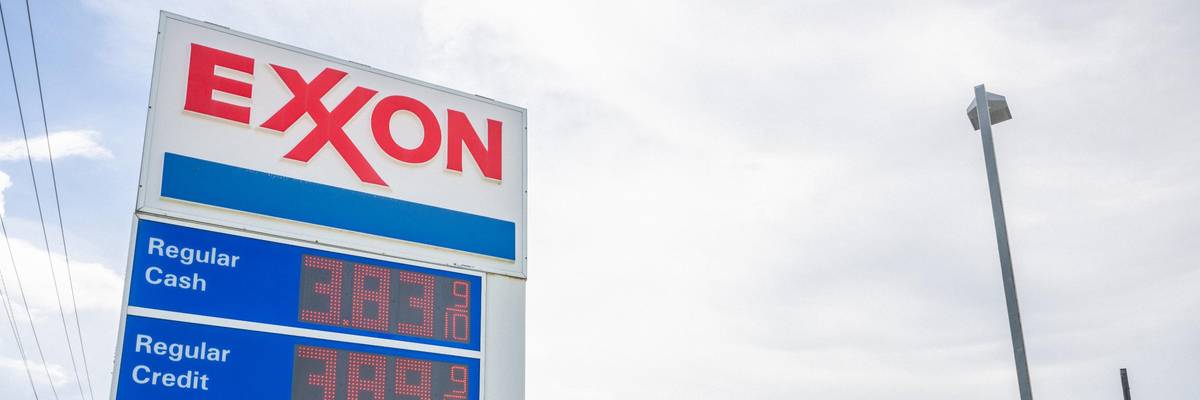
Gas prices are displayed at an Exxon gas station on July 29, 2022, in Houston, Texas.
One researcher called the findings proof that a decarbonization pact signed by the companies "is little more than a forgery."
In another high-profile case of "greenwashing," the oil and gas companies that signed a decarbonization pact at last year's 28th United Nations Climate Change Conference have plans that would burn through around 62% of the carbon dioxide that can still be emitted without pushing global temperatures past 1.5°C above preindustrial levels.
The figures come from a Global Witness analysis published Friday, which found that the more than 50 companies that signed the pact would release over 150 billion metric tons of climate pollution into the atmosphere by 2050.
"This analysis, while jaw-dropping, only reinforces what we've long known—that fossil fuel companies will stop at nothing to extract every last drop of profit from the world's remaining fossil reserves, no matter the cost," Friends of the Earth climate coordinator Jamie Peters said in a statement.
The Oil and Gas Decarbonization Charter was launched at COP28 on December 2 by Saudi Arabia and conference president Sultan Ahmed Al Jaber, who also heads the United Arab Emirates' state oil company. In the announcement, Al Jaber called it a "great first step" and said that companies representing more than 40% of global oil production had agreed to reach net-zero by or before 2050, end methane emissions, and stop routine flaring by 2030.
However, the pact has a major loophole, as Global Witness points out: It only covers emissions released by the companies directly, not by the use of their products once they are sold. These "scope 3" emissions represent as much as 90% of the oil and gas industry's total carbon footprint.
"After looking at the detail of this pact, signed to great backslapping by bosses of some of the world's largest polluters, I have only two questions: Who do these people think they are, and how stupid do they think we are?" asked Global Witness senior fossil fuels investigator Patrick Galey in a statement.
"If a child promises to do less than 10% of their homework, they don't get a gold star. So why are oil and gas bosses congratulating themselves for signing up to rules they wrote themselves and which only address 10% of their companies' contribution to the climate crisis?" Galey asked.
"The only way to slash emissions from usage of oil and gas is to cut demand."
Global Witness used data from Rystad Energy to look at the production plans of the pact's signatories—which include major state and private companies such as Saudi Aramco, Al Jaber's Abu Dhabi National Oil Company (ADNOC), ExxonMobil, and Shell—and then calculated the total emissions of those plans through 2050.
It found that the companies would produce 265 billion barrels of oil and 26.7 billion cubic meters of gas by 2050, and that this would result in 156 billion metric tons of carbon dioxide equivalent emissions, or approximately 62% of the remaining carbon budget.
"This pact is little more than a forgery, publicly committing each company to address its outsize contribution to global heating, while privately allowing them to produce and sell billions of barrels of oil and gas for decades more," Galey said.
Of the companies who signed the pact, those with the largest carbon footprints through 2050 were:
"You'd think the hottest year in the last 125,000 would be enough to end greenwashing once and for all—but since it wasn't, let's state it plainly. No means no—there's not a way to square 'decarbonization' with fossil fuel expansion," 350.org and Third Act co-founder Bill McKibben said in a statement. "They mean the exact opposite."
The fact that the pact was announced at COP28, along with the high future footprint of ADNOC, calls into question the effectiveness of U.N. climate talks, especially when hosted by major fossil fuel-producing nations like the UAE. This year's COP29 is scheduled to take place in oil and gas-rich Azerbaijan, and will be presided over by a former oil executive.
"COP28 has shown that the profits of fossil fuel companies receive more care than the most affected regions of the world," Luisa Neubauer, climate activist and co-organizer of the Fridays for Future climate strike movement, said in a statement. "Parts of the COP agreement sound like a Christmas present for the fossil fuel lobby. Compared to what is needed in the hottest year in human history, the COP agreement is not even close to enough. The future will lie primarily in the hands of those who resist new coal, oil, and gas projects locally and globally."
Campaigners said that governments must act to phase out fossil fuels.
"This powerful analysis by Global Witness highlights that the operations of the fossil fuel industry make up a tiny proportion of the total carbon emissions from the sector," Cara Jenkinson, the cities manager at climate charity Ashden, said in a statement. "The only way to slash emissions from usage of oil and gas is to cut demand—governments across the world must speed up their electrification plans, with poorer nations being supported to bypass fossil fuel vehicles and ramp up clean renewable energy production."
Galey concluded: "We need a rapid and equitable phaseout of fossil fuels, and fossil fuel bosses must be locked out of climate talks. Everything else is marketing and spin, pure and simple."
Dear Common Dreams reader, It’s been nearly 30 years since I co-founded Common Dreams with my late wife, Lina Newhouser. We had the radical notion that journalism should serve the public good, not corporate profits. It was clear to us from the outset what it would take to build such a project. No paid advertisements. No corporate sponsors. No millionaire publisher telling us what to think or do. Many people said we wouldn't last a year, but we proved those doubters wrong. Together with a tremendous team of journalists and dedicated staff, we built an independent media outlet free from the constraints of profits and corporate control. Our mission has always been simple: To inform. To inspire. To ignite change for the common good. Building Common Dreams was not easy. Our survival was never guaranteed. When you take on the most powerful forces—Wall Street greed, fossil fuel industry destruction, Big Tech lobbyists, and uber-rich oligarchs who have spent billions upon billions rigging the economy and democracy in their favor—the only bulwark you have is supporters who believe in your work. But here’s the urgent message from me today. It's never been this bad out there. And it's never been this hard to keep us going. At the very moment Common Dreams is most needed, the threats we face are intensifying. We need your support now more than ever. We don't accept corporate advertising and never will. We don't have a paywall because we don't think people should be blocked from critical news based on their ability to pay. Everything we do is funded by the donations of readers like you. When everyone does the little they can afford, we are strong. But if that support retreats or dries up, so do we. Will you donate now to make sure Common Dreams not only survives but thrives? —Craig Brown, Co-founder |
In another high-profile case of "greenwashing," the oil and gas companies that signed a decarbonization pact at last year's 28th United Nations Climate Change Conference have plans that would burn through around 62% of the carbon dioxide that can still be emitted without pushing global temperatures past 1.5°C above preindustrial levels.
The figures come from a Global Witness analysis published Friday, which found that the more than 50 companies that signed the pact would release over 150 billion metric tons of climate pollution into the atmosphere by 2050.
"This analysis, while jaw-dropping, only reinforces what we've long known—that fossil fuel companies will stop at nothing to extract every last drop of profit from the world's remaining fossil reserves, no matter the cost," Friends of the Earth climate coordinator Jamie Peters said in a statement.
The Oil and Gas Decarbonization Charter was launched at COP28 on December 2 by Saudi Arabia and conference president Sultan Ahmed Al Jaber, who also heads the United Arab Emirates' state oil company. In the announcement, Al Jaber called it a "great first step" and said that companies representing more than 40% of global oil production had agreed to reach net-zero by or before 2050, end methane emissions, and stop routine flaring by 2030.
However, the pact has a major loophole, as Global Witness points out: It only covers emissions released by the companies directly, not by the use of their products once they are sold. These "scope 3" emissions represent as much as 90% of the oil and gas industry's total carbon footprint.
"After looking at the detail of this pact, signed to great backslapping by bosses of some of the world's largest polluters, I have only two questions: Who do these people think they are, and how stupid do they think we are?" asked Global Witness senior fossil fuels investigator Patrick Galey in a statement.
"If a child promises to do less than 10% of their homework, they don't get a gold star. So why are oil and gas bosses congratulating themselves for signing up to rules they wrote themselves and which only address 10% of their companies' contribution to the climate crisis?" Galey asked.
"The only way to slash emissions from usage of oil and gas is to cut demand."
Global Witness used data from Rystad Energy to look at the production plans of the pact's signatories—which include major state and private companies such as Saudi Aramco, Al Jaber's Abu Dhabi National Oil Company (ADNOC), ExxonMobil, and Shell—and then calculated the total emissions of those plans through 2050.
It found that the companies would produce 265 billion barrels of oil and 26.7 billion cubic meters of gas by 2050, and that this would result in 156 billion metric tons of carbon dioxide equivalent emissions, or approximately 62% of the remaining carbon budget.
"This pact is little more than a forgery, publicly committing each company to address its outsize contribution to global heating, while privately allowing them to produce and sell billions of barrels of oil and gas for decades more," Galey said.
Of the companies who signed the pact, those with the largest carbon footprints through 2050 were:
"You'd think the hottest year in the last 125,000 would be enough to end greenwashing once and for all—but since it wasn't, let's state it plainly. No means no—there's not a way to square 'decarbonization' with fossil fuel expansion," 350.org and Third Act co-founder Bill McKibben said in a statement. "They mean the exact opposite."
The fact that the pact was announced at COP28, along with the high future footprint of ADNOC, calls into question the effectiveness of U.N. climate talks, especially when hosted by major fossil fuel-producing nations like the UAE. This year's COP29 is scheduled to take place in oil and gas-rich Azerbaijan, and will be presided over by a former oil executive.
"COP28 has shown that the profits of fossil fuel companies receive more care than the most affected regions of the world," Luisa Neubauer, climate activist and co-organizer of the Fridays for Future climate strike movement, said in a statement. "Parts of the COP agreement sound like a Christmas present for the fossil fuel lobby. Compared to what is needed in the hottest year in human history, the COP agreement is not even close to enough. The future will lie primarily in the hands of those who resist new coal, oil, and gas projects locally and globally."
Campaigners said that governments must act to phase out fossil fuels.
"This powerful analysis by Global Witness highlights that the operations of the fossil fuel industry make up a tiny proportion of the total carbon emissions from the sector," Cara Jenkinson, the cities manager at climate charity Ashden, said in a statement. "The only way to slash emissions from usage of oil and gas is to cut demand—governments across the world must speed up their electrification plans, with poorer nations being supported to bypass fossil fuel vehicles and ramp up clean renewable energy production."
Galey concluded: "We need a rapid and equitable phaseout of fossil fuels, and fossil fuel bosses must be locked out of climate talks. Everything else is marketing and spin, pure and simple."
In another high-profile case of "greenwashing," the oil and gas companies that signed a decarbonization pact at last year's 28th United Nations Climate Change Conference have plans that would burn through around 62% of the carbon dioxide that can still be emitted without pushing global temperatures past 1.5°C above preindustrial levels.
The figures come from a Global Witness analysis published Friday, which found that the more than 50 companies that signed the pact would release over 150 billion metric tons of climate pollution into the atmosphere by 2050.
"This analysis, while jaw-dropping, only reinforces what we've long known—that fossil fuel companies will stop at nothing to extract every last drop of profit from the world's remaining fossil reserves, no matter the cost," Friends of the Earth climate coordinator Jamie Peters said in a statement.
The Oil and Gas Decarbonization Charter was launched at COP28 on December 2 by Saudi Arabia and conference president Sultan Ahmed Al Jaber, who also heads the United Arab Emirates' state oil company. In the announcement, Al Jaber called it a "great first step" and said that companies representing more than 40% of global oil production had agreed to reach net-zero by or before 2050, end methane emissions, and stop routine flaring by 2030.
However, the pact has a major loophole, as Global Witness points out: It only covers emissions released by the companies directly, not by the use of their products once they are sold. These "scope 3" emissions represent as much as 90% of the oil and gas industry's total carbon footprint.
"After looking at the detail of this pact, signed to great backslapping by bosses of some of the world's largest polluters, I have only two questions: Who do these people think they are, and how stupid do they think we are?" asked Global Witness senior fossil fuels investigator Patrick Galey in a statement.
"If a child promises to do less than 10% of their homework, they don't get a gold star. So why are oil and gas bosses congratulating themselves for signing up to rules they wrote themselves and which only address 10% of their companies' contribution to the climate crisis?" Galey asked.
"The only way to slash emissions from usage of oil and gas is to cut demand."
Global Witness used data from Rystad Energy to look at the production plans of the pact's signatories—which include major state and private companies such as Saudi Aramco, Al Jaber's Abu Dhabi National Oil Company (ADNOC), ExxonMobil, and Shell—and then calculated the total emissions of those plans through 2050.
It found that the companies would produce 265 billion barrels of oil and 26.7 billion cubic meters of gas by 2050, and that this would result in 156 billion metric tons of carbon dioxide equivalent emissions, or approximately 62% of the remaining carbon budget.
"This pact is little more than a forgery, publicly committing each company to address its outsize contribution to global heating, while privately allowing them to produce and sell billions of barrels of oil and gas for decades more," Galey said.
Of the companies who signed the pact, those with the largest carbon footprints through 2050 were:
"You'd think the hottest year in the last 125,000 would be enough to end greenwashing once and for all—but since it wasn't, let's state it plainly. No means no—there's not a way to square 'decarbonization' with fossil fuel expansion," 350.org and Third Act co-founder Bill McKibben said in a statement. "They mean the exact opposite."
The fact that the pact was announced at COP28, along with the high future footprint of ADNOC, calls into question the effectiveness of U.N. climate talks, especially when hosted by major fossil fuel-producing nations like the UAE. This year's COP29 is scheduled to take place in oil and gas-rich Azerbaijan, and will be presided over by a former oil executive.
"COP28 has shown that the profits of fossil fuel companies receive more care than the most affected regions of the world," Luisa Neubauer, climate activist and co-organizer of the Fridays for Future climate strike movement, said in a statement. "Parts of the COP agreement sound like a Christmas present for the fossil fuel lobby. Compared to what is needed in the hottest year in human history, the COP agreement is not even close to enough. The future will lie primarily in the hands of those who resist new coal, oil, and gas projects locally and globally."
Campaigners said that governments must act to phase out fossil fuels.
"This powerful analysis by Global Witness highlights that the operations of the fossil fuel industry make up a tiny proportion of the total carbon emissions from the sector," Cara Jenkinson, the cities manager at climate charity Ashden, said in a statement. "The only way to slash emissions from usage of oil and gas is to cut demand—governments across the world must speed up their electrification plans, with poorer nations being supported to bypass fossil fuel vehicles and ramp up clean renewable energy production."
Galey concluded: "We need a rapid and equitable phaseout of fossil fuels, and fossil fuel bosses must be locked out of climate talks. Everything else is marketing and spin, pure and simple."

