SUBSCRIBE TO OUR FREE NEWSLETTER
Daily news & progressive opinion—funded by the people, not the corporations—delivered straight to your inbox.
5
#000000
#FFFFFF
To donate by check, phone, or other method, see our More Ways to Give page.
Daily news & progressive opinion—funded by the people, not the corporations—delivered straight to your inbox.
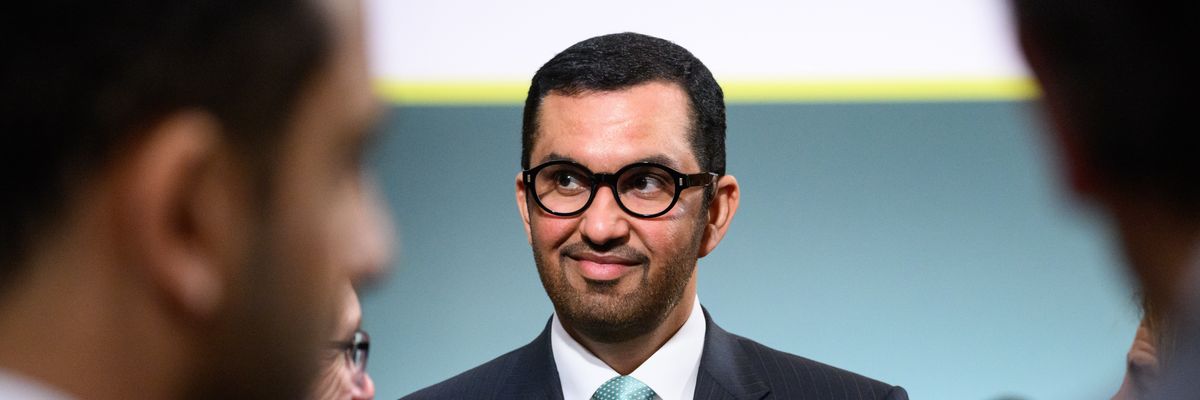
Sultan Al Jaber, CEO of the Abu Dhabi National Oil Company and president of COP28, appears at an event in Berlin, Germany on May 2, 2023.
"This is exactly the kind of conflict of interest we feared when the CEO of an oil company was appointed to the role," said a Greenpeace campaigner.
Internal records leaked by a whistleblower show that Sultan Ahmed Al Jaber—who is simultaneously serving as CEO of Abu Dhabi National Oil Company and president of COP28—used meetings about the upcoming United Nations climate summit to push foreign governments for fossil fuel deals.
The documents, obtained by the Center for Climate Reporting (CCR) and the BBC, include meeting records, briefings, and emails that indicate Al Jaber's role as CEO of the United Arab Emirates' state-owned oil company has bled into his responsibilities as president of the critical U.N. climate talks, validating the fears of climate campaigners who opposed his selection to lead the summit that kicks off Thursday in Dubai.
"Al Jaber, who has continued his role as CEO of the Abu Dhabi National Oil Company (ADNOC) despite calls for him to step down during his COP presidency, has held scores of meetings with senior government officials, royalty, and business leaders from around the world in recent months," CCR said Monday, citing briefings it obtained. "The COP28 team has quietly planned to use this access as an opportunity to increase exports of ADNOC's oil and gas."
The investigative group found that "on at least one occasion a nation followed up on commercial discussions brought up in a meeting with Al Jaber" and that "ADNOC's business interests were allegedly raised during a meeting with another country."
Kaisa Kosonen, policy coordinator at Greenpeace International, said in a statement that "if the allegations are true, this is totally unacceptable and a real scandal."
"The climate summit leader should be focused on advancing climate solutions impartially, not backroom deals that are fueling the crisis. This is exactly the kind of conflict of interest we feared when the CEO of an oil company was appointed to the role," said Kosonen. "This summit is the world's most powerful forum to avert the biggest threat to the survival of humankind, and we urge the presidency to act accordingly."
"It looks ever more like a fox is guarding the hen house."
Advocacy groups and lawmakers have been urging Al Jaber to resign from the COP28 presidency since his appointment earlier this year, citing his glaring conflicts of interest as top executive of ADNOC—a company that is planning to expand fossil fuel production despite scientists' repeated warnings that no new oil, gas, and coal production is compatible with preventing runaway planetary warming.
Al Jaber, who has the support of the Biden administration and other world powers, has refused to step aside, casting further doubt on the prospects of concrete climate progress at COP28.
"Sultan Al Jaber claims his inside knowledge of the fossil fuel industry qualifies him to lead a crucial climate summit but it looks ever more like a fox is guarding the hen house," Ann Harrison, Amnesty International’s climate adviser, said in response to CCR's revelations. "The appointment of the chief executive of one of the world's largest fossil fuel companies to lead COP28 was always a brazen conflict of interests which undermines the meeting's ability to reach the outcome we desperately need."
"Documents suggesting he was briefed to advance business interests in COP meetings only fuel our concerns that COP28 has been comprehensively captured by the fossil fuel lobby to serve its vested interests that put the whole of humanity at risk," Harrison added.
Internal emails obtained by CCR show that COP28 staffers have been instructed to "always" include talking points for ADNOC and Masdar—the UAE's state-owned renewable energy company—in summit meetings.
"In statements to CCR and other media outlets, the team has repeatedly denied allegations of undue influence by the oil company," the group said. "For instance, a summit spokesperson told CCR in September that 'the COP28 staff are separate from any other entity' and that the presidency's 'operations are fully independent and autonomous.'"
"But the leaked briefings, emails, and meeting records paint a different picture," CCR continued. " After questions from CCR, a spokesperson also confirmed that one senior member of the summit team who has been deeply involved in diplomatic efforts, COP28's director of government affairs Mohammed Al Kaabi, works across Al Jaber's 'entire portfolio.'"
CCR previously revealed that Oliver Phillips, an adviser to Al Jaber at ADNOC, played a central role in public relations efforts for COP28, which the head of the U.N. has said must be the catalyst for "dramatic" climate action. In June, The Guardian reported that ADNOC was able to read emails from the COP28 office.
Whistleblowers told CCR that COP28 meetings are still "regularly held" at ADNOC headquarters.
Michael Jacobs, a professor at Sheffield University in the U.K. and an expert on climate politics, told CCR that Al Jaber's actions appear "breathtakingly hypocritical."
"The UAE at the moment is the custodian of a United Nations process aimed at reducing global emissions," said Jacobs. "And yet, in the very same meetings where it's apparently trying to pursue that goal, it's actually trying to do side deals which will increase global emissions.”
Kosonen of Greenpeace argued that "if the presidency wants to claw back credibility, it can only do so through actions."
"That means brokering a global agreement for a just and equitable phaseout of all fossil fuels, in alignment with science, and making polluters pay for the loss and damage they've caused to communities," said Kosonen.
Dear Common Dreams reader, It’s been nearly 30 years since I co-founded Common Dreams with my late wife, Lina Newhouser. We had the radical notion that journalism should serve the public good, not corporate profits. It was clear to us from the outset what it would take to build such a project. No paid advertisements. No corporate sponsors. No millionaire publisher telling us what to think or do. Many people said we wouldn't last a year, but we proved those doubters wrong. Together with a tremendous team of journalists and dedicated staff, we built an independent media outlet free from the constraints of profits and corporate control. Our mission has always been simple: To inform. To inspire. To ignite change for the common good. Building Common Dreams was not easy. Our survival was never guaranteed. When you take on the most powerful forces—Wall Street greed, fossil fuel industry destruction, Big Tech lobbyists, and uber-rich oligarchs who have spent billions upon billions rigging the economy and democracy in their favor—the only bulwark you have is supporters who believe in your work. But here’s the urgent message from me today. It's never been this bad out there. And it's never been this hard to keep us going. At the very moment Common Dreams is most needed, the threats we face are intensifying. We need your support now more than ever. We don't accept corporate advertising and never will. We don't have a paywall because we don't think people should be blocked from critical news based on their ability to pay. Everything we do is funded by the donations of readers like you. When everyone does the little they can afford, we are strong. But if that support retreats or dries up, so do we. Will you donate now to make sure Common Dreams not only survives but thrives? —Craig Brown, Co-founder |
Internal records leaked by a whistleblower show that Sultan Ahmed Al Jaber—who is simultaneously serving as CEO of Abu Dhabi National Oil Company and president of COP28—used meetings about the upcoming United Nations climate summit to push foreign governments for fossil fuel deals.
The documents, obtained by the Center for Climate Reporting (CCR) and the BBC, include meeting records, briefings, and emails that indicate Al Jaber's role as CEO of the United Arab Emirates' state-owned oil company has bled into his responsibilities as president of the critical U.N. climate talks, validating the fears of climate campaigners who opposed his selection to lead the summit that kicks off Thursday in Dubai.
"Al Jaber, who has continued his role as CEO of the Abu Dhabi National Oil Company (ADNOC) despite calls for him to step down during his COP presidency, has held scores of meetings with senior government officials, royalty, and business leaders from around the world in recent months," CCR said Monday, citing briefings it obtained. "The COP28 team has quietly planned to use this access as an opportunity to increase exports of ADNOC's oil and gas."
The investigative group found that "on at least one occasion a nation followed up on commercial discussions brought up in a meeting with Al Jaber" and that "ADNOC's business interests were allegedly raised during a meeting with another country."
Kaisa Kosonen, policy coordinator at Greenpeace International, said in a statement that "if the allegations are true, this is totally unacceptable and a real scandal."
"The climate summit leader should be focused on advancing climate solutions impartially, not backroom deals that are fueling the crisis. This is exactly the kind of conflict of interest we feared when the CEO of an oil company was appointed to the role," said Kosonen. "This summit is the world's most powerful forum to avert the biggest threat to the survival of humankind, and we urge the presidency to act accordingly."
"It looks ever more like a fox is guarding the hen house."
Advocacy groups and lawmakers have been urging Al Jaber to resign from the COP28 presidency since his appointment earlier this year, citing his glaring conflicts of interest as top executive of ADNOC—a company that is planning to expand fossil fuel production despite scientists' repeated warnings that no new oil, gas, and coal production is compatible with preventing runaway planetary warming.
Al Jaber, who has the support of the Biden administration and other world powers, has refused to step aside, casting further doubt on the prospects of concrete climate progress at COP28.
"Sultan Al Jaber claims his inside knowledge of the fossil fuel industry qualifies him to lead a crucial climate summit but it looks ever more like a fox is guarding the hen house," Ann Harrison, Amnesty International’s climate adviser, said in response to CCR's revelations. "The appointment of the chief executive of one of the world's largest fossil fuel companies to lead COP28 was always a brazen conflict of interests which undermines the meeting's ability to reach the outcome we desperately need."
"Documents suggesting he was briefed to advance business interests in COP meetings only fuel our concerns that COP28 has been comprehensively captured by the fossil fuel lobby to serve its vested interests that put the whole of humanity at risk," Harrison added.
Internal emails obtained by CCR show that COP28 staffers have been instructed to "always" include talking points for ADNOC and Masdar—the UAE's state-owned renewable energy company—in summit meetings.
"In statements to CCR and other media outlets, the team has repeatedly denied allegations of undue influence by the oil company," the group said. "For instance, a summit spokesperson told CCR in September that 'the COP28 staff are separate from any other entity' and that the presidency's 'operations are fully independent and autonomous.'"
"But the leaked briefings, emails, and meeting records paint a different picture," CCR continued. " After questions from CCR, a spokesperson also confirmed that one senior member of the summit team who has been deeply involved in diplomatic efforts, COP28's director of government affairs Mohammed Al Kaabi, works across Al Jaber's 'entire portfolio.'"
CCR previously revealed that Oliver Phillips, an adviser to Al Jaber at ADNOC, played a central role in public relations efforts for COP28, which the head of the U.N. has said must be the catalyst for "dramatic" climate action. In June, The Guardian reported that ADNOC was able to read emails from the COP28 office.
Whistleblowers told CCR that COP28 meetings are still "regularly held" at ADNOC headquarters.
Michael Jacobs, a professor at Sheffield University in the U.K. and an expert on climate politics, told CCR that Al Jaber's actions appear "breathtakingly hypocritical."
"The UAE at the moment is the custodian of a United Nations process aimed at reducing global emissions," said Jacobs. "And yet, in the very same meetings where it's apparently trying to pursue that goal, it's actually trying to do side deals which will increase global emissions.”
Kosonen of Greenpeace argued that "if the presidency wants to claw back credibility, it can only do so through actions."
"That means brokering a global agreement for a just and equitable phaseout of all fossil fuels, in alignment with science, and making polluters pay for the loss and damage they've caused to communities," said Kosonen.
Internal records leaked by a whistleblower show that Sultan Ahmed Al Jaber—who is simultaneously serving as CEO of Abu Dhabi National Oil Company and president of COP28—used meetings about the upcoming United Nations climate summit to push foreign governments for fossil fuel deals.
The documents, obtained by the Center for Climate Reporting (CCR) and the BBC, include meeting records, briefings, and emails that indicate Al Jaber's role as CEO of the United Arab Emirates' state-owned oil company has bled into his responsibilities as president of the critical U.N. climate talks, validating the fears of climate campaigners who opposed his selection to lead the summit that kicks off Thursday in Dubai.
"Al Jaber, who has continued his role as CEO of the Abu Dhabi National Oil Company (ADNOC) despite calls for him to step down during his COP presidency, has held scores of meetings with senior government officials, royalty, and business leaders from around the world in recent months," CCR said Monday, citing briefings it obtained. "The COP28 team has quietly planned to use this access as an opportunity to increase exports of ADNOC's oil and gas."
The investigative group found that "on at least one occasion a nation followed up on commercial discussions brought up in a meeting with Al Jaber" and that "ADNOC's business interests were allegedly raised during a meeting with another country."
Kaisa Kosonen, policy coordinator at Greenpeace International, said in a statement that "if the allegations are true, this is totally unacceptable and a real scandal."
"The climate summit leader should be focused on advancing climate solutions impartially, not backroom deals that are fueling the crisis. This is exactly the kind of conflict of interest we feared when the CEO of an oil company was appointed to the role," said Kosonen. "This summit is the world's most powerful forum to avert the biggest threat to the survival of humankind, and we urge the presidency to act accordingly."
"It looks ever more like a fox is guarding the hen house."
Advocacy groups and lawmakers have been urging Al Jaber to resign from the COP28 presidency since his appointment earlier this year, citing his glaring conflicts of interest as top executive of ADNOC—a company that is planning to expand fossil fuel production despite scientists' repeated warnings that no new oil, gas, and coal production is compatible with preventing runaway planetary warming.
Al Jaber, who has the support of the Biden administration and other world powers, has refused to step aside, casting further doubt on the prospects of concrete climate progress at COP28.
"Sultan Al Jaber claims his inside knowledge of the fossil fuel industry qualifies him to lead a crucial climate summit but it looks ever more like a fox is guarding the hen house," Ann Harrison, Amnesty International’s climate adviser, said in response to CCR's revelations. "The appointment of the chief executive of one of the world's largest fossil fuel companies to lead COP28 was always a brazen conflict of interests which undermines the meeting's ability to reach the outcome we desperately need."
"Documents suggesting he was briefed to advance business interests in COP meetings only fuel our concerns that COP28 has been comprehensively captured by the fossil fuel lobby to serve its vested interests that put the whole of humanity at risk," Harrison added.
Internal emails obtained by CCR show that COP28 staffers have been instructed to "always" include talking points for ADNOC and Masdar—the UAE's state-owned renewable energy company—in summit meetings.
"In statements to CCR and other media outlets, the team has repeatedly denied allegations of undue influence by the oil company," the group said. "For instance, a summit spokesperson told CCR in September that 'the COP28 staff are separate from any other entity' and that the presidency's 'operations are fully independent and autonomous.'"
"But the leaked briefings, emails, and meeting records paint a different picture," CCR continued. " After questions from CCR, a spokesperson also confirmed that one senior member of the summit team who has been deeply involved in diplomatic efforts, COP28's director of government affairs Mohammed Al Kaabi, works across Al Jaber's 'entire portfolio.'"
CCR previously revealed that Oliver Phillips, an adviser to Al Jaber at ADNOC, played a central role in public relations efforts for COP28, which the head of the U.N. has said must be the catalyst for "dramatic" climate action. In June, The Guardian reported that ADNOC was able to read emails from the COP28 office.
Whistleblowers told CCR that COP28 meetings are still "regularly held" at ADNOC headquarters.
Michael Jacobs, a professor at Sheffield University in the U.K. and an expert on climate politics, told CCR that Al Jaber's actions appear "breathtakingly hypocritical."
"The UAE at the moment is the custodian of a United Nations process aimed at reducing global emissions," said Jacobs. "And yet, in the very same meetings where it's apparently trying to pursue that goal, it's actually trying to do side deals which will increase global emissions.”
Kosonen of Greenpeace argued that "if the presidency wants to claw back credibility, it can only do so through actions."
"That means brokering a global agreement for a just and equitable phaseout of all fossil fuels, in alignment with science, and making polluters pay for the loss and damage they've caused to communities," said Kosonen.