SUBSCRIBE TO OUR FREE NEWSLETTER
Daily news & progressive opinion—funded by the people, not the corporations—delivered straight to your inbox.
5
#000000
#FFFFFF
To donate by check, phone, or other method, see our More Ways to Give page.
Daily news & progressive opinion—funded by the people, not the corporations—delivered straight to your inbox.
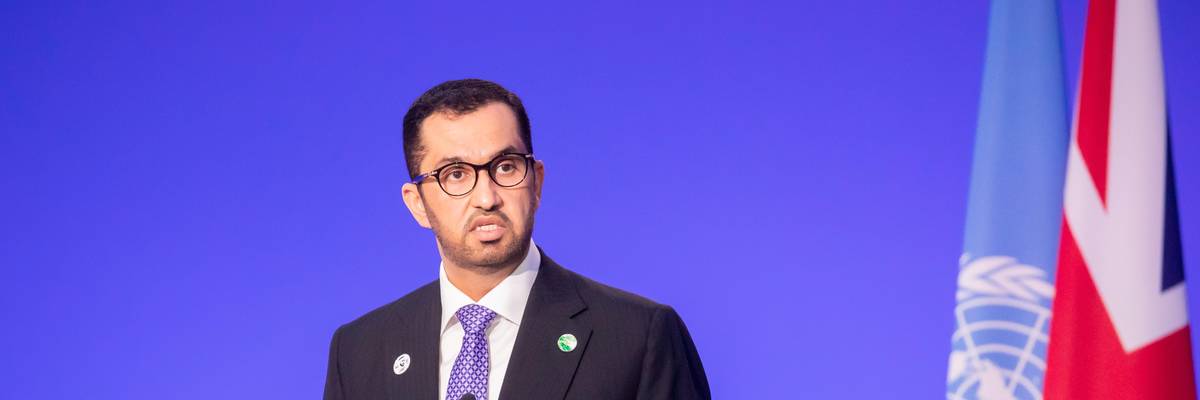
Sultan Ahmed al-Jaber, minister of industry of the United Arab Emirates, speaks at the U.N. Climate Change Conference in Glasgow on November 10, 2021.
The appointment of Sultan al-Jaber is "tantamount to putting the head of a tobacco company in charge of negotiating an anti-smoking treaty," said one campaigner.
Climate campaigners on Thursday warned that the United Arab Emirates all but guaranteed that the United Nations' annual climate conference has already been captured by the fossil fuel industry as it announced the head of the country's state-run oil company will be presiding over the summit later this year.
The UAE announced Sultan al-Jaber, who heads the Abu Dhabi National Oil Company (ADNOC), the world's 12th-largest oil giant by production, will serve as president of the 28th United Nations Framework Convention on Climate Change (COP28) in November.
In addition to running ADNOC, al-Jaber is the UAE's climate enjoy and minister of industry and technology as well as the founding CEO of Masdar, a renewable energy firm in Abu Dhabi in which ADNOC has a 24% stake.
"This appointment risks further undermining the credibility of global climate talks and threatens the action and leadership needed for a rapid and equitable phase out of all fossil fuels."
Oil Change International noted that al-Jaber's oil company is expected to push forward the second-largest expansion of oil production of any company in the world between 2023 and 2025, as the UAE is poised to become "the third largest expander of oil and gas production."
The company's new oil and gas production in that time is expected to "lock in over 2.7 [gigatonnes] of CO2 emissions, which is equivalent to one year of the European Union's CO2 emissions from fossil fuels," said the group.
"This is a truly breathtaking conflict of interest and is tantamount to putting the head of a tobacco company in charge of negotiating an anti-smoking treaty," said Romain Ioualalen, global policy manager at Oil Change International. "This appointment risks further undermining the credibility of global climate talks and threatens the action and leadership needed for a rapid and equitable phase out of all fossil fuels, which over 80 countries called for during last year's COP."
Al-Jaber's appointment was announced two months after the end of COP27 in Sharm el-Sheikh, Egypt, where more than 630 fossil fuel lobbyists mingled with policymakers before the summit ended with an agreement that failed to demand a phaseout of oil, coal, and gas production.
COP26, which took place in Glasgow in 2021, ended with a similar outcome.
The production growth expected at al-Jaber's company is poised to take place as energy experts and climate scientists repeatedly warn in no uncertain terms that fossil fuel extraction must be phased out rapidly in order to limit planetary heating to 1.5°C above preindustrial temperatures.
As COP28 president, al-Jaber will ostensibly be responsible for holding world governments to account regarding their commitments to reducing fossil fuel emissions.
"You couldn't make it up," tweeted Anthony Costello, chair of the University College London-Lancet commission on the health effects of climate change.
Ioualalen posited that ADNOC "will surely tout its investments in renewable energy, but the reality is that the climate talks will be run by the CEO of a company betting on climate failure."
"These are the worst possible credentials for an upcoming COP president," said Ioualalen.
If al-Jaber remains as the head of ADNOC and leads the conference, said Tasneem Essop, executive director of Climate Action Network International, "it will be tantamount to a full-scale capture of the U.N. climate talks by a petrostate national oil company and its associated fossil fuel lobbyists."
"COP28 now seems to be open season for vested interests who will no doubt use the climate talks to continue to undermine any progress on climate action," added Essop. "As civil society we [will] demand that al-Jaber does the right thing and either stand aside or step down."
The "entire U.N. climate progress" that began with the 2015 Paris climate agreement risks being jeopardized by al-Jaber's appointment, said Zeina Khalil Hajj, head of global campaigning and organizing for 350.org.
"We are extremely concerned that it will open the floodgates for greenwashing and oil and gas deals to keep exploiting fossil fuels," Hajj said. "COP28 cannot turn into an expo for the fossil fuel industry."
This country and this world are at a monumental crossroads. US voters have an opportunity to beat back the forces of fascism and confront the billionaires who are rigging the economy, our media system, and our democracy, making it increasingly impossible for ordinary people to get by. We’re not just talking about the election. We’re talking about what must be done once these fascist elements are vanquished from power. We need a bolder set of solutions than what either major party has so far been willing to offer and a working-class movement ready to fight like hell for it. Trump didn't emerge from nowhere. The conditions that fueled MAGA authoritarianism were created by decades of radical neoliberal economic policies and a corrupt political system dominated by corporate interests. They slashed taxes on the super-rich, promising that the benefits would trickle down. They said giveaways to the corporate titans would make life more affordable for the rest of us. It was all bullshit. And when a bitter, betrayed populace searches for someone to blame, right-wing demagogues have little trouble finding scapegoats. People know when they're being lied to, but you won't hear any of this from the corporate media. Only independent journalism—powered and funded by people who believe in building a better world—can deliver truly trustworthy daily news. If you share our vision, please contribute whatever you can to sustain our work. |
Climate campaigners on Thursday warned that the United Arab Emirates all but guaranteed that the United Nations' annual climate conference has already been captured by the fossil fuel industry as it announced the head of the country's state-run oil company will be presiding over the summit later this year.
The UAE announced Sultan al-Jaber, who heads the Abu Dhabi National Oil Company (ADNOC), the world's 12th-largest oil giant by production, will serve as president of the 28th United Nations Framework Convention on Climate Change (COP28) in November.
In addition to running ADNOC, al-Jaber is the UAE's climate enjoy and minister of industry and technology as well as the founding CEO of Masdar, a renewable energy firm in Abu Dhabi in which ADNOC has a 24% stake.
"This appointment risks further undermining the credibility of global climate talks and threatens the action and leadership needed for a rapid and equitable phase out of all fossil fuels."
Oil Change International noted that al-Jaber's oil company is expected to push forward the second-largest expansion of oil production of any company in the world between 2023 and 2025, as the UAE is poised to become "the third largest expander of oil and gas production."
The company's new oil and gas production in that time is expected to "lock in over 2.7 [gigatonnes] of CO2 emissions, which is equivalent to one year of the European Union's CO2 emissions from fossil fuels," said the group.
"This is a truly breathtaking conflict of interest and is tantamount to putting the head of a tobacco company in charge of negotiating an anti-smoking treaty," said Romain Ioualalen, global policy manager at Oil Change International. "This appointment risks further undermining the credibility of global climate talks and threatens the action and leadership needed for a rapid and equitable phase out of all fossil fuels, which over 80 countries called for during last year's COP."
Al-Jaber's appointment was announced two months after the end of COP27 in Sharm el-Sheikh, Egypt, where more than 630 fossil fuel lobbyists mingled with policymakers before the summit ended with an agreement that failed to demand a phaseout of oil, coal, and gas production.
COP26, which took place in Glasgow in 2021, ended with a similar outcome.
The production growth expected at al-Jaber's company is poised to take place as energy experts and climate scientists repeatedly warn in no uncertain terms that fossil fuel extraction must be phased out rapidly in order to limit planetary heating to 1.5°C above preindustrial temperatures.
As COP28 president, al-Jaber will ostensibly be responsible for holding world governments to account regarding their commitments to reducing fossil fuel emissions.
"You couldn't make it up," tweeted Anthony Costello, chair of the University College London-Lancet commission on the health effects of climate change.
Ioualalen posited that ADNOC "will surely tout its investments in renewable energy, but the reality is that the climate talks will be run by the CEO of a company betting on climate failure."
"These are the worst possible credentials for an upcoming COP president," said Ioualalen.
If al-Jaber remains as the head of ADNOC and leads the conference, said Tasneem Essop, executive director of Climate Action Network International, "it will be tantamount to a full-scale capture of the U.N. climate talks by a petrostate national oil company and its associated fossil fuel lobbyists."
"COP28 now seems to be open season for vested interests who will no doubt use the climate talks to continue to undermine any progress on climate action," added Essop. "As civil society we [will] demand that al-Jaber does the right thing and either stand aside or step down."
The "entire U.N. climate progress" that began with the 2015 Paris climate agreement risks being jeopardized by al-Jaber's appointment, said Zeina Khalil Hajj, head of global campaigning and organizing for 350.org.
"We are extremely concerned that it will open the floodgates for greenwashing and oil and gas deals to keep exploiting fossil fuels," Hajj said. "COP28 cannot turn into an expo for the fossil fuel industry."