

SUBSCRIBE TO OUR FREE NEWSLETTER
Daily news & progressive opinion—funded by the people, not the corporations—delivered straight to your inbox.
5
#000000
#FFFFFF
To donate by check, phone, or other method, see our More Ways to Give page.
Daily news & progressive opinion—funded by the people, not the corporations—delivered straight to your inbox.
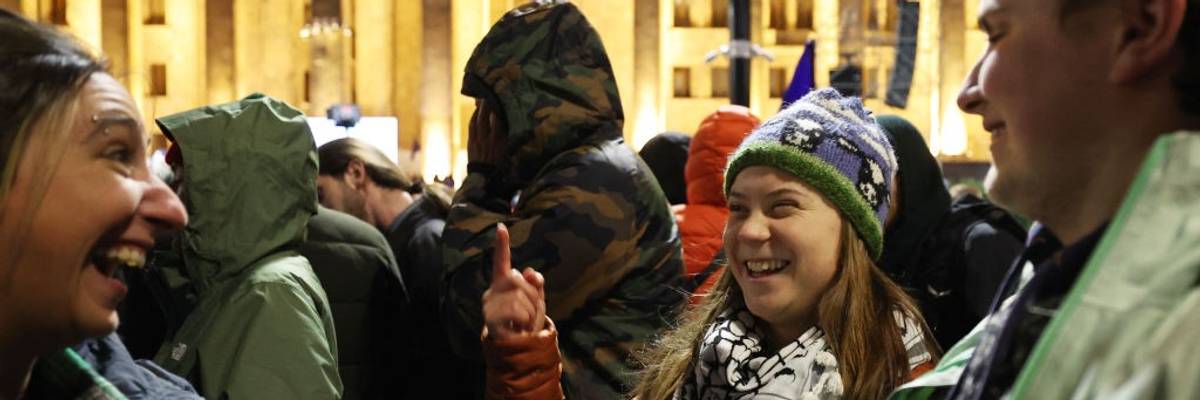
Swedish climate activist Greta Thunberg (C) reacts as she speaks with Georgian opposition supporters during a rally to protest against the results of the parliamentary elections in front of the parliament building in Tbilisi on November 4, 2024.
"We can't legitimize COP meetings in their current form," Thunberg said. "The last three years, they've taken place in authoritarian regimes, and holding them in such places leads nowhere."
When national delegates and civil society representatives gather in Baku, Azerbaijan next week for the United Nations Climate Change Conference, one prominent climate voice will not be among them—Greta Thunberg.
The 21-year-old Swedish activist said she would not attend COP29 due to Azerbaijan's authoritarian record and reliance on fossil fuels, and criticized the U.N. Framework Convention on Climate Change (UNFCCC) for naming it as a host.
"It is extreme hypocrisy of the UNFCCC to let yet another authoritarian petrol state host the COP," Thunberg said in a video posted on social media.
Thunberg expressed concerns about Azerbaijan's record of stifling internal dissent as well as its ethnic cleansing of Armenians. The U.N. summit comes a little over a year after Azerbaijani forces entered the disputed, ethnic Armenian-controlled territory of Nagorno-Karabakh, prompting most ethnic Armenians in the area to flee across the border to Armenia. Armenia told the International Court of Justice in April that Azerbaijan had "completed" ethnic cleansing in the territory and was "erasing all traces of ethnic Armenians' presence" there.
At the same time, Thunberg added her voice to the many environmental advocates who have called out Azerbaijan for planning to expand its fossil fuel production. Azerbaijan's selection was especially controversial because it came on the heels of the United Arab Emirates' hosting of COP28, which also prompted backlash due to the country's human rights record and reliance on oil and gas. Both COPs also came under fire for selecting presidents with close ties to state-run oil companies.
"It is a slap in the face to all the people who are suffering from the climate emergency and from the repression and oppression of the Azerbaijani regime," Thunberg said.
"Climate activism and human rights are united."
There is another reason that Thunberg cannot attend COP29: It has a closed land border, which means that people can only enter the country by plane, something Thunberg has vowed not to do for climate reasons.
"The population in Azerbaijan is trapped. They can't travel in or out of the country except through the airport. Even if I could go there, I wouldn't. I don't want to legitimize the regime," Thunberg told Blankspot.
Instead, she is traveling through Europe ahead of COP29, coming as close as possible to Azerbaijan. Currently, she is in Georgia where people are in the streets protesting a parliamentary election they say was rigged by the ruling party with help from Russia. After COP29 starts, she plans to continue on to Armenia.
During COP29, she will meet with Azerbaijani activists who are not in the country, as well as activists from Georgia and Armenia.
She told Blackspot that one purpose of her trip is to "highlight that we can't legitimize COP meetings in their current form. The last three years, they've taken place in authoritarian regimes, and holding them in such places leads nowhere."
More broadly, she also aims to foreground the relationship between the climate crisis and human rights.
"In countries like Sweden, many people are surprised when you talk about how climate activism, the LGBTQ movement, and human rights are interconnected," she said. "But in countries where people face repression and rights violations every day, activists see a clearer connection."
"Of course, we can't talk about the climate until our fundamental human rights are met," Thunberg continued. "'We can't talk about the climate if we can't go out on the street and hold a sign,' they say. Unfortunately, the climate crisis is extremely urgent, so it has to happen simultaneously. Climate activism and human rights are united."
Thunberg's remarks come as there has been an increasing crackdown on climate and other forms of nonviolent protest, including in so-called democratic countries. In its most recent report on the killing of environmental defenders, Global Witness observed that countries like the U.S., U.K., and E.U. member states had continued to criminalize climate protesters in 2023, with new laws targeting dissent and dolling out harsh penalties for common protest tactics.
"Nonviolent, nondestructive climate protest is increasingly being subjected to criminal prosecution, while punishments are being ratcheted up to levels befitting violent and far more serious crimes," author Stan Cox observed in October.
As for the outcome of COP29 itself, Thunberg does not hold high expectations.
"The only thing that will come out of it is loopholes, more negotiations, and symbolic decisions that look good on paper but are really just greenwashing," Thunberg said.
However, she maintained faith in the importance of speaking out on climate and other issues.
"Every time those in power get a chance to act, they choose not to and instead listen to industries that destroy the planet and violate human rights, rather than doing what's right," Thunberg said. " I want to spread awareness, focus on grassroots activism, and support those who are trying to make a difference."
Dear Common Dreams reader, It’s been nearly 30 years since I co-founded Common Dreams with my late wife, Lina Newhouser. We had the radical notion that journalism should serve the public good, not corporate profits. It was clear to us from the outset what it would take to build such a project. No paid advertisements. No corporate sponsors. No millionaire publisher telling us what to think or do. Many people said we wouldn't last a year, but we proved those doubters wrong. Together with a tremendous team of journalists and dedicated staff, we built an independent media outlet free from the constraints of profits and corporate control. Our mission has always been simple: To inform. To inspire. To ignite change for the common good. Building Common Dreams was not easy. Our survival was never guaranteed. When you take on the most powerful forces—Wall Street greed, fossil fuel industry destruction, Big Tech lobbyists, and uber-rich oligarchs who have spent billions upon billions rigging the economy and democracy in their favor—the only bulwark you have is supporters who believe in your work. But here’s the urgent message from me today. It's never been this bad out there. And it's never been this hard to keep us going. At the very moment Common Dreams is most needed, the threats we face are intensifying. We need your support now more than ever. We don't accept corporate advertising and never will. We don't have a paywall because we don't think people should be blocked from critical news based on their ability to pay. Everything we do is funded by the donations of readers like you. When everyone does the little they can afford, we are strong. But if that support retreats or dries up, so do we. Will you donate now to make sure Common Dreams not only survives but thrives? —Craig Brown, Co-founder |
When national delegates and civil society representatives gather in Baku, Azerbaijan next week for the United Nations Climate Change Conference, one prominent climate voice will not be among them—Greta Thunberg.
The 21-year-old Swedish activist said she would not attend COP29 due to Azerbaijan's authoritarian record and reliance on fossil fuels, and criticized the U.N. Framework Convention on Climate Change (UNFCCC) for naming it as a host.
"It is extreme hypocrisy of the UNFCCC to let yet another authoritarian petrol state host the COP," Thunberg said in a video posted on social media.
Thunberg expressed concerns about Azerbaijan's record of stifling internal dissent as well as its ethnic cleansing of Armenians. The U.N. summit comes a little over a year after Azerbaijani forces entered the disputed, ethnic Armenian-controlled territory of Nagorno-Karabakh, prompting most ethnic Armenians in the area to flee across the border to Armenia. Armenia told the International Court of Justice in April that Azerbaijan had "completed" ethnic cleansing in the territory and was "erasing all traces of ethnic Armenians' presence" there.
At the same time, Thunberg added her voice to the many environmental advocates who have called out Azerbaijan for planning to expand its fossil fuel production. Azerbaijan's selection was especially controversial because it came on the heels of the United Arab Emirates' hosting of COP28, which also prompted backlash due to the country's human rights record and reliance on oil and gas. Both COPs also came under fire for selecting presidents with close ties to state-run oil companies.
"It is a slap in the face to all the people who are suffering from the climate emergency and from the repression and oppression of the Azerbaijani regime," Thunberg said.
"Climate activism and human rights are united."
There is another reason that Thunberg cannot attend COP29: It has a closed land border, which means that people can only enter the country by plane, something Thunberg has vowed not to do for climate reasons.
"The population in Azerbaijan is trapped. They can't travel in or out of the country except through the airport. Even if I could go there, I wouldn't. I don't want to legitimize the regime," Thunberg told Blankspot.
Instead, she is traveling through Europe ahead of COP29, coming as close as possible to Azerbaijan. Currently, she is in Georgia where people are in the streets protesting a parliamentary election they say was rigged by the ruling party with help from Russia. After COP29 starts, she plans to continue on to Armenia.
During COP29, she will meet with Azerbaijani activists who are not in the country, as well as activists from Georgia and Armenia.
She told Blackspot that one purpose of her trip is to "highlight that we can't legitimize COP meetings in their current form. The last three years, they've taken place in authoritarian regimes, and holding them in such places leads nowhere."
More broadly, she also aims to foreground the relationship between the climate crisis and human rights.
"In countries like Sweden, many people are surprised when you talk about how climate activism, the LGBTQ movement, and human rights are interconnected," she said. "But in countries where people face repression and rights violations every day, activists see a clearer connection."
"Of course, we can't talk about the climate until our fundamental human rights are met," Thunberg continued. "'We can't talk about the climate if we can't go out on the street and hold a sign,' they say. Unfortunately, the climate crisis is extremely urgent, so it has to happen simultaneously. Climate activism and human rights are united."
Thunberg's remarks come as there has been an increasing crackdown on climate and other forms of nonviolent protest, including in so-called democratic countries. In its most recent report on the killing of environmental defenders, Global Witness observed that countries like the U.S., U.K., and E.U. member states had continued to criminalize climate protesters in 2023, with new laws targeting dissent and dolling out harsh penalties for common protest tactics.
"Nonviolent, nondestructive climate protest is increasingly being subjected to criminal prosecution, while punishments are being ratcheted up to levels befitting violent and far more serious crimes," author Stan Cox observed in October.
As for the outcome of COP29 itself, Thunberg does not hold high expectations.
"The only thing that will come out of it is loopholes, more negotiations, and symbolic decisions that look good on paper but are really just greenwashing," Thunberg said.
However, she maintained faith in the importance of speaking out on climate and other issues.
"Every time those in power get a chance to act, they choose not to and instead listen to industries that destroy the planet and violate human rights, rather than doing what's right," Thunberg said. " I want to spread awareness, focus on grassroots activism, and support those who are trying to make a difference."
When national delegates and civil society representatives gather in Baku, Azerbaijan next week for the United Nations Climate Change Conference, one prominent climate voice will not be among them—Greta Thunberg.
The 21-year-old Swedish activist said she would not attend COP29 due to Azerbaijan's authoritarian record and reliance on fossil fuels, and criticized the U.N. Framework Convention on Climate Change (UNFCCC) for naming it as a host.
"It is extreme hypocrisy of the UNFCCC to let yet another authoritarian petrol state host the COP," Thunberg said in a video posted on social media.
Thunberg expressed concerns about Azerbaijan's record of stifling internal dissent as well as its ethnic cleansing of Armenians. The U.N. summit comes a little over a year after Azerbaijani forces entered the disputed, ethnic Armenian-controlled territory of Nagorno-Karabakh, prompting most ethnic Armenians in the area to flee across the border to Armenia. Armenia told the International Court of Justice in April that Azerbaijan had "completed" ethnic cleansing in the territory and was "erasing all traces of ethnic Armenians' presence" there.
At the same time, Thunberg added her voice to the many environmental advocates who have called out Azerbaijan for planning to expand its fossil fuel production. Azerbaijan's selection was especially controversial because it came on the heels of the United Arab Emirates' hosting of COP28, which also prompted backlash due to the country's human rights record and reliance on oil and gas. Both COPs also came under fire for selecting presidents with close ties to state-run oil companies.
"It is a slap in the face to all the people who are suffering from the climate emergency and from the repression and oppression of the Azerbaijani regime," Thunberg said.
"Climate activism and human rights are united."
There is another reason that Thunberg cannot attend COP29: It has a closed land border, which means that people can only enter the country by plane, something Thunberg has vowed not to do for climate reasons.
"The population in Azerbaijan is trapped. They can't travel in or out of the country except through the airport. Even if I could go there, I wouldn't. I don't want to legitimize the regime," Thunberg told Blankspot.
Instead, she is traveling through Europe ahead of COP29, coming as close as possible to Azerbaijan. Currently, she is in Georgia where people are in the streets protesting a parliamentary election they say was rigged by the ruling party with help from Russia. After COP29 starts, she plans to continue on to Armenia.
During COP29, she will meet with Azerbaijani activists who are not in the country, as well as activists from Georgia and Armenia.
She told Blackspot that one purpose of her trip is to "highlight that we can't legitimize COP meetings in their current form. The last three years, they've taken place in authoritarian regimes, and holding them in such places leads nowhere."
More broadly, she also aims to foreground the relationship between the climate crisis and human rights.
"In countries like Sweden, many people are surprised when you talk about how climate activism, the LGBTQ movement, and human rights are interconnected," she said. "But in countries where people face repression and rights violations every day, activists see a clearer connection."
"Of course, we can't talk about the climate until our fundamental human rights are met," Thunberg continued. "'We can't talk about the climate if we can't go out on the street and hold a sign,' they say. Unfortunately, the climate crisis is extremely urgent, so it has to happen simultaneously. Climate activism and human rights are united."
Thunberg's remarks come as there has been an increasing crackdown on climate and other forms of nonviolent protest, including in so-called democratic countries. In its most recent report on the killing of environmental defenders, Global Witness observed that countries like the U.S., U.K., and E.U. member states had continued to criminalize climate protesters in 2023, with new laws targeting dissent and dolling out harsh penalties for common protest tactics.
"Nonviolent, nondestructive climate protest is increasingly being subjected to criminal prosecution, while punishments are being ratcheted up to levels befitting violent and far more serious crimes," author Stan Cox observed in October.
As for the outcome of COP29 itself, Thunberg does not hold high expectations.
"The only thing that will come out of it is loopholes, more negotiations, and symbolic decisions that look good on paper but are really just greenwashing," Thunberg said.
However, she maintained faith in the importance of speaking out on climate and other issues.
"Every time those in power get a chance to act, they choose not to and instead listen to industries that destroy the planet and violate human rights, rather than doing what's right," Thunberg said. " I want to spread awareness, focus on grassroots activism, and support those who are trying to make a difference."

