

SUBSCRIBE TO OUR FREE NEWSLETTER
Daily news & progressive opinion—funded by the people, not the corporations—delivered straight to your inbox.
5
#000000
#FFFFFF
To donate by check, phone, or other method, see our More Ways to Give page.
Daily news & progressive opinion—funded by the people, not the corporations—delivered straight to your inbox.

On Tuesday, November 11, Senator Kelly Loeffler
On Tuesday, November 11, Senator Kelly Loeffler accused her opponent, Reverend Raphael Warnock, of having "a history of anti-Israel positions, from embracing anti-Zionist Black Lives Matter... to calling Israel an 'oppressive regime' for fighting back against terrorism." CODEPINK, an organization with a number of Jewish leaders, strongly condemns these false accusations of antisemitism.
Senator Loeffler bases her accusations on Rev. Warnock's support for the Black Lives Matter movement and support for a 2019 statement by the National Council of Churches.
In 2019, Reverend Warnock traveled on a pilgrimage to Palestine and Israel with the National Council of Churches to see the situation with his own eyes. Upon return to the United States, the group, including Warnock, released a statement which observed the heavy militarization of the West Bank, and called it "reminiscent of the military occupation of Namibia by apartheid South Africa." The group called for "an end of weapons sales and proliferation to all sides in the conflict and, indeed, to the entire region." It also recommended preserving "the option of utilizing economic pressure as a means of bringing recalcitrant dominant forces to the negotiating table." We support these recommendations and commend Rev. Warnock for participating in this delegation.
CODEPINK also rejects the claim that the Black Lives Matter movement is antisemitic. Many of the Black Lives Matter leaders have traveled to the region as well, and returned with strong feelings of solidarity with the Palestinian people. That's why the platform of the Movement for Black Lives takes a strong stand for Palestinian rights, calling Israel is an apartheid state that is committing genocide against the Palestinian people.
During its 2014 war in Gaza, Israel killed over 2,000 Palestinians, including over 1,400 civilians, of whom around 500 were children and around were 250 women. Between March 30 and May 15 of 2018, Israeli snipers killed over 100 Palestinian protestors in Gaza, including journalists and medical workers. The United Nations has said that these actions were likely crimes against humanity. Israel currently has a case pending in the International Criminal Court for the wars in Gaza and forced displacement of Palestinians in the West Bank.
Israel's military occupation of the West Bank is composed of separate roads for Israelis and Palestinians, checkpoints, and a military court system that subjects two different groups of people to two separate sets of laws. Anyone who has traveled to the West Bank city of Hebron, as Reverand Warnock did with the National Council of Churches, is immediately confronted by the visceral and appalling reality that Israel is imposing a system of apartheid on the Palestinian people.
CODEPINK finds it ironic that the Senator making false accusations of antisemitism against Reverend Warnock is herself a supporter of incoming congresswoman Marjorie Taylor Greene, who has made blatant Islamophobic and antisemitic statements and supports the conspiracy group QAnon.
As an organization committed to ending racism and militarism in the United States, as well as apartheid and injustice in Israel/Palestine, CODEPINK encourages Reverend Warnock to continue to speak out for freedom and equality for all in Palestine and Israel and hopes to see more members of Congress, as well as candidates, join delegations like the one Reverend Warnock participated in.
CODEPINK is a women-led grassroots organization working to end U.S. wars and militarism, support peace and human rights initiatives, and redirect our tax dollars into healthcare, education, green jobs and other life-affirming programs.
(818) 275-7232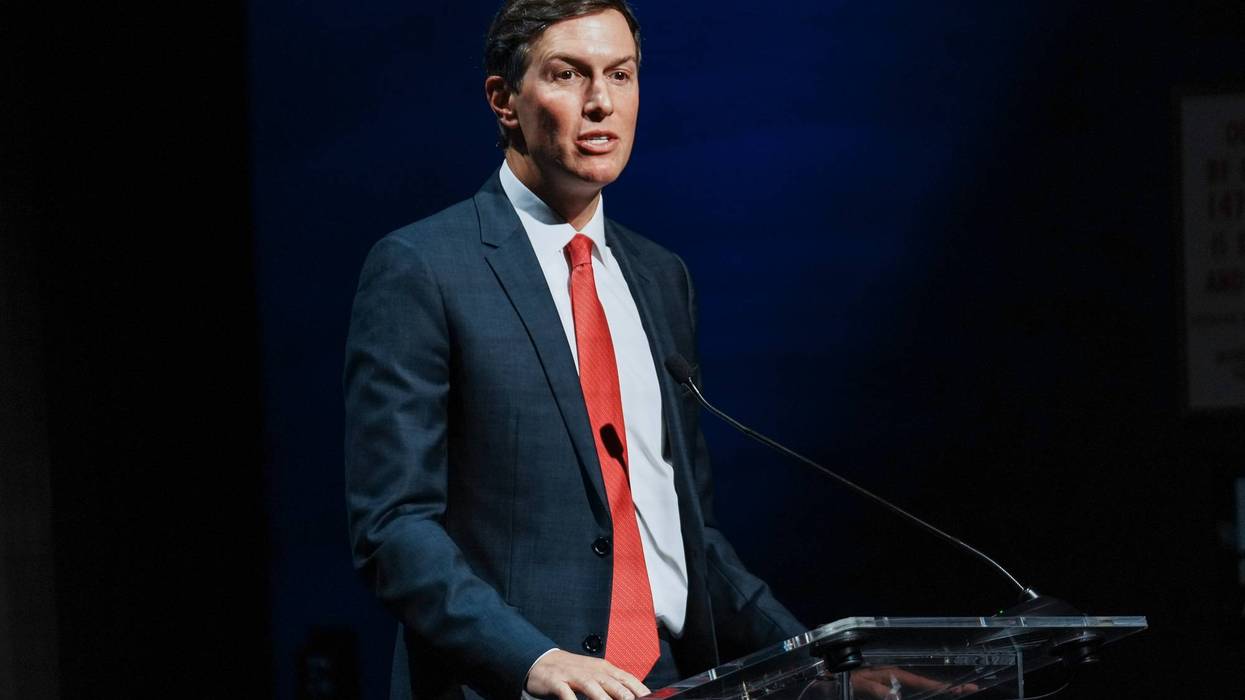
"Senate confirmation processes and financial disclosures exist to ensure that qualified individuals are appointed and carry out their official duties with integrity. Kushner is not an exception."
A government watchdog on Wednesday filed a lawsuit aimed at blocking Jared Kushner from serving as a top American foreign policy official while lacking confirmation from the US Senate.
In a complaint filed with the US District Court for the District of Columbia, Citizens for Responsibility and Ethics in Washington (CREW) alleged that Kushner, who is President Donald Trump's son-in-law, is engaged in "unlawful exercise of government power."
Even though Kushner has been given the role of an informal "envoy," the lawsuit contends that he has been tasked with major responsibilities, such as negotiating an end to Russia's war against Ukraine, that under the Constitution should require Senate confirmation.
"Kushner is one of President Trump’s go-to foreign policy negotiators," the complaint explains. "He represents the United States in the highest profile global conflicts... He negotiates directly with foreign leaders. He fills a crucial and continuing role in shaping and implementing the country’s foreign policy during President Trump’s second term."
Even as Kushner oversees such highly consequential diplomatic efforts, the lawsuit continues, he is still working as a private businessman operating an investment firm that has received billions of dollars in investments from the sovereign wealth funds of Saudi Arabia, Qatar, and the United Arab Emirates.
"The interplay and overlap between his government role and private business interests present a heightened risk of financial conflicts of interest," the complaint says. "Nonetheless, Kushner continues to exercise significant government power while circumventing the very protections put in place to guard against such conflicts."
Kushner has also been appointed in a manner that has helped him completely evade "transparency and conflict-of-interest obligations, including the filing of public financial disclosures during the appointment process," the lawsuit says.
The complaint urges the court to order Kushner to file financial disclosures and, if it finds him in violation of the US Constitution's appointments clause, bar him from continued government service.
CREW president Donald K. Sherman said the lawsuit is necessary to ensure that Kushner is not using US foreign policy as a vehicle for self-enrichment.
"Senate confirmation processes and financial disclosures exist to ensure that qualified individuals are appointed and carry out their official duties with integrity," Sherman explained. "Kushner is not an exception. He cannot simply opt out and expect the public to simply take him at his word.”

“Flock’s technology isn’t making us safer," the Michigan congresswoman said. "Instead, it has been used to stalk people, misidentify and arrest innocent people, surveil protestors, and wrongfully record our neighbors."
Amid what she called a "mass surveillance crisis," US Rep. Rashida Tlaib announced legislation on Wednesday to ban the use of federal funds for powerful dragnet spying systems—including the automated license plate-reading cameras manufactured by Flock Safety.
Flock has quickly grown into a massive nationwide surveillance network with more than 120,000 of its artificial intelligence-powered cameras installed across 49 states, allowing law enforcement agencies to track and reconstruct Americans' movements, often without warrants.
While supporters describe Flock cameras as a tool to help police solve crimes, there is little evidence that they actually reduce it. There are also many documented cases of cops using the technology to stalk romantic partners, track women who've had abortions, monitor First Amendment-protected protests, and surveil people on behalf of US Immigration and Customs Enforcement (ICE) as part of its mass deportation push.
“Flock’s technology isn’t making us safer," Tlaib (D-Mich.) said in a statement on Wednesday. "Instead, it has been used to stalk people, misidentify and arrest innocent people, surveil protesters, and wrongfully record our neighbors. My bill would prevent our government on all levels from selling us out to Big Tech companies that trample our civil rights for profit.”
The bill, titled the Get the Flock Out of Our Communities Act, is co-sponsored by Reps. Sylvia Garcia (D-Texas), Summer Lee (D-Pa.), Ilhan Omar (D-Minn.), Delia Ramirez (D-Ill.), Nydia Velázquez (D-NY), and Bonnie Watson Coleman (D-NJ).
It is part of a growing wave of bipartisan efforts to restrict the use of Flock cameras and other surveillance tech. Reps. Thomas Massie (R-Ky.) and Greg Steube (R-Fla.), along with Rep. Alexandria Ocasio-Cortez, have introduced legislation to limit government use or funding of automated license plate readers, while Sen. Josh Hawley (R-Mo.) has proposed limits on data collection.
Tlaib's legislation would go further. Its restrictions would also extend beyond license plate readers to other "mass surveillance systems," such as those that employ facial recognition technology and biometric tracking.
It would not only prohibit federal, state, and local governments from using federal funds to purchase, operate, or access automated mass surveillance systems; it would also make state and local governments ineligible for certain federal law enforcement grants unless they stop operating or accessing mass surveillance networks that already exist.
Federal agencies would also be barred from using data derived from these systems, and they'd be required to delete certain data that has already been gathered.
The full extent to which Flock cameras are funded with federal dollars is unknown. But the company itself has identified several federal grant programs that local police departments can apply for to purchase the cameras.
"Federal funds should be used to invest in our communities in real safety solutions. We need good jobs, affordable homes, clean water, and reliable electricity. That’s what’s going to make us safer," Tlaib said at a news conference Wednesday. "Instead, our government is sacrificing our rights to big tech companies that care more about their profits, selling our data, than about our safety."
Tlaib's bill comes as backlash to Flock cameras grows around the country. A recent Data for Progress poll showed 52% of voters viewed Flock cameras unfavorably, while more than 200 cities and counties have canceled their contracts with the company.
“People everywhere are starting to recognize that conflating surveillance with safety makes communities less safe,” said Tawana Petty, a digital and data justice organizer from Detroit. “The persistent abuse of Flock cameras and other surveillance systems by law enforcement agencies across the United States, and the lack of transparency by the companies that market them, has caused an awakening among residents and city government agencies who are ridding themselves of the technologies."

A group of Democratic senators warned the company's CEO, Mark Zuckerberg, that the tax maneuver violates "the spirit and, potentially, the letter" of federal law.
A group of Democratic senators wrote Tuesday that Meta is violating "the spirit and, potentially, the letter" of federal tax law by using a research and development tax credit to save billions of dollars on its massive data center buildout.
In a letter to Meta CEO Mark Zuckerberg, the Senate Democrats noted that the $1.9 trillion company has "indicated on federal regulatory filings that it has used the federal research credit to reduce its federal income tax liability by $6.6 billion between 2023-2025." By one measure, the senators noted, Meta alone could be responsible for "more than 10% of all research credits claimed in the US."
"While it remains unclear exactly how Meta was able to reduce its federal tax liability by over $6.6 billion in the last three years using federal research credits, it appears from published reports that a substantial share is by claiming the research credit related to its massive AI data center build out," wrote the group of lawmakers led by Sen. Ron Wyden (D-Ore.), the ranking member of the Senate Finance Committee.
Last month, The New York Times reported that Meta claims in its federal tax filings that the company's AI data centers are "a giant experiment that could fail," allowing it to "tap into a tax credit intended for research and experimentation." Meta specifically characterizes its expensive, resource-devouring data centers as "pilot models."
"Meta’s own accountants recognize that the strategy is on shaky legal ground," the Times reported. "In disclosures buried in securities filings, the tech giant warns that billions in tax savings are vulnerable to being overturned by the IRS, in large part because of 'uncertainties with our research tax credits.'"
In their letter to Zuckerberg, the Democratic senators wrote that the research tax credit "can be a useful and necessary tool to support our nation’s innovation economy and cutting-edge research."
"Subsidizing your AI data center build is not close to meeting this standard," the lawmakers added, demanding that the company provide specific information on its use of the federal research tax credit and its legal justification for the maneuver.
The senators sent their letter to Zuckerberg about a week after more than two dozen House Democrats demanded that the Trump administration prevent Meta and other tech giants from exploiting an "overly expansive interpretation of qualifying expenditures" to reap billions in taxpayer subsidies to fund data centers that a majority of Americans oppose.
"Allowing ordinary data center construction and deployment costs to qualify would significantly expand the research credit beyond its intended purpose and risk converting an incentive for technological experimentation into a subsidy for capital expenditures that companies would undertake in the ordinary course of business," the House Democrats wrote in an October 7 letter to Treasury Secretary Scott Bessent.

"Laggards, including the United States and Japan, are continuing to prop up the fossil fuel industry."
For the first time on record, major international public financial institutions are providing more financing for clean energy around the world than for fossil fuels. But wealthy nations, including the United States, continue to pour billions into oil and gas, hampering the global energy transition, according to a new report.
On Wednesday, two environmental advocacy groups—Oil Change International and Friends of the Earth US—published an analysis of new data on public financing from Group of 20 (G20) nations and multilateral development banks for clean energy projects, such as wind and solar, and planet-warming fossil fuels, including oil, gas, and coal.
They found that from 2023-25, public financing for clean energy averaged at least $52.7 billion annually, compared with just $36.3 billion for fossil fuels. The report attributes the shift mostly to multilateral development banks, while G20 nations' own development and export financing continued to favor fossil fuels.
“This new dataset represents a tipping point. Clean energy financing overtaking fossil fuel financing for the first time is an important milestone," said Claire O'Manique, public finance researcher at Oil Change International. "But it doesn't mean we can sit back and count our wins.”
The level of clean energy financing, the group said, is still far below what is needed to limit global warming to 1.5°C above preindustrial levels, a threshold beyond which the risks of devastating climate impacts increase.
That's largely thanks to four main culprits. Canada, Japan, the United States, and Italy accounted for around 75% of fossil fuel financing from G20 countries during this period.
Canada provided an annual average of $12.5 billion in fossil fuel financing—mostly for domestic projects. Japan averaged about $4.5 billion annually despite a G7 commitment to end public support for new international fossil fuel projects by 2022. Italy likewise averaged $3.8 billion annually, breaking a pledge to end international fossil fuel financing.
Over the same period, the US provided an annual average of about $3.6 billion in fossil fuel financing, mostly through its Export-Import Bank, compared with just $1.5 billion for clean energy.
The data from 2025, the first year of President Donald Trump's second term, is particularly striking. That year, the US provided nearly $8 billion in financing for fossil fuel projects compared with just $2.5 million for clean energy—roughly 3,200 times as much.
This included a loan of up to $4.7 billion for a liquefied natural gas project in Mozambique, despite allegations that soldiers guarding the project committed war crimes. British and Dutch backing has since been withdrawn from the project.
"Important progress is being made to move the world’s largest economies away from supporting fossil fuels and shift that financing toward renewable energy projects," said Kate DeAngelis, economic policy deputy director at Friends of the Earth US. "Unfortunately, laggards, including the United States and Japan, are continuing to prop up the fossil fuel industry instead of helping countries transition to sustainable economies.”
The report also found that less than 2% of the clean energy financing tracked reached low-income countries, despite their unmet energy needs. Meanwhile, nearly half of the funds went toward projects in the highest-income countries, according to World Bank classifications.
The five largest recipients of clean energy financing were all high- or middle-income countries: France, Poland, and Spain fall into the former category, while Brazil and India fall into the latter.
"A just transition will not happen at the scale required without governments actively steering it through redirecting and mobilizing public finance," O’Manique said. "Wealthy governments must move first and fastest to phase out fossil fuels at home and meet their climate finance obligations."
"We are running out of time," she said. "Without a fossil fuel phaseout and public finance being redirected to drive a just energy transition, we will continue to see escalating climate disasters that come at a huge human and economic cost, such as the deadly glacial flood disaster in Nepal.”

"In California, calling yourself a lawyer without a license isn’t puffery; it’s a crime."
A nonpartisan watchdog on Wednesday filed a complaint with the State Bar of California over new White House press secretary Katie Zacharia's claims of being an attorney.
The Campaign for Accountability (CfA) has formally asked the California Bar to investigate whether Zacharia, whose stumbling first press briefing on Tuesday was panned by critics, broke state law by falsely identifying herself as a lawyer.
The group's complaint notes that while Zacharia received a Juris Doctor in 2011 from the Pepperdine University School of Law, there is no record of her being admitted to practice law in any US jurisdiction.
"A law degree, standing alone, does not entitle its holder to practice law," the complaint states. "When the White House was asked whether Ms. Zacharia had ever been admitted to a bar, its press office responded only by referring the reporter to President Trump’s social media post announcing her appointment, which described her as 'an attorney.'"
When asked by a reporter on Tuesday about where she passed the bar exam, Zacharia replied that she became an attorney "when I moved to China."
However, the complaint notes that "published reporting indicates... that China does not permit foreign nationals to sit for its national bar exam or to practice Chinese law."
And even if China had allowed her to practice law, the complaint says that this would still not allow her to represent herself as an attorney in the US.
The complaint concludes that Zacharia "appears to have violated" Section 6126(a) of the California Business and Professions Code, which states anyone who makes false claims about being licensed to practice law is guilty of a misdemeanor offense "punishable by up to one year in a county jail or by a fine of up to $1,000, or by both that fine and imprisonment."
Michelle Kuppersmith, executive director of CfA, pointed to Zacharia's repeated statements during television appearances about being a lawyer as a way to "buttress her reputation and credibility as a television legal commentator and now as the White House spokesperson."
"Yet it seems it was all a lie," Kuppersmith added. "In California, calling yourself a lawyer without a license isn’t puffery; it’s a crime. The State Bar should investigate whether Ms. Zacharia has misled the public about her credentials and hold her accountable if she has."

"Social Security’s future is on the ballot this November," said one advocate, "and that includes the size of annual COLA adjustments.“
The rising cost of healthcare and other essentials means that the modest cost-of-living adjustment for about 76 million Social Security beneficiaries, announced Wednesday by Social Security Administrator Frank Bisignano, is likely to make only a small difference for senior citizens struggling to afford gasoline and groceries, said economic justice advocates.
Bisignano said the COLA for 2027, effective in January for most beneficiaries, will be 3.6%, amounting to an average of about $75 more per month.
Along with senior citizens, 40% of whom rely on Social Security for at least half their income, about 7.3 million people with disabilities who receive Supplemental Security Income will also receive the COLA increase starting December 31.
The COLA is higher than last year's, when the SSA adjusted monthly earned benefits by 2.8%.
But Richard Fiesta, executive director of the Alliance for Retired Americans, said the new increase "is just not enough to keep up with the cost of food, gas, utilities, and prescription drugs."
"A good chunk" of increased Social Security payments "will be wiped out" by higher premiums for Medicare Part B, which covers medically necessary and preventive healthcare services, said Fiesta. Those premiums are projected to rise to $209.50 per month in January, up from $202.90 per month this year.
Medicare Part D prescription drug plans are also expected to see increased premiums next year, while Social Security beneficiaries, like other Americans, will likely be impacted by continued inflation driven by President Donald Trump's illegal war on Iran and his tariff policy.
Social Security recipients are aware of the limits of the COLA, a poll released Monday by the AARP showed. Seventy-six percent of respondents said a 3.5% COLA would not keep up with rising prices they are facing at the grocery store, gas station, and pharmacy.
Fiesta called on billionaires and the wealthiest 1% of Americans to "pay their fair share" to make it possible to "boost benefits for everyone, implement a COLA that reflects the cost of things older Americans spend money on, and guarantee the program’s solvency for future generations."
While most American workers pay into Social Security year-round, millionaires in the US stop paying into the program just two months into the year because the payroll tax does not apply to income over a certain level. Some of the richest Americans, like Tesla CEO Elon Musk, pay very little into the crucial anti-poverty program by earning most of their money through investments rather than income.
"In just three weeks, older Americans will have an opportunity to elect members of Congress who will make strengthening Social Security a priority. The future of our earned benefits is on the ballot.”
“Strengthening and expanding Social Security must be a national priority," said Fiesta. "It’s time for clear and decisive action. In just three weeks, older Americans will have an opportunity to elect members of Congress who will make strengthening Social Security a priority. The future of our earned benefits is on the ballot.”
At Social Security Works (SSW), which advocates for strengthening the program and regularly debunks myths from the Republican Party claiming that Social Security is unaffordable for the country, Nancy Altman said the COLA increase "will help" some seniors, "but it doesn’t fully account for the costs that Social Security beneficiaries face."
"The Trump administration’s war of choice with Iran and tariff chaos have driven gasoline prices up nearly 40 percent, and caused grocery costs to skyrocket," said Altman, president of SSW.
Part of the problem, said Altman, is the SSA's use of the Consumer Price Index for Urban Wage Earners and Clerical Workers (CPI-W), which measures price changes for goods purchased by working families, to determine the annual COLA.
SSW has called for the use of the Consumer Price Index for the Elderly (CPI-E) to better reflect how Social Security recipients spend their money.
Meanwhile, Altman said, Republicans including House Speaker Mike Johnson (R-La.) have proposed calculating the COLA using the chained Consumer Price Index (CPI), which would “substantially lower benefits over time," according to an AARP analysis.
“That’s a cut to the American people’s hard-earned benefits," said Altman. "Over time, switching to the chained CPI, as the Republicans have proposed, would shrink yearly benefits by hundreds and even thousands of dollars. Switching to the CPI-E, as the Democrats propose, would increase benefits. This would particularly impact women and Hispanics, who have longer average life expectancies."
She noted that US senators elected in November will have a say in whether Social Security remains fully funded through their six-year terms—and urged Americans to vote accordingly.
In 2032, said Altman, "Social Security is projected to face a funding shortfall. The vast majority of Republicans refuse to support a single penny in revenue increases, even from the ultra-wealthy, to address the shortfall. That leaves benefit cuts, including less generous COLAs, as their only option."
"The bottom line: Social Security’s future is on the ballot this November," she said, "and that includes the size of annual COLA adjustments.“

The September 1 strike, which killed five women and children and wounded more than 70 other Iranians, is but one of several civilian massacres during Trump's illegal war of choice.
More than 70 House Democrats on Tuesday sought answers and accountability from the Pentagon regarding a likely US strike on a September wedding gathering in southern Iran that killed five civilians—all women and children—and wounded over 70 others.
In a letter to Defense Secretary Pete Hegseth, Reps. Yassamin Ansari (D-Ariz.), Sara Jacobs (D-Calif.), and Jason Crow (D-Colo.) led 74 lawmakers in demanding an explanation for the September 1 bombing in Kuhestak and details of what the Trump administration is doing to protect Iranian civilians.
“We demand urgent answers regarding the United States’ role in this strike, why the strike proceeded given the clear risk of significant civilian harm, and what steps the [US Department of Defense] is taking to prevent further civilian casualties in Iran,” the lawmakers wrote.
The strike occurred at approximately 9:30 pm local time while preparations were underway for the wedding of the daughter of a local fisher.
According to witnesses interviewed by The Associated Press, around 150 women and children were gathered at the Mallahi family compound. The celebration was following a regional tradition in which women and men gather separately. The bride and groom had not yet arrived, and the main celebration had not begun. A bomb struck the room where dinner would have been served.
Four initial fatalities—two women and two children—were identified by Iranian authorities and human rights groups: 50-year-old Zarkhatoun Taheri, 43-year-old Kolsoum Malahi Najandnia, 16-year-old Mohammad Mallahi, and 4-year-old Amir Mohammad Karimi. A fifth victim, 22-year-old woman Asiyeh Molainejad, died in a hospital on September 3.
Weapons experts concluded the blast was likely caused by a direct hit from a US munition. The Pentagon has not publicly accepted responsibility for the strike, which remains under investigation.
"This incident is regrettably among the latest in a string of civilian casualty incidents arising from the US-led war in Iran," the lawmakers wrote in their letter. "This includes a strike at the Shajareh Tayyebeh Elementary School in Minab, Iran, on the first day of the war that killed a reported 175 civilians, including 120 children."
The United Nations' Independent International Fact-Finding Mission on Iran said it found “reasonable grounds" to believe that the Minab school strike constituted a war crime.
"While it has been reported that a preliminary investigation by the department found that the US military was responsible for the strike, over six months later the department has still not publicly acknowledged responsibility for the strike nor released the findings of its investigation," the lawmakers' letter notes.
"Similarly, reporting and independent analysis indicate that US forces were responsible for a strike at a youth sports hall in Lamerd, Iran, that killed 21 civilians, including 7 children, on February 28. While the department has denied responsibility, analysis by weapons experts found that the damage pattern is consistent with that of an American Precision Strike Missile," the lawmakers continued, referring to Lockheed Martin's next-generation surface-to-surface ballistic missile.
Hegseth, who advocates “maximum lethality” for US forces, has expressed disdain for what he called “stupid rules of engagement” designed to minimize civilian harm. He has overseen the dismantling of efforts meant to mitigate wartime harm to civilians—hundreds of thousands of whom have been killed in US-led wars during this century, according to experts.
“Maximum lethality," combined with AI-powered systems allowing for exponentially faster and more numerous target selection, has raised concerns that have been underscored by actions including US-backed Israeli massacres in Gaza and Lebanon, and US airstrikes in Iran, where tens of thousands of people have been killed or wounded during more than seven months of President Donald Trump's illegal war of choice, according to Iranian government figures.
The Washington, DC-based National Iranian American Council (NIAC) welcomed the lawmakers’ intervention, arguing that Iranian civilians must not be treated as expendable casualties of war.
“The lives of Iranian civilians cannot be treated as an acceptable cost of war,” NIAC president Jamal Abdi said in a statement. “These are families, children, and entire communities whose lives have been irreversibly altered by a military campaign that Congress never authorized."
“Credible allegations of unlawful attacks on civilians demand independent investigations, full public disclosure of the findings, and accountability for any violations of international humanitarian law,” Abdi added. “The Trump administration cannot be permitted to wage an unauthorized war in defiance of US and international law while evading responsibility for its devastating human consequences.”
"Real wages are falling, and have been falling for months," said one economist.
Data released by the US Bureau of Labor Statistics on Wednesday showed inflation grew faster than expected in September, driven in large part by costs related to President Donald Trump's illegal war with Iran.
The latest Consumer Price Index (CPI) report showed overall prices in September posted a yearly increase of 3.7%, marking the biggest rise in prices since May.
The main drivers of inflation in September were related to energy, which has surged in cost since Iran shut down the Strait of Hormuz earlier this year in retaliation for Trump's unlawful attack in February.
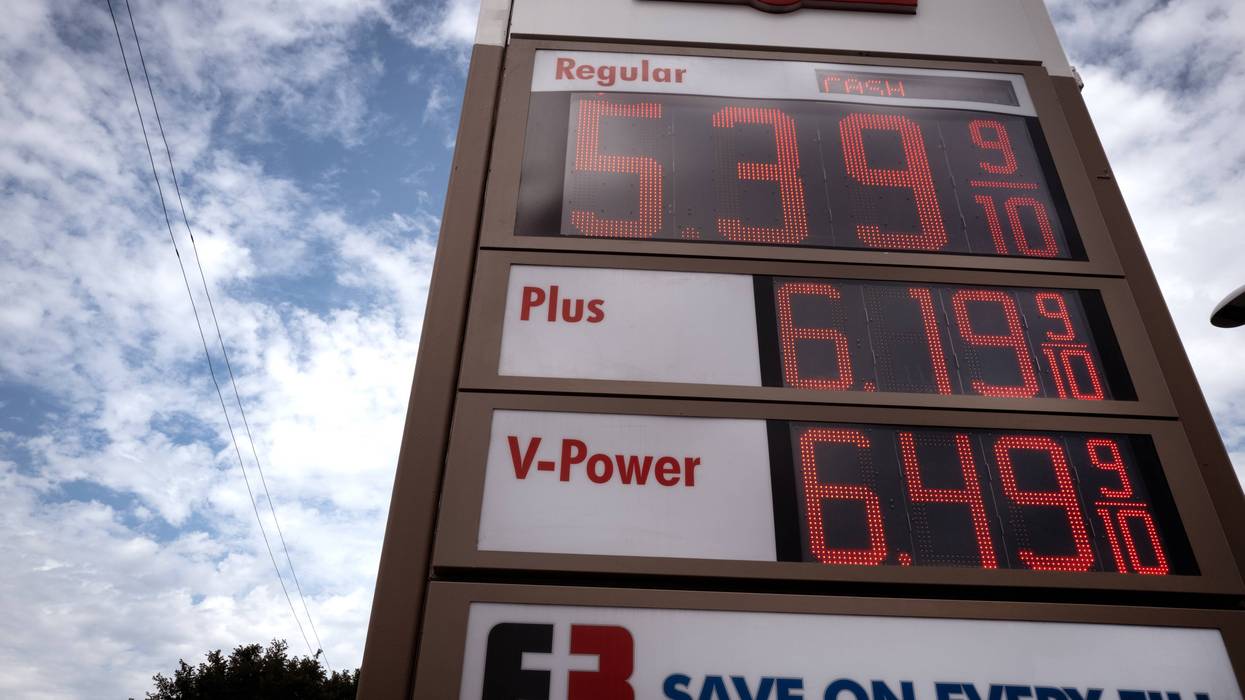
Energy prices increased by an annual rate of 20% in September, with the price of gasoline growing by an annual rate of 34% and the price of fuel oil growing by an annual rate of 74%.
University of Michigan economist Justin Wolfers noted in a Wednesday social media post that average wages are not keeping up with the rate of inflation, meaning workers have seen their purchasing power decrease.
"Real wages are falling," Wolfers wrote, "and have been falling for months."
Jared Bernstein, a senior fellow at the Center for American Progress and who served as chair of the Council of Economic Advisers under former President Joe Biden, said the September data showed that "working families are getting squeezed on both sides (wage, price) of the affordability crunch," as workers' inflation-adjusted earnings are now back to where they were at the start of Trump's second term.
Bernstein's observations were echoed by Heather Long, chief economist at Navy Federal Credit Union, who pointed out that "inflation has nearly wiped out all wage gains since January 2025."
"This is a very different picture from President Trump's first term when wages were up over 15%, well above about 8% inflation," Long added. "It helps explain the frustration many households feel right now with the economy."
Sen. Andy Kim (D-NJ) said that accelerating inflation was yet another sign of Republicans' governing failures.
"Trump and Republicans have no answer for rising inflation caused by soaring gas prices and the war in Iran," Kim wrote. "They're more focused on enriching Trump and his friends and family. This is why we're fighting to take back Congress so we can end the war and bring prices down for you and your family."
Alex Jacquez, senior vice president of policy, advocacy, and research at Groundwork Collaborative, said the CPI report shows why "Americans have lost faith in Trump’s economy."
"The president has repeatedly made promises he can’t keep," Jacquez said, "and despite the band-aid attempts from the White House, there is a gaping hole in our economy just weeks from the midterms. Between the president’s war in Iran and reckless tariffs, his economy is on life support."

"Washington's extrajudicial murders of alleged drug smugglers: not just grossly immoral and flagrantly illegal, but a ridiculous failure on their own terms."
US President Donald Trump has bombed dozens of boats in the Caribbean Sea and Pacific Ocean over the past 13 months, killing more than 230 people, but "record supplies of cocaine still arrive in the US, Europe, and as far away as Australia every day, cheaper and purer than they've been in decades," The Wall Street Journal reported late Tuesday.
After speaking with scholars of the cocaine trade and law enforcement officials across four continents, the Journal's Juan Forero detailed how "Colombian navy divers are detecting greater use of 'parasites'—metal modules packed with cocaine that traffickers bolt onto the hulls of freighters preparing to steam out of this country's largest Pacific port."
"Deep in the Amazon, smugglers have shifted shipments east, hiding drugs on boats moving through the rainforest's vast river network," he noted. "And on Colombia's long coast, crews evade US military airstrikes by hugging the shoreline in the exact same speedboats the Americans are targeting."
"In Europe, the influx is overwhelming authorities. The drugs arrive on container vessels, smaller boats from way stations in Africa, and semi-submersible vessels that cross the Atlantic to rendezvous with ships near Portugal or Spain," the journalist added, pointing out that cocaine prices have dropped in both the United States and Europe.
Since Trump began bombing the alleged drug boats last year, his administration has argued his deadly campaign is both necessary to stem the flow of illicit drugs and lawful because the US is purportedly at war with cartels. Critics, including Democrats in Congress, legal experts, and human rights groups, have condemned the strikes as murders.
The Journal's reporting isn't the first to highlight the initiative's apparent failure. It follows a July article from The Washington Post about a Drug Enforcement Administration analysis concluding the campaign "had failed to affect the supply or price of cocaine in the United States, and had led traffickers to diversify beyond go-fast boats and to avoid international waters, opting instead for larger boats and hemming close to coastlines, where US forces are less likely to open fire."
Sharing the latest article on social media Wednesday, writer Jesse Walker wrote, "Washington's extrajudicial murders of alleged drug smugglers: not just grossly immoral and flagrantly illegal, but a ridiculous failure on their own terms."
Journalist Glenn Greenwald similarly said: "As was completely predictable (and predicted), Trump's policy of bombing speed boats near Venezuela and Colombia has killed hundreds of people while having no success in impeding the flow of cocaine into the US. In fact, reports the WSJ, cocaine is more plentiful, purer, and cheaper in the US than ever, in part because of these bombings. At some point, will people realize that the justifications they're given for US bombings and wars are almost always—always—lies?"

One advocate suggested the administration is suppressing the data because it "doesn't line up" with Trump officials' narrative about the Republican budget law.
With the midterm elections less than three weeks away, US President Donald Trump's administration has delayed the release of Internal Revenue Service data showing how the Republican budget legislation that he signed into law last year has impacted families up and down the income distribution.
Politico reported Wednesday that the IRS "typically releases the data in the wake of each filing season, but this year's rollout is more anticipated because it's expected to provide the first detailed look at how taxpayers are taking advantage of the One Big Beautiful Bill Act, including its new deductions for overtime wages and tipped income." The outlet added that the IRS, whose workforce has been gutted by the Trump administration, is "awaiting approval from the Treasury Department to publish the figures," which were scheduled to be released in July.
The New York Times reported last month that the Trump administration is also withholding IRS estimates of unpaid taxes.
Nina Olson, executive director of the Center for Taxpayer Rights and the former US taxpayer advocate, told Politico that she believes the administration is suppressing information that runs counter to its narrative about the One Big Beautiful Bill Act (OBBBA), which extended provisions of the 2017 Trump-GOP tax cuts that disproportionately benefited the richest Americans and large corporations.
"I think they are hiding stuff that doesn't line up with all the crowing the CEO has been doing," Olson said, referring to IRS chief executive Frank Bisignano, who has celebrated the OBBBA as "historic tax relief for working families."
But an analysis released last week by the Institute on Taxation and Economic Policy showed that the OBBBA "overwhelmingly benefits the rich and corporations."
"While proponents of OBBBA often describe certain portions of the law that they argue benefit the middle class (such as tax breaks for tips and overtime) these provisions are a very small portion of the overall legislation which overwhelmingly benefits high-income people and corporations," the group observed. "Since the 2025 law was enacted, enormous profitable corporations like Meta, Amazon, Google, Tesla, and many others have paid extremely low effective tax rates (from 0 percent to 8 percent) in large part due to OBBBA."
The analysis found that, overall, Trump's major economic policies have hiked taxes and consumer costs for low- and middle-income families while cutting them for the top 1%.
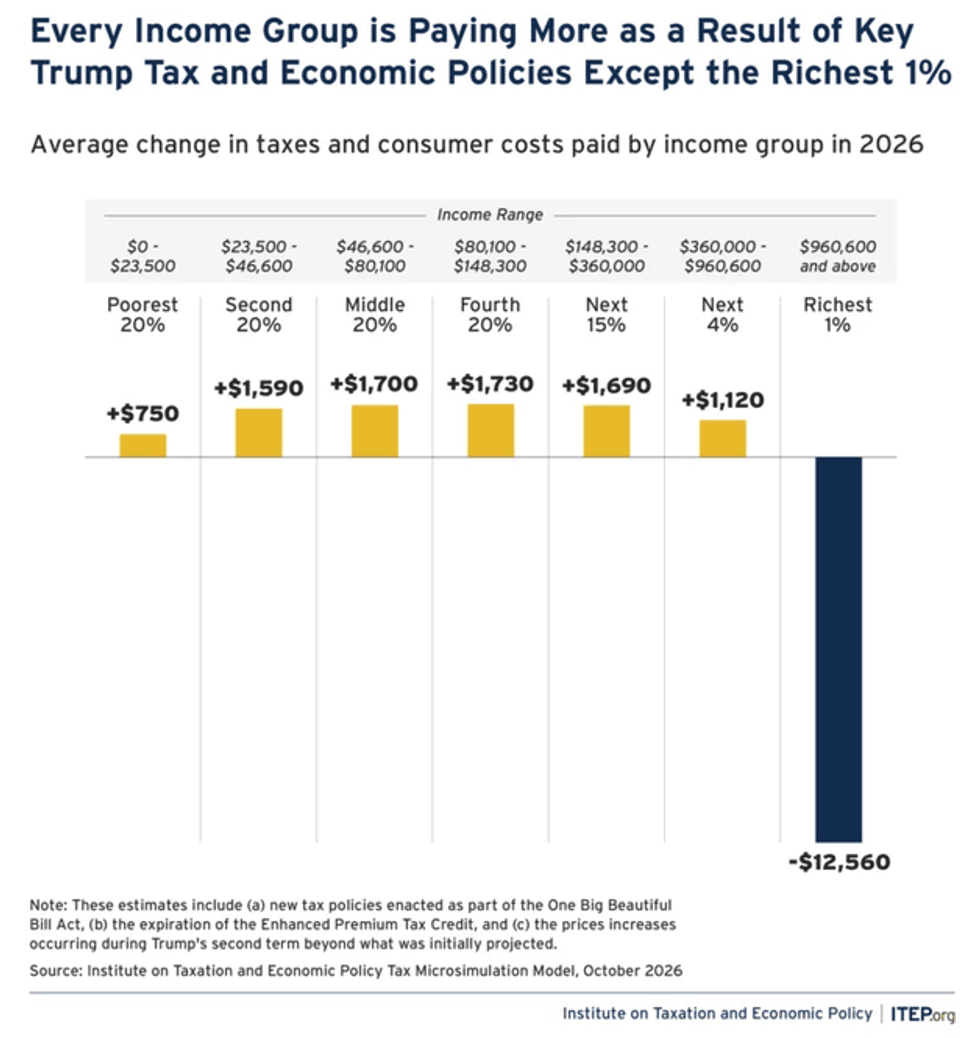
“The tax cuts Americans were promised—which were tilted heavily to the top to start—are being overwhelmed by higher prices and higher healthcare costs for most families,” said Steve Wamhoff, ITEP's federal policy director. “When you look at the full picture rather than tax cuts in isolation, the result is striking: The typical American in every income group is paying more, except that the richest 1% is the one group that comes out ahead.”