SUBSCRIBE TO OUR FREE NEWSLETTER
Daily news & progressive opinion—funded by the people, not the corporations—delivered straight to your inbox.
5
#000000
#FFFFFF
To donate by check, phone, or other method, see our More Ways to Give page.
Daily news & progressive opinion—funded by the people, not the corporations—delivered straight to your inbox.
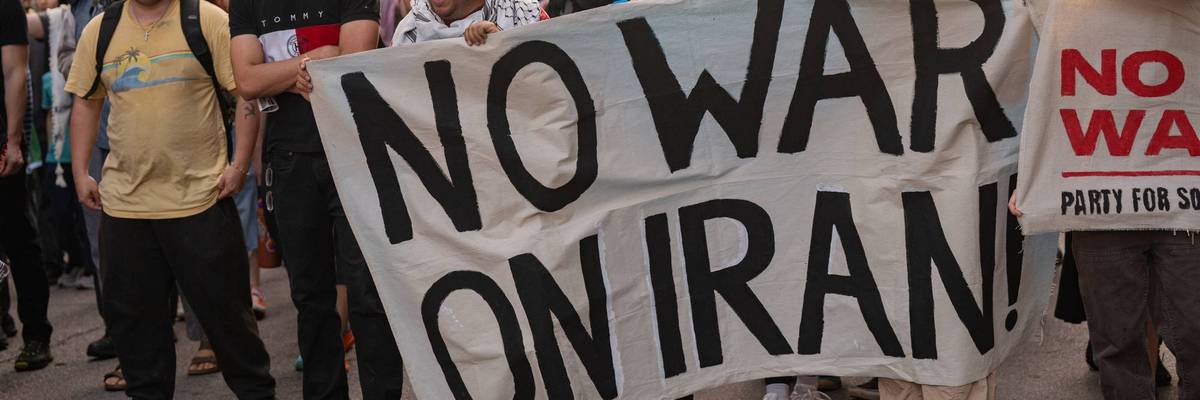
Protesters march in the streets of downtown Austin, Texas to show opposition to the war in Iran during a protest organized by the Austin for Palestine Coalition on April 8, 2026.
"Everyone in the chain of command who authorized this should be charged with murder."
Outrage over another apparent US war crime against Iranian civilians continued to grow over the weekend following New York Times reporting that the United States appears to have dropped a 2,000-pound bomb on a family home in a densely populated neighborhood of Qeshm Island in the Strait of Hormuz.
The newspaper spoke with weapons experts who analyzed photos, videos, and satellite imagery of the strike—which, according to Iranian officials, killed taxi driver Qeysar Jafari, his wife Zahra Jafari, and their 2-year-old son Sina, and hospitalized their two surviving children, Mohammad Reza and Mehdi.
While a spokesperson for US Central Command told the Times it is "looking into" reports that the family members were killed in the strike overnight Thursday and "the US military never targets civilians," Stanford University law professor Tom Dannenbaum outlined the United States' legal obligations.
"The attacking force must take all feasible precautions to minimize civilian harm, including in its selection of munitions, times of attack and, whenever circumstances allow, by issuing effective advance warnings," he said. Using a Mark-84 bomb in a crowded area "is very difficult to reconcile with" that.
Some readers and critics of the war highlighted Dannenbaum's comments while sharing the report on social media.
Former longtime Human Rights Watch leader Kenneth Roth similarly said: "Why did the US military drop a huge 2,000-pound bomb in a densely populated residential area in Iran? It is very hard to reconcile that use with the legal requirement to avoid disproportionate harm to civilians."
Journalist Rania Khalek denounced the attack as "barbaric savagery by soulless ghouls," while Nader Hashemi, director of the Alwaleed Center for Muslim-Christian Understanding at Georgetown University's Edmund A. Walsh School of Foreign Service, condemned it "a clear WAR CRIME."
Responding to Hashemi, Barbara Slavin, a George Washington University lecturer and Stimson Center distinguished fellow, said that "we are becoming more like Israel every day."
Trita Parsi, co-founder and executive vice president of the Quincy Institute for Responsible Statecraft, explained that "for years, Israel was using [2,000-pound] American bombs to kill Gazan refugees in tents. Both the Biden and Trump administrations permitted it. A precedent was set. Now it appears the US is doing the same in Iran."
"A [2,000-pound] bomb was dropped on a family house in Qeshm, killing a taxi driver (the father), the mother, and a 2-year-old, according to The New York Times," he continued. "Yes, a taxi driver. And a toddler. And his mother. "The Times found no indication of a military site near the family's home or any reports of military casualties from the strike."
Cory Archibald, co-founder of Track AIPAC, which documents spending by the American Israel Public Affairs Committee and related groups, stressed to people in the US, "That's what our government spends money on instead of giving you healthcare."
Leftist US political commentator Kyle Kulinski was among those demanding consequences for whoever carried out the deadly attack, declaring: "Pure terrorism. These people need to be in prison for life."
Saikat Chakrabarti, a Democrat who recently ran for Congress in California, agreed, saying that "everyone in the chain of command who authorized this should be charged with murder."
Since President Donald Trump and Israel began bombing Iran in late February, other apparent war crimes have included attacks on civilian infrastructure such as a water desalination plant, strikes that forced children to evacuate a hospital, and the destruction of a school in Minab that killed over 100 people.
Trump claimed late Saturday that he halted planned strikes on Iran due to progress in negotiations to end the illegal conflict. Appearing on CNN after the announcement, Parsi said that "I don't believe there was an imminent attack. We've gone through this several times, in which Trump issues these threats, and then he backs off because the other side calls his bluff."
Dear Common Dreams reader, It’s been nearly 30 years since I co-founded Common Dreams with my late wife, Lina Newhouser. We had the radical notion that journalism should serve the public good, not corporate profits. It was clear to us from the outset what it would take to build such a project. No paid advertisements. No corporate sponsors. No millionaire publisher telling us what to think or do. Many people said we wouldn't last a year, but we proved those doubters wrong. Together with a tremendous team of journalists and dedicated staff, we built an independent media outlet free from the constraints of profits and corporate control. Our mission has always been simple: To inform. To inspire. To ignite change for the common good. Building Common Dreams was not easy. Our survival was never guaranteed. When you take on the most powerful forces—Wall Street greed, fossil fuel industry destruction, Big Tech lobbyists, and uber-rich oligarchs who have spent billions upon billions rigging the economy and democracy in their favor—the only bulwark you have is supporters who believe in your work. But here’s the urgent message from me today. It's never been this bad out there. And it's never been this hard to keep us going. At the very moment Common Dreams is most needed, the threats we face are intensifying. We need your support now more than ever. We don't accept corporate advertising and never will. We don't have a paywall because we don't think people should be blocked from critical news based on their ability to pay. Everything we do is funded by the donations of readers like you. When everyone does the little they can afford, we are strong. But if that support retreats or dries up, so do we. Will you donate now to make sure Common Dreams not only survives but thrives? —Craig Brown, Co-founder |
Outrage over another apparent US war crime against Iranian civilians continued to grow over the weekend following New York Times reporting that the United States appears to have dropped a 2,000-pound bomb on a family home in a densely populated neighborhood of Qeshm Island in the Strait of Hormuz.
The newspaper spoke with weapons experts who analyzed photos, videos, and satellite imagery of the strike—which, according to Iranian officials, killed taxi driver Qeysar Jafari, his wife Zahra Jafari, and their 2-year-old son Sina, and hospitalized their two surviving children, Mohammad Reza and Mehdi.
While a spokesperson for US Central Command told the Times it is "looking into" reports that the family members were killed in the strike overnight Thursday and "the US military never targets civilians," Stanford University law professor Tom Dannenbaum outlined the United States' legal obligations.
"The attacking force must take all feasible precautions to minimize civilian harm, including in its selection of munitions, times of attack and, whenever circumstances allow, by issuing effective advance warnings," he said. Using a Mark-84 bomb in a crowded area "is very difficult to reconcile with" that.
Some readers and critics of the war highlighted Dannenbaum's comments while sharing the report on social media.
Former longtime Human Rights Watch leader Kenneth Roth similarly said: "Why did the US military drop a huge 2,000-pound bomb in a densely populated residential area in Iran? It is very hard to reconcile that use with the legal requirement to avoid disproportionate harm to civilians."
Journalist Rania Khalek denounced the attack as "barbaric savagery by soulless ghouls," while Nader Hashemi, director of the Alwaleed Center for Muslim-Christian Understanding at Georgetown University's Edmund A. Walsh School of Foreign Service, condemned it "a clear WAR CRIME."
Responding to Hashemi, Barbara Slavin, a George Washington University lecturer and Stimson Center distinguished fellow, said that "we are becoming more like Israel every day."
Trita Parsi, co-founder and executive vice president of the Quincy Institute for Responsible Statecraft, explained that "for years, Israel was using [2,000-pound] American bombs to kill Gazan refugees in tents. Both the Biden and Trump administrations permitted it. A precedent was set. Now it appears the US is doing the same in Iran."
"A [2,000-pound] bomb was dropped on a family house in Qeshm, killing a taxi driver (the father), the mother, and a 2-year-old, according to The New York Times," he continued. "Yes, a taxi driver. And a toddler. And his mother. "The Times found no indication of a military site near the family's home or any reports of military casualties from the strike."
Cory Archibald, co-founder of Track AIPAC, which documents spending by the American Israel Public Affairs Committee and related groups, stressed to people in the US, "That's what our government spends money on instead of giving you healthcare."
Leftist US political commentator Kyle Kulinski was among those demanding consequences for whoever carried out the deadly attack, declaring: "Pure terrorism. These people need to be in prison for life."
Saikat Chakrabarti, a Democrat who recently ran for Congress in California, agreed, saying that "everyone in the chain of command who authorized this should be charged with murder."
Since President Donald Trump and Israel began bombing Iran in late February, other apparent war crimes have included attacks on civilian infrastructure such as a water desalination plant, strikes that forced children to evacuate a hospital, and the destruction of a school in Minab that killed over 100 people.
Trump claimed late Saturday that he halted planned strikes on Iran due to progress in negotiations to end the illegal conflict. Appearing on CNN after the announcement, Parsi said that "I don't believe there was an imminent attack. We've gone through this several times, in which Trump issues these threats, and then he backs off because the other side calls his bluff."
Outrage over another apparent US war crime against Iranian civilians continued to grow over the weekend following New York Times reporting that the United States appears to have dropped a 2,000-pound bomb on a family home in a densely populated neighborhood of Qeshm Island in the Strait of Hormuz.
The newspaper spoke with weapons experts who analyzed photos, videos, and satellite imagery of the strike—which, according to Iranian officials, killed taxi driver Qeysar Jafari, his wife Zahra Jafari, and their 2-year-old son Sina, and hospitalized their two surviving children, Mohammad Reza and Mehdi.
While a spokesperson for US Central Command told the Times it is "looking into" reports that the family members were killed in the strike overnight Thursday and "the US military never targets civilians," Stanford University law professor Tom Dannenbaum outlined the United States' legal obligations.
"The attacking force must take all feasible precautions to minimize civilian harm, including in its selection of munitions, times of attack and, whenever circumstances allow, by issuing effective advance warnings," he said. Using a Mark-84 bomb in a crowded area "is very difficult to reconcile with" that.
Some readers and critics of the war highlighted Dannenbaum's comments while sharing the report on social media.
Former longtime Human Rights Watch leader Kenneth Roth similarly said: "Why did the US military drop a huge 2,000-pound bomb in a densely populated residential area in Iran? It is very hard to reconcile that use with the legal requirement to avoid disproportionate harm to civilians."
Journalist Rania Khalek denounced the attack as "barbaric savagery by soulless ghouls," while Nader Hashemi, director of the Alwaleed Center for Muslim-Christian Understanding at Georgetown University's Edmund A. Walsh School of Foreign Service, condemned it "a clear WAR CRIME."
Responding to Hashemi, Barbara Slavin, a George Washington University lecturer and Stimson Center distinguished fellow, said that "we are becoming more like Israel every day."
Trita Parsi, co-founder and executive vice president of the Quincy Institute for Responsible Statecraft, explained that "for years, Israel was using [2,000-pound] American bombs to kill Gazan refugees in tents. Both the Biden and Trump administrations permitted it. A precedent was set. Now it appears the US is doing the same in Iran."
"A [2,000-pound] bomb was dropped on a family house in Qeshm, killing a taxi driver (the father), the mother, and a 2-year-old, according to The New York Times," he continued. "Yes, a taxi driver. And a toddler. And his mother. "The Times found no indication of a military site near the family's home or any reports of military casualties from the strike."
Cory Archibald, co-founder of Track AIPAC, which documents spending by the American Israel Public Affairs Committee and related groups, stressed to people in the US, "That's what our government spends money on instead of giving you healthcare."
Leftist US political commentator Kyle Kulinski was among those demanding consequences for whoever carried out the deadly attack, declaring: "Pure terrorism. These people need to be in prison for life."
Saikat Chakrabarti, a Democrat who recently ran for Congress in California, agreed, saying that "everyone in the chain of command who authorized this should be charged with murder."
Since President Donald Trump and Israel began bombing Iran in late February, other apparent war crimes have included attacks on civilian infrastructure such as a water desalination plant, strikes that forced children to evacuate a hospital, and the destruction of a school in Minab that killed over 100 people.
Trump claimed late Saturday that he halted planned strikes on Iran due to progress in negotiations to end the illegal conflict. Appearing on CNN after the announcement, Parsi said that "I don't believe there was an imminent attack. We've gone through this several times, in which Trump issues these threats, and then he backs off because the other side calls his bluff."