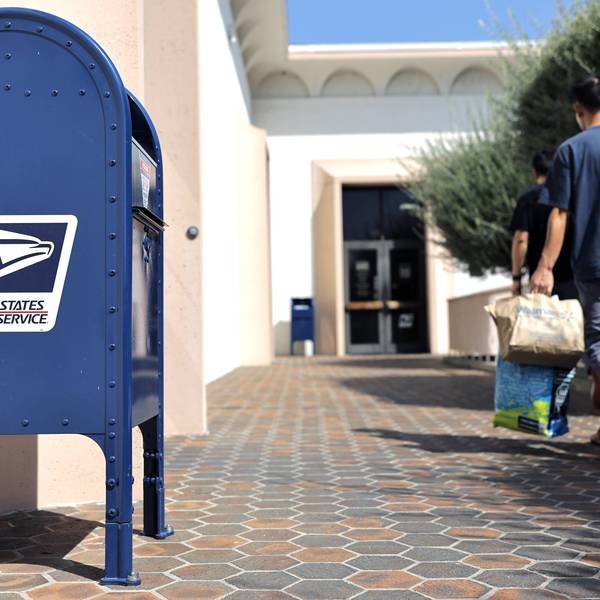

An election worker processes mail-in ballots at the Los Angeles County Ballot Processing Center during California's state primary election in the City of Industry, California, on June 2, 2026.
‘Virtual Elimination of Mail-In Voting’ Feared Under Trump Postal Service Order
"This is not in the president’s power. It's absolutely clear in the Constitution—states run elections," said Oregon Secretary of State Tobias Read.
President Donald Trump's executive order restricting the distribution of ballots by the US Postal Service could effectively end the ability to vote by mail if it isn't struck down, experts told CNN on Wednesday.
The order, which was signed in March, instructs the USPS to not deliver ballots in any states that have not given the federal government access to its voter lists. It is being challenged by congressional Democrats and all 23 Democratic state attorneys general, who are urging courts to block the order before it potentially disenfranchises eligible voters.
Maine Secretary of State Shenna Bellows told CNN that, unless courts intervene quickly, "you will see a virtual elimination of mail-in voting."
Oregon Secretary of State Tobias Read explained to CNN that he believes the Trump order is patently unlawful given that it usurps states' powers outlined in the US Constitution to run their own elections.
"This is not in the president’s power," Read said. "It's absolutely clear in the Constitution—states run elections."
Although Trump-appointed US District Court Judge Carl Nichols last month declined to block the president's executive order, congressional Democrats are appealing the case at the DC US Circuit Court of Appeals, where they are seeking an expedited process that will result in a ruling before the fall.
The legal challenge brought by Democratic attorneys general is currently before a federal judge in Boston.
Without fast action, congressional Democrats warned in a Monday court filing, "millions of American voters’ sensitive personal data will be amassed into inaccurate and unlawful databases and USPS will engage in unprecedented interference with state mail voting programs."
The executive order attacking mail-in voting is just one of many ways the Trump administration has been trying to meddle in the election process ahead of the 2026 midterms.
According to a report from Democracy Docket, a Tuesday court filing by the US Department of Justice argued that states have the power to purge voter rolls at any time ahead of an election and do not have to abide by the 90-day "quiet period" established in the National Voter Registration Act (NVRA).
As the law has been traditionally interpreted, states cannot trim voter rolls less than 90 days before elections so that people affected by the changes have sufficient time to file challenges and potentially restore their eligibility.
However, the Trump DOJ argued that the provision establishing the 90-day period "would not prevent a state like Georgia from investigating and removing ineligible people in an individualized fashion" close to an election "if the United States alerted the state of the possibility that particular individuals on their rolls were ineligible to vote."
As explained by Democracy Docket, this interpretation of the law could let the federal government create lists of voters to be purged and then "pressure states to carry out the removals individually—potentially weakening one of the most important federal safeguards against last-minute disenfranchisement."
We are at a crossroads
This country and this world are at a monumental crossroads. In a few short weeks, US voters will have an opportunity to beat back the forces of fascism and confront the billionaires who are rigging the economy, our media system, and our democracy, making it increasingly impossible for ordinary people to get by. We’re not just talking about the election. We’re talking about what must be done once these fascist elements are vanquished from power. We need a bolder set of solutions than what either major party has so far been willing to offer and a working-class movement ready to fight like hell for it. Trump didn't emerge from nowhere. The conditions that fueled MAGA authoritarianism were created by decades of radical neoliberal economic policies and a corrupt political system dominated by corporate interests. They slashed taxes on the super-rich, promising that the benefits would trickle down. They said giveaways to the corporate titans would make life more affordable for the rest of us. It was all bullshit. And when a bitter, betrayed populace searches for someone to blame, right-wing demagogues have little trouble finding scapegoats. People know when they're being lied to, but you won't hear any of this from the corporate media. Only independent journalism—powered and funded by people who believe in building a better world—can deliver truly trustworthy daily news. Our Fall Campaign is underway, and we need your help. To power our newsroom through the rest of the year, we need to raise $125,000 by midnight on October 31. So if you share our vision, please contribute whatever you can to sustain our work. |
President Donald Trump's executive order restricting the distribution of ballots by the US Postal Service could effectively end the ability to vote by mail if it isn't struck down, experts told CNN on Wednesday.
The order, which was signed in March, instructs the USPS to not deliver ballots in any states that have not given the federal government access to its voter lists. It is being challenged by congressional Democrats and all 23 Democratic state attorneys general, who are urging courts to block the order before it potentially disenfranchises eligible voters.
Maine Secretary of State Shenna Bellows told CNN that, unless courts intervene quickly, "you will see a virtual elimination of mail-in voting."
Oregon Secretary of State Tobias Read explained to CNN that he believes the Trump order is patently unlawful given that it usurps states' powers outlined in the US Constitution to run their own elections.
"This is not in the president’s power," Read said. "It's absolutely clear in the Constitution—states run elections."
Although Trump-appointed US District Court Judge Carl Nichols last month declined to block the president's executive order, congressional Democrats are appealing the case at the DC US Circuit Court of Appeals, where they are seeking an expedited process that will result in a ruling before the fall.
The legal challenge brought by Democratic attorneys general is currently before a federal judge in Boston.
Without fast action, congressional Democrats warned in a Monday court filing, "millions of American voters’ sensitive personal data will be amassed into inaccurate and unlawful databases and USPS will engage in unprecedented interference with state mail voting programs."
The executive order attacking mail-in voting is just one of many ways the Trump administration has been trying to meddle in the election process ahead of the 2026 midterms.
According to a report from Democracy Docket, a Tuesday court filing by the US Department of Justice argued that states have the power to purge voter rolls at any time ahead of an election and do not have to abide by the 90-day "quiet period" established in the National Voter Registration Act (NVRA).
As the law has been traditionally interpreted, states cannot trim voter rolls less than 90 days before elections so that people affected by the changes have sufficient time to file challenges and potentially restore their eligibility.
However, the Trump DOJ argued that the provision establishing the 90-day period "would not prevent a state like Georgia from investigating and removing ineligible people in an individualized fashion" close to an election "if the United States alerted the state of the possibility that particular individuals on their rolls were ineligible to vote."
As explained by Democracy Docket, this interpretation of the law could let the federal government create lists of voters to be purged and then "pressure states to carry out the removals individually—potentially weakening one of the most important federal safeguards against last-minute disenfranchisement."
- Lawsuits Expected After Trump Orders Creation of National Voter List, Mail-In Voting Crackdown - News & Opinion - The Commons ›
- Democrats File Sweeping Lawsuit to Stop 'Unlawful' Trump Attack on Mail-In Voting ›
- Lawsuits Expected After Trump Orders Creation of National Voter List, Mail-In Voting Crackdown ›
- State AGs Applaud Court Blocking 'Unconstitutional' Trump Proof of Citizenship Voting Requirement | Common Dreams ›
- ‘Yeah, That’s Illegal’: USPS Chief Says States Won't Receive Mail Ballots Unless They Hand Voter Rolls to Trump | Common Dreams ›
- Judge Blocks 'Unconstitutional and Dangerous' Trump Order Designed to Derail Mail-In Voting | Common Dreams ›
- Democrats, Groups Fight Back After Supreme Court Clears Way for Trump Attack on Mail Voting | Common Dreams ›
President Donald Trump's executive order restricting the distribution of ballots by the US Postal Service could effectively end the ability to vote by mail if it isn't struck down, experts told CNN on Wednesday.
The order, which was signed in March, instructs the USPS to not deliver ballots in any states that have not given the federal government access to its voter lists. It is being challenged by congressional Democrats and all 23 Democratic state attorneys general, who are urging courts to block the order before it potentially disenfranchises eligible voters.
Maine Secretary of State Shenna Bellows told CNN that, unless courts intervene quickly, "you will see a virtual elimination of mail-in voting."
Oregon Secretary of State Tobias Read explained to CNN that he believes the Trump order is patently unlawful given that it usurps states' powers outlined in the US Constitution to run their own elections.
"This is not in the president’s power," Read said. "It's absolutely clear in the Constitution—states run elections."
Although Trump-appointed US District Court Judge Carl Nichols last month declined to block the president's executive order, congressional Democrats are appealing the case at the DC US Circuit Court of Appeals, where they are seeking an expedited process that will result in a ruling before the fall.
The legal challenge brought by Democratic attorneys general is currently before a federal judge in Boston.
Without fast action, congressional Democrats warned in a Monday court filing, "millions of American voters’ sensitive personal data will be amassed into inaccurate and unlawful databases and USPS will engage in unprecedented interference with state mail voting programs."
The executive order attacking mail-in voting is just one of many ways the Trump administration has been trying to meddle in the election process ahead of the 2026 midterms.
According to a report from Democracy Docket, a Tuesday court filing by the US Department of Justice argued that states have the power to purge voter rolls at any time ahead of an election and do not have to abide by the 90-day "quiet period" established in the National Voter Registration Act (NVRA).
As the law has been traditionally interpreted, states cannot trim voter rolls less than 90 days before elections so that people affected by the changes have sufficient time to file challenges and potentially restore their eligibility.
However, the Trump DOJ argued that the provision establishing the 90-day period "would not prevent a state like Georgia from investigating and removing ineligible people in an individualized fashion" close to an election "if the United States alerted the state of the possibility that particular individuals on their rolls were ineligible to vote."
As explained by Democracy Docket, this interpretation of the law could let the federal government create lists of voters to be purged and then "pressure states to carry out the removals individually—potentially weakening one of the most important federal safeguards against last-minute disenfranchisement."
- Lawsuits Expected After Trump Orders Creation of National Voter List, Mail-In Voting Crackdown - News & Opinion - The Commons ›
- Democrats File Sweeping Lawsuit to Stop 'Unlawful' Trump Attack on Mail-In Voting ›
- Lawsuits Expected After Trump Orders Creation of National Voter List, Mail-In Voting Crackdown ›
- State AGs Applaud Court Blocking 'Unconstitutional' Trump Proof of Citizenship Voting Requirement | Common Dreams ›
- ‘Yeah, That’s Illegal’: USPS Chief Says States Won't Receive Mail Ballots Unless They Hand Voter Rolls to Trump | Common Dreams ›
- Judge Blocks 'Unconstitutional and Dangerous' Trump Order Designed to Derail Mail-In Voting | Common Dreams ›
- Democrats, Groups Fight Back After Supreme Court Clears Way for Trump Attack on Mail Voting | Common Dreams ›