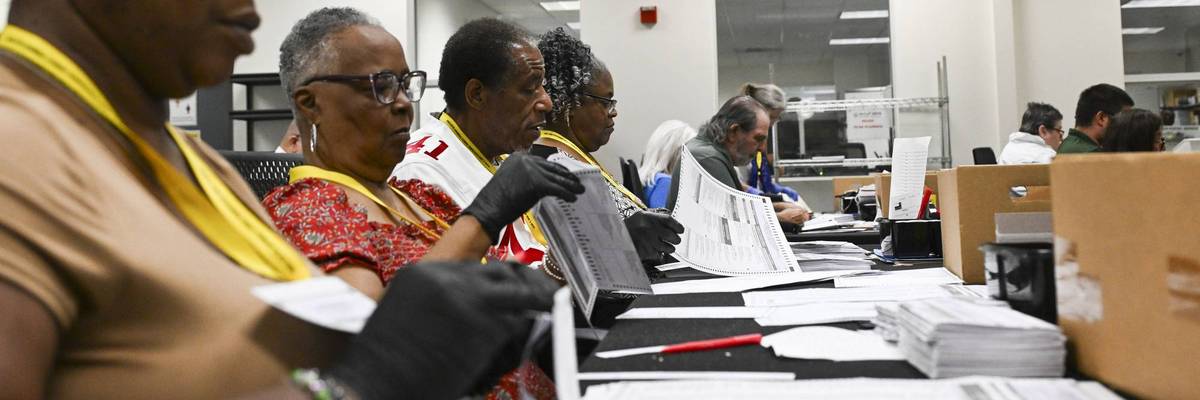
Election workers process mailed ballots in Riverside, California on June 1, 2026.
In 'Win for Voters,' Another Federal Court Blocks Trump Attack on Mailed Ballots
A majority of the three-judge appellate panel called part of the president's March executive order "an unprecedented federal incursion into states’ exclusive power to determine voter eligibility."
A federal appellate panel on Saturday rejected the Trump administration's request to lift a lower court's injunction blocking the US Postal Service from enforcing President Donald Trump's March executive order targeting mail-in ballots as part of Republicans' broader attack on voting rights.
A three-judge panel of the Boston-based 1st US Circuit Court of Appeals ruled 2-1 against a motion by the administration seeking a pause on US District Judge Indira Talwani's June order blocking major portions of Trump's directive, which is aimed at restricting postal voting, including by directing the USPS to ensure that mailed ballots have unique barcodes and envelope logos.
"Under the Constitution, state and local officials are responsible for administering federal elections," Judges Gustavo Gelpí and Julie Rikelman—both appointed by former President Joe Biden—wrote in a joint opinion. "In the spring of 2026, President Trump issued an executive order with nationwide effects on how state and local officials can administer federal elections, including the upcoming primary and general elections in September and November. In particular, the executive order directed substantial involvement by the United States Postal Service in deciding which ballots sent to and from voters would be delivered."
Judge Joshua Dunlap, a Trump appointee, partially dissented from the majority. The decision applies to the 23 states and District of Columbia that filed a lawsuit challenging the executive order.
The ruling also focuses on the executive order’s threats to criminally punish any state or local officials who refuse to comply. Under the order, the USPS would only send mail ballots to states that send their unredacted voter files to [the US Department of Homeland Security], which would approve voter eligibility via a national voter registration database. This is an unprecedented federal incursion into states’ exclusive power to determine voter eligibility as deemed by the US Constitution.
Saturday's ruling comes just over three weeks after Judge Emmet Sullivan of the US District Court for the District of Columbia halted the USPS' implementation of Trump's executive order. Sullivan granted a request by the NAACP to enforce a 2021 settlement agreement requiring the USPS to protect mail-in voting and prioritize delivery of mail related to elections through 2028.
That decision followed a June ruling by Chief US District Judge Denise Casper in Massachusetts that blocked portions of the president's order requiring people to show proof of citizenship when registering to vote.
Trump's March order is part of a broader attack on voting rights that includes pushing an updated version of Republicans' so-called SAVE America Act, which would mandate proof of citizenship and strict photo ID requirements to register to vote in federal elections. The legislation, which was passed by the House of Representatives in February, is stalled in the narrowly split Senate, where it lacks the support of 60 lawmakers needed to avoid a Democrat filibuster.
We are at a crossroads
This country and this world are at a monumental crossroads. In a few short weeks, US voters will have an opportunity to beat back the forces of fascism and confront the billionaires who are rigging the economy, our media system, and our democracy, making it increasingly impossible for ordinary people to get by. We’re not just talking about the election. We’re talking about what must be done once these fascist elements are vanquished from power. We need a bolder set of solutions than what either major party has so far been willing to offer and a working-class movement ready to fight like hell for it. Trump didn't emerge from nowhere. The conditions that fueled MAGA authoritarianism were created by decades of radical neoliberal economic policies and a corrupt political system dominated by corporate interests. They slashed taxes on the super-rich, promising that the benefits would trickle down. They said giveaways to the corporate titans would make life more affordable for the rest of us. It was all bullshit. And when a bitter, betrayed populace searches for someone to blame, right-wing demagogues have little trouble finding scapegoats. People know when they're being lied to, but you won't hear any of this from the corporate media. Only independent journalism—powered and funded by people who believe in building a better world—can deliver truly trustworthy daily news. Our Fall Campaign is underway, and we need your help. To power our newsroom through the rest of the year, we need to raise $125,000 by midnight on October 31. So if you share our vision, please contribute whatever you can to sustain our work. |
A federal appellate panel on Saturday rejected the Trump administration's request to lift a lower court's injunction blocking the US Postal Service from enforcing President Donald Trump's March executive order targeting mail-in ballots as part of Republicans' broader attack on voting rights.
A three-judge panel of the Boston-based 1st US Circuit Court of Appeals ruled 2-1 against a motion by the administration seeking a pause on US District Judge Indira Talwani's June order blocking major portions of Trump's directive, which is aimed at restricting postal voting, including by directing the USPS to ensure that mailed ballots have unique barcodes and envelope logos.
"Under the Constitution, state and local officials are responsible for administering federal elections," Judges Gustavo Gelpí and Julie Rikelman—both appointed by former President Joe Biden—wrote in a joint opinion. "In the spring of 2026, President Trump issued an executive order with nationwide effects on how state and local officials can administer federal elections, including the upcoming primary and general elections in September and November. In particular, the executive order directed substantial involvement by the United States Postal Service in deciding which ballots sent to and from voters would be delivered."
Judge Joshua Dunlap, a Trump appointee, partially dissented from the majority. The decision applies to the 23 states and District of Columbia that filed a lawsuit challenging the executive order.
The ruling also focuses on the executive order’s threats to criminally punish any state or local officials who refuse to comply. Under the order, the USPS would only send mail ballots to states that send their unredacted voter files to [the US Department of Homeland Security], which would approve voter eligibility via a national voter registration database. This is an unprecedented federal incursion into states’ exclusive power to determine voter eligibility as deemed by the US Constitution.
Saturday's ruling comes just over three weeks after Judge Emmet Sullivan of the US District Court for the District of Columbia halted the USPS' implementation of Trump's executive order. Sullivan granted a request by the NAACP to enforce a 2021 settlement agreement requiring the USPS to protect mail-in voting and prioritize delivery of mail related to elections through 2028.
That decision followed a June ruling by Chief US District Judge Denise Casper in Massachusetts that blocked portions of the president's order requiring people to show proof of citizenship when registering to vote.
Trump's March order is part of a broader attack on voting rights that includes pushing an updated version of Republicans' so-called SAVE America Act, which would mandate proof of citizenship and strict photo ID requirements to register to vote in federal elections. The legislation, which was passed by the House of Representatives in February, is stalled in the narrowly split Senate, where it lacks the support of 60 lawmakers needed to avoid a Democrat filibuster.
- In 'Victory for Voters,' Supreme Court Rejects Trump-GOP Attack on Mailed Ballots ›
- In 'Victory for the People,' Judge Blocks Parts of Trump's Attack on Voting Rights ›
- Court Lands Latest Blow to Trump's 'Anti-Voting Agenda' by Blocking USPS Attack on Mailed Ballots ›
- Judge Blocks 'Unconstitutional and Dangerous' Trump Order Designed to Derail Mail-In Voting ›
- 'Painful Setback': Supreme Court Lets Trump Enforce Mailed Ballot Rules—But Punts on Their Legality | Common Dreams ›
- Opinion | The Supreme Court's Mail Voting Ruling Is Manufactured Chaos | Common Dreams ›
- After Judge Unblocks Trump Voting Order, Groups Target His 'Blatantly Unconstitutional' USPS Rule | Common Dreams ›
- Appeals Court Rejects 'Likely Unlawful' Trump Push to Undermine Mail-In Voting as Supreme Court Looms | Common Dreams ›
A federal appellate panel on Saturday rejected the Trump administration's request to lift a lower court's injunction blocking the US Postal Service from enforcing President Donald Trump's March executive order targeting mail-in ballots as part of Republicans' broader attack on voting rights.
A three-judge panel of the Boston-based 1st US Circuit Court of Appeals ruled 2-1 against a motion by the administration seeking a pause on US District Judge Indira Talwani's June order blocking major portions of Trump's directive, which is aimed at restricting postal voting, including by directing the USPS to ensure that mailed ballots have unique barcodes and envelope logos.
"Under the Constitution, state and local officials are responsible for administering federal elections," Judges Gustavo Gelpí and Julie Rikelman—both appointed by former President Joe Biden—wrote in a joint opinion. "In the spring of 2026, President Trump issued an executive order with nationwide effects on how state and local officials can administer federal elections, including the upcoming primary and general elections in September and November. In particular, the executive order directed substantial involvement by the United States Postal Service in deciding which ballots sent to and from voters would be delivered."
Judge Joshua Dunlap, a Trump appointee, partially dissented from the majority. The decision applies to the 23 states and District of Columbia that filed a lawsuit challenging the executive order.
The ruling also focuses on the executive order’s threats to criminally punish any state or local officials who refuse to comply. Under the order, the USPS would only send mail ballots to states that send their unredacted voter files to [the US Department of Homeland Security], which would approve voter eligibility via a national voter registration database. This is an unprecedented federal incursion into states’ exclusive power to determine voter eligibility as deemed by the US Constitution.
Saturday's ruling comes just over three weeks after Judge Emmet Sullivan of the US District Court for the District of Columbia halted the USPS' implementation of Trump's executive order. Sullivan granted a request by the NAACP to enforce a 2021 settlement agreement requiring the USPS to protect mail-in voting and prioritize delivery of mail related to elections through 2028.
That decision followed a June ruling by Chief US District Judge Denise Casper in Massachusetts that blocked portions of the president's order requiring people to show proof of citizenship when registering to vote.
Trump's March order is part of a broader attack on voting rights that includes pushing an updated version of Republicans' so-called SAVE America Act, which would mandate proof of citizenship and strict photo ID requirements to register to vote in federal elections. The legislation, which was passed by the House of Representatives in February, is stalled in the narrowly split Senate, where it lacks the support of 60 lawmakers needed to avoid a Democrat filibuster.
- In 'Victory for Voters,' Supreme Court Rejects Trump-GOP Attack on Mailed Ballots ›
- In 'Victory for the People,' Judge Blocks Parts of Trump's Attack on Voting Rights ›
- Court Lands Latest Blow to Trump's 'Anti-Voting Agenda' by Blocking USPS Attack on Mailed Ballots ›
- Judge Blocks 'Unconstitutional and Dangerous' Trump Order Designed to Derail Mail-In Voting ›
- 'Painful Setback': Supreme Court Lets Trump Enforce Mailed Ballot Rules—But Punts on Their Legality | Common Dreams ›
- Opinion | The Supreme Court's Mail Voting Ruling Is Manufactured Chaos | Common Dreams ›
- After Judge Unblocks Trump Voting Order, Groups Target His 'Blatantly Unconstitutional' USPS Rule | Common Dreams ›
- Appeals Court Rejects 'Likely Unlawful' Trump Push to Undermine Mail-In Voting as Supreme Court Looms | Common Dreams ›