SUBSCRIBE TO OUR FREE NEWSLETTER
Daily news & progressive opinion—funded by the people, not the corporations—delivered straight to your inbox.
5
#000000
#FFFFFF
To donate by check, phone, or other method, see our More Ways to Give page.


Daily news & progressive opinion—funded by the people, not the corporations—delivered straight to your inbox.
“What I saw today made me feel ashamed to be Jewish," said Tamir Pardo after touring Occupied West Bank.
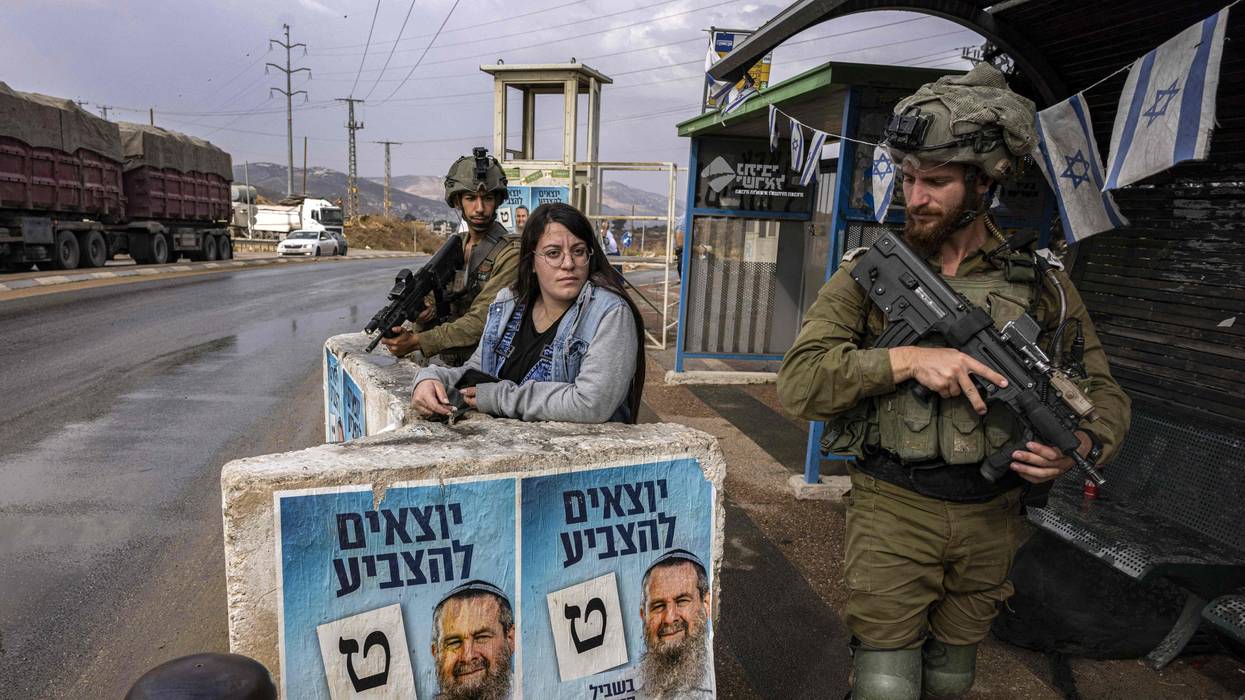
Tamir Pardo, the former chief of Israel's powerful Mossad intelligence agency, drew international attention on Monday by saying that what he witnessed during a tour of the Occupied West Bank reminded him of the treatment of the Jewish people during the Holocaust by Nazi Germany in the 1930s ad 40s.
Pardo, who served as Mossad director from 2011 to 2016, expressed sorrow and shame over what he saw, invoking his Jewish family's history.
“My mother was a Holocaust survivor, and what I saw reminded me of the events that happened against Jews in the last century,” Pardo told Channel 13 news. “What I saw today made me feel ashamed to be Jewish.”
Tamir Pardo, former Mossad head, on a tour documenting Jewish settler terror in the West Bank: “My mother is a Holocaust survivor, and what I saw here reminded me of the events of the previous century against the Jews.“ pic.twitter.com/o1eJ9vkhDi
— Etan Nechin (@Etanetan23) April 28, 2026
Observers noted that Pardo's statements—which echo, at least in certain key ways, those of experts and humanitarian advocates who have documented the abuses in the Occupied Palestinian Territories (OPT)—would come under harsh rebuke by the Anti-Defamation League (ADL) or other pro-Israel hardliners in the United States if spoken by others.
"The former head of the Mossad is comparing the actions of Israeli settlers in the occupied West Bank to Nazis in the Holocaust," said journalist Mehdi Hasan. "If someone said that in the West they'd be accused of antisemitism under the IHRA definition."
The IHRA definition refers to how the International Holocaust Remembrance Alliance articulates antisemitism, a more sweeping definition—one adopted by the ADL and many Zionist political forces in the United States—that equates criticism of the state of Israel or its policies with animus toward or discrimination of the Jewish people. Critics of the IHRA definition, including Jewish scholars and holocaust experts, have said its deployment undermines efforts to confront the real scourge of antisemitism while also insulating Israel from honest and necessary criticism.
“My mother is a Holocaust survivor. What I saw here today recalled the events that happened in the last century”
Former Mossad chief Tamir Pardo, during a tour tracing illegal settler violence in the occupied West Bank, compared the scenes he witnessed to the Holocaust.
Pardo… pic.twitter.com/rrsQx2CvpW
— TRT World (@trtworld) April 28, 2026
Pardo has spoken out previously about what he regards is an apartheid system in the OPT, including in 2023 prior to the October 7 attacks, but his warnings to curb the mistreatment of the Palestinian population were dismissed by the ruling coalition. In the time since, the situation in the West Bank for Palestinians has deteriorated significantly.
Touring the region with other former members of the Israeli Defense Forces (IDF), Pardo warned that the conditions on the ground, where Palestinians live under armed occupation and the near constant threat of settler violence, is setting the stage for a violent reaction similar to what occurred on October 7, 2023 when Gaza militant factions staged a violent assault on Israel.
“To my great regret, what we are seeing today,” said Pardo, “is the next October 7. It will be in a different format, much more painful, because the region is much more complicated."
While he said that Israeli authorities know full well the extent of the settler violence, they choose to ignore it. "The state has chosen to sow the seeds for the next October 7," he said.
Pardo said that what he witnessed in the OPT on Monday "is the existential threat to the State of Israel,” but warned that confronting settler violence, given the amount of backing the far-right settlers have in the current government of Prime Minister Benjamin Netanyahu, could tear the country apart.
As the Times of Israel reports on his comments:
“If we want, we can correct this, but the price will be very high,” Pardo said. “It can drag the entire country to a place” like the situation in Lebanon, an apparent reference to the civil and political strife in that country, where the Hezbollah terror group uses its military means to assert authority on the country.
“It is very much worth our while not to get there,” he said.
Pardo recalled the late Israeli philosopher Yeshayahu Leibowitz, who controversially warned that control over millions of Palestinians in the territories would ultimately corrupt Israeli society.
The former spy chief said he used to think that Leibowitz was misguided in his comments, but after witnessing the actions of settler extremists in recent months, he now believes “there was a lot of truth” to what the Israeli philosopher said.
Human rights group have said the intensified assault on Palestinians by settlers and IDF soldiers in the Occupied West Bank since October of 2023 have unleashed a widespread humanitarian crisis and called on the international community to intervene to halt Israel's continued settlement expansion and the abuses on the ground.
The brutal and unspeakably gruesome attacks of Oct. 7, 2023, which should rightly be condemned, was not an act of religion.
I’m often asked, as a woman with a degree in Islamic law who speaks about Islam and Muslims, about the Israel-Palestine conflict. It’s painful to discuss on multitudinous levels, but perhaps the most important (yet misunderstood) fact about this conflict is this: it is a modern political and territorial conflict, not a religious one. One of its terribly heartbreaking consequences is that it has spilled over into the wide world and increased both anti-Semitism and anti-Muslim hatred.
Why is this not a religious conflict? Before the 20th century, for thirteen hundred years or so, Muslims and Jews got along pretty well, and Jews lived in Muslim lands for centuries. The “they’ve always been at each other’s throats” is lazy nonsense that attempts to rewrite history in light of Israel-Palestine. Islam accepts Judaism and Christianity as part of Islam and therefore Jews were considered to be people who had received an earlier revelation from God. Jews, Christians, and Muslims are therefore, in the Islamic view, religious cousins. Remarkably, the Qur’an explicitly says that it’s not just Muslims who will go to heaven, but that “the Jews, the Christians, and the Sabians—all those who believe in God and the Last Day and do good—will have their rewards with their Lord. No fear for them, nor will they grieve” (2:62). When, in 1492, over 50,000 Jews fled the Spanish Inquisition (from which Muslims also fled), they fled to the Ottoman Empire, which welcomed them. Traditionally, the physician to the Ottoman Sultan was always Jewish.
Although the Israel-Palestine conflict is not motivated by religion, both sides use religious language to advance their agendas. Hamas, though it couches its language in the language of the religious texts, is a nationalist organization, not interested in world dominance but in resisting the Israeli occupation of Gaza. Israeli Prime Minister Netanyahu has invoked the biblical reference to Amalek and referred to the bombing of Gaza as a “holy mission.”
Hamas’s brutal and unspeakably gruesome attack on Oct. 7, 2023, which should rightly be condemned, was not an act of religion. Hamas would probably characterize its attack as jihad, but Islamic law is very clear on the rules of jihad, and Hamas violated them.
Although the Israel-Palestine conflict is not motivated by religion, both sides use religious language to advance their agendas.
Islam contains many types of jihad, which means “struggle.” Military jihad is the taking up of arms only in self-defense or to overthrow an oppressor.
But here’s the really critical bit: even in a legitimate jihad to overthrow an oppressor, never are those undertaking jihad ever allowed to kill non-soldiers. Never are they allowed to commit rape or kill civilians. In fact, never are those undertaking jihad ever allowed to kill non-combatants, poison the water supply, kill children or the elderly, kill anyone taking refuge in a holy building (including churches and synagogues), uproot trees, arbitrarily destroy property, commit terrorism (defined as the clandestine use of force), cheat or use treachery, or use torture on anyone (including animals).
These rules, established in Islam a thousand years ago, are stricter than our modern rules of warfare.
Therefore, Hamas’s attack on Oct. 7 was not jihad, because it clearly violated these rules. Suppose Hamas had publicly announced that they were waging war on Israel and then marched in plain sight to attack Israel and limited their attack to only armed soldiers and didn’t destroy any property or kill or injure anyone else. Would that have been jihad? Possibly, under medieval Islamic law, but not under modern Islamic law, because the old rules of military jihad applied to a historical world that had no nation-states or international law, which is not our world today.
Yes, many people on all sides are angry and frustrated and horrified. But cannot we try for compassion in addition to whatever advocacy we are undertaking?
Military jihad is only one kind of jihad. The greater jihad in Islam is the jihad to make oneself a better person. To resist an oppressor, the preferable jihad is the jihad of patient forbearance, which is nonviolent resistance. There’s also jihad by the hand (like doing good works to help people) and jihad by the word (like writing articles like—I hope—this one to try to build bridges and deepen understanding).
Therefore, the tension on university campuses and elsewhere and the rise in hate crimes against both Jewish Americans and Palestinian Americans (as well as Muslims and people who “look” Muslim and even Jews advocating for a ceasefire in Gaza), is tragic. Our communities are not enemies. We shouldn’t allow political conflicts to tear us apart. Yes, many people on all sides are angry and frustrated and horrified. But cannot we try for compassion in addition to whatever advocacy we are undertaking?
It is possible to advocate in this situation without dehumanizing and demonizing the other side. Let us not rely on our corporate media to inform us properly, either—this is a complicated situation that deserves cool-headed study. And above all, despite our anger, let us exert ourselves in the difficult jihad of endeavoring to understand the opposite point of view and treating one another like human beings who deserve compassion.
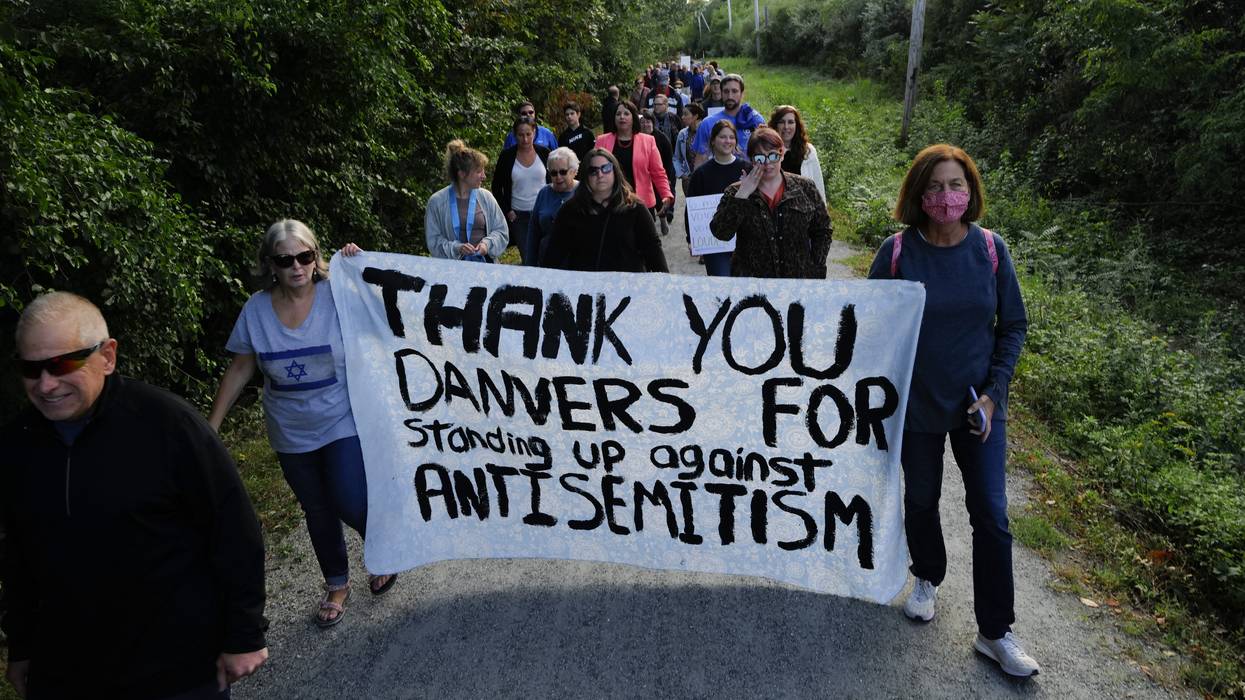
We must be as clear as possible about what is anti-Semitism and what it is not, so that real political differences are not transformed into existential confrontations. This is not always easy to do, but it is necessary nonetheless.
I am no expert on the topic of anti-Semitism—though few of those currently holding forth on the topic can claim expertise, and some who claim it might better be described as experts in special pleading.
But I am a Jewish-American political science professor who writes about American and world politics and has taught at one of the country’s major public universities, Indiana University, for almost four decades. I’ve experienced anti-Semitism; fought anti-Semitism as a co-founder of an anti-hate group called Bloomington United; and served as the volunteer security guard at my local synagogue from 1999—when there was a neo-Nazi murder committed here—until 2004—long after 9-11.
American campuses are now awash with controversy–some of it nasty and some even threatening—and the controversy is often framed as a conflict between supporters of Israel and supporters of Palestine and also as a conflict between Jews and their supporters and the enemies of Jews.
Last week I published an essay arguing that “To Censure Rashida Tlaib Would Be to Censure Democracy Itself.” And the next day, quite predictably, I was called an “anti-Semite” who supports Hamas, promotes terrorism, and endangers my own Jewish students.
There is so much hyperbole flying across our screens and our cities and campuses these days. The stakes are very high, and the issues in some ways very deep, touching on questions of politics, morality, and identity itself.
Threats against Jews, harassment of Jews, violence against Jews—these are wrong, immoral, and often illegal, and they ought to be condemned and punished.
At the same time, the charge of “anti-Semitism” is pretty direct, and it prompts me to offer some very direct observations about the urgency of being as clear as possible about what is anti-Semitism and what is not, so that real political differences are not transformed into existential confrontations. This is not always easy to do. But it is necessary nonetheless.
First, some moral clarity.
The October 7 Hamas attack on Israelis was brutal, murderous, cruel, and terroristic, and all those on American college campuses and society at large who remain horrified or frightened or simply offended by it—and I count myself among them– have every right to feel this way and to express their feelings freely, in private and in public.
The Israeli military response to the Hamas attack has been brutal, relentless, and has already killed five times as many civilians as the Hamas attack. And all those on American college campuses and society at large who remain horrified or frightened or simply offended by it—and I count myself among them–have every right to feel this way and to express their feelings freely, in private and in public.
Threats against Jews, harassment of Jews, violence against Jews—these are wrong, immoral, and often illegal, and they ought to be condemned and punished.
Threats, harassment, and violence against Palestinians, Muslims, or Arabs are equally wrong, immoral, and often illegal, and ought to be condemned and punished.
Indeed, all racial, ethnic, religious, and even ideological bigotry ought to be condemned, especially on college campuses, whoever the perpetrator or the victim of the bigotry.
What I just expressed is a commitment to human decency and a belief in the rule of law and the basic principles of a liberal, constitutional democracy.
It would be nice if this were sufficient. But it is not.
And the question of anti-Semitism is very real, because anti-Semitism is very real, though its forms, settings, and consequences vary across time and place, and this is important (living in the Warsaw Ghetto in 1942 is not like living in Iraq in 1948 is not live living in Israel in 2023 is not like living in New York City or Detroit, Michigan in 2023). And precisely for this reason, it is imperative to speak clearly and honestly and to try to clarify difficult distinctions.
I write here as an ethnic Jewish-American who is a citizen of the U.S. and who is primarily concerned here about what is going on in the U.S. and how this impacts–and endangers–both American democracy and U.S. foreign policy.
It is obvious that anti-Semitism has long plagued the U.S. and the world at large. It is equally obvious that the current Israel-Hamas/Gaza/Palestine war has fueled a rise in anti-Semitism in many places—in the Middle East, in Paris, in Ithaca, New York, and in many other places in the U.S.–and that this is despicable.
It is also obvious to me that much of what is being called “anti-Semitism” on American college campuses, however callous, stupid, or politically foolish it may be, is not anti-Semitic, and that some of what is being called “anti-Semitism” is not even callous, stupid, or politically foolish—as the example of Rashida Tlaib, to which I will return, makes clear.
Such distinctions matter, intellectually, morally, and politically. To refuse to take them seriously is to promote hyperbole, recrimination and, ultimately, the closing of minds and the shutting down of freedoms at a time when reason and freedom are in too short supply.
Instead of speaking in generalities, I will elaborate through specific examples.
Bigotry and Endangerment
The October 30 edition of The Forward leads with a headline: “Cornell’s idyllic campus shaken by graphic threats against Jewish students.”
The article reports on anti-Semitic threats circulated on campus: “One post was titled, ‘eliminate jewish living from cornell campus,’ while another threatened to ‘shoot up 104 west,’ a reference to Cornell’s kosher dining hall. The graphic messages also echoed real atrocities carried out by Hamas on Oct. 7 in Israel. ‘If i see a pig male jew i will stab you and slit your throat,’ read one, with another stating: ‘i will bring an assault rifle to campus and shoot all you pig jews.’ A third post threatened, ‘If i see another pig female jew i will drag you away and rape you and throw you off a cliff. if i see another pig baby jew i will behead you in front of your parents.’”
These messages are outrageous and despicable, and they are manifestly anti-Semitic.
Jewish students on the Cornell campus—and other campuses where such messages circulate–feel understandably threatened by these messages, for they are bigoted, hateful, and threatening. University and criminal authorities have properly treated the threats as hate crimes to be investigated and prosecuted. Police are providing heightened security at local Jewish sites. And an arrest has now been made. It is worth noting that the arrested suspect appears to have nothing to do with “Palestine.” It is also worth noting that when the vicious messages first appeared, Cornell Students for Justice in Palestine immediately posted a denunciation on its Instagram account (last week the account was deactivated, and I can no longer furnish the link or the exact quote, which I read when it was up).
This kind of anti-Semitism is not uncommon on American campuses. And it has become more common in recent years, much of it associated with the ascendancy of the American far right and its connection to the Trumpist Republican Party. Think Charlottesville 2017 and “good people on both sides.”
There is no reason to doubt that current events in Israel-Palestine have played some role in some anti-Semitic incidents like this on American campuses, either by motivating them or by furnishing a “structure of opportunity” for them to be enacted by disturbed or angry individuals with no connection to the Israeli-Palestine issue—as appears to be the case at Cornell.
Such incidents are outrageous, dangerous, and deplorable. Period.
At the same time, there has also been a rise of anti-Muslim or anti-Arab incidents in the U.S. and on college campuses. My own university, Indiana University, has experienced a controversy about a Jewish student’s derisive social media comments about a Palestinian dorm mate—“I wouldn’t have opened my door if I had known he was Palestinian; he could have been a terrorist!”—and whether these nasty comments are being treated with sufficient seriousness by university administrators charged with “inclusion.” This is hardly an isolated incident. Others have been more threatening.
Much has been made of FBI reports of an uptick of “anti-Semitic incidents” since October 7. Much less is being made of the fact that the FBI, in the words of its Assistant Director, is reporting “an uptick in threats across the country. . . focused on Jewish people and people from the Muslim community (emphasis added).”
These threats–and all ethnically, religiously, sexually, or even ideologically-based threats—are dangerous and deplorable.
But recent FBI reports do nothing to support one very dominant frame: that Jews are being singled out for threats by Hamas-inspired terrorism that has come to the U.S. with the intention of harming Jews, who are uniquely vulnerable and indeed especially vulnerable to Arabs and their supporters.
If some recent anti-Semitic incidents may have been initiated by “pro-Palestinian” individuals, it is equally likely that some anti-Muslim incidents have been initiated by “pro-Israeli” individuals (and on the White Christian far right, there are some pretty crazy so-called “Zionists”).
Both vulnerable minority groups are experiencing heightened vulnerability. And there is every reason to believe that the primary source of this vulnerability is not either of these groups, but “lone wolf” haters or people associated with White supremacist groups.
When incidents like the Cornell threats happen in a community or on a campus, they are deplorable. And the relevant campus and community authorities have the means of handling them, and ought to be pressed to employ these means if they fail to do so on their own.
But most of what is being discussed and denounced as anti-Semitism on American campuses and in the society at large does not fall into this category.
Callousness, Stupidity, and Political Irresponsibility
Celebrations of Hamas as “liberators” justly killing “Zionist oppressors” are cruel, stupid, politically infantile, and offensive. I have joined with many colleagues in deploring the outpouring of such statements on some segments of the American left in the immediate aftermath of October 7. Such language is insensitive and morally obtuse at best. It is hurtful to anyone who cares about Israel (and many others too), perhaps even intentionally so, and hurtful to others who simply are revolted by mass murder. It is also politically irresponsible, glorifying a group, Hamas, that seeks to enforce Islamic fundamentalism, pursues its political goals with murderous zeal, and whose charter is undeniably anti-Semitic.
I consider such celebrations and demonstrations politically noxious and I oppose them politically.
But they are anti-Israeli, not anti-Jewish (indeed sometimes their participants include Jewish activists associated with Jewish Voice for Peace or If Not Now When—groups that might be politically naïve, but are not anti-Jewish!); they typically do not denounce or threaten “Jews,” and are not linked to any effort to attack or kill Jews because they are Jews; and they are not per se anti-Semitic. Lots of bad, stupid and dangerous things, things worth opposing politically, are not “anti-Semitic.” And they deserve to be criticized without being demonized or legally sanctioned.
At the same time, such positions can easily come to take on a more insidious and hateful form—unless cooler heads prevail.
Recent events at Indiana University, widely reported in the national media, are perhaps emblematic. (Please note: I did not participate in these events.)
According to press reports, separate vigils for Israeli victims of Hamas and Palestinian victims of the IDF were held on October 10, each event interlaced with demonstrations of solidarity with Israel or with Palestine, respectively. There is no reason to doubt that real moral concern, mixed with authentic grief and fear, motivated those who organized and attended these separate events. And yet some of the interactions between the “Israeli side” and the “Palestinian side” became heated. Apparently some “pro-Palestinian” students shouted “from the river to the sea” at “pro-Israeli” students, and apparently some “pro-Israeli students” yelled “fucking terrorists” at the “pro-Palestinian” students (however unwieldy, it is necessary to use these quotation marks, because these terms are fraught, and do not map neatly onto the identities “Jewish” and “Muslim” or “Arab” or even “Israeli” and “Palestinian”).
Such confrontations can be very hurtful and, like many confrontations, they surely can get out of hand. And it is always possible and perhaps even likely, that wherever such confrontations occur, there are those, on either “side,” who are prone to escalate or even resort to violence.
It is essential that such escalations be avoided, and that provocateurs or violent participants be condemned and restrained.
But confrontations like this are not “anti-Semitic,” nor are they “Islamophobic,” even if they do engender fear among the Jewish or Arab or Muslim students involved, who typically do not really understand how their words and deeds might be experienced by their “adversaries.”
Many Jewish-American students and their allies do not realize how their emphatic celebrations of Israel while the IDF is bombing Gaza might trigger Palestinian-American students and their allies.
And many proponents of “Free Palestine” do not appreciate how their proclamations might trigger Jewish-American students who identify with Israel or have friends or family in Israel, perhaps even people who have been murdered or taken hostage by Hamas.
A Jewish student wearing an IDF tee shirt while grieving Israeli lives means something entirely different to her than it does to an Arab student across the street grieving Palestinian lives. A Palestinian student wearing a keffiyah and a “Free Palestine” tee shirt while grieving Palestinian lives means something entirely different to her than it does to a Jewish or Israeli student across the street grieving Jewish lives.
And profound misunderstandings, and genuine conflicts, can ensue from these situations, which are not really about anti-Semitism or racism.
It is the job of serious educators, administrators, public intellectuals, and elected officials to bring reason to these situations, to promote better understanding and, of course, to prevent such situations from devolving into violence. The rush of many U.S. college and university presidents to issue public statements of support for Jewish American students but not for Palestinian and Arab students does the opposite, exaggerating the anti-Semitic danger posed to Jews while simultaneously ignoring the moral and political experiences of Arab and Muslim community members who also are experiencing outrage, fear, and grief.
More Complicated Political Stances
I’d like to return for a moment to the awful anti-Semitism reported on the campus of Cornell University. In addition to the vicious threats reported, some accounts also mentioned graffiti that says things like “Israel is a fascist state” or “Israel is an apartheid state” or “the IDF is committing genocide.”
Are such statements incendiary? Yes, in the same way that the statement “Trump is a fascist” is incendiary, i.e., bold, provocative, and mobilizing. But are they anti-Semitic? I do not believe so.
Most of the clamor about “anti-Semitism” on American campuses today is not about hatred of Jews or violence against Jews. It is about the Israeli-Palestinian conflict, and the range of emotional, intellectual, and political responses to it...
Such statements simply do not describe or judge or even reference Jewish people or “the Jewish people” (please note, there is a tendency of certain people to speak of Jews as if they are a homogenous collective actor, a “people” who all live, think, act, and worry in the same way. This is wrong, and every Jewish person knows it—though most act otherwise when it comes to Israel). They are statements about a very powerful state—the Israeli state, which is called “Israel” and claims to “represent” all Jews past, present, and future, but does not—that, like all states, monopolizes and exercises violence, codifies exclusions, and is capable of doing very bad things. And when states do bad things, they deserve to be criticized.
While it is common to refer to Israel as “a liberal democracy,” many serious political commentators and social scientists characterize Israel, with good cause, as an “ethnonational” rather than a “civic” democracy. This is because of its illiberal features: in important ways it privileges Jewish over Arab citizens and indeed privileges religious Jewish citizens over secular Jewish citizens. It is similarly understood that the Israeli occupation of the West Bank and Gaza involves many regular violations of Palestinian rights and seizures of property, of the kind that no “liberal democracy” would apply to its own citizens. These things are major topics of real debate among Israeli Jews within Israel, though in the U.S. to raise them is to quickly get labeled as an “anti-Semite.”
Does this mean that Israel is, in fact, a fascist or racist or apartheid regime because some critics say so? No! These descriptors are topics of real debate.
But it does mean that those who use these terms are not anti-Semites for doing so.
They are analyzing and criticizing the Israeli state. Some people disagree with the claims or would articulate them differently. Others agree with them. The claims are controversial—many political claims are controversial. But this does not make them “hate speech.” The proper response of any Jewish American student who is told that Israel is “an apartheid state” and doesn’t like it, is either to go about their business, or to become informed, to come up with their own conclusions, and to debate them in public. It is not to cry “anti-Semitism.”
The website of B’tselem, the much-recognized Israeli human rights group, says this: “Israel’s regime of apartheid and occupation is inextricably bound up in human rights violations. B’Tselem strives to end this regime, as that is the only way forward to a future in which human rights, democracy, liberty and equality are ensured to all people, both Palestinian and Israeli, living between the Jordan River and the Mediterranean Sea.”
Does this make B’tselem an anti-Semitic “hate group?” Really?
Recent charges that the current IDF bombing is “genocide” raise similar concerns.
There is no doubt that the bombing is killing thousands of Palestinian civilians and destroying their lives and their world, even if IDF spokesmen insist that they wish all the people would just go away or not die when bombed. Does this qualify as “genocide”? I’m not sure, though I surely think it qualifies as a war crime. But Raz Segal, an Israeli Jewish expert on genocide thinks it is “a textbook case of genocide,” and he published a long essay explaining why in Jewish Currents, a Jewish journal edited by Peter Beinart. Is Segal an anti-Semite?
Is Jewish Currents—a Jewish journal that publishes a range of critiques of Israel written by Jewish people who actually identify with Israel—an anti-Semitic publication?
Obviously not–though the very fact that this question must be even rhetorically posed should make us very sad.
But a great many Jewish Americans who identify with Israel–along with their philo-Semitic allies and their Christian fundamentalist allies for whom the assigned role of Jewish Zionists is either to be converted or to die in a holy “rapture”—regard all talk of “apartheid” and “genocide” as not simply debatable but hateful and evil and no different than the rhetoric of criminals who send messages about “raping Jewish pigs” or carry Nazi insignias and Tikki torches through the streets of Charlottesville, Virginia yelling “Jews Will Not Replace Us.”
The equation of such things is not merely a mistake. It is an affront to both intellectual credibility and political pluralism.
Genuine Political Disagreements
I’ll now return to the case of Rashida Tlaib, who has become a lightning rod of controversy on and off campuses across the country. The first thing to note is that, like all human beings, she is not one thing but many things.
She is a Democrat who has been an outspoken opponent of Trumpism and a strong supporter of constitutional democracy. She is a woman who strongly supports reproductive freedom and the civil liberties of all minority groups.
And she is a Palestinian-American, indeed the only one in the 435-member House of Representatives. Her mother was born on the West Bank and her father in East Jerusalem. Her elderly grandmother and other family members live in the West Bank village of Beit Ur al-Fauqa. This means that they experience Israeli Occupation and disenfranchisement daily. Let’s be frank: nothing about Zionism has been uplifting or empowering for her family and friends—nor was it intended to be.
Can it really be a shocking surprise that Rashida Tlaib is a harsh critic of Israel’s occupation of the West Bank and Gaza and its denial of human rights to Palestinians?
Tlaib denounces the IDF bombing of large sections of Gaza and the killing of many thousands of Palestinian civilians. She refuses to apologize for believing allegations that IDF bombing was responsible for the October 17 destruction of a Gaza hospital—though the evidence here remains inconclusive (see here and here). She has recently criticized President Biden for supporting the genocide of Palestinians. And she has even posted a video in which some protestors are chanting “from the river to the sea.”
It is possible to disagree with or object to some or all of what Rashida Tlaib says.
But her stance, however controversial or even offensive to some (and heartening to others), has nothing to do with anti-Semitic tropes or the promotion of violence against Jewish people.
And yet many public officials, journalists, and lobbyists describe her as an “anti-Semitic” or a “terrorist sympathizer.”
We are talking about a thrice-elected member of Congress who speaks out on a range of issues and whose views on Israel-Palestine are not only grounded in her personal experience, but also accord with what many of her constituents think.
Yes, many Jewish-Americans get triggered by some of Tlaib’s language, some for understandable reasons, and some because of a vicarious identification, from afar, with the historic vulnerability of Jews. Many good people might be made uncomfortable by Tlaib’s words. This happens in a complex, pluralistic democracy. And a similar thing happens to many Arab-Americans when they listen to the things Jewish-American Rep. Jared Moskowitz says about how the bombing of Gaza is necessary to “defend the Jewish people.”
These are real and consequential political differences, and they are necessarily fractious. But no good can come from elevating them into existential confrontations between people figured as malevolent haters. The “solution” to these differences is quite simple: public debate and dialogue. Politics.
Why Clarity is Now So Important, Especially on American Campuses
Anti-Semitism is real, and often results in real harm that must be addressed and repaired. So too Islamophobia.
But most of the clamor about “anti-Semitism” on American campuses today is not about hatred of Jews or violence against Jews. It is about the Israeli-Palestinian conflict, and the range of emotional, intellectual, and political responses to it, and the ways these responses are often overwrought or defensive or offensive and sometimes very heated and antagonistic but not necessarily bigoted or violent.
And these reactions are being enacted on American campuses, and not in the contested territories of Israel-Palestine, where very real violence is being enacted and a war is unfortunately threatening to rage out of control.
Pro-Israeli Jewish-American demonstrators are American citizens and not IDF soldiers.
And Palestinian-American demonstrators who support “free Palestine” are American citizens and not Hamas terrorists.
The people arguing and yelling and demonstrating and counter-protesting about Israel and Palestine on the streets and campuses of the U.S. are political adversaries in a functioning (if increasingly weak) constitutional democracy whose rhetorical battles are not real battles even if they involve real political contestation.
Framing what is happening as the eternal recurrence of anti-Semitism (or of anti-Arab racism) serves no good intellectual, moral, or political purpose.
But it does serve one very bad political purpose: it furnishes a strong tailwind for the MAGA Republicans seeking to destroy liberal democracy in the U.S, and who are now (as opposed to when actual synagogues are attacked by right-wing fanatics) eager to pose as Defenders of the Jews and Warriors against the Arab Hordes.
The cynical if failed effort of Rep. Marjorie Taylor-Green (D-Ga.)—she of the nefarious “space lasers” supposedly engineered by “Rothschild, Inc.”—to censure Rashida Tlaib, and to harass and weaken Progressive Democrats and Justice Democrats more generally, is one form this is taking, designed to turn Democrats on each other, to convert some into unwitting allies of the GOP effort to restrict civil liberties more generally and to sow divisions in the run up to the 2024 elections.
A second, and more dangerous, effort to advance authoritarianism is being pioneered by Florida Governor and Republican presidential hopeful Ron DeSantis, who recently joined with Ray Rodrigues, the Chancellor of the University of Florida system that he appointed, to deactivate, i.e., expel, two University chapters of Students for Justice in Palestine at University of Florida campuses; called for a broader banning pro-Palestinian student groups from Florida campuses; and promised to revoke pro-Palestinian student visas and deport the students if elected President (moves that have been criticized by FIRE, the Foundation for Individual Rights and Expression, a centrist campus civil liberties organization). These moves, of course, are of a piece with DeSantis’s broader effort to purge Florida higher education of all traces of “diversity, equity, and inclusion,” “gender studies,” and “critical race theory,” and to promote a form of “civic education” mapped by the far-right and conservative Christian Hillsdale College.
DeSantis is hardly alone. The U.S. Senate has passed a Resolution, sponsored by right-wing demagogue Josh Hawley, that condemns Hamas and “denounces the rhetoric of anti-Israel, pro-Hamas student groups as antisemitic, repugnant, and morally contemptible for sympathizing with genocidal violence against the state of Israel and risking the physical safety of Jewish Americans in the United States.” Hawley, and many other legislators, have called on the department of Homeland Security and the FBI to investigate the ties between such groups and “terrorist” organizations.
These efforts are unfortunately—no, deplorably–being promoted by the Anti-Defamation League (“We Stand With Israel”), which on October 20 published a report on a range of “dangerous” campus groups that included Students for Justice in Palestine, Jewish Voice for Peace, and If Not Now When, explaining that “each of these groups has expressed inflammatory rhetoric about Israel and/or Zionism. Many have a history of promoting classic antisemitic themes on social media, at rallies, on webinars and more. Many have also long expressed support for terror against Israel.” The implication is clear: these groups aid and abet Hamas terrorism. On October 27, the ADL followed up by joining with the Louis B. Brandeis Center for Human Rights Under Law to send a letter to over two hundred U.S. colleges and universities accusing Students for Justice in Palestine of supporting anti-Semitism and Hamas terrorism, and calling on administrators to “investigate the activities of your campus chapter of [SJP] for potential violations of 18 USC 2339A and B, and its state equivalents, that is, for potential violations of the prohibition against materially supporting a foreign terrorist organization.” This week Brandeis University became the first private university in the U.S. to comply with this call, banning Students for Justice in Palestine from campus on the grounds that it “supports Hamas.”.
To read harsh political discourse as “hate,” and to inflate very real political differences into existential antagonisms, is to undermine the robust and fractious public disagreement that is at the heart of a pluralistic democracy.
To be very clear: what is being proposed is not simply that university administrators work to limit or ban “pro-Palestinian” student groups—bad enough–but that such groups be investigated for violating federal anti-terrorist law.
Where will such a 21st-Century McCarthyism end? And what role will be played in it by people, alas including some otherwise liberal American Jews, who claim to be supporters of civil rights and believers in democracy and who even claim that they support Israel because it is a democracy?
The logic of these calls to investigate and to ban is clearly hostile to basic principles of both academic freedom and freedom of expression.
They contribute to a hysteria about “terrorism” and “the woke left” and the need for “patriotic” education that has proven quite effective when promoted by illiberal authoritarians from Hungary’s Viktor Orban to India’s Narendra Modi to Donald Trump and Ron DeSantis to Benjamin Netanyahu himself—who until a few weeks ago was being widely denounced for his authoritarianism and extremism and his support for extremist, racist settlers engaging in a concerted effort to harass and attack Wester Bank Palestinians and to seize their land, but who now is apparently an ally in the defense of–“democracy?”
Finally, they contribute to the kind of defensiveness, and dogmatism, that can do no good for the management of real differences on university campuses, or the regulation of real political conflicts in society at large, or the effort to promote peace and justice in a world of violence and injustice.
Anti-semitism is very real—just as Islamophobia is very real–and it ought to be opposed in ways that do not violate the civil rights and liberties of others.
But to read harsh political discourse as “hate,” and to inflate very real political differences into existential antagonisms, is to undermine the robust and fractious public disagreement that is at the heart of a pluralistic democracy.
Those who are doing this ought to know better. And, if they are at all serious about freedom, democracy, or peace, they ought to stop.
Whether your views align with the right or the left, many of us are clear that antisemitism among white supremacists, militant extremists, Christian nationalists, and other bigots poses a deadly threat to all of us.
Jewish communities across the country have been targeted with violence or harassment as anti-semitic hate crimes reach record levels.
In late January, a man tossed a Molotov cocktail — a firebomb — into the entrance of a New Jersey synagogue in the middle of the night.
In early February, a man walked into a San Francisco synagogue firing blank shots from a gun during a religious gathering. And in the suburbs of Atlanta that same week, Jewish families found flyers with antisemitic images and messages littering their driveways.
These terrifying incidents are only a fraction of a disturbing trend in American culture. That trend is especially visible on the far right, whose anti-semitism is now louder, bolder, and more aggressive than it’s been in most of our lifetimes .
At times like these, all of us need to be better neighbors to each other. This got me thinking about an experience I had 15 years ago as a city council member in Ithaca, New York.
A local rabbi approached me then and explained that in traditional Jewish communities, certain types of work and activities — like carrying objects outside the home — are prohibited on the Sabbath.
Tradition accommodates this restriction by creating a larger area called an eruv: a space that defines home as several houses and streets within a community. The boundaries of the eruv are designated by markers around the neighborhood, often attached to utility poles and wires.
The eruv symbolically enlarges the home, so the necessities of faith and of daily life can coexist.
For years, the rabbi said, the Jewish community had asked to put up eruv markers in parts of Ithaca, but the city council hadn’t responded. I was happy to help and even happier that we got it done. But there was some pushback from some of my colleagues, who opposed what they called “catering” to a religious community.
That deeply saddened me then and now. Here’s why.
Whether your views align with the right or the left, many of us are clear that antisemitism among white supremacists, militant extremists, Christian nationalists, and other bigots poses a deadly threat to all of us.
That has been true for a long time — it’s one reason Black, Jewish, and progressive communities were such strong allies to each other during the civil rights era. But for a variety of cultural and political reasons, I now worry these alliances are fraying. When good people are not aligned in opposition, tolerance for division and evil becomes commonplace.
Think of Nick Fuentes, the far-right activist who grabbed headlines for his dinner with Donald Trump and Ye (formerly known as Kanye West). Fuentes and Ye have openly praised Adolf Hitler. Not long ago, this would have been unthinkable in public life.
The way to combat the rising tide of hate and fragmented solidarity is with a strong, progressive, multiracial coalition. All of us must come together to dismantle the forces behind the divide-and-conquer agendas intended to harm Jewish and Black people, along with immigrants, women, LGBTQ people, and indeed most communities in one way or another.
In other words, like the eruv, our communities need to symbolically enlarge our home.
I’m reminded of a quote by Rabbi Leonard Beerman: “We need those who have the courage to be ashamed, who have the muscle to care. And more than caring, we need those who will preserve and cultivate an enduring vision of the good, who will maintain a vision of the future as a permanent possibility in the present.”
Our real and symbolic home should be with each other, where we are united by our shared humanity and where hate by any name is excluded. Let’s make that space, and welcome each other in.
It is only through justice and equality that the Jewish homeland can become what so many hoped and dreamed it would become.
Last month, Israeli forces entered the Jenin refugee camp and killed nine Palestinians. The next day a 21 year old Palestinian killed seven Israeli settlers in East Jerusalem. The Palestinian man, named after a grandfather who had been stabbed to death 25 years earlier by a Jewish Israeli, was seeking revenge for a young Palestinian relative killed by Israeli forces two days earlier. This unending cycle of violence seems almost incomprehensible. Israel was supposed to be a safe-haven for a people forced to endure hundreds of years of dispossession and oppression, but is instead beset by almost constant and unceasing violence.
How did this happen, especially since we often hear that Zionism was a spectacular, almost miraculous success? How did Zionists create a state, accumulate enormous military strength, win almost every battle, yet still fail to create a Jewish safe-haven? Zionism was meant to be the solution to the problem of antisemitism, but has it actually solved anything?
Back in the early 20th century, there were many in the Jewish community who had grave doubts about the Zionist solution to the very serious problem of antisemitism. For example Rabbi Judah Magnes, first chancellor of Hebrew University, was a ‘cultural Zionist’ who supported ethnic equality. He was deeply concerned by the ethnic supremacy that characterized the ‘political Zionism’ supported not only by prominent Jewish Zionists, but also by non-Jewish members of the British government. In 1920 Rabbi Magnes wrote a letter explaining why he opposed Britain’s Balfour Declaration which he said “decrees into existence a Jewish ruling class from the outset”. “This gift of political primacy to the Jews in Palestine rather than political equality,” Rabbi Magnes wrote, “contains the seed of resentment and future conflict.”
If we look past the unending state propaganda, it becomes disturbingly clear that while Zionism did indeed create ‘A State’, the state it created is neither a safe-haven for the Jewish people nor has it solved the problem of antisemitism.
Martin Buber, an influential philosopher and scholar, warned that forcing Jewish rule on the Arab population would lead to permanent national instability. Buber argued that the unceasing security threats faced by a Jewish state would prevent the Jewish homeland from becoming a center of spiritual and culture revival, as so many hoped, and would instead force the new state to “apply its best forces to military activity instead of applying them to social and cultural enterprises”.
This hyper-militarized state, warned cultural Zionist and political philosopher Hannah Arendt, would bear little resemblance to the Zionist dream:
…even if the Jews were to win the [1948] war, its end would find the unique possibilities and the unique achievements of Zionism in Palestine destroyed. The land that would come into being would be something quite other than the dream of world Jewry, Zionist and non-Zionist. The “victorious” Jews would live surrounded by an entirely hostile Arab population, secluded inside ever-threatened borders, absorbed with physical self-defense to a degree that would submerge all other interests and activities...Thus it becomes plain that at this moment and under the present circumstances a Jewish state can only be erected at the price of the Jewish homeland.
Cultural and political Zionists would continue to debate these issues throughout the early 20th century. However all this would change with the terrifying rise of Nazism. The horrors occurring throughout Europe and the growing Jewish refugee crisis infused political Zionism with an urgency that allowed it to overtake and eventually dominate cultural Zionism. After the state of Israel was established in May 1948, cultural Zionists who supported ethnic equality either abandoned the idea or were completely marginalized.
However as Arendt and others had feared, the ethnic supremacy that political Zionists supported and implemented did not produce the safe haven that early Zionists had longed for. Instead, the new state of Israel would be beset by almost constant instability and violence. The state would engage in regional wars with Arab states in 1948, 1956, 1967-70, and 1973. From 1971-82 Israel would fight an insurgency in Lebanon and then launch two large-scale invasions against the country in 1978 and 1982. After a bloody 15-year occupation, Israel would again invade Lebanon in 2006. Internally, Israel would fight two Palestinian uprisings from 1987-93 and 2000-05, and launch large-scale attacks against Palestinians in Gaza in 2008, 2012, 2014, and 2021.
According to former speaker of the Knesset, Avraham Burg:
…the establishment of the State of Israel not only failed to solve the problems for the sake of which it was founded but, on the contrary, made them a great deal worse…Few of us know any other existential reality apart from our unrelenting war with everyone, all the time and over all issues.
Political Zionists had hoped a Jewish state would solve the problem of antisemitism. Instead the state they established is among the most dangerous places for Jewish people in the world. Even worse, through alliances with fascist regimes and ultra-nationalist groups and by undermining the human rights organizations created to protect the vulnerable and oppressed, the state of Israel undermines the safety of Jewish diaspora – the very people the state was created to protect.
The failure of Zionism to create a Jewish safe-haven is also why the state of Israel to this day continues to oppress the Palestinian people. In the West Bank, Israel demolishes Palestinian homes and denies people their most basic rights such as freedom of movement. In Gaza, Israel forces Palestinians, most of whom are children, to live under appallingly inhumane conditions. In the refugee camps around Israel, Palestinians are prevented from exercising their inalienable right to return home. Numerous human rights groups have accused Israel of committing apartheid, which is a crime against humanity. A few weeks ago Israel voted in one of the most extremist governments in its history, containing officials who openly call for ethnic cleansing.
The failure of Zionism to create a Jewish safe-haven is also why the state of Israel to this day continues to oppress the Palestinian people.
If we look past the unending state propaganda, it becomes disturbingly clear that while Zionism did indeed create ‘A State’, the state it created is neither a safe-haven for the Jewish people nor has it solved the problem of antisemitism. To the contrary, it may in fact be making the problem of antisemitism much worse. Political Zionism, we are forced to conclude, has failed to live up to its promise.
So what now? What options are left? First, it is important to keep in mind that ‘A Jewish State’ in and of itself was never the goal, but simply a means to the true goal: the safety and protection of the Jewish people. If the ethnic supremacy pursued by political Zionism has failed to create a safe-haven for the Jewish people, then the obvious alternative has always been ethnic equality. Indeed it is not idealism but simple logic that leads to the conclusion that regimes based on oppression are inherently unstable. More power, more force, and more violence are short-term solutions. A state can use force and violence to provide its citizenry with moments of brief stability, but it is only through justice that a state can offer its people a lasting peace.
Back in 1948, political philosopher Hannah Arendt foresaw the dangers of ethnic supremacy, and warned that a safe and secure homeland for the Jewish people would only be achieved once supremacy was replaced with equality:
The idea of Arab-Jewish cooperation, though never realized on any scale and today seemingly farther off than ever, is not an idealistic day dream but a sober statement of the fact that without it the whole Jewish venture in Palestine is doomed. Jews and Arabs could be forced by circumstances to show the world that there are no differences between two people that cannot be bridged.Political Zionists believed, and continue to believe, that force and violence will lead to security and stability. History is littered with the remains of kingdoms, empires, and rogue states which shared that belief. The truth is that true peace, the peace that repeatedly eludes political Zionists, can only be found through justice. Moreover, it is only through justice and equality that the Jewish homeland can become what so many hoped and dreamed it would become: a center of culture and spiritual revival, a model of coexistence and democracy, and a safe-haven for the oppressed.
I will continue to speak for the families who are seeking justice around the world—Whether they are displaced in refugee camps looking to find a home somewhere, or whether they are hiding under their bed somewhere like I was, waiting for the bullets to stop.
The following are the remarks, as prepared for delivery on the floor of the U.S. House of Representatives, of Rep. Ilhan Omar (D-Minn.) in opposition to a Republican resolution barring her appointment to the House Foreign Affairs Committee on February 2, 2023.
Who gets to be an American? What opinions do you have to have to be counted as American? That is what this debate is about, Mr./Madame Speaker. There is this idea that you are suspect if you are an immigrant. Or if you are from a certain part of the world, of a certain skin tone, or a Muslim.
It is no accident that Members of the Republican Party accused the first Black President, Barack Obama, of being a secret Muslim. It is no accident that former President Donald Trump led a birther movement that falsely claimed he was born in Kenya. Because to them, falsely labeling the first and only Black President of the United States a Muslim and an African immigrant somehow made him less American.
There is nothing objective about policymaking.
Well, I am a Muslim. I am an immigrant. And, interestingly, from Africa. Is anyone surprised that I am a target? Is anyone surprised I am somehow deemed unworthy to speak about American foreign policy? Or that they see me as a powerful voice that needs to be silenced? Frankly that is expected. Because when you push power pushes back.
Representation matters. Continuing to expand our ideas of who is American and who can partake in the American experiment is a good thing. I am an American. An American who was sent by her constituents to represent them in Congress. A refugee who survived the horrors of a civil war, As someone who spent her childhood in a refugee camp, and as someone who knows what it means to have a shot at a better life in the United States. Someone who believes in the American dream, in the American promise, and the ability to voice that in a democratic process.
That is what this debate is about. There is this idea out there that I do not have objective decision-making because of who I am or where I came from and my perspective. But we reject that and we say there is nothing objective about policymaking. We all inject our perspective, point of views, our lived experience, and the voices of our constituents. That is what democracy is about.
So what is the work of the Foreign Affairs Committee? It's not to cosign the stated foreign policy of whatever administration is in power. It's oversight, it’s to critique, and to advocate for a better path forward. But most importantly, it's to make the myth that American foreign policy is intrinsically moral a reality.
The work of the Foreign Affairs Committee... is to make the myth that American foreign policy is intrinsically moral a reality.
So I will continue to speak up because representation matters. I will continue to speak up for the sake of little kids who wonder who is speaking up for them. I will continue to speak for the families who are seeking justice around the world—Whether they are displaced in refugee camps looking to find a home somewhere, or whether they are hiding under their bed somewhere like I was, waiting for the bullets to stop.
Because that’s what this child survivor of war would have wanted. The 9-year-old me would be disappointed if I didn’t talk about the victims of conflict.
Those that are experiencing unjust wars, atrocities, ethnic cleansing, occupation—or displacement like I did—are looking to the international community, including the United States. Asking us for help. They look to us because the international community and the United States profess the value of protecting human rights and upholding international law. And we owe it to them not to make this a myth, but a reality.
I didn’t come to Congress to be silent. I came to Congress to be their voice. And my leadership and voice will not diminish if I am not on this committee for one term. Thank you and I yield back.
"That energy in Madison Square Garden. I know that was one of the first nationally televised playoff games where we had a full arena. . . When they saw that Madison Square Garden full, it was almost like 'Wow, pandemic is ending'. . . . I know for people watching people come together in Madison Square Garden, I think that was meaningful."
Only a few weeks ago Adam Silver faced a problem more serious than attendance at basketball games: what to do about NBA superstar Kyrie Irving's Twitter recommendation of an anti-Semitic film.
NBA Commissioner Adam Silver, commenting on Madison Square Garden in August, 2021.
Only a few weeks ago Adam Silver faced a problem more serious than attendance at basketball games: what to do about NBA superstar Kyrie Irving's Twitter recommendation of an anti-Semitic film. The impasse between Silver and Irving was a teachable moment, for the NBA and its fans, and for the country at large. And indeed, the history of the beloved "Garden"--sometimes the site of things much less uplifting than basketball-might have furnished an important lesson. But the NBA, eyes always on the financial prize, chose instead to settle for hastily conceded gestures and a quick return to the business that is professional basketball.
Irving has now done his penance; Silver has declared that Irving has no hate in his heart; and Irving, his suspension suspended, has returned to the court.
All is well with the NBA.
But all is not well with the world.
For the most important issue raised by the affair was never whether Irving would or should atone or whether "hateful things" should be denounced by decent celebrities. It was anti-Semitism itself, a serious and potentially deadly form of hostility and racism on the rise in a society witnessing a broader rise of extremism and violence.
The controversy over Irving's Tweet was an opportunity for the NBA to step forward and promote public education about anti-Semitism and the importance of solidarity in defense of any group whose human rights are threatened.
The history of "the Garden" indeed provided the NBA with a unique opportunity. But it was squandered.
Take a look at the screen shot below:
It depicts the marquee of the old Madison Square Garden, on 8th Avenue, on the night of February 20, 1939. There was basketball that week at the Garden, hockey too. But on that night, something else was taking place: a "Pro-American Rally."
The photo is a clip from an award-winning seven-minute documentary directed and edited by filmmaker Marshall Curry, entitled "A Night at the Garden." The documentary consists of nothing but seven minutes of newsreel footage from the "pro-American rally" organized by the German-American Bund, a 1930's Nazi organization with chapters and training camps in many states including New York, New Jersey, Pennsylvania, and Wisconsin. On that night, over twenty thousand people filled the Garden to pay tribute to Adolph Hitler against the backdrop of an enormous, 30-foot portrait of George Washington surrounded by American flags and swastikas. Fritz Kuhn, the group's "Bundresfuhrer," led the assembled crowd in the Pledge of Allegiance, and then launched into a diatribe against Jews and "the Jewish controlled press," calling for a "white, gentile-ruled United States" and "gentile-controlled labor unions free from Jewish Moscow-directed domination." "Wake up! You, Aryan, Nordic and Christians," Kuhn declared, enjoining his crowd "to demand that our government be returned to the people who founded it!"
Yes, that happened on the same hallowed Garden floor that days later featured the New York Rangers and the Fordham University basketball team (both the New York Knicks and the NBA were only formed in 1946).
How many NBA players know about this? How many NBA fans know about it? How many Americans know? My Indiana University students are shocked when they learn about this.
And yet the "Pro-America rally" at "The Garden" was hardly a one-off. For in the 1930's a number of Nazi and fascist organizations flourished in the U.S., ranging from the Hitlerite Bund to Father Charles Coughlin's National Union for Social Justice to William Dudley Pelley's Silver Legion of America to the Ku Klux Klan itself. These groups held rallies, organized marches, conducted campaigns of intimidation, and helped elect many politicians to political office.
What if instead of pretending that anti-Semitism in the U.S. is reducible to a Kyrie Irving Tweet, the NBA mandated the showing of the powerful seven-minute "Night at the Garden" during halftime of every single NBA game, live and televised, for a week or two? And what if this were linked to a broader campaign of public education (the film's website provides an excellent link to resources)?
Only weeks before the Irving controversy, PBS aired a six-hour Ken Burns documentary on "The U.S. and the Holocaust." Like most Burns documentaries, "The U.S. and the Holocaust" has been something of a media event--and it is another resource on which the NBA might have drawn if it were serious about anti-Semitism. The film details the history of the Nazi effort to exterminate European Jewry and the ways that the U.S. government turned away Jewish refugees and refused to do everything in its power to put an end to the genocide. It also details the complex interconnections between American racism and Nazi racism, including the ways that both Hitler's racism and Nazi race laws were influenced by Jim Crow laws in the American South (the film draws heavily on historian James Whitman's Hitler's American Model: The United States and the Making of Nazi Race Law). The Burns documentary underscores the synergies between anti-Black and anti-Jewish racism, shedding light on how Jews and Blacks have long been joined as victims but also as allies in the struggle for civil rights and democracy.
Yet another resource is the terrific "Race and Citizenship in Nazi Germany and Jim Crow United States," a new curriculum developed by Aya Marczyk and her colleagues at Yale University's Fortunoff Video Archive for Holocaust Testimonies. While the curriculum was developed for high school students, it is a wonderful resource for anyone seeking to better understood the connections between these two dangerous forms of 20th century racism. Using videotaped testimonies of individuals who lived through these experiences, the curriculum centers on close, empathetic listening, and on the mutual understanding that this can generate. And the curriculum, like the Burns documentary, makes clear how much American Blacks and Jews, and indeed all Americans, have to learn from the sharing of these experiences, and from the collaborative defenses of freedom that such sharing makes possible.
Even the most enlightened NBA responses to the Irving Tweet--the response of Silver and, eventually, the responses of LeBron James and C.J. McCollum, the most vocal and articulate NBA players--have basically taken the position that "it is wrong to say hurtful things about other groups." But anti-Semitism is more than a hurtfulness towards Jewish others. It is a form of racism that is hostile to the core values of a pluralistic and democratic society, and should be offensive to everyone who cares about human rights and democracy. To paraphrase Martin Luther King, Jr., an injustice against any group is an injustice against every group.
Precisely because the incident was about more than a remark that hurt the feelings of some Jews, the NBA and Silver were wrong to focus so narrowly on Kyrie's Tweet, his punishment, and his apology. What should have been--and what should be--the powerful NBA's focus is a matter that runs much deeper: the reservoir of anti-Semitism upon which so many people, from Kyrie Irving and Kanye West to Nick Fuentes and Donald Trump, draw, and the way this reservoir poisons everyone who comes into contact with it.
And some serious attention to that night at the Garden back in February 1939 is a good place to start.
We don't know what dishes were served at the dinner Trump hosted last month for Ye (aka Kanye West) and Nick Fuentes, but the meal has given much of the country indigestion. Real or feigned, following Trump's dining with Fuentes, who describes himself as being "just like Hitler" and diminishes Jim Crow, numerous leaders of the Republican Party offered sanctimonious denunciations and apologies.
Trump's dinner with Ye and Fuentes represented zero aberration from the behavior he's been displaying since throwing his hat into the 2016 presidential ring.
The breakneck speed with which GOP leaders made condemnations might have caused someone not paying much attention to think the Republican Party suddenly, and with horror, had become "woke" to the damages of racism. But, the reality is far more cynical.
As news broke of the dinner, reporters chased down prominent Republicans to see who would denounce and who would remain silent.
"There is no room in the Republican Party for antisemitism or white supremacy," said Mitch McConnell and Rick Scott.
Marco Rubio described Fuentes as "a nasty, disgusting person."
"Nick Fuentes and his views are nowhere within the Republican Party or within this country itself," chimed Kevin McCarthy.
Even Marjorie Taylor Greene, who along with Rep. Paul A. Gosar of Arizona attended Fuentes's America First Political Action Conference in February said she agreed with McCarthy's statement and hinted that Ye might be behind Fuentes's prominence.
It's plainly absurd of the GOP to feign shock. Trump's dinner with Ye and Fuentes represented zero aberration from the behavior he's been displaying since throwing his hat into the 2016 presidential ring. From his "good people on both sides" response to Charlottesville to referring to Black Lives Matters protesters as "thugs," to the clearing of Lafayette Park to raise a bible for a Mussolini-like photo-op, never mind sending insurrectionists with Confederate flags to parade through the halls of the US Capitol, dinner with Ye and Fuentes was simply business as usual.
What's changed hasn't been Trump's behavior but the GOP's political strategy. Just as chattel slavery was based on making human beings into a commodity, white supremacy is today a commodity bought and sold in America, enriching white elites with both money and political power.
In 2019, the white nationalist hate group VDARE, raised $4.3 million, eight times more than the year before. But, the 2022 midterm results are causing the GOP to question if their fascist leanings are still as in vogue as a few years ago. Rather than a genuine change of heart, their condemnations of Fuentes are but a farcical political game to bide time while assessing if the seas of hatred and bigotry are still flowing as plentifully as they were previously. Should they determine the waters to still be warm to Trump's brand of overt racism, they'll surely plunge back in.
The media, with its ongoing coverage, is gifting Fuentes free publicity and a far larger audience than he previously enjoyed. While accurately describing him as a "noted racist and Holocaust denier" they're doing little to cover the root causes of the problem, the insidious ways, such as extra-judicial killings and excessive force by law enforcement, that America's original sin continues to reside within society. It's less a question of whether Marjorie Taylor Greene and her ilk will or will not continue to participate in Fuentes-led events and more the fact that condemnation comes out of the side of her mouth, the identification with Christian nationalism and its hateful racist ideology simultaneously comes out of the other.
Ye, for his part, is a deeply emotionally, mentally, and spiritually disturbed man. Unable to resist his lust for attention and relevancy, his admiration for Trump, appearance in shirts reading "White Lives Matter," and outrageous antisemitism lets people know how mentally he is off kilter. This is not in any way to excuse Ye's behavior but to place it in proper context and perspective. The danger of rising antisemitism that American Jews are legitimately facing right now is not from a (manufactured) Black-Jewish divide but shows through such actions as police officers fist-bumping the racists proclaiming "Kanye was right."
Contrary to Fuentes's prideful arrogant calls for "Catholic Taliban rule in America," the true teachings of Christ are a universal embrace of humility and love. Jesus's affirmation of the Samaritans who faced cultural and theological hatred, and his healing of lepers demonstrate without question his belief in inclusivity and an anti-racist world. We need not guess how he, history's biggest challenger of the powers of oppression, would feel about his name being used for the purposes of spreading hatred and inciting violence.
Fuentes can be placed in the dustbin of history. But we must realize that the problem he represents is much deeper. Conscientious objection to racism, antisemitism, misogyny, Islamophobia, trans and homo-phobia takes far more than sanctimonious condemnations for political point scoring. The GOP will only find hatred repugnant when we, the public, require that of them.
Jonathan Greenblatt, the ADL's CEO, in a speech just given to the ADL Virtual Leadership Summit, proclaims, among many other falsehoods, that anti-Zionism is "predicated on the negation of another people" and devotes considerable time to attacking organizations that are committed to Palestinian justice. His speech was grounded in extreme defamation, in a blatant distortion of history, and in a breath-taking lack of any moral compass.
He is a propagandist for the Israeli state, as is the organization he leads, and he chooses his words deliberately; in the way someone does whose job it is to promote Israeli (propaganda).
Sometimes the word can be overused but there is no better word for Mr. Greenblatt's remarks than that they are a shande, a disgrace. Before I explain why, I'd like to share what came to mind when reading his comments.
I grew up with a father who was the most ethical human being I knew. He was a proud and knowledgeable and loving Jew and was a deeply caring soul who made everyone around him feel special. He taught me to always love who I was but to never think I was better than any other person or community. He taught me by his example that being Jewish meant always speaking the truth and following my heart in the search for justice. He didn't just preach goodness; he embodied it. He represented to me that which I loved about being Jewish. Reading Greenblatt's speech, I immediately thought to myself--this man reflects the opposite of all my father taught me about what it means to embody the best of our tradition and values. His attacks are disingenuous and dangerous. They lack humanity.
Greenblatt knows his attacks on organizations like Jewish Voice for Peace (JVP), Students for Justice in Palestine (SJP), and the Council on American Islamic Relations (CAIR) are baseless and wrong. He is a propagandist for the Israeli state, as is the organization he leads, and he chooses his words deliberately; in the way someone does whose job it is to promote Israeli (propaganda). I know that because, as a young "socialist Zionist" activist over 45 years ago, I attended such sessions in which I was encouraged not to speak the truth but, rather, to aim to discredit seekers of Palestinian justice by accusing them of antisemitism.
Greenblatt intentionally inverts the facts when he says that anti-Zionism is "predicated on the negation of another people." The truth is that anti-Zionism is predicated on the belief that the Zionist movement and Israel should not have expelled 750,000 Palestinians from their land and homes, known as the Nakba (catastrophe, in Arabic). Palestinians, whose families lived through the Nakba--and all those who know the history, as no doubt Greenblatt does--are fully aware that, from its inception, Zionism was fundamentally about negating and denying the rights of the Indigenous Palestinian people. In other words, it is Zionism that is predicated on the negation of another people.
Anti-Zionism is rooted in a commitment to what is just. Anti-Zionism is about redressing a grave historic injustice. Anti-Zionism is about an Indigenous people's right to return home to their land and their homes. Anti-Zionism is about dignity for all peoples. Anti-Zionism stands in opposition to the historic and ongoing processes of settler-colonialism that have always characterized Zionism and Israel's violent dispossession of the Palestinian people, with the clear intention of creating a state that privileges Jews above all others. As someone who is rooted in my Jewish community, I feel grateful for the opportunity to be a Jewish partner in the beautiful, powerful movement for Palestinian justice, to stand with Palestinians in the struggle for freedom.
No organization is beyond critique, of course, but anyone who has taken the time to learn what these organizations are about or who have spent time with members of JVP or SJP or CAIR--or who has gone to an organizing or planning meeting--knows that these are seekers of justice. Each of these organizations is devoted to making the world a better place, to insuring that all people are treated with the dignity they deserve. To suggest otherwise is only a desperate attempt to reify apartheid and injustice, as Greenblatt and the ADL do with such fervor.
Perhaps most slanderous, though it's hard to say which of his falsehoods is worse, Greenblatt accuses these organizations of "regularly denigrating and dehumanizing Jews." But he has no examples of that because it is a vicious lie. And he knows it. In a particularly shameful manner, Greenblatt attacks and grossly distorts the words and sentiments of a young Palestinian poet, Mohammed El-Kurd, who has courageously and with tremendous integrity devoted his life to pursuing justice for his family and for his people. That alone should make Greenblatt bow his head in utter shame.
We must remember that Greenblatt not only denies the reality of the Nakba but actively supports Israel as it continues to violently steal Palestinian land, to force Palestinians out of their homes, and to deny Palestinians refugees the right to return home. Amnesty International's 2022 report, Israel's Apartheid against Palestinians: Cruel System of Domination and Crime against Humanity put it directly: "Israel has established and maintained an institutionalized regime of oppression and domination of the Palestinian population for the benefit of Jewish Israelis - a system of apartheid - wherever it has exercised control over Palestinians' lives since 1948. Even before it was released, Greenblatt dismissed the report on the grounds that it could lead to antisemitism. He expressed not even an ounce of soul-searching.
At a time when we must all be concerned with the rise of white nationalism, which means that so many of our communities are being targeted, Greenblatt spends inordinate time attacking supporters of justice for the Palestinian people. While we need to challenge antisemitism as part of a broader commitment to collective liberation, Greenblatt and the ADL are doing just the opposite. Greenblatt tries in his speech to undermine and discredit the legitimacy of the powerful #DropTheADL campaign, but over 200 social justice organizations--and the list is growing--explain in exquisite detail why the ADL is not a civil rights organization and why it has been and continues to be deeply harmful to our communities and movements.
Last week, Israel's treatment of Palestinians was highlighted and documented in a ground-breaking human rights report. Even before the report was released, the Anti-Defamation League (ADL), which calls itself a civil rights organization, issued a statement saying it "demonizes Israel" and "would likely spark antisemitism." The organization offered no substantive engagement with the contents of the report--only an accusation of antisemitism. Let me offer some context.
Extensive documentation reveals a brutal reality for Palestinians under Israel's rule.
Amnesty International, a global organization that focuses on human rights, released a report on February 1st --Israel's Apartheid Against Palestinians: Cruel System of Domination and Crime Against Humanity, the result of several years of serious investigation that documents Israel's system of apartheid. The report concludes that "massive seizures of Palestinian land and property, unlawful killings, forcible transfer, drastic movement restrictions, and the denial of nationality and citizenship to Palestinians are all components of a system which amounts to apartheid under international law." The findings of apartheid echo what Palestinians have been saying for decades and what has been documented in a series of other human rights reports.
The report should certainly be of concern to anyone who is committed to human rights, civil rights, or to basic principles of humanity. Extensive documentation reveals a brutal reality for Palestinians under Israel's rule. But the ADL didn't utter a word of concern about the painstakingly detailed descriptions of Israel's apartheid system, nor an ounce of self-reflection about the organization's own unequivocal support for Israel's unjust and discriminatory system.
These accusations of antisemitism that ADL hurls so freely are significant. For an organization that prides itself in challenging antisemitism, their recklessness would be mind-boggling but for the fact that, as in the case of this report, they consistently take cheap shots at critics of Israel's human rights abuses--calling them antisemitic.
The ADL has gotten some positive publicity lately because it steps in as "experts" on antisemitism when ugly attacks happen. Also, the Rabbi who survived the hostage crisis in Colleyville reported he had undergone trainings over the years with the Colleyville Police Department, the FBI, and the ADL that he found indispensable. But that does not make the ADL (or the FBI or Police Department, for that matter) right or less harmful in its overarching policies, approach, and practices.
Much has been written about the ADL's history and current priorities that is highly critical of the organization. That research has been compiled in an extensively researched primer, written by organizations concerned with freedom, justice, and equality, that lays out the ADL's past and follows its actions until today. In a letter accompanying the primer signed by over 200 social justice organizations and movements across the country, signatories point out that the ADL "has a history and ongoing pattern of attacking social justice movements led by communities of color, queer people, immigrants, Muslims, Arabs, and other marginalized groups, while aligning itself with police, right-wing leaders, and perpetrators of state violence." While the ADL presents itself as a progressive civil rights organization, the facts tell a very different story.
As we consider how we might participate in movements for justice from the US to Palestine--which of course includes how we challenge antisemitism along with all forms of injustice--an organization that consistently does the kind of harm that the ADL has done and continues to do is not the source to whom we should be turning to for advice about how to challenge antisemitism or anything else. Our commitment must be to liberation for all and to organizations and structures that embody that principle.