SUBSCRIBE TO OUR FREE NEWSLETTER
Daily news & progressive opinion—funded by the people, not the corporations—delivered straight to your inbox.
5
#000000
#FFFFFF
To donate by check, phone, or other method, see our More Ways to Give page.
Daily news & progressive opinion—funded by the people, not the corporations—delivered straight to your inbox.
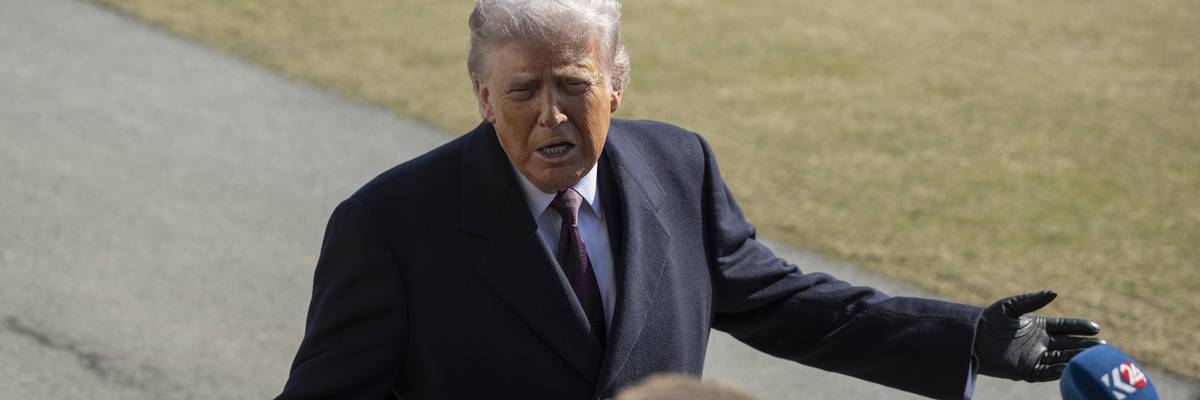
US President Donald Trump speaks to the press before he departs the White House in Washington, DC en route to Corpus Christi, Texas on February 27, 2026.
"Trump ran on an explicitly anti-interventionist platform when he ran for president," noted one critic. "He lied to the American people."
As the world braces for a possible US war on Iran and people in Venezuela, Nigeria, and Yemen still reel from recent US attacks, President Donald Trump—the self-proclaimed "peace president" who has bombed more countries than any other American administration—said Friday that the United States may launch a "friendly takeover" of Cuba.
"The Cuban government is talking with us, they're in a big deal of trouble, as you know," Trump told reporters outside the White House before departing for Texas. "They have no money. They have no anything right now. But they're talking to us, and maybe we'll have a friendly takeover of Cuba."
"We could very well end up having a friendly takeover of Cuba," he added.
Cuban Deputy Foreign Minister Carlos Fernández de Cossío posted on social media Friday that "the US maintains its fuel embargo against Cuba in full force, and its impact as a form of collective punishment is unwavering."
"Nothing announced in recent days changes this reality," he added. "The possibility of conditional sales to the private sector already existed and does not alleviate the impact on the Cuban population."
Trump's comments sparked criticism on social media, with one X user writing: "A 'friendly takeover' is an interesting phrase in international diplomacy. If the US is discussing Cuba’s future, I’m sure [Russian President] Vladimir Putin is suddenly very interested in the definition of friendly' too."
University of North Texas, Dallas political science professor Orlando Pérez said on X that "more often than not, [Trump's] mouth is his worst enemy."
"This BS plays into the hands of hard-liners on both sides of the Florida Straits and reduces chances of a negotiated deal," he added. "Why would anyone in Cuba agree to a deal that leads to a US 'takeover'?"
Meanwhile, dozens of civil society groups on Friday sent a letter to Congress urging lawmakers "to press the Trump administration to reverse its aggressive policy towards Cuba."
"Instead, Congress should call on the administration to expand humanitarian relief, support political and economic engagement, and foster a more vibrant private sector that can deliver a better quality of life for the Cuban people," added the groups, which include Alianza Americas, American Friends Service Committee, CodePink, Demand Progress, Peace Action, Presbyterian Church USA, RootsAction, United Church of Christ, and Win Without War.
Trump's remarks Friday came in response to a question from NBC News senior White House correspondent Gabe Gutierrez regarding Wednesday's incident in which Cuban maritime defense forces killed four men and captured six others during a shootout with a Florida-registered speedboat allegedly carrying weapons intended for what Havana called “an infiltration for terrorist purposes.” South Florida has long been a base for right-wing Cuban exiles who have launched numerous terror attacks against the Cuban people and international tourists on the island, including by speedboat strafings.
Trump did not clarify his comments, seemingly suggesting that moves to topple Cuba's socialist government—which has outlasted a dozen US presidents—could be freshly afoot. Since Cubans overthrew a brutal US-backed dictatorship in 1959, the United States or allied exile forces tried to assassinate former Cuban President Fidel Castro hundreds of times, backed an ill-fated invasion at Bay of Pigs, served as a base for perpetrators of some of the hemisphere's worst terror attacks, and even hatched a plan to detonate a nuclear bomb high above the island to convince its people that the return of Jesus Christ was nigh and the only thing standing in the way of the so-called "Second Coming" was Castro.
A 64-year US economic embargo on Cuba, which Trump recently worsened by cutting off fuel, has been a leading force crippling Cuba's economy and is now being blamed for a soaring infant mortality on the island.
Friday's remarks by Trump came as Iranians and people across the Middle East and beyond are bracing for a possible US attack on Iran—the second in as many years—and less than than two months after the president ordered the bombing and invasion of Venezuela during an operation that ended with Venezuelan President Nicolás Maduro abducted and jailed in United States, where he is expected to face trial for dubious narco-trafficking charges.
If the US strikes Cuba, it will be the 11th country attacked during Trump's two terms in office. The president—who says he deserves a Nobel Peace Prize—has ordered attacks on Afghanistan, Iran, Iraq, Libya, Nigeria, Pakistan, Somalia, Syria, Venezuela, and Yemen, and has bombed dozens of boats allegedly transporting drugs in international waters in the Caribbean Sea and Pacific Ocean.
Dear Common Dreams reader, It’s been nearly 30 years since I co-founded Common Dreams with my late wife, Lina Newhouser. We had the radical notion that journalism should serve the public good, not corporate profits. It was clear to us from the outset what it would take to build such a project. No paid advertisements. No corporate sponsors. No millionaire publisher telling us what to think or do. Many people said we wouldn't last a year, but we proved those doubters wrong. Together with a tremendous team of journalists and dedicated staff, we built an independent media outlet free from the constraints of profits and corporate control. Our mission has always been simple: To inform. To inspire. To ignite change for the common good. Building Common Dreams was not easy. Our survival was never guaranteed. When you take on the most powerful forces—Wall Street greed, fossil fuel industry destruction, Big Tech lobbyists, and uber-rich oligarchs who have spent billions upon billions rigging the economy and democracy in their favor—the only bulwark you have is supporters who believe in your work. But here’s the urgent message from me today. It's never been this bad out there. And it's never been this hard to keep us going. At the very moment Common Dreams is most needed, the threats we face are intensifying. We need your support now more than ever. We don't accept corporate advertising and never will. We don't have a paywall because we don't think people should be blocked from critical news based on their ability to pay. Everything we do is funded by the donations of readers like you. When everyone does the little they can afford, we are strong. But if that support retreats or dries up, so do we. Will you donate now to make sure Common Dreams not only survives but thrives? —Craig Brown, Co-founder |
As the world braces for a possible US war on Iran and people in Venezuela, Nigeria, and Yemen still reel from recent US attacks, President Donald Trump—the self-proclaimed "peace president" who has bombed more countries than any other American administration—said Friday that the United States may launch a "friendly takeover" of Cuba.
"The Cuban government is talking with us, they're in a big deal of trouble, as you know," Trump told reporters outside the White House before departing for Texas. "They have no money. They have no anything right now. But they're talking to us, and maybe we'll have a friendly takeover of Cuba."
"We could very well end up having a friendly takeover of Cuba," he added.
Cuban Deputy Foreign Minister Carlos Fernández de Cossío posted on social media Friday that "the US maintains its fuel embargo against Cuba in full force, and its impact as a form of collective punishment is unwavering."
"Nothing announced in recent days changes this reality," he added. "The possibility of conditional sales to the private sector already existed and does not alleviate the impact on the Cuban population."
Trump's comments sparked criticism on social media, with one X user writing: "A 'friendly takeover' is an interesting phrase in international diplomacy. If the US is discussing Cuba’s future, I’m sure [Russian President] Vladimir Putin is suddenly very interested in the definition of friendly' too."
University of North Texas, Dallas political science professor Orlando Pérez said on X that "more often than not, [Trump's] mouth is his worst enemy."
"This BS plays into the hands of hard-liners on both sides of the Florida Straits and reduces chances of a negotiated deal," he added. "Why would anyone in Cuba agree to a deal that leads to a US 'takeover'?"
Meanwhile, dozens of civil society groups on Friday sent a letter to Congress urging lawmakers "to press the Trump administration to reverse its aggressive policy towards Cuba."
"Instead, Congress should call on the administration to expand humanitarian relief, support political and economic engagement, and foster a more vibrant private sector that can deliver a better quality of life for the Cuban people," added the groups, which include Alianza Americas, American Friends Service Committee, CodePink, Demand Progress, Peace Action, Presbyterian Church USA, RootsAction, United Church of Christ, and Win Without War.
Trump's remarks Friday came in response to a question from NBC News senior White House correspondent Gabe Gutierrez regarding Wednesday's incident in which Cuban maritime defense forces killed four men and captured six others during a shootout with a Florida-registered speedboat allegedly carrying weapons intended for what Havana called “an infiltration for terrorist purposes.” South Florida has long been a base for right-wing Cuban exiles who have launched numerous terror attacks against the Cuban people and international tourists on the island, including by speedboat strafings.
Trump did not clarify his comments, seemingly suggesting that moves to topple Cuba's socialist government—which has outlasted a dozen US presidents—could be freshly afoot. Since Cubans overthrew a brutal US-backed dictatorship in 1959, the United States or allied exile forces tried to assassinate former Cuban President Fidel Castro hundreds of times, backed an ill-fated invasion at Bay of Pigs, served as a base for perpetrators of some of the hemisphere's worst terror attacks, and even hatched a plan to detonate a nuclear bomb high above the island to convince its people that the return of Jesus Christ was nigh and the only thing standing in the way of the so-called "Second Coming" was Castro.
A 64-year US economic embargo on Cuba, which Trump recently worsened by cutting off fuel, has been a leading force crippling Cuba's economy and is now being blamed for a soaring infant mortality on the island.
Friday's remarks by Trump came as Iranians and people across the Middle East and beyond are bracing for a possible US attack on Iran—the second in as many years—and less than than two months after the president ordered the bombing and invasion of Venezuela during an operation that ended with Venezuelan President Nicolás Maduro abducted and jailed in United States, where he is expected to face trial for dubious narco-trafficking charges.
If the US strikes Cuba, it will be the 11th country attacked during Trump's two terms in office. The president—who says he deserves a Nobel Peace Prize—has ordered attacks on Afghanistan, Iran, Iraq, Libya, Nigeria, Pakistan, Somalia, Syria, Venezuela, and Yemen, and has bombed dozens of boats allegedly transporting drugs in international waters in the Caribbean Sea and Pacific Ocean.
As the world braces for a possible US war on Iran and people in Venezuela, Nigeria, and Yemen still reel from recent US attacks, President Donald Trump—the self-proclaimed "peace president" who has bombed more countries than any other American administration—said Friday that the United States may launch a "friendly takeover" of Cuba.
"The Cuban government is talking with us, they're in a big deal of trouble, as you know," Trump told reporters outside the White House before departing for Texas. "They have no money. They have no anything right now. But they're talking to us, and maybe we'll have a friendly takeover of Cuba."
"We could very well end up having a friendly takeover of Cuba," he added.
Cuban Deputy Foreign Minister Carlos Fernández de Cossío posted on social media Friday that "the US maintains its fuel embargo against Cuba in full force, and its impact as a form of collective punishment is unwavering."
"Nothing announced in recent days changes this reality," he added. "The possibility of conditional sales to the private sector already existed and does not alleviate the impact on the Cuban population."
Trump's comments sparked criticism on social media, with one X user writing: "A 'friendly takeover' is an interesting phrase in international diplomacy. If the US is discussing Cuba’s future, I’m sure [Russian President] Vladimir Putin is suddenly very interested in the definition of friendly' too."
University of North Texas, Dallas political science professor Orlando Pérez said on X that "more often than not, [Trump's] mouth is his worst enemy."
"This BS plays into the hands of hard-liners on both sides of the Florida Straits and reduces chances of a negotiated deal," he added. "Why would anyone in Cuba agree to a deal that leads to a US 'takeover'?"
Meanwhile, dozens of civil society groups on Friday sent a letter to Congress urging lawmakers "to press the Trump administration to reverse its aggressive policy towards Cuba."
"Instead, Congress should call on the administration to expand humanitarian relief, support political and economic engagement, and foster a more vibrant private sector that can deliver a better quality of life for the Cuban people," added the groups, which include Alianza Americas, American Friends Service Committee, CodePink, Demand Progress, Peace Action, Presbyterian Church USA, RootsAction, United Church of Christ, and Win Without War.
Trump's remarks Friday came in response to a question from NBC News senior White House correspondent Gabe Gutierrez regarding Wednesday's incident in which Cuban maritime defense forces killed four men and captured six others during a shootout with a Florida-registered speedboat allegedly carrying weapons intended for what Havana called “an infiltration for terrorist purposes.” South Florida has long been a base for right-wing Cuban exiles who have launched numerous terror attacks against the Cuban people and international tourists on the island, including by speedboat strafings.
Trump did not clarify his comments, seemingly suggesting that moves to topple Cuba's socialist government—which has outlasted a dozen US presidents—could be freshly afoot. Since Cubans overthrew a brutal US-backed dictatorship in 1959, the United States or allied exile forces tried to assassinate former Cuban President Fidel Castro hundreds of times, backed an ill-fated invasion at Bay of Pigs, served as a base for perpetrators of some of the hemisphere's worst terror attacks, and even hatched a plan to detonate a nuclear bomb high above the island to convince its people that the return of Jesus Christ was nigh and the only thing standing in the way of the so-called "Second Coming" was Castro.
A 64-year US economic embargo on Cuba, which Trump recently worsened by cutting off fuel, has been a leading force crippling Cuba's economy and is now being blamed for a soaring infant mortality on the island.
Friday's remarks by Trump came as Iranians and people across the Middle East and beyond are bracing for a possible US attack on Iran—the second in as many years—and less than than two months after the president ordered the bombing and invasion of Venezuela during an operation that ended with Venezuelan President Nicolás Maduro abducted and jailed in United States, where he is expected to face trial for dubious narco-trafficking charges.
If the US strikes Cuba, it will be the 11th country attacked during Trump's two terms in office. The president—who says he deserves a Nobel Peace Prize—has ordered attacks on Afghanistan, Iran, Iraq, Libya, Nigeria, Pakistan, Somalia, Syria, Venezuela, and Yemen, and has bombed dozens of boats allegedly transporting drugs in international waters in the Caribbean Sea and Pacific Ocean.