SUBSCRIBE TO OUR FREE NEWSLETTER
Daily news & progressive opinion—funded by the people, not the corporations—delivered straight to your inbox.
5
#000000
#FFFFFF
To donate by check, phone, or other method, see our More Ways to Give page.
Daily news & progressive opinion—funded by the people, not the corporations—delivered straight to your inbox.
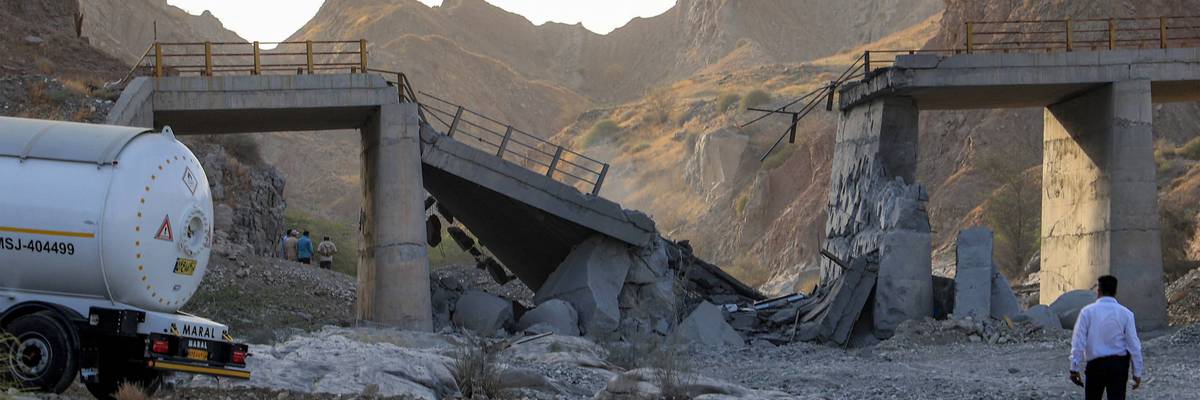
A bridge that was hit and heavily damaged by a US strike is pictured along the road connecting Roudan and Bandar Abbas in southern Iran on July 18, 2026.
"It's a narrative designed to give the impression that Trump is in the driving seat in this conflict. It's been clear for some time now: He isn't."
Trita Parsi, an expert on US-Iranian relations, cast doubt on President Donald Trump's Saturday claims that he halted planned strikes on Iran due to progress in negotiations to end the illegal conflict, launched by the Republican and Israel in February.
"The U.S.A. is locked and loaded and ready to go against the Islamic Republic of Iran, at levels of Military Terror, Strength, and Power not seen since World War II. Despite this, we have just been asked by Iran, and other Middle Eastern Countries, to hold off any attack in that the perimeters of a deal has been agreed to," Trump wrote on his Truth Social platform at 10:05 pm Eastern time.
"This would include the Immediate, Complete, and Total OPENING OF THE HORMUZ STRAIT, and an end to Iran's nuclear threat," Trump declared—despite repeated conclusions from US intelligence agencies that the Iranian government was not aiming to build a nuclear weapon when the United States and Israel began bombing Iran five months ago.
"Based on this request, I have agreed, for the future benefit of the WORLD and, likewise, the survival of a successful and prosperous Iran, to cancel the attack, subject to being able to rapidly make a DEAL," Trump added. "The Country of Israel joins me in this commitment. Get to work, everybody, and get it DONE."
Sharing the post on the platform X, Parsi said, "Trump 'cancels' 'planned' 'attack' on Iran..." The expert struck a similarly skeptical tone during a Saturday on-air interview with CNN about the president's announcement.
Parsi, co-founder and executive vice president of the Quincy Institute for Responsible Statecraft, said that "I don't believe there was an imminent attack. We've gone through this several times, in which Trump issues these threats, and then he backs off because the other side calls his bluff."
"Trump does not have an escalatory way out of this conflict, but what he is trying to do is to give the impression that he is in control—that he is in the driving seat," Parsi suggested. "And I think it's been quite clear for quite some time now he is not."
During Trump's first term, he tore up the Obama administration's Iran nuclear deal, and so far, he has been unable to negotiate a replacement. Since launching this war, without authorization from Congress and in violation of the United Nations Charter, the ceasefire agreement reached in April and a June memorandum of understanding ultimately have not stopped the bloodshed.
Earlier this week, most US Senate Republicans and Democratic Sen. John Fetterman (Pa.) blocked yet another war powers resolution intended to prevent the Trump administration from launching further attacks on Iran without congressional approval—a vote that came as polling showed 64% of Americans disapprove of continuing the war, including 37% of Republicans.
The Iran War has killed thousands of Iranians and Lebanese civilians—the latter mostly from Israeli attacks purportedly targeting Hezbollah—as well as hundreds of people in other nations across the Middle East and at least 18 US service members.
In the hours before Trump's Saturday Truth Social post, Axios revealed that "Saudi Crown Prince Mohammed bin Salman and Trump spoke on Saturday, with MBS expressing concern over the strike plans," and "other regional powers, including Qatar, the United Arab Emirates, Turkey and Pakistan, have also pressed the US and Iran to de-escalate.”
CBS chief foreign affairs correspondent Margaret Brennan reported on social media about Saturday's "flurry of phone calls by Iran's top diplomat Abbas Araghchi to regional leaders, which suggests an effort underway to avoid military strikes."
"Earlier today, the State Department advised Americans throughout the Mideast to leave the region," Brennan noted.
Araghchi said Saturday that "any hostile action by the US or Israel—or participation or cooperation by regional countries in such actions—would be met with a decisive and proportionate response from Iran's powerful armed forces."
Dear Common Dreams reader, It’s been nearly 30 years since I co-founded Common Dreams with my late wife, Lina Newhouser. We had the radical notion that journalism should serve the public good, not corporate profits. It was clear to us from the outset what it would take to build such a project. No paid advertisements. No corporate sponsors. No millionaire publisher telling us what to think or do. Many people said we wouldn't last a year, but we proved those doubters wrong. Together with a tremendous team of journalists and dedicated staff, we built an independent media outlet free from the constraints of profits and corporate control. Our mission has always been simple: To inform. To inspire. To ignite change for the common good. Building Common Dreams was not easy. Our survival was never guaranteed. When you take on the most powerful forces—Wall Street greed, fossil fuel industry destruction, Big Tech lobbyists, and uber-rich oligarchs who have spent billions upon billions rigging the economy and democracy in their favor—the only bulwark you have is supporters who believe in your work. But here’s the urgent message from me today. It's never been this bad out there. And it's never been this hard to keep us going. At the very moment Common Dreams is most needed, the threats we face are intensifying. We need your support now more than ever. We don't accept corporate advertising and never will. We don't have a paywall because we don't think people should be blocked from critical news based on their ability to pay. Everything we do is funded by the donations of readers like you. When everyone does the little they can afford, we are strong. But if that support retreats or dries up, so do we. Will you donate now to make sure Common Dreams not only survives but thrives? —Craig Brown, Co-founder |
Trita Parsi, an expert on US-Iranian relations, cast doubt on President Donald Trump's Saturday claims that he halted planned strikes on Iran due to progress in negotiations to end the illegal conflict, launched by the Republican and Israel in February.
"The U.S.A. is locked and loaded and ready to go against the Islamic Republic of Iran, at levels of Military Terror, Strength, and Power not seen since World War II. Despite this, we have just been asked by Iran, and other Middle Eastern Countries, to hold off any attack in that the perimeters of a deal has been agreed to," Trump wrote on his Truth Social platform at 10:05 pm Eastern time.
"This would include the Immediate, Complete, and Total OPENING OF THE HORMUZ STRAIT, and an end to Iran's nuclear threat," Trump declared—despite repeated conclusions from US intelligence agencies that the Iranian government was not aiming to build a nuclear weapon when the United States and Israel began bombing Iran five months ago.
"Based on this request, I have agreed, for the future benefit of the WORLD and, likewise, the survival of a successful and prosperous Iran, to cancel the attack, subject to being able to rapidly make a DEAL," Trump added. "The Country of Israel joins me in this commitment. Get to work, everybody, and get it DONE."
Sharing the post on the platform X, Parsi said, "Trump 'cancels' 'planned' 'attack' on Iran..." The expert struck a similarly skeptical tone during a Saturday on-air interview with CNN about the president's announcement.
Parsi, co-founder and executive vice president of the Quincy Institute for Responsible Statecraft, said that "I don't believe there was an imminent attack. We've gone through this several times, in which Trump issues these threats, and then he backs off because the other side calls his bluff."
"Trump does not have an escalatory way out of this conflict, but what he is trying to do is to give the impression that he is in control—that he is in the driving seat," Parsi suggested. "And I think it's been quite clear for quite some time now he is not."
During Trump's first term, he tore up the Obama administration's Iran nuclear deal, and so far, he has been unable to negotiate a replacement. Since launching this war, without authorization from Congress and in violation of the United Nations Charter, the ceasefire agreement reached in April and a June memorandum of understanding ultimately have not stopped the bloodshed.
Earlier this week, most US Senate Republicans and Democratic Sen. John Fetterman (Pa.) blocked yet another war powers resolution intended to prevent the Trump administration from launching further attacks on Iran without congressional approval—a vote that came as polling showed 64% of Americans disapprove of continuing the war, including 37% of Republicans.
The Iran War has killed thousands of Iranians and Lebanese civilians—the latter mostly from Israeli attacks purportedly targeting Hezbollah—as well as hundreds of people in other nations across the Middle East and at least 18 US service members.
In the hours before Trump's Saturday Truth Social post, Axios revealed that "Saudi Crown Prince Mohammed bin Salman and Trump spoke on Saturday, with MBS expressing concern over the strike plans," and "other regional powers, including Qatar, the United Arab Emirates, Turkey and Pakistan, have also pressed the US and Iran to de-escalate.”
CBS chief foreign affairs correspondent Margaret Brennan reported on social media about Saturday's "flurry of phone calls by Iran's top diplomat Abbas Araghchi to regional leaders, which suggests an effort underway to avoid military strikes."
"Earlier today, the State Department advised Americans throughout the Mideast to leave the region," Brennan noted.
Araghchi said Saturday that "any hostile action by the US or Israel—or participation or cooperation by regional countries in such actions—would be met with a decisive and proportionate response from Iran's powerful armed forces."
Trita Parsi, an expert on US-Iranian relations, cast doubt on President Donald Trump's Saturday claims that he halted planned strikes on Iran due to progress in negotiations to end the illegal conflict, launched by the Republican and Israel in February.
"The U.S.A. is locked and loaded and ready to go against the Islamic Republic of Iran, at levels of Military Terror, Strength, and Power not seen since World War II. Despite this, we have just been asked by Iran, and other Middle Eastern Countries, to hold off any attack in that the perimeters of a deal has been agreed to," Trump wrote on his Truth Social platform at 10:05 pm Eastern time.
"This would include the Immediate, Complete, and Total OPENING OF THE HORMUZ STRAIT, and an end to Iran's nuclear threat," Trump declared—despite repeated conclusions from US intelligence agencies that the Iranian government was not aiming to build a nuclear weapon when the United States and Israel began bombing Iran five months ago.
"Based on this request, I have agreed, for the future benefit of the WORLD and, likewise, the survival of a successful and prosperous Iran, to cancel the attack, subject to being able to rapidly make a DEAL," Trump added. "The Country of Israel joins me in this commitment. Get to work, everybody, and get it DONE."
Sharing the post on the platform X, Parsi said, "Trump 'cancels' 'planned' 'attack' on Iran..." The expert struck a similarly skeptical tone during a Saturday on-air interview with CNN about the president's announcement.
Parsi, co-founder and executive vice president of the Quincy Institute for Responsible Statecraft, said that "I don't believe there was an imminent attack. We've gone through this several times, in which Trump issues these threats, and then he backs off because the other side calls his bluff."
"Trump does not have an escalatory way out of this conflict, but what he is trying to do is to give the impression that he is in control—that he is in the driving seat," Parsi suggested. "And I think it's been quite clear for quite some time now he is not."
During Trump's first term, he tore up the Obama administration's Iran nuclear deal, and so far, he has been unable to negotiate a replacement. Since launching this war, without authorization from Congress and in violation of the United Nations Charter, the ceasefire agreement reached in April and a June memorandum of understanding ultimately have not stopped the bloodshed.
Earlier this week, most US Senate Republicans and Democratic Sen. John Fetterman (Pa.) blocked yet another war powers resolution intended to prevent the Trump administration from launching further attacks on Iran without congressional approval—a vote that came as polling showed 64% of Americans disapprove of continuing the war, including 37% of Republicans.
The Iran War has killed thousands of Iranians and Lebanese civilians—the latter mostly from Israeli attacks purportedly targeting Hezbollah—as well as hundreds of people in other nations across the Middle East and at least 18 US service members.
In the hours before Trump's Saturday Truth Social post, Axios revealed that "Saudi Crown Prince Mohammed bin Salman and Trump spoke on Saturday, with MBS expressing concern over the strike plans," and "other regional powers, including Qatar, the United Arab Emirates, Turkey and Pakistan, have also pressed the US and Iran to de-escalate.”
CBS chief foreign affairs correspondent Margaret Brennan reported on social media about Saturday's "flurry of phone calls by Iran's top diplomat Abbas Araghchi to regional leaders, which suggests an effort underway to avoid military strikes."
"Earlier today, the State Department advised Americans throughout the Mideast to leave the region," Brennan noted.
Araghchi said Saturday that "any hostile action by the US or Israel—or participation or cooperation by regional countries in such actions—would be met with a decisive and proportionate response from Iran's powerful armed forces."