SUBSCRIBE TO OUR FREE NEWSLETTER
Daily news & progressive opinion—funded by the people, not the corporations—delivered straight to your inbox.
5
#000000
#FFFFFF
To donate by check, phone, or other method, see our More Ways to Give page.
Daily news & progressive opinion—funded by the people, not the corporations—delivered straight to your inbox.
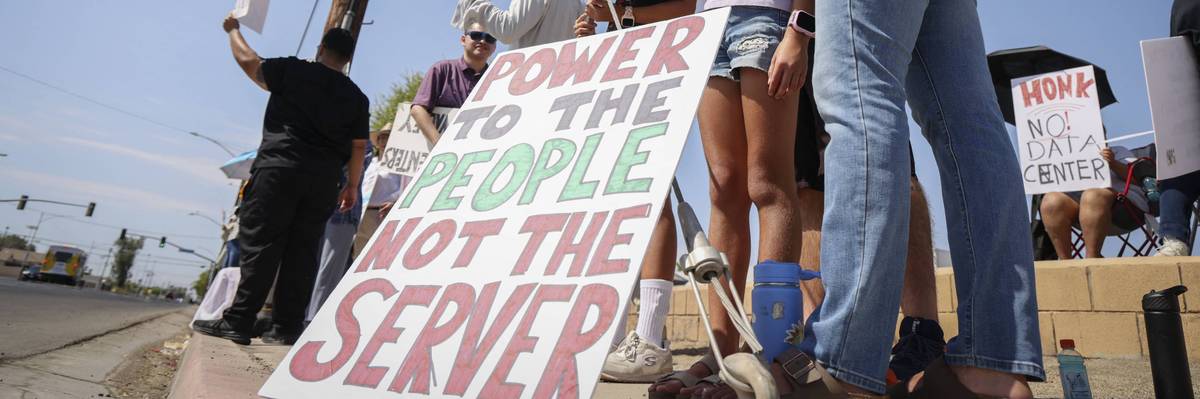
Demonstrators wave signs during a nationwide protest against artificial intelligence data center expansion in Imperial, California on July 18, 2026.
“This is really just yet another class divide for the American public."
Regardless of tech executives' promises that artificial intelligence will make people's workdays more efficient, more productive, and even happier, a new survey out Monday found that employees "are bracing for the impacts of AI rather than embracing them."
That was the interpretation of Elizabeth Pancotti, the vice president of policy, advocacy, and research at the progressive think tank Groundwork Collaborative, after the group joined research firm Ipsos in releasing the first results of a yearlong study of worker attitudes on AI.
Workers, said Pancotti, "expect the tech to deepen existing inequality in the workplace."
Just one-third of US workers expect the technology, whose expansion President Donald Trump has aggressively pushed, to improve their jobs, according to the poll.
The rest of the respondents rejected the idea that AI would automate tedious tasks at work and provide support, allowing them to complete more challenging responsibilities faster. Instead, two-thirds of workers said they expect their lives at work to get harder as AI eliminates jobs—theirs or their coworkers—and increases pressure at the workplace.
"This sentiment is consistent across race, gender, education, and income lines," reported Ipsos, while people with a college degree were more likely to believe that AI could improve their jobs. Only 1 in 5 people with a high school education or less said they expected their jobs to be improved by the technology.
Black workers (12%) were more likely than white respondents (4%) to feel that AI could eventually replace their jobs.
“Workers know bosses who say AI will make their jobs easier and allow them to be more productive are pulling a fast one."
More than a quarter of employed people said AI is already having a negative impact on their work, while 41% of unemployed people said the same.
As Jessica Grose wrote in The New York Times last month, AI has made it easy for companies to rapidly post job listings and give "the impression a business is thriving," without following up with many applicants, leaving job seekers in "purgatory."
More than half of the workers surveyed by Groundwork and Ipsos said they believe the widespread use of AI in workplaces will "only or mostly benefit business owners and executives."
"The benefits of AI in the workplace are not being split evenly," said Pancotti. "The workers who expect to reap the rewards of adoption are already high earners in white-collar jobs.”
Just 6% of respondents said workers will benefit, and about 14% said the technology will ultimately not benefit anyone.
About 40% of people making $100,000 per year or more expected their jobs to get better and easier due to AI—more than twice the percentage of people who make under $50,000.
“This is really just yet another class divide for the American public,” Alex Jacquez, senior vice president of policy, advocacy, and research at Groundwork Collaborative, told Semafor.
The poll comes as communities across the country have mobilized to stop AI data centers from being built, arguing that the facilities' massive water and electricity consumption, as well as the evidence that they could ultimately lead to job losses while creating little-to-no permanent work, makes them undesirable additions to their cities and towns.
“Workers know bosses who say AI will make their jobs easier and allow them to be more productive are pulling a fast one," said Pancotti. "Across the board, workers report AI putting more pressure on productivity rather than supporting workers as many AI proponents claim."
Dear Common Dreams reader, It’s been nearly 30 years since I co-founded Common Dreams with my late wife, Lina Newhouser. We had the radical notion that journalism should serve the public good, not corporate profits. It was clear to us from the outset what it would take to build such a project. No paid advertisements. No corporate sponsors. No millionaire publisher telling us what to think or do. Many people said we wouldn't last a year, but we proved those doubters wrong. Together with a tremendous team of journalists and dedicated staff, we built an independent media outlet free from the constraints of profits and corporate control. Our mission has always been simple: To inform. To inspire. To ignite change for the common good. Building Common Dreams was not easy. Our survival was never guaranteed. When you take on the most powerful forces—Wall Street greed, fossil fuel industry destruction, Big Tech lobbyists, and uber-rich oligarchs who have spent billions upon billions rigging the economy and democracy in their favor—the only bulwark you have is supporters who believe in your work. But here’s the urgent message from me today. It's never been this bad out there. And it's never been this hard to keep us going. At the very moment Common Dreams is most needed, the threats we face are intensifying. We need your support now more than ever. We don't accept corporate advertising and never will. We don't have a paywall because we don't think people should be blocked from critical news based on their ability to pay. Everything we do is funded by the donations of readers like you. When everyone does the little they can afford, we are strong. But if that support retreats or dries up, so do we. Will you donate now to make sure Common Dreams not only survives but thrives? —Craig Brown, Co-founder |
Regardless of tech executives' promises that artificial intelligence will make people's workdays more efficient, more productive, and even happier, a new survey out Monday found that employees "are bracing for the impacts of AI rather than embracing them."
That was the interpretation of Elizabeth Pancotti, the vice president of policy, advocacy, and research at the progressive think tank Groundwork Collaborative, after the group joined research firm Ipsos in releasing the first results of a yearlong study of worker attitudes on AI.
Workers, said Pancotti, "expect the tech to deepen existing inequality in the workplace."
Just one-third of US workers expect the technology, whose expansion President Donald Trump has aggressively pushed, to improve their jobs, according to the poll.
The rest of the respondents rejected the idea that AI would automate tedious tasks at work and provide support, allowing them to complete more challenging responsibilities faster. Instead, two-thirds of workers said they expect their lives at work to get harder as AI eliminates jobs—theirs or their coworkers—and increases pressure at the workplace.
"This sentiment is consistent across race, gender, education, and income lines," reported Ipsos, while people with a college degree were more likely to believe that AI could improve their jobs. Only 1 in 5 people with a high school education or less said they expected their jobs to be improved by the technology.
Black workers (12%) were more likely than white respondents (4%) to feel that AI could eventually replace their jobs.
“Workers know bosses who say AI will make their jobs easier and allow them to be more productive are pulling a fast one."
More than a quarter of employed people said AI is already having a negative impact on their work, while 41% of unemployed people said the same.
As Jessica Grose wrote in The New York Times last month, AI has made it easy for companies to rapidly post job listings and give "the impression a business is thriving," without following up with many applicants, leaving job seekers in "purgatory."
More than half of the workers surveyed by Groundwork and Ipsos said they believe the widespread use of AI in workplaces will "only or mostly benefit business owners and executives."
"The benefits of AI in the workplace are not being split evenly," said Pancotti. "The workers who expect to reap the rewards of adoption are already high earners in white-collar jobs.”
Just 6% of respondents said workers will benefit, and about 14% said the technology will ultimately not benefit anyone.
About 40% of people making $100,000 per year or more expected their jobs to get better and easier due to AI—more than twice the percentage of people who make under $50,000.
“This is really just yet another class divide for the American public,” Alex Jacquez, senior vice president of policy, advocacy, and research at Groundwork Collaborative, told Semafor.
The poll comes as communities across the country have mobilized to stop AI data centers from being built, arguing that the facilities' massive water and electricity consumption, as well as the evidence that they could ultimately lead to job losses while creating little-to-no permanent work, makes them undesirable additions to their cities and towns.
“Workers know bosses who say AI will make their jobs easier and allow them to be more productive are pulling a fast one," said Pancotti. "Across the board, workers report AI putting more pressure on productivity rather than supporting workers as many AI proponents claim."
Regardless of tech executives' promises that artificial intelligence will make people's workdays more efficient, more productive, and even happier, a new survey out Monday found that employees "are bracing for the impacts of AI rather than embracing them."
That was the interpretation of Elizabeth Pancotti, the vice president of policy, advocacy, and research at the progressive think tank Groundwork Collaborative, after the group joined research firm Ipsos in releasing the first results of a yearlong study of worker attitudes on AI.
Workers, said Pancotti, "expect the tech to deepen existing inequality in the workplace."
Just one-third of US workers expect the technology, whose expansion President Donald Trump has aggressively pushed, to improve their jobs, according to the poll.
The rest of the respondents rejected the idea that AI would automate tedious tasks at work and provide support, allowing them to complete more challenging responsibilities faster. Instead, two-thirds of workers said they expect their lives at work to get harder as AI eliminates jobs—theirs or their coworkers—and increases pressure at the workplace.
"This sentiment is consistent across race, gender, education, and income lines," reported Ipsos, while people with a college degree were more likely to believe that AI could improve their jobs. Only 1 in 5 people with a high school education or less said they expected their jobs to be improved by the technology.
Black workers (12%) were more likely than white respondents (4%) to feel that AI could eventually replace their jobs.
“Workers know bosses who say AI will make their jobs easier and allow them to be more productive are pulling a fast one."
More than a quarter of employed people said AI is already having a negative impact on their work, while 41% of unemployed people said the same.
As Jessica Grose wrote in The New York Times last month, AI has made it easy for companies to rapidly post job listings and give "the impression a business is thriving," without following up with many applicants, leaving job seekers in "purgatory."
More than half of the workers surveyed by Groundwork and Ipsos said they believe the widespread use of AI in workplaces will "only or mostly benefit business owners and executives."
"The benefits of AI in the workplace are not being split evenly," said Pancotti. "The workers who expect to reap the rewards of adoption are already high earners in white-collar jobs.”
Just 6% of respondents said workers will benefit, and about 14% said the technology will ultimately not benefit anyone.
About 40% of people making $100,000 per year or more expected their jobs to get better and easier due to AI—more than twice the percentage of people who make under $50,000.
“This is really just yet another class divide for the American public,” Alex Jacquez, senior vice president of policy, advocacy, and research at Groundwork Collaborative, told Semafor.
The poll comes as communities across the country have mobilized to stop AI data centers from being built, arguing that the facilities' massive water and electricity consumption, as well as the evidence that they could ultimately lead to job losses while creating little-to-no permanent work, makes them undesirable additions to their cities and towns.
“Workers know bosses who say AI will make their jobs easier and allow them to be more productive are pulling a fast one," said Pancotti. "Across the board, workers report AI putting more pressure on productivity rather than supporting workers as many AI proponents claim."