SUBSCRIBE TO OUR FREE NEWSLETTER
Daily news & progressive opinion—funded by the people, not the corporations—delivered straight to your inbox.
5
#000000
#FFFFFF
To donate by check, phone, or other method, see our More Ways to Give page.
Daily news & progressive opinion—funded by the people, not the corporations—delivered straight to your inbox.
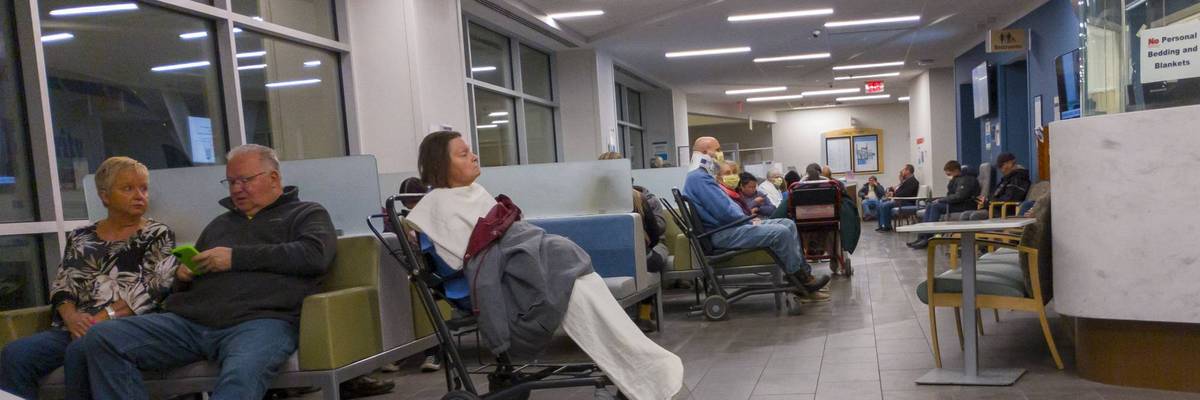
People wait for care in an over crowded hospital emergency room in Coon Rapids, Minnesota on December 18, 2025.
"We’re really crushing people who are desperately trying to pay their bills," said a chief executive at a nonprofit hospital group.
Months after congressional Republicans refused to extend enhanced subsidies for Americans who receive their health insurance through the Affordable Care Act, hospitals across the US are seeing a surge in uninsured patients seeking emergency medical care.
According to a Thursday report in The New York Times, executives at large hospital systems have been raising alarms over "the unexpectedly sharp rise in uninsured patients and the costs associated with treating them."
With many uninsured patients unable to pay their hospital bills, the Times noted, hospitals are seeing "lost revenues amounting to hundreds of millions of dollars across the country's vast health systems."
The Times linked this surge in uninsured patients directly to the Republican-controlled Congress allowing more generous subsidies for plans purchased through the ACA to lapse at the end of 2025. Enrollment in the program has fallen by about 3 million people since last year.
"What that tells me is that there are patients who are completely unable to pay," Laura Kaiser, chief executive of Catholic nonprofit hospital group SSM Health, told the Times. "We’re really crushing people who are desperately trying to pay their bills."
Executives at Universal Health Services (UHS), a for-profit hospital operator, said during an earnings call on Tuesday that the losses they expect to incur from treating uninsured patients have been significantly higher than their initial projects.
As reported by Healthcare Dive on Wednesday, UHS had initially projected that some patients who dropped their coverage provided by the ACA would find another way to get health insurance.
However, UHS CFO Steve Filton told investors that "it felt like virtually everyone who lost their exchange coverage became an uninsured patient."
UHS is hardly alone in suffering losses due to lapsed ACA subsidies, as Axios reported on Tuesday that HCA Healthcare, the largest for-profit hospital chain in the US, is projecting a $400 million hit to revenue that is tied partially to "an influx of uninsured patients."
HCA CEO Sam Hazen said the increase in uninsured patients was a direct consequence of the GOP's refusal to extend the ACA subsidies.
"The effects, as expected, were that many people became uninsured and still needed emergency care from hospitals," Hazen said. "As we look at the first half of the year, our expectations proved accurate, although the impact was greater than our estimates."
An increase in uninsured patients is bad both for hospitals' finances and patients themselves.
As KFF explained in a June report, people without insurance are more likely to avoid seeking medical treatment until their situation becomes too dire to ignore.
"People without health coverage are more likely to be hospitalized for avoidable health problems," KFF wrote, "and to experience declines in their overall health as a consequence of having undiagnosed conditions and a lower likelihood of receiving preventive and chronic disease management care. When they are hospitalized, uninsured people receive fewer diagnostic and therapeutic services and also have higher mortality rates than those with insurance."
Dear Common Dreams reader, It’s been nearly 30 years since I co-founded Common Dreams with my late wife, Lina Newhouser. We had the radical notion that journalism should serve the public good, not corporate profits. It was clear to us from the outset what it would take to build such a project. No paid advertisements. No corporate sponsors. No millionaire publisher telling us what to think or do. Many people said we wouldn't last a year, but we proved those doubters wrong. Together with a tremendous team of journalists and dedicated staff, we built an independent media outlet free from the constraints of profits and corporate control. Our mission has always been simple: To inform. To inspire. To ignite change for the common good. Building Common Dreams was not easy. Our survival was never guaranteed. When you take on the most powerful forces—Wall Street greed, fossil fuel industry destruction, Big Tech lobbyists, and uber-rich oligarchs who have spent billions upon billions rigging the economy and democracy in their favor—the only bulwark you have is supporters who believe in your work. But here’s the urgent message from me today. It's never been this bad out there. And it's never been this hard to keep us going. At the very moment Common Dreams is most needed, the threats we face are intensifying. We need your support now more than ever. We don't accept corporate advertising and never will. We don't have a paywall because we don't think people should be blocked from critical news based on their ability to pay. Everything we do is funded by the donations of readers like you. When everyone does the little they can afford, we are strong. But if that support retreats or dries up, so do we. Will you donate now to make sure Common Dreams not only survives but thrives? —Craig Brown, Co-founder |
Months after congressional Republicans refused to extend enhanced subsidies for Americans who receive their health insurance through the Affordable Care Act, hospitals across the US are seeing a surge in uninsured patients seeking emergency medical care.
According to a Thursday report in The New York Times, executives at large hospital systems have been raising alarms over "the unexpectedly sharp rise in uninsured patients and the costs associated with treating them."
With many uninsured patients unable to pay their hospital bills, the Times noted, hospitals are seeing "lost revenues amounting to hundreds of millions of dollars across the country's vast health systems."
The Times linked this surge in uninsured patients directly to the Republican-controlled Congress allowing more generous subsidies for plans purchased through the ACA to lapse at the end of 2025. Enrollment in the program has fallen by about 3 million people since last year.
"What that tells me is that there are patients who are completely unable to pay," Laura Kaiser, chief executive of Catholic nonprofit hospital group SSM Health, told the Times. "We’re really crushing people who are desperately trying to pay their bills."
Executives at Universal Health Services (UHS), a for-profit hospital operator, said during an earnings call on Tuesday that the losses they expect to incur from treating uninsured patients have been significantly higher than their initial projects.
As reported by Healthcare Dive on Wednesday, UHS had initially projected that some patients who dropped their coverage provided by the ACA would find another way to get health insurance.
However, UHS CFO Steve Filton told investors that "it felt like virtually everyone who lost their exchange coverage became an uninsured patient."
UHS is hardly alone in suffering losses due to lapsed ACA subsidies, as Axios reported on Tuesday that HCA Healthcare, the largest for-profit hospital chain in the US, is projecting a $400 million hit to revenue that is tied partially to "an influx of uninsured patients."
HCA CEO Sam Hazen said the increase in uninsured patients was a direct consequence of the GOP's refusal to extend the ACA subsidies.
"The effects, as expected, were that many people became uninsured and still needed emergency care from hospitals," Hazen said. "As we look at the first half of the year, our expectations proved accurate, although the impact was greater than our estimates."
An increase in uninsured patients is bad both for hospitals' finances and patients themselves.
As KFF explained in a June report, people without insurance are more likely to avoid seeking medical treatment until their situation becomes too dire to ignore.
"People without health coverage are more likely to be hospitalized for avoidable health problems," KFF wrote, "and to experience declines in their overall health as a consequence of having undiagnosed conditions and a lower likelihood of receiving preventive and chronic disease management care. When they are hospitalized, uninsured people receive fewer diagnostic and therapeutic services and also have higher mortality rates than those with insurance."
Months after congressional Republicans refused to extend enhanced subsidies for Americans who receive their health insurance through the Affordable Care Act, hospitals across the US are seeing a surge in uninsured patients seeking emergency medical care.
According to a Thursday report in The New York Times, executives at large hospital systems have been raising alarms over "the unexpectedly sharp rise in uninsured patients and the costs associated with treating them."
With many uninsured patients unable to pay their hospital bills, the Times noted, hospitals are seeing "lost revenues amounting to hundreds of millions of dollars across the country's vast health systems."
The Times linked this surge in uninsured patients directly to the Republican-controlled Congress allowing more generous subsidies for plans purchased through the ACA to lapse at the end of 2025. Enrollment in the program has fallen by about 3 million people since last year.
"What that tells me is that there are patients who are completely unable to pay," Laura Kaiser, chief executive of Catholic nonprofit hospital group SSM Health, told the Times. "We’re really crushing people who are desperately trying to pay their bills."
Executives at Universal Health Services (UHS), a for-profit hospital operator, said during an earnings call on Tuesday that the losses they expect to incur from treating uninsured patients have been significantly higher than their initial projects.
As reported by Healthcare Dive on Wednesday, UHS had initially projected that some patients who dropped their coverage provided by the ACA would find another way to get health insurance.
However, UHS CFO Steve Filton told investors that "it felt like virtually everyone who lost their exchange coverage became an uninsured patient."
UHS is hardly alone in suffering losses due to lapsed ACA subsidies, as Axios reported on Tuesday that HCA Healthcare, the largest for-profit hospital chain in the US, is projecting a $400 million hit to revenue that is tied partially to "an influx of uninsured patients."
HCA CEO Sam Hazen said the increase in uninsured patients was a direct consequence of the GOP's refusal to extend the ACA subsidies.
"The effects, as expected, were that many people became uninsured and still needed emergency care from hospitals," Hazen said. "As we look at the first half of the year, our expectations proved accurate, although the impact was greater than our estimates."
An increase in uninsured patients is bad both for hospitals' finances and patients themselves.
As KFF explained in a June report, people without insurance are more likely to avoid seeking medical treatment until their situation becomes too dire to ignore.
"People without health coverage are more likely to be hospitalized for avoidable health problems," KFF wrote, "and to experience declines in their overall health as a consequence of having undiagnosed conditions and a lower likelihood of receiving preventive and chronic disease management care. When they are hospitalized, uninsured people receive fewer diagnostic and therapeutic services and also have higher mortality rates than those with insurance."