SUBSCRIBE TO OUR FREE NEWSLETTER
Daily news & progressive opinion—funded by the people, not the corporations—delivered straight to your inbox.
5
#000000
#FFFFFF
To donate by check, phone, or other method, see our More Ways to Give page.

Daily news & progressive opinion—funded by the people, not the corporations—delivered straight to your inbox.
"We're heading into an extremely tumultuous election season," said one expert. "What's happening in the United States is political violence is going from the fringe to the mainstream."
More than two years after the deadly January 6 insurrection, 12 million people in the United States, or 4.4% of the adult population, believe the use of violence is justified to restore former President Donald Trump to power, The Guardian reported Friday.
This percentage has declined from nearly 10% in 2021, when the Chicago Project on Security & Threats (CPOST) first began conducting its Dangers to Democracy surveys of U.S. adults. But April data the University of Chicago research center shared exclusively with The Guardian reveals that a treacherous amount of support for political violence and conspiracy theories persists nationwide.
In the two and a half years since Trump's bid to overturn his 2020 loss fell short, Republican state lawmakers have launched a full-fledged assault on the franchise, enacting dozens of voter suppression and election subversion laws meant to increase their control over electoral outcomes. Due to obstruction from Republicans and corporate Democrats, Congress has failed to pass federal voting rights protections and other safeguards designed to prevent another coup attempt ahead of November 2024.
"We're heading into an extremely tumultuous election season," Robert Pape, a University of Chicago professor and CPOST director, told The Guardian. "What's happening in the United States is political violence is going from the fringe to the mainstream."
Several right-wing candidates who echoed Trump's relentless lies about President Joe Biden's 2020 victory lost in last year's midterms. But more than 210 others—including at least two who participated in the January 6 rally that escalated into an attack on the U.S. Capitol—won congressional seats and races for governor, secretary of state, and attorney general, underscoring the extent to which election denialism is now entrenched in the GOP and jeopardizes U.S. democracy for the foreseeable future.
The CPOST survey conducted in April found that 20% of U.S. adults still believe "the 2020 election was stolen from Donald Trump and Joe Biden is an illegitimate president," down only slightly from the 26% who said so in 2021.
"What you're seeing is really disturbing levels of distrust in American democracy, support for dangerous conspiracy theories, and support for political violence itself," Pape told The Guardian.
According to the newspaper, Pape compared "sentiments about political violence" to "the kindling for a wildfire." While "many were unaware that the events on January 6 would turn violent, research shows that public support for violence was widespread, so the attacks themselves should not have come as a surprise."
"Once you have support for violence in the mainstream, those are the raw ingredients or the raw combustible material and then speeches, typically by politicians, can set them off," said Pape. "Or if they get going, speeches can encourage them to go further."
Pape pointed out that there was chatter among far-right groups and on online forums about potentially using force to prevent lawmakers from certifying Biden's win, but Trump's January 6 address at the White House Ellipse was the spark that ignited the mob to storm the halls of Congress.
CPOST's latest findings are based on polling completed before Trump was federally indicted Thursday night on seven criminal counts in the special counsel investigation into his handling of classified documents. The charges, including willful retention of national defense secrets, obstruction of justice, and conspiracy, could carry years in prison for the GOP's leading 2024 presidential candidate.
In response to the indictment, several Republican lawmakers rallied to Trump's defense, parroting his dismissal of the probe as a "witch hunt." Fox News personalities also denounced what they called the "weaponization" of the U.S. justice system, while commenters on Breibart opined that "this is how revolution begins."
The menacing language mirrored what was said after the FBI in early August 2022 searched Trump's Mar-a-Lago resort and removed boxes of documents as part of the federal probe into his handling of classified materials.
At the time, many anonymous and some well-known reactionaries called for "civil war" on Twitter, patriots.win, and elsewhere. Soon after, Ricky Shiffer, a Trump loyalist with suspected ties to a far-right group and an unspecified connection to the January 6 insurrection, was shot and killed by police following an hourslong standoff. Shiffer, wielding an AR-15 and a nail gun, allegedly attempted to break into the FBI's Cincinnati office and fled to a nearby field when he was unsuccessful.
Afterward, Trump continued to lie about the Mar-a-Lago search on Truth Social, sparking an "unprecedented" surge in threats against FBI personnel and facilities. In March, just before he was hit with a 34-count felony indictment in the Manhattan district attorney's investigation into alleged hush money payments made during the run-up to the 2016 election, Trump called on his supporters to "protest" and "take our nation back," though right-wing violence did not materialize in that instance.
The Guardian on Friday observed that "it's important to track public sentiment about political violence regularly," noting that CPOST plans to release data from its Dangers to Democracy survey every three months from now until the 2024 election. "The instigating event, usually a speech or comment by a person in power, is unpredictable and can set people off at any moment, but the underlying support for violence is more predictable and trackable."
The research center's most recent survey found that "almost 14%—a minority of Americans, but still a significant number—believe the use of force is justified to 'achieve political goals that I support,'" the newspaper reported. "More specifically, 12.4% believe it's justified to restore the federal right to abortion, 8.4% believe it's justified to ensure members of Congress and other government officials do the right thing, 6.3% think it's justified to preserve the rights of white Americans, and 6.1% believe it's justified to prevent the prosecution of Trump."
Citing Duke University political science professor Peter Feaver, The Guardian noted that "while public support for political violence might seem extreme, a confluence of factors is necessary for actual violence to occur—which is still rare. On January 6, there was a time-sensitive action, an already existing rally, and inciters including Trump who encouraged others to commit violence."
According to Feaver, "You needed all of that at the same time to turn what would have been latent sentiment of the sort that this survey captures into actual violence."
On top of broad support for Trump's "Big Lie," the survey found that one in ten U.S. adults think "a secret group of Satan-worshiping pedophiles is ruling the U.S. government," meaning QAnon had roughly the same percentage of adherents in April as it did in 2021. The survey also found that a quarter of U.S. adults agree that "the Democratic Party is trying to replace the current electorate with new people, more obedient voters from the Third World," revealing an alarming amount of ongoing support for the white nationalist "great replacement" theory.
More optimistically, the survey found that over 77% of U.S. adults want Republicans and Democrats in Congress to issue a joint statement condemning any political violence.
"There's a tremendous amount of opposition to political violence in the United States," Pape remarked, "but it is not mobilized."
The notorious FBI director as far-right conspiracy theorist.
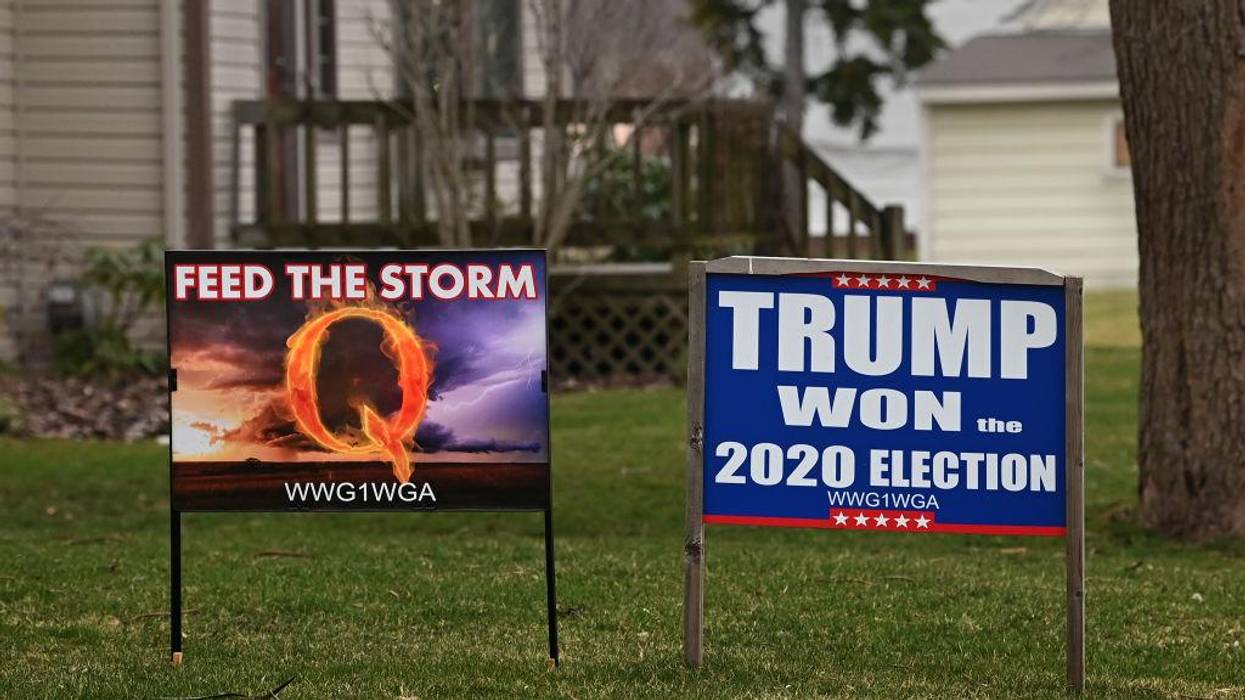
Ours is an age beset by conspiracy theories, with the fascist QAnon cult at the center of much public lunacy. These completely implausible ideas, apparently taken seriously by millions of people, have been enabled by the internet, by social media, and by the rise of a new, militant billionaire class that funds them. Indeed, with the turn to such conspiracies by new Twitter owner Elon Musk, that site has seen an explosion of hate speech, calumny, and wacky but dangerous ideas. Just to refresh our memories, QAnon accused Hillary Clinton and other high officials of running a pedophile ring out of a Washington, D.C., pizzeria. At one point these vicious lies even led to the pizzeria being shot up. This conspiracy theory was believed and broadcast by Gen. Michael Flynn, the former U.S. National Security Advisor! More recently, QAnon acolytes were involved in the January 6, 2021, attempted coup d’etat.
You may wonder if the world has abruptly gone mad.
Alas, it is the sad duty of historians to remind everyone shocked by the present that, as Ecclesiastes 1:9 has it,
What has been is what will be,
and what has been done is what will be done;
there is nothing new under the sun.
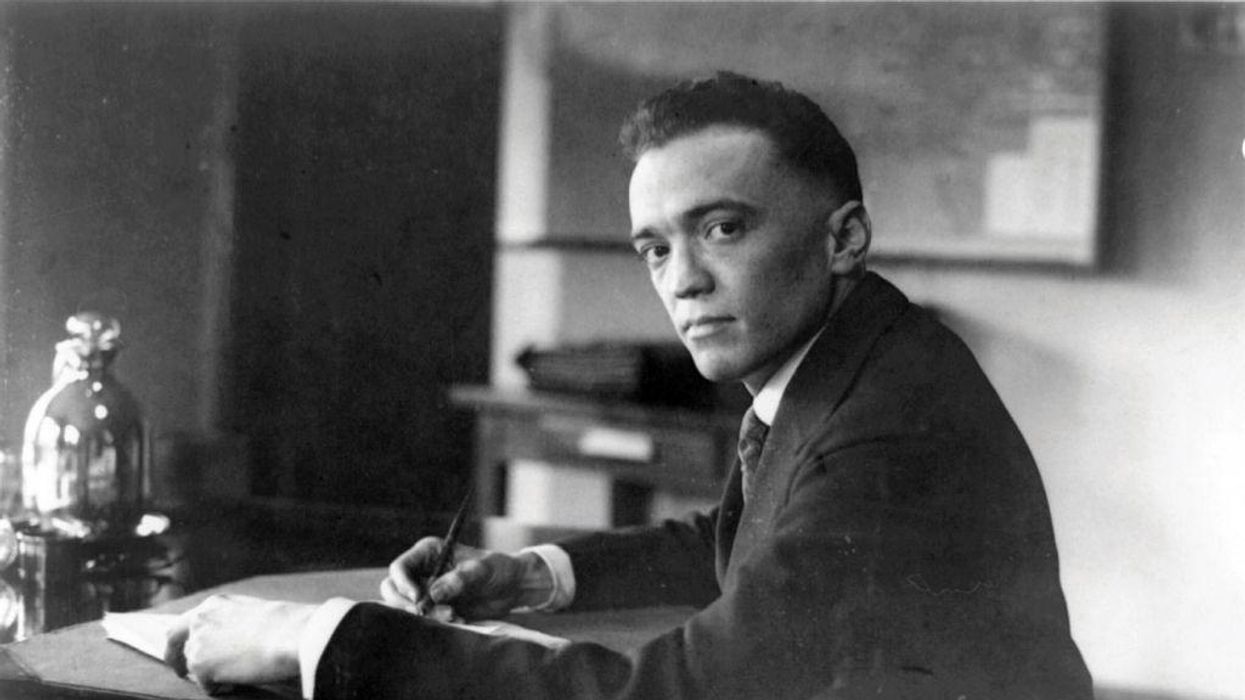
As we commemorate the Rev. Martin Luther King, Jr., it is worth remembering that the Q of his era was not anonymous. It was J. Edgar Hoover, the long-term head of the Federal Bureau of Investigation.
The FBI was formed in 1908 by Teddy Roosevelt, over the objections of Congress, which feared a secret police. Its initial charge was to hunt down anarchists, who in the hysteria that swept the country after the assassination of President McKinley were thought to be lurking just about everywhere in the country and making designs to pull down Western civilization. In fact, there were not many anarchists and they weren’t, as you might expect, very well organized. Many were German, Italian and Jewish immigrants involved in labor movements and many stood against WW I. That was a legitimate stance to take, but it was made illegal, quite in contravention of the First Amendment, and an Anarchist Exclusion Act was passed making it easy to bar such people from coming to the U.S. and to deport those already here. The Red Scare gripped America. One of its teenaged proponents was a young J. Edgar Hoover.
Sixteen years after the FBI was created, J. Edgar Hoover became its head at age 29, surfing the wave of the Red Scare. He ran the organization with an iron fist until 1972, during which time he perfected the techniques later used by press lord Rupert Murdoch at Fox, of spying on prominent people, getting dirt on them, and then using the dirt to manipulate them.
Another QAnon-type conspiracy theory that gripped Washington in the 1940s through the 1960s was McCarthyism, which held that there were a lot of U.S. Communists and that they might take over the government. They were the new anarchists. There were likely about 100,000 Communists in the U.S. by the 1950s, about half of whom left after 1956 when Soviet Premier Nikita Khrushchev revealed dictator Josef Stalin’s crimes. None of them wanted to overthrow the government and most were in provincial unions or were writers, etc., and had no power to do so. To this day, spoiled rich people and over-testosteroned rightists bemoan the proliferation of American Communists. As with the pedophile rings in pizzerias, they don’t exist and are a chimera used to beat people into submission regarding perfectly reasonable demands like a living wage. Republicans tried to defeat a corporate Democrat like Joe Biden, who may be a bit to the right of Ike Eisenhower, as a “socialist.” They meant, “Communist.”
The real purpose of red-baiting is to make sure that U.S. workers find it difficult to organize for better pay and conditions. By stigmatizing sympathy with working class people, the Right makes the demands of the latter politically and socially taboo.
Hoover had obsessed about the socialist and Communist menace all his adult life, and that was the lens through which he saw demands for rights for Black people. It seems to me that Hoover must have also been a racist, or he would have been better able to separate demands for civil rights from dialectical materialism. So Hoover saw the Rev. Martin Luther King, Jr. as potentially a Communist. Communists don’t believe in God, so I’m not sure how that was supposed to work. In fact, King preached against Communism as incompatible with Christianity. Duh.
King was a socialist, no doubt, and much more radical than today’s mainstream news will allow him to be. But he was not a violent revolutionary who wanted to impose Bolshevism on people.
Sarah Pruitt at History.com explains that one of the attorneys who supported and advised Rev. King, Stanley David Levison, had been a Communist and appears to have been in the mass exodus from the movement of 1956. Years later, Attorney General Bobby Kennedy granted Hoover permission to wiretap Levison on these grounds.
In all the years the FBI monitored King under the COINTELPRO domestic surveillance program, no evidence ever surfaced that he was a Communist or anything like a Communist. Instead of calling off his dogs, however, Hoover doubled down and used the monitoring of King’s personal life to gather evidence of his extramarital affairs. Hoover then tried to use those tapes to convince King that his reputation would be ruined and that he should commit suicide.
Hoover actually wrote a note to King instructing him to commit suicide.
Today’s FBI looks back on this episode as one of the darkest in the Bureau’s history.
But with the reemergence of conspiracy theories at the heart of the U.S. government during the Trump QAnon presidency, we should not be sanguine about the threats they pose to democracy. King renewed American democracy by forcing his co-citizens to face the evils of racial segregation and racial discrimination enshrined in the laws of the Jim Crow states.
That’s not Communism. That’s simple human decency. That is the sum of American values. Beware the ideological termites burrowing away at the fundament of our basic rights.
What I found in the deepest reaches of the Internet and the lost art—and political potency—of true human connection.
We all do it. Make little snap judgments about everyday strangers as we go about our lives. Without giving it a second’s thought, we sketch minibiographies of the people we pass on the sidewalk, the guy seated across from us on the train, or the woman in line in front of us at the grocery store. We wonder: Who are they? Where are they from? How do they make a living? Lately, though, such passing encounters tend to leave me with a sense of suspicion, a wariness tinged with grim curiosity. I think to myself: Is he or she one of them?
By them, I mean one of the tens of thousands, if not hundreds of thousands, of “people” I encountered during my many forays into the darkest recesses of the Internet. Despite the staggering amount of time many of us spend online — more than six-and-a-half hours a day, according to recent research — we tend to haunt the same websites and social media platforms (Facebook, YouTube, CNN, Reddit, Google) again and again. Not me, though. Over the past five years, I’ve spent more hours than I wish to count exploring the subterranean hideaways and uncensored gathering spaces for some of the most unhinged communities on the Internet.

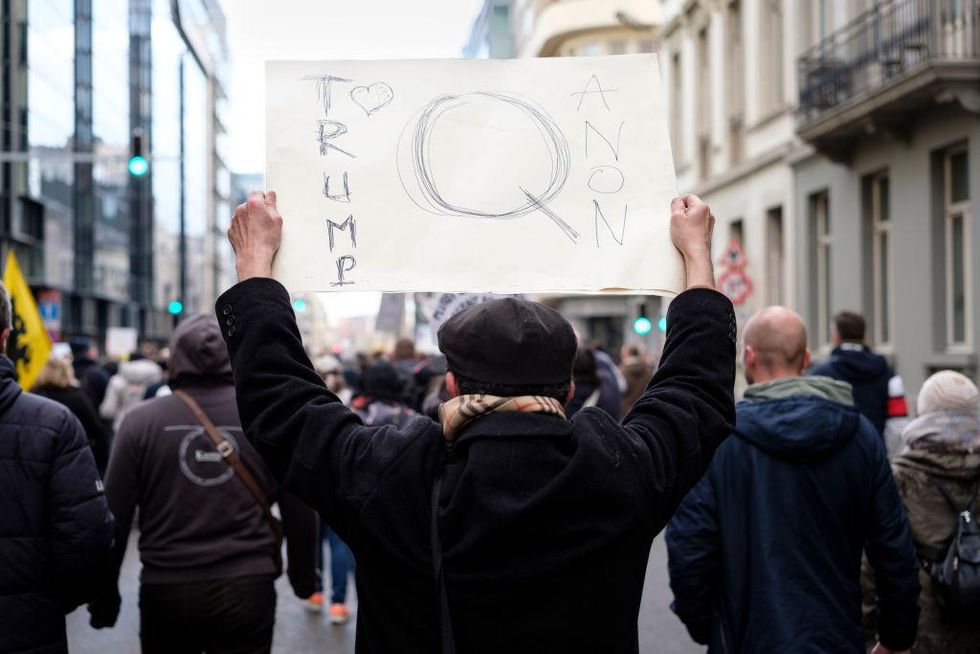
A man holds a placard with 'Trump loves QAnon' written while he protests against the compulsory vaccination campaign against SARSCoV2, on January 9, 2022 in Brussels, Belgium.
(Photo by Thierry Monasse/Getty Images)
Call it an occupational hazard. Only recently, I published my first book, A Death on W Street: The Murder of Seth Rich and the Age of Conspiracy, an investigative political thriller that opens with the 2016 street murder of a 27-year-old who had worked for the Democratic National Committee. In the absence of a culprit, Seth Rich’s killing got swept into the fast-flowing conspiratorial currents of that year’s presidential race, a contest that pitted an unabashed conspiracy theorist, Donald Trump, against a candidate, Hillary Clinton, who had been the subject of decades’ worth of elaborately sinister claims (with no basis in reality). For my book, I set out to understand how a senseless crime that took the life of a beloved but hardly famous mid-level political staffer became a national and then international news story, a viral phenomenon of ever more twisted conspiracy theories that reached millions and all too soon became a piece of modern folklore.
To do so, I traced the arc of those Rich conspiracy theories back to their origins. In practical terms, that meant hundreds of late nights spent huddled over my desk, eyes fixed on my computer screen, clicking and scrolling my way through a seemingly endless trail of tweets, memes, posts, and videos. The Internet is, in some ways, like an ancient city, its latest incarnation resting atop the ruins of so many civilizations past. I came to think of myself then as an online archeologist digging my way through the digital eons, sifting through archived websites and seeking out long-vanished posts in search of clues and answers.
Or maybe I was a waste handler, holding my nose as I picked through piles (or do I mean miles?) of toxic detritus that littered old versions of social media sites you’d know like Twitter and Reddit, and others you probably don’t, like 4chan, 8kun, and Telegram. It was there that I encountered so many of them, those faceless users, the ones I might have passed on the street, who, with the promise of anonymity, had felt unburdened to voice their unfiltered, often deeply disturbing selves. It was all id, all the time.
Who were these people? I couldn’t help but wonder whether they actually believed the stuff they wrote. Or was it all about the thrill of saying it? In an unnervingly boundless online world, were they testing the boundaries of the acceptable by one-upping each other with brazen displays of racism, misogyny, or antisemitism (just to start down the list)?
Firing up my laptop and venturing into those noxious places was like entering an inside-out world impervious to logic and critical thinking. They had their own language — losers were “cucks,” loyal foot soldiers “pedes,” and Hillary Clinton was Hillary “Klanton” — and they operated with their own sets of elaborate but twisted rules and hierarchies. After a few hours of studying such “conversations,” a form of vertigo would set in, a spinning sensation that made me get up from my desk and clear my head with a walk or a conversation with a real human being.
Now that the book is published, I don’t spend much time in those disturbing online worlds. Still, every once in a while, I can’t help checking in — old habits die hard — despite the horrors I saw there while gathering material for my book. What nags at me even now — in fact, it haunts me in some way — is the knowledge that there were real people behind those toxic accounts. The same people you might sit next to on a bus without having the slightest suspicion of just how disturbed they were and what a disturbing world they were helping create or elaborate. That knowledge still weighs on me.
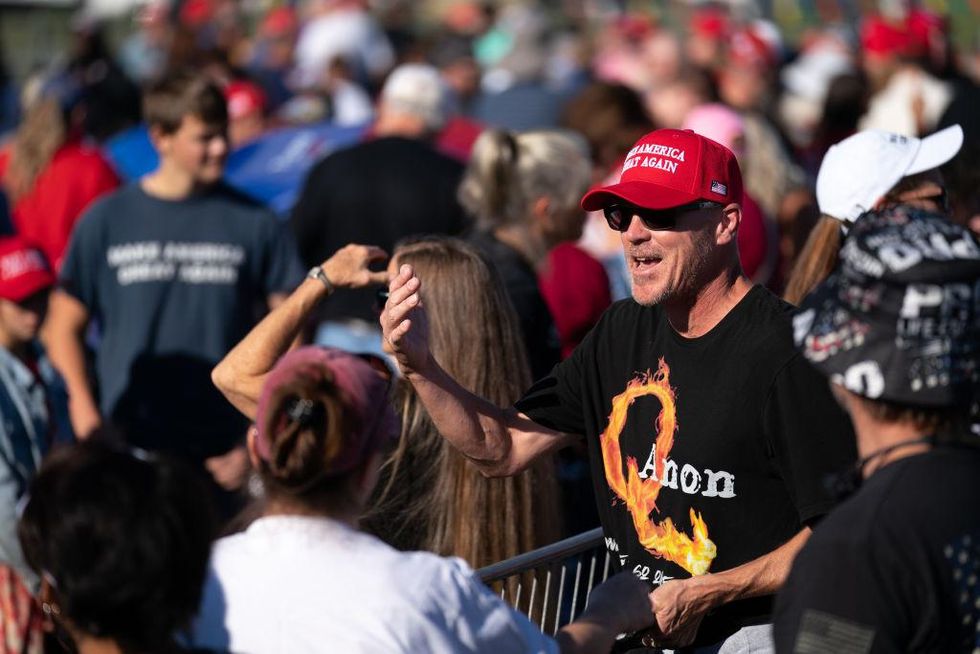
A man wearing a QAnon t-shirt waits in line for a rally featuring former President Donald Trump on September 25, 2021 in Perry, Georgia.
(Photo:Sean Rayford/Getty Images)
A confession: on a few of those late nights spent in the online ruins, I caught myself starting to nod along with some of the wild-eyed nonsense I was reading. Maybe I found a particular Reddit thread surprisingly convincing. Maybe the post in question had sprinkled a few verifiable facts amid the nonsense to make me think, Huh? Maybe my sixth cup of coffee and lack of sleep had so weakened my mental safeguards that madness itself began to seem at least faintly reasonable. When I felt such heretical thoughts seep into my stream of consciousness, I took it as a sure sign that I should log off and go to bed.
Thinking back on those moments, I admit that the first feeling I have is pure and utter embarrassment. I’m an investigative reporter. I make a living dealing in facts, data, and vetted information. Heck, my first job in journalism was as a full-time, trained fact-checker. I should be impervious to the demented siren song of conspiracy theories, right?
The correct answer is indeed: right. And yet…
I realize now that, on those disturbing long nights at the computer, I was more than an avid journalistic explorer of online content. I had immersed myself — and immersion is what the Internet does best. It’s the gateway point to a seemingly infinite number of rabbit holes. Who hasn’t clicked on a Wikipedia entry about, say, the making of the atomic bomb only to check the time, realize that two hours had slipped by, and you’re now watching a YouTube video about the greatest comebacks in baseball history with no memory of how you got here in the first place?
To be clear, I’m not suggesting that conspiracy theories weren’t a fixture of American life before the Internet came along. Quite the opposite: for as long as we humans have existed, we’ve dreamt up elaborate theories and fables to explain the inexplicable or, increasingly in our time, the otherwise all too explicable that we refuse to believe. Some of the founders of this country were unashamed conspiracy-mongers. What those delirious late nights at the computer led me to believe, however, is that tools for spreading such fantastical theories have never been more powerful than they are today and they’ve entered our politics in an unnerving fashion (as anyone paying attention to the January 6, 2021, assault on the Capitol knows).
Put simply, we don’t stand a chance against the social media companies. Fueled by highly sophisticated algorithms that maximize “engagement” at all costs by feeding users ever more inflammatory content, Facebook, Twitter, YouTube, and the rest of them don’t simply entertain, inform, or “connect” us. As New York Times reporter Max Fisher writes in his book The Chaos Machine, “This technology exerts such a powerful pull on our psychology and our identity, and is so pervasive in our lives, that it changes how we think, behave, and relate to one another. The effect, multiplied across billions of users, has been to change society itself.”
Spending so much time burrowing into such websites, I came away with a deep sense of just how addictive they are. More than that, they rewire your mind in real-time. I felt it myself. I fear that there’s no path out of our strange, increasingly conspiratorial moment, filled with viral lies and rampant disinformation, without rewriting the algorithms that increasingly govern our lives.
The Lost Art of Saying Hello
Still, I’m under no illusion that Tweets and memes can adequately explain the schisms in American life and this country’s descent into a more embittered, polarized, us-versus-them cultural moment. Nor can Donald Trump, who is as much a product of the strange Internet world of conspiracies as a cause of it. They are, in fact, the ever-more-virulent symptoms of a country in which it’s not enough to disagree with your opponents. You also have to demonize them as subhuman, criminal, and alien, while, in the process, doing genuine harm to yourself.
In what still passes for the real world, how else to explain the prominence of conspiracy theories like QAnon or the current far-right trend of accusing someone, especially anyone who disagrees with you, of being a “groomer”? Or how do you account for the existence of a seemingly inextinguishable belief now lurking in our world that one of the country’s prominent political families, the Clintons, are also prolific serial killers who have slaughtered dozens, if not hundreds of people? Or the explosion of those baseless claims I spent all that time exploring about the murdered Seth Rich, claims that would haunt his family for years, denying them even the space to grieve for their own son?
No amount of late-night online sleuthing was going to provide an answer to the larger social ills afflicting this country. Indeed, the more time I spent online, the greater the chasm appeared — so vast, in fact, that I began to wonder whether it could ever be bridged. Nor is this a malady that can be dealt with by politicians or governments, important as they are. It runs even deeper than that.
When I think about the root causes of such societal drift, I return to a phrase I read in a 2021 study that described a “national friendship decline.” According to that survey, “Americans report having fewer close friendships than they once did, talking to their friends less often, and relying less on their friends for personal support.” The data wasn’t all grim. More than four in ten respondents said that they had made a new friend during the pandemic. Still, the lockdowns and self-isolation of these Covid years had exacerbated what the survey’s authors called a “loneliness epidemic.”
When I think about those endless Twitter rants and Reddit screeds I encountered, I envision lonely people hunched over their computers in empty apartments, posting and scrolling madly (sometimes in the most literal sense) deep into the night. Loneliness and social isolation, of course, can’t explain away all the mad conspiratorial rants you find on the Internet, nor are they the sole cause of the brittle, increasingly dangerous state of American politics. But it’s so much easier to resent and rage against a perceived enemy if you’ve never met them or anyone like them, so much easier to cast the other side as the out-group or the villain if you’ve never shared a meal or a coffee or a phone call with them.
I mention that “loneliness epidemic” only to underscore my belief that healing the schism in our culture and politics will require something more difficult and yet simpler than major policy reforms or electing a new generation of officials. Don’t get me wrong: both of those are needed, on both sides of the proverbial aisle. Today’s politics too often resemble a race to the bottom, as politicians rush to outflank their rivals and whip up their constituencies (often using social media to do it). All the while, powerful interest groups, their lobbyists, and a growing billionaire class shape (or sink) the kinds of wholesale changes needed to reboot our political system.
Yet our problems run deeper than that — and the solutions can’t be found in Washington, D.C.
One answer is finding ways to knit back together an unbearably frayed nation. Neighborhood groups, book clubs, sports leagues, civic associations, labor unions, religious groups, whatever it is, the surest way out of this stubborn conflict must come through the simplest of gestures — human connection. The lost art of saying hello.
Tech executives love to talk about the value of “connection” and their goals of “connecting” the world. Almost two decades into the social media era, we should know better than to believe those empty paeans used as cover for the relentless pursuit of profits. Now more than ever, it’s time to step away from those weapons of mass disinformation.
I don’t care much for New Year’s resolutions, but if I did, I would say: let’s make 2023 the year of logging off. Get to know your neighbors and colleagues. For my part, I’ll work on not thinking of those everyday strangers, or even those tiny avatars on the Internet, as them. Instead of fearing them, I’ll think I say hello.