SUBSCRIBE TO OUR FREE NEWSLETTER
Daily news & progressive opinion—funded by the people, not the corporations—delivered straight to your inbox.
5
#000000
#FFFFFF
To donate by check, phone, or other method, see our More Ways to Give page.
Daily news & progressive opinion—funded by the people, not the corporations—delivered straight to your inbox.
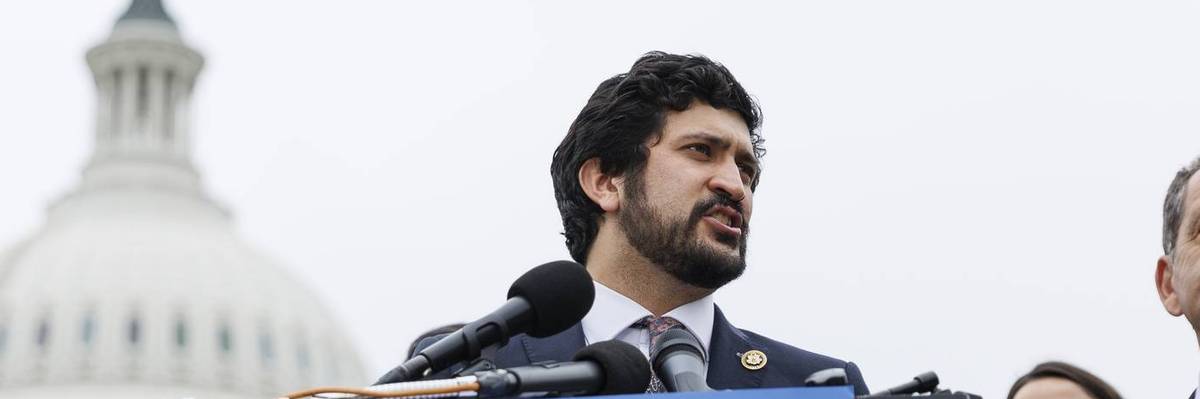
Rep. Greg Casar (D-Texas), joined by fellow Democrats, speaks during a news conference on April 29, 2026, outside the US Capitol in Washington, DC.
Consumers bore the vast majority of the costs of Trump's illegal tariffs, but it's the large corporations that raised prices who are seeing massive refunds.
Congressional Progressive Caucus Chair Greg Casar (D-Texas) said on Monday that "every single cent" of the refunds for President Donald Trump's illegal tariffs should go to consumers who bore the brunt of the financial strain rather than the large corporations currently receiving them.
"Apple got a $2.2 billion tariff refund. Amazon got $600 million," Casar wrote in a post to social media. "Trump is sending the 'refunds' to the companies, not working people."
The Supreme Court struck down many of Trump's sweeping tariffs in February, ruling that he could not impose them unilaterally using powers under the International Emergency Economic Powers Act of 1977.
A group of 25 Democratic states sued the Trump administration on Monday for once again attempting to reimpose the tariffs under a different law, the 1974 Trade Act.
According to the Congressional Budget Office report from February 2026, about 70% of the tariffs were being passed onto consumers in the form of higher prices, while businesses absorbed about 30% of the cost.
Companies were able to pass on even more of the costs to consumers by hiking prices of domestic goods as well, meaning ordinary people were forced to swallow about 95% of the overall cost.
Yale's Budget Lab estimated that Trump's full tariff regime was costing the average household about $2,400 annually. Even after the Supreme Court rolled them back, the Budget Lab estimates that households will pay an extra $1,100 per year.
But the system for refunding the approximately $166 billion taken as part of the unlawful tariff regime allows only "importers" to apply for reimbursement, meaning the refunds have largely flowed to big companies who get to decide how much, if any, of the windfall they want to trickle down. So far, it does not seem to be very much.
Amazon disclosed on Thursday that it was participating in the refund process and that it had received over $600 million from the federal government in quarter two.
Brian Olsavsky, Amazon’s finance chief, said there was a "limited set of circumstances” in which the company could find examples of it directly passing prices along to consumers, since third-parties are the importers for most products, but said it would refund them when they could be identified.
He added that the refunds would also be invested in “low prices for customers," though he provided no details on how that would work.
Apple, meanwhile, is one of the biggest beneficiaries of the refunds. In a press release on Thursday, the company celebrated that the tariff refunds on their own were worth “2 percentage points” of its 50.1% gross margin, which AppleInsider calculated put the total refund at about $2.2 billion, though its most recent earnings report did not disclose the full amount.
But there's no indication that any of that windfall will be seen by consumers, even through lowered prices, let alone through any sort of reimbursement program.
"While Apple is celebrating its margins, it won’t stop your next MacBook Air from becoming more expensive and more scarce," wrote Kyle Barr on Monday for Gizmodo. "Last month, Apple increased prices for practically all its various products."
Other companies have also received or are expecting refunds in the billions or hundreds of millions, including Ford, General Motors, UPS, Nike, and Walmart, though only some have indicated plans to pass on even part of the savings to consumers.
Rep. Mark Pocan said it was "just another transfer of wealth from everyday Americans to mega-corporations."
Several pieces of legislation have been introduced in Congress aiming to provide tariff relief for consumers.
One bill introduced by Reps. Rosa DeLauro (D-Conn.) and Frank Mrvan (D-Ind.) would require companies to reduce prices in accordance with the size of the refund they receive. Another from Rep. Mike Thompson (D-Calif.) would create an individual tariff refund tax credit and tax corporations unless they absorbed tariff costs rather than passing them to consumers.
None of these bills have advanced out of committee or received a floor vote.
Dear Common Dreams reader, It’s been nearly 30 years since I co-founded Common Dreams with my late wife, Lina Newhouser. We had the radical notion that journalism should serve the public good, not corporate profits. It was clear to us from the outset what it would take to build such a project. No paid advertisements. No corporate sponsors. No millionaire publisher telling us what to think or do. Many people said we wouldn't last a year, but we proved those doubters wrong. Together with a tremendous team of journalists and dedicated staff, we built an independent media outlet free from the constraints of profits and corporate control. Our mission has always been simple: To inform. To inspire. To ignite change for the common good. Building Common Dreams was not easy. Our survival was never guaranteed. When you take on the most powerful forces—Wall Street greed, fossil fuel industry destruction, Big Tech lobbyists, and uber-rich oligarchs who have spent billions upon billions rigging the economy and democracy in their favor—the only bulwark you have is supporters who believe in your work. But here’s the urgent message from me today. It's never been this bad out there. And it's never been this hard to keep us going. At the very moment Common Dreams is most needed, the threats we face are intensifying. We need your support now more than ever. We don't accept corporate advertising and never will. We don't have a paywall because we don't think people should be blocked from critical news based on their ability to pay. Everything we do is funded by the donations of readers like you. When everyone does the little they can afford, we are strong. But if that support retreats or dries up, so do we. Will you donate now to make sure Common Dreams not only survives but thrives? —Craig Brown, Co-founder |
Congressional Progressive Caucus Chair Greg Casar (D-Texas) said on Monday that "every single cent" of the refunds for President Donald Trump's illegal tariffs should go to consumers who bore the brunt of the financial strain rather than the large corporations currently receiving them.
"Apple got a $2.2 billion tariff refund. Amazon got $600 million," Casar wrote in a post to social media. "Trump is sending the 'refunds' to the companies, not working people."
The Supreme Court struck down many of Trump's sweeping tariffs in February, ruling that he could not impose them unilaterally using powers under the International Emergency Economic Powers Act of 1977.
A group of 25 Democratic states sued the Trump administration on Monday for once again attempting to reimpose the tariffs under a different law, the 1974 Trade Act.
According to the Congressional Budget Office report from February 2026, about 70% of the tariffs were being passed onto consumers in the form of higher prices, while businesses absorbed about 30% of the cost.
Companies were able to pass on even more of the costs to consumers by hiking prices of domestic goods as well, meaning ordinary people were forced to swallow about 95% of the overall cost.
Yale's Budget Lab estimated that Trump's full tariff regime was costing the average household about $2,400 annually. Even after the Supreme Court rolled them back, the Budget Lab estimates that households will pay an extra $1,100 per year.
But the system for refunding the approximately $166 billion taken as part of the unlawful tariff regime allows only "importers" to apply for reimbursement, meaning the refunds have largely flowed to big companies who get to decide how much, if any, of the windfall they want to trickle down. So far, it does not seem to be very much.
Amazon disclosed on Thursday that it was participating in the refund process and that it had received over $600 million from the federal government in quarter two.
Brian Olsavsky, Amazon’s finance chief, said there was a "limited set of circumstances” in which the company could find examples of it directly passing prices along to consumers, since third-parties are the importers for most products, but said it would refund them when they could be identified.
He added that the refunds would also be invested in “low prices for customers," though he provided no details on how that would work.
Apple, meanwhile, is one of the biggest beneficiaries of the refunds. In a press release on Thursday, the company celebrated that the tariff refunds on their own were worth “2 percentage points” of its 50.1% gross margin, which AppleInsider calculated put the total refund at about $2.2 billion, though its most recent earnings report did not disclose the full amount.
But there's no indication that any of that windfall will be seen by consumers, even through lowered prices, let alone through any sort of reimbursement program.
"While Apple is celebrating its margins, it won’t stop your next MacBook Air from becoming more expensive and more scarce," wrote Kyle Barr on Monday for Gizmodo. "Last month, Apple increased prices for practically all its various products."
Other companies have also received or are expecting refunds in the billions or hundreds of millions, including Ford, General Motors, UPS, Nike, and Walmart, though only some have indicated plans to pass on even part of the savings to consumers.
Rep. Mark Pocan said it was "just another transfer of wealth from everyday Americans to mega-corporations."
Several pieces of legislation have been introduced in Congress aiming to provide tariff relief for consumers.
One bill introduced by Reps. Rosa DeLauro (D-Conn.) and Frank Mrvan (D-Ind.) would require companies to reduce prices in accordance with the size of the refund they receive. Another from Rep. Mike Thompson (D-Calif.) would create an individual tariff refund tax credit and tax corporations unless they absorbed tariff costs rather than passing them to consumers.
None of these bills have advanced out of committee or received a floor vote.
Congressional Progressive Caucus Chair Greg Casar (D-Texas) said on Monday that "every single cent" of the refunds for President Donald Trump's illegal tariffs should go to consumers who bore the brunt of the financial strain rather than the large corporations currently receiving them.
"Apple got a $2.2 billion tariff refund. Amazon got $600 million," Casar wrote in a post to social media. "Trump is sending the 'refunds' to the companies, not working people."
The Supreme Court struck down many of Trump's sweeping tariffs in February, ruling that he could not impose them unilaterally using powers under the International Emergency Economic Powers Act of 1977.
A group of 25 Democratic states sued the Trump administration on Monday for once again attempting to reimpose the tariffs under a different law, the 1974 Trade Act.
According to the Congressional Budget Office report from February 2026, about 70% of the tariffs were being passed onto consumers in the form of higher prices, while businesses absorbed about 30% of the cost.
Companies were able to pass on even more of the costs to consumers by hiking prices of domestic goods as well, meaning ordinary people were forced to swallow about 95% of the overall cost.
Yale's Budget Lab estimated that Trump's full tariff regime was costing the average household about $2,400 annually. Even after the Supreme Court rolled them back, the Budget Lab estimates that households will pay an extra $1,100 per year.
But the system for refunding the approximately $166 billion taken as part of the unlawful tariff regime allows only "importers" to apply for reimbursement, meaning the refunds have largely flowed to big companies who get to decide how much, if any, of the windfall they want to trickle down. So far, it does not seem to be very much.
Amazon disclosed on Thursday that it was participating in the refund process and that it had received over $600 million from the federal government in quarter two.
Brian Olsavsky, Amazon’s finance chief, said there was a "limited set of circumstances” in which the company could find examples of it directly passing prices along to consumers, since third-parties are the importers for most products, but said it would refund them when they could be identified.
He added that the refunds would also be invested in “low prices for customers," though he provided no details on how that would work.
Apple, meanwhile, is one of the biggest beneficiaries of the refunds. In a press release on Thursday, the company celebrated that the tariff refunds on their own were worth “2 percentage points” of its 50.1% gross margin, which AppleInsider calculated put the total refund at about $2.2 billion, though its most recent earnings report did not disclose the full amount.
But there's no indication that any of that windfall will be seen by consumers, even through lowered prices, let alone through any sort of reimbursement program.
"While Apple is celebrating its margins, it won’t stop your next MacBook Air from becoming more expensive and more scarce," wrote Kyle Barr on Monday for Gizmodo. "Last month, Apple increased prices for practically all its various products."
Other companies have also received or are expecting refunds in the billions or hundreds of millions, including Ford, General Motors, UPS, Nike, and Walmart, though only some have indicated plans to pass on even part of the savings to consumers.
Rep. Mark Pocan said it was "just another transfer of wealth from everyday Americans to mega-corporations."
Several pieces of legislation have been introduced in Congress aiming to provide tariff relief for consumers.
One bill introduced by Reps. Rosa DeLauro (D-Conn.) and Frank Mrvan (D-Ind.) would require companies to reduce prices in accordance with the size of the refund they receive. Another from Rep. Mike Thompson (D-Calif.) would create an individual tariff refund tax credit and tax corporations unless they absorbed tariff costs rather than passing them to consumers.
None of these bills have advanced out of committee or received a floor vote.